
Why Accessibility Matters for Venues Transport and Growth
A disabled passenger may reach a station, venue or campus and still be unable to complete the journey independently because the accessible route is unclear, broken or impossible to discover. That is why accessibility matters. It determines whether people can enter, move through and use a service, and it affects customer experience, workforce participation, legal compliance and commercial performance.
For venue and transport operators, the practical question isn't whether accessibility belongs in the organisation's plans. It's how reliably people can find the right entrance, platform, room, toilet, counter or exit when conditions change. The strongest approach treats accessibility as an operational service standard, supported by accurate information, usable infrastructure and wayfinding that reflects the environment as it exists today.
Why Accessibility Matters Right Now
A passenger arrives at a transport interchange with enough time for the journey. The lift is on another level, the signs point towards stairs, and the published assistance information doesn't explain where to wait. Staff may eventually help, but the passenger has lost independence and confidence before reaching the platform. If the lift is unavailable, the journey may end there.
The same pattern appears in large venues. A visitor can have a valid ticket, a step-free entrance and an accessible toilet, yet still struggle to locate either without a reliable route. Accessibility fails when the individual components exist but don't work together as a usable journey.
Practical rule: Accessibility isn't complete when a facility has been installed. It's complete when people can find and use it with reasonable independence.
This is why accessibility matters beyond a compliance checklist. It affects whether a person attends an appointment, accepts a job, visits a shop, uses public transport, studies on campus or returns to a venue. It also affects colleagues, carers and families who often change their plans when a journey feels uncertain.
At Waymap, we view accessibility through the operator's environment. Estates teams have to manage physical constraints, changing layouts, maintenance schedules, staffing and limited capital budgets. Transport operators have to maintain information across stations, interchanges and routes, often while construction or service changes are under way. A static accessibility statement can't solve those operational problems on its own.
The useful test is straightforward:
- Can a disabled person identify the route before travelling?
- Can they follow it without relying on visual signage?
- Does the route reflect current closures, entrances and facilities?
- Can the operator update the information without rebuilding the environment?
The rest of this guide connects those questions to the scale of the audience, suppressed journeys, legal duties, infrastructure choices and a practical improvement sequence.
Who Accessibility Is Really For and How Many People It Affects
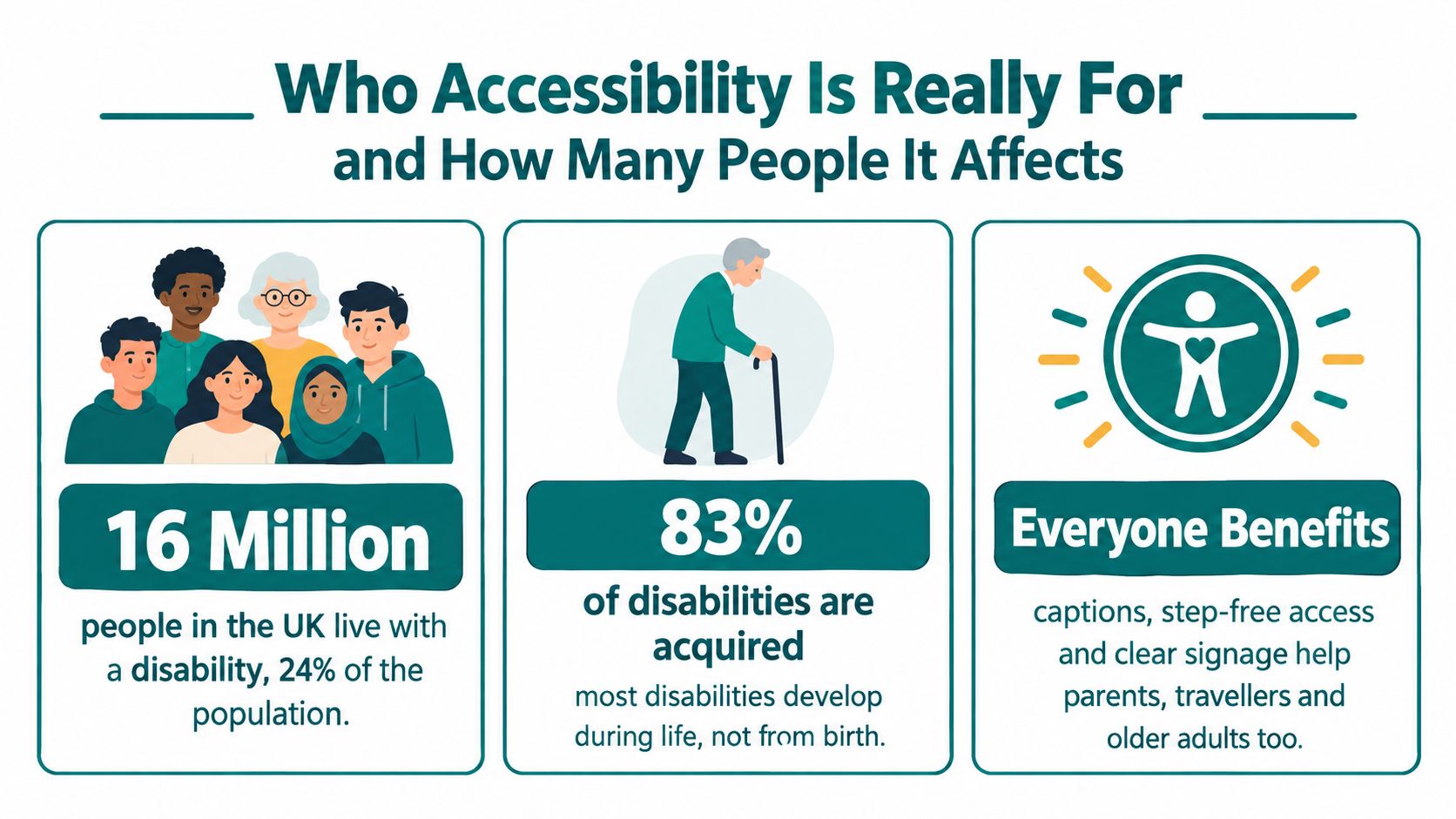
Accessibility serves a mass audience, not a small specialist group. Scope gives an estimate of 16.1 million disabled people in the UK, about one in four people, while the Motability Foundation reports 14.6 million disabled people, more than one-fifth of the UK population. A 2025 UK Parliament transport report also refers to around 16 million disabled people in the UK. These estimates differ, but they point to the same operational conclusion: accessibility affects a core part of the public. (Scope's UK business accessibility facts, Motability Foundation transport accessibility report, UK Parliament transport accessibility report)
The audience also includes people whose access needs change over time or vary by context. Older adults may need step-free routes or more legible signs. Parents may be pushing a pram. Travellers may carry luggage. Someone with a temporary injury may need a lift, a seat or a shorter route. Clear information, predictable circulation and good audio guidance can help all of them without removing the specific support disabled people require.
Why the journey gap matters
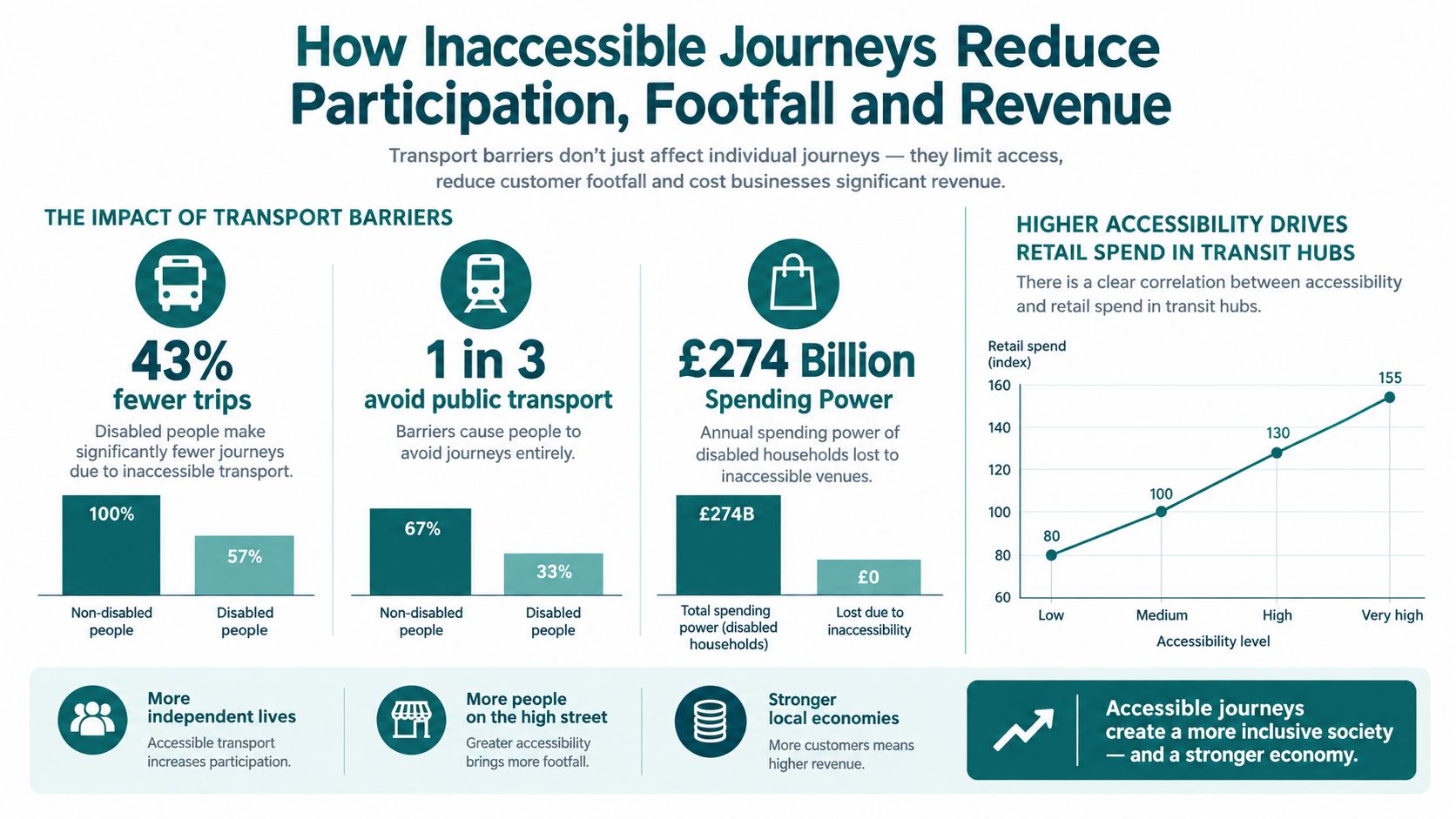
The scale becomes more meaningful when paired with travel behaviour. Disabled people in the UK make 38% fewer journeys than non-disabled people, and the Motability Foundation says that gap hasn't changed for over a decade. In England, disabled adults made 581 trips per person in 2020, compared with 803 trips for non-disabled adults, according to the transport accessibility evidence compiled by NCAT. (NCAT transport barriers report)
That difference doesn't prove every missed journey results from one inaccessible feature. It does show that access conditions influence participation at network level. If a passenger can't trust a route, find assistance, manage a transfer or identify the correct entrance, they may travel less often or avoid the journey altogether.
Digital navigation has to be part of that wider picture. A smartphone navigation approach for visually impaired people can complement physical improvements by making route information available in a format that supports independent movement. It can't replace lifts, ramps, accessible toilets or trained staff, but it can connect those assets into a journey a person can understand and follow.
How Inaccessible Journeys Reduce Participation Footfall and Revenue
Transport access determines who reaches a venue, workplace or campus. A person who cannot trust the route from a station to a shopping centre, a car park to a stadium entrance, or a campus gate to a lecture room may decide not to travel. The operator then loses more than a comfortable visit. It loses a potential customer, employee, student or visitor.
UK transport evidence shows the scale of suppressed participation. Disabled people make 38% fewer trips than non-disabled people, a gap that has remained for over a decade. One in five disabled people are unable to travel because they lack appropriate transport options, according to Innovate UK's accessible and inclusive transport report.
The commercial effect appears at each stage of the journey:
- Retail visits: A visitor who cannot identify an accessible entrance or move between floors may shorten the trip or leave.
- Venue attendance: Uncertainty about seating, toilets, gates and exits can affect whether someone books, attends or returns.
- Workforce access: An employee may decline a role or struggle to reach a workplace when the final connection is inaccessible.
- Public transport use: A passenger who expects barriers may choose another mode, delay travel or avoid the journey.
A 2026 report cited by The Guardian associates transport barriers with roughly 2.8 million disabled people being effectively locked out of the workforce and estimates that fully accessible public transport could add £176 billion to the UK economy. (The Guardian report on accessible public transport and the UK economy) Accessibility therefore affects staffing and productivity as well as visitor services.
Footfall depends on confidence
Entry counts, transactions and complaints show what happened after arrival. They do not show the people who stayed away because the journey seemed unreliable, confusing or physically difficult. Operators need to treat that absence as suppressed demand, not as proof that demand does not exist.
The effect extends beyond the disabled traveller. Families, friends and colleagues may choose a different shop, venue, campus facility or transport route when one person cannot travel confidently. A single inaccessible connection can therefore influence the group's spending and attendance.
Waymap's discussion of accessibility and retail footfall connects route quality with commercial activity. The practical measure is access from the journey's starting point to the point of spend, rather than accessibility as a separate facilities metric.
Infrastructure-free navigation can reduce information friction without waiting for major construction or adding another physical asset to maintain. It cannot replace lifts, ramps, accessible toilets or trained staff, but it can help people identify and follow the accessible route using facilities already in place.
What the Law and Standards Require From Venues and Transport Operators
The Equality Act 2010 requires employers and service providers to make reasonable adjustments where a disabled person faces a substantial disadvantage compared with a non-disabled person. The duty can involve changing policies or practices, addressing physical features of premises, and providing auxiliary aids or services, including information in accessible formats. The Equality Act 2010 reasonable adjustments guidance sets out how the duty applies in practice.
For operators, responsibility cannot rest only with reception staff or an accessibility lead. A policy that sends passengers along an inaccessible route, a gate arrangement that creates a physical barrier, or information provided in an unusable format can each place someone at a disadvantage. These failures also create operational friction, including staff interventions, missed connections and avoidable complaints.
What good practice looks like in the built environment
England's Approved Document M sets building-regulation requirements for access to and use of buildings. BS 8300 provides design guidance for inclusive buildings and approaches, while BS EN 17210 addresses accessibility and usability in the built environment. Together, these references support decisions about entrances, circulation, sanitary facilities, seating, signage and other features that determine whether people can use a building. The government's Approved Document M provides the relevant regulatory reference.
Meeting a physical specification does not guarantee an easy journey through a complex venue. Visitors may still struggle to locate the accessible entrance, identify a lift or understand a diversion. Estates teams therefore need to connect the physical environment with information that remains accurate when routes, closures and operating arrangements change.
The UN Convention on the Rights of Persons with Disabilities reinforces the principle that disabled people should participate independently and on an equal basis. For operators, that means assessing how services work in real conditions, rather than recording facilities without checking whether people can reach and use them.
An accessibility statement from Splash Access shows how an organisation can communicate available access, known limitations and feedback routes. A useful statement helps someone decide whether and how they can use a service. It does not replace barrier removal, staff support or a dependable alternative route.
Why wayfinding belongs in the adjustment plan
Wayfinding may form part of an auxiliary service when someone needs information in a different format or support locating a route through a complex environment. It can also help operators apply access arrangements consistently when staff availability differs between shifts.
Our guide to Equality Act 2010 accessibility requirements explains the practical connection between legal duties and service delivery. Compliance is experienced at the point of use. If a person cannot locate the accessible route, a ramp elsewhere in the building does not resolve the disadvantage. Clear route information can improve access using existing facilities, while physical barriers still require physical fixes.
Why Infrastructure Free Navigation Changes the Accessibility Equation
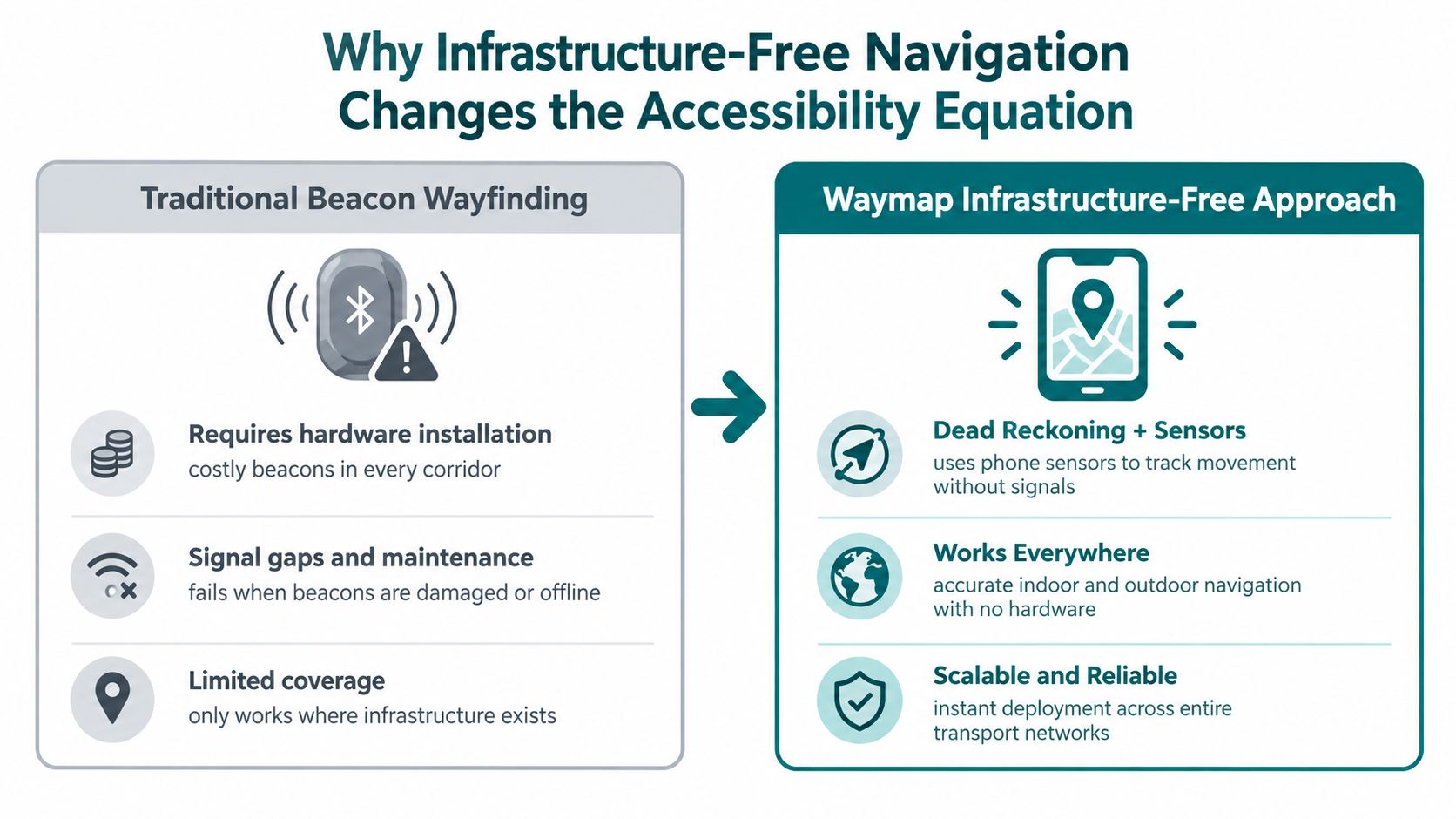
Traditional indoor wayfinding often depends on installed hardware. Beacons, local signal systems and other devices can support location services, but they also create a physical estate that someone has to procure, install, power, monitor, replace and keep aligned with changing layouts. That burden matters in hospitals, airports, rail networks, stadiums, shopping centres and campuses where corridors, entrances and temporary closures change frequently.
Waymap uses dead reckoning with device-native smartphone sensors. Its navigation platform is designed to operate indoors, outdoors and underground without GPS, Wi-Fi or installed hardware, using movement sensors and detailed maps to provide step-by-step guidance. The stated capability includes sub-three-metre accuracy in infrastructure-free environments and no pre-mapping requirement for venues where staff turnover or layout changes make a permanent hardware estate difficult to maintain.
The trade-off is operational, not theoretical
Hardware-dependent systems can make sense where an operator already has the infrastructure, a stable environment and a clear maintenance owner. They become harder to justify when each new corridor or station requires additional equipment, when devices fail, or when capital approval is separate from the team responsible for daily accessibility information.
An infrastructure-free model changes the cost and maintenance question. It removes the need to place beacons in every corridor, but it still requires accurate mapping, route governance, user testing and a process for updating closures and points of interest. Technology doesn't eliminate operational responsibility. It moves that responsibility from a distributed hardware estate to the accuracy and management of the digital route layer.
The named deployments supplied for Waymap include WMATA, Lord's Cricket Ground with MCC, Westfield London, SBS Transit, LTA Singapore and CapMetro Austin. They represent the types of environments where operators need guidance across complex indoor, outdoor or underground journeys, rather than simple point-to-point directions. The relevant problem is consistent across these settings: a passenger or visitor needs to reach an exact door, platform, entrance or point of interest despite weak signals, changing infrastructure or a large footprint.
Waymap's GPS-free navigation approach is relevant where signal coverage and physical hardware don't provide a dependable basis for inclusive wayfinding. For an NHS estates manager facing capital-spend restrictions, or a transport operator maintaining a high-footfall network, avoiding installed infrastructure can make a pilot easier to approve and a wider deployment easier to manage.
How to Make Your Venue or Network More Accessible in Practice
Improvement starts with the journey a person needs to complete, not with a list of isolated facilities. A venue can have compliant toilets, ramps and lifts yet still provide a poor experience if users can't find them, reach them or receive accurate information when conditions change.
Start with the asset and barrier audit
Map the critical journeys first:
- List the destinations that matter. Include entrances, ticket offices, platforms, gates, toilets, lifts, accessible seating, consultation rooms, classrooms, exits and set-down points.
- Record the route conditions. Note stairs, gradients, narrow gates, uneven surfaces, doors, crossings, lighting, hearing loops and places where assistance is required.
- Test the information. Check the website, app, signage, staff scripts and accessibility statement against the route. Remove contradictions.
- Walk with disabled users. Include people with different access requirements, and pay attention to decision points where a person has to choose between routes.
- Assign ownership. Give named teams responsibility for physical defects, digital content, temporary diversions and feedback.
The National Rail Enquiries knowledgebase tracks around 15 accessibility identifiers per station across more than 2,500 stations, including step-free access, accessible ticket machines, hearing loops, ramps, toilets and set-down points. (House of Commons Library analysis of Britain's railway stations) That level of detail is useful because “accessible station” doesn't describe the specific barriers a passenger may encounter.
Prioritise independent movement
Fix the barriers that prevent a journey from starting or being completed. A working lift may matter more than a new sign, but the sign becomes essential when the lift is in a separate entrance. Make step-free routes continuous, keep accessible facilities available, and publish changes promptly.
Then add a dynamic wayfinding layer. It should provide step-free route options, accessible information formats, audio or haptic guidance where appropriate, multilingual content where needed and updates that managers can make without waiting for a physical installation.
Waymap's accessibility best-practice guidance can help teams frame that work around the complete user journey. The practical success measure isn't the number of accessibility features installed. It's whether people can reach their destination with less uncertainty and fewer avoidable requests for help.
Frequently Asked Questions About Why Accessibility Matters
Why does accessibility matter to businesses?
Accessibility affects customer access, participation and workforce inclusion. Inaccessible transport can prevent disabled people from reaching workplaces, venues and services, while reliable access gives operators more opportunities to serve customers and retain staff. Accessible journeys therefore support operational performance, not just compliance.
What does the Equality Act 2010 require?
The Equality Act 2010 requires employers and service providers to make reasonable adjustments where a disabled person faces substantial disadvantage. These may involve policies, physical features, auxiliary aids or accessible information. The adjustment should address the barrier in the actual service or workplace, rather than sit only in a policy document.
How can operators measure accessibility progress?
Track completed journeys, failed routes, complaints, assistance requests, lift and facility availability, information accuracy and feedback from disabled people. Test published routes during closures, construction and service disruption. A route that works only under normal conditions is not a dependable accessible service.
Does accessible wayfinding require beacons or Wi-Fi?
Accessible wayfinding does not always require beacons or Wi-Fi. Waymap uses device-native motion sensors and dead reckoning to provide indoor, outdoor and underground guidance without GPS, Wi-Fi or installed hardware. That approach can reduce maintenance work and avoid new hardware across complex estates.
How does accessibility support ESG and reputation?
Accessibility supports ESG and reputation when inclusion commitments produce reliable service delivery. A policy has limited value if people still cannot enter, move through a site or obtain information independently. Operators should assess the experience people receive, including how quickly teams correct failed routes and inaccurate guidance.
Waymap's founder, Tom Pey, is a blind accessibility technologist who built the platform around independent navigation. That perspective keeps attention on what a person can do, rather than only what an organisation has documented.
Waymap helps venue, campus and transport teams add dynamic step-by-step indoor, outdoor and underground guidance without GPS, Wi-Fi or installed hardware. Visit Waymap to discuss priority journeys, accessible routes and points of interest.
