
Equality Act 2010 Requirements for Venues
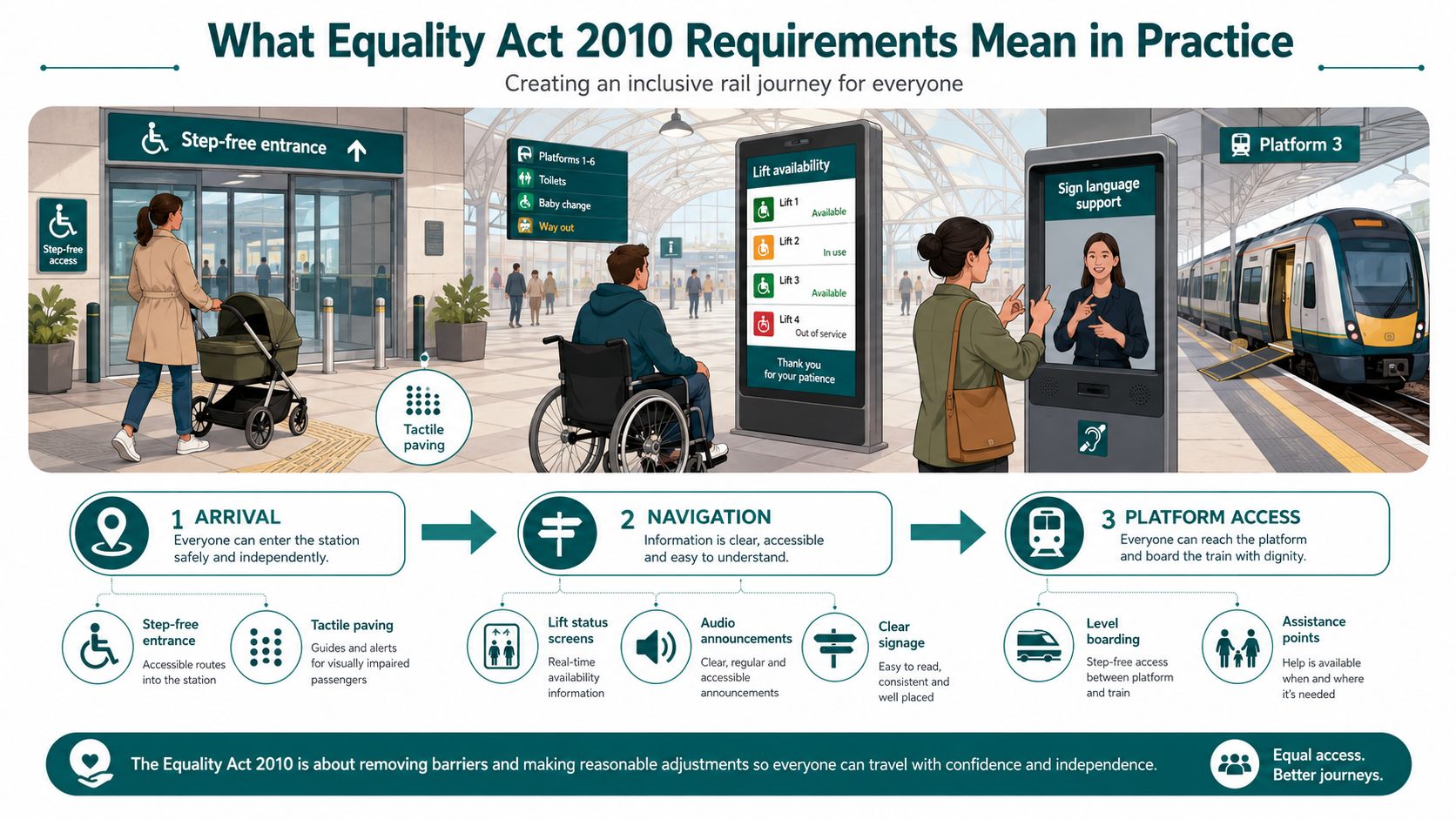
A passenger arrives at a busy rail terminus with a pram and needs a step-free route. A wheelchair user checks whether the lift is working before committing to a platform. A deaf traveller looks for visual announcements because an audio-only disruption message won't reach them. These aren't unusual edge cases. They're ordinary visitor journeys that show why Equality Act 2010 requirements affect signage, information, staff decisions, procurement, building alterations and emergency planning at the same time.
For venue managers, transit agencies and public-sector teams, compliance isn't a poster saying that everyone is welcome. It means identifying where a policy, physical feature or missing service creates substantial disadvantage, then taking reasonable steps to remove or reduce it. This guide translates the statutory framework into decisions that can be tested across the whole visitor journey, from pre-arrival information to the exact door, seat or platform a person needs to find.
What Equality Act 2010 Requirements Mean in Practice
A station may provide ramps, lifts and accessible toilets, yet a disabled visitor can still be unable to complete the journey independently. The lift might work but be difficult to find. A step-free route might close without a clear alternative. A platform change might be announced audibly, with no equivalent visual or tactile information. Each failure occurs at a different point in the same service journey.
The Equality Act 2010 is the UK statute that brings anti-discrimination duties together. For venues and public bodies, section 20 has direct operational consequences. Organisations must take reasonable steps where a disabled person would otherwise face substantial disadvantage because of a policy, physical feature, or missing auxiliary aid or service. The Act covers services provided to the public, whether or not users pay for them. Read the current Equality Act 2010 text on legislation.gov.uk.
The operational questions managers must answer
A defensible accessibility programme records four decisions:
- Who may face disadvantage? Review the experience of disabled passengers, visitors, staff and companions before a complaint identifies the gap.
- What creates the barrier? Check ticketing rules, stairs, confusing interchanges, unavailable facilities, inaccessible documents and missing real-time information.
- What step is reasonable? Consider whether the measure works, how practical it is, its cost and resource implications, and any safety constraints. The answer depends on the service and the circumstances.
- What evidence supports the decision? Record the assessment, chosen action, responsible owner, delivery date and review result.
These questions apply to transport hubs, campuses, stadiums, shopping centres, theatres and public facilities. The duty follows the visitor beyond the entrance. People need usable information before arrival, an accessible route through the site, suitable service delivery, and clear guidance when a lift, platform, room or entrance changes.
A continuously updateable digital navigation layer can support that journey by describing accessible routes and changes without relying on GPS, Wi-Fi, mobile data, Bluetooth beacons or installed hardware. It supports operational access decisions, but it does not replace the statutory assessment or the organisation's duty to provide the service. Our inclusive design principles apply the same journey-based view.
The legal test is not whether an adjustment exists in isolation. It is whether the organisation has identified disadvantage and planned effective access across the points where people encounter the service.
Who Is Protected and Who Must Comply
A passenger cannot use the ticket machine, a visitor cannot find an accessible entrance, or a staff member cannot work a scheduled shift. Each example may engage a different Equality Act duty. The Act identifies nine protected characteristics in section 4:
- Age
- Disability
- Gender reassignment
- Marriage and civil partnership
- Pregnancy and maternity
- Race
- Religion or belief
- Sex
- Sexual orientation
The Act addresses several forms of unlawful conduct. Direct discrimination means less favourable treatment because of a protected characteristic. Indirect discrimination may occur where a provision, criterion or practice applies broadly but puts people sharing a protected characteristic at a particular disadvantage. Harassment is unwanted conduct related to a protected characteristic. Victimisation is detrimental treatment after someone raises or supports an equality concern.
Disability creates a separate operational responsibility. A service may look neutral while remaining inaccessible if the organisation does not change the practice, physical feature or auxiliary support causing the disadvantage. The visitor journey includes information before arrival, entry, movement through the site, service delivery and changes affecting a lift, platform, room or entrance.
A continuously updateable digital navigation layer can describe accessible routes and operational changes without relying on GPS, Wi-Fi, mobile data, Bluetooth beacons or installed hardware. It can give visitors current route information and help teams maintain access decisions, but it does not replace the statutory assessment or the organisation's duty to provide the service.
Three duty-bearers in a complex venue
One organisation may hold several legal roles. A transport operator can be an employer, a service provider and a body exercising a public function. A publicly owned arena may have public-sector responsibilities, while a private concessionaire inside it has separate service and employment obligations.
| Duty-bearer | Part of the Act | Examples for venues |
|---|---|---|
| Employers | Part 5 | Recruitment, working patterns, staff facilities, training and workplace adjustments |
| Service providers | Part 3 | Ticketing, entrances, toilets, seating, information and customer assistance |
| Bodies exercising a public function | Part 3 | Transport operations, public access decisions, enforcement and service design |
| Public authorities | Section 149 and related duties | Strategic decisions, equality objectives, information and consideration of equality impacts |
Managers should map these roles instead of relying on one general policy. Employment adjustments might involve shift patterns or equipment. Visitor access may require route changes, accessible formats, quiet spaces or assistance procedures. Public authorities must have due regard to eliminating discrimination, advancing equality of opportunity and fostering good relations when carrying out their functions, as described in the Equality Act public-sector guidance.
Practical distinction: A general equality statement communicates intent. A documented barrier assessment records the disadvantage, decision, owner, action and review.
Sex, gender and single-sex facilities require careful operational records. Following the Supreme Court ruling on sex in the Act and interim EHRC guidance, venue operators should review facility arrangements rather than rely on an old policy. A combination of single-sex, mixed-sex and self-contained facilities may be needed to provide access without leaving trans people without facilities. Guidance and amendments continue to develop, so managers should obtain current legal advice. A 2025 legal update from Reed Smith outlines this changing context.
How Reasonable Adjustments Work
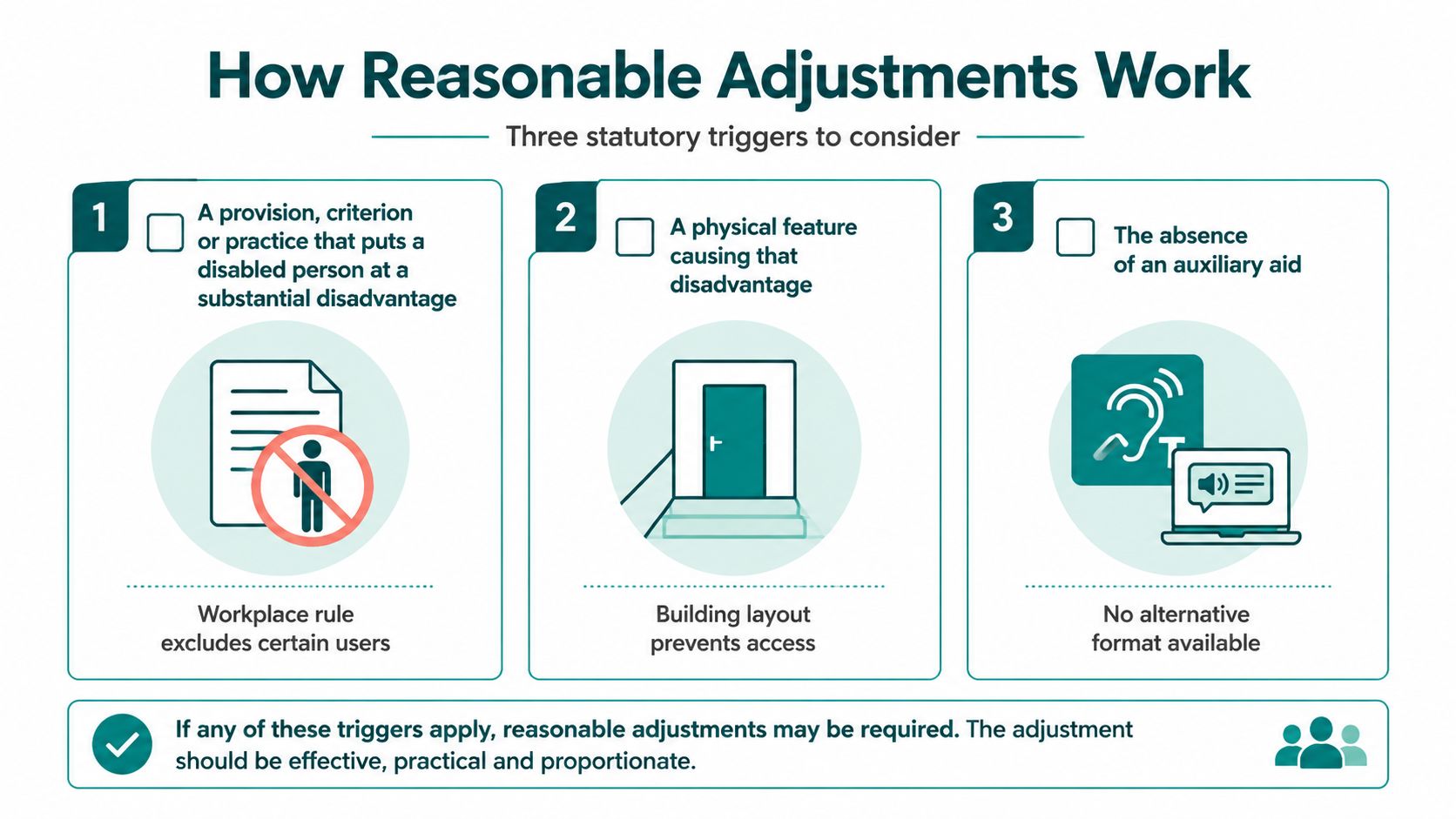
The disability adjustment duty has three statutory triggers. An organisation must assess whether:
- A provision, criterion or practice places a disabled person at a substantial disadvantage compared with non-disabled people.
- A physical feature of the premises creates that disadvantage.
- The person is disadvantaged because an auxiliary aid or service isn't provided.
The disadvantage must be more than minor or trivial. That doesn't mean managers should wait for a dramatic failure. A policy requiring every passenger to use a touchscreen can create a serious barrier for someone who can't see or operate it. A narrow route, inaccessible toilet or missing hearing support can prevent a person from using the service on equal terms.
The statutory duty is anticipatory for service providers and public functions. The organisation must plan for disabled people generally before a particular visitor arrives or asks for help. A reactive response at the customer-service desk may be useful, but it doesn't erase a failure to put reasonable arrangements in place beforehand.
What makes an adjustment reasonable
Reasonableness depends on the circumstances. The assessment can consider:
- Effectiveness, including whether the step removes or reduces the disadvantage.
- Practicality, including whether staff can operate it reliably.
- Cost and resources, viewed in the context of the organisation.
- Disruption, including effects on other users and service continuity.
- Health and safety, where relevant.
- Available alternatives, especially where a permanent building change isn't immediately possible.
A station might alter a ticketing process, publish accessible route information, provide visual disruption alerts and train staff to explain alternatives. A venue might offer large-print menus, a hearing loop, a quiet space or a different entrance route. An employer might consider flexible shift patterns or adapted equipment. Costs can't be passed to a disabled employee, and employers must consider adjustments when they know, or could reasonably be expected to know, that someone is disabled. Acas explains the factors employers should consider when making reasonable adjustments, while this guide to accommodating disabled employees offers additional context from a US employment-law perspective.
Accessible information is part of this analysis. The Act expressly identifies accessible formats as a reasonable step, so a digital navigation layer can support compliance where it gives people usable route information. It doesn't replace lifts, ramps, staff assistance or safe physical routes. Waymap's explanation of braille and QR-code access shows how a digital entry point can sit alongside tactile and printed information.
What Accessibility Looks Like Across a Visitor Journey
Accessibility works best when managers audit the whole journey rather than one building feature. Start before arrival, when a visitor needs to understand entrances, routes, facilities and current restrictions. Continue through the kerb, entrance, service point, internal route and final destination.
Three layers usually operate together:
- Physical infrastructure, such as step-free entrances, lifts, tactile paving, wide aisles, accessible counters and suitable seating.
- Auxiliary aids and services, such as hearing loops, alternative formats, portable ramps, staff assistance and captioning.
- Digital information, such as accessible websites, route filters, disruption notices and indoor navigation.
None of these layers automatically discharges the statutory duty. A ramp may solve a level change but not a confusing interchange. A hearing loop may support a ticket counter but not a deaf visitor trying to locate a temporary event room. A digital route may explain the accessible path but cannot make a closed lift operational.
Audit each transition
At each stage, ask what the visitor must know, do and experience:
| Journey stage | Physical checkpoint | Information checkpoint |
|---|---|---|
| Arrival | Kerb access, parking, crossings and entrance location | Pre-arrival access details and current restrictions |
| Entrance | Doors, thresholds, ramps and security arrangements | Clear route from the public boundary |
| Wayfinding | Lifts, stairs, tactile signs and corridor width | Accurate directions and alternative routes |
| Service point | Counter height, seating and queue arrangement | Accessible forms, ticketing and announcements |
| Seating or destination | Door, platform, seat, toilet and exit access | Exact location and disruption updates |
For complex sites, continuously updateable navigation can fill information gaps left by legacy buildings. Waymap uses device-native motion sensors for dead reckoning, with no dependence on GPS, Wi-Fi, mobile data, Bluetooth beacons or installed hardware. Its approach can provide step-by-step audio guidance to exact doors, platforms and points of interest, including step-free routes, while managers update mapped destinations as layouts change.
The useful test is independence gained. If a visitor can discover and follow a viable route without repeatedly asking staff, the information layer is doing practical work. Customer journey mapping guidance from Waymap provides a framework for identifying those points of friction.
A short demonstration can help teams understand how audio route guidance fits into the wider visitor experience.
A Practical Equality Act Compliance Process
A workable compliance process produces evidence as it improves access. The following seven stages suit a station, stadium, hospital campus, university or shopping centre.
1. Identify barriers
Use mystery shopping, accessibility walk-throughs, complaints, incident logs and direct user feedback. Record the location, affected journey, type of disadvantage and whether the barrier is permanent or temporary. Photographs and route maps are useful, but they should be accompanied by a description of what the visitor cannot do.
2. Score risk
Prioritise by likelihood and severity, not by which complaint arrived most recently. A closed lift on a step-free route may require immediate action. A confusing sign may need a rapid temporary measure while a capital project is assessed.
3. Consult
Speak with disabled visitors, employees, access panels and disability-led organisations. Consultation isn't a substitute for decision-making, but it can reveal barriers that an internal inspection misses, especially around sensory information, cognitive load and unfamiliar interchanges.
4. Plan adjustments
Combine physical works, staff procedures, accessible formats and digital tools. Assign an owner, delivery date, dependencies, budget route and interim measure. The responsible body should have regard to allocating adequate resources when implementing written school accessibility plans, and the same discipline is useful across large estates. Schedule 10 of the Act sets out the statutory accessibility-planning framework for schools.
5. Implement
Deliver the adjustment and test it in the environment. A new sign can be technically compliant yet invisible from the approach route. A published accessible map can become inaccurate when a contractor closes a corridor.
6. Train and record
Keep staff briefings, route instructions, escalation protocols, supplier records, equality impact assessments, accessibility statements and change logs. Record why an option was selected, what alternatives were considered and who approved the decision.
7. Review
Set a review date and compare the intervention with visitor outcomes, feedback, incidents and route failures. Waymap's compliance reporting system illustrates the value of connecting operational changes with an evidence trail, although a reporting tool doesn't replace legal judgement or user consultation.
Evidence standard: A strong record shows the barrier, the affected users, the options considered, the reasonableness assessment, the action taken and the result after testing.
The process should be owned by a named manager, not left as a general responsibility shared by everyone and therefore owned by no one.
Applying the Law in Transit Agencies and Large Venues
The same statutory framework produces different operational decisions in a metro station, stadium or conference centre.
At a metro interchange, a wheelchair user reaches a closed gate and must find an alternative lift. A useful response includes a visible closure notice, an accessible diversion, trained staff and updated digital information. If the diversion is only available through a staff-only route, the agency should assess whether that practice itself creates disadvantage.
At a stadium, a blind passenger may reach the correct concourse but still be unable to locate a turnstile, accessible toilet or seat. Static signs and staff assistance remain important. A navigation layer can add precise directions through a large site, particularly where infrastructure changes or temporary event layouts make permanent beacon installation difficult.
At a conference centre, a deaf visitor may need captioning, visual announcements and clear information about room changes. A ticketing system that communicates only through spoken announcements creates an information barrier even if the physical room is accessible.
Compare the available responses
| Solution | Relative Cost | Deployment Time | Compliance Evidence | Independence Gained |
|---|---|---|---|---|
| Permanent building alteration | Often substantial | Usually longer | Design records, completion checks and user testing | High where the barrier is structural |
| Improved signage and tactile information | Usually lower | Shorter, subject to design and approvals | Sign schedule, photographs and route audits | Moderate, if signs are positioned and maintained well |
| Trained staff assistance | Ongoing operational resource | Can be introduced quickly | Training records, assistance logs and feedback | Variable, because the visitor remains dependent on staff availability |
| Accessible digital information | Varies by scope | Can be relatively quick for content changes | Version history, accessibility testing and usage feedback | High for people who can use the format, provided information is accurate |
| Infrastructure-free indoor navigation | Avoids installed hardware costs | Depends on mapping and testing | Route test records, update logs and user feedback | Can be high for independent movement through complex sites |
Waymap's technical model uses smartphone motion sensors and detailed maps for dead reckoning, rather than GPS, Wi-Fi, mobile data, Bluetooth beacons or installed hardware. The stated capability includes sub-3-metre accuracy in infrastructure-free environments and no pre-mapping requirement for venues with high staff turnover or frequent layout changes. For an operator, the relevant trade-off is not whether navigation technology replaces construction. It doesn't. The question is whether an updateable information layer can reduce navigation disadvantage while the organisation addresses lifts, ramps, signage, announcements and staff processes.
Teams should measure operational signals without turning them into invented compliance scores. Useful records include repeated route failures, assistance requests, complaints about inaccessible information, missed appointments, event-entry problems and the time needed to communicate a diversion. A transport agency can then distinguish a physical capacity problem from an information problem, while a venue can see whether visitors are abandoning a journey before reaching a ticketed area.
Public Duties, Enforcement and Legal Risk
The public sector equality duty applies beyond individual adjustment requests. Public authorities must have due regard to three aims when carrying out their functions: eliminating discrimination, advancing equality of opportunity and fostering good relations. Covered authorities may also need to address inequalities of outcome linked to socio-economic disadvantage when making strategic decisions. As noted earlier, the Equality Act provides the statutory framework.
| Duty area | Public bodies under the PSED | Private service providers and employers |
|---|---|---|
| Strategic decisions | Show due regard to equality aims and relevant inequalities | Assess service and employment decisions under applicable duties |
| Information and objectives | Publish equality information and objectives where required | Maintain proportionate policies, records and evidence |
| Visitor access | Consider equality in public functions and service design | Make reasonable adjustments for disabled service users |
| Employment | Apply employment duties alongside public responsibilities | Apply employment duties and workplace adjustment requirements |
| Evidence | Record how equality was considered, not only the final outcome | Record barriers, options, decisions, implementation and review |
The practical test is whether the organisation can show how it considered equality before deciding. A transit agency reviewing a station closure should record affected journey stages, alternative routes, communication formats and the reasons for its chosen mitigation. A venue should retain access assessments, consultation notes, temporary-change decisions and review dates. These records support accountability, but they do not remove the underlying duty.
Enforcement depends on the duty and facts. Employment claims generally proceed through the employment tribunal, while service discrimination claims may proceed in the County Court. Remedies can include declarations, injunctions, damages and recommendations where the relevant legal test is met. The Act does not impose an automatic fine whenever a venue falls short, and good practice alone does not establish liability. The claimant or reviewing body must prove the relevant facts under the applicable statutory route.
A finding can also lead to reputational damage, procurement scrutiny, corrective work and reduced public confidence. Managers should use EHRC guidance when setting processes, while recognising that guidance is not legal advice for a live dispute. Waymap's overview of the public-sector equality duty links strategic obligations with practical access planning, including physical routes, information and updateable digital directions. Such tools may support independent movement, but they do not replace accessible infrastructure, staff procedures or legally required adjustments.
Action Checklist and Frequently Asked Questions
Use this checklist during the next working week:
- Identify barriers: Walk the route from kerb to destination, including temporary diversions.
- Record evidence: Take photographs, save information versions and log affected journey stages.
- Consult users: Ask disabled visitors and staff whether the proposed change solves the actual problem.
- Trial a mitigation: Test signage, staff procedures, accessible formats or digital directions in the live environment.
- Document the decision: Record the disadvantage, options, reasonableness assessment and owner.
- Set a review date: Check whether the adjustment remains effective after operational changes.
- Assign accountability: Give one manager responsibility for delivery and escalation.
Equality Act 2010 requirements FAQ
What counts as a reasonable adjustment?
A reasonable adjustment is a step that avoids or reduces substantial disadvantage caused by a policy, physical feature or missing auxiliary aid or service.
Who decides whether an adjustment is reasonable?
The organisation assesses reasonableness against effectiveness, practicality, resources, cost, disruption, safety and alternatives, while considering the affected person's circumstances.
Can digital wayfinding count as an auxiliary aid?
It can support the auxiliary-aid or information analysis where it provides usable access to information, but it doesn't replace physical access, safe routes or trained assistance.
How far does the anticipatory duty extend?
Service providers and public functions must plan for disabled people generally before an individual visitor requests help or encounters the barrier.
What records help defend a claim?
Keep barrier audits, consultation notes, equality impact assessments, photographs, incident and complaint logs, adjustment decisions, training records, implementation dates and review results.
Reactive fixes are rarely enough. Test the visitor journey, preserve the evidence and improve the arrangement before the next person arrives.
Waymap provides infrastructure-free indoor and outdoor navigation to exact doors, platforms and points of interest using smartphone motion sensors, with step-by-step audio guidance that can support accessible routes through complex venues. Visit Waymap to discuss how an updateable navigation layer could complement your Equality Act 2010 access planning.
