
Compliance Reporting System: Architecture, KPIs & Guide 2026
Selecting a compliance reporting system sounds like a software decision. In practice, it's usually a data architecture decision disguised as a software one. If the source systems are fragmented, the “best” platform just produces a prettier report built on weak evidence.
That matters in UK regulated operations because regulators now publish measurable enforcement data and expect organisations to do the same internally. The OPSS reported that its border enforcement work across 2025–2026 covered 11,310,080 goods, with 2,742,936 judged unsafe or non-compliant, and quarterly unsafe or non-compliant counts of 832,431 in Q1, 786,665 in Q2, 424,223 in Q3, and 699,617 in Q4, alongside avoided detriment estimates of around £81 million for unsafe products and £209 million for non-compliant products OPSS statistical annex. That is the direction of travel, evidence first, narrative second.
Why Most Compliance Reporting Systems Fail Before They Start
The most common failure point isn't the dashboard. It's the data estate underneath it. In transit operators, stadiums, airports, and universities, compliance evidence usually lives in separate systems for facilities, safety, HR, accessibility, procurement, and incident management, so the reporting team spends more time reconciling definitions than proving control performance.
The real problem is not automation, it's data ownership
Independent analysis has made the same point in different language, compliance reporting often creates the data problems it's meant to solve, because teams automate inconsistent inputs rather than fixing the structure underneath Ideagen analysis. Feasibility work on integrated reporting also centred on data dictionary, central data collection point, and governance as the three core challenges, which is exactly where large venue reporting programmes tend to stall.
Practical rule: if two departments use different definitions for the same control, no software layer will make the report defensible.
That's why the buyer question should be, “Do we have a shared reporting model?” rather than “Which platform has the nicest interface?” A system can only be as reliable as its source data, lineage, and ownership model. For a live operations environment, the audit trail matters more than the presentation layer.
The best change programmes start with a mapping exercise, not a tool demo. They identify the evidence owner, the source of truth, the refresh cadence, and the escalation path for every field that lands in the report. Without that, automation just multiplies inconsistency at speed.
For teams that are trying to align people, process, and systems before a roll-out, a useful starting point is Waymap's change management strategy, because the same governance discipline applies whether you're centralising accessibility evidence or safety reporting.
Large venues need a single reporting spine
A shopping centre, rail station, or campus can't treat each department as a separate compliance universe. Complaints, inspections, maintenance logs, training records, and accessibility evidence all have to land in one reviewable workflow if the organisation wants to answer auditor questions quickly and consistently.
That's also why “more channels” is not automatically better. If each channel creates its own case queue, duplicate records, and confidentiality risk, the organisation has built a reporting problem, not a reporting solution. The architecture has to force convergence.
Core Capabilities and Architecture of a Compliance Reporting System
A defensible compliance reporting system does five things well, it defines scope, reviews process, summarises results, assigns next steps, and stores annexures that prove the evidence trail Vanta compliance reporting guidance. That structure sounds simple, but it is exactly what separates audit-ready reporting from a narrative update that can't survive scrutiny.
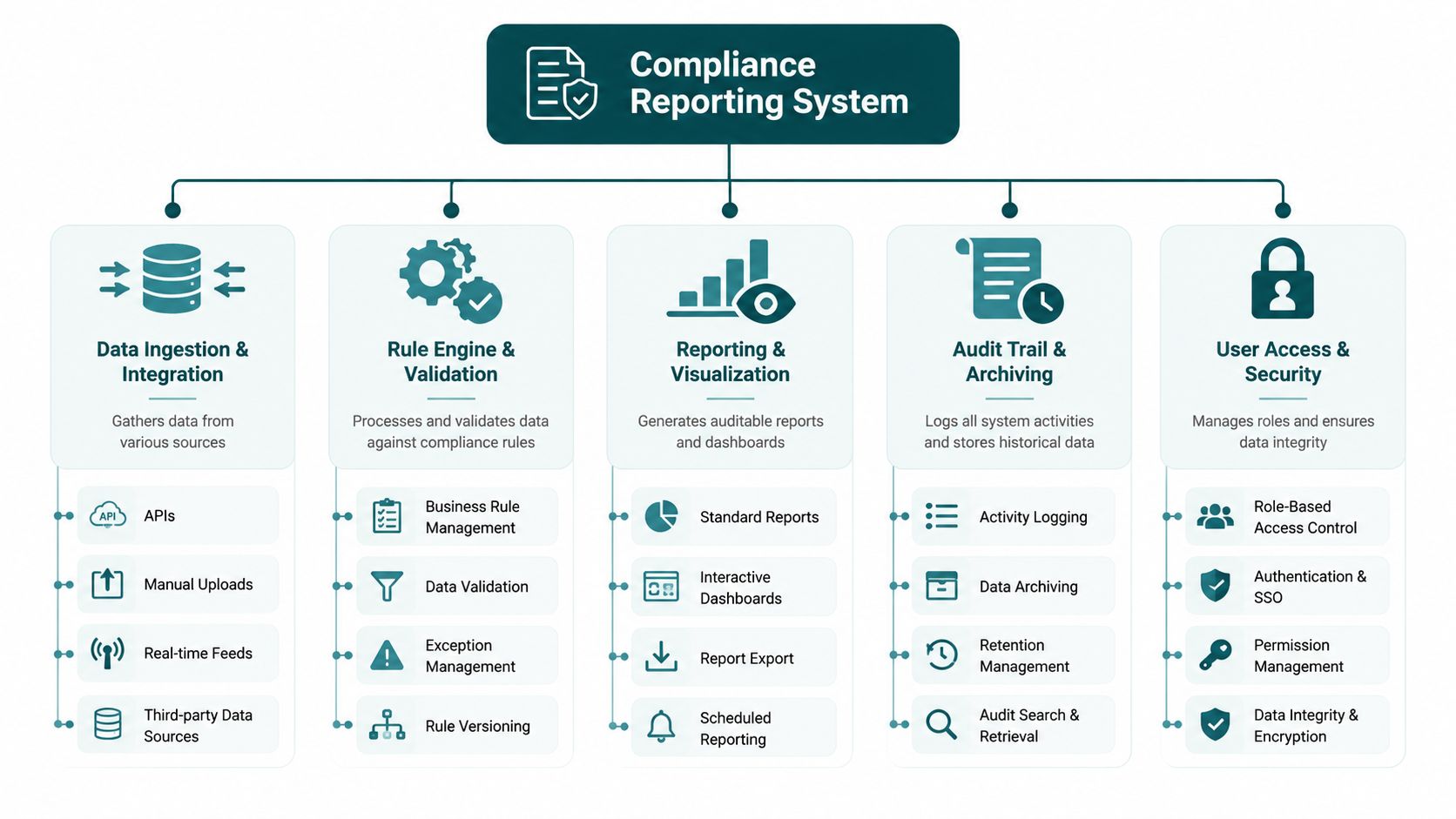
What the system has to hold together
The architecture starts with data ingestion and integration. That layer pulls from APIs, manual uploads, and real-time feeds, then normalises the incoming fields before any compliance rule is applied. If the reporting layer doesn't know how to reconcile source systems, the control test results will be hard to trust.
Next comes the rule engine and validation layer. Here, policy, regulation, and internal thresholds are translated into repeatable checks. In UK settings, that matters because regulators increasingly expect demonstrable, time-stamped proof of compliance rather than a static policy statement, especially where inspections, incidents, or filings happen at volume.
Then you need reporting and visualisation, but not as a cosmetic layer. It has to surface control status, identified vulnerabilities, open findings, and remediation plans with named owners and timelines Optro compliance report guide. The report also needs KRIs and KPIs, plus trend data and prior-period comparison, so decision-makers can see whether risk is moving in the right direction.
Practical rule: if a report can't show what changed since the last period, it's a snapshot, not a management tool.
How evidence should flow through the architecture
The strongest systems use a central collection point with version-controlled records, so every field has lineage back to a source and a reviewer. That's the difference between a “reporting tool” and an auditable system. It also explains why governance belongs in the architecture diagram, not just in the policy library.
For teams building out the data layer in connected buildings and operational estates, Waymap's Internet of Things and smart buildings perspective is a useful adjacent read because the same integration logic applies to spatial data, maintenance data, and compliance evidence.
For businesses standardising this across SAP-led estates, the Kagool SAP compliance framework is a good external reference point on governance, controls, and platform discipline. The lesson is consistent, software only works when the underlying evidence model is already coherent.
Regulatory, Accessibility, and ESG Drivers Creating Demand
Large organisations do not buy a compliance reporting system because reporting is fashionable. They buy it because regulation, accessibility, and ESG now draw on the same evidence, and fragmented spreadsheets cannot keep up with that demand.
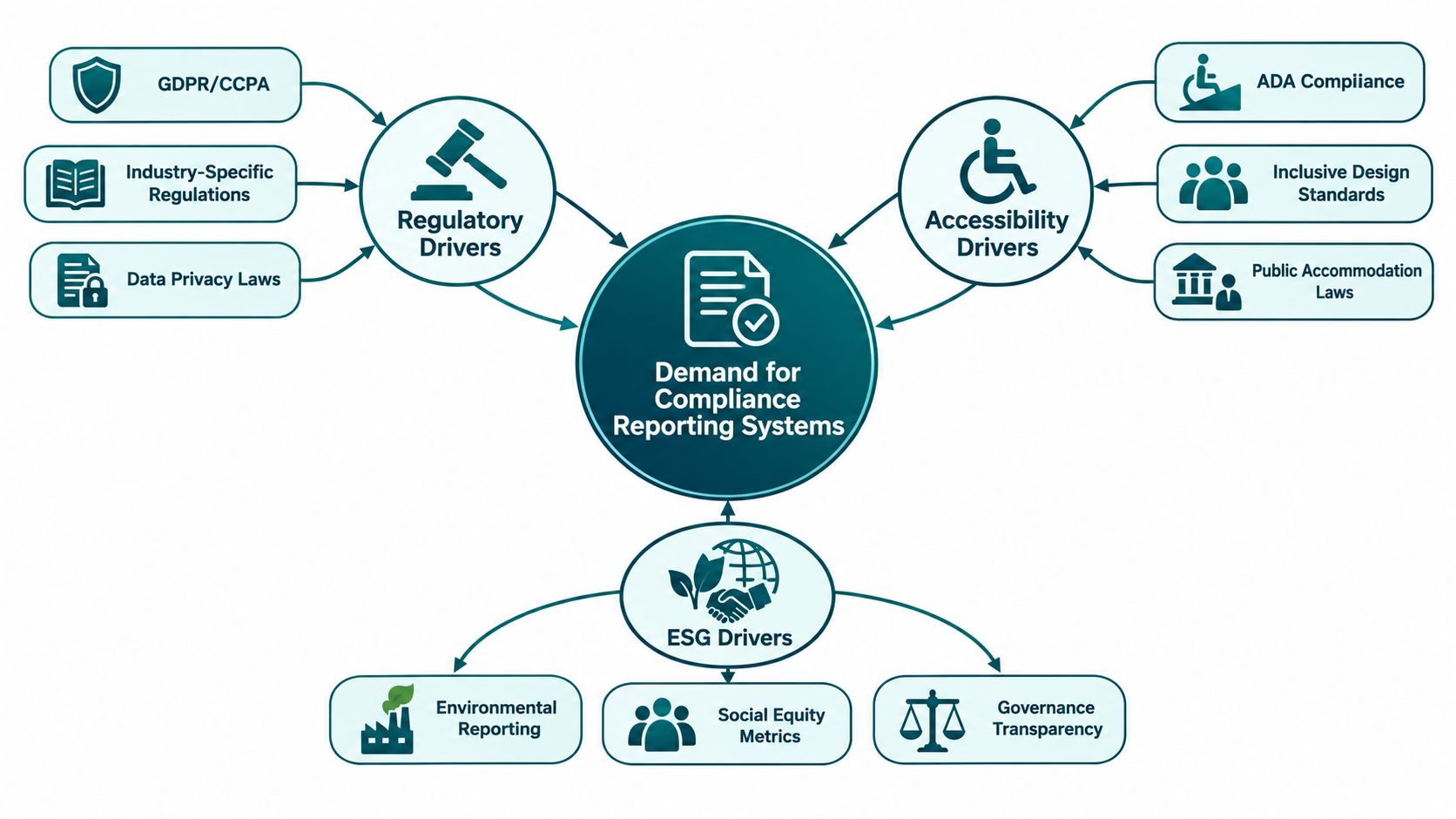
Regulatory pressure is now measurable
The OPSS numbers show why compliance reporting has become an operational issue, not a ceremonial one. Once enforcement data is published at that level of detail, organisations cannot treat reporting as an annual tidy-up. They need a live evidence trail that shows where risk is building, which controls are slipping, and where manual sign-off is masking weak performance.
That shift changes budget discussions as well. Reporting is no longer only about avoiding penalties, it is about showing where the organisation is carrying risk and where it is reducing it. The economic impact estimates in the previously cited OPSS annex show that enforcement is being framed in operational and financial terms, not just legal ones.
Accessibility evidence needs to be auditable, not aspirational
For venues and transit operators, accessibility obligations sit alongside the Equality Act 2010, BS 8300, PAS 78, and BS EN 17210. Those standards create demand for evidence that inclusive design works in practice, not just that a policy exists on paper.
Spatial and operational evidence matters here. If accessibility teams can show how people move through an environment, where assistance is available, and which routes are usable, they can support compliance discussions with something stronger than a checklist. The third-party verification approach matters because many organisations now need evidence that can stand up to independent review, not just internal sign-off.
ESG pulls the same data in a different direction
ESG reporting sounds separate, but the underlying problem is the same, fragmented data spread across departments. Sustainability teams need traceable inputs, clear ownership, and consistent definitions, just like compliance teams do. The difference is the audience, not the mechanics.
A single evidence spine can support regulatory, accessibility, and ESG reporting if the organisation standardises its data model early.
That unified approach matters most in venues that must justify spend to legal, operations, and sustainability leaders at the same time. If each team works from its own spreadsheet universe, the organisation pays for duplicate effort and still cannot tell one coherent story.
Key Features and KPIs to Evaluate in a Compliance Reporting System
The right compliance reporting system is the one that can prove control performance, not just display it. The KPIs that matter most are the ones auditors can test and leaders can act on, including training completion rate, policy attestation rate, control test pass rate, automated control coverage, issue remediation on-time, and regulatory filing SLA adherence AccountableHQ KPI guidance.
What to measure and why it matters
| KPI | Benchmark Target | Why Regulators Care |
|---|---|---|
| Training completion rate | 95%+ on-time | Shows staff have been instructed before exposure to risk |
| Policy attestation rate | Qualitative compliance with documented proof | Confirms people have acknowledged the current policy set |
| Control test pass rate | Period-over-period improvement | Indicates whether controls are designed and operating as intended |
| Automated control coverage | Higher coverage where feasible | Reduces manual error and makes reporting more repeatable |
| Issue remediation on-time | All material findings closed by deadline | Proves findings are tracked to resolution |
| Regulatory filing SLA adherence | On or before deadline | Demonstrates deadline control and governance discipline |
How to judge features without getting distracted
A vendor demo can make almost any system look complete. The better test is whether the product can state the applicable law, regulation, standard, or policy, the reporting period and deadline, the legal entity, geography, business unit, and process scope, the required data fields and evidence expectations, the intended audience, and any materiality thresholds and escalation criteria Fanruan compliance reporting explainer. If it can't do that cleanly, the report will stay broad and internal, not regulator-facing.
That's also why third-party or vendor status belongs in the report. Large venues and transport networks depend on outsourced services, and auditors will ask who owns each control, who signed off the evidence, and what happens when the vendor falls behind.
For teams trying to quantify the return on better monitoring discipline, the Doczen compliance ROI guide is a useful companion read because continuous monitoring only pays off when the reporting layer can prove the change in control performance. The metric set should reward evidence quality, not dashboard aesthetics.
Waymap's user retention metrics perspective is also relevant when accessibility and operational reporting intersect, because adoption tells you whether a service is usable, not just available.
Implementation and Data Integration Best Practices
Implementation fails when teams treat integration as a technical afterthought. The hard part is deciding which systems feed the report, who owns the definitions, and how the organisation prevents duplicate cases or confidentiality breaches when intake comes through multiple channels.
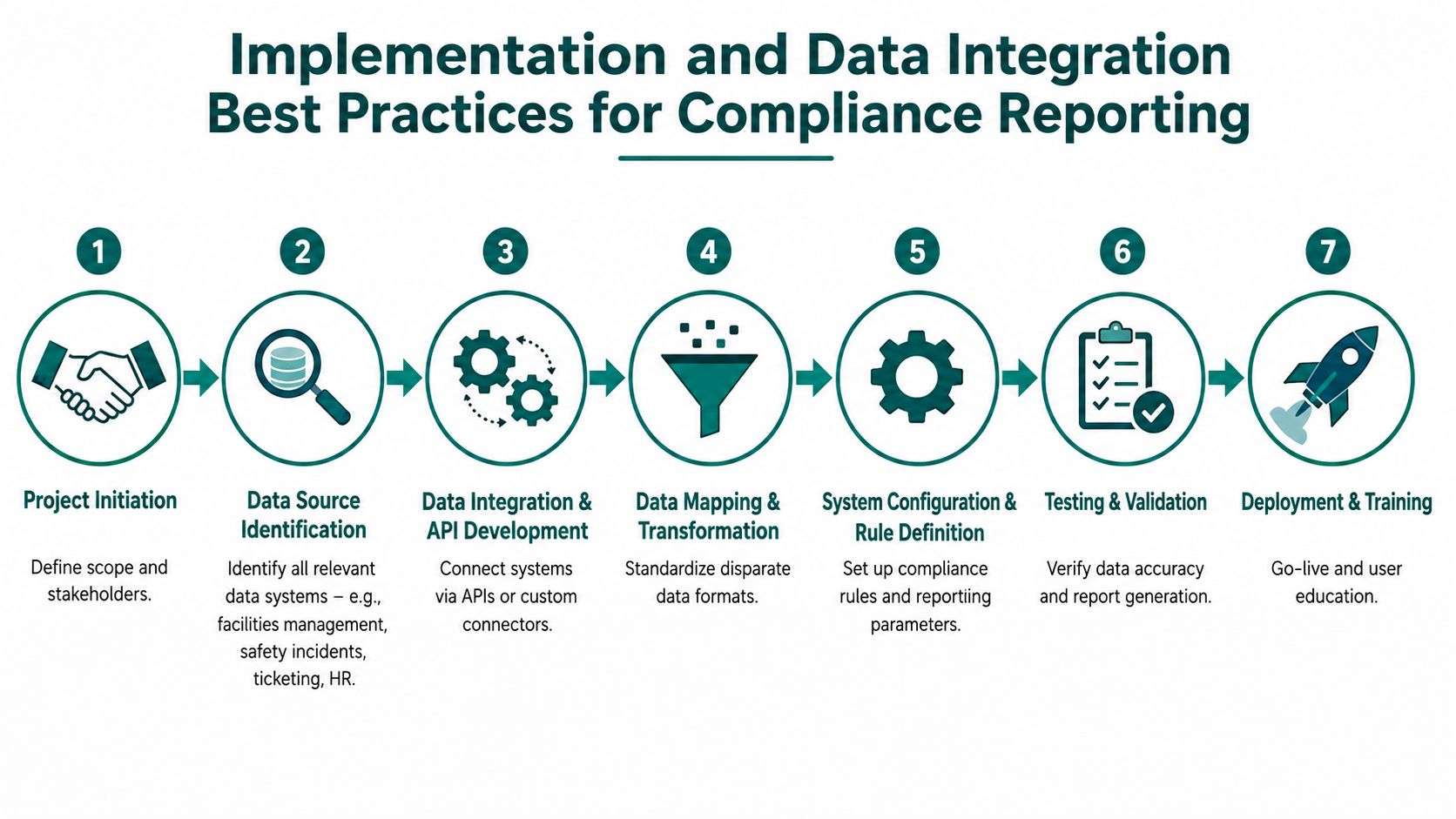
Build the workflow before you build the connectors
Start with the reporting path, not the software stack. For whistleblower and worker intake, the channels commonly include letters, email, text, telephone hotlines, and online forms, but the key design question is how those inputs route into one case management workflow without creating silos or duplicate cases ELA safe reporting paper.
The channel mix matters because accessibility and confidentiality need to coexist. Some organisations assume more channels always improve reporting quality. In reality, more channels can mean more administration if triage, anonymity handling, and escalation rules are weak.
What large estates teams run into
NHS estates managers often face capital spend restrictions that make fixed infrastructure politically difficult. Transit operators and venue owners face a different burden, the operational cost of maintaining physical hardware in environments that change frequently and carry high footfall. Universities sit in between, because they need one system that can serve both student-facing and staff-facing obligations without muddying governance.
Those constraints change the buying criteria. Standardisation and ownership matter more than another layer of automation. If the data dictionary is weak, no amount of workflow polish will fix the last mile.
Implementation rule: centralise the evidence model first, then automate the repetitive tasks around it.
A practical sequence that works
- Define scope and stakeholders so every reporting path has an owner.
- Inventory all source systems before design starts, including facilities, HR, safety, accessibility, and incident tools.
- Map fields to a shared dictionary so one term means one thing everywhere.
- Set rule definitions and escalation criteria before go-live.
- Test with real cases rather than synthetic examples.
- Lock the audit trail so changes stay versioned and reviewable.
- Train users by role so intake, triage, and sign-off are consistent.
For teams handling migrations between disconnected systems, Waymap's data migration process guidance is a useful operational reference because the same discipline applies when moving compliance evidence from spreadsheets and inboxes into a governed reporting workflow.
Selection Checklist for Large Venues and Transit Operators
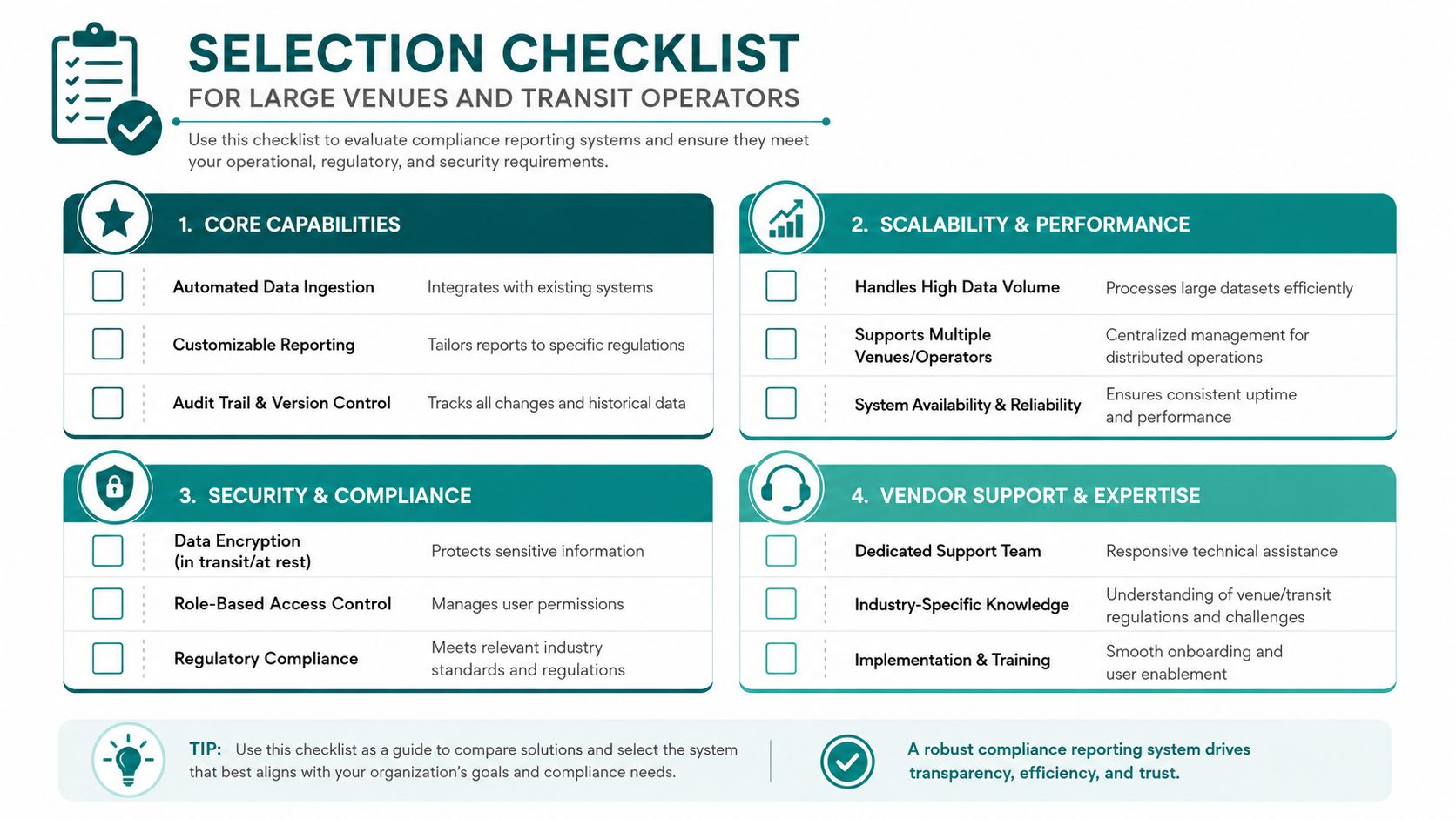
The right shortlist for a shopping centre, stadium, airport, or transit network has to answer a simple question, what creates defensible evidence with the least operational drag? Infrastructure-heavy systems, like beacon deployments or hardware-dependent audit tools, add maintenance overhead and can be hard to justify when layouts change often or budgets move slowly.
What to score in procurement
- Automated data ingestion: Can it connect to the systems you already run without a manual export chain?
- Custom reporting by obligation: Can it produce reports aligned to the Equality Act 2010, ADA Title III, or BS EN 17210 without rebuilding the template each time?
- Audit trail and version control: Can you show what changed, who changed it, and when?
- High-change environment tolerance: Will it still work when layouts, routes, or points of interest change often?
- Multi-site governance: Can one team oversee several venues or operators without losing local accountability?
- Role-based security: Can access be separated cleanly for compliance, operations, and vendor users?
- Operational burden: Does it require physical hardware that someone has to install, maintain, and replace?
Why infrastructure-free navigation data changes the discussion
Wayfinding systems based on dead reckoning using device-native sensors remove the need for installed hardware and pre-mapping in the way beacon-led systems require. That kind of infrastructure-free data is useful because it creates a live evidence trail without adding another layer of site equipment to maintain. For venues and transit networks, that is a serious advantage when capital budgets are tight and the physical environment changes often.
The selection test should be whether the system can support auditable accessibility evidence, not just a nice user experience. If the reporting output helps teams show how people move through a venue, and it can do that without installing more hardware, it earns a place on the shortlist. That's especially relevant for operators balancing compliance, visitor experience, and maintenance workload at the same time.
Frequently Asked Questions About Compliance Reporting Systems
What is a compliance reporting system? A compliance reporting system is a governed workflow for collecting, validating, and presenting evidence that an organisation is meeting legal, regulatory, policy, or contractual obligations.
How is compliance reporting different from compliance monitoring? Compliance monitoring tracks whether controls are working, while compliance reporting packages that evidence into an auditable record for managers, auditors, or regulators.
How do transit operators manage cross-border compliance data? They need one data dictionary, one ownership model, and one audit trail across jurisdictions, otherwise reporting becomes inconsistent and hard to defend.
Is infrastructure-free navigation data accepted as compliance evidence in the UK? It can support accessibility evidence when it is captured and governed properly, but the organisation still has to map that evidence to the relevant duty under the Equality Act 2010 or applicable built-environment standard.
How long does implementation usually take for a large venue? The timeline depends on how many source systems, teams, and reporting obligations need to be unified, so the primary variable is data readiness rather than software installation.
For in-house teams that need to coordinate evidence, review obligations, and manage risk across multiple departments, AI for in-house legal teams is a useful adjacent reference because legal review, compliance reporting, and audit response increasingly depend on the same structured information.
Waymap helps venues and transport operators turn accessibility into auditable operational evidence, not just policy language. If you're building a compliance reporting system that has to handle fragmented estate data, accessibility obligations, and real-world reporting pressure, visit Waymap and see how that evidence layer can fit into your wider governance model.
