
Third Party Verification: A Guide to ESG and Accessibility

By Celso Zuccollo, CEO at Waymap
The UK market for identity verification is projected to nearly triple by 2030, as noted earlier in this article. For venue operators, the implication is practical. Independent verification is no longer confined to onboarding and fraud controls. It now affects accessibility evidence, ESG reporting, procurement decisions, and how well your organisation can defend its claims under scrutiny.
Venue teams often assume a documented internal review will be enough. In practice, that position weakens quickly once a complaint is raised, a public body asks for evidence, or legal disclosure starts. If you state that a venue is accessible, a digital service meets requirements, or an ESG claim is substantiated, you need evidence that was tested outside the team that made the claim.
Independent verification gives you that evidence.
It does not transfer liability. That is the point many operators miss. A third party can assess, certify, or assure, but your organisation still carries the legal and operational responsibility for what visitors experience, what contracts promise, and what published statements claim. That liability paradox matters in UK venues, where accessibility duties, public sector procurement conditions, insurer questions, investor scrutiny, and ESG disclosure expectations can collide in the same project.
Used properly, third party verification reduces risk, strengthens procurement discipline, and exposes gaps early enough to fix them at a sensible cost. Used badly, it becomes expensive theatre. A certificate from a weak verifier or a narrow desktop review will not help much if the building fails in use, the website blocks disabled users, or your sustainability claims cannot be evidenced against a recognised standard.
What Is Third Party Verification and Why Is It Essential
Third party verification is an independent assessment of whether your venue, service, system, or published claim meets a defined requirement. In practice, it is how you replace internal opinion with evidence that can stand up in procurement, complaint handling, insurer queries, regulatory review, and legal disclosure.

For venue operators, that usually shows up in four areas. Accessibility audits for websites, apps, and visitor journeys. Compliance checks on buildings and front-of-house services. ESG assurance over data, statements, and reported performance. Identity, eligibility, or concession validation delivered by specialist providers.
The reason it matters is simple. If your organisation makes the claim, your organisation carries the risk when the claim fails.
That is the liability paradox many teams miss. Hiring a verifier does not pass legal responsibility to the verifier. The venue operator still answers for what disabled visitors experience on site, what ticketing flows block online, what procurement documents promise, and what sustainability statements imply. Independent verification reduces exposure by improving the evidence base. It does not remove accountability.
What independent verification gives you in practice
A credible verifier does more than issue a certificate. They apply a named standard, test against that standard, record limitations in scope, and produce findings someone outside the project team can follow. That changes the conversation internally. Boards get clearer assurance. Procurement teams get firmer acceptance criteria. Operations teams get a usable defect list instead of vague recommendations.
Used well, third party verification gives you:
- A documented method tied to a recognised benchmark, not internal preference
- Evidence that survives scrutiny from public bodies, funders, insurers, campaigners, and claimants
- A remediation plan with specific failures, affected services, and priority actions
- Stronger procurement control because suppliers can be measured against independent findings
- Better operational decisions on whether an issue needs redesign, retraining, or a contractual fix
For a venue team rolling out digital wayfinding or inclusive visitor support, that distinction matters. An access feature is only useful if it works in real conditions, with real users, across the full journey. Projects such as inclusive wayfinding technology for public spaces illustrate why verification has to cover lived use, not just design intent.
Why internal checks are rarely enough
Internal review still has a role. Teams know the site, the service model, the supplier history, and the budget constraints. But they also carry delivery pressure, political pressure, and sunk-cost bias. That makes self-assessment weak evidence when a complaint arrives or a tender asks for proof.
I see the same failure pattern repeatedly in venue portfolios. A supplier says a booking flow is accessible. Estates signs off a route as step-free without testing the full arrival sequence. Sustainability data is compiled from spreadsheets with inconsistent boundaries. Then a challenge lands, and nobody can show what standard was applied, what was tested, what was excluded, or who signed it off.
At that point, the absence of verification becomes an operational problem, not a paperwork problem.
What good verification looks like
Good verification starts early enough to influence design, procurement, and remediation budgets. It names the standard before testing begins. It defines scope properly, including interfaces between landlord, operator, and supplier responsibilities. It records assumptions and exceptions. It gives you evidence you can retain in an audit file, alongside contracts, issue logs, and corrective actions. If your team needs to tighten that evidence trail, this audit-proof documentation guide is a useful reference point.
Poor verification is easy to spot. It stays at checklist level. It avoids user testing where user testing is needed. It produces broad statements with no severity ratings, no replicable method, and no clear owner for fixes. In a dispute, that kind of report offers very little protection.
Third party verification should be treated as part of operational control. For UK venues, it supports safer procurement decisions, clearer accountability across suppliers, and stronger evidence when accessibility or ESG claims are challenged.
The Role of Verification in Accessibility and ESG Compliance
For accessibility and ESG, independent verification isn't an optional polish layer. It's the proof behind the claim.
In UK public sector digital services, the standard is explicit. Under the Public Sector Bodies (Websites and Mobile Applications) Accessibility Regulations 2018, public sector websites and apps must demonstrate conformance with WCAG 2.2 Level AA and publish accessibility statements. The GOV.UK guidance on getting an accessibility audit makes that legal mechanism concrete. A claim of accessibility has to be tied to identifiable barriers, conformance level, and a route for users to report issues.

Accessibility claims need more than good intentions
For venue operators, accessibility isn't just about a website footer or a policy statement. It cuts across journey planning, ticketing, venue maps, customer support, signage, content, and staff workflows. The Equality Act 2010 sets the legal backdrop. The practical test is whether disabled people can use the service in a fair and reliable way.
That's where third party verification matters. An independent audit can show whether your digital service meets WCAG 2.2 Level AA, whether your accessibility statement is credible, and whether the issue log reflects the actual user journey rather than internal assumptions.
It also helps with supplier control. If an external agency publishes PDFs, maps, forms, or app content on your behalf, you still need structure and evidence. Teams that need stronger records often benefit from an audit-proof documentation guide because audit readiness is usually lost in version control, approval history, and missing remediation notes rather than in the standard itself.
A practical example of how accessibility can create wider public value appears in Waymap's App for Good announcement, where accessible navigation is framed as a shared civic benefit rather than a niche add-on.
ESG evidence fails when the assurance chain is weak
ESG reporting has the same problem in a different form. Operators make claims about emissions, social impact, governance, and inclusion. Investors, public authorities, and procurement teams increasingly ask how those claims were verified.
That pressure is healthy. It forces organisations to separate aspiration from evidence.
Use this video as a simple visual refresher on where verification sits in a broader compliance workflow.
Where verification changes decisions
Third party verification changes decisions in three practical ways:
- It disciplines scope so teams define exactly what has been assessed
- It exposes unsupported claims before they appear in public reports or tenders
- It creates an audit trail that can survive personnel changes and supplier churn
Accessibility and ESG both fail in the same place. The organisation makes a broad claim, but the evidence only covers a fraction of the service.
That's why serious operators don't treat verification as comms support. They treat it as part of legal, operational, and procurement control.
Key Types of Verification and Governing Standards
Not all third party verification does the same job. Venue operators make better buying decisions when they separate what is being verified from which standard governs the review.
Accessibility verification
Accessibility verification usually tests a digital service, document set, or customer journey against a defined benchmark. For UK public bodies, WCAG 2.2 Level AA is the obvious digital standard. In the built environment, teams also work against design and usability frameworks such as BS 8300, PAS 78, and BS EN 17210, depending on scope.
If you're procuring built environment advice alongside accessibility work, it helps to understand how formal inspection differs from informal opinion. A short primer such as this RICS survey guide from Corinthian Surveyors London is useful because it shows what disciplined, standards-based assessment looks like in property practice.
Accessibility verification is strongest when it covers more than automated scans. A credible review usually combines code checks, manual testing, content review, assistive technology compatibility, and evidence of remediation.
Data assurance and identity verification
A second category focuses on whether records, attributes, or declared identities are reliable enough for the purpose being served. That can include residency checks, age assurance, supplier records, and onboarding workflows.
The question here isn't “does the data exist?” It's “who checked it, against what source, and with what audit trail?” That distinction matters for venues handling concession access, customer eligibility, or regulated services.
ESG and emissions assurance
Standards become especially important in this context. In the UK's Renewable Transport Fuel Obligation and SAF Mandate, third party verification of data must be carried out independently under ISAE 3000 or an equivalent standard, with validation against standards such as ISO 14064, as set out in the government's third party assurance guidance for RTFO and SAF.
That matters beyond transport fuel. It demonstrates a regulatory model that many venue operators should understand: when a claim has public policy consequences, government often expects assurance against a named framework, by a competent and independent verifier, with logs and records that can be examined later.
Verification of legal or regulatory status
Some regimes go further and regulate the verifier itself. Under the UK STS securitisation framework, a third party verification service is legally defined and the verifier must be registered with the Financial Conduct Authority to provide that service. The principle is simple. In higher-risk contexts, independence alone isn't enough. The verifier may also need formal registration, oversight, or sector-specific standing.
For venue teams, that's the lesson to carry into procurement. Don't buy “verification” as a vague service category. Buy a defined assessment against a named standard, delivered by a verifier with competence that matches the regulatory stakes.
For a related view on how standards intersect with built environment duties, Waymap's building code compliance article is a useful reference point.
How the Third Party Verification Process Works in Practice
A good verification engagement follows a disciplined sequence. The order matters because weak scoping produces weak evidence, and weak evidence produces reports nobody can rely on.
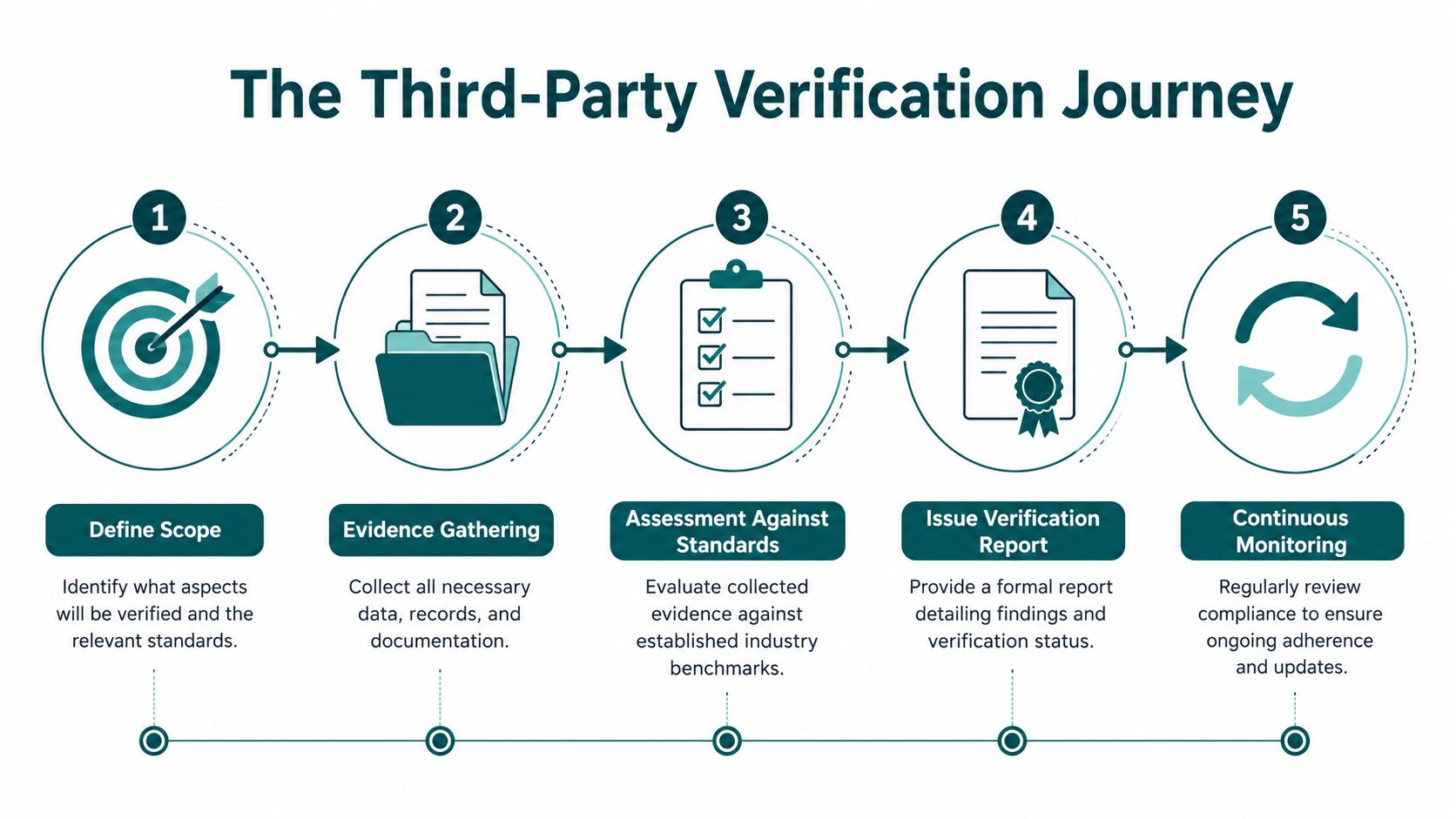
The five stages most teams should expect
Define scope
The verifier and the client agree what is being assessed, against which standard, and across which assets, records, or journeys.Gather evidence
This usually includes policies, datasets, statements, system outputs, screenshots, logs, supplier records, and sample transactions.Test against the benchmark
The verifier checks whether the evidence supports the claim. This process reveals unsupported assumptions.Issue findings
A useful report distinguishes between conformant items, partial conformance, non-conformance, limitations, and recommendations.Remediate and monitor
The best teams treat verification as a cycle. Issues are fixed, controls are updated, and the evidence base is kept current.
A public sector example that shows the mechanics
The HMRC first-stage verification exercise on Scottish address data is a useful example because it shows third party data assurance at scale. HMRC reported that it matched 71.7% of 5.5 million Scottish address records to third party data sources, with a 99.6% match rate where a match was established, and noted a correct identification rate between 98% and 99% for active records, according to the HMRC letter published by the Scottish Parliament Public Audit Committee.
That example matters because it separates two questions that venue operators often blur together. First, can you establish a match? Second, if you establish one, how reliable is it? Good verification reports keep those questions distinct.
A verification report is only useful if it tells you both where confidence is high and where coverage is incomplete.
What goes wrong during delivery
Most failed engagements don't fail because the standard is unclear. They fail because the evidence base is poor.
Common friction points include:
- Fragmented ownership where estates, digital, procurement, and legal each hold part of the required record
- Uncontrolled versions where nobody can confirm which policy, map, or statement was live at the audit date
- Shallow remediation where teams fix the symptom but not the control weakness that caused it
When findings recur, structured investigation helps. A practical resource on methods for root cause analysis is useful here because repeat non-conformance is usually a process problem, not a one-off mistake.
For teams dealing with digital journeys and user-facing systems, Waymap's guide to accessibility testing is a good companion piece to the verification process itself.
How to Select a Credible Third Party Verifier
The hardest procurement mistake is assuming that any independent reviewer reduces your risk. Some do. Some produce a report that looks authoritative until someone challenges it.
The first rule is to understand the liability paradox. In the UK, regulated entities can remain ultimately liable even when they use third party verification services. The government's guidance on digital identity and the Money Laundering Regulations makes that point clearly in the UK government blog on digital identity and compliance. A certified external service may support verification, but it doesn't remove the client's final legal burden.
The questions that separate serious verifiers from paper suppliers
Ask direct questions. If a verifier can't answer them clearly, don't appoint them.
What exact standard are you assessing against
If the answer is broad or marketing-led, the engagement will drift.What evidence do you require from us
Good verifiers can describe inputs before the work starts.What are the limits of your opinion
Every proper verification has boundaries. If they claim to cover everything, be cautious.Who performs the work
You want named practitioners with relevant sector experience, not only a sales lead.How do you report non-conformance and remediation
If findings aren't prioritised and traceable, the report won't help your operations team.
Verifier Selection Checklist
| Criteria | What to Look For |
|---|---|
| Standard alignment | A named benchmark such as WCAG 2.2 Level AA, ISAE 3000, or another defined framework relevant to the scope |
| Independence | No conflict with the design, implementation, or sales of the thing being verified |
| Competence | Demonstrable experience in your sector, with staff who understand venue operations and regulated environments |
| Methodology | A clear explanation of sampling, testing, evidence review, and limitations |
| Reporting quality | Findings mapped to requirements, with severity, remediation actions, and residual risk clearly stated |
| Audit trail | Version control, evidence references, dates, and retained records |
| Insurance and liability terms | Appropriate professional cover and contract terms that don't obscure accountability |
| Re-verification approach | A sensible plan for follow-up after remediation or service change |
What venue operators should not outsource mentally
There are decisions you can delegate operationally but not intellectually:
- Risk acceptance stays with the client
- Control ownership stays with the client
- Public claims stay with the client
That's why verifier selection is a governance task, not just a purchasing task. Public bodies and regulated operators should align legal, accessibility, digital, and estates teams before appointment. Waymap's public sector procurement article is a useful reminder that buying well often matters as much as specifying well.
The ROI of Independent Verification for Your Venue
The return on independent verification doesn't sit in one line of the budget. It shows up in fewer disputed claims, cleaner procurement, faster issue triage, stronger public trust, and less operational drift.
Where the value appears first
For most venue operators, the first benefit is decision quality. Verified evidence is easier to act on than internal assurance language because it ties findings to a standard and a remediation path.
The second benefit is resilience. Teams change, suppliers change, and estates change constantly. A good verification trail survives those changes because it records what was tested, what passed, what failed, and what was fixed.
The real return isn't the certificate. It's the ability to defend your position when challenged and correct problems before they become public failures.
Why operating model matters
Technology choices notably influence verification cost and durability. Systems that depend on installed hardware create an ongoing assurance burden. If a venue relies on distributed physical devices, the organisation then has to manage placement, maintenance, replacement, battery state, firmware, inspection routines, and change control across the estate. Each moving part becomes another verification point.
Infrastructure-free systems are simpler to govern because there's less field hardware to maintain and fewer physical failure points to evidence. That matters to NHS estates teams, transport operators, and large venues where maintenance access is difficult and layouts change often.
A hardware-light model also reduces one common cause of compliance decay. Physical equipment goes out of date unnoticed. Documentation rarely keeps pace.
Why this matters for accessibility and facilities teams
Accessibility leaders often know what should happen. Facilities teams know what can realistically be maintained. Independent verification works best when those two perspectives are aligned early.
For operators thinking about long-term maintenance, Waymap's view on the benefits of facilities management is relevant because compliance failures often begin as maintenance failures, not policy failures.
The commercial point is straightforward. Verification costs money. Unverified claims usually cost more once they trigger rework, complaint escalation, procurement friction, or reputational damage.
Frequently Asked Questions About Third Party Verification
What is third party verification in simple terms
Third party verification is an independent check that your claim, data, process, or service meets a defined standard. The verifier is separate from the team making the claim and tests evidence rather than taking your word for it.
When does a venue need third party verification
A venue needs third party verification when it is making a claim that could create legal, procurement, accessibility, ESG, or public accountability risk. Typical triggers include accessibility statements, sustainability disclosures, regulated data assurance, supplier claims, and major service changes.
Does third party verification remove legal responsibility from the client
No. Third party verification supports compliance, but it doesn't transfer the client's ultimate responsibility. That's the central lesson of the liability paradox discussed earlier.
What should a verification report include
A useful verification report should include the scope, the standard used, the evidence reviewed, the method applied, the findings, the limits of the assessment, and the actions required to remediate gaps. If any of those are missing, the document is harder to defend.
How often should third party verification be repeated
Re-verification should happen whenever the underlying service, data, estate, or regulatory position changes enough to affect the original conclusion. Many operators also schedule periodic reviews so the evidence base stays current and issues don't accumulate.
What happens if a venue fails verification
Failure isn't the end of the process. It usually means the verifier has identified non-conformance or insufficient evidence, and the venue needs a remediation plan. Strong teams use failed findings to improve controls, update documentation, and retest the areas that matter most.
How do you avoid buying weak verification
Start by naming the standard, then check the verifier's independence, competence, reporting method, and contractual terms. Avoid vendors who promise blanket compliance without defining limits, evidence requirements, or remediation responsibilities.
Is third party verification only about digital systems
No. Third party verification can apply to digital accessibility, physical environment standards, ESG disclosures, identity data, content supplied by contractors, and regulated reporting. The method changes by context, but the principle stays the same. Independent evidence beats self-attestation.
If you're reviewing accessibility, operational resilience, or inclusive navigation across a complex venue, Waymap can help you reduce infrastructure burden while improving the clarity of the user journey. Our platform works indoors, outdoors, and underground without GPS, Wi-Fi, or installed hardware, giving operators a practical way to support accessible wayfinding with less maintenance overhead.
