
What Is an App for Good and Why Should You Have One?

When people talk about an ‘app for good’, it’s easy to think of charity donation platforms or volunteer-matching software. While those are valuable tools, the concept has grown into something much more powerful for modern organizations. It's time to move past the old idea that "for good" must mean "not for profit." In today's world, purpose and profit are two sides of the same coin.
An app for good is no longer just a piece of software with a positive mission; it's a strategic tool that delivers genuine social value and measurable commercial returns.
More Than Just a Feel-Good Label
Let's broaden the definition. In a business context, an app for good is a tool that solves a real human problem while creating tangible benefits for the organization that deploys it. This creates a powerful ‘double bottom line’ where improving people's lives directly improves the business's performance. They aren't competing priorities; they fuel each other.
A great starting point for understanding this is thinking about what website accessibility means. At its heart, it’s about making digital tools that work for everyone, regardless of their ability. An app for good often takes that same spirit and applies it to a real-world, physical challenge.
Where Purpose and Profit Meet

Think about an accessible navigation app inside a sprawling, confusing space like a major airport or a shopping center. At its core, this is an app for good. It gives people, including those with sight loss, the freedom to find their way around with confidence and independence. That’s a fundamental human need—autonomy—being met directly.
But the story doesn't end there. For the airport or shopping center operator, that very same app is a powerful tool for their business.
An app for good stops being a corporate social responsibility checkbox. It weaves a social mission right into the daily operations of the business, creating a model where making lives better also makes the business better.
The Double-Bottom-Line in Practice
This is where the real value becomes clear. The same technology that champions inclusivity also delivers a clear return on investment. It's a classic win-win.
- For your visitor: It offers dignity, independence, and a much less stressful experience. A visually impaired person can find their gate, a first-year student can get to their lecture, or a tourist can navigate a foreign station, all without having to ask for help.
- For your business: It unlocks rich data on how people move through your space, eases the burden on customer service staff, and boosts your brand’s reputation as an inclusive, forward-thinking organization.
Smart, ESG-aware organizations now realize they don't have to choose between doing good and doing well. An app for good is proof that the most powerful way to build a stronger business is by serving the needs of every single person in your community. It’s purpose and profit, working in perfect sync.
The Growing Demand for Digital and Physical Accessibility
For too long, the conversation around accessibility has been stuck in a loop of compliance checkboxes and corporate goodwill gestures. But that’s changing, and fast. The demand for genuinely accessible experiences—both in the digital world and on the ground—is no longer a side project. It's a core commercial and social priority.
Let's be clear about the numbers. There are 16 million people in the UK with a disability, which is nearly a quarter of the population (24%). To ignore their needs isn't just poor ethics; it’s a massive business blind spot. There's a loyal, valuable, and frankly, overlooked group of customers right there, waiting for someone to get it right.
The Digital Cliff-Edge
Think about it from a customer's perspective. A person with sight loss wants to visit a new shopping center. They use a screen reader to navigate the center's beautifully designed website, check opening times, and even get directions to the front door. So far, so good.
But the moment they arrive, all that digital support evaporates. They're left at the entrance with no way to navigate the physical building. This is what we call the ‘digital cliff-edge’. It’s that jarring moment when a smooth online journey smashes into a confusing physical reality, leaving the visitor stranded.
This disconnect is more common than you might think. A recent analysis of the UK's top 100 retail websites was eye-opening, finding that a staggering 84% had critical accessibility flaws. In fact, 100% of the homepages tested failed to meet the global WCAG 2.1 AA standard. The full report on this retail accessibility gap from Level Access makes for sobering reading.
When your digital front door is open and welcoming, but your physical venue is a confusing maze, you’ve broken the journey. You've broken the trust. An app for good is the bridge across that chasm, carrying the supportive digital experience right into the physical world.
True accessibility isn't just about having a compliant website. It's about creating one continuous, supportive journey from someone's phone screen all the way to their seat, gate, or platform inside your venue.
A Growing Legal and Commercial Risk
This isn't just about a missed opportunity anymore; it's a very real and growing risk. Governments are finally taking action, and the legal ground is shifting beneath our feet.
- The European Accessibility Act (EAA): This is now being written into UK law. It mandates that a whole range of products and services, including e-commerce and transport, must be accessible. Not complying will lead to significant fines and public relations headaches.
- The Equality Act 2010: This has been around for a while, but it's getting more teeth. It requires organizations to make 'reasonable adjustments' for disabled people. Failing to provide something as fundamental as navigation could easily be seen as a breach of that duty.
Trying to ignore this is no longer a viable strategy. The most forward-thinking leaders in transport, venues, and city planning already get it. They see that acting now isn’t just about dodging legal trouble—it’s about actively opening their doors to a huge part of the community and turning a requirement into a powerful competitive edge. The demand is here. The technology is here. The time to act is now.
How Infrastructure-Free Technology Creates More Value
When you're looking at indoor navigation, the choice of technology often comes down to a simple question of value. For years, the go-to approach was to install physical hardware—think Bluetooth beacons or extra Wi-Fi points—all over a venue. It worked, but this model brings with it some serious, and often hidden, costs that can limit its true worth.
An infrastructure-free approach flips this model on its head.
Instead of cluttering up your building with expensive hardware that needs constant looking after, this technology uses the powerful motion sensors already built into every modern smartphone. It’s the difference between scattering digital breadcrumbs you have to keep replacing and giving each user their own personal compass that just works, wherever they are.
This method unlocks a huge amount of value by sidestepping the biggest headaches of hardware-based systems. It's not just an app for good because of its social impact; it's a smart, financially responsible choice for any large organization.
The Operational Advantage of Going Hardware-Free
Take the physical infrastructure out of the equation, and the operational benefits stack up almost immediately. This is the kind of advantage that really speaks to budget-holders, facilities managers, and IT teams—the people tasked with doing more with less.
Here’s where you really start to see the difference:
- Zero Upfront Hardware Costs: You completely avoid the hefty capital outlay of buying and installing hundreds, or even thousands, of beacons. This alone changes the entire financial picture for deploying a wayfinding solution.
- No Ongoing Maintenance: Beacons have batteries that die. They get damaged, moved, or just stop working. This creates a never-ending cycle of finding, fixing, and replacing them, all of which eats up staff time and money. An infrastructure-free system has zero physical maintenance.
- Rapid Deployment and Scalability: Mapping a venue can be done in days, not weeks or months, and there’s no disruptive installation work. Need to add a new wing or another building? It’s as simple as mapping the new area, not ordering and installing more hardware.
Failing to provide accessible digital tools creates a real gap between your organization and a big part of the population, as this diagram shows.
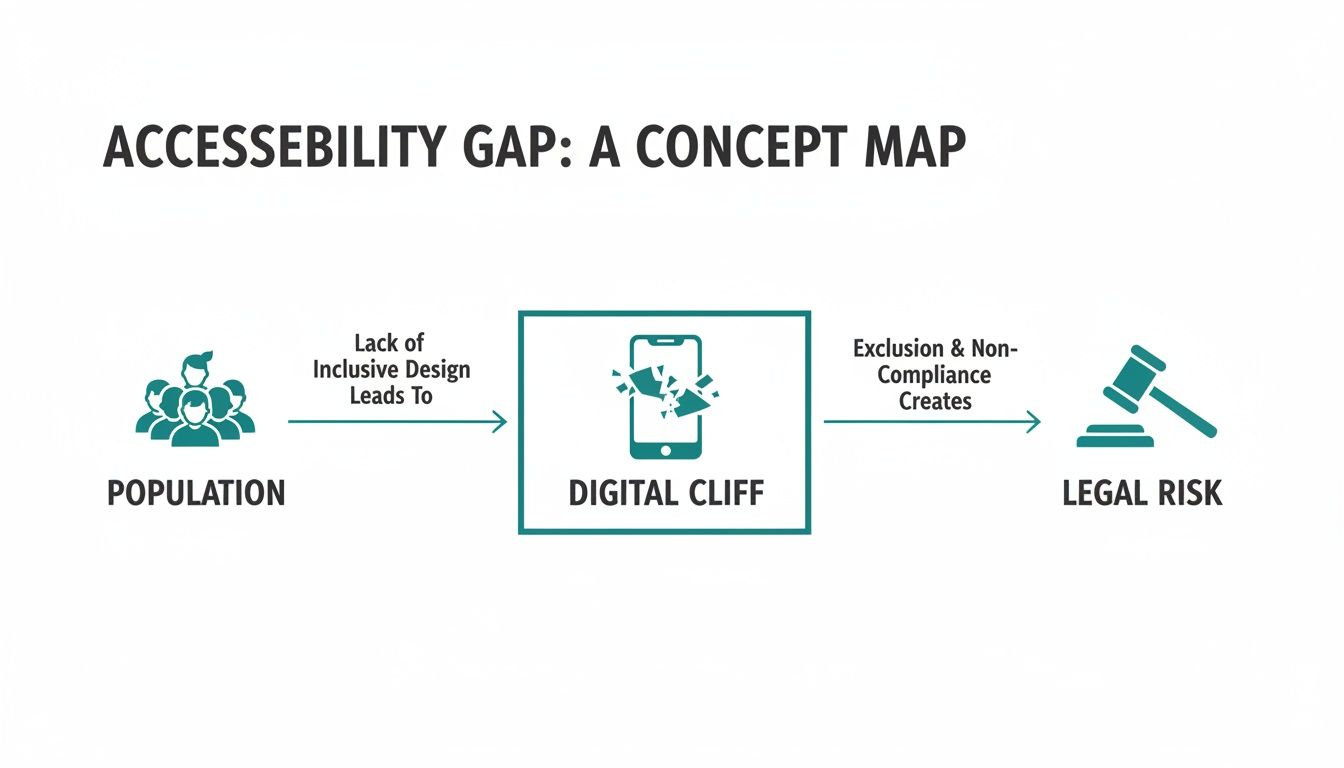
You can see the journey: a large population hits a 'digital cliff' where accessibility fails, and that, in turn, opens up organizations to legal risk. Infrastructure-free solutions are one of the most efficient ways to bridge this gap.
A Smarter Path to Inclusive Design
Beyond the obvious cost savings, a software-based approach offers a much more flexible and intelligent way to manage your space. Because the whole system runs on algorithms and map data, updates are simple, fast, and can be pushed out remotely.
If a room name changes, a corridor is temporarily closed, or a new pop-up shop opens, you can update it in the system instantly. This ensures your navigation information is always accurate—a feat that’s nearly impossible with static physical signs or hardware-dependent systems.
This kind of agility is often delivered through a white label app, which lets an organization offer a powerful, branded navigation tool without having to build the core technology from the ground up.
To get a better sense of how this works in practice, we've put together a quick comparison.
The Real-World Impact of an App for Good
Theory is one thing, but the true measure of an app for good is what happens when it hits the ground. It’s where abstract ideas about accessibility and social value meet the real, lived experiences of people—and the day-to-day operational challenges of a business.
Let’s move past the boardroom slides and look at how this plays out in the real world. These aren’t just nice stories; they’re concrete examples of how genuinely inclusive tech delivers a clear, measurable return for everyone involved.

From the Train Platform to the Bus Stop
Imagine a packed, multi-level train station during the morning rush. A traveler who is blind has just stepped off her train. In the past, this next part of her journey would have been a massive source of stress, relying on the hope of finding a staff member or trying to decipher a chaotic mess of sounds to find her bus connection.
With a precision navigation app, her experience is completely different. The moment she steps onto the platform, audio instructions begin. Step-by-step, the app guides her along the platform, to the right escalators, through the ticket barriers, and directly to the exact bus stop she needs.
She moves with confidence, her journey completely independent. For the transit operator, this single successful trip is a huge win on multiple fronts:
- Greater Visitor Independence: It frees up staff from giving basic directions, letting them tackle more complex passenger issues.
- Stronger Accessibility Credentials: The operator isn't just ticking a box for compliance; it's actively proving its commitment to every single passenger.
- Smoother Passenger Flow: People who know exactly where they’re going create a less congested, more efficient environment for everyone else.
This level of detail is what really matters. While countless apps offer digital services, the reality of mobile accessibility is often poor. A UK analysis of 50 popular mobile apps found that only two earned a 'Great' accessibility score. A staggering 72% of common user journeys were riddled with barriers, creating poor or failing experiences. You can find out more by reading the research on why most apps are failing disabled users, which really highlights the gap in the market.
Navigating the Sprawling Campus
Now, picture a first-year student on a huge university campus. It's their first lecture, and they’re trying to find a specific room in a building they've never seen before. That mix of being late and the social anxiety of being the lost new person can be overwhelming.
An app for good changes this from a stressful ordeal into a simple task. The student just types in the lecture hall, and the app gives them a precise, turn-by-turn route from where they're standing.
The real value here is the reduction of cognitive load. By taking away the 'how do I get there?' problem, the app allows the student to focus on what really matters—their education.
For the university, this translates into happier students, a more welcoming atmosphere for new arrivals, and a modern reputation that helps attract the next cohort. It’s a powerful signal that the institution cares about the student experience from the very first day. We've explored this link between accessibility and confidence in our Theory of Change.
Dynamic Guidance in a Retail Center
Finally, let’s think about a large shopping center getting ready for a big weekend event—a seasonal market with temporary stalls popping up everywhere. The operations team needs to guide thousands of visitors to these new attractions, a job that static signs just can't handle.
With an infrastructure-free navigation platform, the team can update the digital map on the fly.
- They simply add the temporary stalls as new points of interest.
- The update is pushed live to every user's phone almost instantly.
- Visitors can now get directions straight to a specific craft stall or food truck, which boosts sales for vendors and makes the entire event better for guests.
This example points to a massive business advantage: agility. The venue operator gets a powerful tool to manage footfall, promote specific shops or events, and see anonymized data on how people move through the space. This is where an app for good becomes an essential operational asset. It proves that making a space more accessible and independent for visitors also creates a more efficient, profitable, and data-rich environment for the business itself.
How to Build Your Business Case for Accessibility
Making a real investment in accessibility takes more than just good intentions; it needs a rock-solid business case. If you're an accessibility manager, operations director, or smart city planner, you're the one who can champion this change from the inside. This is your guide to building a proposal that gets the right people in your organization to say "yes".
The aim here is to stop people from seeing accessibility as just another cost. It’s not. It’s a strategic move that improves the experience for every single visitor, customer, and staff member. An app for good, like a precision navigation tool, isn't just about ticking a compliance box—it's a serious asset for running a smarter, better operation.
Identifying Your Key Stakeholders
First things first: you need to know who to talk to. A winning business case speaks the language of different departments, hitting on their specific priorities and concerns. Your job is to build a coalition by showing each person what’s in it for them.
Think about what matters to these key groups:
- Finance and Procurement: They’re all about ROI, saving money, and long-term value. You need to show them how infrastructure-free tech means no big spend on hardware and much lower maintenance bills.
- Operations and Facilities Management: This team lives and breathes efficiency, staff workload, and how people move around your space. Highlight how clear, step-by-step directions mean staff spend less time pointing the way and more time on valuable tasks. It’s also a powerful tool for managing crowds.
- Marketing and Brand: Their world revolves around public perception, customer loyalty, and how the company looks. Show them how embracing accessibility creates a powerful, authentic story that connects with today's socially conscious audience.
- Legal and Compliance: They’re focused on one thing: avoiding risk. Your case needs to spell out exactly how your proposed solution meets today’s legal standards and gets you ahead of what’s coming next.
The biggest mistake is treating accessibility as a side project. The strongest business cases frame it as a strategy that lifts the entire organization, from its bottom line to its brand reputation.
Quantifying the Return on Investment
To get the budget approved, you have to talk numbers. The ROI from an accessibility solution like Waymap goes way beyond just direct savings. You need to show its impact across three key areas: compliance, commercial opportunity, and brand value.
There’s a huge amount of momentum behind accessibility in the UK right now, especially with the European Accessibility Act (EAA) coming into force in June 2025. While 73% of organizations say meeting legal requirements is their main driver, the commercial upside is just as significant.
Consider the travel and tourism sector, where the spend from households including a disabled person—often called the ‘purple pound’—is worth an estimated £14.6 billion a year in England alone. This is a hugely underserved market. By bringing in a precision navigation platform, organizations can meet EAA requirements, open up new revenue streams, and give their ESG credentials a serious boost. You can dig into these findings in AbilityNet's latest report on UK digital accessibility attitudes.
Presenting Your Solution Effectively
Once you've gathered your data and you know who you're talking to, it’s time to build your pitch. Frame this as a proactive investment in a better experience for everyone, not just a cost. Leading with benefits that appeal to all visitors—like multilingual support or stress-free navigation for first-timers—makes it an easier sell.
You can find out more on how our solution helps every visitor in our guide to improving accessibility for venues.
Finally, get ready to tackle the practical questions, especially around data privacy and security. Our system was designed with privacy at its heart. It uses anonymized, aggregated data to give you operational insights without ever collecting personal information. Getting your IT and legal teams comfortable on this point is crucial.
Follow these steps, and you’ll build an undeniable case that shows doing good is also just good business.
Where Do You Go From Here?
If you've followed along with us, you'll see that an ‘app for good’ is far from a niche idea. It's becoming a core part of how modern, forward-thinking organizations operate. This is the point where doing good and doing good business don't just coexist; they actively boost each other.
Choosing genuinely inclusive technology like Waymap takes your organization far beyond ticking a box on a compliance form. It’s a real step toward making your venue ready for the future, building strong relationships with your entire community, and finding new efficiencies you didn’t even know were there.
More Than Just a Box-Ticking Exercise
The conversation around accessibility is changing, and fast. The best leaders are no longer asking, "What's the bare minimum we have to do?" Instead, they're asking, "What's the best possible experience we can create?" That’s a significant shift in thinking.
When you make your spaces truly easy to navigate for everyone—whether they have sight loss, use a wheelchair, or are just a first-time visitor feeling a bit lost—you send a very clear message. You're saying this place was designed with them in mind. That builds a sense of belonging and loyalty that static signs could never hope to achieve.
An app for good is the bridge between your organization's values and your visitors' real, lived experiences. It turns a mission statement about inclusivity into something they can actually feel and use every day.
This is where a partnership begins. We provide the technology and the tools, but it’s the leaders in transport, retail, education, and public venues who bring it to life. You are the ones who turn this technology into a more accessible world for all of us. You’re the architects of that change.
The Groundwork for a Smarter Future
So, the final call to action is simple: start thinking about accessibility as the very foundation for a smarter, more efficient, and more human-friendly environment. When you design for inclusion, you don’t just help one group; you make the experience better for every single person.
By putting accessibility first, you’re laying the groundwork for a venue that’s more intuitive to get around, less stressful for visitors, and frankly, runs more smoothly. The anonymized data helps you understand how people really move through your space. Multilingual support makes international guests feel genuinely welcome. And clear, step-by-step guidance takes the pressure off your staff, freeing them up to focus on what they do best.
Ultimately, investing in an app for good is an investment in a better future—for your business and for the people you serve. It's a commitment to building a world that's not just smarter, but kinder and more equitable for everyone who walks through your doors. The time to build that future is now.
Answering Your Questions
Whenever you’re looking at bringing new technology into a public space, there are always going to be questions. It’s a big decision. Here are the answers to some of the most common ones we hear from procurement, IT, and operations teams trying to get a feel for how a system like Waymap works in the real world.
How Difficult Is It to Map a Large Venue and Keep It Updated?
This is one of the first—and best—questions people ask. You’re probably imagining weeks of disruption, drilling, and cabling. The reality is completely different.
Because our system is entirely infrastructure-free, mapping even a huge, complex venue is remarkably quick and simple. We don’t install any hardware like beacons or special Wi-Fi points, so there’s zero disruption to your day-to-day operations. A trained mapper can often cover an entire major transit station or a sprawling shopping center in just a few days. The whole process is quiet, unobtrusive, and captures every detail needed for step-accurate navigation.
Keeping things current is even easier. If a shop moves, a platform changes, or a room is renamed, we simply make the change in our central digital system. As soon as it’s published, that update goes live for every user almost instantly. This gets rid of the cost and frustrating delays of changing physical signs or reprogramming hardware, making sure your visitor information is always accurate.
How Does This App Benefit All Visitors?
While our technology was born from a mission to serve blind and visually impaired users to the highest standard, its benefits extend to every single person who walks through your doors. This is the heart of inclusive design.
Think of the curb-cut effect. Ramped curbs were designed for wheelchair users, but they also make life easier for people pushing strollers, pulling luggage, or riding bicycles. A truly accessible solution helps everyone.
Our app works in exactly the same way. The clear, step-by-step audio navigation reduces that feeling of stress and confusion for any first-time visitor trying to find their way around a complex building. It also offers multilingual support that static signage simply can't, creating a far more welcoming experience for international tourists. It's an app for good in the truest sense, improving the journey for the entire community.
What’s more, every person who walks with the app active is subtly helping to refine and validate the map data. This constant feedback loop continuously improves the system's precision, especially for those who rely on it most for their independence.
What Are the Data Privacy Implications for Our Venue?
We built Waymap with privacy at its very core. The navigation technology works using only the motion sensors already inside a user’s smartphone—the accelerometer, gyroscope, and compass. It does not require personal information, GPS, or signal o do its job.
For our venue partners, we provide powerful operational insights based on fully anonymized and aggregated data. This can include things like:
- Footfall patterns showing how people move through different zones.
- Dwell times in specific areas.
- Popular routes and the paths people naturally take.
This kind of information is invaluable for optimizing layouts, managing staffing, and making smarter operational decisions. Crucially, none of it contains any personally identifiable information (PII). Our system is fully GDPR compliant and is built on the principle of data minimization—we only collect what is absolutely essential to provide and improve the service.
Ready to make your venue more accessible, efficient, and welcoming for everyone? Waymap provides the technology to turn that vision into a reality. Learn more and find out how Waymap can transform your venue.
