
A Practical Guide to Public Sector Procurement in the UK
By Tom Pey, Founder and blind accessibility technologist at Waymap
The scale of public sector procurement is easy to underestimate until you look at the numbers. The UK public sector spends over £300 billion annually on goods, works, and services from external suppliers, and in 2023-24 that spending reached £341 billion, according to PSIP's review of UK government procurement statistics. That isn't a back-office process. It's one of the main ways public bodies shape services, infrastructure, access, and long-term value.
For buyers, that means procurement has to do more than complete a compliant purchase. It has to stand up to scrutiny, support delivery, and show why a decision was the right one. For suppliers, it means the winning bid is rarely the one with the loudest claims. It's the one that fits the process, answers the requirement properly, and proves value in terms the authority can defend.
The practical challenge now is that the definition of value has widened. Cost still matters. Quality matters. Delivery risk matters. Increasingly, accessibility, sustainability, and wider public benefit matter too. That creates opportunity, but it also creates confusion when teams know a solution is beneficial and still struggle to express that benefit in procurement language. For organisations thinking about navigation, accessibility, and inclusive service design, that's why practical guidance matters as much as policy. A good example is the growing attention on wayfinding apps in public spaces, where the procurement question isn't only what the technology does, but how its value should be assessed.
What Is Public Sector Procurement and Why Does It Matter?
Public sector procurement is the process public bodies use to buy goods, works, and services from external suppliers. In practice, that covers everything from estates maintenance and software to transport systems, clinical equipment, accessibility services, and major capital programmes.
The reason it matters is straightforward. Procurement decides how public money turns into operational reality. If the process is poor, authorities buy the wrong thing, write contracts they can't manage, or optimise for headline savings while creating downstream cost and service failure. If the process is strong, procurement becomes a delivery function rather than an administrative hurdle.
Procurement is a value decision, not just a buying exercise
Many teams still treat procurement as the stage where a specification is issued and bids are scored. That's too narrow. Good public sector procurement starts earlier, when the authority defines the need properly and decides what outcomes it is trying to secure.
Those outcomes usually sit in four areas:
- Service performance: Will the purchase improve delivery for patients, passengers, students, staff, or residents?
- Public accountability: Can the authority explain the decision clearly if it is challenged by auditors, suppliers, or elected members?
- Commercial value: Does the contract represent value for money over its operational life, not only at point of award?
- Wider policy impact: Does the procurement support accessibility, inclusion, sustainability, or other organisational duties?
Practical rule: If the team can only explain a procurement in terms of upfront price, the business case is probably under-developed.
Why decision-makers should care
In public bodies, procurement often carries competing pressures. Finance wants control. Operational teams want speed. Legal teams want defensibility. End users want something that works in practice. A well-run procurement balances those pressures rather than allowing one to dominate.
That balance matters especially in high-footfall environments such as hospitals, rail stations, universities, shopping centres, and civic buildings. In those settings, buying decisions affect both compliance and lived experience. A low-cost option that creates maintenance burden, excludes users, or requires repeated retrofit work can become expensive very quickly.
A stronger approach is to ask a more useful question early: what is the authority trying to achieve, and what evidence will prove that the contract delivered it?
How Is UK Public Procurement Regulated?
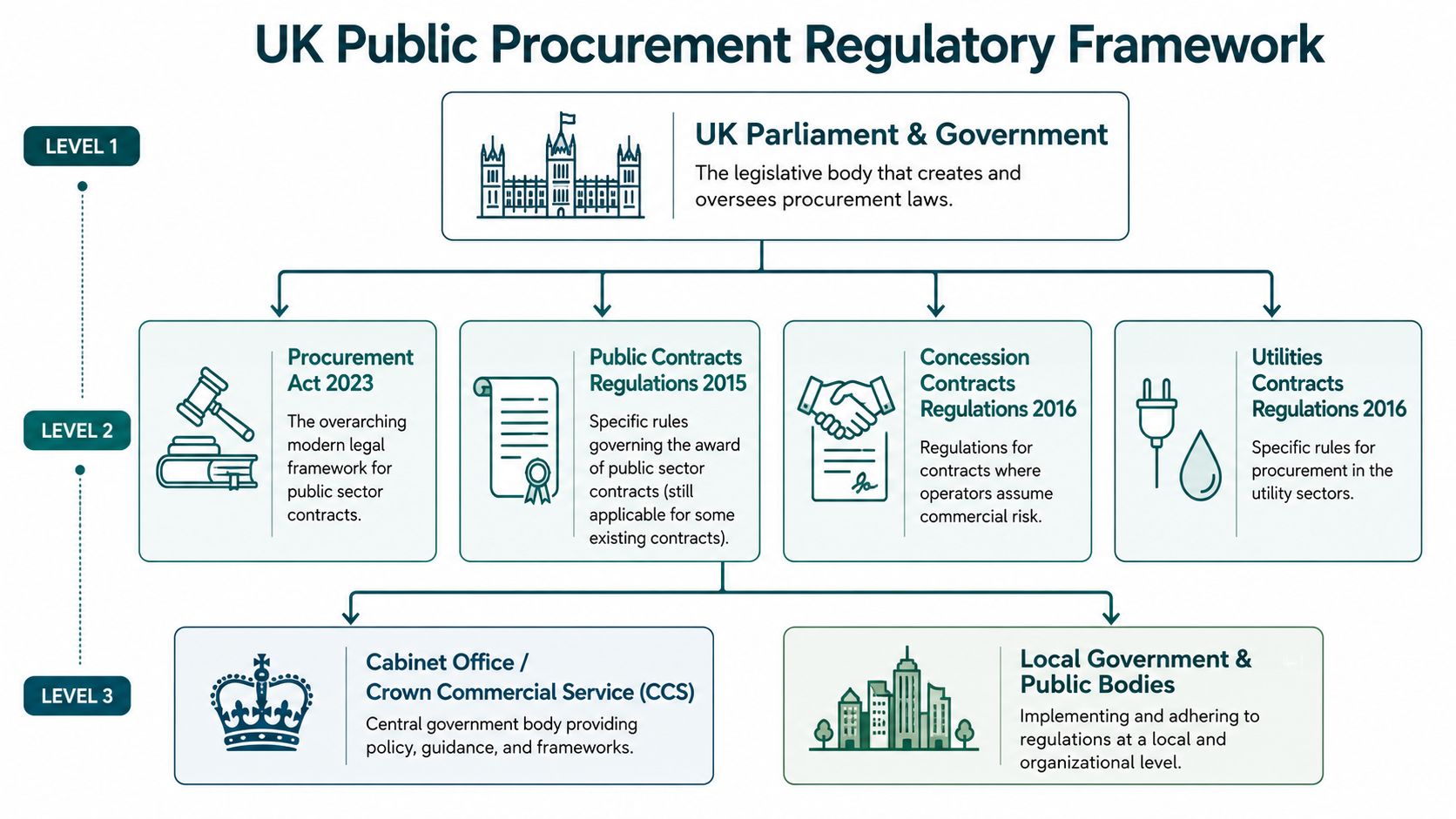
The current legal environment is defined by the Procurement Act 2023, alongside the wider regulatory framework that still matters for certain contracts and sectors. For practitioners, the point isn't to memorise every legislative instrument. It's to understand what the framework expects buyers to do and what suppliers must respond to.
Under the UK's Procurement Act 2023, effective 24 February 2025, public sector buyers must secure value for money by integrating sustainability and quality alongside cost, and the Act mandates competition to achieve economically advantageous outcomes. It also requires contracting authorities with over £200m annual spend to publish procurement pipelines, increasing transparency, as summarised in the overview of government procurement in the United Kingdom.
What the regulatory framework means in practice
The most important practical change is that authorities are expected to think more broadly about value. That affects how requirements are defined, how evaluation criteria are set, and how award decisions are justified.
A simple way to read the framework is through three tests.
| Regulatory test | What buyers should ask | What suppliers should prove |
|---|---|---|
| Transparency | Have we been clear about the route, criteria, and process? | Have we answered exactly what was asked, in the order requested? |
| Equal treatment | Would every bidder receive the same information and opportunity? | Have we avoided relying on assumptions or unstated advantages? |
| Value for money | Does the chosen bid deliver a defensible balance of cost, quality, effectiveness, and wider outcomes? | Can we evidence operational and social value, not just features? |
The shift from MEAT to MAT
The move from Most Economically Advantageous Tender to Most Advantageous Tender matters because it changes the language of decision-making. Buyers now have firmer ground to consider broader value, provided they set out their approach clearly and evaluate consistently.
That sounds like a technical drafting change. It isn't. It affects real procurement behaviour.
For example, if an authority is buying accessibility technology for an estate with frequent layout updates, the right question isn't only which supplier is cheapest to appoint. The authority should ask which option is easier to maintain, less dependent on physical hardware, better aligned with inclusion duties, and more likely to remain workable when the environment changes. That's a MAT question.
Which organisations shape the operating environment
Most public sector teams will encounter guidance or commercial routes influenced by bodies such as the Cabinet Office and the Crown Commercial Service. Local authorities, NHS bodies, universities, and transport operators then apply those rules within their own governance, delegations, and approval processes.
Compliance also reaches into adjacent areas. Data handling, for example, often becomes part of the commercial conversation long before contract award. When digital tools are involved, procurement teams need a workable understanding of privacy implications and supplier architecture, which is why practical topics such as IP addresses and GDPR often surface during due diligence.
Public procurement law doesn't remove judgement. It structures judgement so that a public body can explain why it acted fairly and why the result serves the public interest.
What Are the Main Public Procurement Routes?
The operating model is now simpler than many teams were used to. The UK Procurement Act 2023, which came into force on 24 February 2025, replaced the Find a Tender system with the Central Digital Platform and simplified tender procedures to three types: the open procedure, the restricted procedure, and the competitive flexible procedure, as outlined by Procurement Hub's summary of the reforms.
Open, restricted, and competitive flexible
The easiest way to distinguish the three routes is to think about how much structure the authority needs.
- Open procedure: Anyone can submit a tender. This suits straightforward procurements where the authority wants a single-stage competition and expects the market to respond clearly to a fixed requirement.
- Restricted procedure: Suppliers first pass through a selection stage. Only shortlisted bidders move to tender. This works when the authority needs to control evaluation effort or test capability before inviting full responses.
- Competitive flexible procedure: This is the customizable route. It gives the authority room to design a process that fits a complex purchase, including dialogue, refinement, or staged negotiation, provided the rules are clear and the process remains fair.
When each route works well
Open procedures are efficient when the requirement is mature and comparison is relatively direct. They work less well when the authority is still learning what the market can offer.
Restricted procedures help where bid volumes are likely to be high or where specialist capability matters. They can, however, create unnecessary work if the requirement could have been run as a simpler competition.
Competitive flexible is the route many teams were missing under the old regime. It gives buyers more room to procure innovation without forcing a poor fit into a rigid process. For suppliers, that flexibility cuts both ways. It creates opportunity, but only if the authority drafts the process tightly enough to remain transparent.
Frameworks still matter
Beyond the three core procedures, many authorities continue to buy through frameworks and similar pre-procured routes, particularly for common categories such as technology and professional services. Frameworks can save time, reduce duplicated effort, and provide commercial assurance where the route is appropriate.
The trade-off is that a framework is only useful if it fits the requirement. Teams sometimes force a complex or novel need through a familiar route because it appears quicker. That usually creates problems later.
For suppliers trying to respond efficiently, structured tools can help teams understand common tender formats and framework logic. A practical example is AI-powered frameworks for tenders, which can help bid teams organise responses around the commercial route they're facing.
Authorities buying digital estate or operational systems often run into this same issue. The route may look simple on paper, but the requirement crosses multiple functions. That's why procurement and FM teams increasingly need a joined-up view of systems such as integrated workplace management software, not just a route to market.
The End-to-End Tendering Lifecycle Explained
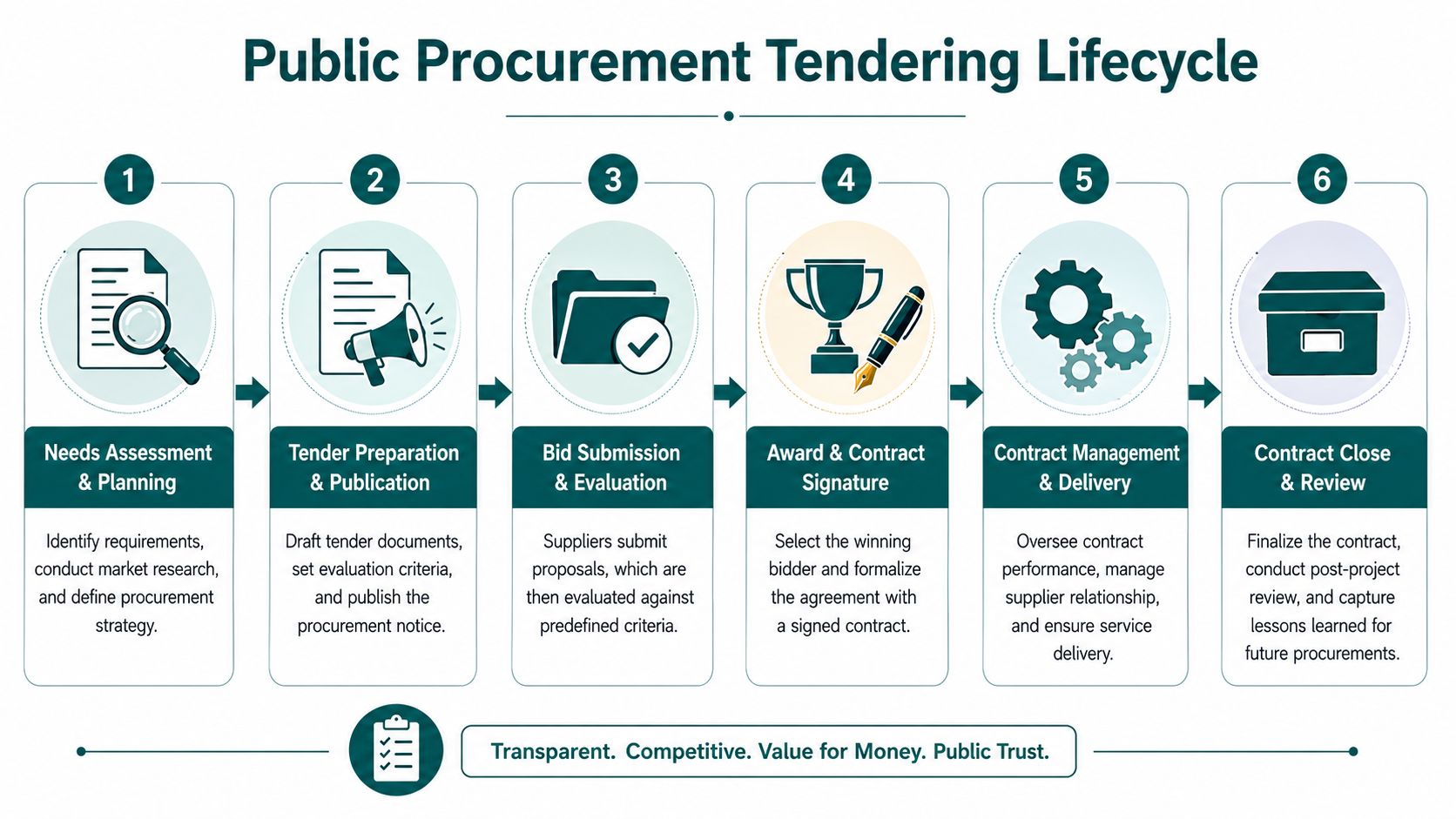
Strong public sector procurement is usually won or lost before the contract award report is drafted. The lifecycle matters because each decision shapes the next one. A weak requirement leads to a weak specification. A weak specification leads to confused bids. Confused bids produce poor evaluation outcomes, supplier challenge, or both.
Early in the process, this lifecycle view helps teams keep commercial and operational priorities aligned.
Plan the procurement before writing anything
Start with the need, not the paperwork. The core questions are basic, but teams often skip them.
- What problem are we solving
- Who is affected by it
- What outcome would count as success
- What constraints are real, and which are inherited assumptions
At this stage, authorities should involve operations, finance, legal, digital, estates, and service users where relevant. If any one function writes the requirement alone, the final tender usually reflects a partial understanding of the need.
A useful market scan also belongs here. That isn't about giving one supplier an advantage. It's about making sure the authority understands what the market can deliver before locking itself into the wrong model.
Write a specification that describes outcomes
The best specifications are specific about outcomes and disciplined about unnecessary prescription. They tell the market what the authority needs to achieve, the environment the solution must work in, and any genuine constraints.
Poor specifications usually fail in one of two ways:
- They are too vague, so suppliers answer different questions and evaluation becomes inconsistent.
- They are too prescriptive, so they describe one assumed solution and shut out innovation.
If you want innovation, don't write a specification that already dictates the mechanism unless that mechanism is genuinely mandatory.
For digital and built-environment procurements, teams should define interoperability, data handling expectations, support requirements, accessibility expectations, and operational realities such as changing layouts or staff turnover. In wayfinding and navigation procurements, technical context matters too. Buyers need to understand whether the solution depends on installed hardware, frequent remapping, or complex ongoing maintenance. Practical background on floor mapping software often helps operational teams ask better questions before tender release.
A short explainer can help align internal stakeholders before publication.
Publish, manage clarifications, and protect fairness
Once the tender is live through the appropriate platform, the authority's discipline matters as much as the documents. Clarifications need to be handled consistently. Changes to requirement or scope need to be visible and controlled. Internal stakeholders must not have side conversations with bidders that create unequal access to information.
For suppliers, this stage is about compliance and judgement. Answer the question asked. Follow the structure. Use clarifications well. Don't rely on evaluators to infer value from a generic proposal library.
Teams looking across wider opportunity pipelines often supplement official notices with structured search tools. A practical example is a government RFP database, which can help suppliers track relevant opportunities and plan bid capacity before deadlines converge.
Evaluate against the published model
Evaluation should never become a debate about which bid evaluators personally prefer. It must track the published criteria and the evidence in the submissions.
A reliable evaluation process usually includes:
- Calibration before scoring: evaluators agree what good evidence looks like.
- Structured moderation: differences in score are discussed against the stated criteria, not personality or departmental bias.
- Clear records: the final rationale can be defended if challenged.
Manage the contract after award
Here, many procurements fail unnoticed. The tender closes, the contract is signed, and everyone assumes value will now appear automatically. It won't.
Contract management needs named owners, performance reporting, escalation routes, and review points linked to the outcomes that justified the purchase in the first place. If the authority said accessibility, service quality, or operational resilience formed part of the award logic, those things must be monitored in delivery.
Closeout matters too. A good lessons-learned review improves the next procurement. A bad one gets skipped because the team has already moved on.
How to Prove Social Value and Meet Accessibility Obligations
The shift to Most Advantageous Tender has exposed a practical gap in UK public sector procurement. Buyers are expected to consider broader value. Suppliers are expected to evidence it. But many tenders still describe social value in abstract terms that are difficult to score consistently.
That gap matters because the Procurement Act 2023's move to MAT creates a challenge for suppliers trying to quantify social value, and research cited in LawCareers.net's discussion of the reform notes that 77.8% of suppliers miss opportunities due to opaque requirements. In practice, the hard part is not saying that inclusion matters. It's translating inclusive outcomes into evidence a contracting authority can evaluate.

Start with the legal and operational obligation
Accessibility should not sit in the social value section as a soft extra if the environment, service, or technology materially affects disabled people's access. Authorities need to consider duties under the Equality Act 2010, and built-environment decisions are often shaped by standards and guidance such as BS 8300 and PAS 78.
For buyers, the practical question is this: does the procurement improve equitable access in a way that can be described, tested, and managed through contract delivery?
For suppliers, the matching question is different: can we demonstrate that our approach reduces barriers without creating an unsustainable maintenance burden?
What buyers should ask when assessing accessibility technology
An NHS estates manager, transport operator, or university campus lead often faces the same friction point. The need is real, but capital approvals for installed hardware can be slow, politically difficult, and operationally hard to justify if the environment changes frequently.
That is why infrastructure-free navigation is strategically important. A system based on dead reckoning using device-native sensors, capable of sub-3-metre accuracy in infrastructure-free environments, changes the procurement conversation. It reduces reliance on beacons or similar hardware, avoids venue-wide installation programmes, and can suit environments with regular layout changes or high staff turnover. Those are procurement advantages, not just technical ones.
Turn social value into procurement evidence
When evaluating or bidding, avoid generic statements like “improves inclusion” unless they are attached to contractable evidence. Use a structured model instead.
| Social value theme | Weak wording | Stronger procurement wording |
|---|---|---|
| Accessibility | Improves access for all | Supports equitable navigation and service access for blind and low-vision users within the operational environment |
| Operational resilience | Easy to manage | Reduces dependence on installed hardware and associated upkeep across complex estates |
| Innovation | Modern technology | Uses device-native sensors and digital mapping rather than physical infrastructure |
| ESG and governance | Supports ESG goals | Aligns inclusion objectives with a maintainable delivery model that can be governed through service reporting |
Commercial advice: If the claimed social value cannot be linked to a requirement, an evaluation criterion, or a contract management measure, it probably won't survive moderation.
This is also where cross-jurisdictional procurement guidance can be useful. For teams working with international accessibility standards or digital compliance requirements, ADA Compliance Pros' Section 508 guide is a useful reference point for how accessibility requirements can be embedded into formal procurement decision-making.
For authorities assessing digital accessibility in the round, this should sit alongside practical review of user testing, technical assurance, and governance. Accessibility procurement is stronger when it connects policy, user need, and delivery evidence, rather than treating accessibility testing as a late-stage check.
Best Practices and Common Procurement Pitfalls
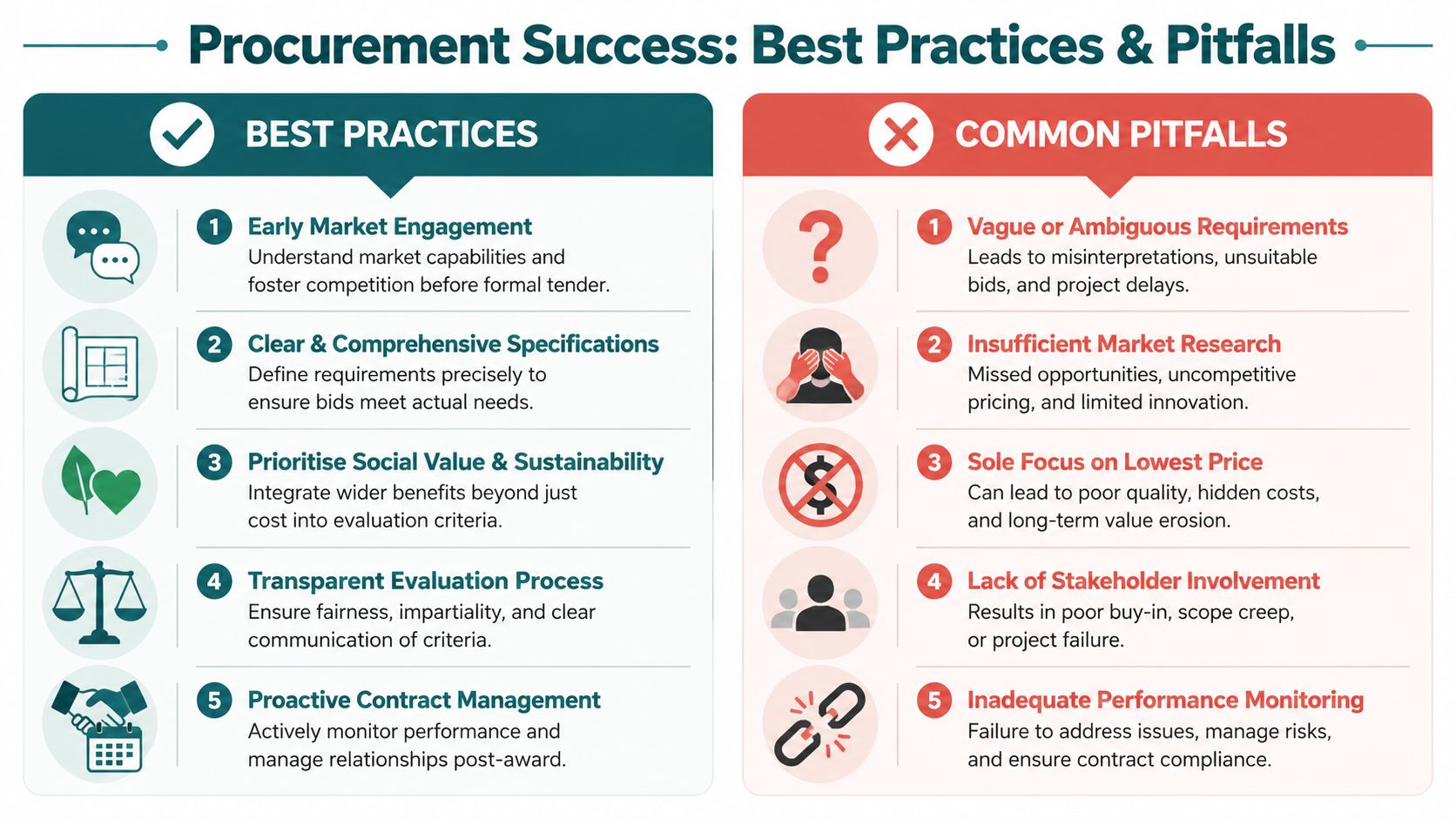
The fastest way to improve public sector procurement is usually not to add more documentation. It's to make fewer unforced errors. Most weak procurements fail in familiar ways: the need wasn't clear, the market wasn't understood, the scoring model was loose, or the contract was left to run itself.
Do this
- Engage the market early: Preliminary engagement helps buyers understand what the market can deliver before the specification hardens. It also helps suppliers identify whether the authority wants innovation, standardisation, or a mix of both.
- Write for outcomes, not assumptions: A concise outcome-based specification often produces better bids than a long document built from copied clauses and inherited preferences.
- Build an evaluation model you can defend: Weightings, questions, and scoring descriptors should line up. If evaluators can't explain the difference between two adjacent scores, the model probably needs work.
- Treat contract management as part of procurement: Performance measures, governance cadence, and escalation routes should be designed before award, not improvised after it.
- Keep internal governance clear: Procurement, legal, finance, digital, estates, and service leads need defined roles. Ambiguity slows decisions and creates inconsistent bidder messaging.
Not that
- Don't default to lowest price thinking: Even where budgets are tight, a narrow price focus often hides maintenance burden, poor usability, and delivery risk.
- Don't over-engineer the tender pack: Excessive complexity deters capable bidders, particularly specialist SMEs who may be strongest on the actual requirement.
- Don't write a specification around one presumed solution: That approach can shut out approaches that better meet the authority's real need.
- Don't let stakeholder disagreement surface after publication: If internal teams haven't aligned before the notice goes live, clarifications become messy and credibility drops.
- Don't assume award equals success: A contract that is not actively managed can drift from its original value case very quickly.
A simple comparison
| Stage | Better practice | Common failure |
|---|---|---|
| Planning | Define the problem and involve the right stakeholders | Start with a recycled template |
| Specification | State outcomes and genuine constraints | Describe one assumed solution in detail |
| Evaluation | Use clear criteria and moderation discipline | Allow scoring drift and subjective preference |
| Delivery | Monitor the outcomes used to justify award | Focus only on invoice and compliance admin |
Procurement teams rarely regret being clearer earlier. They often regret trying to fix ambiguity after the tender is live.
Frequently Asked Questions about Public Sector Procurement
What is public sector procurement?
Public sector procurement is the process public bodies use to buy goods, works, and services from external suppliers. It must be conducted in a way that is fair, transparent, compliant, and defensible in the use of public money.
How can suppliers find public sector procurement opportunities in the UK?
Suppliers should monitor the relevant public platforms, framework routes, and published pipeline information from contracting authorities. They should also watch for early market engagement activity, because many opportunities are shaped before the formal tender is issued.
What is the Most Advantageous Tender in public sector procurement?
Most Advantageous Tender means the authority can assess value more broadly than cost alone. In practice, that can include quality, sustainability, accessibility, innovation, delivery confidence, and wider public benefit, provided the criteria are published and applied fairly.
When should a buyer use the competitive flexible procedure?
A buyer should use the competitive flexible procedure when the requirement is complex and a more specialized process is needed. It is particularly useful where dialogue, refinement, or phased competition will help the authority identify the best solution without sacrificing transparency.
How should accessibility be evaluated in public sector procurement?
Accessibility should be evaluated as a substantive procurement issue where the contract affects access to services, spaces, or digital tools. Buyers should look for clear user need, relevant legal or standards alignment, operational feasibility, and contractable evidence rather than broad statements of intent.
If your organisation is procuring navigation, accessibility, or inclusive wayfinding for complex public environments, Waymap can help you evaluate what good looks like. We work with public bodies and venue operators to make navigation practical in real-world settings, with precision guidance that works indoors, outdoors, and underground without GPS, Wi-Fi, or installed hardware.
