
A Guide to Integrated Workplace Management Systems
Think of an Integrated Workplace Management System (IWMS) as the central nervous system for your building. It’s the platform that connects every part of a physical space, bringing all your facility operations together into one smart system.
From maintenance and space planning to energy use and visitor experiences, an IWMS helps coordinate it all.
The Brain of the Modern Workplace
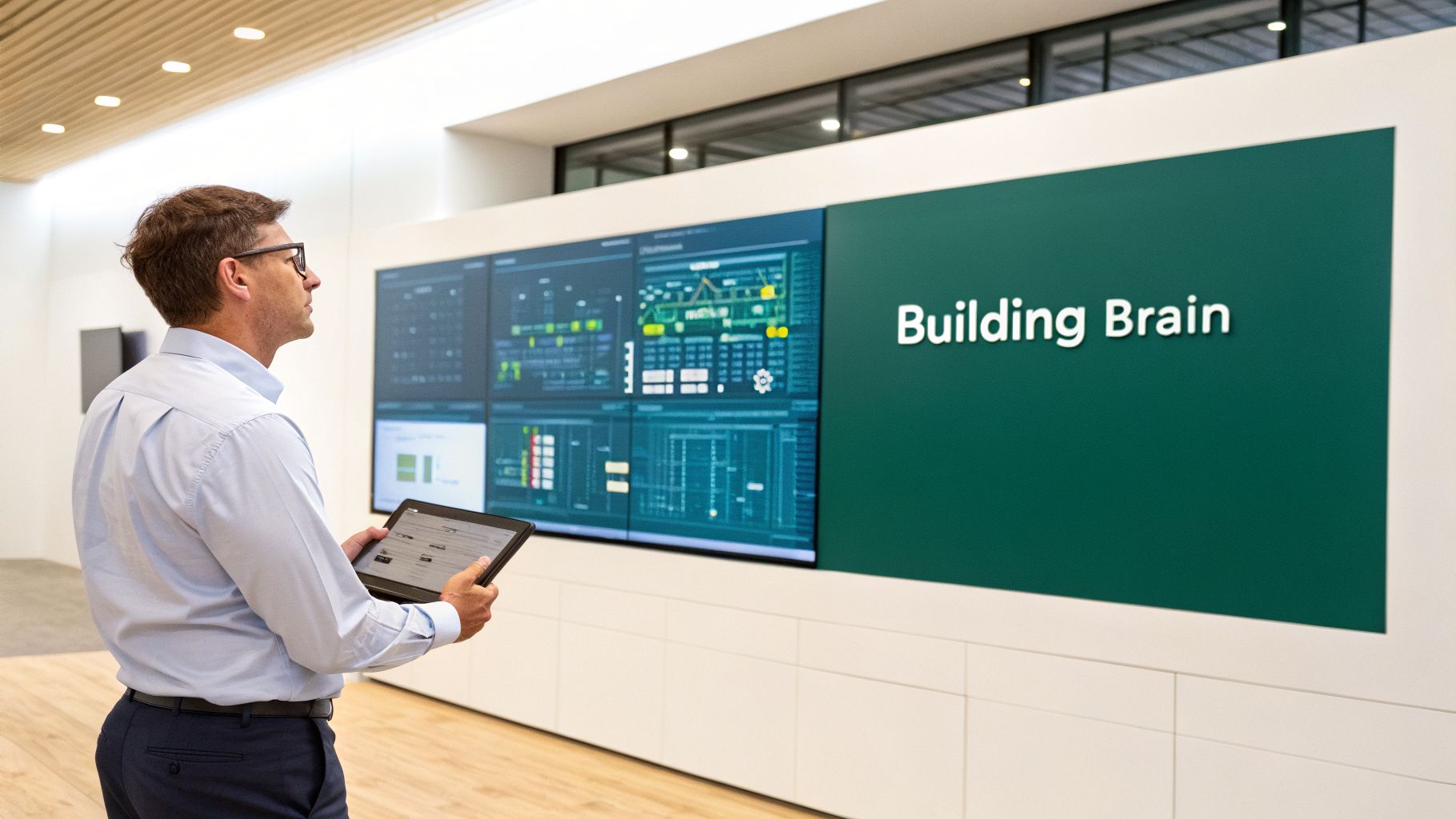
If you manage a large, complex venue—a sprawling university campus, a busy transit hub, or a corporate headquarters—you know the headache of data silos. This is where crucial information gets stuck in separate, disconnected software systems that don’t talk to each other.
This disjointed approach leads to wasted time, missed opportunities, and rising costs. An integrated workplace management system breaks down those silos, creating a single, reliable source for all your operational data.
More Than Just Putting Out Fires
This unified view helps facility leaders move from a constant state of reaction to one of proactive control. Instead of just fixing what’s broken, you can start making data-backed decisions that streamline operations, reduce expenses, and create a better, more accessible environment for everyone.
You might have seen an all-in-one staff management platform that pulls various HR functions into one place. An IWMS does the same thing, but for the entire physical environment.
By linking all these previously separate functions, an IWMS uncovers connections you simply couldn't see before. It starts answering the big questions that drive efficiency and improve the user journey:
- How can we redesign our floor plans based on how people actually use the space?
- Can we anticipate equipment failures and fix them before they cause major disruption?
- Which parts of the building are using the most energy, and how can we be smarter?
- How do we make sure our venue is safe, welcoming, and easy to navigate for every visitor?
An IWMS elevates facility management from a daily checklist to a strategic function. It connects the dots between building performance, operational costs, and the human experience.
A Foundation for Smarter Venues
Ultimately, an integrated workplace management system lays the groundwork for a truly smart and responsive venue. It ensures every component of the building—from the HVAC systems to the digital services on a visitor's phone—is working in harmony.
This level of integration is essential for delivering the seamless experience people now expect. You can even take it a step further by weaving in advanced tools. For example, understanding how Waymap’s technology works shows how precise indoor navigation can be linked to facility data. This connection ensures points of interest are always up-to-date and fully accessible to everyone, including people with vision impairments.
The Five Core Modules of a Modern IWMS
To really understand what an Integrated Workplace Management System does, think of it less as a single piece of software and more as a set of specialized tools in a single toolbox, all designed to work together.
Most IWMS platforms are built around five core modules. Each one addresses a different part of managing a large facility, but their real strength comes from sharing information to create a complete picture of your operations. Let's explore these from the perspective of running a complex space, like a university campus or a major transport hub.
1. Real Estate and Lease Management
For any organization with a property portfolio, juggling leases, payments, and critical dates is a significant task. The Real Estate and Lease Management module acts as the financial command center for all of it.
Instead of digging through spreadsheets or filing cabinets, this module pulls all your lease information into one clean, accessible dashboard. It tracks renewal deadlines, helps manage payment schedules, and gives you a clear financial overview. This is all about making smarter decisions with your property portfolio and avoiding costly administrative errors.
2. Maintenance and Facilities Management
This is the operational engine of the IWMS, streamlining everything it takes to keep a facility running smoothly. It’s where you’ll manage work orders, schedule preventive maintenance, and track the entire life cycle of every asset, from the escalators in a station to the HVAC units in a lecture hall.
The goal is to shift from the reactive "break-fix" cycle to a proactive, predictive model of care. For a transport authority, that means scheduling track inspections before a fault can cause delays, keeping services running reliably. Many modern IWMS platforms now incorporate technology-enabled maintenance solutions, including IoT monitoring and predictive maintenance, to make operations even more efficient.
When you connect maintenance schedules to real-time data from your assets, you can reduce equipment downtime, cut repair costs, and maintain a safer environment for everyone.
3. Space Planning and Management
Physical space is one of the most expensive assets an organization has, but it's often poorly understood. The Space Planning and Management module gives you the data-driven tools you need to get the most out of every square foot.
This has become vital in a world of hybrid working and evolving needs. Its key functions include:
- Utilization Tracking: Using sensors or booking data to see which rooms and desks are actually being used and which are sitting empty.
- Scenario Planning: Creating digital models of different floor plans to see how you could accommodate growing teams or new work styles.
- Move Management: Coordinating departmental moves and office reconfigurations with minimal disruption.
For a university, this module could be used to optimize lecture hall bookings based on actual attendance, potentially saving millions on new building projects by simply using existing spaces more effectively.
4. Capital Project Management
Large projects—like a major renovation, a system-wide retrofit, or new construction—involve complex risks and significant budgets. The Capital Project Management module is built to guide these initiatives from idea to completion, keeping them on time and on budget.
It provides tools for tracking budgets, allocating resources, and monitoring every project milestone. By pulling in data from the other IWMS modules, managers get a holistic view. For instance, you can see how a proposed new building wing will affect future maintenance needs or energy bills long before construction begins.
5. Energy and Sustainability Management
With a strong focus on environmental, social, and governance (ESG) reporting, managing a building's environmental footprint is no longer optional. The Energy and Sustainability Management module gives you the tools to monitor consumption, identify inefficiencies, and deliver on your green initiatives.
The system can connect to utility meters and building sensors to provide a live feed of electricity, water, and gas usage. It helps you pinpoint which equipment is using the most power, measure the impact of efficiency upgrades, and produce the accurate reports needed for compliance and ESG disclosures.
These five modules don't just sit next to each other; they're deeply interconnected. Data from the space module informs the maintenance module, which in turn impacts the energy module. This seamless communication is what defines an integrated workplace management system and turns it into a powerful strategic asset.
IWMS vs. CAFM vs. BMS: What's the Difference?
If you work in facility or workplace management, you’ve probably encountered a sea of acronyms. Three of the most common—and most frequently confused—are IWMS, CAFM, and BMS. While they all help run a building, they play very different roles. Understanding the distinctions is the first step to choosing the right tool for your needs.
Let’s think of a large, complex building as a living organism.
A Building's Systems
A Building Management System (BMS) is like the building’s autonomic nervous system. It’s the behind-the-scenes operator, automatically controlling core functions like heating, ventilation, air conditioning (HVAC), and lighting. Its main job is to keep the physical environment stable and efficient, often without direct human intervention.
A Computer-Aided Facility Management (CAFM) system is more like a specialized toolkit for the maintenance team. It’s excellent for logging work orders, scheduling repairs, and tracking physical assets. It’s a tactical workhorse, but its focus is usually on one or two operational areas.
An Integrated Workplace Management System (IWMS), on the other hand, is the strategic brain overseeing the entire operation.
An IWMS doesn’t just manage a single piece of the puzzle; it connects all of them. It can take data from the BMS and CAFM and combine it with information from other business systems, like HR and finance, to create a complete picture.
This is where you move from just running a building to optimizing the entire workplace experience. It’s about connecting the dots between maintenance, space use, and energy consumption.
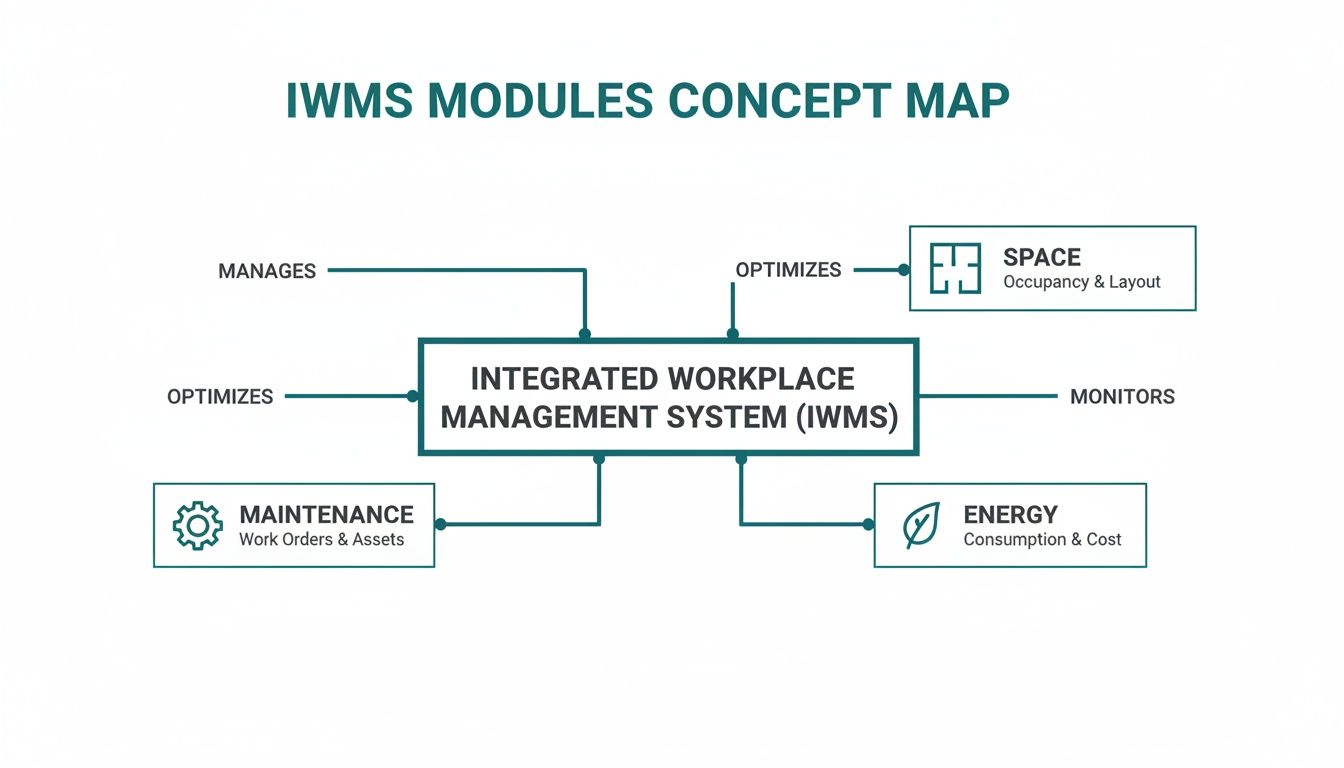
As you can see, an IWMS isn't a single tool but a unified platform, bringing separate functions together to create a smarter, more responsive environment.
To make the distinction even clearer, this table breaks down how each system compares.
Comparing IWMS, CAFM, and BMS
Each system has its place, but they serve different purposes and answer different questions.
Choosing the Right System for Your Goals
So, which one do you need? It all comes down to what you’re trying to achieve.
A smaller organization that just wants to better manage its maintenance schedule would do well with a dedicated CAFM system. Likewise, a building owner focused on automating HVAC to cut energy bills would look to a BMS.
But for anyone managing a large venue, a sprawling corporate campus, or a busy public transit network, the goals are much bigger. You need to tie building operations directly to your overarching business strategy. That’s where an integrated workplace management system becomes essential.
An IWMS lets you ask—and answer—the strategic questions that a BMS or CAFM can’t tackle on their own:
- Strategic Planning: How can we use real-time occupancy data from our BMS to redesign floor plans and potentially defer a multi-million-dollar construction project?
- Financial Oversight: If we combine our CAFM’s maintenance data with our finance system, can we accurately forecast asset lifecycle costs across our entire property portfolio?
- User Experience: How do we link our room booking system with our visitor management and wayfinding platforms, like Waymap, to create a seamless journey for staff and guests?
In short, a BMS and CAFM are built to manage the building. An IWMS is built to help you manage the business of the building. It provides the crucial, portfolio-level view you need for true workplace optimization, turning a flood of data from disconnected systems into clear, actionable insights.
Measuring the ROI of an IWMS for Large Venues
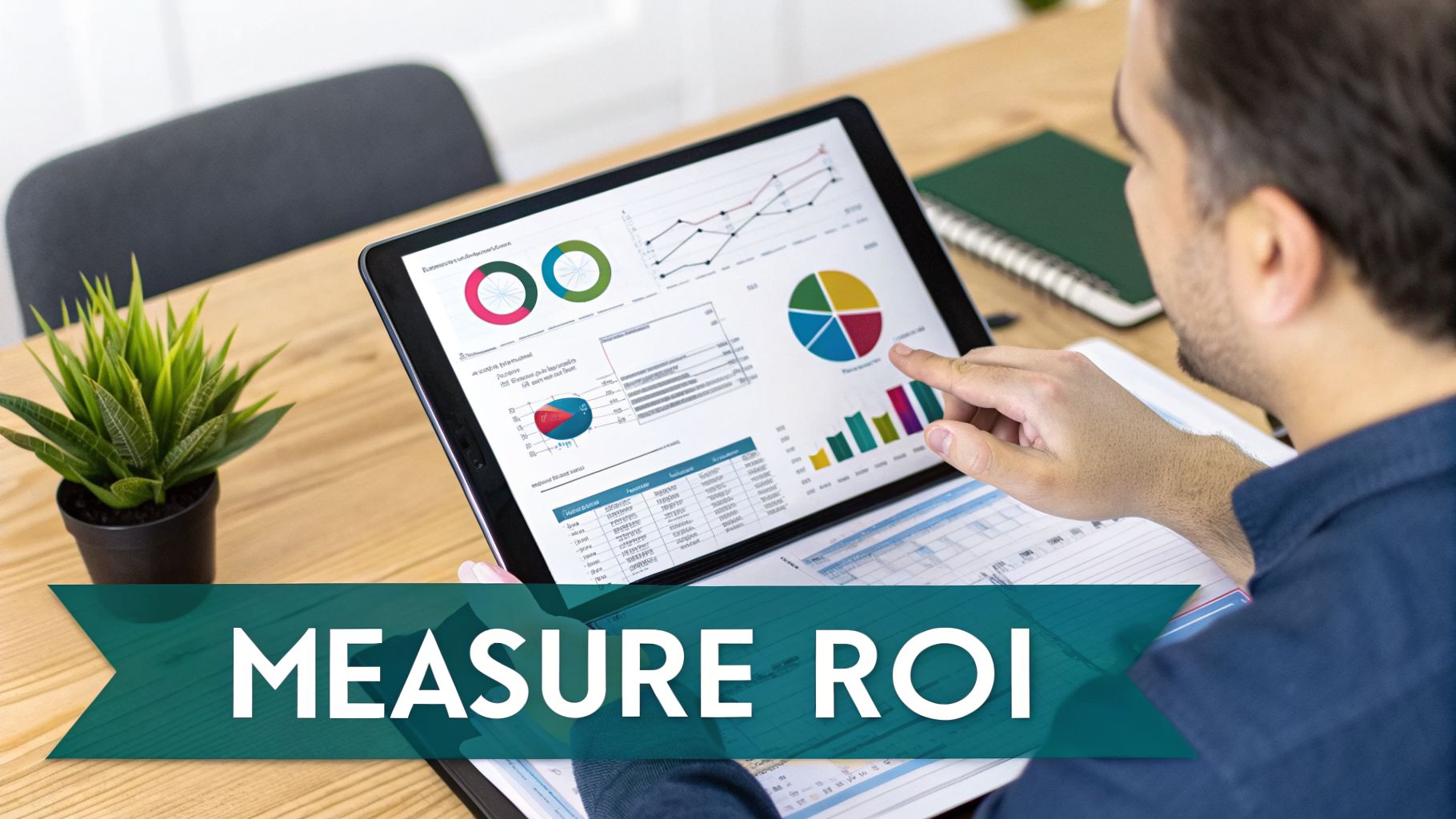
Implementing an Integrated Workplace Management System is a significant strategic move, and stakeholders will want to see a clear return on that investment. The value of an IWMS is measured by its direct, positive impact on your finances and daily operations, especially for large venues like transport hubs or university campuses.
The business case for an IWMS stands on three pillars: reducing operational costs, making smarter use of physical space, and improving the experience for every person in your venue. To build a solid case and track your success, you need to monitor the right Key Performance Indicators (KPIs) for each of these areas.
Driving Down Operational and Maintenance Costs
One of the first and most tangible returns from an IWMS comes from rethinking maintenance. By moving away from a "break-fix" model to a proactive, data-driven one, you can reduce costs and improve reliability.
Instead of waiting for an escalator to stop or an air conditioning unit to fail during a heatwave, an IWMS can use asset data to schedule maintenance at the right time. This means fewer expensive emergency call-outs and less disruption. At the same time, the energy management module provides live consumption data, letting you spot and stop waste.
To prove this is working, you should track KPIs like:
- Percentage reduction in reactive maintenance calls: A lower number shows you’re successfully shifting to a more predictive and less costly way of working.
- Improvement in asset uptime: This is critical in places like airports or train stations, where equipment reliability directly impacts service.
- Annual energy cost savings per square foot: This KPI puts a clear financial number on your sustainability efforts, showing the bottom-line impact of using energy more wisely.
Improving Space Utilization and Deferring Capital Costs
For most organizations, physical space is the second-biggest expense after payroll. Yet, it's often poorly understood and underused. An IWMS gives you the tools to see how your property portfolio is actually being used, unlocking huge potential savings.
By tracking real space usage, organizations can often make their existing footprint more efficient. This data-driven approach allows you to reconfigure layouts, consolidate teams, and make smarter decisions before committing to expensive leases or new construction.
For a university, this could mean optimizing lecture hall schedules to the point where they can avoid building a new facility. For a large corporate campus, it might involve reallocating entire floors based on new hybrid work patterns, saving millions in rent and operating costs.
Key KPIs to monitor include:
- Seat or office utilization rate: This shows you how effectively your bookable spaces are being used.
- Cost avoidance from deferred construction or leases: This directly quantifies the capital you didn't have to spend because you used your existing space more intelligently.
- Reduction in vacant or underutilized space: Tracking this metric highlights opportunities for consolidation or even subleasing parts of your property.
Enhancing Visitor Experience and ESG Reporting
Finally, an IWMS adds value by improving the experience for employees, passengers, and visitors. A well-managed building is safer, more comfortable, and easier to navigate. The system helps ensure services are responsive—when someone reports a problem, it gets fixed faster. This directly impacts satisfaction and public perception.
By exploring how advanced navigation works in Waymapped venues, you can see how this rich facility data can power a more inclusive and accessible journey for everyone.
What’s more, an integrated system is a great asset for ESG (Environmental, Social, and Governance) reporting. It centralizes and helps automate the collection of energy, waste, and water usage data. This not only simplifies compliance but also demonstrates a verifiable commitment to sustainability and corporate responsibility—strengthening your brand and making you more attractive to talent and investors.
Successful IWMS Implementation and Integration
An Integrated Workplace Management System is powerful on its own, but its true potential is realized when it connects to your other systems. A successful rollout isn't just about turning on new software. It’s a strategic project that depends on proper planning, getting your people on board, and, most importantly, smart integration.
Think of it as the central nervous system of your building. Each part has a job, but the real power comes when everything is connected and sharing information. The performance of your integrated workplace management system is directly tied to how well it communicates with the other technologies that keep your organization running.
Laying the Groundwork for Success
Before you start connecting systems, you need a solid plan. Rushing this stage is a common mistake that can undermine the entire project. The best deployments always start with a clear, people-first strategy.
First, you need buy-in from key people across the organization. This is more than just getting the budget signed off. It means sitting down with department heads, facilities crews, and IT staff to understand their daily challenges and show them exactly how this new system will make their work easier.
From day one, establish clear project governance with a detailed plan, key milestones, and realistic timelines. Many organizations find a phased deployment works best. You might roll out one or two modules at a time—like maintenance or space management—before tackling more complex integrations. This makes the change more manageable and lets you learn as you go.
A successful IWMS project is as much about managing change as it is about managing technology. Your plan must include training, clear communication, and a feedback loop to bring everyone on the journey with you.
Creating a Connected Ecosystem
The real value emerges when your IWMS starts communicating with your other business-critical systems. This is where you finally break down the data silos that have been holding your organization back, creating a single source of truth for your entire operation.
Key integrations to consider include:
- Human Resources (HR) Platforms: Connecting to your HR system provides the IWMS with accurate, real-time headcount data. This is vital for space planning, especially in a hybrid world where you need to know who is in the office and when.
- Enterprise Resource Planning (ERP) Systems: Linking your IWMS to the company’s main finance system allows for real-time budget tracking. When a maintenance team orders a part, the cost is automatically logged against the right budget, giving you full financial visibility.
- Internet of Things (IoT) Sensors: Integrating with IoT sensors that monitor occupancy, temperature, or air quality feeds live data straight into your IWMS. This lets you shift from reactive fixes to predictive maintenance and data-led space optimization. You can read more about this in our article on indoor positioning systems.
This web of connected systems means data entered in one place is automatically shared everywhere it’s needed. It reduces manual data entry, minimizes errors, and frees up your teams for more important work.
From Back Office to Visitor Experience
One of the most valuable integrations elevates your IWMS from a back-office tool to a central part of the visitor experience. A perfect example is connecting it to an advanced audio wayfinding solution like Waymap.
This direct link between facility management and visitor guidance makes your venue far more responsive and inclusive. When a point of interest is moved, a room is temporarily closed, or a new accessibility feature is added, a facility manager can update the information in the IWMS.
With a deep integration, that single change is instantly reflected in the step-by-step audio navigation provided to all users, including those with vision impairments. It ensures every visitor has the most current and accurate information, creating a safer, more welcoming, and genuinely accessible environment. This is how an integrated workplace management system becomes a cornerstone of a truly user-centric venue.
How to Choose the Right IWMS Partner
Choosing an integrated workplace management system isn’t like buying off-the-shelf software. It’s about finding a long-term strategic partner. The right partner provides more than a platform; they offer a foundation for a smarter, more user-friendly, and future-proof operation. To choose well, you have to look past feature lists and assess what makes a vendor a true partner.
Start by thinking about the long term. Your organization will grow and change, and your IWMS must be able to keep up. Can the system handle a larger property portfolio or more users down the line without performance issues?
Scrutinize Scalability and Mobile Capabilities
Today, solid mobile capabilities are essential. Your facilities and maintenance teams are on the move, not tied to a desk. A powerful and intuitive mobile app is non-negotiable for them to manage work orders, update asset information, and respond to incidents in real-time.
Just as critical is a proven, open Application Programming Interface (API). An IWMS can’t exist in isolation. Its real power is unlocked when it communicates seamlessly with your other essential systems—from HR and finance platforms to specialized tools for visitor experience.
Choosing a partner is about shared vision. Does the vendor understand the unique challenges you face—whether in a complex transit system or a sprawling university campus—and do they have a clear roadmap that aligns with your future goals?
Look for Industry-Specific Expertise
A generic, one-size-fits-all IWMS rarely works for specialized environments. You need to examine a vendor's track record in your specific industry. Have they deployed their system in a busy transit network like yours? Do they understand the unique compliance, safety, and crowd-flow challenges that come with public spaces?
Don’t hesitate to ask for case studies and references from organizations similar to yours. It’s the best way to know if their technology can handle the real-world demands you manage every day.
A Checklist for Vendor Evaluation
When you start talking to potential vendors, go in with a practical checklist. This helps you compare them on the factors that will make a difference to your success.
- Product Roadmap: What's coming in the next 1-3 years? Are they planning for AI-driven analytics and enhanced accessibility features like Waymap?
- Integration Capabilities: Ask for concrete examples of how their open API has connected with other systems. What kind of support do they offer for custom integrations?
- Support and Training Model: What happens after the system goes live? Do they offer comprehensive training for everyone, from your on-the-ground teams to strategic planners?
- Data Security and Compliance: How are they protecting your data? Can they demonstrate that they meet relevant industry and regional security standards?
By focusing on these strategic points—scalability, integration, deep industry knowledge, and a forward-looking vision—you move beyond a superficial feature comparison. This approach helps you choose not just a software supplier, but a genuine partner who will help you achieve your long-term goals for both your operations and your users.
Your IWMS Questions, Answered
You’ve got the basics down, but a few questions often come up when people start seriously considering an Integrated Workplace Management System. Let's tackle some of the most common ones.
How Long Will an IWMS Implementation Take?
There’s no single answer, as it really depends on the scale of your organization. Think of it like a renovation—you can repaint a single room or redesign the entire building.
A focused, phased rollout is usually the best approach. If you’re starting with core functions like maintenance and space management, a four to nine month project is a reasonable estimate. For a full-scale deployment across a large property portfolio, it’s more realistic to plan for 12 to 24 months. The key to staying on track is always the same: clear goals and a solid plan for bringing your teams along on the journey.
Is This Just for Large Global Companies?
Not anymore. While that may have been true a decade ago, modern, cloud-based IWMS platforms have changed the landscape. The key is modularity.
You don't have to buy the entire platform at once. Many providers allow you to start with the functions that address your most urgent needs—like space management—and then add more modules as your organization grows or your requirements change.
The real question isn't about your company's size, but its complexity. If you're juggling multiple separate tools to manage your facilities and it’s becoming a challenge, it’s probably time to look at a unified platform.
How Can an IWMS Help With Our ESG Goals?
An Integrated Workplace Management System is one of the most practical tools you can have for achieving your ESG (Environmental, Social, and Governance) targets. It turns abstract goals into measurable actions.
For the 'Environmental' component, the energy management module gives you the hard data needed to track consumption, find savings, and reduce your carbon footprint. At the same time, smarter space management helps you use your existing buildings more efficiently, reducing the need for new, carbon-intensive construction.
When it comes to the 'Social' aspect, an IWMS becomes incredibly powerful, especially when connected to other smart technologies. For instance, integrating your system with an accessibility platform like Waymap helps you build a genuinely inclusive environment. It's a tangible way to show you’re committed to making your spaces welcoming for every visitor and employee.
Waymap makes any large venue truly navigable for everyone. By integrating our hardware-free navigation with your IWMS, you can instantly update points of interest and provide precise, step-by-step audio directions to every user. Learn more about creating a more accessible and responsive environment at https://www.waymapnav.com.
