
The Benefits of Facilities Management for UK Venues

Facilities management has a branding problem. Too many organisations still treat it as the team that fixes faults, signs off contractors, and keeps buildings open. That view is out of date.
In UK venues, FM now sits much closer to strategy than many boards admit. It shapes operating cost, resilience, accessibility, visitor confidence, and the quality of ESG reporting. It also determines whether a building works only on paper or works for the people moving through it.
The benefits of facilities management are easiest to see when you stop looking only at plant rooms and planned maintenance. The core question is broader. Can your estate support inclusive journeys, adapt quickly, and produce evidence that operational decisions are improving performance?
Why 'Keeping the Lights On' Is No Longer Enough for UK Facilities
Only a minority of large UK venues fully meet accessible navigation expectations, and non-compliance can carry significant penalties. For facilities leaders, that is not a side issue. It is a live test of whether the estate is being managed as a strategic asset or merely kept open.
Boards still ask whether buildings are safe, compliant, and operational. Users ask a harder question. Can they get where they need to go easily, confidently, and independently?
That difference is where traditional FM starts to fall short. Plant performance, statutory checks, cleaning standards, and contractor control still form the backbone of the job, but they do not describe the full experience of a station, stadium, hospital, campus, or civic venue. A building can pass audit and still fail its visitors.
Accessibility now sits inside operational performance
In practice, people do not experience an estate as a set of assets. They experience it as a route.
That creates a real management gap in large, changeable environments:
- Transport interchanges need reliable, step-by-step guidance when platforms change, lifts go out of service, or crowding alters normal flows.
- Campuses deal with frequent room moves, temporary closures, and multi-building journeys that static signage cannot keep pace with.
- Stadiums and arenas have to move large volumes of people to the right entrance, concourse, seat, or hospitality area without confusion or delay.
I have seen estates teams invest heavily in physical upgrades, then lose the operational benefit because visitors still cannot orient themselves. That is where infrastructure-free digital tools such as Waymap change the equation. They add a dynamic accessibility layer without waiting for major capex, rewiring, or a full signage replacement programme. For FM, that means faster deployment, lower disruption, and a clearer line between accessibility action and measurable service improvement.
Practical rule: If a visitor cannot reliably reach the right entrance, platform, clinic, desk, or seat, the facility is underperforming, whatever the maintenance dashboard says.
ESG performance is won or lost in day-to-day operations
ESG targets are often presented as a reporting exercise. In reality, they are delivered through FM decisions made every day. Energy settings, maintenance intervals, cleaning regimes, access arrangements, contractor standards, and occupancy data quality all sit with operations.
The trade-off is familiar. Capital projects get attention because they are visible. Operational changes get delayed because they look incremental. Yet many of the fastest gains in accessibility, service quality, and reporting confidence come from operational tools that improve how people use the building right now.
That is also why practical operating discipline still matters. If you are reviewing cleaning standards, consumable use, and spend control, this guide for improved facility hygiene and ROI is useful because it stays close to execution.
Facilities teams are no longer judged only on uptime. They are judged on whether the estate supports inclusion, stands up to scrutiny, and produces evidence that operations are improving ESG outcomes as well as user experience.
How Effective FM Translates into Measurable Financial and Operational Gains
The strongest business case for FM isn't philosophical. It's operational.
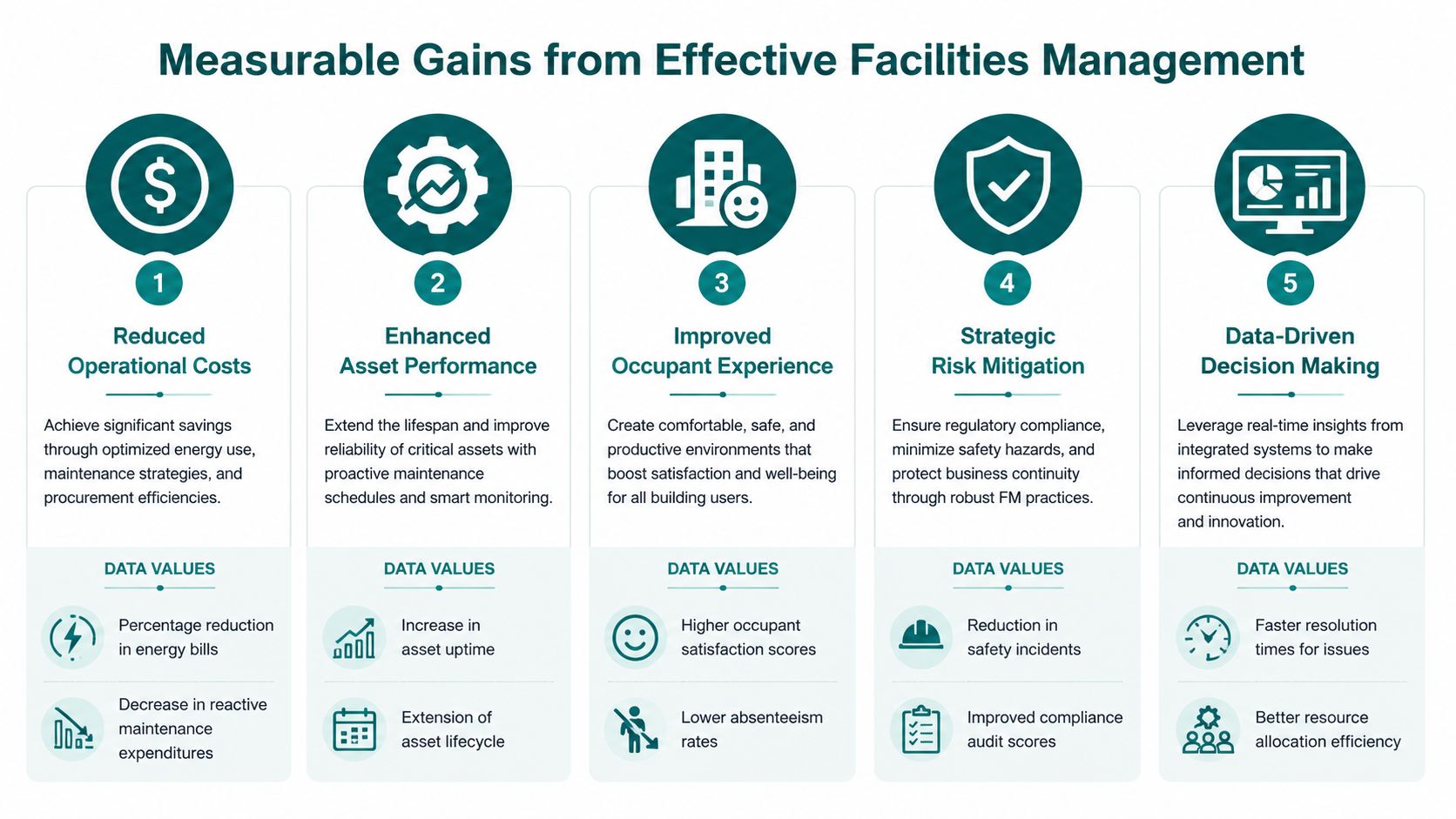
In the UK, integrated FM models can deliver 15-30% reductions in operational expenditure, and the market is projected to reach £50.6 billion by 2027 according to ServiceChannel's analysis of integrated facilities management. Those numbers matter because they show what many estates teams already know from experience. Coordinated operations usually beat fragmented contracting.
Cost reduction comes from coordination, not from cutting blindly
The easiest mistake is to read FM savings as a synonym for budget cuts. Good FM doesn't just spend less. It spends in the right places, earlier, with better information.
Integrated models tend to reduce cost through three mechanisms:
| FM action | Operational effect | Measurable outcome |
|---|---|---|
| Vendor consolidation | Fewer duplicated services and simpler oversight | 15-30% lower operational expenditure |
| Preventive and predictive maintenance | Fewer avoidable failures and less disruption | Lower reactive cost pressure |
| Energy optimisation | Better control of high-load building systems | Reduced utility spend |
That distinction matters in board discussions. Deferred maintenance can make a budget look tidy for a quarter, but it usually stores up higher cost and greater risk.
Occupant outcomes affect operating performance
The benefits of facilities management aren't limited to the hard estate line. They also show up in how people use and experience the building.
FM interventions have been linked to 15-20% reductions in absenteeism and 10-25% rises in employee retention in large venues. Some shopping centres have also reported 12% higher visitor satisfaction scores after FM-led redesigns. Those outcomes are commercially relevant because poor environments drive avoidable friction, complaints, and churn.
Here, layout decisions, cleaning standards, maintenance response, and accessibility work together. A building that feels confusing, poorly maintained, or inconsistent creates drag even when every contractor technically meets their scope.
A lot of FM value is hidden in avoided failure. You don't always see it as a headline saving first. You see it in smoother days, fewer complaints, and fewer escalations.
Better FM improves decision quality
Strong facilities teams don't just automate tasks. They improve the quality of operational judgement.
When FM data is connected across maintenance, occupancy, and service delivery, leaders can make better calls on:
- Where to invest first instead of spreading capital too thinly
- Which contractors are delivering results rather than only closing tickets
- Which spaces underperform because the layout, access route, or support services aren't right
That is why the benefits of facilities management are often underestimated. Boards tend to notice only direct savings, yet much of the value sits in avoided disruption, better retention, and more credible planning.
Financial gains only hold if the operating model is realistic
There is a trade-off. Integrated FM requires cleaner governance, stronger data discipline, and a willingness to standardise where standardisation helps. Some organisations want integrated outcomes while still letting every site run its own exceptions. That usually fails.
The practical lesson is straightforward. If you want measurable gains, define a small number of operational outcomes first, then align contracts, systems, and reporting against them. FM performs best when the model is built around outcomes, not around historic service silos.
From CAFM to AI What Tech-Enabled FM Looks Like in Practice
Facilities technology now influences far more than maintenance admin. For large estates, it affects energy cost, compliance evidence, accessibility performance, and the quality of the visitor journey.
Most estates teams already run a CAFM platform, a BMS, and some form of reporting. The gap is not software coverage. The gap is whether those systems help teams intervene sooner, prioritise the right risks, and improve how people use the building.

Better data changes maintenance policy
Asset registers and condition surveys are still the foundation. They are not the full operating picture.
Idox's discussion of accurate facilities data highlights the practical issue. Fixed maintenance intervals often reflect assumptions made years ago, not current occupancy, environmental stress, or actual equipment duty. In mixed estates, that leads to over-servicing in quiet areas and missed risk in heavily used ones.
The trade-off is familiar. Smarter maintenance needs better data discipline, clearer naming conventions, and teams who trust exceptions-based workflows. Without that, predictive maintenance becomes another dashboard that no one acts on.
For campus, healthcare, and transport estates, the policy shift is straightforward. Service assets by usage profile and risk, not by template alone.
Energy management depends on live use patterns
The same principle applies to utilities. Static schedules still waste a remarkable amount of money in buildings that have variable occupancy across the day.
Where sensors, BMS data, and booking information are linked properly, FM teams can tune HVAC, lighting, and plant operation to actual demand. The result is lower consumption, fewer comfort complaints, and better carbon reporting. Those outcomes matter to finance and sustainability teams alike because they improve both operating margin and ESG credibility.
A practical stack usually includes:
- Sensors and BMS inputs to show how spaces are being used
- CAFM or IWMS workflows to turn signals into work orders, inspections, and exceptions
- Analytics tools to surface abnormal trends before they become cost or compliance problems
Waymap's view of the integrated workplace management system is useful here because value comes from connecting systems around outcomes, not from buying another isolated reporting layer.
Digital wayfinding should sit inside the FM technology stack
Many FM programmes still stop at assets, compliance tasks, and helpdesk workflows. That misses a growing part of operational performance. People need to move through buildings easily, independently, and safely.
In practice, wayfinding data belongs alongside occupancy and service data. If visitors regularly miss entrances, queue at key junctions, or rely on staff for basic orientation, the building is underperforming operationally. The issue affects labour demand, customer satisfaction, and accessibility outcomes at the same time.
This matters even more in older estates and transport settings where installing and maintaining extra hardware is expensive. Infrastructure-free digital tools change the economics. They let teams improve user experience and inclusive access without creating another physical asset base to inspect, power, repair, and replace. That is a better fit for FM teams already carrying backlog risk on core systems.
It also supports a broader shift in how FM value is measured. Good estates management is no longer only about keeping plant available. It includes reducing friction for visitors, improving access for disabled users, and producing evidence that accessibility investment generates operational return as well as compliance cover.
The same point appears in adjacent discussions about autonomous service environments. Constructive-IT on unmanned facility design is relevant because once staff intervention reduces, digital guidance and interface quality start affecting throughput, confidence, and service reliability.
AI works when the operating model is ready for it
AI has a role in FM, but the sensible use cases are narrower than the marketing suggests.
It can help identify patterns across maintenance history, energy anomalies, cleaning demand, and helpdesk volumes. It can also improve triage by ranking exceptions that need human attention first. What it cannot do is fix poor asset data, unclear service standards, or weak governance.
That is why the move from CAFM to AI should be staged. First get clean data, reliable workflows, and agreed operational outcomes. Then apply automation and AI to the decisions that benefit from faster pattern recognition.
Used properly, tech-enabled FM shifts from tracking the estate to improving how the estate performs. That includes the physical assets, the visitor experience, and the ESG and accessibility returns boards increasingly expect to see.
Putting FM Benefits to the Test in Transit Hubs, Stadiums, and Campuses
The fastest way to judge FM quality is to look at venues where failure is public. In stations, stadiums, and campuses, poor operations show up as queues, missed appointments, repeated help requests, accessibility complaints, and staff pulled away from higher-value work.

Transit hubs need flow, not just compliance
Rail and metro estates are still judged on safety and punctuality, but passengers experience the station before they experience the service. If people cannot find the right entrance, platform, lift, or interchange route quickly, the operational hit lands on the estate team as much as the operator.
The challenge for transit operators is that they usually face three competing realities at once:
| Operational pressure | Traditional response | Better FM response |
|---|---|---|
| Constant layout and service updates | Add more signage | Use digital information layers that can be updated quickly |
| Signal-poor underground environments | Install extra infrastructure | Prioritise approaches that work without added hardware |
| High accessibility expectations | Treat compliance as a separate workstream | Build navigation into day-to-day operations |
The trade-off is straightforward. New physical infrastructure can help, but it is slow to approve, expensive to install, and awkward to maintain across complex estates. Infrastructure-free digital guidance gives FM teams a faster way to reflect temporary closures, route changes, and lift outages without waiting for a capital project.
That changes the return profile. Accessibility stops being viewed only as a compliance cost and starts producing measurable operational value through fewer assistance requests, less confusion at pinch points, and better use of frontline staff.
Stadiums win or lose on arrival experience
Stadium operations compress risk into short windows. Arrival peaks, gate changes, hospitality routing, concession demand, and egress all need to work under pressure, often with temporary overlays that do not exist on a normal day.
What fails in practice is often the gap between the physical estate and the live event setup. Visitors do not judge the venue by the maintenance plan. They judge it by queue length, clarity of instructions, and whether they can reach the right entrance, seat, toilet, or concession without asking for help.
That is why digital mapping needs to be maintained as an operational asset, not treated as a one-off design task. Waymap's work on floor mapping software is relevant here because the primary FM challenge is keeping venue information accurate as layouts, access routes, and event conditions change.
Here's a good example of why that matters in practice.
In high-footfall venues, every repeated wayfinding question carries a cost. Across a full season, that cost shows up in stewarding pressure, slower gate resolution, more manual accessibility support, and poorer visitor sentiment.
Practical guidance from Overton Security on facility management aligns with that reality. Good FM practice in venues depends on consistent processes, current information, and clear accountability during live operations.
Campuses expose the limits of static FM thinking
University estates are a hard test of FM maturity because they behave like small towns. Teaching rooms, labs, accommodation, sports facilities, libraries, health services, and event spaces all sit on one estate, but they do not operate on one simple timetable.
Static building data is rarely enough. Departments move. Room uses change. Temporary closures disrupt established routes. Open days and exam periods create travel patterns that differ sharply from a normal week.
A stronger campus model usually includes three things:
- Space planning linked to actual occupancy and movement patterns
- Navigation that can be updated when rooms, services, or routes change
- Shared ownership across estates, accessibility, digital, and student experience teams
The practical test is simple. Can a new student, visiting lecturer, contractor, or blind visitor complete a journey confidently without depending on ad hoc staff intervention?
Campuses that answer yes usually treat inclusive navigation as part of operations, not a side project for student services. That is where FM starts to shift from cost control to strategic return. Better journey data supports ESG reporting, accessibility investment becomes easier to justify, and the estate performs better for everyone using it.
Across transit hubs, stadiums, and campuses, the pattern is consistent. FM delivers its strongest returns when it manages physical assets and the user journey together. That is the gap traditional asset-focused FM often misses, and it is exactly where infrastructure-free digital tools can produce accessibility ROI, operational savings, and stronger ESG evidence at the same time.
How to Move from a Tactical to a Strategic FM Approach
Most organisations don't fail because they ignore FM. They fail because they stop at a tactical version of it.
That usually means the team is busy, competent, and permanently reactive. Work orders are closed. Audits are prepared. Contractors are managed. Yet the organisation still can't explain which operational choices are improving accessibility, reducing friction, or strengthening reporting.

Stop treating automation as the end point
A common mistake is to assume that digitising tickets or workflows is the same as becoming strategic.
It isn't. Data-driven FM is being adopted by 39.6% more UK facilities planning investments through 2026, while simple automation can reduce administrative burdens by 27.4%. The point is that administration savings are useful, but they are not the final goal. Better decisions are. That distinction comes through in the earlier ServiceChannel evidence discussed above.
If your system only helps people process tasks faster, you're still managing yesterday's problem.
Four habits that keep FM stuck
The pattern tends to repeat across sectors. Strategic progress stalls when leaders cling to one of these habits.
- Budget-first thinking: Cost control matters, but chasing the cheapest line item can increase failure risk and erode user experience.
- Siloed data: Maintenance, occupancy, accessibility, and energy sit in separate systems, so nobody sees the full operating picture.
- Hardware bias: Teams over-invest in fixed infrastructure because it feels tangible, then inherit maintenance overhead they didn't price properly.
- Compliance by document: Policies exist, but the lived experience of the venue still falls short.
A useful external sense-check is Overton Security on facility management, particularly for leaders reviewing how operational discipline, site standards, and service consistency fit together.
What a strategic model looks like
The better approach is not abstract. It changes how decisions are made.
Start with outcomes. Decide which problems matter most. That could be accessibility complaints, HVAC waste, contractor sprawl, poor visitor orientation, or weak occupancy insight. Then ask whether your current FM stack can explain those outcomes with evidence.
A practical sequence looks like this:
Define a small set of cross-functional KPIs
Include operational cost, user experience, and compliance evidence. If a KPI can't be influenced by day-to-day decisions, it won't guide behaviour.Join datasets that reflect how the building is used
Maintenance logs alone won't tell you why friction happens. Occupancy, journey, and service data fill the gap.Challenge every asset-heavy proposal
Ask what it will cost to maintain, update, and govern over time. Hardware often looks sensible at procurement stage and awkward by year two.Give FM a voice in accessibility and ESG reporting
Those agendas often sit elsewhere, but much of the evidence lives in operations.
One useful test: if your estates report proves the site was serviced, but can't show whether the site was easy to use, you're still operating tactically.
Strategic FM needs broader ownership
This shift won't stick if it sits only with the facilities director. Estates, digital, accessibility, sustainability, operations, and customer experience teams have to align on what the building is meant to do.
That is uncomfortable for some organisations because it breaks old boundaries. But that's also where the larger value sits. Strategic FM doesn't replace technical discipline. It gives that discipline a commercial and social purpose.
Why Your Next Big ESG Win Lies Within Your Facility's Operations
The most credible ESG gains usually don't start in a report. They start in how a venue is run.
Facilities operations sit at the point where environmental performance, social inclusion, and governance discipline become tangible. Energy management affects the environmental case. Accessibility and navigation affect the social case. Auditability, maintenance logic, and compliance records affect the governance case. That makes FM one of the few functions that can improve all three at once.
The social case is operational, not rhetorical
A venue can't claim inclusion convincingly if people still struggle to reach the right entrance, platform, room, or service point. Respectful accessibility work is practical. It depends on routes, instructions, updates, and reliable information.
That's why digital inclusion should be treated as part of operational design, not as a bolt-on initiative. Programmes that connect public good, usability, and data-led improvement are often the ones that endure. Waymap's work with App for Good reflects that wider principle. Accessibility becomes more durable when it is built into how organisations think about products, places, and public value.
Environmental gains are easier to defend when they are tied to use
Plenty of estates teams have sustainability targets. Fewer can show, in a clear operational line, how control decisions, maintenance policy, and real occupancy patterns produced the outcome.
That is where FM earns its place in ESG. It can provide evidence, not aspiration. Leaders can point to changes in building operation and explain why those changes mattered.
Governance improves when FM data is board-ready
Governance isn't only about policy. It's about whether the organisation can show why a decision was made, what evidence supported it, and what happened next.
That is one reason the benefits of facilities management deserve more board attention than they usually get. FM is one of the few functions that can turn estate complexity into something measurable, governable, and defensible.
The next big ESG win in your organisation may not come from a new pledge. It may come from operating the existing estate with better data, stronger accessibility, and a clearer view of how people move through space.
Frequently Asked Questions
How do I calculate the ROI of facilities management improvements?
Start with the costs you can already see and the failure points you already know. Compare current spend on maintenance, energy, contractor coordination, complaints handling, and staff time against the expected effect of a specific FM intervention.
Don't try to model everything at once. Pick one journey or one building problem first, then track direct operational change, user feedback, and any reduction in manual intervention.
What are the most important benefits of facilities management for large UK venues?
The most important benefits are lower operating cost, better resilience, stronger compliance, and a better experience for people using the venue. In large estates, those benefits matter most when FM combines asset performance with accessibility, occupancy insight, and updateable operational information.
For senior leaders, the strategic value is that FM can support finance, ESG, customer experience, and governance at the same time.
How does facilities management affect ESG performance?
Facilities management affects ESG by changing how a building consumes energy, how inclusive it is to use, and how well decisions can be evidenced. The environmental case sits in control of assets and consumption. The social case sits in accessibility and user experience. The governance case sits in data quality, compliance, and auditability.
If FM isn't feeding those conversations, ESG reporting is missing part of its operational evidence.
Is retrofitting older buildings for accessibility always expensive?
No, it isn't always expensive. Physical retrofit can be costly and slow, especially in listed, complex, or operationally sensitive environments, but not every accessibility improvement requires structural change.
Software-led guidance, better digital mapping, clearer route management, and faster point-of-interest updates can improve usability without adding more installed infrastructure. In many older buildings, that is the more realistic place to start.
What usually stops organisations getting full value from FM technology?
Poor integration usually stops them. Teams buy systems for maintenance, energy, booking, accessibility, and reporting, but the data stays fragmented and the operating model doesn't change.
The best results come when technology supports decisions across functions, not when each team gets another standalone dashboard.
If you're reviewing how accessibility, operational performance, and ESG reporting fit together in your estate, Waymap is worth exploring. We help venues deliver precise indoor, outdoor, and underground navigation without GPS, Wi‑Fi, or installed hardware, giving operators a practical way to improve user journeys while reducing the maintenance burden that often comes with traditional wayfinding infrastructure.
