
Change Management Strategy for New Transit Tech

You can buy strong transit tech and still lose the rollout. The screens work, the route logic works, the accessibility case is sound, and the board already likes the direction, but the station teams haven't been briefed, the union has questions, and the launch date collides with a facilities shutdown. That's where a change management strategy stops being an internal document and starts acting like the operating system for the deployment.
In metro systems, hospitals, stadiums, and campuses, the friction usually isn't the product itself. It's the handoff between procurement, operations, accessibility, comms, legal, estates, and frontline managers, all of whom own a different part of the risk. If you've ever watched a launch slide because someone treated rollout as a comms exercise, you already know why structured change matters.
Why a Change Management Strategy Matters When the Tech Is Good
The cleanest way to understand this is through the moment a rollout should have been easy. A transit operator approves a navigation deployment for a busy interchange, the vendor is ready, and the pilot has already shown that people can follow the route guidance. Then the launch slips because the duty manager rota wasn't aligned, the accessibility panel heard about it late, and the comms team couldn't sign off the visitor messaging in time.
That pattern shows up in large venues too. A stadium can have the right technology and still miss adoption because staff are uncertain about who answers the first wave of user questions, while estates worries about signage changes and the executive sponsor wants a cleaner business case before phase two. The technology doesn't fail, but the rollout loses momentum because nobody defined the change as a managed operational shift.
Change management is the thing that turns good tech into usable tech
A change management strategy is not a comms plan attached to a project. It is the set of decisions that keeps the implementation moving when different teams pull in different directions. That matters in the UK, where digital change is no longer rare, it's embedded across most organisations, with the Office for National Statistics reporting that in 2023, 96% of UK businesses with 10+ employees had internet access, 43% used cloud computing services, and 73% of firms with 10+ employees were already using some form of AI technology. Those adoption levels make structured change a practical necessity, not a nice-to-have. ONS-linked UK change context
The historical lesson from government is similar. When GOV.UK launched in 2012, it consolidated hundreds of separate departmental websites into one platform, replacing a fragmented web estate with a centralised service model. That worked because the change was managed as phased migration, governance, and user testing, not just branding. For operators under pressure, the same logic applies, as the Waymap blue dots rollout notes show in practical terms.
Practical rule: if the pilot can't survive a bad briefing, a rota change, or a crowded launch window, the problem isn't the product. It's the change design.
For anyone comparing rollout complexity across industries, this transition guide for fleet management providers is useful because it shows the same truth from another angle, the handoff is usually where value is won or lost.
Mapping the Stakeholders You Actually Have
A useful stakeholder map in a transit or venue deployment starts with named roles, not abstractions. The common mistake is to list “operations” or “customers” and stop there. In a real rollout, the people who can slow you down, approve you, or undermine adoption are usually the access forum chair, the duty manager, the union or staff council rep, the estates lead, the local authority contact, the advertising partner, and the technology partner whose roadmap you depend on.
The map has to reflect decision rights, not org-chart hierarchy. A customer-experience lead may care about passenger confidence, but the estates director owns hardware implications, legal owns compliance exposure, and frontline supervisors own whether the change gets used on day one. If you skip the people who live in the operational detail, you end up with sign-off but no uptake.
A working stakeholder map for a hospital and transit crossover rollout
A hospital-to-station corridor, a campus interchange, or a venue connected to a transport hub all create the same challenge, the user journey crosses teams that don't naturally coordinate. The access forum wants evidence that the route supports inclusive use. The transport ops team wants minimal disruption to dwell time and no extra burden on staff. The vendor team wants a fast deployment path. The union rep wants clarity on how staff roles change, if they change at all.
Use the first meeting to ask direct questions, not broad ones:
- What can you approve, block, or delay? This reveals actual authority.
- What does success look like for your team? That's how you align incentives.
- What will make this harder to support internally? This surfaces hidden resistance early.
- What evidence do you need before you'll back scale-up? That feeds the pilot design.
The customer journey mapping note from Waymap matters here because it shows why a deployment can't be planned from the perspective of the project team alone. The user path has to match the operational path.
| Stakeholder map template for venue and transit rollouts | | | |
| Stakeholder group | What they need to know | What they can block | Primary tactic |
|---|---|---|---|
| Accessibility forum | How the route supports real users and what evidence exists | Approval confidence and reputational support | Early consultation and live pilot review |
| Union or staff council | Whether roles, workload, or expectations change | Staff buy-in and informal resistance | Briefing, Q&A, and manager cascade |
| Duty managers | What happens on launch day and when issues escalate | Operational readiness | Shift-based training and escalation rules |
| Estates | What hardware, signage, or maintenance burden is added | Site access and physical deployment | Technical review and risk register input |
| Local authority | Whether the change aligns with site obligations | External permissions and scrutiny | Evidence pack and structured update cadence |
| Advertising partner | Whether screens, wayfinding, or media assets change | Visual estate coordination | Timed change windows and asset map |
| Technology partner | What data, updates, and support are required | Delivery timing and roadmap fit | Shared milestone plan and issue log |
A stakeholder map only works when it feeds the comms plan, the training plan, and the risk register. If it stays on a slide, it's decoration.
Building a Communications Plan That Stands Up to Auditors
A serious communications plan has to prove more than that messages were sent. In a regulated venue or public transport environment, it has to show that the right groups were consulted in the right order and that the record could survive audit, scrutiny, or a complaint. That's especially true under the Equality Act 2010 and the Public Sector Equality Duty, where consultation and evidence aren't optional habits, they're part of how responsible decisions are defended.
The plan also needs to respect the difference between audiences. Staff need operational detail, passengers need plain-language guidance, accessibility groups need a seat at the table, and the board needs a decision narrative. If you compress those into one generic email campaign, you miss the point and usually create noise where clarity was needed.
Four communications streams that do the real work
An airport operator launching a new accessible routing app would need at least four distinct streams. The internal staff and union track should cover what changes for frontline teams, what questions they can't answer yet, and who owns escalation. The passenger or visitor track should explain where the tool works, how to use it, and what support exists if someone gets stuck.
The regulatory and accessibility-forum track is where you show your evidence trail, including consultation timing and the issues raised. The board and executive track is the place for risk, readiness, and what happens if adoption lags. These aren't separate because the information is different only, they're separate because the audience has a different job to do.
A defensible archive usually includes:
- Briefing notes for managers and duty teams.
- Accessibility forum minutes showing input before launch.
- Passenger-facing copy in the forms published.
- Issue logs with questions, responses, and dates.
- Approval records for the final launch decision.
The consent management note from Waymap is relevant because consultation discipline and user trust travel together. If the process around consent, feedback, or issue handling is sloppy, the rollout inherits that distrust.
Operational insight: if accessibility stakeholders only see the plan at sign-off, the comms process has already failed.
For the UK operator audience, PAS 78, the Equality Act 2010, and internal equality review processes all point in the same direction. People who rely on the environment need more than awareness, they need predictable communication, a clear escalation path, and visible follow-through. That's what makes the plan defensible when someone asks why a change was launched the way it was.
Designing a Pilot That Earns the Right to Scale
A pilot that gets board confidence has to look and feel like the wider estate. Too many pilots are too tidy, too short, or too unrepresentative to tell you anything useful. One empty station, one off-peak day, or one friendly user group won't teach you how the rollout behaves under pressure.
The better approach is simple. Choose one site, one route, or one building that reflects the operating profile. Set a fixed window, recruit a panel that includes disabled passengers, frontline staff, and shift supervisors, and define success before the pilot begins.

What to test before anyone asks for rollout approval
The point of a pilot is not to prove the idea works in theory. It's to show whether the route logic, onboarding, staff support, and issue handling hold up in a live environment. That's why the data set should include user completion, staff confidence, complaint trends, and the specific operational issues that show up during the first weeks of use.
A Waymap-style infrastructure-free deployment changes the pilot economics because you're not waiting on beacons, Wi-Fi handshakes, or installed hardware. That means pilot sites can be stood up quickly, which is useful when a venue has high staff turnover or a station layout changes often. In practice, that speed matters because a board is more likely to approve scale when it sees a pilot repeat cleanly across multiple sites. The Waymap user adoption guidance fits this model, with phased pilots, staff training, accessible onboarding, map governance, and post-launch monitoring as the core mechanics.
Use these exit criteria before launch:
- Completed journey success rather than app activity.
- Frontline confidence rather than attendance alone.
- Issue resolution speed rather than issue count alone.
- Operational fit across shifts, not just one calm time window.
A pilot is promising when people like it. It is successful when the site team can explain why it works, the users can complete the journey, and the board can see how it scales without creating new burdens.
KPIs That Actually Move the Decision
Most technology rollouts are measured in the wrong units. Teams count app downloads, training attendance, or message reach, then wonder why the board still hesitates. Those numbers tell you activity happened, but they don't tell you whether users completed the journey, staff knew what to do, or the site absorbed the change without added friction.
The KPI tree has to connect change management to operational outcomes. For accessibility-led navigation, that means tracking journey completion, time-to-platform for unfamiliar passengers, frontline confidence, incident trends, complaint patterns, and the cost implications of maintaining the old wayfinding approach. If the metric doesn't change the decision, it's just reporting.
The metrics that matter to operators
For a stadium or metro operator, the most persuasive KPIs are usually the ones that show behaviour, not awareness. Accessibility-completion rates show whether the route works for the people it was built for. Time-to-platform shows whether unfamiliar passengers can move through the space with less uncertainty. Staff confidence helps reveal whether the rollout is being absorbed into daily practice.
The Equality Act 2010, BS 8300, and PAS 78 all push organisations toward evidence that the environment is usable in practice, not just compliant on paper. That's why a KPI set focused only on digital engagement misses the point. You need proof that people can complete the task in the built environment and that the support model doesn't collapse after launch.
For one stadium operator, the key shift was abandoning a download-based KPI in favour of a completed-journey KPI. That reframed the rollout discussion from “How many people installed it?” to “How many people got where they were trying to go?” The second question is the one that moves phase-two approval.
Here is the rewritten paragraph:
The Waymap user retention metrics note is useful here because retention only matters if it reflects repeated use in the actual environment. A strong KPI tree should tell you whether the tool is becoming part of the journey, not just part of the launch.
Risk, Governance and the Infrastructure-Free Advantage
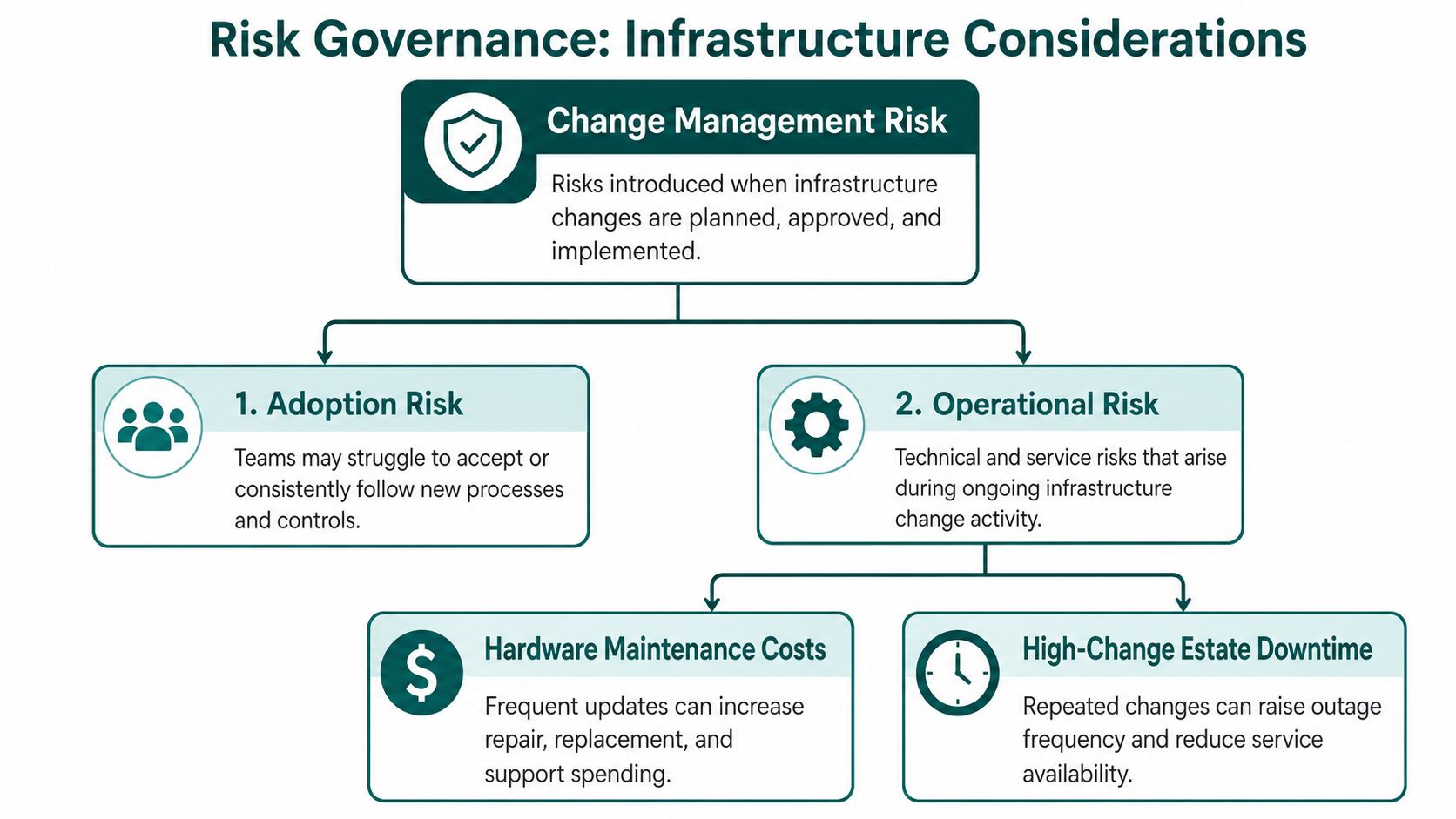
Risk registers for new navigation tech often underweight the problem. They list adoption risk, then ignore the maintenance burden of physical hardware. They list implementation risk, then ignore the political cost of investing in beacons, gateways, or cabling that becomes a headache when layouts change or estates teams need flexibility.
That matters in high-footfall, high-change environments. Stations, venues, hospitals, and campuses don't stand still, and every installed device creates a future maintenance obligation. If procurement, estates, and legal aren't aligned on who owns that burden, the rollout creates a problem that outlasts the pilot.
What belongs in the governance cadence
A workable governance model should name an owner for each risk, not just list categories. Adoption risk belongs with the change lead and the site sponsor. Operational risk belongs with estates or the relevant technical owner. Legal and accessibility input belongs wherever compliance and consultation are tracked. If a risk has no owner, it tends to survive every meeting.
Waymap's named deployments make this easier to talk about in concrete terms. Lord's Cricket Ground became the first stadium in the world to implement the technology, and deployments at WMATA and SBS Transit show that infrastructure-free navigation can be governed across complex transit environments. The value of those examples isn't just the technology, it's the risk shape. Software-led guidance changes the maintenance profile because you're not tying every route adjustment to physical install work.
That's why governance should ask different questions depending on the rollout type:
- Who approves map changes? This controls content risk.
- Who monitors frontline issues weekly? This keeps adoption visible.
- Who signs off on scale-up? This prevents premature expansion.
- Who owns accessibility feedback? This keeps compliance active, not retrospective.
Governance rule: if adding a route change requires a facilities project, the change design has already become too heavy.
The iterative rollout model is the safest fit for these environments because it lets teams review what happened, adjust, and only then expand. That aligns with the UK public-sector habit of phased service migration and with the evidence-based change literature that favours feedback-gated methods over one-shot launches. In operational terms, it also gives you a cleaner answer when senior leaders ask whether the site can absorb the next phase without creating hidden work.
Your First 90 Days of a Change Management Strategy
The first 30 days are about evidence, not enthusiasm. Map the stakeholders, document the operational baseline, and collect the facts you need from observation, metrics, stakeholder input, and literature, which follows the four-step method outlined by Rousseau and colleagues. In practical terms, that means you should know who can block the rollout, what the current passenger or visitor journey looks like, and where the friction sits before you promise a launch date.
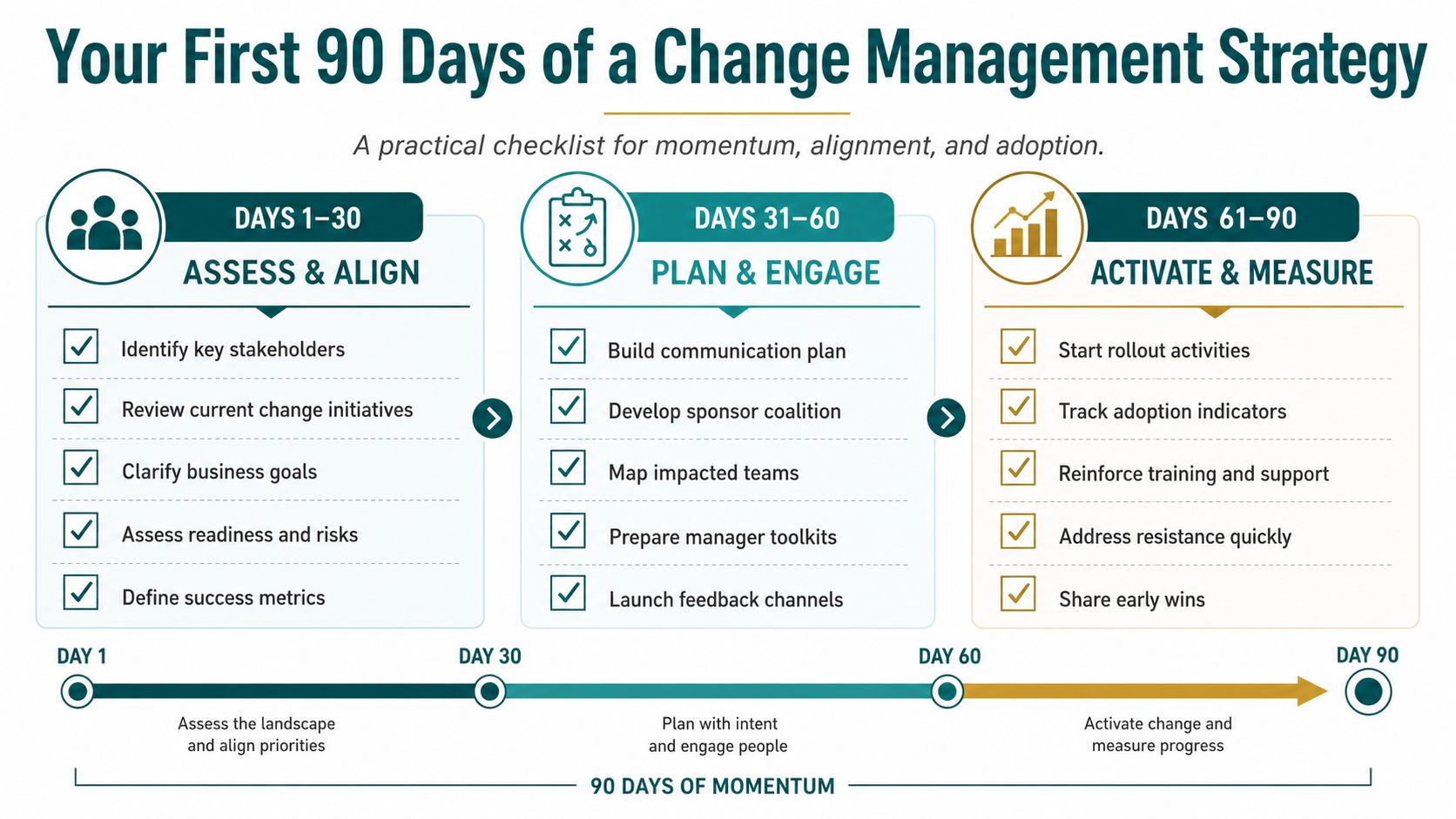
Month two is where the plan becomes operational. Open the comms streams, lock the pilot scope, assign the risk owners, and set the pilot exit criteria in writing. This is also the point where you test whether the board, estates, accessibility, and frontline teams are all looking at the same version of the truth.
Month three is for live learning and the phase-two story. Run the pilot, test the KPI tree, capture the issues that recur, and decide whether the site is ready to scale. If the launch surfaces repeated questions from staff or users, the answer is usually not “send another email,” it's to tighten the support model and refresh the governance cadence.
The most common early mistakes are predictable. Leaders announce too early, consult too late, measure the wrong thing, or assume the pilot proves the wider estate will behave the same way. In transit and venue deployments, those mistakes usually show up as delay, trust erosion, or a board that won't sign the next stage.
A strong change management strategy is where the accessibility case, the operational case, and the commercial case meet without fighting each other. If those three don't converge, the rollout will feel busy but not controlled. If they do converge, the technology starts to look like part of the estate rather than an extra object on it.
Waymap helps venues, transit operators, and campus teams roll out infrastructure-free navigation in a way that fits the real estate, the staff model, and the compliance burden. If you're planning a change management strategy for new wayfinding tech, visit Waymap and see how the rollout, adoption, and governance pieces fit together.
