
A Guide to the Public Sector Equality Duty in 2026

How are public services in the UK legally required to ensure fairness? It’s not a suggestion; it's a core legal requirement known as the Public Sector Equality Duty (PSED). This is not a tick-box exercise. The PSED is a framework from the Equality Act 2010 that embeds genuine equality into the DNA of public services, ensuring decisions are made with due regard for their impact on everyone.
Authored by Tom Pey, Founder, Waymap. Tom's lived experience as a blind person who founded an accessibility technology company provides a unique perspective on turning legal duties into tangible outcomes.
What is the Public Sector Equality Duty?
At its heart, the Public Sector Equality Duty is about proactive responsibility. It compels public bodies to consciously consider how their decisions—from high-level policies to day-to-day operations—affect people with different protected characteristics.
Brought into force in April 2011 under Section 149 of the Equality Act 2010, the duty unified a patchwork of older regulations into a single, cohesive framework. It applies to public authorities across Great Britain, including local councils, NHS trusts, government departments, and transport operators like Transport for London. To understand the PSED, it helps to understand the wider legal context, which is covered well in this analysis of legal fairness.

The duty requires these organisations to have ‘due regard’ for three key aims when they exercise their functions. These aims are the mandatory core of the PSED.
What are the three aims of the Public Sector Equality Duty?
The table below breaks down the three essential objectives that public bodies must actively consider in their decision-making.
| Core Aim | What It Means in Practice |
|---|---|
| Eliminate Discrimination | Actively identify and remove unlawful discrimination, harassment, and victimisation related to protected characteristics. |
| Advance Equality of Opportunity | Proactively reduce disadvantages, meet different needs, and encourage participation for people from protected groups. |
| Foster Good Relations | Promote understanding and tackle prejudice between people from different backgrounds to build more cohesive communities. |
These aims force a conscious consideration of how policies and services impact people based on nine protected characteristics: age, disability, gender reassignment, marriage and civil partnership, pregnancy and maternity, race, religion or belief, sex, and sexual orientation.
A decision on a new train station layout, a change in library opening hours, or a hospital's communication strategy must all be scrutinised through this lens. The goal is to move from simply avoiding illegal discrimination to actively promoting a more equal society. This shift is central to creating truly welcoming public spaces, a concept we explore in our article on inclusive design principles.
The entire PSED hinges on the legal concept of ‘due regard’. This is not a last-minute check. It means consciously and deliberately thinking about the duty's three core aims at every stage of the decision-making process. For a decision to be lawful, a public body must be able to prove it actively considered its impact on equality. This translates into a series of practical, evidence-based steps.
How do you put 'due regard' into practice?
To show ‘due regard’, a public body must do more than just state that it did. It requires actively documenting work in three key areas.
Gather evidence: Collect robust data to understand how a new policy or change might affect different groups. An NHS trust, for example, might analyse patient data to spot disparities in access or outcomes, while a transport authority could review passenger feedback categorised by demographic.
Engage with affected communities: Proactively consult with the communities and individuals who will be affected. A transport authority cannot redesign a station and only inform disabled passenger groups after the fact; those groups must be part of the conversation from the beginning. Research from the Equality and Human Rights Commission (EHRC) has repeatedly shown how critical this early engagement is.
Assess and record the process: Maintain a detailed record of the entire process, including the evidence gathered, the feedback received, and how equality impacts were weighed against other factors like cost or operational constraints. This paper trail is the proof that the duty was a core part of the decision, not an afterthought.
Many public sector managers worry about the threat of legal challenges. Reframe ‘due regard’ as a constructive way to make stronger, more defensible decisions. It stops being a legal chore and becomes a strategic advantage that reduces the risk of later reversal.
This process ensures that decisions are not only fairer but also more effective and less likely to be challenged in court. When public sector procurement processes are built around these principles, services are more inclusive and efficient from the start, as detailed in our guide to improving public sector procurement. A clear, documented process of ‘due regard’ is the best defence against legal problems and the surest path to creating public services that work for everyone.
What are the most common PSED compliance gaps?
Although the Public Sector Equality Duty has been law for over a decade, many public bodies still fail to comply effectively. The problem often points to a cultural issue where the PSED is treated as a bureaucratic hurdle rather than a tool for better service design. The consequences of these failures—legal, financial, and reputational—can be severe.
The problem with 'paper compliance'
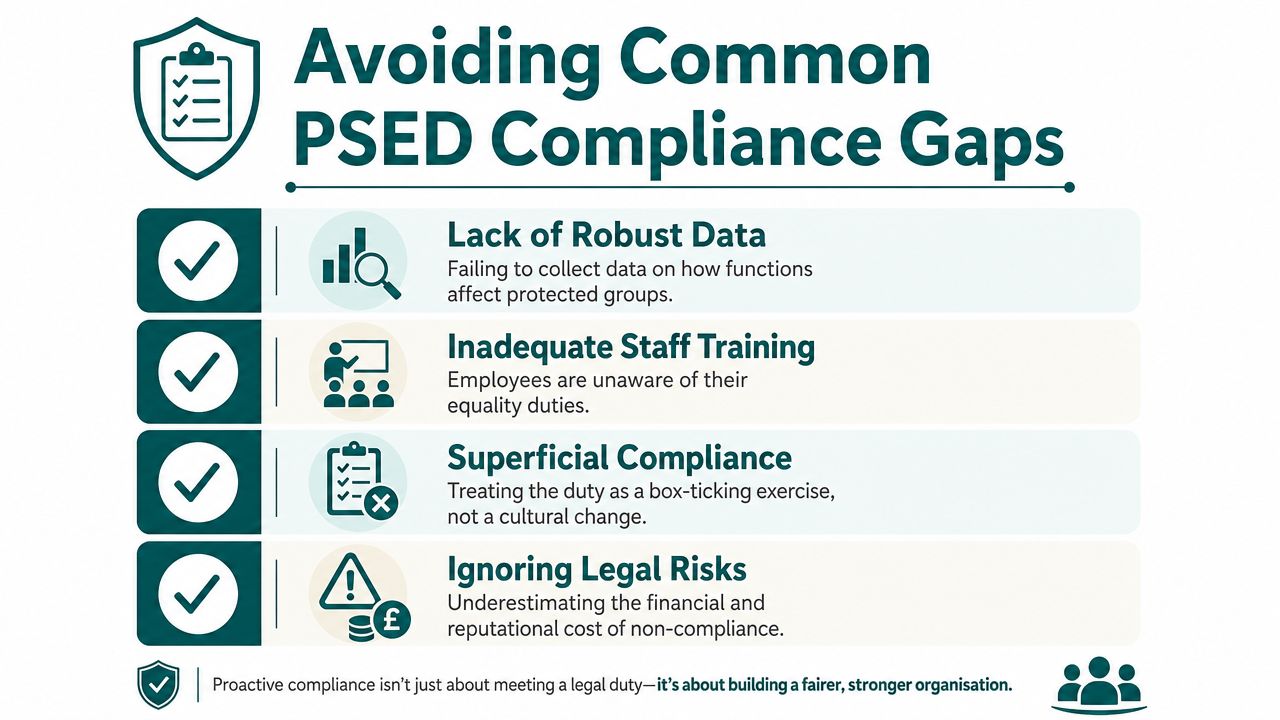
A significant failure is the lack of robust data. Without good evidence on how services affect different groups, it’s impossible to have ‘due regard’ in any meaningful way. This is often compounded by poor staff training, leaving employees unaware of their legal obligations.
A UK government review highlighted this issue, finding that while 78% of public bodies published some equality information, only 45% had set specific, measurable equality objectives. The report also noted that a staggering 60% of local councils had not conducted proper equality impact assessments for their transport policies—a massive blind spot, given that disabled people make up a significant portion of public transport users. The full details are in the government's official PSED review.
What happens after a PSED breach?
When public bodies get it wrong, the consequences are serious. Failing to comply with the Public Sector Equality Duty is a breach of the law that can be challenged in court through a judicial review.
Successful legal challenges often lead to:
- Quashed Decisions: Courts can overturn major policy or budget decisions, forcing a costly return to the drawing board.
- Significant Legal Costs: The expense of defending a judicial review can run into tens or hundreds of thousands of pounds.
- Reputational Damage: Being found in breach of the duty erodes public trust and can destroy an organisation’s credibility.
A key takeaway from court rulings is that the duty is substantive, not merely procedural. It is not enough to say you thought about equality; you must be able to prove with evidence that the potential impacts were rigorously assessed before a decision was made.
High-profile court cases have cemented the PSED as an enforceable legal standard. In a landmark case, the High Court found that Transport for London (TfL) had breached the duty when changing its bus services, as it hadn't properly considered the impact on disabled passengers. Cases like this send a clear message: ignoring the duty carries significant risk.
A practical checklist for PSED compliance
Navigating the Public Sector Equality Duty (PSED) should not be a box-ticking exercise. When approached correctly, it’s a powerful framework for making fairer, more robust decisions. The key is to embed the duty into everyday workflows, treating it as a blueprint for genuine, defensible, and inclusive service design.
PSED Compliance Checklist
| Step | Action Required | Key Consideration |
|---|---|---|
| 1. Identify Relevance | Screen your policy or decision. | Does it have the potential to affect people with protected characteristics differently? If yes, the PSED is engaged. |
| 2. Gather Evidence | Collect robust quantitative and qualitative data. | Mix demographic stats with real-world insights from consultations. Speaking to affected groups is a critical data source. |
| 3. Assess Impact | Conduct a thorough Equality Impact Assessment (EIA). | This is your working document. Analyse potential positive and negative impacts on all relevant protected groups. |
| 4. Inform Decisions | Present EIA findings to decision-makers. | The equality impacts must be actively considered alongside all other factors. A decision cannot be justified on cost alone. |
| 5. Mitigate and Adapt | Use the EIA to shape and improve the policy. | If negative impacts are identified, what steps can you take to remove or reduce them? Can you enhance positive impacts? |
| 6. Monitor Outcomes | Track the real-world impact of the decision post-implementation. | Did your assessment hold up? Set measurable equality objectives and track your progress against them. |
| 7. Publish and Report | Make your equality information and objectives publicly available. | Transparency is fundamental. This demonstrates accountability and builds public trust. |
This checklist provides a solid foundation, but successful PSED compliance is a continuous cycle of improvement, not a one-off task.
From evidence to action
The process begins by asking: could this decision impact different groups of people in different ways? If the answer is yes, the duty applies. That's the cue to gather evidence—not just spreadsheets of demographic data, but the rich, qualitative insights that come from genuine consultation with affected communities.
With evidence in hand, the Equality Impact Assessment (EIA) becomes a live, working document that directly shapes the final outcome. It lays out potential positive and negative effects on each protected group, creating a clear record of ‘due regard’. These findings must be presented to decision-makers, who must weigh equality impacts alongside financial or operational arguments.
Closing the loop
Responsibility does not end when the decision is made. True compliance involves monitoring what happens on the ground. This ongoing review process is vital, turning the PSED from a one-time task into a continuous engine for improvement. Finally, transparency is non-negotiable. You must publish your equality information and objectives, showing the public how you're meeting your commitments. For digital services, this loop is especially important, and it is essential to understand what is accessibility testing and how it fits into this continuous cycle.
How does accessible wayfinding help fulfil the Public Sector Equality Duty?
The Public Sector Equality Duty is a call to action. It requires public bodies to actively "advance equality of opportunity." For estates managers in hospitals, transport hubs, or university campuses, one of the most direct ways to answer this call is to provide navigation that works for everyone, especially blind and low-vision individuals.
Physical access is a cornerstone of the PSED, aligned with standards like BS 8300 (Design of an inclusive environment). Yet, for indoor wayfinding, public sector managers often hit a familiar barrier.
The friction point: Overcoming the infrastructure barrier
For years, the standard answer to indoor navigation has been beacon-based systems, requiring the installation and maintenance of hundreds of Bluetooth beacons. This creates a major roadblock for public sector leaders who must navigate tight budget approval cycles and capital spend restrictions.
- High Capital Spend: The upfront cost of hardware is a tough sell when budgets are stretched.
- Operational Burden: Beacons are not a "set it and forget it" solution. Batteries need changing and hardware gets damaged, creating a constant maintenance task for estates teams in high-footfall environments.
These factors make beacon projects politically and financially difficult, leaving the accessibility gap unaddressed.
Waymap’s proprietary technology offers a direct solution. By using dead reckoning and the motion sensors already in a smartphone, Waymap provides sub-3-metre accuracy in infrastructure-free environments. It requires no beacons, Wi-Fi, or GPS.
This infrastructure-free approach removes the primary friction point for public bodies. By eliminating the need for hardware installation and maintenance, Waymap offers a financially and operationally sound way to meet a vital legal duty under the PSED. This approach also directly supports compliance with BS EN 17210, which specifies accessibility requirements for the built environment.
By providing a digital navigation layer, public bodies can do more than tick a compliance box. They make a measurable difference in advancing equality, giving disabled visitors true independence and showing a proactive commitment to the spirit of the PSED. You can see how our wayfinding app is making this a reality.
WMATA as a model for proactive accessibility
While the Public Sector Equality Duty is a UK law, the challenges of public service accessibility are universal. The Washington Metropolitan Area Transit Authority (WMATA) provides an excellent model for how a public transport operator can move beyond basic compliance to deliver genuine independence for disabled users, solving problems familiar to every UK transport authority.
WMATA needed to provide reliable, step-by-step audio navigation for blind and low-vision riders across its vast Metrorail system. Traditional solutions based on physical infrastructure were too expensive and operationally disruptive to be practical—a common story for UK transport managers facing tight budgets and the high cost of maintaining hardware.
A smart solution that aligns with UK standards
WMATA chose Waymap's infrastructure-free approach, sidestepping the financial and operational barriers that so often halt accessibility projects.
- The technology: Instead of costly beacons or relying on patchy GPS, Waymap uses a phone’s built-in motion sensors and dead reckoning to achieve sub-3-metre accuracy indoors and underground.
- The outcome: For the first time, blind and visually impaired riders could navigate the entire Metrorail system independently. This was a transformative leap in independence that directly "advances equality of opportunity."
This project transformed the user experience. By removing reliance on physical infrastructure, WMATA delivered a more reliable, scalable, and fiscally responsible solution that other transport authorities can replicate.
This outcome perfectly illustrates the spirit behind UK standards like BS 8300 (Design of an inclusive environment) and the principles of the UN Convention on the Rights of Persons with Disabilities. It proves that modern, software-based technology can empower public bodies to not only meet their legal duties but to go far beyond them, delivering tangible improvements to accessibility and freedom.
You can dive into the details of this partnership in our full WMATA case study. It provides a clear blueprint for turning legal obligations into an operational advantage.
Frequently Asked Questions about the Public Sector Equality Duty
What is the difference between the general and specific duties?
The general duty is the overarching legal requirement for all public bodies to have ‘due regard’ to eliminating discrimination, advancing equality, and fostering good relations. The specific duties are practical, legally-required steps for certain listed public bodies in England, Scotland, and Wales, such as publishing equality information and objectives, to help them meet the general duty.
Does the Public Sector Equality Duty apply to private companies?
The duty does not apply directly to private businesses in general, but it does apply when a private company is contracted to carry out public functions. For example, if a local council hires a private security firm to manage its facilities, that firm must adhere to the PSED when performing those specific public services.
What is an Equality Impact Assessment (EIA)?
An Equality Impact Assessment (EIA) is a tool used to analyse how a new policy, project, or service might affect people with different protected characteristics. While not a legal requirement in itself, a thorough EIA provides the documented evidence that a public body has paid ‘due regard’ to its equality duties, and its absence is often a key factor in successful legal challenges.
Can a public body justify a PSED breach because of cost?
No, cost can never be the sole justification for a decision that breaches the Public Sector Equality Duty. Financial constraints are a relevant factor for a public body to consider, but it must be able to demonstrate that it rigorously weighed its equality obligations and actively explored less discriminatory alternatives first.
Making accessibility a core part of your strategy isn't just about meeting your legal duties; it's about creating better, more inclusive experiences for absolutely everyone. Waymap offers a powerful, infrastructure-free solution to make any venue easy and intuitive to navigate for all your visitors.
