
What Is ESG and Why Is It Important for Venues
Most advice about what ESG is and why it's important starts with values, purpose statements and recycling campaigns. That framing is too soft for a stadium, hospital, transport hub, campus or shopping centre. For estate directors, ESG is increasingly a question of which risks get funded, which services remain accessible, and whether operational claims can withstand regulatory and investor scrutiny.
The practical test is simple. Can you show how the organisation measures environmental impact, serves people with different needs, and controls the decisions behind those outcomes? If the answer depends on a polished sustainability page rather than maintenance records, accessibility testing, emissions data and board accountability, the ESG programme isn't mature enough.
Moving Beyond ESG as a Corporate Branding Exercise
ESG means environmental, social and governance factors used to assess how an organisation manages its wider impacts and long-term risks. For venues, that definition has operational consequences. Energy performance affects capital planning, climate exposure affects risk management, accessibility affects service quality, and governance determines whether the evidence is reliable.
The UK's reporting direction makes the change clear. The government published the final UK Sustainability Reporting Standards on 25 February 2026, aligning them with the ISSB global baseline. The FCA consultation on making the standards mandatory for listed companies closed on 20 March 2026 and proposed application from 1 January 2027, as reported in the Institute of Chartered Accountants in England and Wales summary of the UK standards. The standards are currently voluntary for entities that choose to adopt them, so venue operators shouldn't describe UK SRS as mandatory across the market yet.
What ESG changes for estate directors
A venue's ESG decisions rarely sit in one department. An estates team might need to justify an energy upgrade, an accessibility retrofit, a new visitor-information system and a maintenance contract through the same investment process. Finance wants evidence of value, operations wants reliability, and governance teams want an audit trail.
That creates real trade-offs:
- Capital versus operating spend: physical infrastructure can look familiar to procurement teams, but it also creates installation and maintenance obligations.
- Consistency versus local conditions: a portfolio-wide policy may be efficient, yet different venues have different layouts, user groups and heritage constraints.
- Narrative versus evidence: a commitment to inclusion has little value if disabled visitors still can't find entrances, platforms or facilities independently.
- Immediate cost versus long-term exposure: deferring work may protect this year's budget while increasing climate, insurance, compliance or service risk.
Practical rule: Treat every ESG promise as an operational control. Assign an owner, define the evidence, and decide how often someone will test it.
A sustainability plan for event organisers can provide useful context on practical environmental measures, but venue leaders need to connect those measures to their own estates, contracts and visitor services. The Venue Finder sustainability guide is a helpful supplementary resource for that event-planning perspective. For Waymap's own view of inclusive technology and social value, see App for Good.
The Environmental Pillar and Decarbonisation in the Built Environment
For estate directors, the environmental pillar becomes real in plant rooms, procurement decisions and disruption plans. It covers energy, emissions, materials, assets and climate-related disruption across the life of a building or portfolio.
UK data provides useful context. The Office for National Statistics records UK greenhouse gas emissions on a residence basis at 479 million tonnes of carbon dioxide equivalent in 2023, the lowest level since 1990 and 43.0% below the 1990 level, in its UK environmental accounts. The same source reports that emissions intensity fell by 64% between Q1 1999 and Q2 2025.
Converting emissions goals into estate decisions
National progress does not determine how a stadium runs its floodlights or how a hospital schedules plant replacement. It does set an expectation: organisations should measure environmental impacts, explain changes over time and connect performance to asset and risk decisions.
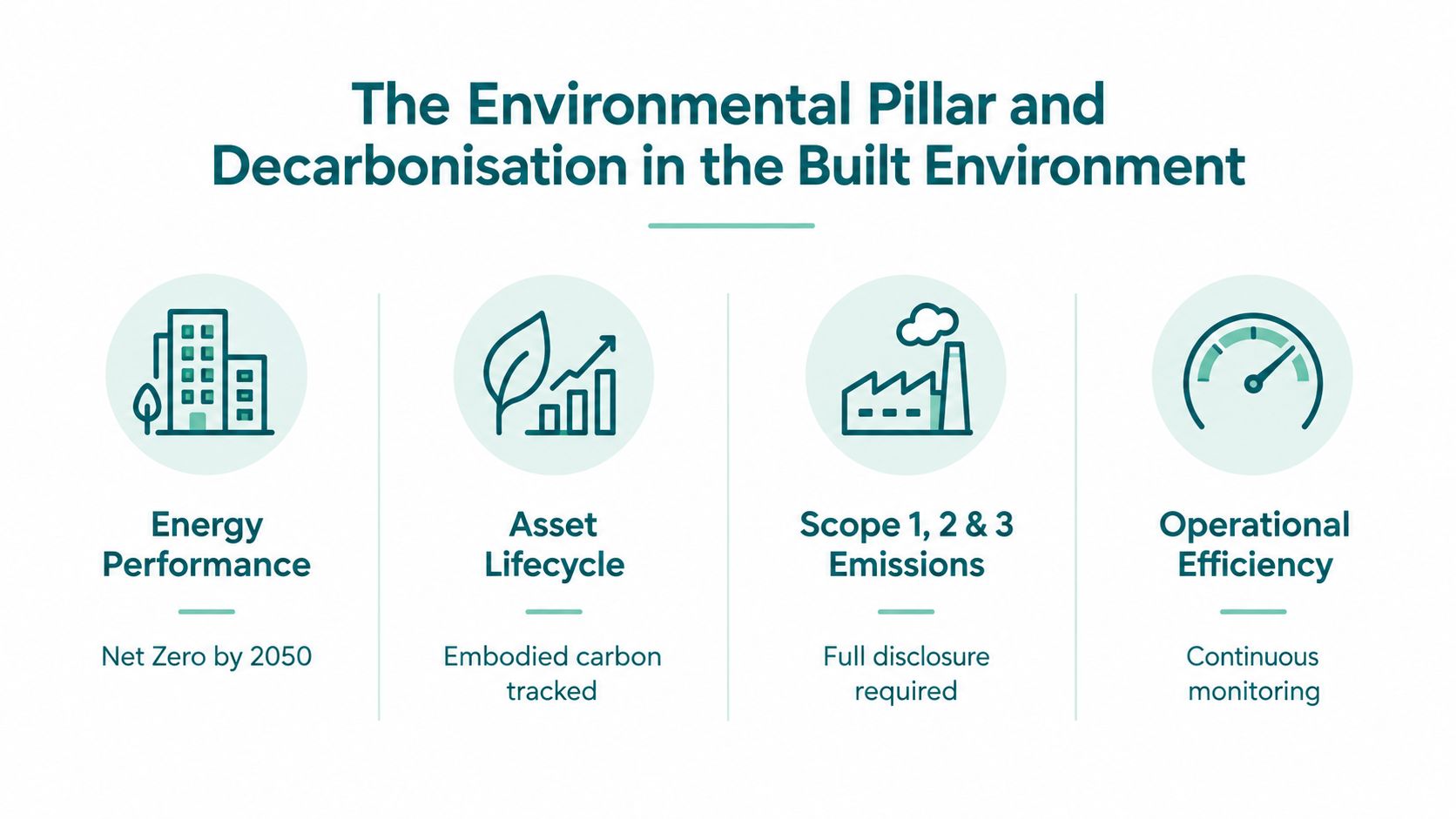
A useful venue review starts with the links between:
- Energy performance, including controls, heating, cooling, lighting and occupancy.
- Asset lifecycle, including embodied carbon, replacement schedules, procurement and whole-life cost.
- Emissions reporting, covering Scope 1, Scope 2 and relevant Scope 3 data.
- Operational efficiency, supported by monitoring, maintenance response and verified improvement.
The low-carbon and renewable energy economy generated £60.2 billion in gross value added in 2022, representing just under 3% of total UK GVA, according to the ONS source above. Decarbonisation therefore affects more than environmental reporting. It influences suppliers, investment priorities, workforce capability and the technologies available to estates teams.
Approval is usually harder than identifying a desirable intervention. Capital limits, heritage requirements and restricted access can delay work, while event schedules may leave little tolerance for downtime. A credible business case compares carbon reduction with reliability, maintenance workload, visitor disruption and financial risk.
Digital services can support this work without replacing energy or asset programmes. Clear navigation may make public transport, walking and cycling easier to use, contributing to carbon footprint reduction. The estate still needs measured energy performance and a defined replacement strategy. Teams assessing physical options can also review solar and electric vehicle products alongside site capacity, connection requirements and maintenance obligations.
The Social Pillar and Accessibility as a Compliance Requirement
Accessibility is not a branding detail within the Social pillar. For public-facing venues, it is an operational and legal requirement: people need to access information, services and places on an equal basis.
UK government websites and mobile applications must meet accessibility duties by law. The Government Digital Service accessibility monitoring guidance identifies 16.1 million disabled people in the UK who rely on accessible digital services and recommends testing with target users, including people with visual impairments or cognitive disabilities.
Venue operators should apply the same discipline to the whole customer journey. Digital ticketing, event information, wayfinding, transport advice and customer support determine whether a person can use a site independently. Ramps and accessible toilets do not resolve an inaccessible booking process or unclear route instructions.
A venue also has to keep access working while conditions change. Platforms close, clinics move, retail entrances become blocked and events redirect pedestrian flows. Static signs and one-time audits cannot control every temporary change.
The operating model needs clear ownership rather than another general policy statement. Record who maintains destination data, checks route changes, reviews digital content and responds when a visitor reports a barrier. Test the service with disabled users, compare their experience with expert accessibility reviews, and keep corrective actions visible in risk and performance reporting.
The evidence should cover:
- Representative user testing, including practical friction that technical checklists may miss.
- Consistent information across channels, from websites and apps to announcements, signage and staff instructions.
- Maintenance responsibility, so routes and destination details remain accurate after operational changes.
- Recorded assurance, including findings, testing dates, corrective actions and unresolved risks.
An accessible entrance does not create an accessible experience if a visitor cannot locate it, understand the route or recover when conditions change.
Infrastructure-free navigation can support this control model because route guidance can be updated without installing new physical equipment at every decision point. It still depends on accurate mapping, accessible instructions and operational processes that reflect closures and diversions. If a visitor cannot interpret an app, identify a destination or handle a complex interchange, staff demand rises and the journey may be abandoned.
Communication access forms part of the same service obligation. Venues reviewing announcements and event content can consider live captions for hearing loss. Waymap's explanation of accessibility requirements connects legal duties with inclusive service design. Together, these controls give the Social pillar measurable operational content.
Governance and the Shift to Mandatory Sustainability Reporting
Governance makes ESG operational. It assigns ownership for data, investment decisions, risk controls and corrective action, so environmental and social claims can be examined rather than treated as brand language.
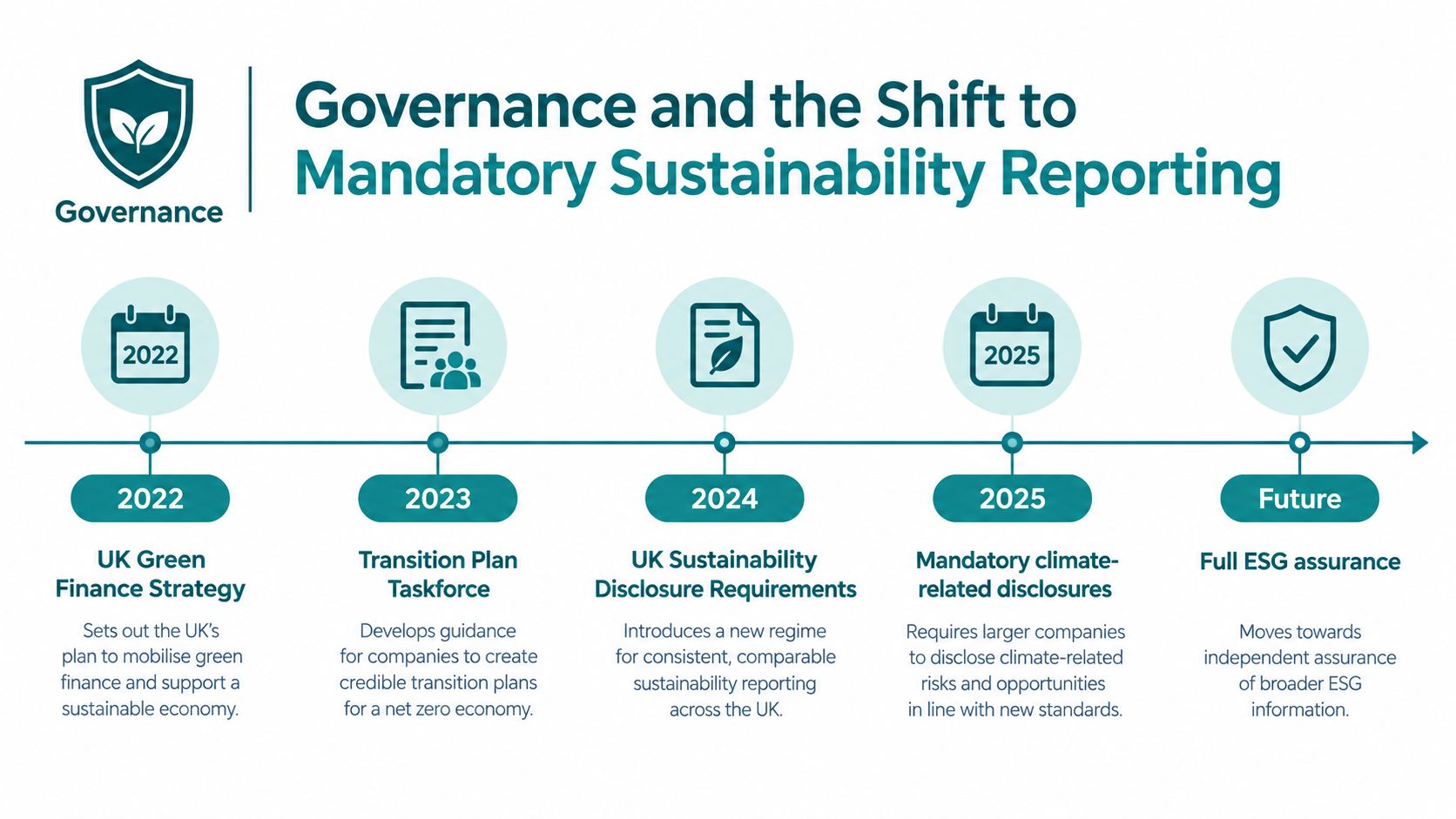
The reporting architecture includes the ISSB's IFRS S1 and IFRS S2, issued in 2023, and the UK standards built on that global baseline. UK SRS S1 covers general sustainability-related financial disclosures, while UK SRS S2 addresses climate-related risks and opportunities, as set out in the UK government's UK SRS publications. These standards sit alongside financial reporting.
What the UK timeline means in practice
Because UK SRS are voluntary today, boards should treat adoption as a readiness exercise. They need to map the data owners, controls and assurance steps that would be required if the FCA's proposed future application becomes binding. The UK government guidance on UK Sustainability Reporting Standards explains the current position.
The FCA already requires certain asset managers and FCA-regulated asset owners to make annual climate-related disclosures consistent with TCFD, at entity and product or portfolio level. Firms with more than £5 billion in assets under management must produce an annual sustainability entity report, according to the FCA's climate change and sustainable finance guidance.
For venue groups, the practical question is whether their operating records can support a defensible disclosure. That means assigning responsibility for:
- asset registers and maintenance records;
- energy and emissions data;
- accessibility risk assessments;
- supplier due diligence;
- incident escalation;
- approval trails for sustainability claims.
These controls also expose weak handovers. A route may be accessible in a design document but unavailable during a closure. An emissions figure may exist without a clear owner or review history. Governance links the reported outcome to the decision, evidence and person accountable for it.
UK policy is also progressing on ESG ratings rules and sustainability assurance. The Simmons & Simmons ESG regulatory update discusses the UK's draft ESG Ratings rules, ISSA (UK) 5000 and the developing reporting regime. Weak evidence can therefore create regulatory and reputational exposure.
Operators can use ESG reporting frameworks guidance when connecting inclusive navigation outcomes with wider reporting structures. For venue directors, the governance test is direct: can the organisation show who made the decision, what evidence supported it and how performance is checked?
How Infrastructure-Free Navigation Supports ESG Goals
Physical accessibility infrastructure creates a familiar estate-management problem. Bluetooth beacons, dedicated transmitters and other installed hardware may require procurement, installation, battery replacement, surveys and updates whenever a venue changes. At a hospital, transit hub or stadium with frequent layout changes, the technical solution can become another asset estate to maintain.
Budget approval adds friction. Capital spend restrictions may make a hardware rollout difficult to authorise, while operational teams may resist a system that creates hundreds of additional maintenance points. The alternative isn't to accept inaccessible wayfinding. It is to consider whether the navigation layer can use infrastructure already carried by visitors.

Waymap uses dead reckoning based on device-native smartphone sensors, combining motion data with detailed maps. Its stated capability includes sub-3-metre accuracy in infrastructure-free environments, without a pre-mapping requirement. That design is relevant to venues with high staff turnover, temporary closures or frequent layout changes because the operator can update destinations and routes without maintaining a network of installed beacons.
The operational trade-off
Infrastructure-free navigation doesn't remove every responsibility. The venue still needs accurate maps, clear destination data, route governance and user testing. It does, however, shift the maintenance burden from distributed physical hardware to a managed digital information layer.
That can support the social pillar by helping visitors reach exact doors, platforms and points of interest. It can support the environmental pillar when better journey information helps visitors choose public transport, walking or cycling instead of higher-impact travel options. Waymap's Lord's Cricket Ground deployment is presented in that context, supporting matchday journey planning at the venue.
The Equality Act 2010 provides the relevant UK legal anchor for considering reasonable access and non-discriminatory services. Other built-environment references, including BS 8300 and BS EN 17210, can help teams think about inclusive design, but standards don't make an inaccessible service acceptable by themselves. Operators need to test the complete journey, from finding information to reaching the correct destination.
A short demonstration can help estates and accessibility teams assess how the approach fits their own constraints.
Waymap also describes its platform as working indoors, outdoors and underground without GPS, Wi-Fi or installed hardware. Its GPS-free navigation explanation gives operators a more detailed account of that infrastructure-free model. The right procurement decision still depends on route complexity, data governance, accessibility testing and the venue's existing systems.
Measuring and Reporting ESG Impact in Large Venues
A venue can't report credible ESG performance from slogans. It needs a chain from risk, to control, to evidence, to decision. Accessibility belongs in that chain alongside emissions, energy and governance.
Start with a baseline audit. Walk the customer journey with disabled users and accessibility specialists, covering digital discovery, arrival, entrances, internal routes, facilities, changes of level, temporary restrictions and recovery from error. Record the barrier, its operational cause, the responsible owner and the action required.
Then establish measures that show service performance rather than activity. A count of installed signs says little about whether visitors can find the correct entrance. A statement that accessibility matters says nothing about whether route information remains accurate after a refurbishment.
A practical reporting sequence
- Define material risks. Identify where inaccessible information, poor route continuity, climate exposure or weak data controls could affect users, operations, finance or reputation.
- Assign accountable owners. Give estates, digital, customer service, procurement and governance teams clear responsibilities.
- Capture evidence at source. Store audit findings, test results, route changes, maintenance actions and user feedback in a controlled process.
- Report exceptions openly. An unresolved barrier is more useful in a risk register than hidden inside a positive narrative.
- Review outcomes. Compare planned actions with completed actions and test whether the change improved the user journey.
| ESG Pillar | Traditional Metric (Avoid) | Auditable Operational Metric (Adopt) |
|---|---|---|
| Environmental | “We support sustainable travel” | Recorded journey-information updates, route coverage and evidence of public-transport, walking and cycling guidance |
| Social | “We are an inclusive venue” | Accessibility audit findings, user-testing records, resolved barriers and route-information accuracy checks |
| Governance | “Accessibility is overseen by leadership” | Named control owner, review schedule, approval record, risk escalation and corrective-action status |
| Environmental | “We are reducing our footprint” | Verified energy, emissions and asset-performance data linked to improvement decisions |
| Social | “Visitors receive accessible information” | Testing evidence across web, mobile, signage, announcements and assistance channels |
The Financial Reporting Council's corporate reporting material highlights investor expectations for granular ESG data and stronger connections between narrative reporting, governance and risk controls. That is the standard venue operators should aim for, even where a particular reporting requirement doesn't yet apply to them.
Deloitte's UK corporate reporting review found that all companies studied had at least one climate target, 80% included Scope 3 reduction targets, and 97% disclosed Scope 3 metrics for at least one category, according to its 2025 corporate reporting review. The lesson isn't to copy another organisation's targets. It is to build reporting around evidence that finance, operations and assurance teams can challenge.
Frequently Asked Questions About ESG and Accessibility
What is ESG and why is it important for venues?
ESG is a framework for managing environmental, social and governance impacts, risks and controls. For venues, that means connecting energy use, accessible services, climate exposure and decision quality with compliance, funding, day-to-day operations, reputation and long-term asset value.
Are UK Sustainability Reporting Standards mandatory?
UK SRS are currently available for voluntary use and are not mandatory for most UK companies. The UK government published the standards on 25 February 2026, while requirements for certain UK entities remain under consideration, as explained in the official UK SRS guidance.
What does the social pillar mean for accessibility?
The social pillar includes whether people can access services and information in practice. Public-sector websites and mobile apps must meet legal accessibility requirements. Venue operators should apply the same operational discipline to digital information, wayfinding, testing, assistance channels and maintenance.
Does ESG require reporting Scope 1 and Scope 2 emissions?
The answer depends on the reporting framework and entity involved. Operators should confirm which requirements apply, then connect emissions data to board oversight, risk management and the evidence used in sustainability reporting. Scope 1 and Scope 2 data should not sit separately from operational decisions.
Can infrastructure-free navigation support ESG?
Infrastructure-free navigation can support the social pillar by helping people reach destinations without installed beacons or similar hardware. Accurate journey information may also support environmental goals by making public transport, walking and cycling more practical. The system still requires accurate maps, route testing, governance and maintenance.
What should a venue measure first?
Start with material barriers and operational evidence. Audit the full visitor journey, assign each corrective action to an owner, record testing and route changes, and report unresolved accessibility risks alongside environmental and governance information. Short, dated records are more useful than broad statements of intent.
Waymap provides indoor, outdoor and underground navigation through smartphone sensors and detailed maps, without relying on GPS, Wi-Fi or installed hardware. Venue and estate teams can visit Waymap to assess whether an updateable navigation layer fits their sites, routes and reporting processes.
