
Accessibility Requirements: A Practical Guide for Venues
A passenger arrives at a major terminus and finds tactile paving that stops before the correct platform, audio information that doesn't match the departure board, and staff who aren't sure where accessible assistance begins. At a stadium, a wheelchair user may face a different problem at every turnstile, while a blind visitor needs more than a map at the entrance. These are failures of the whole journey, not isolated signage defects.
Accessibility requirements for venues and transit operators therefore cover the built environment, digital services, procurement, information, and staff procedures. The UK public-sector regime became formally enforceable on 23 September 2018, when the accessibility regulations for public-sector websites and mobile apps came into force, and government guidance states that at least 1 in 5 people in the UK have a long-term illness, impairment, or disability (UK government guidance). The practical question is no longer whether accessibility matters. It's how an operator can meet binding duties across a complex estate without waiting for every building, platform, or service to be rebuilt.
What Accessibility Requirements Mean Across Venues and Transit
A venue operator can comply with a building standard and still leave a visitor unable to complete a journey. A station may provide a step-free entrance but fail to explain which lift serves the platform. A hospital may publish an accessible website while its reception desk, corridor junctions, and ward directions remain difficult to traverse. A stadium may install an induction loop but provide no reliable way to reach the accessible seating entrance from the transport interchange.
That's why accessibility requirements should be treated as a multi-domain operational duty, not a single compliance tick-box. The duty may arise from building regulations, equality law, digital accessibility rules, transport guidance, procurement terms, or an operator's own policies. Each source addresses a different part of the experience, but disabled visitors experience them as one continuous service.
Where the legal duties converge
The built environment is shaped in England by Approved Document M, which establishes the baseline for access to and use of buildings and facilities (Approved Document M). Digital access is governed differently. Public-sector bodies must meet the Public Sector Bodies Accessibility Regulations 2018, while private and public operators also need to consider the Equality Act 2010 and the accessibility of any service delivered through an app, website, kiosk, or customer portal.
Transport adds another layer. Licensed train and station operators must maintain an Accessible Travel Policy, and the Department for Transport's rights guidance covers both vehicle access and passenger information (disabled passengers on transport). For a rail passenger, a ramp, a clear announcement, a functioning lift, a staffed assistance process, and accurate digital directions all form part of the same journey.
Practical rule: assess the route a person must complete, not the individual feature your project has installed.
The scale of the need is clear. Scope reports 16.1 million disabled people in the UK, approximately 1 in 4 people, alongside 2 million people living with sight loss, 12 million people with hearing loss greater than 25 dBHL, and 151,000 British Sign Language users (Scope disability facts and figures). A venue that designs only for wheelchair access, only for screen readers, or only for hearing loss is designing an incomplete service.
Large estates should also connect accessibility planning with wider risk controls. A structured health safety compliance systems approach can help teams record responsibilities, inspection evidence, emergency procedures, and corrective actions alongside accessibility actions.
The Four Domains of Accessibility Requirements
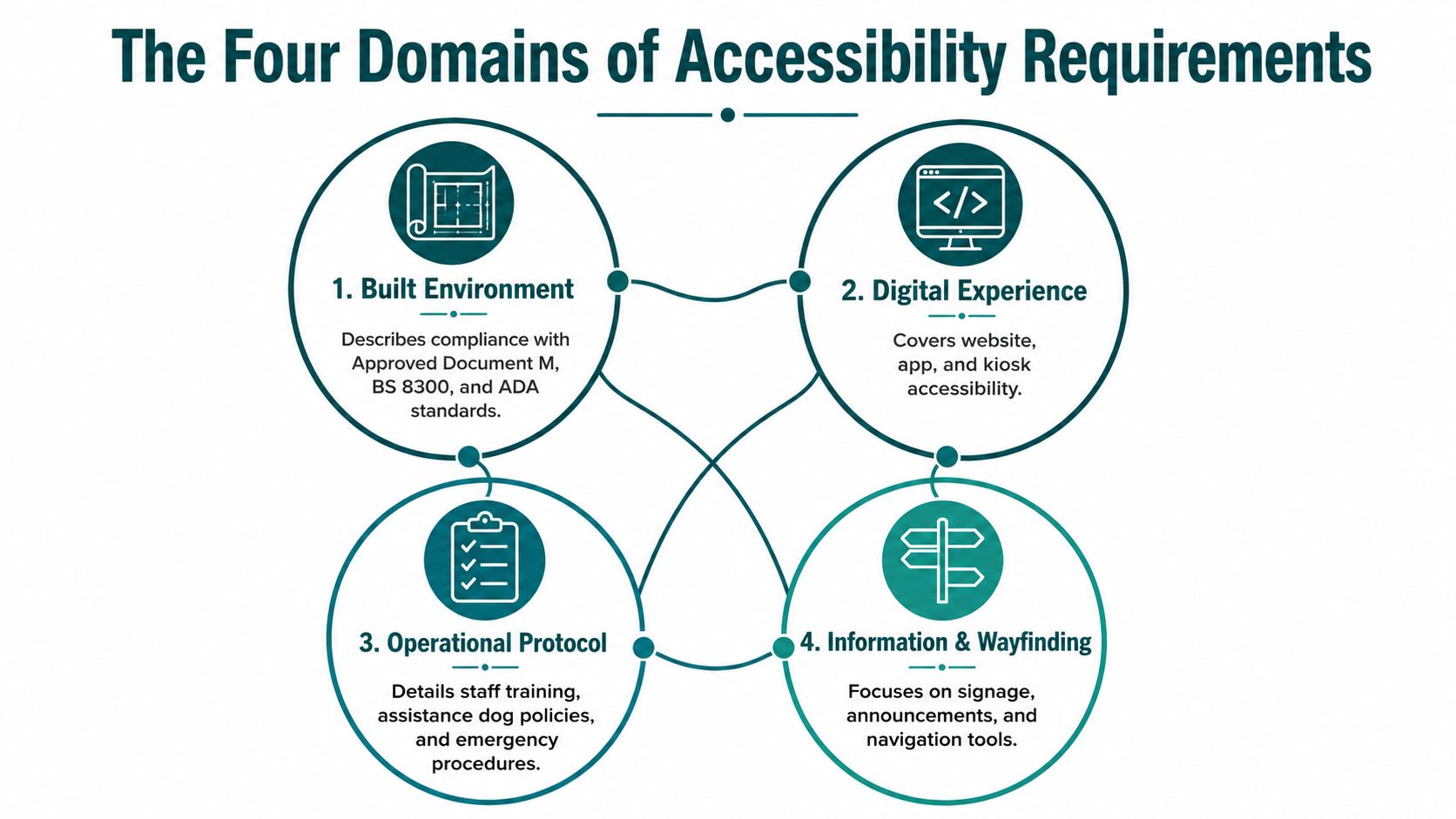
The four domains are built environment, digital experience, operational protocol, and information and wayfinding. They're interlocking workstreams. A procurement team that separates them may buy compliant components that fail when combined.
Built environment
In England, Approved Document M provides the building-regulation baseline for entrances, circulation, sanitary facilities, and vertical movement. BS 8300 gives more detailed built-environment guidance, while ADA Title III applies to places of public accommodation in the United States. These frameworks influence doors, routes, ramps, lifts, counters, seating areas, refuge arrangements, and the visibility of hazards.
Compliance at design stage matters because physical changes become expensive once concrete, services, listed-building constraints, and public access patterns have been fixed. A project brief should identify accessible routes and decision points before it selects a wayfinding supplier.
Digital experience
WCAG 2.2 provides testable success criteria for websites, mobile applications, and other digital interfaces. In the US, Section 508 governs covered federal information and communication technology. In the UK, the Public Sector Bodies Accessibility Regulations 2018 require public-sector websites and apps to meet accessibility obligations and publish an accessibility statement.
The operator remains responsible for the journey even when a third-party vendor supplies the ticketing platform, payment screen, passenger app, or content management system. Accessibility clauses must therefore cover testing, remediation, content authoring, release management, and evidence, not just a promise that the product is accessible. Our practical guidance on accessibility best practices treats digital access as part of service delivery rather than a design afterthought.
Procurement
The Equality Act 2010 affects how a service provider commissions and delivers services. A tender that specifies minimum conformance but ignores maintenance, staff workflows, data ownership, and route updates can create a procurement-versus-reality gap.
Write requirements around outcomes. Ask suppliers how they'll handle a closed lift, a changed platform, a temporary entrance, an inaccessible route, or a new point of interest. Require operators to retain usable accessibility data and to test the complete journey with disabled people.
Operational protocol
Transport operators must maintain an Accessible Travel Policy, and staff procedures can form part of the reasonable-adjustment duty. Training, assistance arrangements, announcements, alternative formats, ramps, hearing loops, and escalation procedures all matter. The EU Web Accessibility Directive, as transposed by member states, adds a separate public-sector digital framework for organisations operating in relevant EU jurisdictions.
A policy is only credible when front-line staff can apply it under pressure. Audit what happens during disruption, not only what the published policy says.
Built-Environment Standards Operators Must Apply
Project managers need measurable requirements in the retrofit brief, but they also need to distinguish between a binding building-regulation baseline and detailed design guidance. Approved Document M is the legal building-regulation reference in England, while BS 8300:2018 provides practical guidance for inclusive design. The 2010 edition of Approved Document M took effect on 1 October 2015 in England (Approved Document M technical source).
BS 8300:2018 specifies a minimum general access-route width of 1,800 mm, with 2,000 mm preferred to accommodate larger electric mobility scooters. It also gives a setting-down-point dimension of at least 9 m by 3.6 m (BS 8300:2018 guidance).
Put the requirements into the brief
| Element | Threshold | Source | Operator action |
|---|---|---|---|
| General access route | 1,800 mm minimum, 2,000 mm preferred | BS 8300:2018 | Protect the clear route from furniture, queues, displays, and temporary equipment |
| Setting-down point | At least 9 m by 3.6 m | BS 8300:2018 | Position it close to the accessible entrance and connect it to a continuous route |
| Entrances and circulation | Access to and use of buildings and facilities | Approved Document M | Confirm the route at concept, planning, and construction stages |
| Vertical movement | Accessible lift and stair provision where required | Approved Document M and project design | Check every public level and identify the fallback route during lift failure |
| Wayfinding | Clear, consistent information at decision points | BS 8300 principles and operator policy | Coordinate signs, tactile information, announcements, and digital directions |
The dimensions don't solve wayfinding by themselves. A wide corridor still fails if a blind visitor can't identify the correct branch, and a compliant entrance still creates a barrier if temporary barriers divert people without accessible instructions.
A retrofit brief should specify the route, the decision points, and the failure mode, not just the sign type.
The design decision also affects later technology choices. Structural widening, new lifts, tactile surfaces, and fixed signage can take years to approve and install. An infrastructure-free navigation layer can sit alongside those works, helping operators address route communication without waiting for another capital cycle. Our overview of UK accessibility standards places those physical requirements in the wider compliance context.
How ADA, Equality Act, and WCAG Duties Compare
These frameworks overlap, but they don't create the same duty or use the same enforcement model. Operators should identify the legal trigger first, then define the evidence needed to show that the service works.
| Criterion | ADA Title III, US | Equality Act 2010, UK | WCAG 2.2 and PSBAR 2018 |
|---|---|---|---|
| Primary trigger | A place of public accommodation provides goods or services | A service provider must avoid disability discrimination and make reasonable adjustments | A covered digital service must meet testable accessibility criteria |
| Practical focus | Equal access, effective communication, physical and service access | Anticipatory accessibility duties and case-specific reasonable adjustments | Perceivable, operable, understandable, and robust digital content |
| Typical evidence | Accessible facilities, policies, testing, complaint handling | Adjustment decisions, service processes, consultation, staff actions | Test results, accessibility statements, remediation records |
| Digital coverage | Digital duties depend on the relevant ADA title, entity, and enforcement position | Digital barriers can amount to service discrimination | WCAG success criteria provide the technical benchmark for websites and apps |
| Operator response | Remove barriers and provide equal access | Anticipate barriers and take reasonable steps | Build accessibility into design, content, procurement, and release testing |
Under the Equality Act, the duty to make reasonable adjustments is case-specific. The assessment can consider practicality, cost, impact on other users, organisational resources, and available financial support (ORR Accessible Travel Policy guidance). That makes a blanket “we meet the standard” response weak when a particular service still puts someone at a substantial disadvantage.
The US and UK also differ in enforcement routes and remedies. ADA disputes may involve private claims, government enforcement, or negotiated settlements. UK disputes can involve Equality Act claims, regulator engagement, or an Equality and Human Rights Commission inquiry. The precise risk depends on the entity, service, facts, and jurisdiction, so legal advice is appropriate for a live dispute.
WCAG 2.2 moves the digital conversation towards criteria such as 2.4.11 Focus Not Obscured and 2.5.7 Dragging Movements. Those criteria don't make an indoor navigation app a legal requirement, but they do affect the accessibility of the app itself. For video and public information, teams also need a reliable process for WCAG-compliant caption creation.
Our Equality Act 2010 requirements guidance provides further context. In a retrofit, the strictest binding duty is the one triggered by the operator, service, building, and user journey in front of you. A voluntary standard cannot cancel a statutory duty, and a digital conformance statement can't cure an inaccessible physical route.
Where Waymap and Named Deployments Bridge the Gap
Operators often know what better access should look like, but physical infrastructure creates the delay. Beacons need installation, power, asset registers, survey updates, and maintenance. Floor tags and fixed signs can become inaccurate after a refurbishment, temporary closure, or change to passenger circulation.
Waymap uses dead reckoning from device-native motion sensors, rather than GPS, Wi-Fi, Bluetooth beacons, or installed hardware. Its navigation model is designed for sub-3-metre accuracy in infrastructure-free environments and doesn't require pre-mapping, which is relevant to venues with frequent layout changes or high staff turnover. The app can provide step-by-step audio and visual instructions, including step-free routes, on a person's own smartphone.

What named deployments show
The relevance becomes clearer in live settings:
- WMATA demonstrates the transit challenge, where passenger information and journey planning must connect with a large network of stations, platforms, entrances, and assistance processes.
- Lord's Cricket Ground illustrates the venue problem, where step-free routing needs to reflect the actual visitor journey rather than a generic site map. The Lord's Cricket Ground case study describes the deployment context.
- Royal Hospital for Children and Young People shows why indoor navigation matters in care environments, where caregivers need to locate wards and services inside a complex building.
These deployments don't replace compliant doors, lifts, signs, tactile surfaces, staff assistance, or Accessible Travel Policies. They address a different gap: communicating a route accurately after the building has already been built and while the environment continues to change.
The procurement advantage is operational. A venue can update mapped points of interest and route information without installing ceiling beacons, floor tags, or fixed navigation hardware. That reduces dependence on a capital-budget cycle and avoids a hardware estate that must be surveyed, repaired, and refreshed as the venue changes.
The demonstration video provides a useful view of the navigation experience:
Operational Implications and the EU/UK Digital Split
Compliance cost is driven less by the first installation than by what happens afterwards. A lift goes out of service, a platform changes, a reception desk moves, or a supplier releases a new app version. Operators need ownership, update procedures, staff capability, and evidence that remains current.
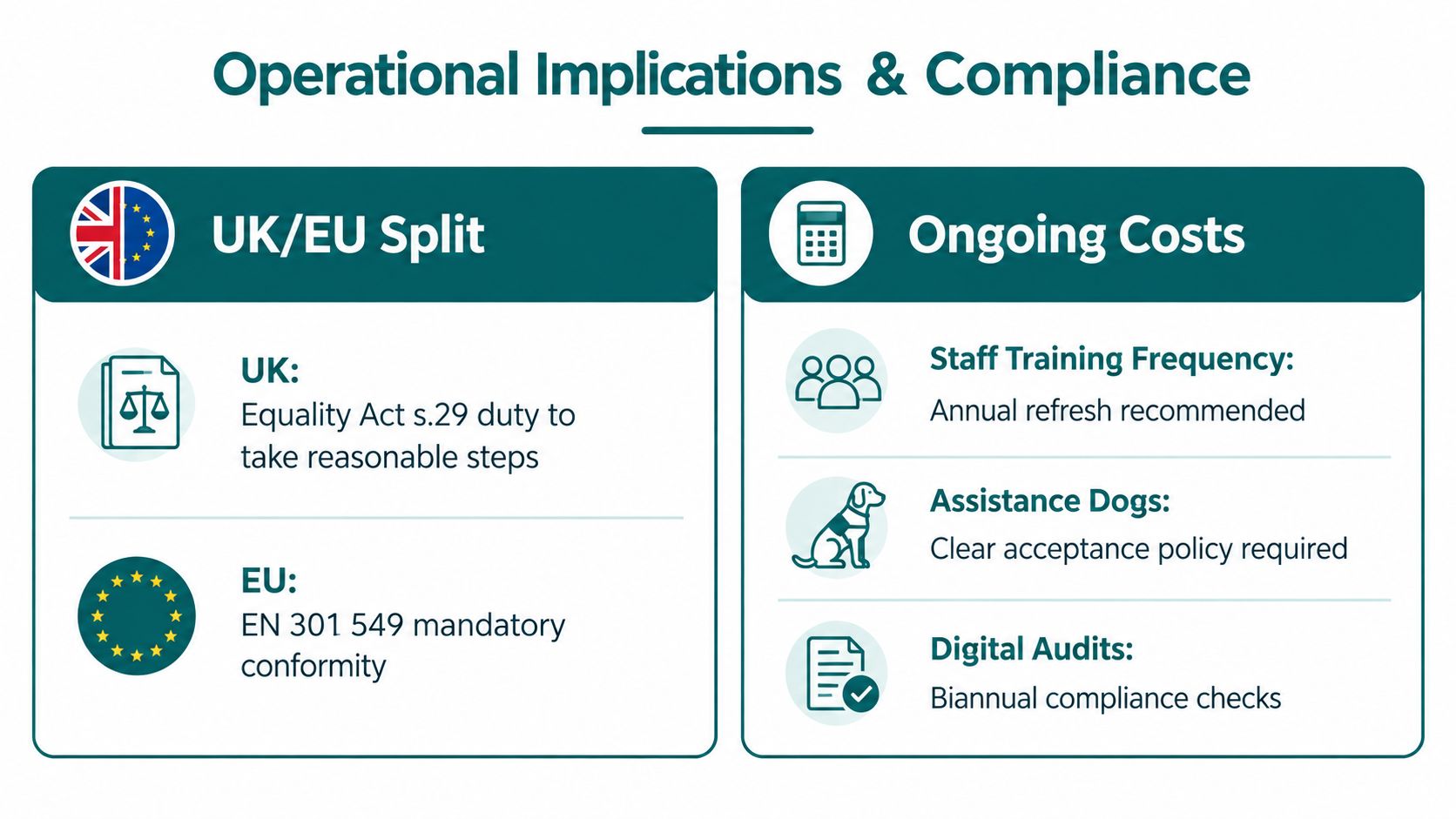
The Equality Act duty under section 29 can require reasonable adjustments to the way a service operates. ORR guidance identifies examples including staff assistance, announcements for visually impaired passengers, hearing loops, alternative-format information, and ramps (ORR transport guidance). Rail and bus operators also need an Accessible Travel Policy, with processes that disabled passengers can understand and staff can follow.
The cross-border digital question
The European Accessibility Act became enforceable on 28 June 2025, affecting covered digital products, services, and self-service terminals. UK public-sector digital obligations continue under the Public Sector Bodies Accessibility Regulations 2018 and the Equality Act 2010. UK and EU rules therefore shouldn't be treated as one harmonised code, particularly for a UK operator serving EU users through ticketing, kiosks, apps, or customer communications (UK and EU digital accessibility comparison).
A cross-border operator should map both regimes to one practical digital baseline, then record where scope, exemptions, enforcement, or market obligations differ. The defensible business case is not “buy accessibility technology”. It's “reduce recurring route-maintenance work, make service changes traceable, and address barriers before they become complaints or emergency workarounds”.
Teams should also control consent and privacy properly when services use location or movement data. Our consent management guidance is relevant to the governance layer, although consent design doesn't replace accessibility testing.
Friction Points Decision-Makers Face
A visitor may receive accurate digital directions and still encounter a closed lift, a blocked corridor, or an entrance they cannot identify after arriving by taxi. Physical access remains the point at which many journeys succeed or fail, so operators must connect digital information with conditions on the ground.
Capital budgets create a second constraint. Widening a route, installing a lift, replacing a counter, or altering a listed building can involve planning consent, conservation approval, stakeholder consultation, and substantial funding. At a listed station or hospital, the preferred intervention may be impossible or cause disproportionate disruption. Infrastructure-free navigation can provide a responsive wayfinding layer while longer building work is assessed, but it cannot remove the underlying duty to provide accessible physical access.
Different users encounter different failures
- Blind and partially sighted passengers need consistent tactile and audio cues, with reliable updates when routes change.
- Deaf passengers may rely on visual displays, written updates, and working induction loops rather than spoken announcements alone.
- Neurodivergent visitors may benefit from predictable routes, consistent terminology, less ambiguity, and clear information about changes.
- Wheelchair users need turning space, accessible counter heights, step-free routes, and doors that are open and suitable at the route's end.
High-footfall sites must manage competing effects. Additional signs can improve visibility for some people while narrowing circulation space or increasing visual noise for others. A low-cost tender may meet a minimum specification yet exclude the route ownership, testing, and update process required to keep information accurate after launch.
The cheapest compliant component is not always the lowest-cost service. Maintenance, failed journeys, staff intervention, and repeated rework belong in the total cost.
Procurement should therefore test the operating model, not only the installed product. Ask who verifies route changes, how closures reach users, who owns accessible content, and how staff respond when the digital route and physical environment diverge. This is especially important across campuses, hospitals, stations, shopping centres, offices, theatres, and stadiums, where fixed infrastructure can be slow or politically difficult to change.
Infrastructure-free navigation works as a supplement to physical access. It gives operators a dynamic layer for estates that cannot be rebuilt on a short cycle, while statutory duties and practical accessibility still determine whether the overall journey works.
Accessibility Requirements Questions Operators Ask Most
What counts as an accessibility requirement under UK and US law?
An accessibility requirement is the combined duty to remove or reduce foreseeable barriers across the service, building, communication channels, and operating procedures. In the UK, the main anchors include the Equality Act 2010, the Public Sector Bodies Accessibility Regulations 2018, Approved Document M, and transport-specific obligations. In the US, operators may need to consider ADA Title III and Section 508, depending on the organisation and service.
Are digital wayfinding apps a compliance requirement?
Digital wayfinding apps aren't generally a standalone legal requirement. They can, however, support reasonable adjustments and effective communication where a physical environment is complex, changing, or difficult to use. An app must itself be accessible, and it should complement, not replace, step-free routes, staff assistance, tactile information, announcements, and visual displays.
What is the difference between ADA and Equality Act duties for a venue operator?
The ADA and Equality Act both address disability discrimination, but their tests and enforcement routes differ. The Equality Act requires a UK service provider to consider reasonable adjustments where a disabled person would otherwise face substantial disadvantage, while ADA obligations depend on the covered entity, place of public accommodation, service, and applicable title. Operators should obtain jurisdiction-specific legal advice rather than assume that compliance under one framework proves compliance under the other.
Does WCAG 2.2 cover indoor navigation?
WCAG 2.2 applies to digital products, so an app-based indoor map and its navigation interface inherit relevant accessibility obligations. A signage-only system isn't itself assessed as a website under WCAG, although the physical information still needs to meet applicable building, equality, transport, and communication duties. Test the digital route with assistive technology and disabled users, then test whether it corresponds to the building.
Waymap provides infrastructure-free indoor, outdoor, and underground navigation using smartphone motion sensors, with step-by-step audio and visual guidance to specific doors, platforms, wards, and points of interest. If your organisation needs to connect statutory accessibility requirements with a maintainable wayfinding service, visit Waymap to discuss your venue or transit network.
