
ESG Reporting Frameworks: A Practical Guide for UK Operators
A venue ESG lead can open a board pack and find GRI, SASB, ISSB, TCFD, CDP and CSRD cited by different stakeholders, all asking for apparently similar information. Investors want decision-useful climate data, an auditor wants evidence, a parent company wants its template completed, and a customer procurement team wants social and accessibility commitments. The difficult question isn't which acronym sounds most. It's which obligation applies now, which framework is voluntary, and what data should the operator build this quarter.
The UK's reporting environment is in a major transition. The Department for Business and Trade published UK Sustainability Reporting Standards, UK SRS S1 and S2, on 25 February 2026, creating a voluntary baseline aligned with global ISSB-based disclosure norms. The current government and FCA timeline points towards proposed applicability for accounting periods beginning on or after 1 January 2027, which means calendar-year reporters would generally expect their first UK SRS-aligned annual reports in 2028, subject to the final regulatory process. The UK Government's UK SRS guidance sets out that transition.
This guide separates the live UK rules from proposed requirements, then addresses the part many framework explainers omit: where accessibility outcomes fit inside a climate-weighted reporting system. For a transport operator, university, stadium, airport or shopping centre, accessible navigation isn't a marketing footnote. It can be operational evidence about customer access, resilience, service quality and inclusion, even where the principal climate framework doesn't prescribe a disability metric.
When Five Frameworks Land on the Same Desk
The estates or ESG lead at a mid-sized UK venue group rarely receives one clean reporting request. A listed parent may ask for TCFD-aligned information. A sustainability team may use GRI. An investor questionnaire may reference SASB or ISSB. A procurement portal may require CDP-style climate answers, while an EU-connected customer asks for CSRD-related value-chain data.
The friction is practical rather than academic. Energy data sits with facilities, employee information with HR, supplier evidence with procurement, risk controls with legal, and accessibility information may exist only in customer-service logs or project notes. Each stakeholder uses a different vocabulary for overlapping questions about governance, risk, targets, impacts and performance.
Practical rule: Don't start by choosing a favourite framework. Start by identifying the legal entity, reporting trigger, reporting period and audience.
A framework-selection exercise should answer four questions for every operating entity:
- What applies now: Separate binding rules from voluntary guidance and proposals.
- Who is asking: Distinguish regulators, investors, customers, parent groups and internal decision-makers.
- What evidence exists: Trace each disclosure to a source system, owner, methodology and review control.
- What can be reused: Build one controlled evidence base rather than separate spreadsheets for every questionnaire.
That distinction matters particularly in the UK because UK SRS is available for voluntary use in 2026, while mandatory listed-company adoption is still being consulted on for accounting periods beginning on or after 1 January 2027. The FCA and UK reporting transition commentary captures the live implementation issue: companies must sequence preparation without treating a proposed obligation as though it already applies.
Accessibility needs the same discipline. A venue can report step-free routes, accessible entrances, assistance requests, wayfinding barriers and improvement actions, but it shouldn't label those disclosures as mandatory UK SRS requirements unless the applicable rule requires them. The credible approach is to connect inclusion outcomes to operational or financial risks, then report them through appropriate voluntary or stakeholder-facing channels.
What an ESG Reporting Framework Actually Does
An ESG reporting framework gives a business a structured way to decide what it should disclose, to whom and with what evidence. For an operator, it works less like a scorecard and more like a reporting grammar. It defines the subjects, relationships and evidence rules that allow a reader to understand how environmental, social and governance matters affect the organisation.
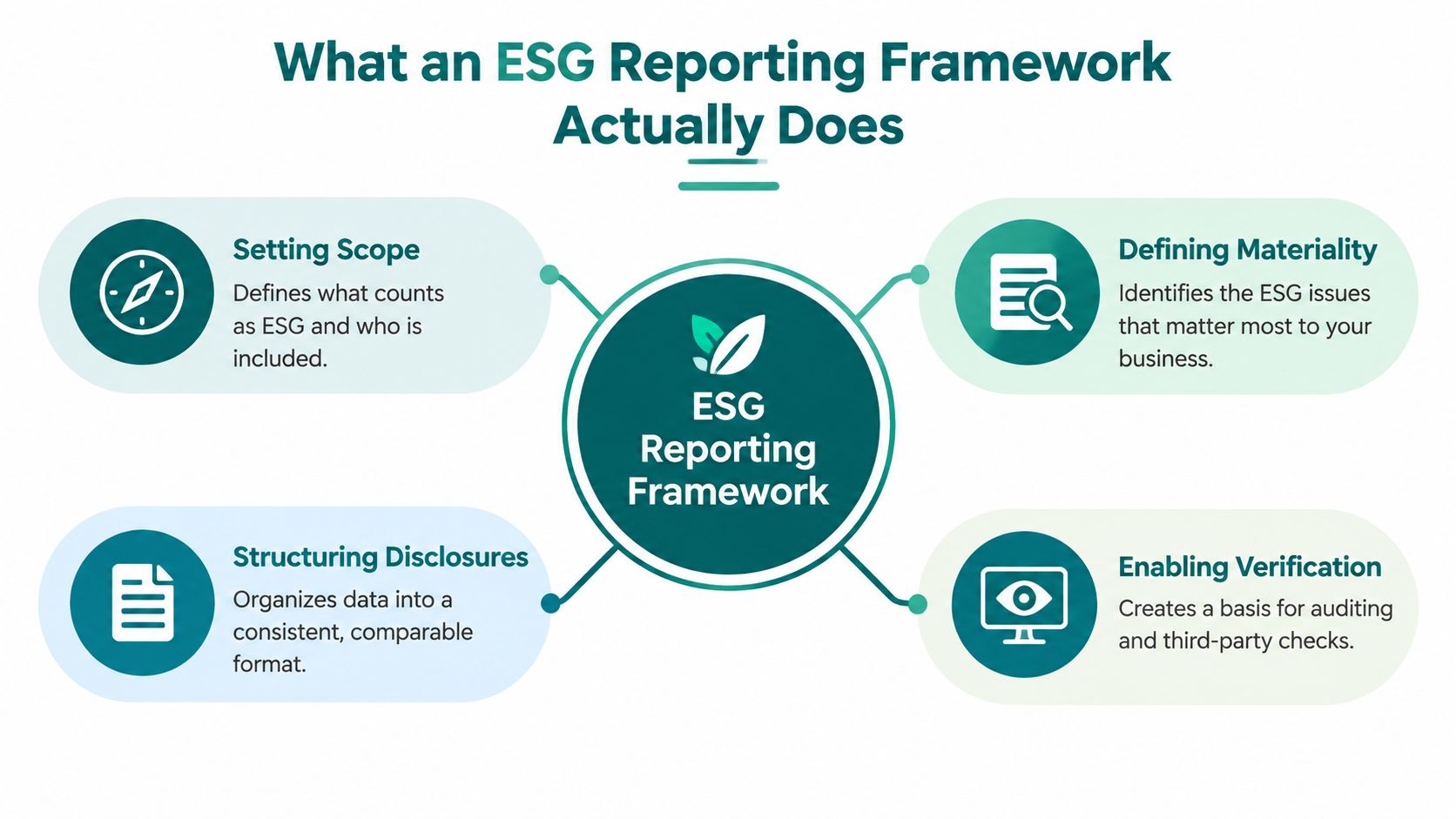
The four jobs a framework performs
Scope establishes the boundaries. Does the report cover one venue, a legal group, leased buildings, contractors, subsidiaries or the wider value chain? A transport operator needs to know whether stations, platforms, concessionaires and outsourced services fall inside the reporting boundary.
Materiality determines relevance. A climate investor may prioritise matters that could affect enterprise value, while a community stakeholder may focus on an organisation's impacts on people and places. The materiality model changes what gets prioritised.
Disclosure structure turns scattered information into a consistent format. Governance, strategy, risk management, metrics and targets are familiar disclosure categories in climate reporting, but each framework sets its own emphasis and detail.
Verification creates a basis for internal review, audit or third-party assurance. A framework doesn't automatically make information accurate. It gives the organisation a consistent place to record methodology, controls, assumptions and evidence. Waymap's discussion of a compliance reporting system is relevant to this evidence problem because regulated, accessibility and ESG information can share a controlled data model.
Frameworks also differ from standards and ratings. A standard contains defined disclosure requirements. A framework provides organising principles. A rating is an external assessment that may use public filings, questionnaires and proprietary methodology. A high rating doesn't prove that a report meets a legal requirement, just as a well-designed report doesn't guarantee a favourable rating.
The audience changes the reporting choice. Regulators need compliance, investors need decision-useful information, customers need procurement evidence, and operational leaders need data they can act on. The major frameworks covered below perform the same four jobs differently, so selecting one is a strategic decision about scope, materiality, audience and evidence.
Comparing the Major Global ESG Frameworks
The major global frameworks aren't interchangeable. They answer different questions, use different materiality concepts and carry different legal weight.
| Framework | Materiality | Primary Audience | Geography | Binding Status | Primary Use Case |
|---|---|---|---|---|---|
| GRI | Impact materiality, focused on an organisation's effects on people, environment and economy | Broad stakeholders, communities, employees, civil society and investors | Global, developed by the Global Reporting Initiative | Generally voluntary unless adopted through a rule, policy or stakeholder requirement | Broad impact and sustainability reporting |
| SASB | Financial materiality, focused on industry-specific investor information | Investors and capital markets | Global industry standards, now maintained within the IFRS Foundation architecture | Generally voluntary, unless incorporated into a jurisdictional or investor requirement | Sector-specific, financially material disclosure |
| ISSB | Financial materiality, focused on sustainability-related risks and opportunities affecting enterprise value | Investors and capital markets | Global baseline developed by the International Sustainability Standards Board | Binding only where adopted or required by a jurisdiction, exchange or regulator | Comparable investor-focused sustainability disclosure |
| TCFD | Financial materiality, organised around governance, strategy, risk management, metrics and targets | Investors, lenders and insurers | Global recommendations originating from the Task Force on Climate-related Financial Disclosures | Binding in some jurisdictions through local rules, but the TCFD framework itself is not UK legislation | Climate-risk governance and disclosure |
| CDP | Questionnaire-based disclosure, drawing on established climate and environmental reporting concepts | Investors, procurement teams and stakeholders | Global | Usually voluntary, unless requested or required by a commercial relationship | Climate, water, forests and supply-chain questionnaires |
| CSRD and ESRS | Double materiality, covering both financial effects and the organisation's impacts | Investors, regulators, workers, communities and other stakeholders | European Union, with potential reach beyond the EU through group and market connections | Binding for entities within scope under EU rules | Detailed, standardised sustainability reporting |
How the global pieces fit together
GRI is the broad stakeholder lens. It suits a venue group that needs to explain effects on workers, communities, customers and the environment, particularly where the audience includes civil society or supply-chain partners.
SASB is narrower and sector-focused. Its value is precision for investors who want to understand financially material sustainability topics in a comparable industry context. The IFRS Foundation now houses the SASB Standards, and the ISSB uses industry-based guidance as part of its wider architecture.
ISSB provides a global investor baseline. IFRS S1 covers general sustainability-related financial disclosures, while IFRS S2 focuses on climate-related disclosures. The ISSB standards build on the TCFD structure, so TCFD's familiar four-pillar approach is largely absorbed into IFRS S2 rather than operating as a separate future global endpoint.
CDP is best understood as a questionnaire and disclosure platform, not a complete accounting standard. Its questions draw on recognised climate and environmental reporting concepts, including TCFD and the former CDSB architecture, and its outputs are often requested by investors and procurement teams.
CSRD and ESRS use double materiality. A company assesses both how sustainability matters affect it financially and how its activities affect people and the environment. UK firms can encounter CSRD through EU subsidiaries, group structures, customers and value-chain information requests, even when the UK-only operating company isn't directly in scope.
For a useful governance perspective alongside the technical frameworks, see governance at Lighthouse Consultants. Waymap's ESG reporting examples also help translate abstract disclosure categories into operational evidence.
The UK Reporting Stack and the 2027 Transition
UK operators need a stack view, not a single-framework view. Different rules apply to different entities, and the presence of one reporting obligation doesn't automatically trigger the others.
| Regulation | Trigger Threshold | First Reporting Period | Scope | Assurance |
|---|---|---|---|---|
| UK SRS S1 and S2 | Voluntary at publication; proposed mandatory application for relevant listed companies subject to FCA consultation | Proposed accounting periods beginning on or after 1 January 2027, with calendar-year annual reports expected in 2028 | ISSB-aligned sustainability and climate disclosures | Follow the applicable legal and FCA assurance requirements once finalised |
| FCA TCFD-aligned listing rules | Relevant major UK-listed companies under FCA listing requirements | Already applies to major UK-listed companies under the existing regime | Climate governance, strategy, risk management, metrics and targets | Depends on applicable FCA and listing requirements |
| Companies Act climate-related financial disclosure regulations | Certain publicly quoted companies and large private companies, including companies outside the quoted and private categories where they exceed both 500 employees and £500m turnover | Applies under the relevant accounting periods for in-scope entities | TCFD-aligned climate-related financial disclosures | Requirements depend on the applicable statutory regime |
| LLP climate disclosure regulations | Certain traded or banking LLPs, and large LLPs that exceed both 500 employees and £500m turnover | Applies under the relevant accounting periods for in-scope LLPs | Climate-related financial disclosures in the strategic report or, for qualifying large LLPs without a strategic report, the energy and carbon report | Requirements depend on the applicable statutory regime |
| SECR | Quoted and qualifying large unquoted companies and LLPs under the relevant energy and carbon reporting rules | Applies under the relevant annual reporting cycle | Energy use and carbon information | Existing reporting controls and any applicable assurance arrangements |
The legal baseline already reaches beyond voluntary sustainability reports. Under the UK Companies Act climate-related financial disclosure rules, in-scope companies include those with more than 500 employees and more than £500 million in turnover, subject to the categories and conditions in the rules. The UK Government guidance on climate-related financial disclosures makes clear that the rules apply to in-scope companies and LLPs, not to every UK business.
For LLPs, the reporting location depends on structure. Traded or banking LLPs put climate-related disclosures in the strategic report. A large LLP that isn't traded or a banking LLP can place the disclosures in its energy and carbon report where it doesn't prepare a strategic report, as set out in the legislation for climate disclosures by LLPs.
What changes with UK SRS
The Department for Business and Trade published UK SRS S1 and S2 on 25 February 2026. UK SRS is currently voluntary, but it provides an endorsed UK version of the IFRS Sustainability Disclosure Standards and a clear preparation path for organisations that want to align early. The UK framework and terms of reference explains the ISSB-based direction.
The practical distinction is sequencing. A listed operator may need to reconcile its existing FCA TCFD controls with UK SRS S2 if the FCA proceeds with the proposed transition. A large private venue group may remain primarily governed by Companies Act climate disclosure rules, while using UK SRS voluntarily to make its reporting more comparable. The UK SRS transition is therefore not a reason to discard current controls. It is a reason to map them, identify missing evidence and avoid building a second disconnected reporting process.
The Accessibility Gap Inside UK SRS
UK SRS is built around a single-materiality, climate-weighted investor lens. That creates a predictable gap: disability access, inclusive design and navigation outcomes may not appear unless the operator can connect them to financially or operationally material risks and opportunities.
The UK Government's sustainability reporting guidance for 2025 to 2026 states that its coverage is environmental and climate-related, rather than a complete treatment of broader social and governance topics. The Equality Act 2010 remains a separate legal framework. It doesn't become satisfied because a venue publishes a climate report.
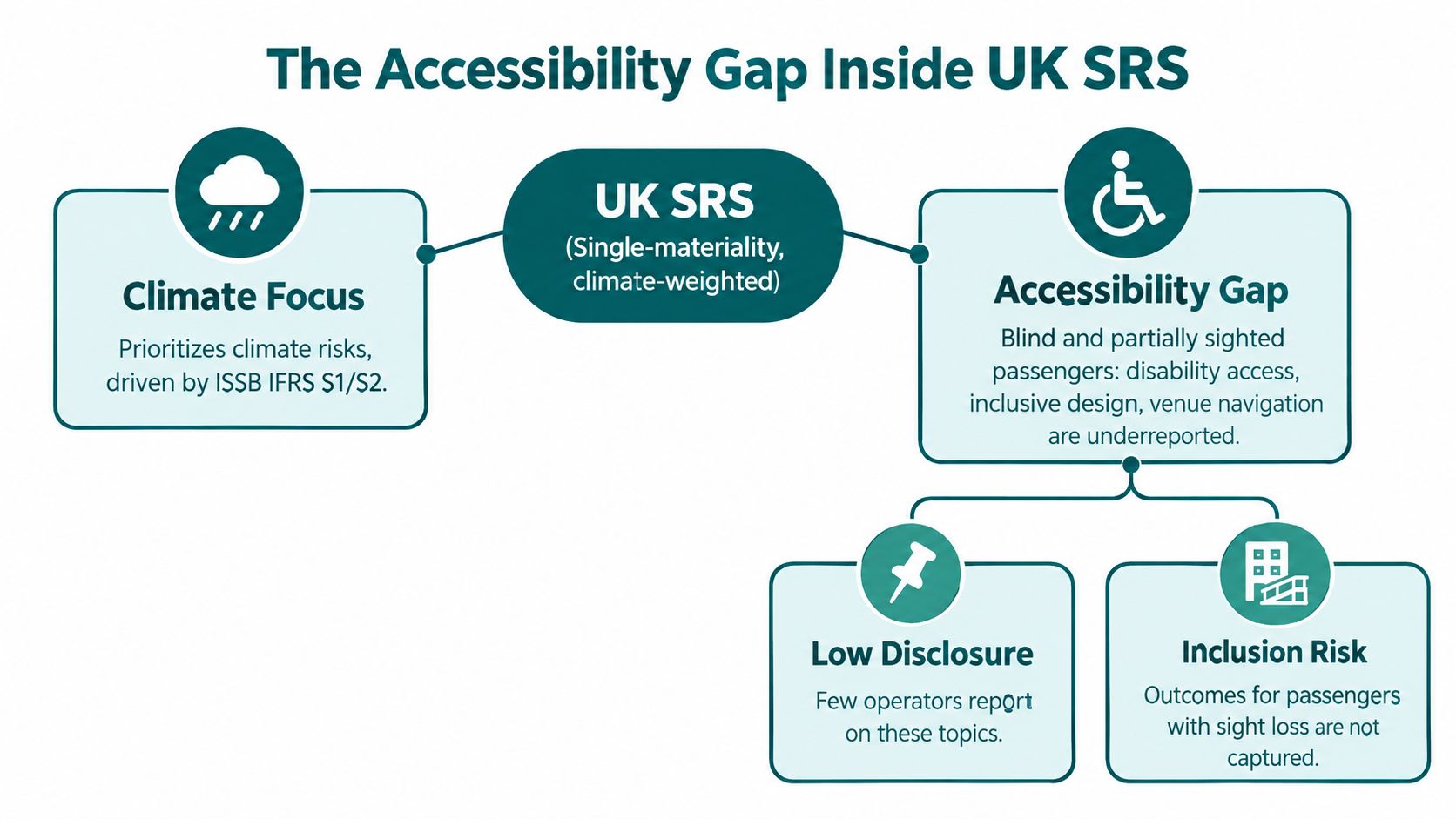
How accessibility can still enter the report
A venue operator can surface accessibility through narrative disclosures when the evidence connects inclusion to enterprise value, operational resilience or stakeholder relationships. Relevant channels include:
- Customer-base resilience: Whether inaccessible routes limit participation, repeat visits or service reach.
- Operational risk: Whether layout changes, station closures or poor information create avoidable service failures.
- Workforce capability: Whether accessible environments support recruitment, retention and employee participation.
- Reputational exposure: Whether public accessibility commitments are supported by documented delivery and controls.
That doesn't make UK SRS an accessibility standard. It creates a defensible place for material accessibility information within a wider risk and opportunity narrative.
GRI can provide a broader stakeholder reporting route, including GRI 405 on diversity and equal opportunity. ESRS offers a double-materiality structure where relevant EU obligations apply, but CSRD doesn't automatically apply to every UK operator. A UK-only venue may instead face social-data requests through customers, investors, parent groups or procurement processes.
Waymap's accessibility best practices provide a practical reference point for documenting navigation and inclusive-design outcomes. The operational test is simple: don't claim that a venue is accessible in general terms. Record which routes, entrances, platforms, facilities or points of interest are usable, how the information is maintained, what barriers were identified and what action followed.
A social claim becomes credible when an operator can show the decision, the owner, the evidence and the review date.
How to Pick and Sequence Your Frameworks
The most reliable selection method starts with compliance, not ambition. Build a mandatory-first matrix for every legal entity, then layer voluntary frameworks according to audience demand.
First, establish the reporting floor
List the relevant triggers in separate rows:
- UK SRS: Record whether the organisation is preparing voluntarily or may fall within the proposed listed-company transition.
- FCA rules: Identify whether the entity is subject to the existing TCFD-aligned listing requirements.
- Companies Act CFD: Test quoted status, private-company category, employee count and turnover thresholds.
- SECR: Check whether energy and carbon reporting applies to the company or LLP.
- Parent or EU nexus: Establish whether a parent group, EU subsidiary or major customer requires CSRD or ESRS information.
Add the reporting year and accountable owner. This stops a customer questionnaire from being mistaken for a statutory obligation, and it prevents a proposed UK SRS requirement from being treated as already mandatory.
Second, map data before buying a platform
Create a line-by-line gap analysis. For each disclosure, record the current source, data owner, calculation method, review control and evidence file. Typical sources include utility bills, building-management systems, fleet records, HR systems, procurement questionnaires, supplier contracts, incident logs and customer-service records.
The exercise should expose overlap. Governance, risk management, climate strategy, metrics and targets may be requested in several forms, but the underlying evidence can often be shared. Accessibility data needs the same treatment. Assistance requests, route audits, accessible-facility records and user feedback should have definitions and ownership rather than living in an unstructured inbox.
Third, add the overlay that matches the audience
Choose GRI when communities, employees, NGOs, civil-society stakeholders and supply-chain partners need broad impact information.
Choose SASB when investors want industry-specific financial-materiality detail.
Choose CDP when institutional investors or procurement teams request its climate and environmental questionnaire.
Choose CSRD and ESRS when a relevant EU subsidiary or group relationship brings the operator within scope or requires structured value-chain information.
For venue navigation, infrastructure-free data can strengthen the social pillar without introducing fixed beacon infrastructure. Waymap uses device-native motion sensors and detailed maps for dead reckoning, supporting navigation in indoor, outdoor and underground environments without GPS, Wi-Fi or installed hardware. Its practical relevance is the ability to document route availability and changes without adding a hardware maintenance programme to a high-footfall venue.
A procurement team should still evaluate mapping governance, data protection, accessibility testing, content ownership and update controls. Waymap's vendor selection criteria offers a useful checklist for that assessment.
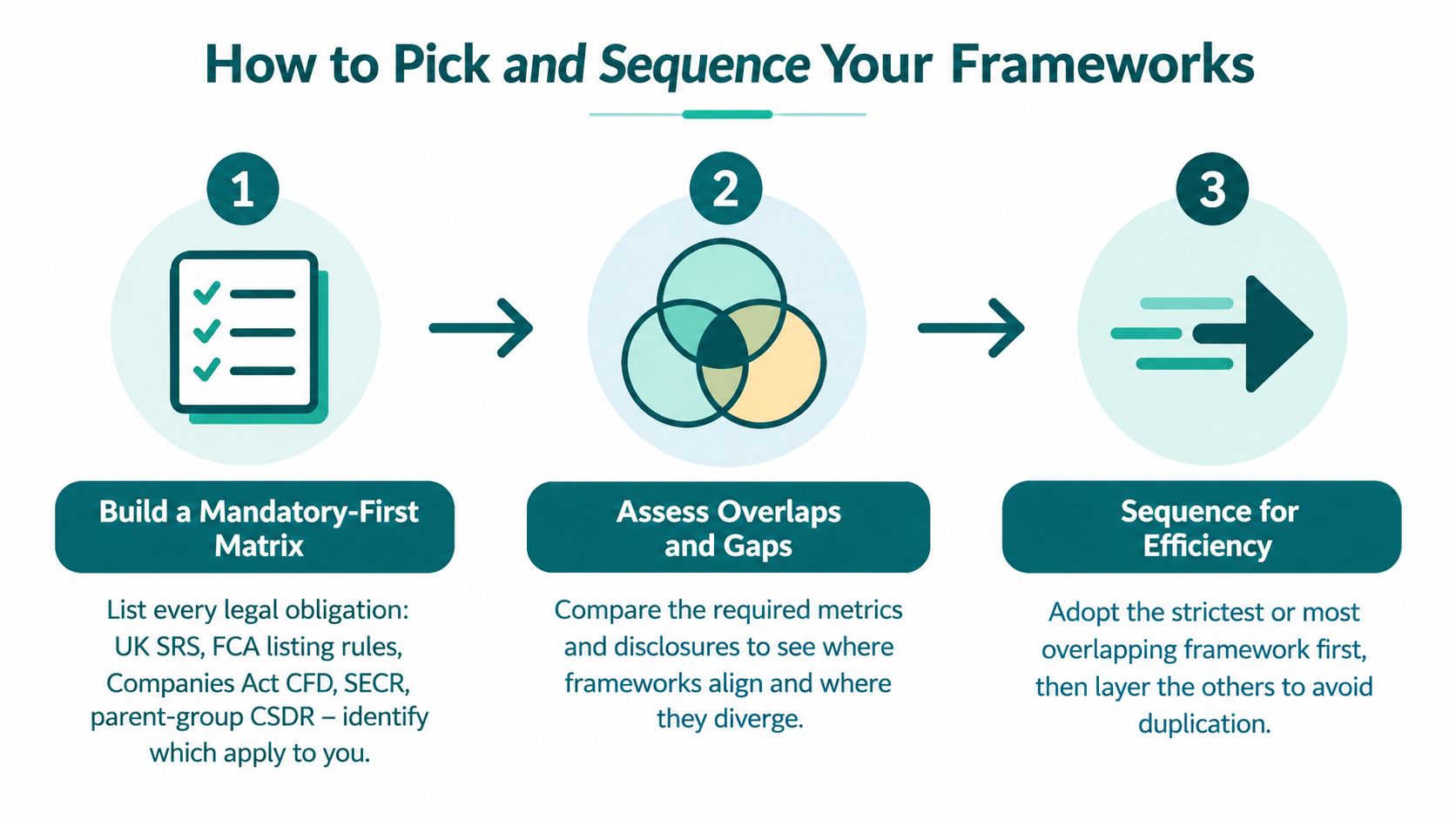
The sequencing principle is straightforward: adopt the strictest or most overlapping applicable structure first, then map additional frameworks to the same evidence spine. Avoid collecting a separate version of the truth for every stakeholder.
Practical Next Steps for UK Venue Operators
A UK estates or ESG lead can make useful progress this quarter without commissioning a full external programme.
Start with applicability. Confirm which rules affect each entity this year. Check FCA listing requirements, Companies Act climate disclosures, SECR and the proposed UK SRS transition. Record the conclusion, the evidence used and the person responsible for updating it.
Refresh materiality with two lenses. Even where UK SRS uses an investor-focused approach, a venue should understand wider stakeholder impacts. EU-connected customers and parent groups may ask for information that resembles double-materiality analysis, including effects on passengers, visitors, workers and communities.
Close the accessibility evidence gap. Document accessible entrances, step-free routes, navigation support, sensory provisions, assistance requests, incidents and remediation. Use consistent definitions and write the narrative so that the operational consequence is clear.
Instrument the underlying data. Footfall, assistance requests and incident logs can support service improvement and social reporting, but only when the organisation defines ownership, retention, quality checks and access controls. Accessibility information should be collected respectfully and proportionately.
Prepare for review. Reporting teams should expect stronger scrutiny of ESG data quality as disclosure becomes more standardised. Create an evidence register now, including source documents, calculation notes, approvals and version history.
The immediate objective isn't to publish every framework. It's to produce one controlled set of facts that can support the statutory baseline, investor questions, customer requests and credible accessibility reporting. Waymap's UK ESG reporting requirements guide takes the same evidence-first approach for venue operators.
Frequently Asked Questions on ESG Reporting Frameworks
Does CSRD apply to UK firms?
CSRD can apply through relevant EU subsidiaries, group structures or significant EU activity, while UK-only operators may encounter it through supply-chain data requests from EU customers. The exact scope depends on the entity and EU nexus, so operators should obtain entity-level legal advice rather than assume that every UK company is covered.
What is the difference between TCFD and ISSB?
TCFD is a climate disclosure framework organised around governance, strategy, risk management, and metrics and targets. ISSB's IFRS S1 and S2 standards provide a broader global sustainability baseline and incorporate the TCFD architecture into structured investor disclosures.
Is GRI or SASB better for a venue operator?
GRI suits broad stakeholder and impact reporting, while SASB suits financially material, investor-focused sector disclosure. Many groups use one as the primary structure and map selected information to the other.
How should accessibility outcomes be reported?
Report accessibility where it is material to operational risk, customer reach, workforce capability or reputation, and supplement UK SRS disclosures with broader stakeholder reporting where appropriate. Utility data also underpins credible environmental reporting, so teams may find this FAQ on utility submetering programmes useful when reviewing source-data controls.
Waymap helps venue and transport operators document accessible navigation across indoor, outdoor and underground environments without GPS, Wi-Fi or installed beacons, using smartphone motion sensors and detailed maps. Visit Waymap to discuss how navigation evidence can support your accessibility programme and wider ESG reporting controls.
