
ESG Reporting Requirements Explained for UK Venues
A venue manager can start the week with a request from an investor, a questionnaire from a major tenant and a procurement form from a public-sector partner. One asks about energy and carbon, another asks about accessibility and workforce practices, and a third wants evidence of governance controls. These are all called ESG reporting requirements, but they don't necessarily come from the same rule.
For UK venues, transport hubs, campuses and estates teams, the practical answer depends on the organisation's entity type, listing status, size and reporting year. Good ESG reporting isn't a sustainability story assembled at year end. It's a controlled record that connects meters, travel data, accessibility actions, risks, targets and decision-making evidence.
What ESG Reporting Requirements Actually Mean
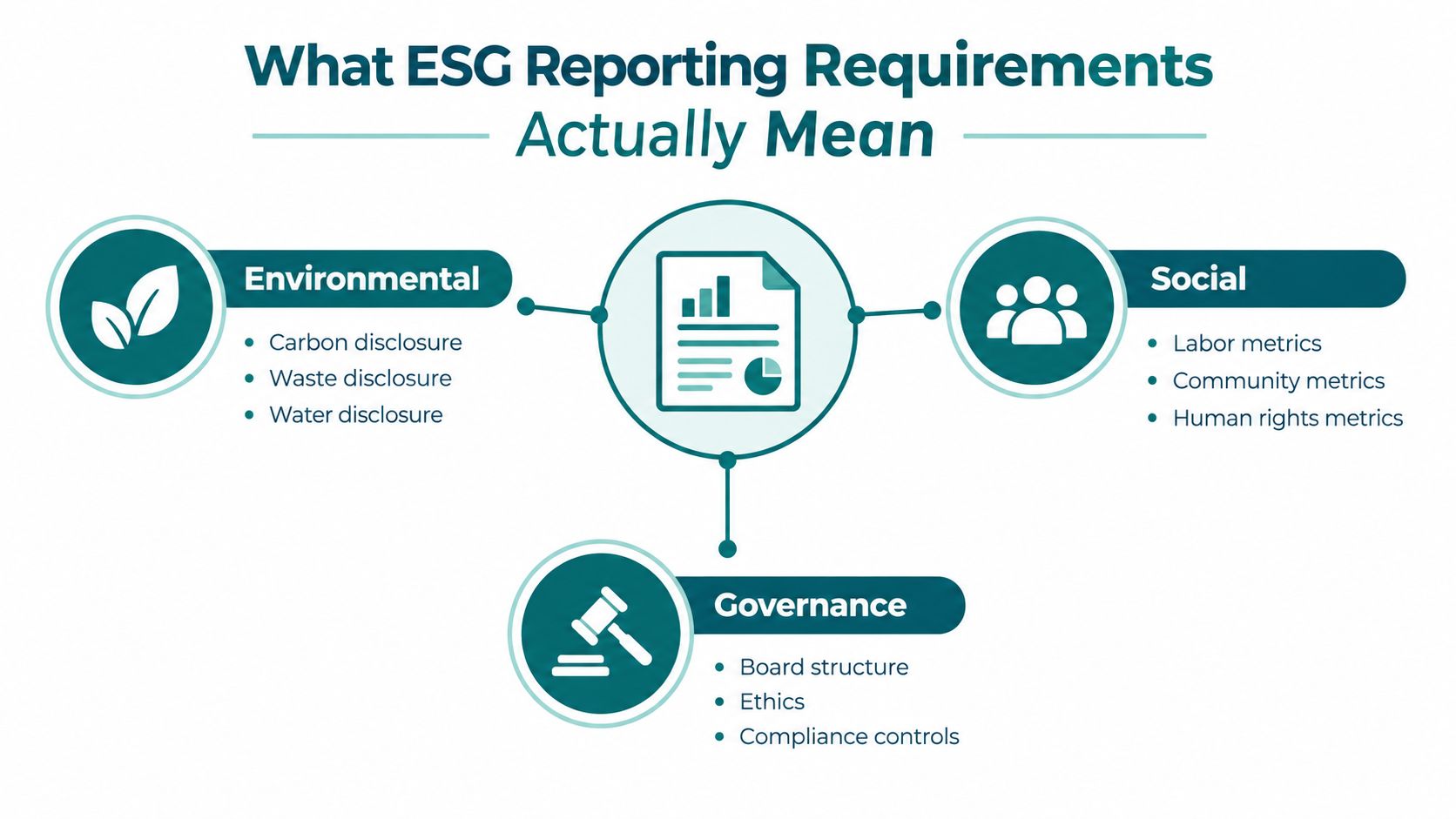
ESG reporting is the structured disclosure of an organisation's environmental, social and governance performance. Investors use it to assess risk and resilience. Regulators use it to test compliance. Tenants, passengers, visitors, employees, procurement teams and local communities use it to understand how an organisation operates.
For a shopping centre, the environmental evidence might include energy consumed across shared areas, Scope 1 and Scope 2 greenhouse gas emissions, an intensity ratio and the actions taken to improve energy efficiency. The social evidence could include workforce information, accessibility provision, health and safety controls and community impacts. Governance evidence might cover board oversight, ethical controls, responsibilities and the process used to approve reported information.
ESG reporting is more than sustainability storytelling
A sustainability webpage may describe a venue's goals and projects. A reporting requirement asks a different question: what can the organisation demonstrate, how was the information produced, and who controls it?
That distinction matters when a transport operator says it has improved access across a station estate. A credible disclosure should identify the relevant action, its operational owner, how the organisation monitors delivery and what evidence supports the statement. The same principle applies to energy, procurement, staff training and climate risk.
Practical rule: Treat every material ESG statement as a claim that needs an owner, a source record, a method and a review trail.
This is also why data security belongs in the reporting conversation. ESG systems can bring together operational, workforce, supplier and facility information, so teams should consider access permissions, retention, validation and governance alongside the metrics themselves. The discussion of data security in ESG disclosures offers useful context for designing that control environment.
Why venue operations create ESG evidence
Venue leaders often own the data without owning the final report. Facilities teams manage meters. Transport teams hold fuel and fleet information. Estates teams know the building portfolio. Accessibility leaders understand visitor barriers. Procurement teams hold supplier records, while the company secretary or finance team manages formal reporting.
The reporting process must connect those functions. If a venue can't trace a figure from source data to methodology and approval, its ESG narrative may look polished but remain difficult to defend. A reliable operational data trail gives investors and other stakeholders a clearer basis for judging performance, priorities and risk.
Why There Is No Single UK ESG Reporting Requirement
There isn't one universal UK ESG reporting requirement that applies in the same way to every company. UK reporting is a layered system of mandatory regimes, company law duties, FCA rules and standards that organisations may adopt voluntarily.
The right first question isn't, “Which ESG report should we write?” It's, “Which obligations apply to this entity, for this reporting year, and at what level of detail?”

The mandatory layer
Streamlined Energy and Carbon Reporting, or SECR, is a mandatory baseline for quoted companies and for qualifying large unquoted companies and LLPs. It focuses on energy use, emissions, intensity, methodology, comparatives and energy-efficiency action.
Companies Act and LLP climate-related disclosures add TCFD-style reporting for certain large companies and LLPs. These disclosures require more than an energy total. They bring governance, strategy, risk management, metrics and targets into the evidence set.
FCA sustainability rules apply to relevant firms and listed entities within the FCA regime. They establish publication requirements for TCFD entity reports and, where relevant, public product reports.
Strategic-report duties can also affect how a company explains material risks, performance and future prospects. A venue group may therefore have to combine operational carbon information with a wider narrative about climate-related risks, governance and business strategy.
The standards layer
The UK Sustainability Reporting Standards, or UK SRS, now sit on the emerging standards side of this scene. The UK government published the final UK SRS for voluntary use on 25 February 2026, and they are expected to form the foundation of the UK's future sustainability disclosures regime (PwC's explanation of the UK SRS transition).
That doesn't make UK SRS the mandatory starting point for every UK company in 2026. A private venue operator may already have mandatory SECR or climate-related duties, while UK SRS remains voluntary for that year.
For public-sector suppliers, the practical consequences may also appear through procurement evidence, contract conditions and equality responsibilities rather than through a single ESG filing. Venue leaders should connect reporting controls with wider public-sector procurement requirements, particularly where accessibility and environmental performance influence tender responses.
Who Needs to Report and When in the UK
The answer depends on the reporting regime. A company can fall within one obligation and outside another, so finance and sustainability teams should assess each layer separately.
Start with SECR size tests
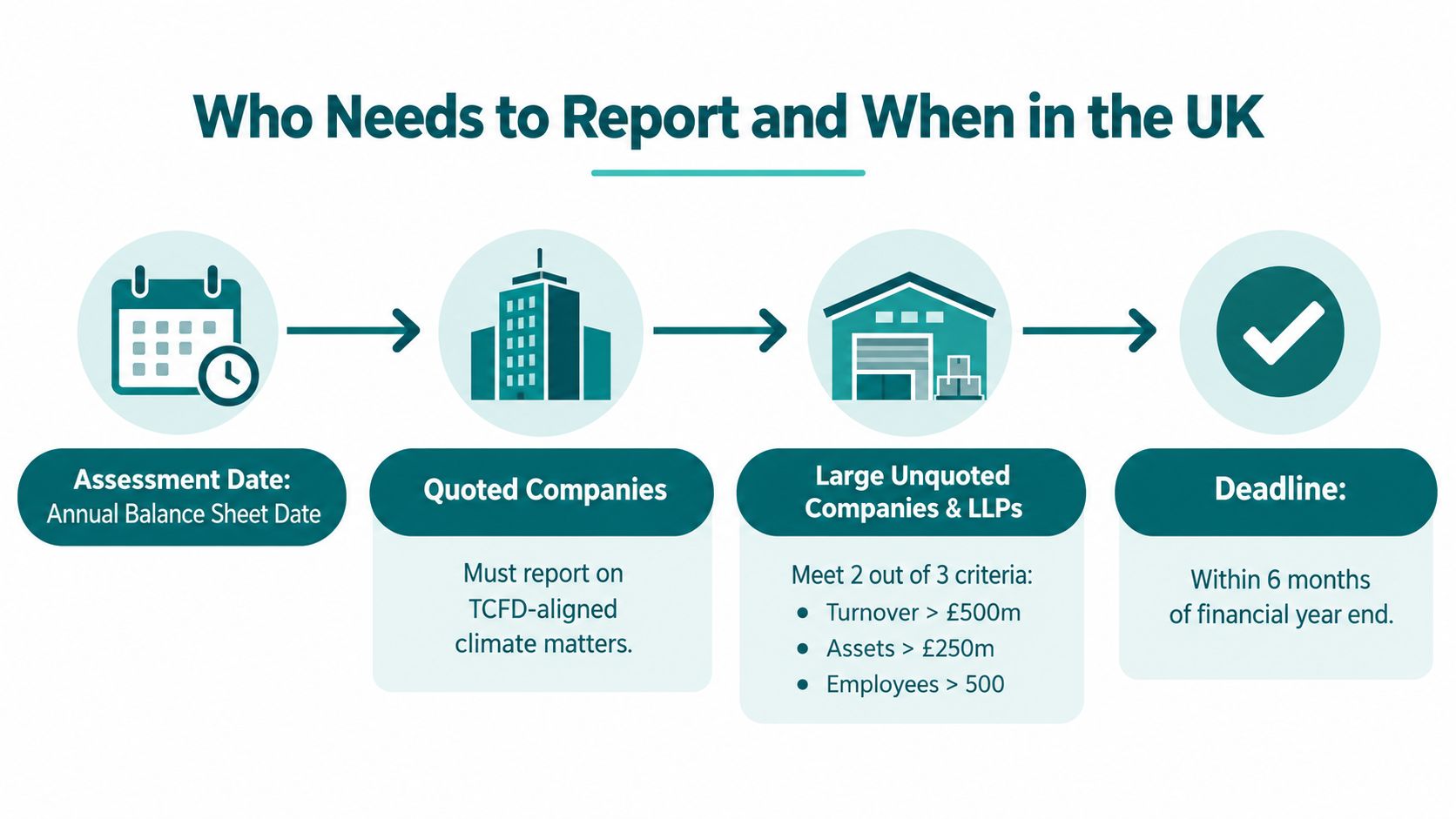
SECR applies to large quoted companies and to unquoted UK companies and LLPs that meet at least two of three tests:
- Employees: More than 250 employees.
- Turnover: Above £36 million.
- Balance sheet total: Above £18 million.
These thresholds and the two-out-of-three test are set out in UK SECR guidance for qualifying organisations (SECR thresholds and scope). A group structure, reporting entity and financial year can affect the assessment, so the company should document how it reached its conclusion rather than relying on an informal assumption.
For quoted companies, SECR covers global energy use. For qualifying unquoted companies and LLPs, the disclosure also includes fuel used for business travel that begins and ends in the UK. The directors' report must include annual energy use, Scope 1 and Scope 2 emissions, at least one intensity ratio, prior-year comparatives, methodology notes and a narrative about energy-efficiency actions (UK environmental reporting guidance).
Check climate disclosure duties separately
The FCA introduced TCFD-aligned disclosure requirements for UK listed companies in 2021, with the regime applying to the largest firms from 1 January 2022 and first public disclosures due by 30 June 2023 (FCA TCFD-aligned application guidance).
The Companies Act and LLP regime extended TCFD-style reporting to large companies and LLPs from 6 April 2022, often capturing firms with more than 500 employees and turnover above £500 million. Listed-company application developed in phases, with premium-listed commercial companies from 2021 and standard-listed commercial companies from 2022 (UK TCFD requirements).
An FCA firm must prepare and publish its TCFD entity report and any public TCFD product reports by 30 June each calendar year (FCA ESG reporting rules). That fixed deadline differs from the ordinary process of preparing annual accounts and directors' reports.
Track the UK SRS transition
UK SRS remains voluntary through 2026. The FCA has proposed making UK SRS S2 mandatory for listed companies for accounting periods beginning on or after 1 January 2027, with first reports due in 2028 (UK SRS regulatory developments).
The FCA consulted on aligning listed-company sustainability disclosures with UK SRS and expects a Policy Statement in autumn 2026, with rules coming into force from January 2027 (FCA sustainability reporting requirements). The sequence gives venue groups time to map data and controls, but it doesn't remove existing obligations that already apply.
A public-sector venue or operator should also consider how equality responsibilities, procurement questions and stakeholder commitments create evidence requirements outside the formal annual report. The public-sector equality duty is a useful reference point for leaders connecting accessibility decisions with governance and social-value processes.
What You Actually Have to Disclose and Measure
A sound reporting process separates what the organisation measures from how it proves the measurement. SECR creates an operational energy and carbon evidence layer. TCFD-style reporting creates a broader climate evidence layer covering governance, strategy, risk management, metrics and targets.
Environmental evidence starts with source data
For SECR, estates and facilities teams need a dependable chain from meters and invoices to annual energy use and emissions factors. Transport teams may need to connect fleet information, business travel fuel and operational records. The final disclosure should explain the methodology, show a relevant intensity ratio and include prior-year comparatives.
The narrative also matters. A venue should identify the energy-efficiency actions it has taken, not only publish a figure. A change in occupancy, a building retrofit, altered operating hours or a transport service change may affect interpretation, so the reporting owner should retain the context that explains material movements.
Social and governance evidence needs ownership
Social measures vary by venue, but relevant evidence can include:
- Accessibility: Accessible routes, visitor information, navigation provision, consultation records and action tracking.
- Workforce: Training records, workforce composition, employee policies and engagement information.
- Health and safety: Risk assessments, incident controls, contractor processes and review records.
- Community impact: Local engagement, service access and social-value commitments.
- Governance: Board oversight, delegated responsibilities, ethics policies, approval records and internal controls.
Not every topic belongs in every report. Materiality should determine which subjects receive detailed treatment. The operational test is simple: can the team identify the responsible owner, source system, calculation method, approval route and retained evidence?
Core UK ESG disclosure topics by pillar
| Pillar | Disclosure Topic | Example Metric or Evidence | UK Regime Link |
|---|---|---|---|
| Environmental | Energy and emissions | Annual energy use, Scope 1 and Scope 2 emissions, intensity ratio | SECR |
| Environmental | Methodology | Emissions factors, boundary decisions and calculation notes | SECR |
| Environmental | Efficiency action | Narrative of energy-efficiency measures and implementation records | SECR |
| Environmental | Climate governance | Board oversight, climate strategy, risks, metrics and targets | TCFD-style reporting |
| Social | Accessibility | Route information, inclusive design decisions and review records | Strategic reporting, stakeholder and procurement context |
| Social | Workforce and safety | Policies, training records and operational controls | Materiality-led disclosure |
| Governance | Accountability | Named owners, review evidence and approval records | TCFD-style reporting and strategic reporting |
Evidence standard: If a facilities manager can explain where a figure came from, how it was calculated and who approved it, the organisation has a stronger basis for credible disclosure.
Operational planning can reduce duplication. Teams mapping energy and mobility data may find the practical guidance on carbon footprint reduction useful when assigning data owners and documenting improvement actions. The aim isn't to collect every possible ESG metric. It's to maintain a consistent, reviewable record for the topics that matter to the organisation and its stakeholders.
How Standards and Frameworks Fit With Legal Requirements
A legal requirement tells an organisation what it must disclose and when. A standard or framework helps define the structure, concepts and quality of that disclosure. Confusing those two roles leads companies either to under-report mandatory information or to build an unnecessarily large reporting process.
SECR is a legal reporting regime for qualifying organisations. TCFD-aligned requirements under the Companies Act, LLP rules and FCA arrangements are also legal obligations where the relevant scope tests apply. Their details must be assessed against the entity and reporting year.
Standards provide structure
The UK SRS are standards for sustainability disclosure, with voluntary use in 2026. They are expected to underpin the UK's future regime, but they don't replace existing mandatory obligations during the voluntary period.
The international standards IFRS S1 and IFRS S2, developed by the International Sustainability Standards Board, provide a broader reference point for sustainability-related and climate-related financial disclosures. GRI focuses on impacts and stakeholder reporting, while SASB provides industry-oriented metrics. An organisation may use these frameworks to improve consistency, respond to investor requests or prepare for future regulation, but adoption doesn't automatically create a UK legal filing duty.
The FCA's proposed approach would align listed-company sustainability disclosures with UK SRS, subject to the consultation process and the expected Policy Statement in autumn 2026. Current indications point to a phased, climate-first pathway, with listed companies moving before broader categories of private entities.
Build one control system, not several disconnected reports
A venue group can map SECR data, TCFD governance evidence and UK SRS data points into one internal register. That register should show the source, owner, reporting boundary, calculation method, review status and intended disclosure.
External assurance and verification may become more relevant as standards-based reporting develops. Teams assessing procurement opportunities or assurance suppliers can also consult a Financial Reporting Council tender opportunities guide for context on how formal reporting institutions structure tender activity.
The practical objective is controlled reuse. One approved energy dataset should support the relevant disclosures without being recalculated separately by facilities, finance and sustainability teams. The same principle applies to climate risk registers, accessibility actions and governance approvals. Waymap's third-party verification approach can be considered alongside the organisation's wider evidence and assurance model where external validation is relevant.
How to Prepare for Compliance Without Duplicating Work
A venue doesn't need to begin by buying a new reporting platform. It needs a defensible scope decision, clear ownership and a data map that shows how operational records become reported information.
Build the reporting workflow in sequence
Scope the entity and year. Record the legal entity, group structure, listing status, reporting period and applicable thresholds. Separate mandatory duties from voluntary standards adoption.
Assess material topics. Consider climate, energy, accessibility, workforce, safety, community impact, governance and the concerns raised by investors, tenants, passengers or public-sector buyers. Materiality should guide effort. It shouldn't become a reason to ignore a mandatory disclosure.
Map source systems. Link utility meters, invoices, fleet records, travel data, HR systems, procurement records, risk registers and accessibility action logs to named owners. Document boundaries and calculation methods before the reporting cycle becomes urgent.
Add controls and review. Reconcile totals, retain methodology notes, compare reporting periods, record management review and keep an approval trail. This creates the two evidence layers needed for SECR and TCFD-style reporting.

Connect accessibility with operations
Accessibility work often fails to enter ESG systems because teams treat it as a service feature rather than operational evidence. For venues and transport operators, the relevant friction is practical. Beacon networks and other installed hardware can create capital approval challenges, maintenance obligations and update work across environments where layouts, entrances and points of interest change frequently.
Waymap uses dead reckoning with device-native sensors, providing sub-3-metre accuracy in infrastructure-free environments without a pre-mapping requirement. It has been deployed in named settings including WMATA and Lord's Cricket Ground with MCC, addressing indoor and complex-site navigation constraints without adding beacon hardware.
That capability is relevant to the social pillar and to governance because inclusive access should have an accountable operational process. It can support work connected to the Equality Act 2010 and BS EN 17210, while the organisation retains its own records of accessibility decisions, user feedback, route updates and service ownership.
For estates leaders: Choose evidence-generating improvements that fit existing operational processes. A solution that needs a new hardware estate may create a second maintenance problem instead of resolving the first.
Teams can record venue maps, points of interest, accessibility actions and responsible owners in an integrated workplace management system, then connect that operational record to annual ESG review. The right system depends on the organisation's estate and controls, but the principle is consistent: capture evidence where work happens, not in a spreadsheet assembled after the fact.
Frequently Asked Questions About ESG Reporting Requirements
Is UK SRS mandatory in 2026?
No, UK SRS remains voluntary through 2026. The UK government published the final standards for voluntary use on 25 February 2026, while the FCA has proposed mandatory UK SRS S2 reporting for listed companies for accounting periods beginning on or after 1 January 2027, with first reports due in 2028 (PwC's UK SRS timeline).
How does SECR differ from TCFD reporting?
SECR focuses on operational energy and carbon disclosure. TCFD-style reporting addresses governance, strategy, risk management, metrics and targets, so an in-scope organisation needs both operational data and broader climate evidence.
What happens if a company meets only one SECR size test?
Meeting only one of the three size tests doesn't satisfy the stated two-out-of-three threshold for a large unquoted company or LLP. The organisation should still check whether it is quoted or subject to another reporting regime.
Can UK groups still fall within EU CSRD?
Yes, some UK-headquartered groups with substantial EU activity can be caught. The current scoping test can apply where EU net turnover exceeded €450 million in each of the last two consecutive financial years, alongside an EU subsidiary that is a large undertaking or an EU branch with net turnover above €200 million, with reporting from financial year 2028 (UK groups and CSRD scope).
How can accessibility support ESG reporting?
Accessibility actions can provide evidence for the social and governance pillars. A venue can document inclusive design decisions, navigation provision, user feedback, ownership, review dates and links to its Equality Act 2010 responsibilities. Infrastructure-free navigation is one operational example, but the report must still explain the organisation's own process and evidence.
The immediate next step is to identify which regime applies now, which changes later and which operational records support both. That phased approach prevents premature reporting while avoiding an expensive rush when mandatory scope expands.
Waymap provides infrastructure-free indoor and outdoor navigation for venues, transport operators, campuses and other complex sites, using device-native sensors to guide people to precise destinations without GPS, Wi-Fi or installed hardware. Visit Waymap to see how accessible navigation can become a documented part of your social and operational ESG programme.
