
How to Achieve Carbon Footprint Reduction in Large Venues and Transport Hubs

Carbon footprint reduction is the systematic process of cutting the greenhouse gas emissions associated with an organisation's entire operation—from energy consumption to visitor travel. For large venues, this is not about symbolic gestures; it is about embedding measurable, sustainable practices into core business strategy to improve efficiency, reduce costs, and enhance brand reputation.
Why Is Reducing Your Carbon Footprint a Core Operational Goal?
For operators of large venues, university campuses, or transport hubs, reducing your carbon footprint is no longer a peripheral corporate responsibility task. It is a critical component of modern operational strategy, financial planning, and brand management. A robust sustainability plan delivers tangible returns on investment.
This approach aligns with proven national strategies. The UK, for example, has reduced its territorial greenhouse gas emissions by 50.4% since 1990 while simultaneously growing its economy. This was driven by systemic changes, such as phasing out coal for power generation. For a closer look at applicable methods, this guide offers some excellent practical carbon reduction strategies.

However, the UK's Climate Change Committee (CCC) has noted that the most straightforward reductions have already been made. Future progress depends on focused efforts in key areas, including:
- Energy Efficiency: Reducing consumption in buildings and daily operations.
- Heat Decarbonisation: Transitioning from fossil-fuel heating systems.
- Low-Carbon Transport: Encouraging and enabling sustainable travel options.
The mandate for venues and transport operators is clear. When a site consumes less energy and facilitates more efficient, sustainable journeys, it contributes to national climate goals. Exploring the benefits of improved facilities management is therefore a strategic necessity.
A powerful, often overlooked, lever for carbon footprint reduction is optimising the movement of people. Efficiently guiding staff and visitors reduces wasted energy from lighting and HVAC systems, minimises unnecessary travel, and lowers operational waste. This directly impacts your bottom line and sustainability credentials.
How to Establish Your Carbon Footprint Baseline
Before you can reduce your carbon footprint, you must establish an accurate baseline. This carbon audit is a foundational step that must reflect the specific operational reality of your venue or transit network.
The process involves gathering and analysing data across three distinct categories, known as Scopes, as defined by the Greenhouse Gas (GHG) Protocol. This framework is the industry standard for classifying emissions, separating those an organisation controls directly from those it influences indirectly.
What Are Your Core Emission Sources?
For any large, public-facing organisation, the emissions profile is complex. The globally recognised Greenhouse Gas (GHG) Protocol provides the standard for categorising these emissions into three scopes, which helps to focus efforts on the most significant sources first.
The table below outlines the most common emission sources for large venues and transport hubs.
Key Carbon Emission Sources for Large Venues
| Emission Scope | Source Category | Examples in a Venue or Transit Context |
|---|---|---|
| Scope 1 | Direct Emissions | Fuel combusted in on-site boilers for heating; fuel used in fleet vehicles like maintenance vans or shuttle buses. |
| Scope 2 | Indirect Emissions (Purchased Energy) | Electricity purchased for lighting, HVAC systems, escalators, digital signage, and electric vehicle charging stations. |
| Scope 3 | Other Indirect Emissions | Emissions from staff and visitor travel, waste disposal, water treatment, and the entire supply chain of purchased goods and services. |
The Scopes provide a clear road map for data collection, helping to pinpoint where your greatest impacts lie—from the fuel you burn on-site to the journeys your visitors make to reach your venue.
What Data Do You Need to Collect?
With your sources identified, the next step is data collection. A full 12 months of utility bills are required to account for seasonal variations in energy use. For your vehicle fleet, fuel purchase records are essential.
Scope 3 data is more complex to acquire. To estimate commute and travel patterns for staff and visitors, you will likely need to conduct surveys. Analysing footfall data can provide powerful insights into visitor travel behaviours and help you build a more accurate model.
Your goal is to build a detailed emissions inventory. This is not about producing a single number. It is about understanding the specific activities driving your footprint, whether that is the electricity demand of a shopping centre like Westfield London or the aggregated travel emissions of a sprawling university campus.
What Are High-Impact Interventions for Visitor and Staff Transport?
For any public-facing organisation, transport is a significant component of its carbon footprint. Emissions from visitors and staff travelling to and from your site often represent the largest and most complex part of your Scope 3 emissions.
Addressing this requires actively improving the entire journey experience to influence travel choices at scale. This is especially pertinent in the UK, where domestic transport was the single largest emitting sector in 2023, accounting for 99.5 million tonnes of CO2e. With cars and vans responsible for the majority of these emissions, even a small shift away from single-occupancy car journeys can have a substantial impact. More data is available from sources like the EPA's website on carbon dioxide emissions.
When a venue makes walking, finding a step-free route, or completing a public transport transfer simple and efficient, it removes the friction that often pushes people to use their cars. The first step is to measure and understand current travel patterns.
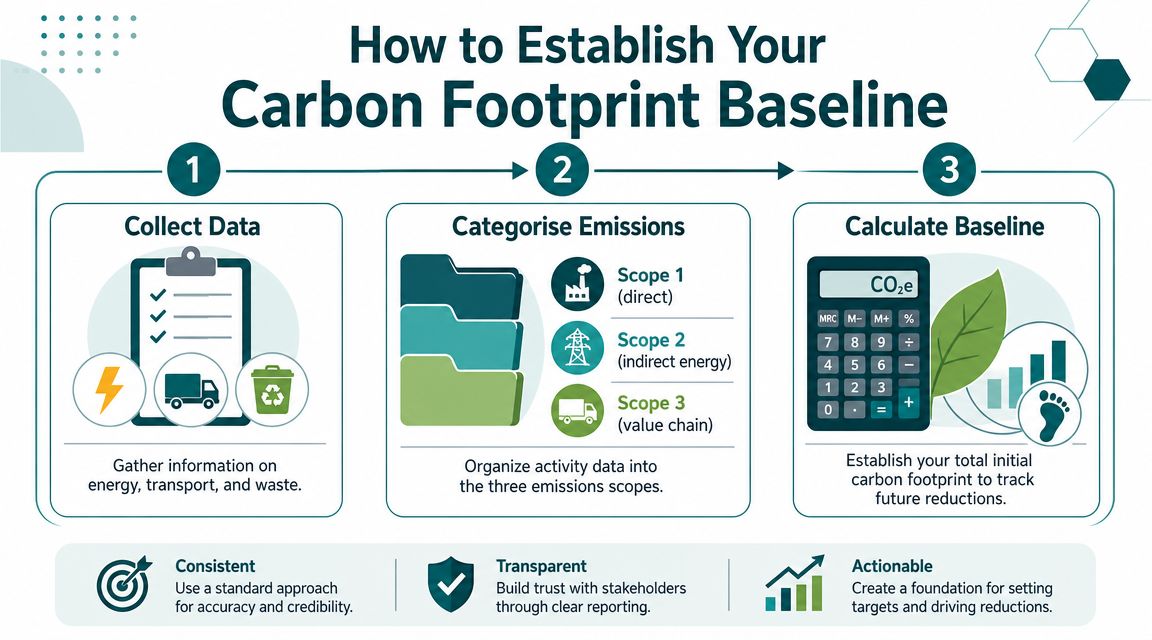
This process of categorising emissions allows you to identify where to implement the most effective changes, such as those targeting transport.
How Does Better Wayfinding Support Carbon Footprint Reduction?
Improving how people move through and around your site is a direct method for cutting transport-related emissions.
At a large shopping centre like Westfield London or a sprawling university campus, a visitor who can park once and then confidently navigate the entire site on foot eliminates multiple small, unnecessary car journeys between shops or buildings.
Waymap’s hardware-free navigation is designed to facilitate this. By providing precise, step-free audio directions, we make it easier for everyone to choose more active, sustainable modes of transport within a venue. For example, our work with transit agencies like SBS Transit optimises pedestrian flow within their stations, making transfers smoother and public transport a more attractive alternative to driving. This improvement in journey efficiency drives the modal shift necessary for a real reduction in your carbon footprint. You can learn more about how our interactive campus maps enable this.
By optimising journeys within your venue, you are not just improving visitor experience; you are creating a tangible incentive for lower-carbon travel choices, turning accessibility and efficiency into a powerful tool for sustainability.
How Can Smart Building Management Reduce Energy Consumption?
After transport, the energy consumed by buildings is the next major focus for carbon footprint reduction. For complex sites like hospitals, shopping centres, and transit hubs, improving operational efficiency is one of the most direct ways to cut emissions at the source.
UK emissions data confirms that a significant portion of the country's carbon output comes from the energy used to heat, cool, and power buildings. The Climate Change Committee consistently states that achieving net-zero targets is impossible without making buildings drastically more efficient. Improvements made to these long-term assets will deliver benefits for decades. You can get a sense of the global impact of climate change on footprintnetwork.org.
For any large venue, this constitutes a direct operational mandate. Every kilowatt-hour saved is a measurable step toward sustainability.
What Are Practical Smart Building Management Strategies?
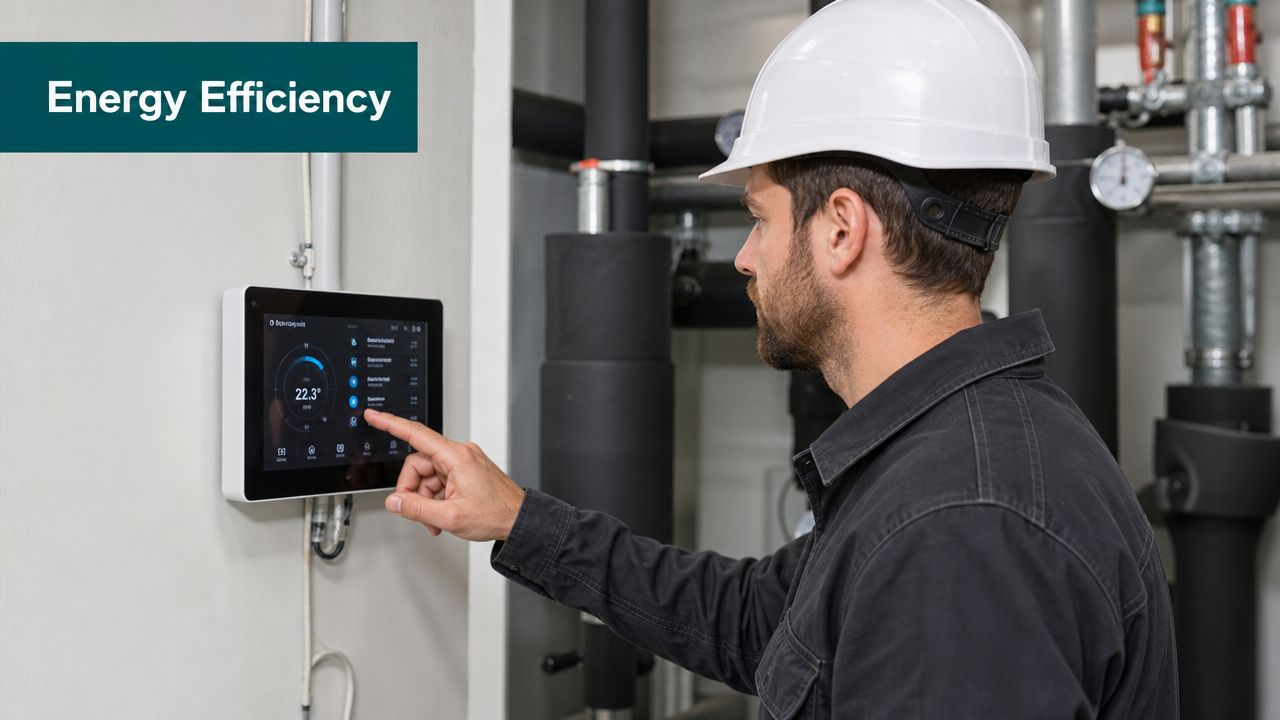
At its core, smart building management is about eliminating wasted energy by deploying intelligent systems and strategies to control the largest energy drains.
- Smarter HVAC Systems: Smart thermostats and occupancy sensors can ensure areas are heated or cooled only when they are in use, avoiding the energy waste of conditioning empty halls.
- Intelligent Lighting: Using motion-activated or timer-based lighting is a simple but highly effective measure, particularly in back-of-house areas or after operating hours.
- Renewable Energy Sources: Generating your own clean power through technologies like solar panels is becoming increasingly cost-effective. A good analysis of the business case can be found in this guide on selling solar panels door-to-door.
How Does Better Wayfinding Reduce a Building's Energy Load?
An often-missed factor is how visitor and staff movement directly impacts a building's energy consumption. When people get lost or take inefficient routes, they spend more time inside. This extended dwell time places a heavier load on HVAC and lighting systems.
A visitor wandering for an extra ten minutes is ten more minutes of lighting, heating, and air conditioning that did not need to be used. Across thousands of daily visitors at a venue like the Royal Hospital for Children and Young People, this wasted energy accumulates significantly.
This is where dynamic digital wayfinding provides a solution. By guiding people along the most efficient routes, tools like Waymap reduce unnecessary movement and decrease the total time people spend inside your venue. This demonstrates how a better visitor experience can be directly linked to measurable energy savings and a smaller carbon footprint. It is a key example of how the Internet of Things is creating smarter buildings.
How to Track and Report Your Reduction Progress
Once your carbon reduction projects are in motion, you must track what is working and report on that progress transparently. This is essential for effective management.
Effective reporting transforms sustainability initiatives from an internal cost into a compelling public narrative, building trust with stakeholders, strengthening your brand, and ensuring regulatory compliance. The goal is to demonstrate tangible, data-backed results, not just declare intentions.
What Key Performance Indicators (KPIs) Should You Set?
Your Key Performance Indicators (KPIs) must be tied directly to the high-impact interventions you are making. Focus on specific, measurable goals that reflect operational changes.
Effective KPIs for carbon footprint reduction include:
- Energy Consumption: Monthly kWh of electricity and therms of gas, compared against the same period from the previous year.
- Waste Diversion Rate: The percentage of total waste that is recycled or composted instead of sent to landfill.
- Modal Split: The breakdown of how visitors and staff travel to your site (e.g., car, public transport, cycling), monitored through periodic surveys.
- Water Usage: Cubic metres of water consumed, which is especially critical for large venues with kitchens and extensive restroom facilities.
How Do You Calculate the Return on Investment?
The ROI on sustainability extends beyond lower utility bills. When reporting progress, it is vital to communicate the full spectrum of value created.
This broader ROI includes:
- Enhanced Brand Reputation: A proven commitment to sustainability attracts environmentally conscious customers, talent, and corporate sponsors.
- Regulatory Compliance: Proactive data tracking prepares you for current and future mandates, such as the UK's Streamlined Energy and Carbon Reporting (SECR) framework.
- Improved Stakeholder Relations: Transparent, data-driven reporting builds confidence among investors, employees, and the local community.
Technology partners can provide invaluable data for this. Waymap's analytics, for example, deliver detailed insights into how people move through a venue. By quantifying efficiency gains from better navigation, you can demonstrate real progress toward ESG goals. This data helps draw a direct line from operational improvements to environmental outcomes, a core function of any integrated workplace management system.
By tracking metrics like reduced journey times and optimised foot traffic, you can calculate the 'avoided emissions' from more efficient building use—turning a positive visitor experience into a quantifiable sustainability win.
Frequently Asked Questions About Carbon Footprint Reduction
Here are direct answers to some of the most common questions we receive from venue and transit operators.
How much does it cost to implement a carbon reduction strategy?
The cost of a carbon reduction strategy varies depending on the scale of the initiatives, but it should be viewed as an investment, not an expense. Some effective changes, such as a full switch to LED lighting, have a low upfront cost and a rapid payback period. Larger projects like installing solar panels or overhauling an HVAC system require more significant capital but deliver the largest long-term energy savings and often generate a positive return on investment. Many organisations start with low-cost, high-impact actions to build momentum and budget for larger projects. Government grants and incentives can also significantly offset initial costs.
Can small changes really make a difference in a large venue?
Yes, the cumulative effect of small, consistent changes across a large organisation can be substantial. In a venue with hundreds of staff and thousands of daily visitors, collective action is a powerful force for carbon footprint reduction. For example, increasing your recycling rate by 10% can divert tonnes of waste from landfill annually. Similarly, a policy to power down all non-essential equipment overnight can significantly cut energy consumption. These "small" actions are multiplied across the scale of your operation, leading to impressive, measurable results.
How do we get staff and visitors to participate in reduction efforts?
Participation is best achieved by making the sustainable choice the easiest and most beneficial choice. For staff, this involves clear communication, ongoing training, accessible recycling points, and incentives for using public transport or cycling. For visitors, the key is seamless integration into their experience. For instance, a tool like Waymap doesn't just encourage walking; it provides precise, step-by-step navigation that makes walking or using public transport more efficient and less stressful than driving. When the sustainable option is also the superior experience, participation becomes the natural choice.
At Waymap, we believe inclusive design is one of the most powerful and overlooked tools for genuine carbon footprint reduction. By integrating sustainability and accessibility into the core of your operation, you can achieve meaningful environmental progress.
Discover how our hardware-free navigation can make your venue more efficient and sustainable by visiting us at https://www.waymapnav.com.
