
Vendor Selection Criteria: A Practical Framework
Three vendors have just finished polished demonstrations of the same venue technology. Each says the platform is accessible, compliant, quick to deploy and easy to maintain. Your evaluation panel has plenty of impressions, but no reliable way to distinguish a durable operating model from a convincing sales presentation.
That is where vendor selection criteria matter. For venues, NHS estates, transit agencies and campuses, the decision isn't only whether a product works on launch day. It also concerns capital constraints, physical maintenance, changing layouts, accessibility upkeep, integrations, data governance and the cost of correcting a poor choice after the contract begins.
Why Most Vendor Evaluations Fail Before They Start
Many evaluations begin with product demonstrations rather than a documented definition of success. The vendor controls the environment, chooses the user journey and highlights features that are easy to show. The buyer then scores confidence, presentation quality and perceived cultural fit, even when those factors weren't intended to decide the award.
That approach creates predictable blind spots. An NHS estates manager may approve a solution that needs physical infrastructure, only to discover that capital approval and installation planning are harder than expected. A transit operator may underestimate the work involved in maintaining devices across busy stations. A stadium or shopping centre may find that an accessibility journey becomes inaccurate after a concourse, entrance or point of interest changes.
Practical rule: If a vendor claim can't be translated into evidence, a test or a contract obligation, it isn't a useful evaluation criterion.
Start by separating the evaluation into three questions:
- Can the supplier deliver? Check legal eligibility, financial standing, technical ability, relevant experience and delivery capacity.
- Does the solution fit? Test integrations, accessibility, security, operational workflows and the actual environment.
- Will it remain suitable? Examine update processes, support, maintenance, ownership costs and the supplier's response to change.
That third question is routinely underweighted. A solution can meet the original specification and still become expensive when a venue changes its floorplan, a station modifies passenger routes or a campus adds buildings. Accessibility can also regress if updated content isn't reviewed with the same care as the initial deployment.
A documented framework protects the organisation from subjective scoring and gives stakeholders a shared basis for challenge. The Waymap implementation best practices guide is useful when turning a selected solution into an operational plan, while UX agency tips from 925 Studios offers a practical perspective on checking process, evidence and fit rather than choosing the most persuasive pitch.
The discipline matters legally as well as operationally. Under the UK Procurement Act 2023, award criteria must be clear, measurable, specific and proportionate, with an explicit method for showing their relative importance. A procurement record should therefore explain not only who won, but why the winning tender performed best against criteria that were published and tied to the contract.
Understanding the Legal Structure of Selection Criteria
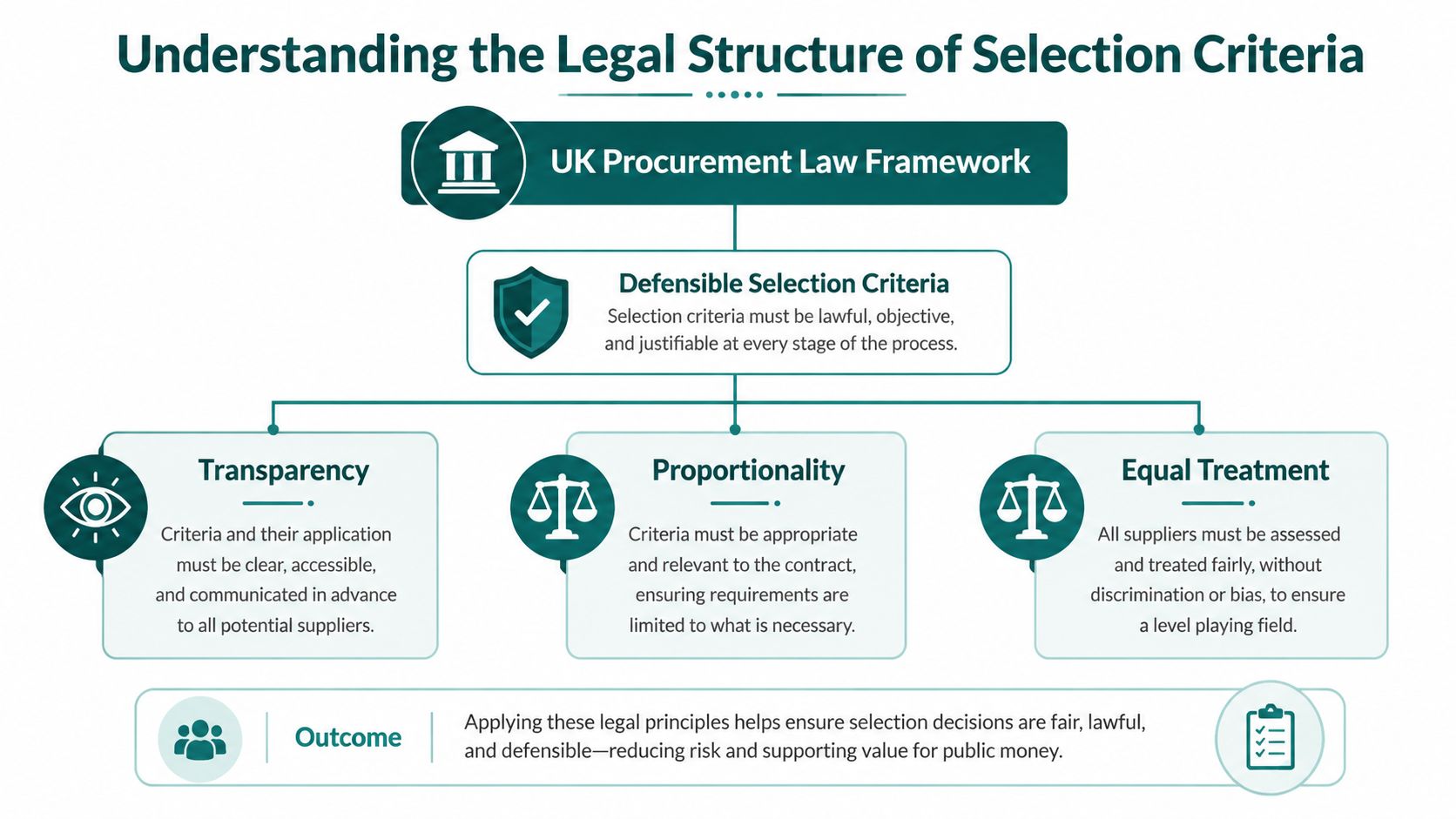
A venue technology supplier can have an impressive product and still fail a lawful procurement. UK public procurement separates conditions of participation from award criteria. The first establishes whether a supplier is eligible and capable of delivering the contract. The second determines which eligible tender is most advantageous against the authority's published requirements. A guide to public-sector procurement rules explains how these decisions fit within the wider process.
Under the Procurement Act 2023, supplier selection conditions cover two headline areas: legal and financial capacity and technical ability to perform the contract. The government's supplier-selection guidance describes a standard selection questionnaire with three parts: basic supplier information, exclusion grounds, and evidence of economic and financial standing alongside technical and professional ability. The official supplier-selection guidance sets out this structure.
Conditions of participation test eligibility
Financial checks should match the contract's risk, rather than a buyer's preference for large suppliers. UK guidance allows an authority to require a minimum yearly turnover, but the threshold generally cannot exceed twice the estimated contract value except in duly justified cases. It also generally limits requests for annual accounts to the last three years, while permitting other evidence where those accounts are unavailable. The FELP supplier selection criteria guidance summarises these constraints.
The standard questionnaire also includes a modern slavery test for relevant commercial organisations with annual turnover of at least £36 million. Supplier selection therefore examines governance and compliance as well as price and technical delivery.
Award criteria decide the tender
An authority can award only to the most advantageous tender, or MAT. The tender must meet the authority's requirements and perform best against criteria connected to the contract's subject matter. The assessment method must explain how each criterion will be judged and whether failure is disqualifying. The government's guidance on assessment and award of contracts explains this requirement.
Proportionality prevents qualification rules from excluding capable smaller suppliers without a defensible reason. Annex A guidance on the selection stage warns against criteria that unfairly exclude SMEs. Connect every threshold to a documented contract risk, including infrastructure dependencies, change handling and accessibility maintenance, and retain an audit trail showing why it is necessary.
Building a Weighted Scoring Matrix for Technology Vendors
A useful scoring matrix translates broad requirements into evidence that evaluators can apply consistently. Build it before inviting proposals, agree the scoring method with procurement, technical, operational, finance and accessibility stakeholders, and keep pass/fail requirements separate from weighted preferences.
For a venue or transit technology purchase, the matrix should cover more than features and licence cost. The weighting ranges below are a practical starting point, not legal prescriptions. Adjust them to the subject matter, risk profile and published procurement method.
| Criteria Category | Weighting Range | What to Score | Pass/Fail Threshold |
|---|---|---|---|
| Technical fit and integration | 20% to 30% | Required functions, APIs or SDK options, mapping, identity, support for existing digital channels and operational workflows | Must demonstrate each critical integration |
| Accessibility and inclusive design | 15% to 25% | Alignment with the Equality Act 2010, BS 8300 and relevant accessibility requirements, plus testing with disabled users | Fail if a mandatory accessibility requirement is absent |
| Deployment and infrastructure | 15% to 20% | Installation dependencies, site preparation, rollout method, staff effort and resilience in signal-poor environments | Fail if the required environment cannot support deployment |
| Total cost of ownership | 15% to 25% | Licence, implementation, support, content updates, hardware, recalibration, training and exit costs | Fail if mandatory cost information is incomplete |
| Privacy, security and compliance | 10% to 15% | Data flows, retention, hosting, access controls, assurance evidence and incident response | Fail if a required control isn't evidenced |
| Maintainability and change tolerance | 10% to 20% | Update workflow, turnaround, regression testing, vendor support and cost when the environment changes | Fail if the supplier can't describe controlled updates |
| ESG and organisational alignment | 5% to 10% | Procurement values, accessibility ownership, environmental approach and governance | Usually weighted, unless a stated policy requirement applies |
The ranges intentionally overlap because a hospital navigation deployment and a metro-wide passenger service won't carry identical risks. A buyer should record the reason for every weighting, particularly where accessibility or maintainability receives less attention than initial functionality.
Write requirements that demand proof
Replace “the system is easy to update” with a request for a documented change scenario. Ask the supplier to show how it would amend a point of interest, test the revised route, approve the content and release it. Request the roles involved, dependencies, expected customer impact and pricing basis.
For content-heavy technology, a reviewable .po diff approach provides a useful model for requiring visible, reviewable changes rather than accepting opaque updates. The same principle applies to maps, accessibility content and configuration.
Use a gating method for essential requirements, then score the remaining criteria. Public-sector evaluation documents often make the consequence explicit. In a Lancashire example, a response of Yes, or N/A where applicable, is a pass and No is a fail. The document also says the panel may stop evaluating a submission that fails a criterion or scores less than 2 on one. The Lancashire evaluation criteria document shows how a defined threshold can support a defensible go or no-go decision.
Your indoor positioning systems evaluation should be treated as a technical comparison, not a feature checklist. Ask what happens at the edges of coverage, during layout changes and when the buyer needs to maintain the service with limited operational capacity.
Evaluating Change Tolerance and Long-Term Maintainability
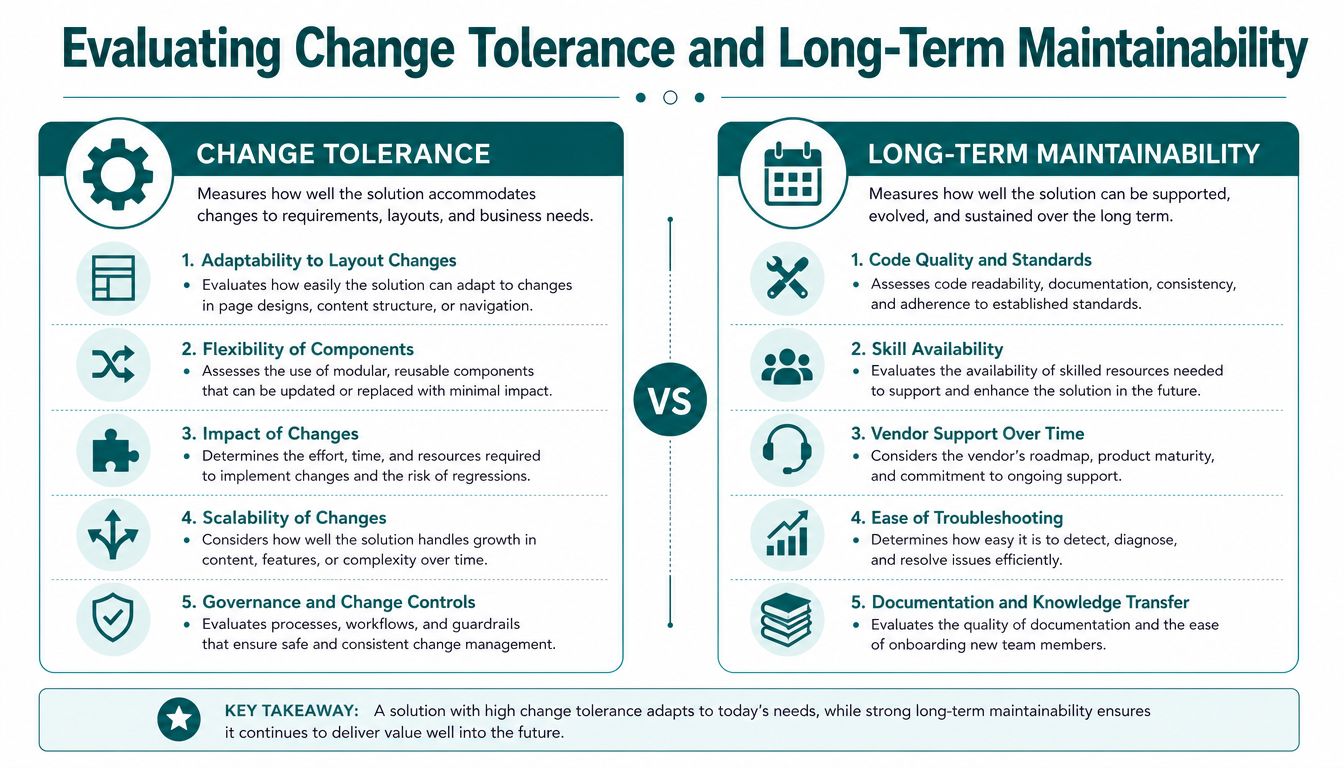
The most revealing vendor question is often the least glamorous: what happens when the environment changes? A venue's entrances move, a stadium closes a concourse, a station changes a platform route and a hospital revises its departments. The buyer needs to know how quickly the supplier can reflect that change, how much internal work it creates and how accessibility is checked afterwards.
Infrastructure-dependent systems can introduce a physical maintenance burden. Beacons, tags and other installed components need inventory control, battery or replacement planning, site access and recalibration when the environment changes. That burden may be manageable in a stable building, but it becomes more difficult across high-footfall transit networks and venues with frequent events or refurbishments.
Waymap's stated technical approach uses dead reckoning from device-native smartphone sensors, rather than GPS, Wi-Fi or installed hardware. Its product information describes sub-3-metre accuracy in infrastructure-free environments and no pre-mapping requirement, capabilities that are particularly relevant where staff turnover is high or layouts change often. These are product claims that still need to be tested in the buyer's environment, not accepted as substitutes for a pilot.
Compare the cost of change, not just the launch plan
WMATA represents the kind of transit environment where physical maintenance across stations can become an ongoing operational consideration. Lord's Cricket Ground provides a different test, because Waymap deployed without venue infrastructure. At the Royal Hospital for Children and Young People, frequent layout changes and difficult justification for new capital hardware make updateability a central procurement concern. These examples should prompt questions about the operating model, rather than serve as proof that every deployment will produce the same result.
Score vendors against a change register containing realistic scenarios:
- Layout amendment: Who updates the map, and what approval process follows?
- New destination: Can a new department, platform, shop or gate be added without a physical installation project?
- Accessibility review: How does the supplier detect and correct a route that has become unsuitable?
- Operational ownership: Can venue staff make approved changes, or does every amendment require specialist intervention?
- Exit and continuity: What happens to maps, content, user data and integrations if the contract ends?
A solution that performs well initially may still be a poor choice if every change requires new hardware, specialist site work or a lengthy vendor queue. The Waymap maintenance cost reduction discussion is relevant to this issue because it frames maintenance as an operating-model question rather than a one-off implementation task.
Score the supplier's response to change as carefully as its response to the original specification.
Running Pilot Evaluations and Stakeholder Trials
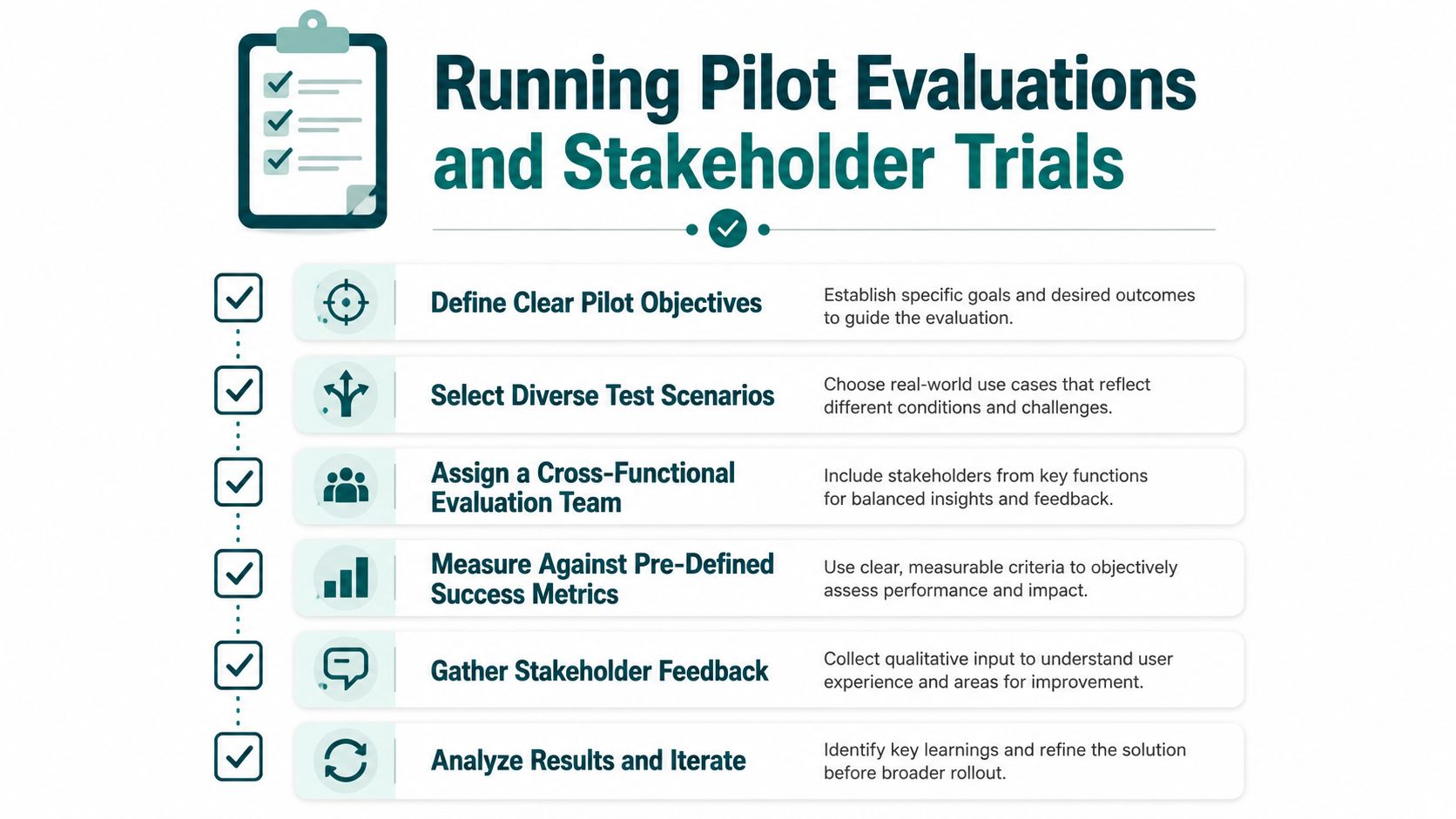
A pilot should challenge the vendor's assumptions. Don't use a controlled route with perfect lighting, clear signage and a cooperative operator if the live service will run through a crowded station, changing hospital or multi-use venue. Select test areas that expose the operational conditions your scoring matrix treats as important.
Begin with a written pilot protocol. State the objectives, test routes, user groups, evidence required, accessibility safeguards, data-handling rules and decision thresholds. Give every shortlisted supplier the same protocol and the same opportunity to ask questions, then record clarifications for the evaluation file.
Test users, staff and failure recovery
A navigation pilot needs more than procurement and IT observers. Include disabled visitors or staff where participation is appropriate and properly supported, frontline teams, facilities, security, digital services and accessibility leads. Their questions differ. A blind user may identify a confusing instruction, while a facilities manager may expose a change-control problem that a demonstration conceals.
Capture both measured and observed results:
- Route performance: Record whether participants reach the specified destination and where instructions become ambiguous.
- Operational effort: Note the steps required to prepare, update, monitor and support the service.
- Accessibility experience: Gather structured feedback on clarity, independence, control and barriers, without treating one person's experience as representative of everyone.
- Change response: Introduce an approved route or point-of-interest amendment and document the work needed to release it.
- Support quality: Record response times, ownership and the supplier's ability to diagnose problems with evidence.
Don't ask participants to overlook a failure because the rest of the demonstration was impressive. If a mandatory criterion fails, apply the published rule consistently. The Lancashire evaluation example shows why thresholds need to be defined before scoring, including the possibility that a panel stops evaluating a submission after a serious failure.
Keep the process fair and auditable
A pilot can create procurement risk if one supplier receives more coaching, a more favourable site or informal access to decision-makers. Use the same test conditions, give equivalent information, preserve written answers and separate usability feedback from commercial negotiation.
The Waymap user adoption strategies resource can inform rollout thinking, but adoption shouldn't replace technical evaluation. A popular interface still needs evidence of maintainability, governance and performance against the criteria that matter to the contract.
The video below can provide additional context for stakeholder discussion, but it shouldn't substitute for your own protocol or recorded findings.
Negotiating Contracts That Lock In Your Selection Criteria
A scoring matrix has little value if the contract captures only a broad description of the product. Every criterion that influenced the award should appear in a schedule, service level, acceptance test, reporting obligation or change-control mechanism.
Translate the high-value promises into measurable obligations. If the supplier scored well for deployment, define the deliverables and acceptance evidence. If maintainability carried significant weight, specify how updates are requested, tested, approved and released. If accessibility mattered, require ongoing review against the relevant obligations and standards, including the Equality Act 2010, BS EN 17210 and the principles of the UN Convention on the Rights of Persons with Disabilities where applicable to the organisation's commitments.
Link payment to accepted outcomes
Payment milestones should reflect accepted deliverables rather than merely the passage of time. A venue might require verified map content, approved accessibility testing, integration evidence, staff training and a live operational handover before the relevant milestone becomes payable.
Build a performance schedule around the same evidence used during evaluation:
- Availability and support: Define service expectations, escalation routes and reporting.
- Content maintenance: Set ownership, review steps and treatment of urgent route changes.
- Accessibility protection: Require regression checks after material amendments.
- Change tolerance: Record the cost and process for ordinary layout or destination updates.
- Exit assistance: Protect access to configuration, content, documentation and required transition support.
The Procurement Act 2023's MAT requirement reinforces the connection between award and contract. Award criteria must relate to the subject matter, and the assessment methodology must explain how performance is judged. Contract schedules should therefore preserve the promises that made the tender most advantageous, rather than allowing them to disappear after award.
Include remedies that match the risk. These might involve corrective action plans, service credits, withheld acceptance, review meetings or termination rights, subject to legal advice and the final contract structure. The aim isn't to punish a supplier for every operational issue. It's to make responsibility clear when a scored capability fails to materialise.
A strong vendor selection process ends with an operating relationship that can be inspected, challenged and improved. If the contract can't show how the organisation will protect accessibility and manage change, the procurement team hasn't finished the job.
Waymap helps venue, campus and transit teams assess infrastructure-free navigation against practical vendor selection criteria, including deployment dependencies, accessibility maintenance and the cost of future changes. Visit Waymap to discuss the right platform format for your venue, budget and timeline, and test whether its device-native dead-reckoning approach fits your operational environment.
