
Indoor Wayfinding Implementation Best Practices
You're already past the point where a procurement checklist will save you. The issue is implementation best practices under pressure, when estates teams are balancing capital approval cycles, transit teams are staring at maintenance tickets, and accessibility leads are being asked to prove outcomes instead of promises. If the rollout can't survive staff turnover, layout churn, multilingual passenger mixes, and the scrutiny that comes with the Equality Act 2010 and BS EN 17210, it isn't ready.
That's why Waymap treats deployment as a governance problem first and a technology choice second. Infrastructure-free navigation changes what's politically and operationally possible, but only if the rollout is run with discipline, clear owners, and evidence at every stage.
Why Implementation Best Practices Start With the Real Friction
Most wayfinding rollouts fail before the first user ever taps a phone. NHS-style estates teams run into capital cycles that make beacon hardware hard to justify, transit operators inherit the maintenance burden of physical infrastructure across large, high-footfall estates, and venue leaders are expected to evidence accessibility outcomes, not just nominal compliance. If your plan starts with vendor features instead of these realities, you've already made the mistake.
The Equality Act 2010 forces a practical question, not a marketing one. What reasonable adjustment will work when entrances change, tenants move, and platforms or concourses don't stay static? BS EN 17210 pushes in the same direction, because accessibility has to be embedded in the built environment, not bolted on after people are already lost.
The wrong mindset
A generic procurement checklist assumes the main job is choosing a product. It isn't. The main job is deciding who owns updates, what gets measured, and how the system stays accurate when the site changes.
Practical rule: If your rollout can't be maintained by the people who already own the estate, it will drift.
That's why infrastructure-free precision navigation matters here. It removes the hardware drag that often stalls approval, and it lets teams focus on governance, testing, and service quality instead of decommissioning, patching, and replacing installed kit. For teams mapping customer journeys and service pain points, the starting point should be operational friction, not technology preference. A useful reference is Waymap's own customer journey mapping, because implementation only works when the route problems are understood from the user's side first.
The Four Phases That Frame Any Deployment
The cleanest way to run implementation best practices is to treat rollout as Explore, Prepare, Deliver, Sustain, the same four-stage structure used in Education Endowment Foundation guidance for schools. That sequence matters because it forces evidence before scale, and it keeps the team from confusing enthusiasm with readiness.
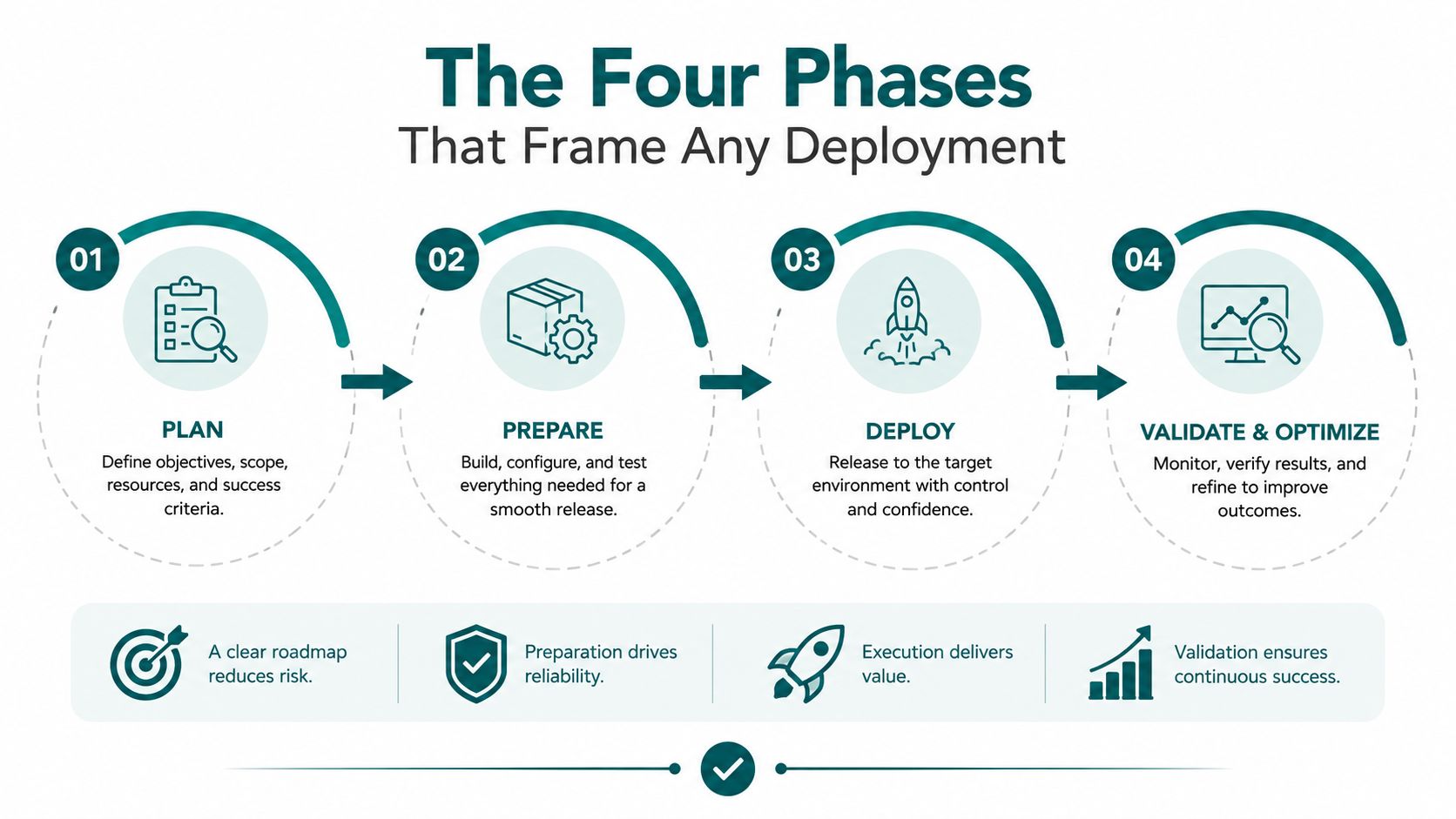
The Explore phase is where you stop guessing. Use a resource and data inventory, identify what systems, sites, teams, and suppliers are affected, and separate observable facts from assumptions. RESP's zero-trust roadmap gets this right by insisting on a small, verifiable deliverable, not a sprawling wish list.
What each phase must produce
- Explore. A live inventory of spaces, entrances, platforms, points of interest, owners, and risks.
- Prepare. A baseline KPI snapshot, a pilot route list, and written agreement on what success looks like.
- Deliver. Formal sign-off from named owners, not just verbal acceptance in a steering meeting.
- Sustain. A review cadence, update triggers, and a clear escalation path when layouts change.
The point of staging is not bureaucracy. UK-facing project guidance consistently recommends phased rollout because it reduces delivery risk, and one implementation study cited in the brief reports 45% higher success rates with phased approaches versus big-bang implementations. That is exactly why the big-bang mindset fails in estates and transit, where one bad launch can create workarounds that never die.
If you want a practical comparator for sequencing and dependencies, the Wi-Fi deployment timeline is useful because it shows how a deployment can be broken into accountable steps without pretending every site is identical. For Waymap projects, the equivalent discipline is to keep each phase tied to a named artefact and a human owner.
Practical rule: A phase only counts when there's a document, a decision, or a test result that lets the next phase begin.
The EEF guidance also supports modelling or simulating the change before implementation, then obtaining formal written commitments from the people who will support it. That's the difference between a plan that survives contact with the building and a plan that collapses at go-live.
Why Infrastructure-Free Navigation Changes the Build
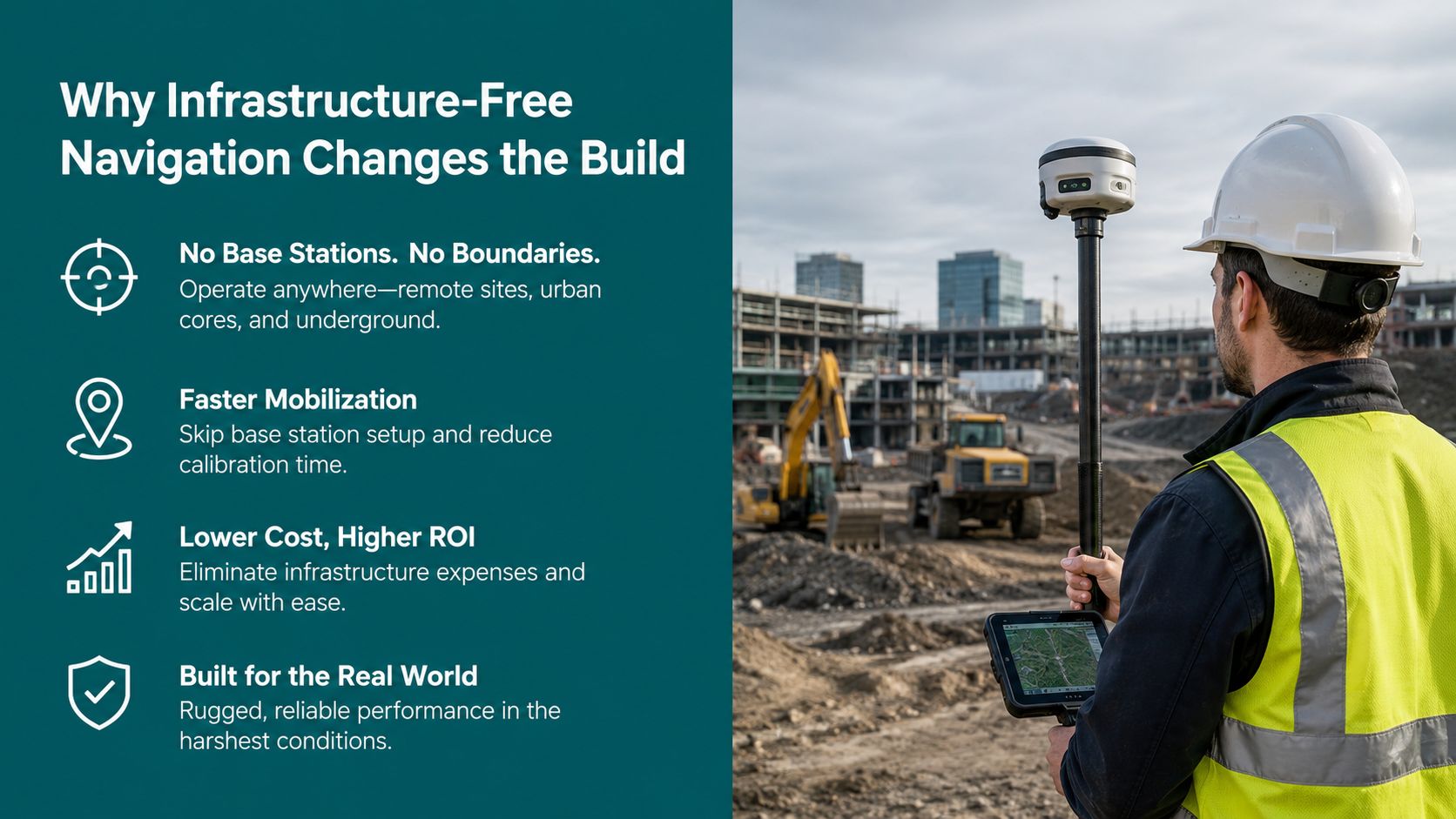
Most wayfinding RFPs assume beacons, Wi-Fi fingerprinting, or a full pre-survey of every relevant space. That assumption is expensive, brittle, and unnecessary when the operating environment changes constantly. Waymap's approach uses dead reckoning with device-native motion sensors plus a world-first fusion algorithm, which is what allows it to work without GPS, Wi-Fi, or installed hardware in the places that need it most.
The practical advantage is simple. You remove the hardware estate, and you remove a whole maintenance layer with it. That matters in places where staff turnover is high, shop units change fast, platforms are noisy and signal-poor, and a fresh survey can become outdated before the ink dries.
What procurement and estates teams care about
Waymap's infrastructure-free navigation is designed for environments where sub-3-metre accuracy in infrastructure-free settings is the threshold that makes usable indoor navigation credible. The point isn't a technical trophy, it's that a venue can support exact doors, platforms, and points of interest without first building and maintaining a hardware layer.
That changes deployment economics. It can mean faster rollout, lower maintenance cost, and no beacon network to decommission later. It also reduces the dependency on a site-by-site pre-mapping regime that can be awkward in venues with frequent tenant churn or underground sections.
Named deployments make that easier to see. The Royal Hospital for Children and Young People needed a model that could support a care environment without turning the estate into an infrastructure project. Lord's Cricket Ground and Westfield London show the same logic in public-facing estates, where layout complexity and operational change make static assumptions fragile. SBS Transit highlights the transport side, where underground and signal-poor conditions are exactly where infrastructure-free navigation is most useful.
For readers comparing options, the relevant question is not whether a system can be installed. It's whether it still works after the next refurbishment, tenant change, or platform reconfiguration. The benefit of infrastructure-free deployment is that the map layer stays updateable while the building keeps changing.
The benefits of infrastructure-free solutions for wayfinding are easiest to understand when you've dealt with hardware that keeps breaking under real estate pressure. In practical terms, this is the build that estates teams can live with.
Surveying, Mapping and Meeting Your Accessibility Obligations
Surveying still matters. The algorithm can do a lot, but it can't infer the parts of the building that the operator hasn't identified properly in the first place. You still need a disciplined capture of building footprints, entrance points, platform edges, vertical connections, and points of interest that match the operator's accessibility and safety narrative.
The legal context makes that essential. Under the Equality Act 2010, reasonable adjustments need to be more than a statement of intent. Under BS 8300, good design has to reflect accessibility from the start. PAS 78 and BS EN 17210 reinforce the same principle, accessibility is a built and managed condition, not a decorative layer.
What the estates team should document
Before launch, produce an audit pack that includes:
- Mapped access routes. Entrances, lifts, stairs, ramps, gates, and primary circulation lines.
- Named points of interest. Ticket desks, toilets, customer service points, platforms, exits, and tenant entrances.
- Accessibility assumptions. What's been verified on site, what still needs checking, and what depends on future works.
- Formal sign-off. A dated approval from the responsible estates and accessibility owners.
The reason to make this paper trail explicit is simple. When a route changes, no one wants to argue later about whether the service ever met the standard in the first place. The audit artefact should be boring, specific, and easy to repeat.
For teams that want a sensible benchmark for how to test the experience rather than just the map, the accessibility testing guidance is worth comparing against your own process. It keeps the focus on actual route performance, not abstract compliance language.
The key trade-off here is restraint. Don't over-survey just because the building is complex. Capture the points that matter, verify what the algorithm needs, and leave the rest to structured updates. That's how you keep the map accurate without turning every change into a reimplementation project.
Pilot Testing With Blind and Low-Vision Users
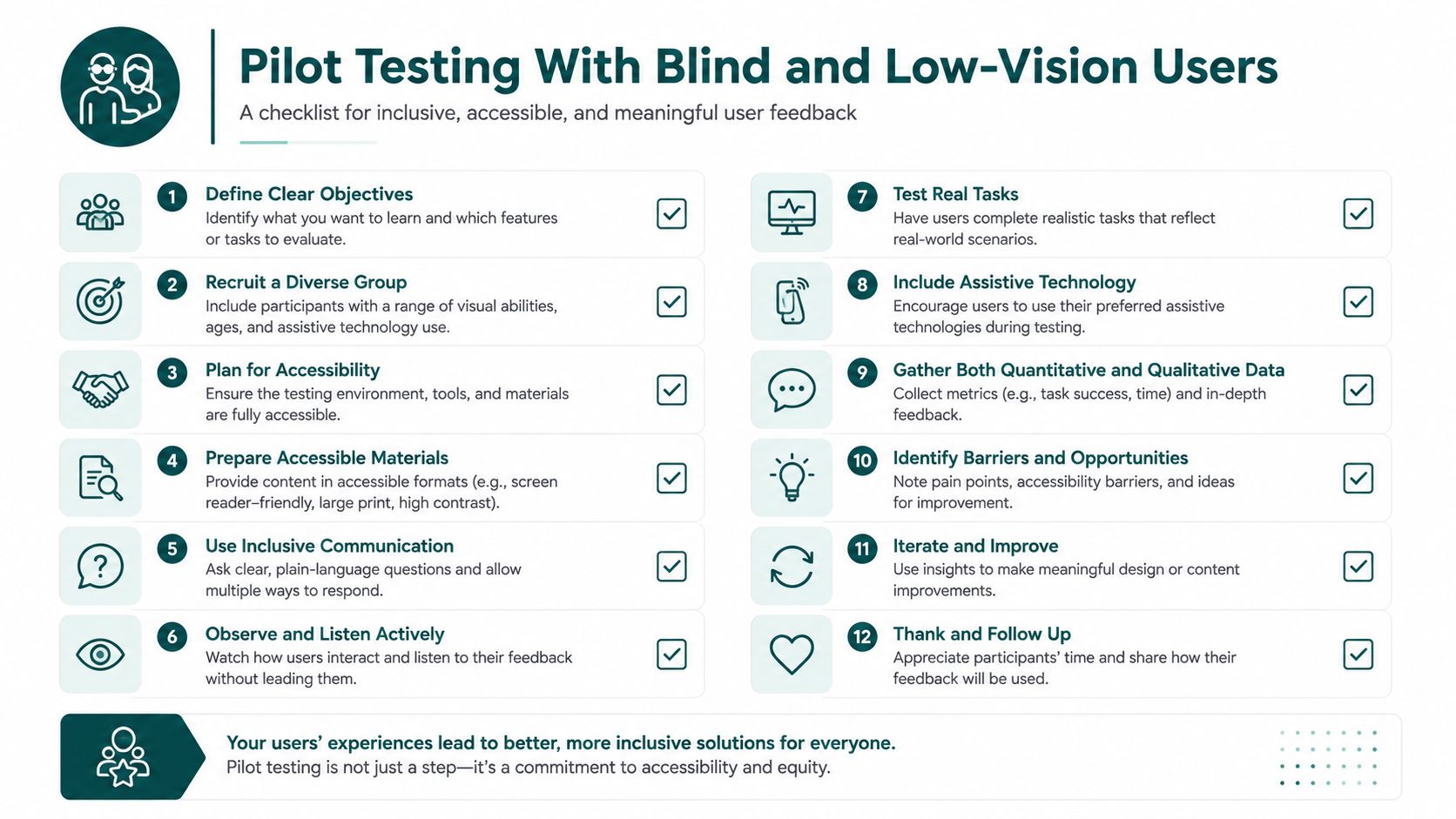
The pilot reveals whether a team is building a service or merely purchasing assurance. Designing for blind and low-vision users sharpens route geometry, POI naming, and audio cue timing for all users, making them the ideal first validation group rather than an afterthought.
Tom Pey's role as founder and blind accessibility technologist matters here because the product was built from lived experience, not abstract UX theory. That changes the questions the pilot asks. A strong pilot is not, “Did the app open?” It is, “Could the user complete the route, understand the handover points, and recover cleanly when they drifted off path?”
What to test before general launch
Use a practical checklist:
- Route completion. Can users reach the destination without manual intervention?
- Audio clarity. Do cues still work in noisy concourses and platform areas?
- Transition handling. Does the experience remain stable between indoor and outdoor segments?
- Recovery behaviour. What happens when a user strays from the intended line?
- Naming quality. Are points of interest phrased the way users recognise them?
The Royal Hospital for Children and Young People and SBS Transit are useful examples because pilot validation had to work in live operational settings, not synthetic test spaces. In both cases, user feedback helped tighten route logic and edge cases before broader launch. That's the part many teams miss; they treat testing as verification of the product, when it should be validation of the service.
The client case studies resource is a useful contrast if you want to see how real deployments get described when they're grounded in outcomes rather than slogans. The important lesson is not the marketing language, it's the sequence, validate with the people most affected, then widen the rollout.
Practical rule: If blind and low-vision users can't complete the pilot confidently, the wider audience won't get a better result by chance.
This is also where the Waymap smartphone visually impaired context matters. The device is the interface, but the pilot proves whether the interface supports movement, decision-making, and confidence in the actual building.
Rollout, Training and Change Management
Rollout fails when everyone gets the same message. Frontline staff need one script, accessibility leads need a dashboard, estates need an update workflow, and comms teams need approved multilingual wording. If you try to train all of them together in one launch session, you'll get polite nods and inconsistent execution.
The practical answer is role-based rollout. NHS-style capital restrictions mean the message to estates has to focus on maintenance burden and change control. Transit operators need shift-friendly training that works across handovers. Retail and venue teams need instructions that recognise tenant turnover, seasonal churn, and the pressure to communicate quickly with the public.
Train by role, not by department
- Frontline staff. A 90-second script, plus a recovery path for a stuck user.
- Accessibility leads. Access to the data dashboard and the POI editor.
- Estates. The workflow for map updates, approvals, and issue escalation.
- Comms. Pre-approved multilingual messages that can go live without delay.
Waymap can deliver guidance in the languages a venue's actual passenger mix needs, so multilingual support should be treated as part of the deployment, not a translation afterthought. That matters because a good message in the wrong language is still a failed intervention.
The baseline-then-measure discipline is essential. Structured implementation practices that baseline performance before automation and measure cycle time, error rate, labour hours and cost per transaction after launch can improve project success rates by 35% workflow-automation guidance. For this kind of rollout, that means measuring before you celebrate. Vendor claims do not count as evidence.
A steering group needs a short list of KPIs it can govern. Use the change management strategy material only as a reference point, then keep the metrics site-specific.
| Audience | Primary KPI | Why it matters | Baseline source |
|---|---|---|---|
| Estates | Mean map-update cycle time | Shows whether the service can stay current without heavy admin | Pre-launch maintenance logs |
| Transit | Navigation completion rate by route | Tells you whether passengers can finish the journey as intended | Pilot route testing |
| Retail and venues | Dwell time | Indicates whether wayfinding is helping people move and stay comfortably | Existing footfall or tenant data |
| Accessibility leads | Accessibility-related incident reports | Shows where users still struggle or need support | Existing incident records |
| Operations | Support tickets per 10,000 journeys | Signals whether the rollout is creating avoidable friction | Helpdesk baseline |
The point of the table isn't perfect measurement. It's to stop teams drowning in vanity metrics. If a KPI doesn't change a decision, it doesn't belong in the steering pack.
Monitoring, Maintenance and Continuous Improvement
The test starts after launch. That's when tenant changes, platform reconfigurations, seasonal pressure, and staffing shortages start to expose whether your implementation best practices were genuine or just ceremonial. A live map is only valuable if someone owns it, reviews it, and updates it before users notice it has drifted.
The best UK implementation research keeps coming back to the same point: local adaptation beats one-size-fits-all rollout because underserved groups get missed when services are not adapted to context. That applies directly here. If a mall changes tenants, or a transit hub reassigns entrances, the operator has to decide who updates the POIs, when survey refreshes are triggered, and what evidence gets logged.
The sustainment artefact you need
Every quarter, produce a one-page sustainment report with:
- KPI movement. What changed since launch, and why.
- Map updates. What was edited, who approved it, and when.
- User feedback themes. What blind and low-vision users, staff, and passengers are saying.
- Decisions taken. What changed as a result, and what stays under review.
That document is the difference between a living service and a forgotten project. It also creates the paper trail that accessibility leaders need when they're asked to evidence ongoing reasonable adjustment under the Equality Act 2010 or conformance with BS EN 17210.
For teams that want to sharpen the continuous-improvement mindset at the leadership level, the top improvement methods for CIOs is a decent contrast piece, because the underlying idea is the same, small governed changes beat rare heroic resets.
Practical rule: Treat every layout change as a governance event, not a support ticket.
A few questions come up every time a deployment matures, and the answers should be blunt.
How long does a Waymap rollout take from kick-off to general launch? Waymap rollout timing depends on site complexity, but the work is structured through the Explore, Prepare, Deliver, and Sustain phases rather than rushed as a single install.
How are blind and low-vision users included in validation? They are the first validation group, because their feedback tightens route geometry, naming, and audio cue behaviour before wider release.
How do operators keep maps accurate after layout changes? They assign ownership for POI edits, schedule review points, and trigger survey refreshes when entrances, tenants, or circulation paths change.
What evidence supports an Equality Act 2010 or BS EN 17210 reasonable adjustment claim? A dated audit pack, pilot validation records, update logs, and the quarterly sustainment report together create the paper trail decision-makers need.
The decision to keep a system accurate is not technical. It's managerial. If the map is not owned, reviewed, and revised, then the service is already slipping.
If you're planning an indoor navigation rollout, Waymap can help you do it without beacons, fragile hardware, or a maintenance burden your team can't sustain. Visit Waymap to see how infrastructure-free navigation, pilot testing, multilingual guidance, and ongoing map governance fit together in a deployment that's built to last.
