
Proven Maintenance Cost Reduction Strategies for 2026
To achieve meaningful maintenance cost reduction, you have to stop firefighting. For anyone managing a large UK venue or transport network, the goal is always the same: move away from expensive, chaotic emergency repairs and towards planned, predictable work that keeps assets running and budgets in check. This guide outlines the strategies to get there.
Written by the Waymap Team. The author of this article, Tom Pey, is the Founder of Waymap and a blind accessibility technologist.
What Drives High Maintenance Costs in UK Transport Hubs and Venues?
If you manage a sprawling NHS hospital estate or a major transit network like those run by Transport for London, you know the real problem isn't just a broken lift or a faulty beacon. It's the spiralling, often hidden cost of fixing it. The biggest drain on maintenance budgets is a reliance on reactive maintenance—a costly cycle of waiting for things to break before you do anything about them.
This 'break-fix' approach seems straightforward, but it triggers a cascade of expenses that go far beyond the initial repair bill.
Here are the real culprits I see driving up costs:
- Emergency Labour Rates: An urgent, unplanned call-out always comes at a premium. You’ll pay significantly more for an engineer’s time than you would for the same work if it were scheduled in advance.
- Operational Downtime: When a critical asset like a lift or an escalator fails, the knock-on effects can be enormous. The cost of service disruption, frustrated visitors, and damage to your reputation can easily dwarf the actual repair cost. For a retailer, this is lost revenue; for a transport operator, it's a breach of public trust and potential regulatory penalties.
- Rushed Procurement: Trying to source parts for an emergency job means you’re in a weak negotiating position. You’ll pay top-tier prices and expensive shipping fees just to get the asset back online quickly.
Think of it as the difference between a planned check-up and a trip to A&E. One is calm and controlled; the other is chaotic and expensive.
How do reactive and proactive maintenance costs compare?
To truly understand the financial impact, it helps to compare the two approaches side-by-side. The following table breaks down how reactive and proactive strategies affect key cost drivers for large venues.
| Cost Driver | Reactive Maintenance Impact | Proactive Maintenance Impact |
|---|---|---|
| Labour Costs | High due to premium rates for emergency call-outs and overtime. | Lower and predictable; work is scheduled during normal hours. |
| Equipment Downtime | Unplanned and often lengthy, causing significant disruption and revenue loss. | Minimal and scheduled during off-peak hours, minimising operational impact. |
| Parts & Procurement | Expensive due to rush orders and lack of time for price negotiation. | Lower costs from bulk purchasing, better inventory management, and price negotiation. |
| Asset Lifespan | Shortened due to repeated failures and stress on components. | Extended by preventing major failures and addressing wear and tear early. |
| Safety & Compliance | Increased risk of incidents and potential compliance breaches from unexpected failures. | Improved safety and easier compliance through regular checks and documentation. |
The proactive model transforms unpredictable, high-cost events into manageable, scheduled expenses. It’s a fundamentally more stable and cost-effective way to operate.
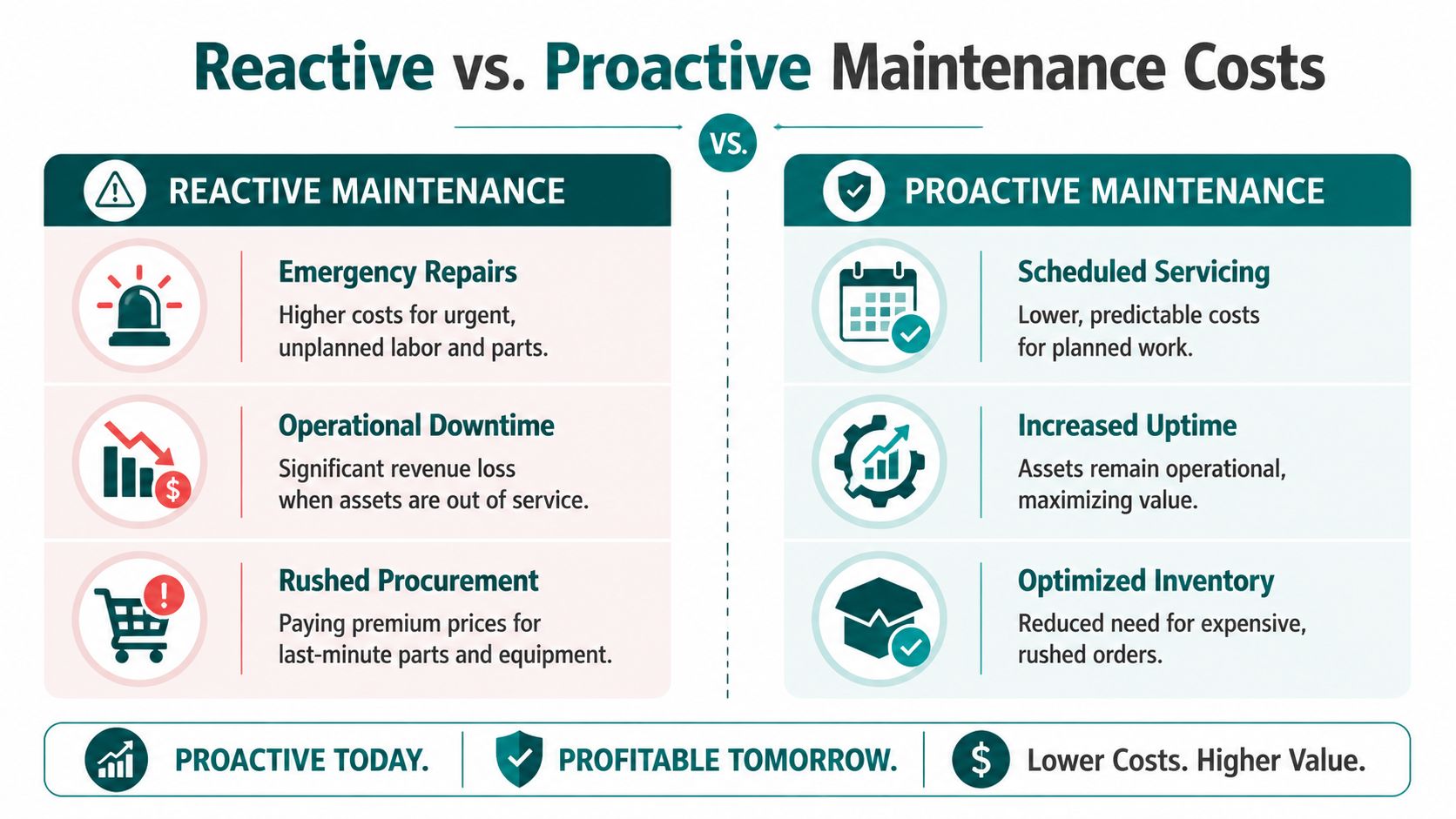
The business case for making this shift is clear. Predictive maintenance can lead to 18% to 25% lower maintenance costs. A proactive repair can be 4 to 5 times less expensive than fixing the same problem in an emergency.
A truly effective cost-reduction strategy looks at every contributing factor. For instance, a focused effort like implementing a guide to hydraulic energy savings can deliver targeted savings within a much larger plan. Even static infrastructure, like physical signs and wayfinding beacons, can become a significant and often overlooked financial drain—a challenge we explore in our article on moving beyond the blueprint of traditional building management.
How Does Predictive Maintenance Slash Unplanned Spending?
If your maintenance strategy still revolves around fixing things after they break, you’re missing a huge opportunity to control costs. Moving away from that reactive ‘break-fix’ model is the first real step towards cutting your maintenance bill. This means getting proactive, and that usually comes in two flavours: preventive and predictive maintenance.
Preventive maintenance is all about a fixed schedule. It’s like servicing your car every 10,000 miles or replacing an air filter every three months, whether it truly needs it or not. It’s simple, predictable, and a massive improvement on just waiting for something to fail.
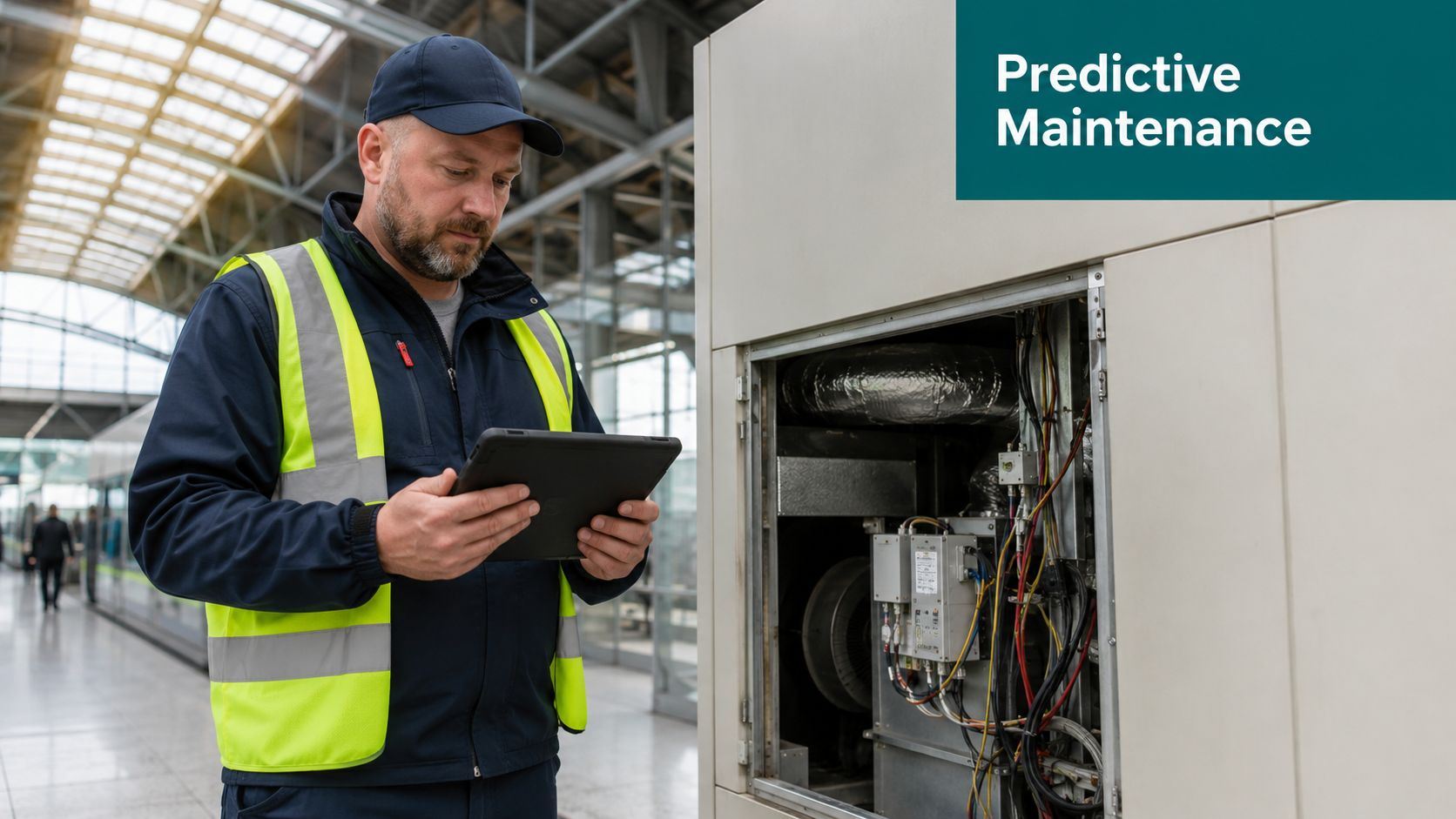
Predictive maintenance (PdM), on the other hand, is based on an asset's actual condition. It uses sensors and data to forecast when a failure is likely to happen. Instead of following a rigid schedule, you step in only when the data tells you it's necessary—for example, replacing a bearing only after sensors detect vibrations that are outside the normal range.
Why is predictive maintenance more cost-effective?
While both approaches are proactive, it’s predictive maintenance that gives you a much tighter grip on your finances. A purely preventive plan can lead to wasted effort and money—servicing equipment that’s running perfectly fine—or failing to catch a problem that crops up between your scheduled checks.
Predictive maintenance does away with the guesswork. For complex systems like your HVAC, escalators, or even the servers running your digital signage, this data-first approach means fewer interventions, less costly downtime, and letting your engineering team focus on what really matters.
The numbers back this up. For many organisations, maintenance can account for 15% to 40% of total operational costs. Just moving to a well-run preventive programme can cut that spend by up to 18%. This is vital, especially when you consider that for UK operators, every £1 of deferred maintenance can spiral into £4 of capital renewal costs down the line. You can dig deeper into these maintenance cost statistics and their impact on Upkeep.com.
A blended strategy is often the smartest play. Use predictive maintenance for your high-value, critical assets where failure would be a disaster. For everything else, a simpler, schedule-based preventive plan is usually more than enough.
This same logic applies to the digital side of your operations. As venues get smarter, it’s crucial to understand the maintenance demands of new tech. The Internet of Things is creating smart buildings that come with their own unique maintenance challenges.
By matching the right maintenance strategy to each asset—be it a lift motor or a network switch—you stop treating your budget like an emergency fund and start using it as a strategic tool for running a tighter, more efficient operation.
How Can 'Design for Maintainability' Reduce Future Costs?
If you want to get a handle on maintenance costs, you can't just focus on fixing things more efficiently. The most powerful move you can make happens way before your first engineer is ever called out. It all starts at the design and procurement stage.
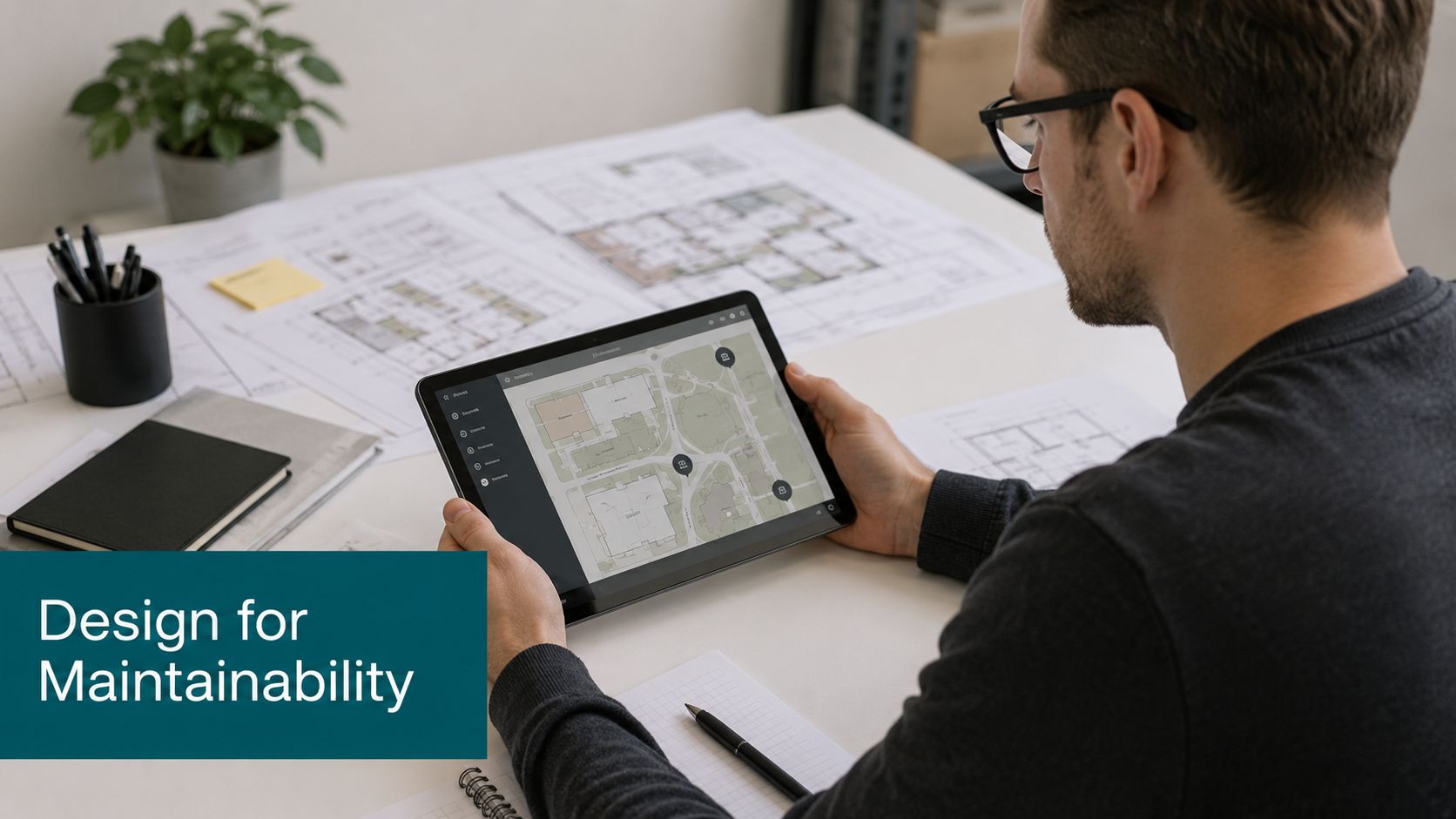
By thinking about long-term upkeep from day one, you can design out entire categories of future spending. This idea is called design for maintainability. It’s about shifting your mindset from reacting to problems to making sure they never have a chance to happen in the first place.
For anyone managing a large estate—whether it's a sprawling NHS hospital or a massive retail centre like Westfield London—the headache of physical hardware is all too real. Capital spend is tight, and getting budgets approved for new kit can take an age. Every sensor, beacon, or digital screen you install is another thing on the long list of future liabilities. It’s another point of failure that will eventually need power, a check-up, a repair, or a full replacement.
Why does infrastructure-free technology lower maintenance?
This is where choosing infrastructure-free solutions becomes a perfect example of design for maintainability in action. This is where Waymap offers a completely different approach by sidestepping the hardware lifecycle altogether. Instead of dotting your buildings with a network of beacons or cameras, our system was built for a world without them.
We’ve engineered our navigation to work using only the sensors already inside a standard smartphone.
- Proprietary Motion Tracking: Waymap's algorithm uses dead reckoning, combining data from a phone's built-in inertial sensors—the accelerometer, gyroscope, and compass—to calculate movement.
- No Beacons, No Wi-Fi, No GPS: Our technology is reliable underground, deep inside complex buildings, and anywhere else that normal signals can't reach. It is not dependent on external infrastructure.
- Sub-3-Metre Accuracy: We can achieve this precision without needing a single piece of hardware installed in your venue, delivering a reliable tool that helps meet accessibility standards like the UK's Equality Act 2010 and BS 8300.
By designing the system to be infrastructure-free, we designed out the maintenance costs from day one. There are no beacons to fail, no batteries to replace, and no engineer call-outs needed to repair physical hardware. This directly addresses the budget and operational constraints that estates managers face.
For a transit operator like WMATA (the Washington Metropolitan Area Transit Authority) or a major retail destination, this is a huge deal. It simply erases the enormous operational burden of installing and maintaining thousands of devices across a vast public space. Instead of inheriting a future maintenance nightmare, you get a dynamic digital layer that can be updated instantly and managed from one place—locking in a significant and permanent reduction in maintenance costs.
How Can Digital Wayfinding Eliminate Physical Maintenance Costs?
Physical wayfinding assets are such a familiar part of our venues that we often accept their running costs as unavoidable. But from the simplest static signs to complex digital kiosks, every physical component is a ticking clock, counting down to its next repair or replacement. This creates a constant, low-level drain on maintenance budgets—a significant liability that’s too often overlooked.
Static signs get vandalised, damaged, or simply become outdated. Hardware-heavy digital systems, like screens and beacon networks, introduce even more headaches. You’ve got hardware failures, power supply issues, and software glitches to contend with. Each problem means calling out an engineer, leading to a steady drip-feed of unplanned labour costs and operational disruption.

Why does a software-only approach remove maintenance burdens?
A purely software-based approach designs the problem out of existence. An infrastructure-free system like Waymap turns the visitor's own smartphone into the primary navigation tool. Suddenly, there’s no need for any installed hardware in the venue, completely removing these physical maintenance burdens.
The financial upside here is huge. Analysis shows that organisations with less reactive maintenance see 51.8% lower additional costs from faults and 52.7% less unplanned downtime. Predictive approaches can also slash spare-parts inventory costs by up to 20%—a saving that becomes total when you have no spare parts to stock in the first place. You can dive into the full research on the benefits of proactive maintenance on NCBI.
By shifting wayfinding from a physical asset to a digital service, you convert a recurring capital and operational expense into a predictable, software-based operating cost. The entire cycle of inspection, repair, and replacement is eliminated.
What are the real costs of physical wayfinding maintenance?
Let’s get specific about the costs tied to traditional systems—all of which simply vanish with a software-only solution:
- Vandalism and Accidental Damage: No more budgets for repairing or replacing damaged signs, screens, or beacons.
- Hardware Failure: Forget diagnosing dead beacon batteries or faulty power supplies in digital kiosks.
- Labour Costs: You can stop dispatching engineers for on-site repairs, often at premium emergency rates.
- Layout Changes: The major cost of physically changing signage every time a tenant moves or a layout is reconfigured? Gone.
With a system like Waymap, updates are pushed out instantly from a central management platform. A shop moves, a route is temporarily closed, or a new point of interest is added—it can all be updated across the entire venue in minutes, without a single engineer setting foot on site. This also ensures that compliance with standards like the Equality Act 2010 is not just met, but is far more reliable and easier to maintain. You can find out more about the reliability and scalability of infrastructure-free wayfinding in our detailed article.
How Do You Measure the ROI of Your Maintenance Strategy?
Getting buy-in from the board for any new maintenance strategy always comes down to the numbers. To get that budget approved, you need a business case that clearly shows how operational improvements translate into real financial gains.
It’s about more than just trimming expenses. You need to tell the whole story, connecting your maintenance efforts directly to asset performance and the overall efficiency of your venue. This is the data that will make your case, whether you’re pushing for a new predictive maintenance programme or investing in modern, infrastructure-free technology.
Which KPIs are best for tracking maintenance ROI?
The best approach is to track a handful of core metrics that paint a clear picture of where you are now and where you’re heading. These are your Key Performance Indicators, or KPIs.
- Mean Time Between Failures (MTBF): This is the average time a piece of equipment runs smoothly between breakdowns. When your MTBF starts climbing, you have hard evidence that your proactive work is paying off with fewer emergencies and less money spent on reactive repairs.
- Overall Equipment Effectiveness (OEE): A classic for a reason. OEE bundles asset availability, performance, and quality into one powerful score. A higher OEE means your assets are more reliable and efficient, which feeds directly into a stronger bottom line.
- Planned Maintenance Percentage (PMP): This shows how much of your team’s time is spent on scheduled work versus firefighting unexpected problems. A high PMP is a fantastic sign that you’re breaking free from the expensive, chaotic 'break-fix' cycle.
To get a clear, ongoing view of your progress, it’s best to present these metrics in a simple, trackable format. This helps everyone from the C-suite to the on-the-ground team understand the impact of your strategy.
Table: KPIs for Measuring Maintenance Cost Reduction
Here are the key performance indicators to track the effectiveness of your maintenance strategy and calculate ROI.
| KPI | What It Measures | How It Demonstrates Cost Reduction |
|---|---|---|
| MTBF | The average operational time between asset failures. | A rising MTBF means fewer breakdowns, less downtime, and lower costs for emergency repairs. |
| OEE | Asset availability, performance, and quality combined into a single percentage. | An improved OEE shows assets are running more efficiently, increasing output without new investment. |
| PMP | The percentage of maintenance hours spent on planned tasks versus reactive ones. | A higher PMP indicates a shift from expensive reactive repairs to cost-effective proactive work. |
| Maintenance Backlog | The total volume of overdue or outstanding maintenance tasks. | A shrinking backlog shows your team is gaining control, preventing small issues from becoming costly failures. |
| TCO | The total cost of an asset over its entire lifecycle, from purchase to disposal. | A lower TCO demonstrates that your strategy is reducing long-term expenses, not just initial costs. |
By consistently tracking these KPIs, you can build a powerful, data-driven narrative that proves the financial wisdom of your maintenance investments.
Why is a Total Cost of Ownership model so persuasive?
To make a truly compelling case for a specific investment, like upgrading to an infrastructure-free wayfinding solution, you need to think beyond the initial price tag. This is where a Total Cost of Ownership (TCO) model becomes your most powerful tool.
A TCO analysis forces a much broader, more honest conversation about what an asset really costs over its lifetime.
For example, a TCO for a hardware-based wayfinding system wouldn't just be the price of the beacons and screens. It would include the ongoing bleed from installation, power consumption, repair labour, replacement parts, and the massive disruption caused by downtime. In sharp contrast, the TCO for Waymap completely removes these hardware costs, turning a huge, unpredictable expense into a simple, predictable software subscription.
This kind of direct comparison is incredibly persuasive. It lets you present a clear, data-backed argument that highlights not just immediate savings, but a fundamental shift away from long-term financial risk and operational headaches.
For more ideas on modernising your operations, our guide on the benefits of facilities management is a great place to continue.
How Do You Implement a Successful Cost Reduction Programme?
A lasting reduction in maintenance costs never happens by accident. It’s the result of a deliberate, structured plan that moves from initial analysis through to a full-scale rollout, building momentum and proving its value at every step.
The first step is always a deep-dive audit of all your physical assets. This isn't just about making a list; it's about digging into the data to understand which assets are behind your most frequent and expensive reactive maintenance calls.
Once you have that clear picture, you can start to categorise everything. High-value, critical equipment might be a perfect candidate for predictive maintenance, while less vital assets could be shifted to a simpler preventive schedule. For some businesses, focusing on specifics like commercial drain cleaning can yield huge wins. A detailed UK grease trap compliance guide is a great example of how to tackle a niche area to prevent costly blockages and keep operations running smoothly.
How can a pilot programme de-risk new technology?
The smartest way to introduce new strategies is to start small. A pilot programme lets you test new technologies or methods on a limited scale, which minimises risk and helps you gather the hard data needed to build a convincing business case. It's a credible, low-risk way forward that even the most cautious decision-makers can get behind.
For a transit operator like SBS Transit in Singapore, this might look like trialling an infrastructure-free navigation solution like Waymap at a single, complex interchange station. The goal would be to measure the immediate operational and maintenance benefits before committing to a full network rollout.
The stages of a pilot programme typically unfold like this:
- Define Clear Objectives: What does success look like? It could be a 20% reduction in maintenance call-outs, a 15% improvement in visitor feedback, or faster update times for wayfinding information.
- Deploy and Measure: Implement the new technology in your controlled pilot area. Track your chosen KPIs and compare them against your baseline data.
- Analyse and Report: Pull the results into a clear, concise report. Show the ROI by outlining not just the cost savings but also the operational improvements.
- Scale with Confidence: Armed with proven success, you can now confidently secure the budget and support for a wider, phased implementation across the rest of your estate.
This methodical approach turns what could be a massive organisational change into a series of manageable, data-driven steps. It replaces guesswork with solid evidence, building a powerful case for a smarter, more cost-effective maintenance strategy — a core goal of any modern integrated workplace management system.
Frequently Asked Questions About Maintenance Cost Reduction
Here are direct answers to some of the most common questions we hear from venue and transport operators trying to get a handle on their maintenance spend.
What is the fastest way to start reducing maintenance costs?
The fastest way to reduce maintenance costs is to conduct an asset audit to identify the 20% of assets causing 80% of your emergency repair calls. Once identified, move these "bad actor" assets from a reactive 'break-fix' model to a scheduled preventive or predictive maintenance plan. This immediately reduces premium-rate emergency call-outs, which are a primary driver of inflated maintenance budgets.
Is predictive or preventive maintenance better for cost reduction?
Neither is universally better; a blended strategy is the most cost-effective approach. Use data-driven predictive maintenance (PdM) for high-value, critical assets where failure would be catastrophic (e.g., primary escalators, HVAC systems). Use simpler, schedule-based preventive maintenance for less critical equipment where the cost of PdM technology would outweigh the benefits. This hybrid model optimises spending across your entire asset portfolio.
How does infrastructure-free technology contribute to maintenance cost reduction?
Infrastructure-free technology delivers maintenance cost reduction by designing physical hardware—and its associated lifetime costs—out of the system entirely. A solution like Waymap's navigation system, which uses only a smartphone's internal sensors, requires no beacons, cameras, or wiring to be installed in a venue. This eliminates all costs related to hardware procurement, installation, power consumption, repairs, and eventual replacement, converting an unpredictable capital expense into a predictable operational one. This aligns with accessibility mandates like the Equality Act 2010 by providing a more robust and maintenance-free tool for all users.
Ready to eliminate hardware maintenance costs and make your venue more accessible? Waymap delivers precision indoor navigation without a single beacon, saving you money while improving visitor experience. Find out how at waymapnav.com.
