
Visually Impaired Support: A Practical Guide for Venues
A passenger arrives at a busy interchange with a clear plan, then finds the route changed by temporary works. The announcement system is difficult to hear above the crowd, the expected tactile path ends at a resurfaced section, and a staff member gives directions using landmarks that aren't accessible to everyone. For the venue operator, each feature may appear reasonable in isolation. For the passenger, the journey has become uncertain.
That's the operational reality behind effective visually impaired support. It isn't a single app, sign, paving treatment, or assistance desk. It's an interconnected service made up of the physical environment, digital information, and trained human support. When one layer fails, the others need to provide a dependable alternative.
Understanding the Daily Navigation Reality
A blind or partially sighted commuter entering a multi-level station during peak hours may already have built a mental map of the journey. They know where the entrance should be, which sound indicates the ticket barrier, and where a familiar tactile route normally leads. Construction hoardings can invalidate that map within a day. A lift closure can force a change of level, while crowd noise can obscure an announcement that would otherwise confirm the next step.
The passenger often relies on several cues at once:
- Auditory information: Platform announcements, pedestrian signals, staff instructions, and identifiable ambient sounds.
- Tactile information: A long cane contacting kerbs, edges, tactile paving, handrails, and changes in surface.
- Memory and orientation: A learned sequence of turns, doors, corridors, stairs, and landmarks.
- Human confirmation: Assistance from staff when the designed route becomes unavailable or ambiguous.
Each cue has a failure mode. Audio may be masked by trains and conversations. Tactile paving may be obstructed, damaged, or interrupted by temporary works. A remembered route may no longer match the physical layout. Staff may be helpful but unavailable at the precise point where a decision is needed.
UK guidance treats tactile paving as more than a visual warning. The government review of tactile paving in the accessible public realm describes a guidance path that can be followed by walking on the tactile surface or by keeping continuous contact with a long cane. That design only works when the route remains continuous, unobstructed, and connected to clear transition points.
Practical rule: A compliant feature that stops working during construction, disruption, or overcrowding isn't dependable support.
The scale of need makes this an operational issue, not a niche consideration. RNIB reports 322,638 registered blind and partially sighted people across the UK, including 268,500 registered in England as of 31 March 2023. England recorded 20,330 new registrations in 2022/23, around 56 each day, so support demand is continuous rather than static.
A useful navigation instruction must describe the next decision, not merely identify the building. Waymap's guidance on navigation instructions for accessible journeys reflects that distinction. In practice, operators should test whether a person can locate the correct entrance, interpret a change of route, recover from a missed turn, and reach the exact destination without depending on visual landmarks.
The Three Pillars of Comprehensive Support
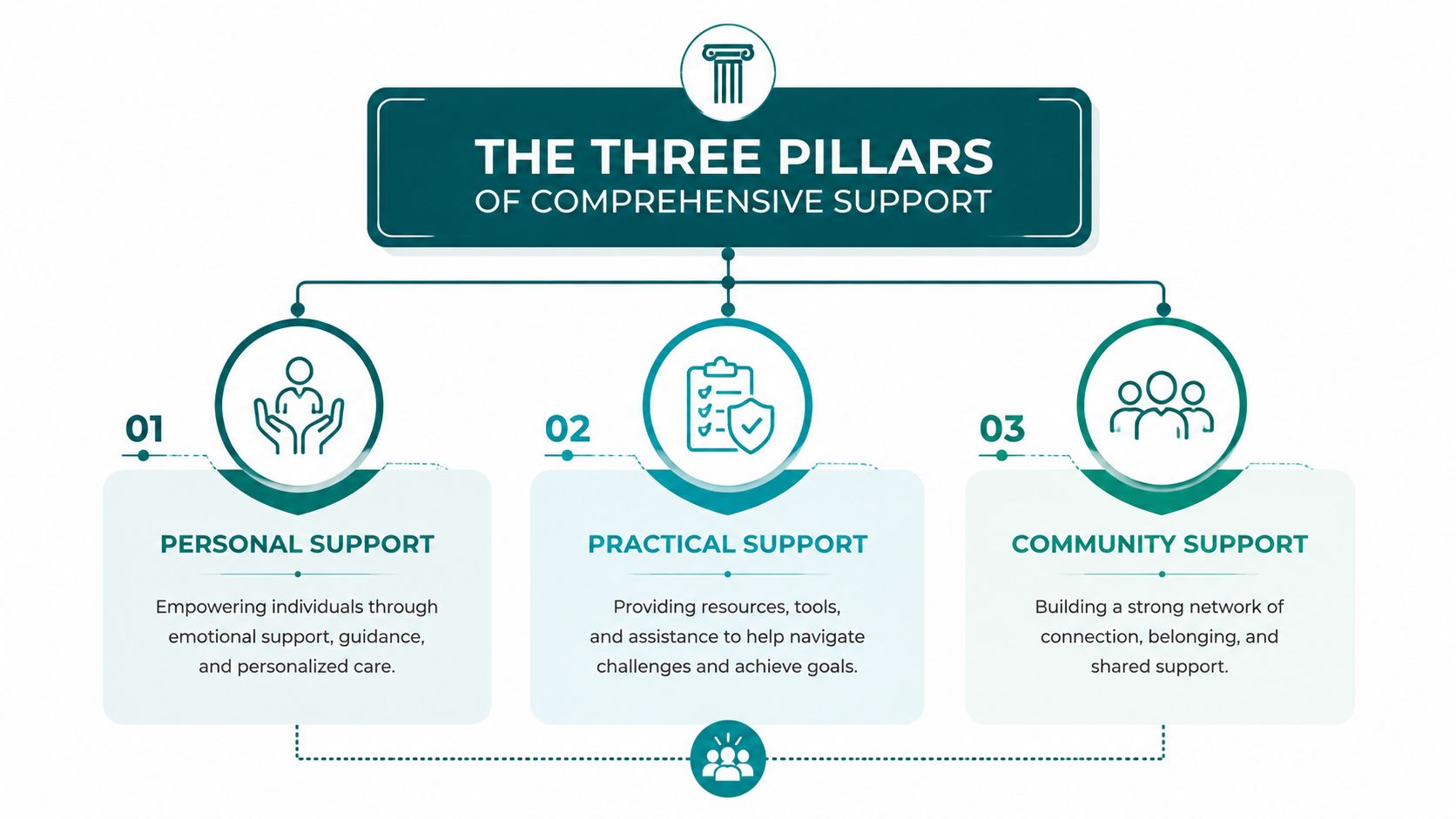
Support has three connected pillars: physical design, digital assistance, and organised human programmes. The strongest deployments don't treat them as competing budgets. They assign each layer a job and test how the layers behave when another layer is unavailable.
Physical support needs continuity
Tactile walking surface indicators can communicate route direction, crossing points, hazards, or platform edges. High-contrast signs help people with useful residual vision, while consistent handrails and audible pedestrian signals reinforce orientation. Their value falls sharply when a delivery trolley blocks the route, a sign uses inconsistent terminology, or maintenance teams replace one surface without reconnecting it to the next.
Physical support also needs a clear ownership model. Estates teams maintain surfaces, transport teams manage announcements, and contractors control temporary diversions. Unless those responsibilities meet in one accessibility process, users experience the gaps between departments.
Digital support adds information and recovery
Smartphone navigation, accessible ticketing, screen-reader-compatible kiosks, and real-time audio updates can provide information that fixed infrastructure cannot. Digital tools are especially useful when a route changes, a venue has multiple entrances, or the destination is a specific platform, room, counter, or gate.
Infrastructure-dependent systems can work well in controlled areas, but beacon networks and Wi-Fi positioning introduce installation, calibration, battery, coverage, and replacement tasks. Digital guidance also fails when maps are stale, instructions depend on an unavailable data connection, or the interface exposes information visually without an accessible equivalent.
Waymap's work on technology for visually impaired users illustrates why digital navigation should be evaluated as part of the whole service, rather than purchased as an isolated feature.
Programmes close the gaps
Staff training, pre-visit familiarisation, and on-demand assistance remain important. A trained employee can explain an unexpected closure, identify a safe alternative, or help someone understand a venue-specific process. The constraint is operational capacity. Assistance must be available when demand occurs, and staff need current information rather than a generic accessibility script.
The pillars should connect at known hand-off points. Tactile routes can lead to information desks or digital wayfinding entry points. Digital instructions can direct a user to a staffed fallback location. Staff can report recurring route failures to facilities and technology teams. This turns individual complaints into maintenance and service data.
The government accessibility study for private-sector products and services found that 47% of respondents with a vision impairment experienced barriers in the technology sector, the highest rate reported for that sector. That finding reinforces a practical point: physical access and digital access must be commissioned together.
Assistive Technologies That Deliver
Technology should reduce operational dependencies, not create another asset register. At a large venue, ask whether a system works indoors and underground, whether operators can update routes quickly, whether it supports a person's existing phone, and what happens when the map or signal is wrong. Those questions expose the cost of deployment, including maintenance, staff response, and fallback procedures.
Waymap is one smartphone-based option. It uses dead reckoning through device-native motion sensors and detailed maps to provide turn-by-turn audio guidance without GPS, Wi-Fi fingerprinting, or installed beacons. The publisher describes sub-three-metre accuracy in infrastructure-free environments, with no pre-mapping requirement for venues where staff turnover or frequent layout changes make extensive surveying difficult. Operators should still validate these capabilities with users in the actual venue, especially around stairs, lifts, platform edges, temporary barriers, and crowded concourses. A successful demonstration does not remove the need for route governance and update ownership.
For a wider review of smartphone-based support, see smartphone navigation for visually impaired users.
Screen-reader compatibility is a separate requirement. Ticket machines, kiosks, websites, and passenger apps need logical focus order, labelled controls, predictable error messages, scalable text, and information that is not communicated through colour alone. Public transport display requirements can also be concrete. The UK's Inclusive Mobility guidance links to accessible information rules requiring relevant displayed characters to be at least 22 mm high.
Audio induction loops can improve counter conversations where staff and customers need clearer speech, but they require correct installation, testing, and staff awareness. Object-detection tools using smartphone cameras may help users interpret signs or identify objects. They should supplement reliable venue information, not replace it or serve as a guaranteed description of a changing environment.
| Technology | Infrastructure Required | Accuracy | Maintenance Burden | Scalability |
|---|---|---|---|---|
| Smartphone dead-reckoning navigation | Device sensors and a mapped route, without installed beacons | Depends on map quality, sensor performance, and user testing | Map and content updates, device compatibility checks | Strong for large or changing sites where hardware installation is difficult |
| Bluetooth beacon wayfinding | Beacons, mounting, power or battery replacement, and calibration | Depends on beacon placement, signal behaviour, and environmental interference | Physical inspection, battery management, and recalibration | More difficult across extensive, high-footfall environments |
| Wi-Fi positioning | Wi-Fi coverage, access-point data, and positioning configuration | Depends on network coverage and signal stability | Network changes can affect positioning | Suitable only where network conditions remain controlled |
| Accessible digital kiosks | Accessible software, labelled controls, audio output, and suitable hardware | Depends on interface testing and content accuracy | Hardware, software, and content maintenance | Effective at fixed service points |
| Audio induction loops | Installed loop system and compatible hearing equipment | Depends on installation quality and local testing | Equipment inspection and fault reporting | Useful at defined counters, not as a complete navigation system |
The trade-off is operational. Beacons can provide useful location events in a defined area, yet every physical unit adds inspection, battery, and replacement work. Infrastructure-free navigation reduces hardware dependency, while increasing the importance of accurate maps, accessible instructions, testing, and a fallback process that staff can deliver when conditions change.
Implementation Steps for Large Venues and Transit
Large-scale implementation succeeds when accessibility is treated as an operational change programme rather than a technology purchase. Start with the journeys users need to complete: entrance to ticketing, ticketing to platform, car park to stadium gate, reception to clinic, or station to a particular shop.
Establish the baseline
Run an accessibility audit with blind and partially sighted participants, facilities staff, customer service leads, IT teams, security, and disability advisory groups. Record route breaks, confusing terminology, inaccessible machines, temporary obstructions, announcement failures, and destinations that staff routinely need to explain.
Map decision ownership before procurement. Facilities may control paving and barriers, IT may control APIs and identity systems, customer service may own assistance protocols, and contractors may manage construction changes. A project without these owners will produce a pilot that works only while one enthusiastic person is present.
Use staged delivery
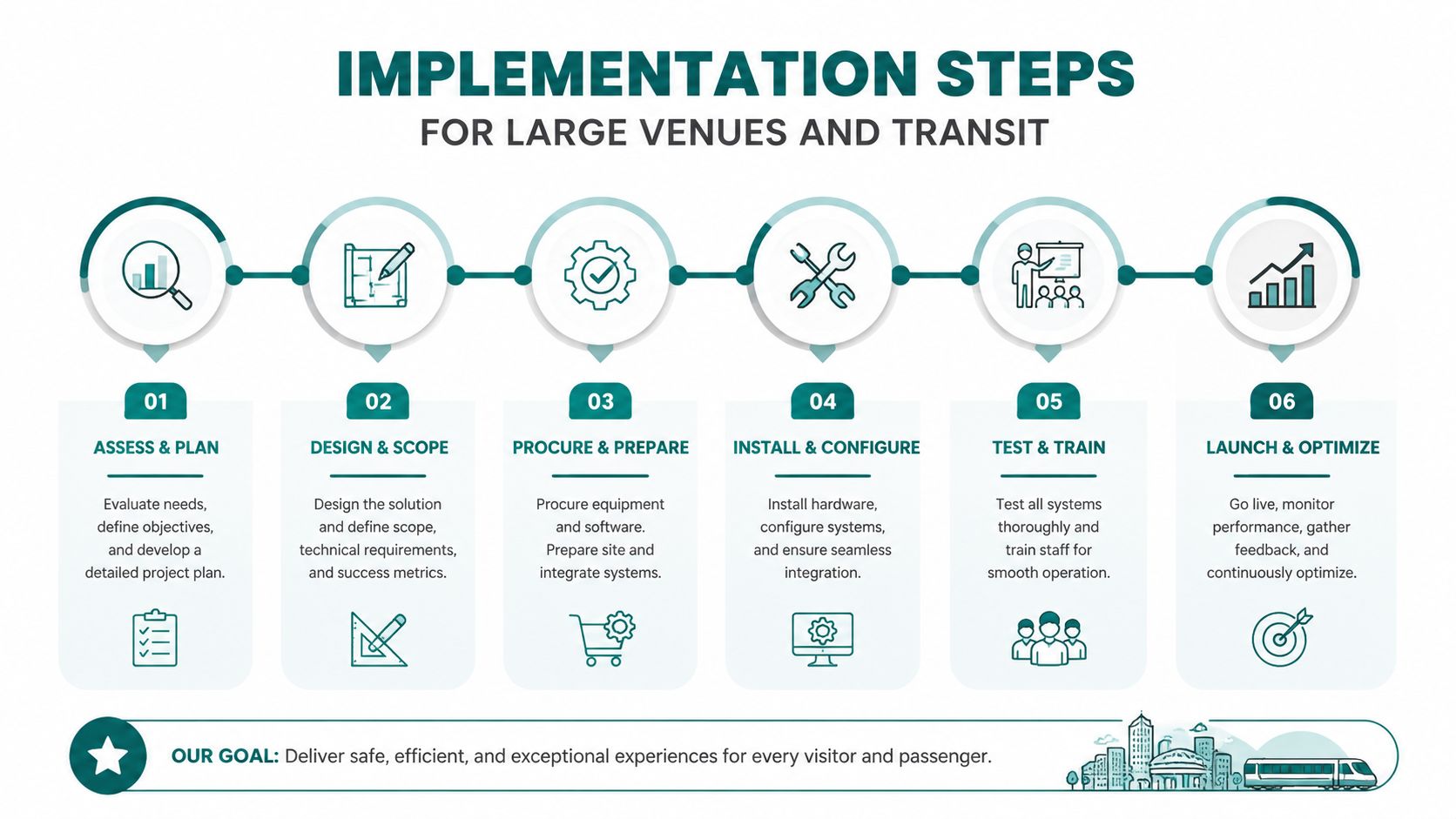
A practical programme can run through repeated 90-day sprints, with each sprint ending in evidence rather than a presentation.
- Discovery and selection: Define priority journeys, audit current information, agree success measures, and assess suppliers against accessibility, security, maintenance, and integration requirements.
- Pilot preparation: Choose a high-traffic zone with a meaningful mix of entrances, level changes, service points, and disruption risks. Prepare accessible content and train staff before inviting users.
- Live testing: Ask blind and partially sighted participants to complete real journeys at different times. Record missed turns, unclear instructions, map errors, assistance requests, and recovery behaviour.
- Iteration: Correct route data, signage, staff scripts, and hand-off points. Test planned construction diversions and closed facilities rather than waiting for a live failure.
- Operational rollout: Expand by zone or journey, publish ownership for updates, and connect the system to passenger information and incident-management processes.
- Review: Audit performance with users and frontline teams, then maintain an improvement backlog.
The Waymap approach to end-user support is relevant to the part many procurement plans under-resource, user onboarding, issue reporting, and ongoing assistance.
The accompanying deployment discussion is useful for teams comparing pilot and rollout decisions.
Budget owners should separate capital and operating costs. A beacon estate may require physical installation and recurring replacement, while an infrastructure-free system shifts more attention towards mapping, content management, testing, and integration. Don't promise a return based only on app downloads. Track completed journeys, avoidable assistance requests, staff time, incident recovery, user confidence feedback, and the cost of keeping routes current.
The most common failure is not technical. It's change management. A venue launches a tool, fails to brief frontline employees, leaves old signs in place, and doesn't give anyone responsibility for temporary route changes. Users then encounter several conflicting systems and reasonably conclude that none can be trusted.
Legal Obligations and ESG Considerations
Accessibility planning starts with the legal duty, but it shouldn't end there. In the UK, the Equality Act 2010 places an anticipatory duty on service providers and public authorities to make reasonable adjustments before an individual encounters a problem. The adjustment routes include changing a policy or practice, altering a physical feature, or providing an auxiliary aid or service, as outlined in the Equality Act explanatory notes.
That duty affects procurement. Accessible information, alternative formats, orientation support, and staff-assisted routes need to appear in service specifications from the beginning. A venue shouldn't wait for a complaint before deciding how a passenger will receive information about a closed entrance or a changed platform.
The law also has limits. The Equality Act 2010 reasonable-adjustment regulations explain that removing or altering a physical feature isn't always reasonable, including in circumstances where the feature was provided to help people access a building or use its facilities. Operators therefore need a balanced plan that considers information, auxiliary services, physical design, and the specific context of the feature.
| Regulation | Jurisdiction | Key Requirements | Enforcement Timeline |
|---|---|---|---|
| Equality Act 2010 | UK | Anticipatory reasonable adjustments, accessible information, auxiliary aids, and consideration of physical features | Applies to relevant UK services and public authorities |
| Inclusive Mobility and accessible transport rules | UK | Accessible pedestrian and passenger environments, including specified information presentation requirements | Applies through relevant transport guidance and rules |
| WCAG and EN 301 549 procurement criteria | International and European-facing digital services | Accessible websites, applications, documents, and digital interfaces | Set through the applicable contract, policy, or public-sector requirement |
| ADA Title III | United States | Accessible public accommodations and effective communication | Applies to covered US entities under federal disability law |
| European Accessibility Act | European Union | Accessibility requirements for covered products and services | Implementation and enforcement depend on the relevant national framework |
The Waymap material on third-party verification is relevant where decision-makers need evidence beyond supplier declarations. Independent testing with disabled users, documented acceptance criteria, accessible content review, and repeatable route audits provide stronger assurance than a one-time compliance statement.
ESG reporting adds another reason to measure delivery. Accessibility is a social-performance issue involving participation, service quality, and equal access. Claims should be tied to evidence, such as tested journeys, resolved barriers, staff readiness, route-update records, and user feedback. Avoid presenting an installation as an outcome. The outcome is whether people can use the service with fewer avoidable barriers.
Real Deployments and Measurable Outcomes
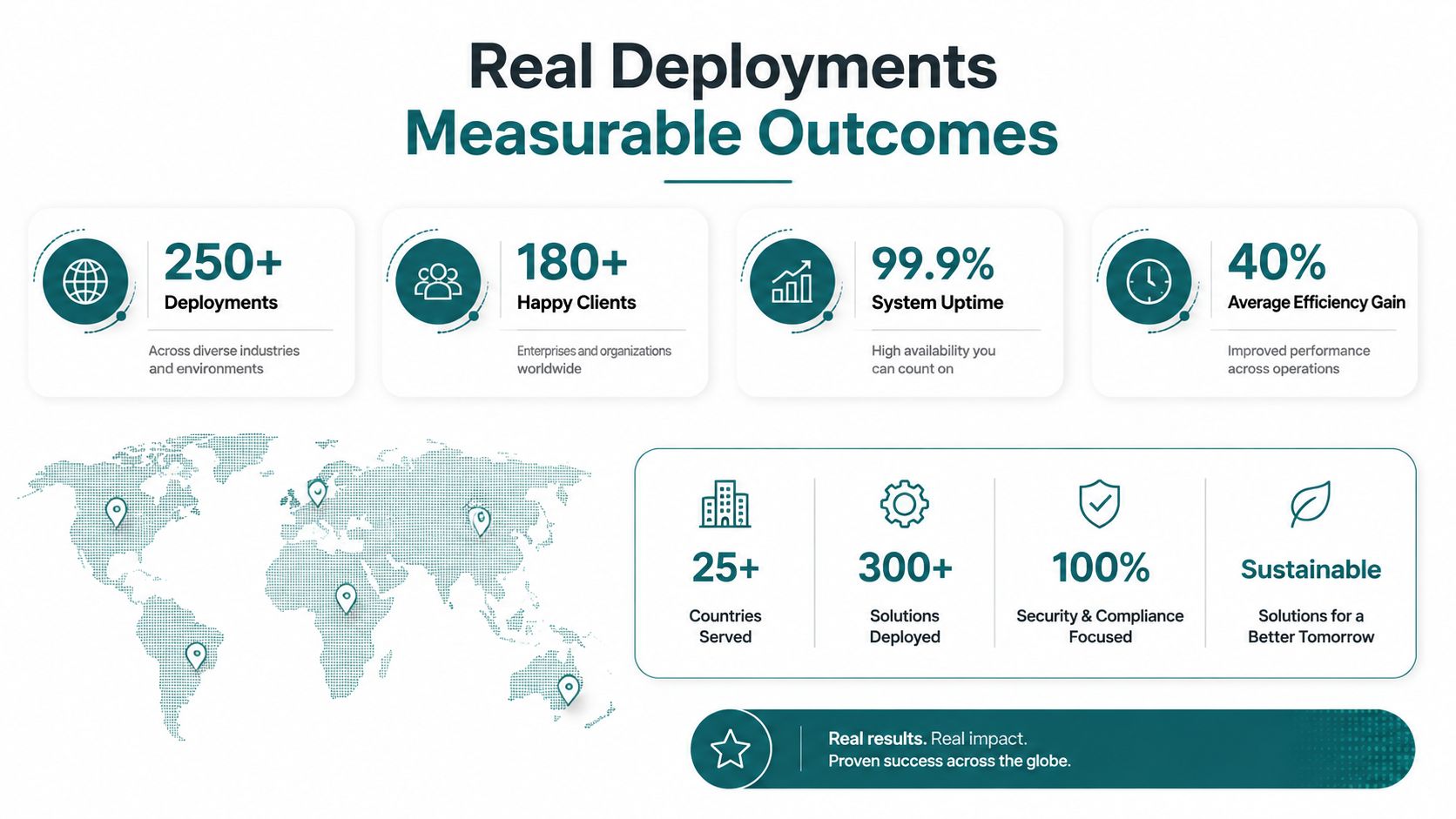
Deployment claims need careful scrutiny. The supplied material names Waymap deployments and partners including WMATA, SBS Transit, LTA Singapore, CapMetro Austin, the Royal Hospital for Children and Young People, and Westfield London, but it doesn't provide verified outcome figures for those specific sites. They can inform a discussion about deployment contexts, not justify invented reductions in assistance requests or customer-satisfaction scores.
The operational lesson is still concrete. At a transit operator such as WMATA or SBS Transit, the relevant constraint is not whether audio navigation can be demonstrated. Teams need to understand how route content is updated during station works, how users find the service, how staff respond when a passenger reports an obstruction, and how the solution behaves where GPS is unavailable.
A hospital such as the Royal Hospital for Children and Young People presents a different challenge. The destination may be a specific clinic, reception point, or entrance, and the environment can include temporary departments, sensitive privacy requirements, lifts, and changing appointment patterns. A shopping centre such as Westfield London needs precise destination handling across entrances, retail units, public facilities, and busy pedestrian areas.
What credible pilots measure
A useful pilot doesn't stop at technical uptime or installation completion. It measures:
- Journey completion: Whether participants reach the intended destination using the planned route.
- Recovery quality: What happens after a missed turn, closure, or unexpected obstruction.
- Assistance demand: When users need staff help and whether the reason is physical, digital, or procedural.
- Content maintenance: How quickly teams update a point of interest, diversion, or service message.
- User experience: Whether participants describe the route as understandable, predictable, and usable.
A successful pilot proves that the operator can maintain the service after launch, not merely that a supplier can demonstrate it on launch day.
RNIB's transport evidence shows why this discipline matters. In its 2025 bus-travel research, bus travel was very important for 83% of respondents, yet fewer than half could make all the bus journeys they wanted or needed to. The reported barriers include inaccessible stops, poor real-time information, dependence on flagging down buses, and inconsistent service design. A pilot should therefore test information and predictability across the entire journey, including disruption, rather than assess only the final indoor route.
Frequently Asked Questions
What does visually impaired support include?
Visually impaired support combines physical access, accessible information, and prepared human assistance. Tactile routes, audible announcements, screen-reader-compatible services, smartphone tools, staff procedures, and pre-visit information should operate as one service. Each element also needs an owner when layouts or services change.
Is infrastructure-free navigation better than beacons?
Infrastructure-free navigation can reduce installed hardware and its maintenance burden, while beacons can suit tightly defined areas. Compare map updates, coverage, route changes, device compatibility, testing, and fallback assistance before choosing. Smartphone tools for visually impaired navigation may help venues avoid new hardware, but they still require accurate mapping and operational support.
What does the Equality Act 2010 require?
The Equality Act 2010 requires anticipatory reasonable adjustments from relevant UK service providers and public authorities. Depending on the setting, this can mean changing practices, altering physical features where reasonable, or providing an auxiliary aid or service.
How should a venue begin?
Start with a user-tested audit of priority journeys and a contained pilot zone. Bring facilities, IT, customer service, contractors, and disability advisory groups into procurement. Assign responsibility for route updates, staff readiness, and budgeted maintenance.
Waymap provides smartphone-based, step-by-step audio navigation for indoor, outdoor, and underground journeys without GPS, Wi-Fi, or installed hardware. Visit Waymap to discuss a practical pilot for your venue, transport network, hospital, campus, or public service.
