
A Guide to Technology for People who are Visually Impaired
Imagine navigating a bustling airport or a sprawling university campus with limited or no sight. For millions of people, this isn't a thought experiment; it's a daily reality. A straightforward journey can quickly become a stressful and uncertain one.
This is where the right technology for visually impaired individuals stops being about convenience and starts being about independence, confidence, and the freedom to take part in public life.
Why Accessible Navigation in Venues Is a Critical Need
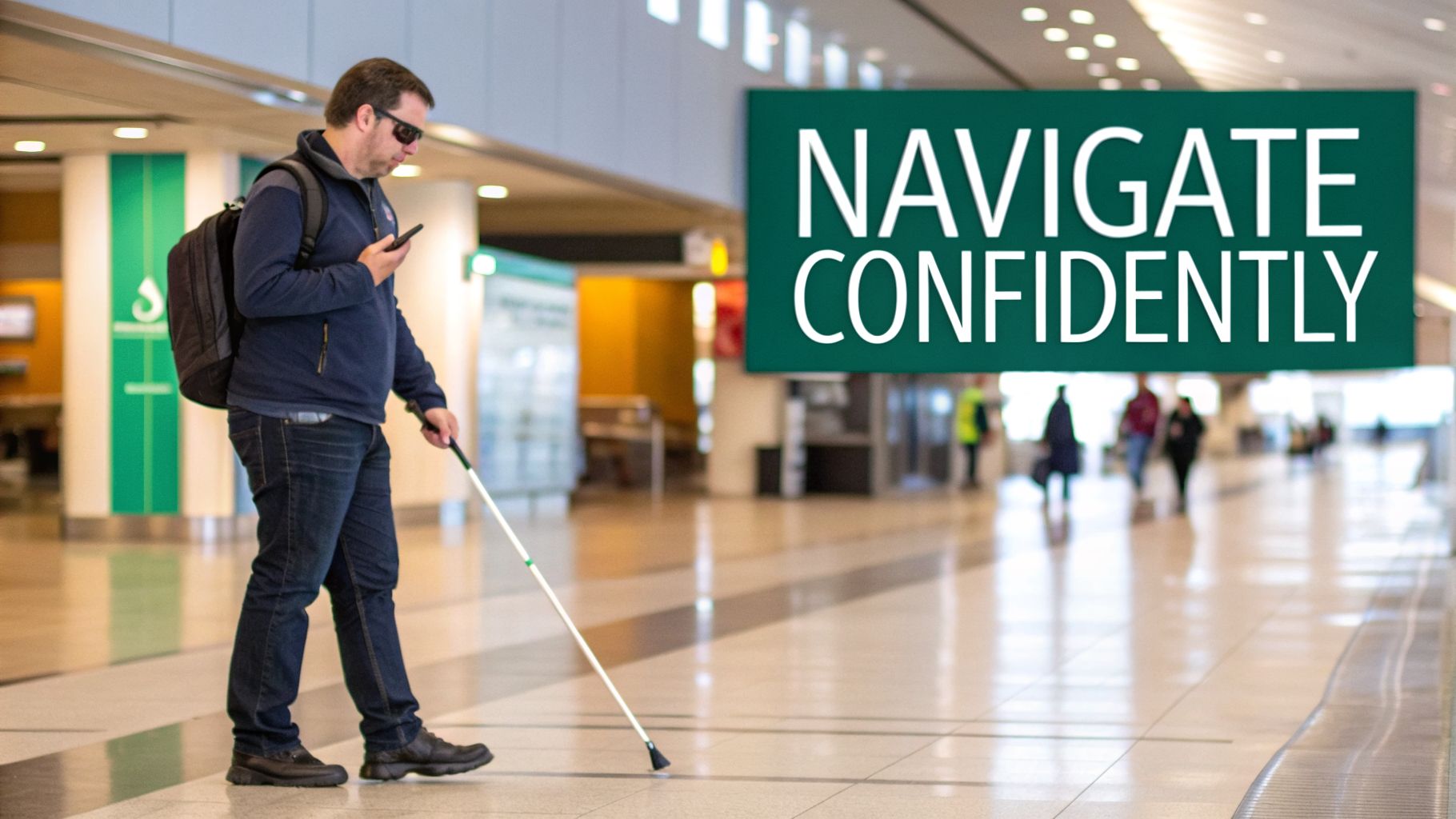
For a person with sight loss, entering a large, unfamiliar public space like a transit hub or shopping center can feel like hitting a wall of sensory information. The visual cues that most of us take for granted—static signs, overhead directories, and physical landmarks—are often inaccessible. This creates an immediate barrier to independence.
The trip becomes a constant stream of questions. Where is the correct platform? Which way to the food court? How do I find the accessible restroom? Relying on staff or the kindness of strangers is not a sustainable or dignified way to get around. It undermines autonomy and can turn a simple outing into a major source of stress.
Beyond Compliance to True Inclusion
While features like tactile paving and braille signage are important parts of accessibility regulations, they are just the starting point. They offer basic orientation but fall short of providing the detailed, turn-by-turn guidance needed for true navigation. This is the gap that effective technology must fill.
True accessibility isn't about ticking boxes to meet minimum requirements. It’s about designing spaces and systems that empower every individual to navigate with the same freedom and confidence as anyone else.
This shift in mindset is crucial for venue operators and transport authorities. When you move beyond a compliance-only mindset and focus on the customer experience, you create a genuinely welcoming environment for everyone. When a person with sight loss can navigate your space independently, it sends a powerful message that they are a valued customer. This is how you build loyalty and earn a reputation as an inclusive organization.
The Economic Case for Accessibility
There is also a clear financial reason to prioritize accessibility. In the UK alone, businesses lose an estimated £120 billion annually from inaccessible e-commerce sites. This "Purple Pound" represents immense spending power that is often left untapped. For venues and transport networks, this translates directly into lost ticket sales, missed retail spending, and fewer repeat visits.
Investing in inclusive technology is not just the right thing to do; it unlocks significant economic benefits.
Furthermore, digital exclusion remains a major hurdle. In the UK, where around 16.1 million people live with a disability, a significant digital divide persists. The RNIB reports that over half of blind and partially sighted people are late to adopt new technology, often held back by cost and poor design.
This problem is compounded when essential online tasks, like booking a train ticket, are inaccessible. For example, a staggering 55.5% of images on websites lack alt text, making them useless for screen readers. You can read more about these web accessibility statistics to see the full picture. By providing reliable, easy-to-use navigation tools, venues can help bridge this gap and ensure everyone can plan and complete their journey from start to finish.
Understanding the Landscape of Assistive Technologies
To make a venue truly accessible, it is essential to understand the available tools. Think of it like a toolkit: you wouldn't use a hammer to turn a screw. The same logic applies to assistive technology.
Different tools are built for very different jobs. For venue operators and mobility planners, understanding what each tool does—and what it doesn't do—is the first step toward identifying and filling accessibility gaps in your organization.
The world of assistive tech for people with sight loss can be broken down into a few key categories. Some are for reading a screen, others for spotting a curb. Let's explore them.
Digital Access Tools
This first group is all about making the digital world usable—think websites, documents, and the apps on our phones. The most common tools here are screen readers, like VoiceOver on an iPhone or TalkBack on Android, and screen magnifiers.
- Screen Readers: This software reads out everything on a screen: text, buttons, images, and more. For many people who are blind, it’s the primary way they use a computer or a smartphone.
- Screen Magnifiers: This software enlarges parts of the screen, making it easier for people with low vision to see and interact with content.
These tools are essential, but they can only work with what they are given. If a website or app isn't designed with accessibility in mind, a screen reader cannot make sense of the information. It is also why details like choosing the right voice for audio instructions are so important for clarity.
Orientation and Mobility Aids
Next are Orientation and Mobility (O&M) aids. Their job is to help someone navigate the physical world safely and understand their immediate environment. The white cane is the most well-known O&M tool, used to detect obstacles, texture changes on the ground, and drop-offs like stairs.
More recently, “smart canes” and other wearables have entered the market. They often use sensors, such as ultrasonic ones, to provide a vibration or sound to warn the user about an obstacle just out of the cane's reach, like a low-hanging sign. They are useful for immediate safety, but they are not navigation systems.
A smart cane can tell you that something is in your path. It cannot tell you what it is or how to get around it to reach your intended destination, like a specific shop in a mall.
This is a critical distinction. O&M aids provide information about your immediate personal space, but they do not provide the bigger picture needed to get from A to B in a complex building. You can find a broader look at the ecosystem of products for people with vision impairments here.
To help clarify how these tools fit together, here is a quick comparison.
Comparison of Assistive Technology Categories
Technology CategoryPrimary FunctionTypical EnvironmentKey Limitation for VenuesDigital Access ToolsInteracting with digital content (apps, websites)On a smartphone or computerCannot provide physical navigation; relies on the venue's digital assets being accessible.Orientation & Mobility AidsDetecting immediate obstacles and hazardsAnywhere the user walksDoes not provide directions or "big picture" awareness of a route.Dedicated Navigation AppsProviding step-by-step routing to a destinationIndoors, outdoors, public transportRelies on accurate mapping of the venue; some types require costly infrastructure.
As you can see, each category plays a specific role, but there is a clear gap when it comes to independent travel through complex spaces.
The Rise of Dedicated Navigation Solutions
This brings us to the final category: dedicated navigation applications. This is exactly where a solution like Waymap fits in. A screen reader helps you use your phone, and a cane can help you avoid walking into a wall, but a navigation app gives you the turn-by-turn instructions to get where you’re going.
The market for these kinds of assistive technologies is growing, spurred on by an aging population and an increased focus on inclusive public spaces. Globally, the market is projected to reach $12.71 billion by 2030, with reports like this assistive technologies market analysis showing a clear demand for better tools that enable independent travel.
Unlike the other tools, a sophisticated navigation app can give detailed, contextual guidance like, "turn left in 3 meters and walk towards the ticket barrier." It fills that crucial gap, turning what could be a stressful, uncertain journey into one that feels predictable, calm, and completely independent.
How Different Indoor Navigation Systems Work
When GPS fades at the front door of a complex venue, a visitor's journey is often only just beginning. For anyone managing a large public space, from a transport hub to a shopping center, the key question is how to provide accurate and reliable directions inside the building. This is where indoor navigation technology comes in, but it's crucial to understand that not all systems are created equal.
Making an informed decision for your venue means getting to grips with the different approaches. Broadly, you have two main choices: systems that require you to install physical hardware throughout your space, and more modern solutions that are entirely infrastructure-free.
Hardware-Based Systems: The Beacon and Wi-Fi Approach
The first wave of indoor navigation technology relied on creating a network of physical hardware. This typically meant installing dozens, or even hundreds, of Bluetooth Low Energy (beacons) or piggybacking on existing Wi-Fi access points.
You can think of it as creating an indoor constellation of digital signals. A person's smartphone picks up signals from these nearby beacons or Wi-Fi routers. By measuring the signal strength from several points, an app can triangulate the user’s approximate position and then plot a route.
This approach was an important first step, but for venue operators, it quickly revealed some serious practical and financial challenges:
- High Installation Costs: Purchasing and physically installing hundreds of beacons across a major airport, university campus, or shopping center represents a significant capital outlay.
- Constant Maintenance: Beacons run on batteries that need changing. They get damaged, moved, or interfered with, creating a constant maintenance task for facilities teams.
- Signal Interference: In busy public spaces packed with electronic devices, both beacon and Wi-Fi signals can become patchy and unreliable. This leads to inaccurate positioning and frustrated visitors.
These hardware-dependent systems have a high total cost of ownership. The initial investment is only the beginning; the long-term operational burden of maintenance and recalibration can be immense, making them difficult to scale across one large site, let alone multiple locations.
Infrastructure-Free Solutions: The Modern Alternative
A new generation of indoor navigation technology has emerged that completely does away with the need for physical hardware. These infrastructure-free systems, including Waymap, use the sensors already built into every modern smartphone—the accelerometer, gyroscope, and compass.
It’s a fundamentally different, and much smarter, way of doing things. Instead of listening for external signals from the building, the system uses advanced algorithms to understand a person's own movement. By analyzing a user's steps, turns, and even changes in elevation (like going up an escalator), the app can pinpoint their exact position on a pre-mapped route.
This method turns the user's smartphone into a completely self-contained navigation tool. It doesn't need to 'see' or 'hear' anything from the building to know precisely where someone is and where they need to go.
For venue operators, this is a far more sustainable and flexible model. With no beacons or other hardware to install, deployment is much faster and dramatically more cost-effective. Maintenance is practically nonexistent because the system relies on software and the user’s own device. You can get a deeper comparison of these technologies in our guide to indoor positioning systems.
This infographic shows how different types of assistive technology fit together to support a user's entire journey, from basic mobility aids to sophisticated navigation apps.
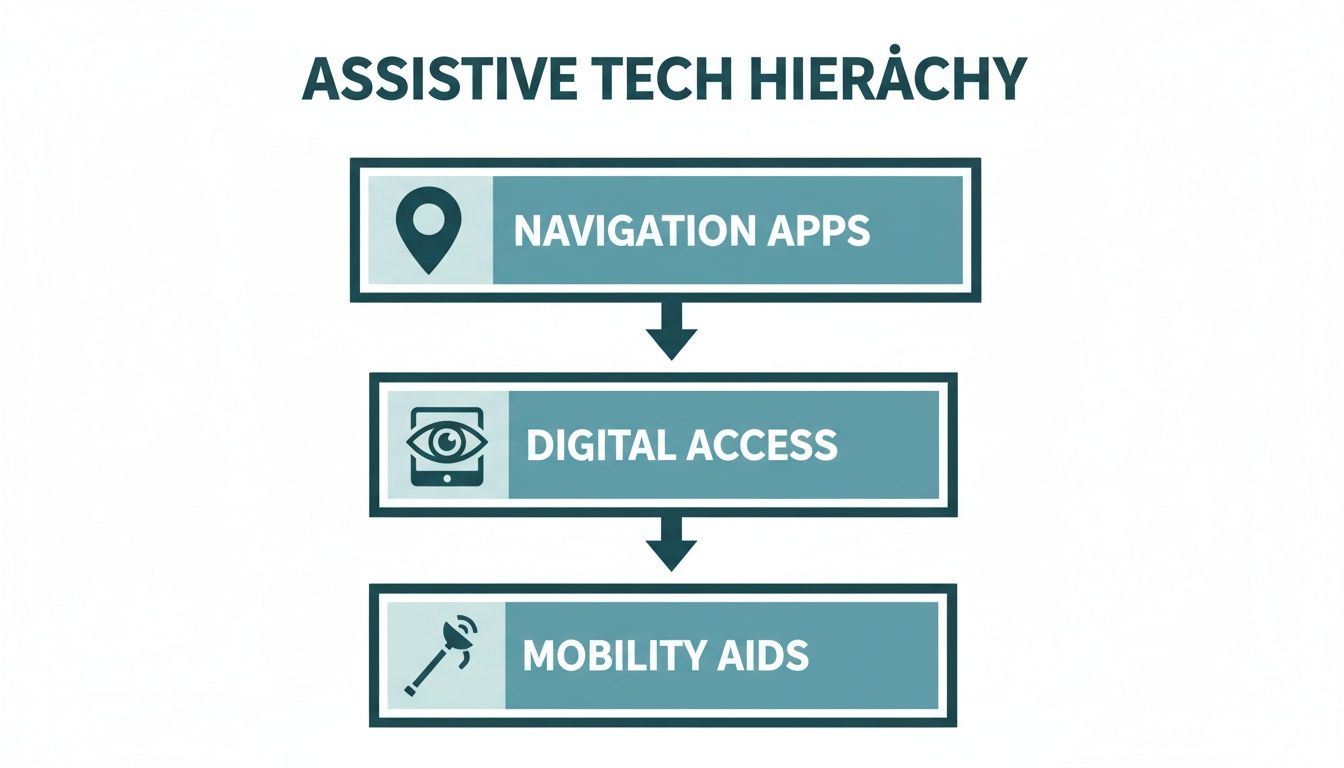
As the diagram shows, navigation apps fill a specific and vital role. They provide the "big picture" routing that other tools simply are not designed to deliver.
Why User Trust and Simplicity Are Everything
Choosing the right technology for people with visual impairments isn’t just a technical decision—it’s a deeply human one. Digital exclusion is a real and persistent barrier. The RNIB’s research highlights a stubborn divide, showing that over 50% of blind and partially sighted people are slow to adopt new technology because of factors like age, a lack of training, or complexity.
This has a tangible cost. A staggering 73% of disabled users will simply give up on a website or app if it's too difficult to use. You can read more in the RNIB's insightful report on sight loss and technology.
This is precisely why an intuitive, reliable solution is so vital. Waymap was developed in close partnership with the blind and visually impaired community to be as simple as possible. It works entirely through audio instructions, so users never need to look at or touch their phone while on the move. By providing guidance that is accurate to the step—and works flawlessly even deep underground in a subway station—it builds the trust that is essential for true independent travel.
For venue managers, this means you’re not just ticking a box. You’re delivering an accessible experience that people will actually use, trust, and rely on.
The Business Case for Inclusive Navigation Technology
Bringing advanced navigation technology into your venue or transit network is not just a matter of social responsibility. It's a sharp business decision with a clear return on investment.
For too long, accessibility has been seen as a cost center. But for transport operators, venue managers, and city planners, it's time to reframe that thinking. When you embrace inclusive design, you unlock new operational efficiencies, build powerful brand loyalty, and make the visitor experience better for every single person.
The conversation is shifting. This is no longer about simply ticking a box to meet a legal requirement. It's about a fundamental truth: a venue that's easy to navigate for a person with sight loss is, by definition, easier and more pleasant for everyone.
Strengthening Your ESG Profile
In today’s world, a strong Environmental, Social, and Governance (ESG) profile is vital. It’s what attracts investment, builds partnerships, and earns public trust. The ‘Social’ pillar of ESG is all about how you manage relationships with your customers, your staff, and the communities you serve.
Implementing a solution like Waymap is a tangible, measurable way to demonstrate your commitment to social inclusion.
- Demonstrates Inclusivity: It moves beyond simple compliance, creating a genuinely welcoming environment for the 16 million people in the UK living with a disability.
- Builds Community Trust: When you partner with sight loss organizations and accessibility advocates to deploy a genuinely useful tool, you prove you’re listening to and serving your entire community.
- Enhances Corporate Reputation: A public commitment to accessibility generates positive press and cements your brand as a forward-thinking, responsible leader.
Unlike an abstract policy document, a working, well-implemented navigation app is concrete proof of your organization’s values in action.
Unlocking Operational Efficiencies and New Revenue
Think about the limits of static signage. It's expensive to install, a headache to update, and a constant maintenance task. It can't speak multiple languages, adapt to a temporary closure, or tell you a single thing about how people actually move through your space.
A modern, infrastructure-free navigation system changes all that, turning wayfinding into a dynamic, digital asset. Because it’s built on software and detailed digital maps, you gain operational benefits that are simply impossible with metal and plastic signs. This is especially powerful when you consider the technology as an app for good, where social impact and operational gains go hand-in-hand.
Think of it as upgrading from a printed paper map to a live, interactive digital one. You can instantly change routes, add new points of interest, or provide targeted information to visitors without any physical changes to your building.
This agility leads directly to cost savings and better service. For instance, a transit operator can instantly reroute passengers around a broken-down elevator. A shopping center can guide thousands of visitors to a special promotional event. The technology also provides multilingual guidance, a massive benefit for international tourists who might struggle with English-only signs.
Driving Customer Loyalty and Measurable Returns
At the end of the day, a positive experience is what brings people back. A stressful, confusing journey is one of the fastest ways to lose a customer for good. By removing navigational barriers, you reduce visitor anxiety and create a more enjoyable, welcoming atmosphere for everyone.
This inclusive approach doesn’t just help those with visual impairments. It helps the parent trying to find a baby changing room, the tourist searching for a specific landmark, or the conference attendee rushing to their next session. They all benefit from clear, step-accurate directions.
When you invest in the right kind of technology for visually impaired individuals, you are not just serving a niche group. You are investing in a superior experience for every single person who walks through your doors. You’re turning accessibility into a powerful operational advantage that delivers a measurable return.
A Practical Checklist for Picking the Right Navigation Solution
You have realized you need to improve your wayfinding. That’s the easy part. The hard part is moving from that realization to taking real action. For anyone running a busy transport hub, a sprawling venue, or leading an organization’s accessibility strategy, the sheer number of technology options can feel overwhelming.
This checklist is here to cut through the noise. Think of it as a clear, step-by-step guide to help you evaluate and deploy the right solution. It is designed to ensure you choose a technology that delivers genuine value, both for the people you serve and for your bottom line.
Let's walk through the key things you need to consider to create a space that’s truly navigable and welcoming for everyone.
1. Find the Gaps in Your Current Wayfinding
Before you can choose a new direction, you have to know where you are. A proper audit of your current wayfinding system is the only place to start. Put yourself in the shoes of a first-time visitor, especially someone with a visual impairment, and walk your own venue.
- Map your blackspots. Where does your signage let people down? Pinpoint those confusing junctions, long, featureless corridors, or underground areas where GPS simply dies. These are your priority zones.
- Check your existing aids. How well do your tactile paths, Braille signs, or audio announcements actually work? Do they just give a hint of orientation, or do they provide true, A-to-B navigation? Be honest.
- Talk to people. Your best intelligence will come from accessibility user groups and your own front-line staff. They have first-hand experience of where visitors get lost, frustrated, or simply give up.
This audit isn't just a box-ticking exercise. It will give you a clear map of the real-world problems you need to solve, forming a solid foundation for your entire project.
2. Set Clear, Human-Centered Goals
Once your audit is done, you can set meaningful goals. A vague objective like “improve accessibility” is a recipe for failure. You need to focus on tangible outcomes that will define what success looks like.
Remember, you’re not just buying a piece of technology. You’re solving a specific human problem. Whether that’s getting a passenger to their train on time or helping a student find a lecture hall without assistance, a clear objective guides every decision you make.
Try to set goals like these:
- Enable a passenger with sight loss to travel independently from the station entrance to platform 9.
- Provide step-accurate, multilingual directions to every key facility—restrooms, information desks, and food courts.
- Eliminate the operational costs and maintenance headaches associated with physical beacons or constantly updating physical signs.
These sharp, focused targets make it much easier to assess potential technology partners and, later on, to measure your return on investment.
3. Judge the Tech on What Really Matters
Now you’re ready to look at solutions. This is where you need to be critical. Every provider will have slick marketing, but you have to dig into the practical reality of deploying and living with their system.
Here are the critical factors to put under the microscope:
- Accuracy: How precise is it, really? A system that’s only accurate to within five or ten meters is useless for getting someone to a specific door or ticket machine. Demand live demos and ask for hard data on its step-level accuracy, especially in areas with zero signal.
- Total Cost of Ownership: Look way beyond the initial price tag. If a system relies on hardware like beacons, you have to factor in the cost of installation, battery replacements, ongoing maintenance, and recalibration. This is where an infrastructure-free solution like Waymap completely changes the equation by eliminating those long-term hidden costs.
- Scalability and Maintenance: How difficult will it be to update a map or expand your coverage? A software-based system lets you make changes instantly from a computer. A hardware-based system means sending engineers out to do physical work.
By rigorously comparing these core factors, you’ll be able to spot the partner who can offer a truly sustainable, reliable, and cost-effective solution for your venue. It turns a complex, daunting decision into a clear and confident choice.
A Few Common Questions About Venue Accessibility Tech
When you start looking at new accessibility technology for a large venue, a few key questions always come up. It's one thing to talk about inclusion, but facility managers, ESG leaders, and transport operators need to know about the practicalities. We understand. These are the real-world questions that help you make the right choice.
What's the Difference Between Assistive Technology and Accessibility?
This is an excellent question because it gets right to the heart of how you create a genuinely inclusive space.
Think of it like this: assistive technology is a specific tool that a person with a disability uses. It could be a screen reader app on their phone or a smart cane for spotting obstacles. It's a personal tool that assists the user.
Accessibility, on the other hand, is about the physical environment itself. An accessible building is one that's designed from the ground up to be used by everyone, with features like ramps, wide doorways, and clear signage. The best results happen when you get both working together.
An accessible venue that also supports a navigation app like Waymap creates a truly seamless journey. Our goal is to build a layer of digital accessibility into your physical venue, making it independently navigable for all visitors.
We Already Have Beacons. Why Should We Consider an Infrastructure-Free Solution?
Beacons were an important first step for indoor navigation, but years of real-world use have shown they have some major drawbacks. They demand a large upfront investment for installation, and from that point on, they create a constant maintenance headache with battery replacements and endless recalibration. Worse, signal interference in busy areas often leads to unreliable directions.
An infrastructure-free solution like Waymap sidesteps all of those problems.
- No Hardware: Our system works using the motion sensors already built into a standard smartphone. There is absolutely nothing to install, power, or maintain in your venue.
- Lower Costs: When you eliminate the hardware, the total cost of ownership plummets. It’s much faster to set up, and you’ll never get a surprise bill for maintenance.
- Rock-Solid Reliability: Because the system doesn't need external signals, it's completely immune to interference. It works perfectly even in underground stations or basements where there's no mobile or Wi-Fi signal.
It's simply a more sustainable, scalable, and accurate approach for a modern venue, and it gives your visitors a much better experience.
How Do We Get Visitors to Actually Use a New Navigation App?
This is a great question. Getting people to adopt any new technology, especially for the blind and visually impaired community, all comes down to trust and awareness. You can't just launch an app and hope people find it. You need a proactive, community-first strategy.
The first step is to partner with local and national sight loss organizations to introduce the technology. We often co-host demonstration days where people can try the system for themselves in a friendly, supportive environment. It’s a chance to ask questions and build real confidence. Waymap was built with and for the blind community, and its audio-first design was specifically created to feel intuitive from the start.
Next, you need to weave information about the app into all your existing accessibility communications. Make it a prominent feature on your website’s accessibility page, include it in scripts for your customer service teams, and train your on-site staff so they can confidently recommend it as a helpful tool.
How Does This Help Visitors Who Aren't Visually Impaired?
This is where the business case really clicks into place. While this kind of navigation technology is designed with the needs of people with sight loss first, its benefits ripple out to every single person who walks through your doors. It creates a universally better experience.
Think about these everyday situations:
- International Tourists: A family visiting from abroad can get directions in their native language, taking away the stress of trying to read English-only signs in an unfamiliar place.
- Anxious Travelers: Anyone rushing for a train or trying to find a specific departure gate can get clear, step-accurate guidance that cuts down on stress and that "am I going the right way?" feeling.
- Large Groups and Families: A parent searching for baby-changing facilities or a group of friends trying to meet up at a specific shop can find where they're going without any fuss.
When you provide a universally designed tool, you aren’t just buying an accessibility feature. You’re investing in a better, smoother, and more welcoming service for everyone.
Ready to make your venue truly navigable for everyone? Waymap provides step-accurate indoor and outdoor navigation without any costly hardware. Contact our team today to learn how we can help you achieve your accessibility goals.
