
A Guide to Products for VI and Blind Users

When you can't see, or see very little, navigating the world requires a different approach. Everyday tasks that many people take for granted, like finding the right platform in a busy train station or a specific gate at the airport, can become significant challenges.
To bridge this gap, a wide range of assistive technology has been developed. These aren't just gadgets; they're essential tools designed to enhance independence, ranging from personal aids like smart canes and electronic magnifiers to software-based solutions like screen readers and navigation apps.
Navigating the World with Vision Impairment
True independence is about having the freedom to move through the world on your own terms. For a person who is blind or has low vision, this means not having to rely on finding a staff member or asking a stranger for directions just to get around.
The market for assistive products has grown to meet these needs, offering solutions that empower people to engage more fully and independently with their environments. This guide will walk you through the essential products available, focusing on the tools that deliver genuine freedom and mobility.
Understanding the Spectrum of Support
The available technology can be seen as a spectrum of support, from simple aids for specific tasks to comprehensive systems for entire journeys.
This spectrum includes:
- Personal Aids: These are the immediate, hands-on tools. Think of white canes, electronic magnifiers, and braille displays that help with the immediate surroundings.
- Software Applications: Smartphone apps have become powerful assistants. They can do everything from identifying objects and reading text aloud to connecting users with sighted volunteers in real time.
- Navigation Platforms: This is where advanced systems like Waymap come in, built to provide precise, step-by-step guidance through large, complex indoor and outdoor venues.
For venue operators and public transport providers, deploying the right technology is about more than just checking a compliance box. It’s the key to creating a genuinely inclusive and welcoming environment where every visitor can have a seamless experience.
Fostering True Independence
While many tools offer a helping hand, the ultimate goal is to enable true autonomy. The right technology makes this level of independence not just a possibility, but a practical reality. You can get a deeper sense of how this works by reading about what Waymap means for blind and low-vision people in our detailed article.
Here, we'll explore the different categories of assistive products, break down what to look for when evaluating them, and discuss how venues can implement solutions that turn accessibility into a real operational strength.
The Growing Need for Advanced Accessibility
The conversation around public accessibility is changing. For anyone managing a public venue or transport network, providing access was once seen as a matter of legal compliance. That view is now outdated. Today, accessibility is a core strategic priority.
This shift is a response to a simple fact: our populations are changing, and so are the needs of the people using our services. A growing number of visitors and passengers require more sophisticated support than signage or basic staff assistance can provide. This isn’t a niche concern; it’s a mainstream reality that impacts customer experience, operational efficiency, and social commitments.
The Numbers Behind the Shift
Public health data illustrates this trend clearly. Conditions that affect sight, like age-related macular degeneration, glaucoma, and diabetic retinopathy, are on the rise. This means a significant and growing part of the public faces real challenges getting around complex places like airports, hospitals, and train stations.
This trend is set to accelerate. Research from the Royal National Institute of Blind People (RNIB) projects a 27% increase in the number of people in the UK living with sight loss by 2035. Within a decade, nearly 2.8 million people in the UK will have a vision impairment, with cases of severe sight loss expected to jump by 29%.
The data paints a clear picture. The demand for advanced accessibility and products for vision impaired people isn't a passing trend. It’s fundamental to future-proofing public spaces for a society where one in five people will experience sight loss in their lifetime.
Beyond Compliance to Real Advantage
When you view accessibility through this lens, it stops being a cost and starts looking like a smart investment. If a large segment of the population struggles to use your venue, you're looking at lost revenue, poor visitor satisfaction, and a failure to meet your social responsibilities. Getting ahead of these challenges provides a strong competitive edge.
- A Better Experience for Everyone: Tools that help people navigate independently make your venue more welcoming and usable for all, not just those with sight loss.
- Hitting Your ESG Goals: A genuine commitment to accessibility is a powerful, measurable part of any organization's social and governance strategy.
- Meeting Clear Market Demand: By putting advanced solutions in place, you’re directly serving a large and growing market of customers who actively seek out accessible places.
As the need for better physical accessibility grows, it’s a good reminder to think about the whole visitor experience. This includes digital touchpoints, too. For instance, subtitles in video content are essential for millions of users, and this Quick Guide for Accessibility offers a useful parallel. Ultimately, creating truly accessible spaces means looking at every part of the visitor journey and turning a challenge into an opportunity.
Unpacking the World of Assistive Products
If you manage a large public space—be it a bustling transport hub, a sprawling university campus, or a major stadium—the term "assistive technology" can feel overwhelming. There are many options out there, but breaking them down is the first step toward making a smart decision that genuinely helps your visitors who are blind or have low vision.
You can think of products for vision impaired people as falling into a few main categories. Each serves a different, but equally important, purpose.
Understanding these categories helps you know what tools your visitors might already be using. It also clarifies where a more comprehensive, venue-wide solution like an indoor navigation system fits into their day. It’s all about recognizing the different ways people navigate the world and providing something that enhances their existing independence.
The scale of sight loss worldwide is growing, which is why understanding these product types is so critical for future-proofing any public space.
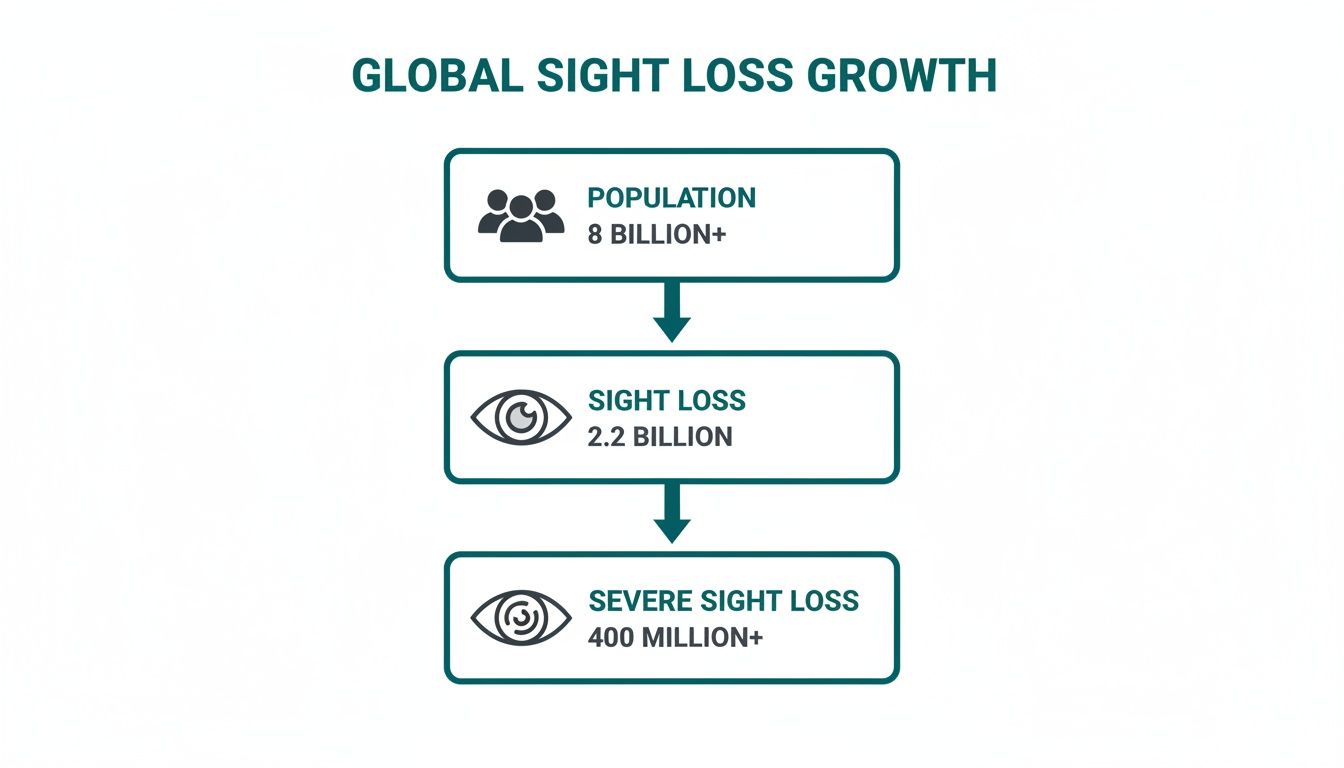
The numbers speak for themselves. As our global population increases, so does the number of people living with some form of vision impairment. This isn't a niche issue; it's an essential part of modern public service and design.
Personal Hardware
First, we have personal hardware. These are the physical devices a person carries to make sense of their immediate surroundings. For many people with a vision impairment, these are the fundamental tools they learn to use for safety and close-quarters orientation, providing tangible, real-time feedback.
You’ll likely be familiar with some of them:
- The White Cane: The most recognizable tool for orientation, the cane provides vital tactile information. It detects obstacles on the ground, drop-offs like curbs and stairs, and changes in surface texture that signal a new path or a potential hazard.
- Electronic Magnifiers: For people with low vision, these portable devices are very useful. Ranging from small handheld gadgets to larger desktop units, they enlarge text and images, making it possible to read anything from a departure board to a printed document.
- Smart Canes: A modern take on a classic tool. These canes are fitted with sensors that use ultrasound or vibrations to detect obstacles above ground level—things like low-hanging branches or projecting signs that a traditional cane would miss.
Standalone Mobile Apps
The smartphone has become an incredibly powerful accessibility tool. An entire ecosystem of apps now exists, each designed to solve a specific, immediate problem using the phone's built-in camera and sensors. They are excellent for getting quick bits of information on the fly.
Think of a standalone app like asking a helpful stranger for a single piece of information—"What does this sign say?" or "Is this the right bus stop?" It's great for that one moment, but it isn’t designed to guide you on a longer, more complex journey.
Many of these apps fall into a few key categories:
- Object and Text Recognition: Apps like Seeing AI or Be My Eyes use the phone’s camera and AI to do things like reading a menu aloud, identifying a product on a shelf, or describing a scene.
- Light and Color Identifiers: Simple but incredibly useful. These apps can help a user identify the color of their clothes or tell if the lights are on in a room.
- Magnification Apps: These turn a smartphone into a powerful digital magnifier, often with added features to increase contrast or change color schemes to make text more readable.
Comprehensive Navigation Platforms
This final category is the most relevant for anyone running a large, complex venue. Unlike a standalone app that solves one problem at a time, a comprehensive navigation platform is designed to guide a user through an entire journey, step-by-step, from their starting point right to their final destination.
Platforms like Waymap provide a continuous, connected experience. To use another analogy: if a standalone app is like asking for a single direction, a navigation platform is like having a personal guide for your whole trip. They are essential for navigating large, unfamiliar environments like airports, train stations, or shopping centers. This push for advanced accessibility is part of a wider trend in smart living technologies, which aim to create more integrated and responsive environments for everyone.
To help clarify the differences, this table offers a quick comparison of how each product category functions in the real world.
Comparison of Assistive Product Categories
| Product Category | Primary Function | Typical Use Case | Infrastructure Dependency |
|---|---|---|---|
| Personal Hardware | Immediate obstacle detection and orientation | Navigating sidewalks, stairs, and personal spaces | None |
| Standalone Apps | On-demand information (text, object, color) | Reading a sign, identifying a product, checking lights | None |
| Navigation Platforms | End-to-end journey guidance | Navigating a large airport, hospital, or transit network | Requires pre-mapped venue data |
As the table shows, each category plays a distinct role. While hardware and standalone apps are crucial for personal independence, they don't solve the challenge of navigating large, complex public spaces.
That's where a true navigation platform comes in. It works by integrating highly detailed, pre-mapped information about a venue with a user's real-time position to provide reliable, turn-by-turn audio directions. This is the technology that empowers a person with vision impairment to travel with the same confidence and independence as anyone else.
Key Criteria for Evaluating Navigation Technology
Choosing a navigation solution for your venue is an important decision. With a wide range of products for vision impaired people on the market, it’s easy to get lost in marketing claims. To make a smart choice that serves everyone, you need to look past the sales pitch and focus on real-world impact.
This isn’t just about adopting a new technology. It's a strategic move that will shape your visitor experience, operational efficiency, and bottom line. Getting it right means picking a true asset, not a long-term headache.
The need for these solutions is becoming more urgent. A 2020 study by the CDC showed that at least 12 million people aged 40 and over in the United States have vision impairment. This staggering number represents the people walking through your doors and highlights just how critical robust, accessible navigation is in our public spaces.
Accuracy and Reliability
Let’s be direct: the single most important factor is accuracy. For someone with a vision impairment, "close enough" is not good enough. A system that just gives a general idea of where something is—placing a user in the vague vicinity of their destination—is a world away from one that offers step-level precision, guiding them right to a specific door, ticket barrier, or platform edge.
Think of it this way: a system that says a coffee shop is "on your left" is somewhat helpful. But one that says, "in five steps, the door to the coffee shop will be on your left" is truly empowering. That level of detail is the difference between simply assisting someone and giving them genuine independence.
When you're looking at a system, insist on a live demo. Does it give you step-accurate directions every time, or does it just offer vague prompts? Reliability isn’t just about the technology working; it's about earning a user's trust with every step they take.
A platform’s accuracy is directly linked to its usability and safety. For transport hubs and large venues, rolling out a system that can’t be trusted to guide people precisely can create more problems than it solves.
User Experience
A great user experience feels effortless and natural. For a person who is blind or has low vision, that almost always means a "heads-up, hands-free" approach. Many people rely on a white cane or a guide dog to detect immediate obstacles, which makes holding and looking at a smartphone impractical while on the move.
The best solutions deliver clear, timely audio instructions through headphones. This lets people keep their hands free and their attention on the world around them—a far safer and more natural way to get from A to B than constantly glancing at a screen.
Here are a few key questions to ask about the user experience:
- Hands-Free Operation: Does the system force someone to hold or look at their phone to get directions?
- Adaptive Guidance: Can the app learn and adjust to an individual's walking speed and stride length for more personal instructions?
- Audio Quality: Are the audio cues clear, to the point, and delivered at the right moment so they’re helpful, not distracting?
An outstanding user experience gives people the confidence to travel freely, just as sighted people do every day.
Infrastructure Needs and Scalability
The technology that powers a navigation system has huge implications for its cost, maintenance, and ability to scale. Many older systems are built on physical hardware, like Bluetooth beacons or special Wi-Fi points that have to be installed all over a venue.
This hardware-first approach comes with significant hidden costs:
- High Installation Costs: Fitting hundreds or even thousands of beacons is an expensive and time-consuming project.
- Ongoing Maintenance: Beacons run on batteries that need replacing, and they can be damaged or moved, which means they need constant recalibration.
- Limited Scalability: Want to expand coverage to a new wing or floor? That means buying and installing more hardware, locking you into a cycle of cost and effort.
In contrast, a hardware-free solution like Waymap uses the sensors already built into every smartphone. By eliminating the need for installed infrastructure, venues can roll out a highly accurate navigation system much faster and at a fraction of the cost. Maintenance becomes simple, since updates to maps or points of interest are purely digital and can be done instantly. This approach gives you far more flexibility and a much lower total cost of ownership. For a detailed breakdown of different systems, you can explore our comparison of indoor navigation technologies.
The Hidden Costs of Inaccessible Spaces
When a space isn’t accessible, the consequences go beyond legal compliance. For transport hubs, shopping centers, and other large public venues, poor accessibility has a real, tangible cost that shows up on the balance sheet and in the wider community.
From the customer’s perspective, if a person who is blind or has low vision finds a venue confusing or stressful to navigate, they are unlikely to return. That’s a direct loss of revenue, but the ripple effect is larger. It's a negative experience shared with friends and family, and a missed opportunity to build a loyal customer base from a significant and growing part of the population.
The Financial Drain of Outdated Systems
Beyond lost footfall, many venues are losing money by clinging to outdated accessibility solutions. Physical signage is a perfect example of a static system with a surprisingly high lifetime cost.
Consider the ongoing expenses involved:
- Manufacturing and Installation: Getting physical signs made and fitted, especially tactile ones, is a costly upfront investment.
- Updates and Replacements: When a shop moves, a platform changes, or a department is relocated, every relevant sign has to be manually replaced. It's a slow, expensive, and labor-intensive cycle.
- Vandalism and Wear: Signs get damaged and wear out over time. Keeping them effective requires constant monitoring and replacement.
These costs add up, year after year, creating a steady drain on operational budgets. This is money that could be better spent on modern, dynamic solutions that create a better experience for every visitor.
The Broader Societal Impact
The price of inaccessibility goes far beyond any single venue's finances. When people can't independently get to essential public services—like transport, healthcare, or government offices—it can create dependence, limit employment opportunities, and lead to social isolation for people with disabilities.
This is not a problem that is going away; it is set to grow. Health projections for the United Kingdom, for instance, show that conditions like glaucoma are on the rise. The number of adults aged 40 and over living with glaucoma is forecast to jump to more than 1.6 million by 2060—a 60% increase from 2025. With over 40% of UK patients already losing vision due to late diagnosis, the need for truly accessible infrastructure is an urgent public health issue. You can learn more about the projected rise in glaucoma cases and what it means for the country.
Proactively investing in modern accessibility is not just about mitigating risk; it’s a strategic decision to convert a potential liability into a clear competitive advantage.
By bringing in advanced products for vision impaired people, like hardware-free navigation platforms, venues can tackle these financial and social challenges head-on. They can reduce the high maintenance costs of physical infrastructure while opening their doors to a much wider audience. This isn't just about improving access; it's about building a more inclusive, efficient, and profitable environment for everyone.
How Waymap Creates Truly Navigable Environments
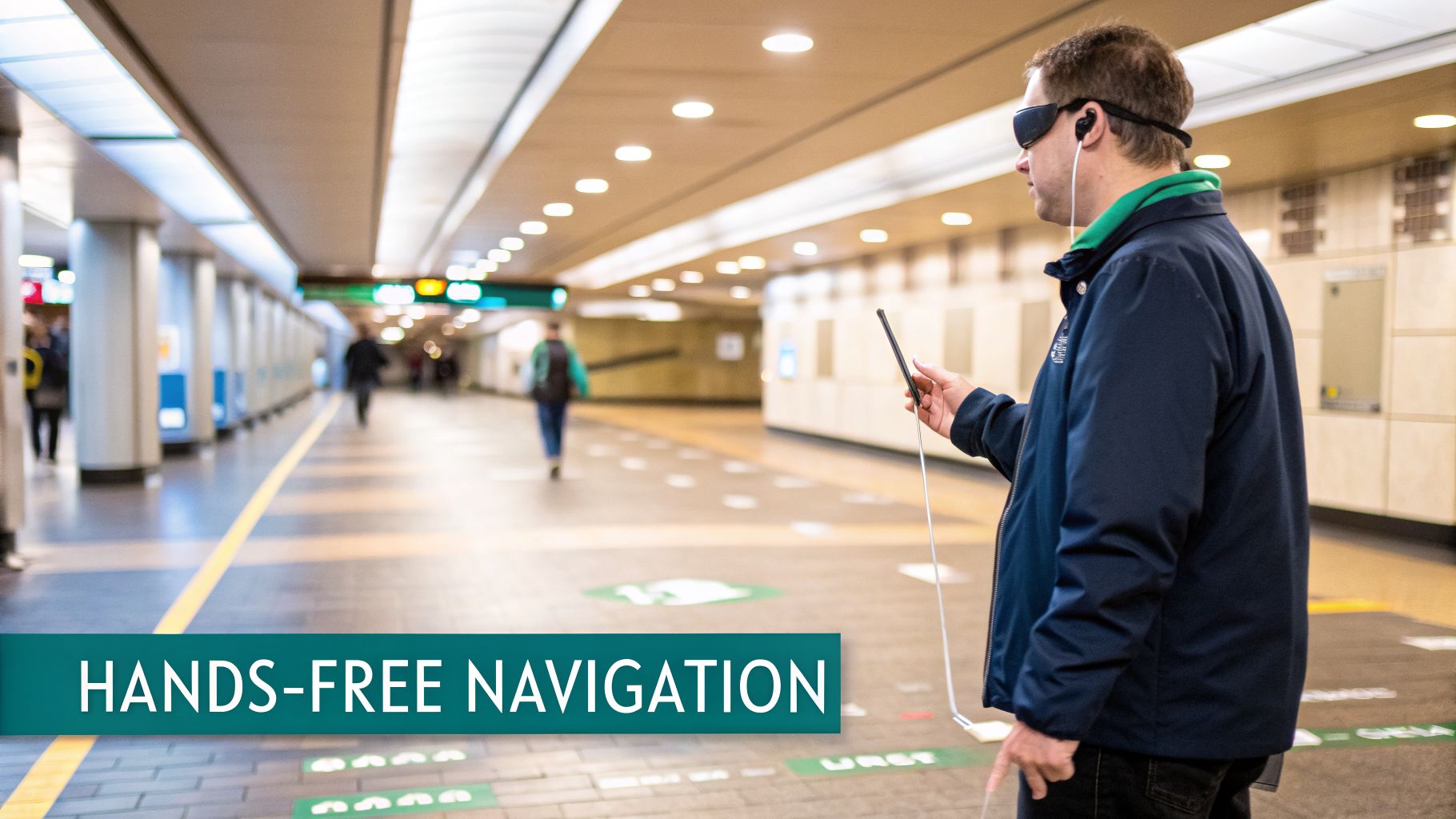
When you look at the different products for vision impaired people, you realize that genuine independence in large, complex places needs more than a nudge in the right direction. It demands something precise, reliable, and built around how people actually move. This is the challenge Waymap was created to solve.
We tackle the toughest parts of navigating large public venues with a complete platform that works without any installed hardware. Forget expensive, high-maintenance beacons or patchy Wi-Fi signals; our system uses a proprietary algorithm that is highly accurate.
By using the motion sensors already inside every smartphone, Waymap can determine a user's location to within one meter. That means we can give you true, step-by-step audio directions that lead you right where you need to go—whether it’s a specific seat in a stadium, a platform deep underground, or a shop in a sprawling shopping center.
An Intuitive Hands-Free Experience
From day one, we knew that for any navigation tool to be genuinely useful, it had to let people keep their heads up and their hands free. Many of our users rely on a white cane or a guide dog, so holding a phone while walking isn't just awkward, it’s unsafe.
That's why Waymap delivers its instructions through clear, timely audio cues via headphones. The entire experience is designed to feel like you have a trusted friend walking with you, giving directions that are not just accurate but also feel natural and easy to follow.
Our system doesn't just give out generic directions. It learns and adapts to your unique walking style, including your stride length and pace, to deliver guidance that feels truly personal.
This focus on the user is at the heart of everything we do. It changes the act of getting around a confusing space from something stressful into a smooth, confident journey. To see this in action, you can get a deeper look into how our technology works here.
The Operational Advantage for Venues
For venue managers and transport operators, Waymap’s hardware-free approach brings significant operational and financial benefits. By eliminating the need for any physical hardware, we cut out the main sources of cost and hassle that come with older navigation systems.
The advantages for your organization are clear:
- Low-Cost, Rapid Deployment: With no hardware to install, mapping and launching Waymap in your venue is incredibly fast and much more affordable.
- Zero Hardware Maintenance: You’ll never have to worry about replacing beacon batteries, recalibrating sensors, or fixing damaged equipment.
- Instant Updates: Need to change a route, add a new point of interest, or mark a temporary closure? We can make updates instantly and push them to all users digitally, so your venue map is always up to date.
This kind of flexibility isn't possible with static signs or hardware-based systems. Waymap turns your venue’s accessibility into a dynamic, manageable asset that improves the visitor experience for everyone while reducing long-term costs. It’s a complete platform that delivers a real advantage, transforming inclusive design from a cost center into a strategic strength.
Your Questions Answered on Products for Vision Impaired People
When you're looking to make your venue truly accessible, it’s natural to have questions. We hear them all the time from venue operators and facilities managers trying to make sense of the technology out there. Understanding what different products for vision impaired people actually do is the first step towards a smart investment.
Let's clear up some of the most common questions we encounter. The goal here is to help you understand how the right solution can bring real independence to your visitors and genuine operational gains for your organization.
What’s the Difference Between a Navigation App and a Tool Like Be My Eyes?
That's an excellent question, because they both play important, but very different, roles. A service like Be My Eyes is great for on-the-spot help. It connects a blind or low-vision user to a sighted volunteer through a live video call for a quick, specific task – things like reading an expiration date, confirming the color of an item, or telling two similar-looking cans apart.
A navigation platform like Waymap, however, is about the entire journey. It provides the continuous, step-by-step audio guidance needed to get through a complex space from start to finish. Think of it like this: Be My Eyes is like asking a stranger for a single piece of information, whereas Waymap is like having a personal guide with you for the whole trip, whether you're navigating a sprawling transport hub or finding a specific shop in a large retail center.
Why Should We Invest in a Platform Instead of Just Better Signage?
This comes up a lot, and it’s understandable. But physical signage, even the best-designed tactile signage, has serious limitations. It's static, which means it’s expensive to change. It can't give personalized directions in real time, offer instructions in multiple languages, or adapt when an elevator is out of order or a corridor is temporarily closed.
A digital navigation platform is dynamic, not static. It transforms a venue’s accessibility from a fixed cost into a flexible, powerful asset that improves the experience for everyone.
With a platform like Waymap, you can change routes and update points of interest on the fly. That information is fed directly to the user as audio guidance in their own language. Suddenly, your venue isn’t just navigable for someone with sight loss; it’s more user-friendly for everyone. And you've just avoided the significant long-term costs of maintaining and replacing physical signs.
Is Our Existing Wi-Fi and Bluetooth Infrastructure Enough for Navigation?
Many venues believe their current setup will do the job, but this is a common misunderstanding. While standard Wi-Fi and Bluetooth beacons can give a user a general idea of where they are, they don't have the accuracy needed for proper step-by-step navigation. For a person who is blind and needs to find the exact edge of a train platform or a specific doorway, "nearby" is not good enough.
Worse, these hardware-based systems can be a headache. They're expensive to install and maintain, with endless battery replacements and recalibrations. Waymap’s hardware-free technology avoids all of that. By using the motion sensors already built into every smartphone, we deliver pinpoint accuracy without any need for installed beacons, which means better reliability and a much lower cost for you.
At Waymap, we're building a world where anyone can get around with confidence and independence. Our hardware-free platform makes public spaces accessible for all, turning inclusive design into a real operational advantage.
Ready to see how it works? Learn more about Waymap and book a demo today.
