
Visitor Experience in Large Venues: Measures and Fixes
Only 47% of disabled people in England were satisfied with information that helped them plan journeys in 2023, compared with 54% of non-disabled people, according to the Office of Rail and Road's accessible-travel reporting. That gap reframes visitor experience: an accessible destination isn't enough if visitors can't confidently work out how to reach it.
For a stadium, shopping centre, campus or transport interchange, the operational question is whether someone can get from their actual starting point to the exact place they need. At Waymap, we recommend measuring that completed journey, including the information, decisions and assistance required along the way, rather than counting accessible facilities alone.
Visitor Experience Measures and Benchmarks to Track
Visitor experience measures and reference values
| Measure | What It Shows | Reference Value | Source |
|---|---|---|---|
| Assistance fulfilment | Whether booked help arrives | 89%, derived from 11% non-delivery, not a published fulfilment statistic | ORR 2024–25, calculated |
| Satisfaction with assistance | Quality of help when delivered | 94% | ORR 2024–25 |
| Booked assistance not received | Reliability gap | 11%, broadly unchanged from 12% | ORR 2024–25 |
| Satisfaction with journey-planning information | Information quality | 47% disabled, 54% non-disabled | England 2023, ORR reporting |
| Task completion to a named destination | Independent navigation | Completed journeys divided by attempted journeys | Venue-measured |
| Missed stops and route reversals | Navigation errors | Record each event against its decision point | Venue-measured |
The assistance reference values come from the Office of Rail and Road's 2024–25 passenger research: 94% were satisfied when assistance was delivered, but 11% received none of the help they'd booked, broadly unchanged from 12% previously; the 89% figure is calculated by subtracting non-delivery from the whole, not a published ORR fulfilment statistic.
That distinction matters. The complement of receiving no assistance can include partial delivery, so don't label it complete fulfilment. A venue should separately record help delivered in full, delivered partially, delivered late and not delivered.
Why satisfaction needs a delivery denominator
A high score for delivered assistance describes the service received by people who were served. It doesn't tell an operations manager what happened to visitors whose help never arrived.
Don't assume every satisfaction survey excludes those visitors, either. Check the questionnaire and sampling method. The practical requirement is to retain unsuccessful bookings and abandoned journeys in the operational record, whether or not those visitors answer a survey.
Measurement rule: Record whether the journey succeeded before asking how the visitor felt about it.
For independent navigation, specify the task before testing. Reaching a shopping centre isn't the same as reaching a particular store entrance; reaching a stadium concourse isn't reaching the correct seat block. Record whether the visitor completed the task independently, requested help, accepted unsolicited help or stopped.
Build a dashboard operators can act on
Connect booking, confirmation, arrival, meeting-point navigation, handover and destination arrival. Give each failed stage an owner rather than placing every complaint in a general customer-service category.
Our guidance on customer satisfaction metrics supports a broader measurement approach, but the first dashboard should remain compact:
- Task completion: Did visitors reach the named destination, with their preferred level of independence?
- Assistance fulfilment: Was the promised support delivered as agreed?
- Information satisfaction: Could visitors understand and use the information provided?
Segment each measure by entrance, time of day and access need. Report sample sizes alongside results, and keep assisted and independent completion distinguishable. Otherwise, an overall improvement can conceal an entrance that still fails wheelchair users or a late shift without adequate support.
How to Audit Every Decision Point in a Visitor Journey
Audit decisions, not just assets. A lift inspection establishes whether equipment works. A visitor-route audit establishes whether someone can find the lift, recognise the correct floor and continue from its exit.
England's 2023–24 figures illustrate the distinction: 99.5% of buses held accessibility certification, while 52.8% provided audio-visual information, a calculated gap of 46.7 percentage points, according to the Department for Transport's accessibility statistics. Certification and usable journey information measure different things.
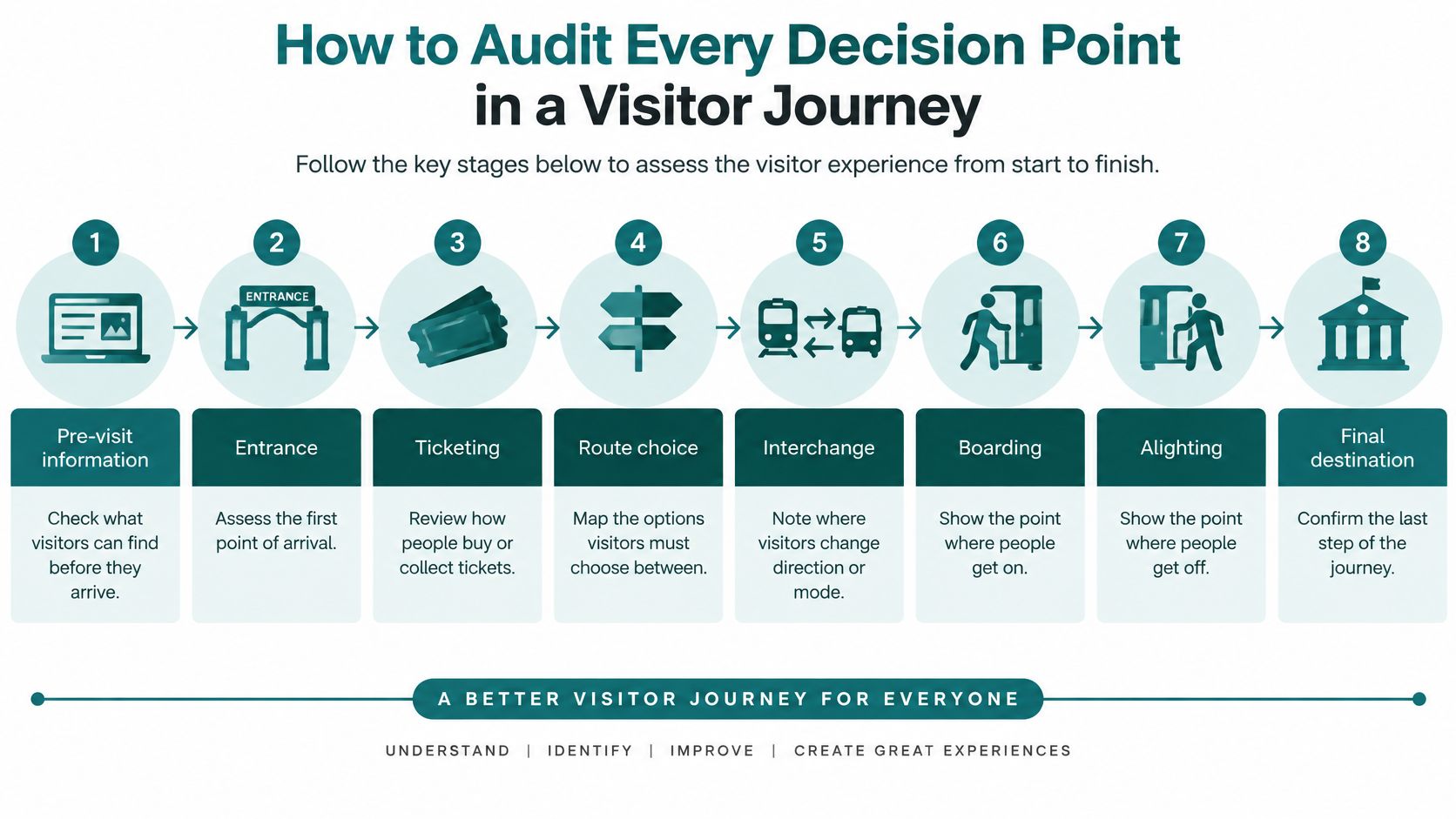
Use this journey sequence to structure the walk-through.
Run the audit in the order visitors travel
- List the decisions. Include pre-visit information, entrance, ticketing, route choice, interchange, boarding, alighting and final destination. Mark boundaries between organisations.
- Walk the route as a first-time visitor. Invite paid participation from people with relevant access needs, including long-cane, guide-dog and wheelchair users. Don't treat one participant as representative of everyone.
- Record the information formats. Note visual and audible provision, readability, terminology and whether instructions identify the same destination.
- Check timing and placement. Information after a junction doesn't support the decision before it.
- Test independent action. Ask whether the visitor can choose and follow the route without staff interpreting the instruction.
- Calculate accessible decision points divided by total decision points. Define what counts as accessible for the tested needs, and repeat the audit after map, signage or layout changes.
Set improvement targets from your baseline, not the certification rate of another transport system. Keep visual availability, audible availability and independent usability as separate fields so one aggregate score doesn't conceal a missing format.
Score a stadium journey through to the facilities
Say a visitor arrives by train, enters a stadium, finds their seat block and then needs an accessible toilet. Use a simple pass/fail record:
| Decision | Pass condition | Example finding |
|---|---|---|
| Station exit | Correct stadium approach is identifiable | Pass |
| Stadium entrance | Ticket and route information name the same gate | Fail |
| Seat block | Guidance continues beyond the concourse | Pass |
| Accessible toilet | Location and return route are understandable | Fail |
These are hypothetical audit findings, not venue performance results. Each failure needs an owner and a retest, not merely a photograph in a report.
Our customer journey mapping guidance helps organise these handovers. For temporary event operations, PSW Events' resource on how to improve customer experience at corporate events is a useful companion when reviewing arrivals and guest support.
Waymap's team combines venue plans with movement patterns to create a precise navigation model. Even with a detailed model, operators must maintain current information: step-free access isn't automatically usable access, and the property boundary isn't the end of the visitor's journey.
Pre-Visit Information That Builds Visitor Confidence
A visitor can work through an entire pre-visit check and still arrive unsure which door to use. Disabled audiences report repeatedly that accessibility information is hard to find and harder to interpret, and the space between a published page and a usable answer is where bookings disappear.
Editorial perspective from Tom Pey, Founder of Waymap.
I would judge a pre-visit page by the decisions it supports, not its length. A list of lifts and toilets leaves the visitor to work out whether those facilities connect to their entrance, ticket type and destination.
The arrival experience begins before someone reaches the door.
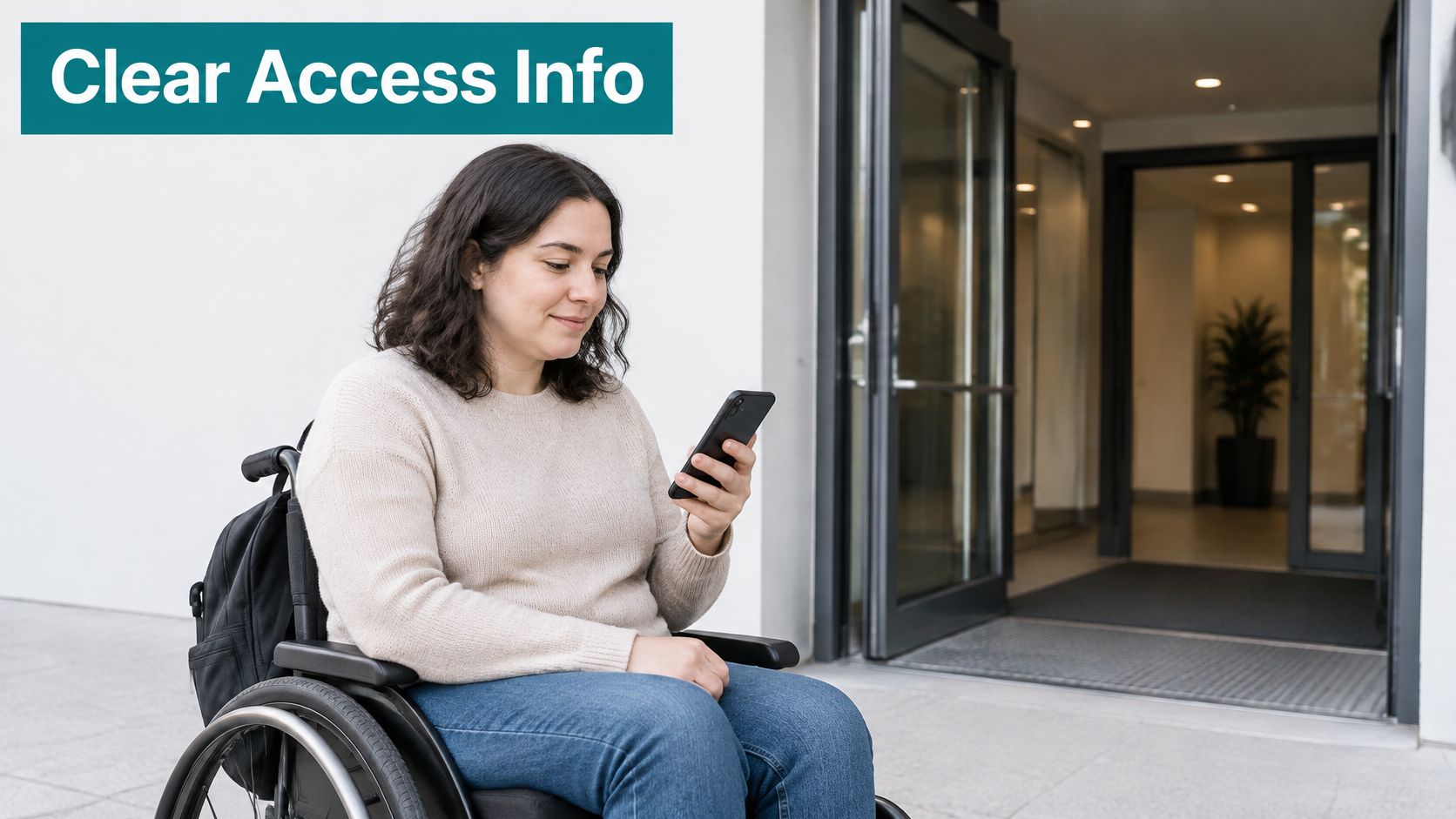
Answer the questions that prevent a booking
Write entrance-specific instructions. Avoid calling a venue accessible when only one approach offers the route someone needs.
- Describe the approach: Identify step-free entrances, measured route distances, surfaces and relevant gradients.
- Locate useful facilities: Explain where accessible toilets sit relative to entrances, seating and service points.
- Publish operational status: State how visitors can check lift and escalator availability before travelling.
- Name the fallback: Explain what happens when an advertised accessible option is unavailable, including where support can be reached.
- Show currency: Display when the information was last checked and assign responsibility for updating it.
Maintenance is the trade-off nobody budgets for. Detailed instructions become liabilities when nobody owns them. Keep stable route descriptions in one block and changing operational notices in another, so staff can post a lift closure without rewriting the page. A route description naming a specific side door fails the first time that door is locked for a refurbishment and no one holds the update.
Offer confidence without requiring a phone
QR codes and mobile ordering serve some visitors and exclude others. Neither should be the only route to information or service. Provide accessible web content, a printable or spoken route description, and a staffed alternative that delivers the same practical answers.
A destination page such as plan your visit to Clos Pegase shows how a venue can gather visit planning into one place. Read the structure, then test whether the content answers the entrance, route and facility questions for the visitor who needs them. Our accessible tourism guidance covers the wider planning context for disabled travellers, from arrival logistics to what happens once they are through the door.
“Thank you for providing independence and less reliance on people.”
Evelyn V., Waymap user
Independence is the outcome visitors name when the information works, and it can be measured rather than merely appreciated. Publish testing outcomes with participant numbers, the task tested and the measure used before treating confidence as a performance claim. At Birmingham New Street, testing across diverse user groups produced strong satisfaction, with users who have visual impairments reporting greater confidence navigating the station independently. That result describes navigation on the day, not the pre-visit page, but it sets the standard the page is promising.
The acceptance test is practical: could a first-time visitor plan the trip, arrive and reach their seat without writing to the venue? If not, identify the unanswered question and fix the information at its source.
Wayfinding Options Compared for Changing Venues
Wayfinding approaches compared on the criteria that matter
| Approach | Updates When Layout Changes | Covers Indoor, Outdoor and Multi-Floor Routes | Needs Installed Hardware |
|---|---|---|---|
| Static signage | Reprint and reinstall affected signs | Only where signs provide continuous guidance | Yes, signs and fixings |
| Staff and information desks | Immediate once staff are briefed | Directions from staffed locations; escorts require capacity | No navigation hardware, but staffing cost recurs |
| Bluetooth beacons | Update the route model; survey or reposition hardware when coverage changes | Coverage requires a designed deployment across relevant spaces and floors | Yes, beacons and maintenance |
| Dynamic navigation layer (Waymap) | Update points of interest through the venue's content management system | Indoor, outdoor and multi-floor routing | No installed navigation hardware; uses visitors' phone sensors |
Physical signs remain useful orientation points, particularly at entrances and major junctions.

National Centre for Accessible Transport findings cited in the Consumer Council's public transport accessibility report found that 23% of disabled people considered information on vehicles unavailable or inaccessible. A physically usable route can still fail when people can't obtain instructions they can act on.
Choose for change frequency and operational ownership
Static signs suit stable routes, but changing a destination can require work at several upstream junctions. Staff can explain unusual situations, although briefings, shift coverage and escort availability become recurring commitments.
Beacon-based systems require more than buying devices. Operators need access for installation, an asset register, battery or power arrangements, and a maintenance process. Beacons also don't remove the need to maintain accurate route information.
Waymap uses a dead-reckoning approach, combining device-native motion sensors with detailed maps and personalised movement patterns rather than relying on GPS, Wi-Fi or installed beacons. Its content management system lets authorised venue teams maintain points of interest and publish approved updates. That removes navigation-hardware maintenance, not the obligation to check routes and manage closures.
This video offers additional context for the navigation approach.
Test the exact destination, not the building
In user testing at Liverpool ONE, visitors successfully reached exact store destinations using Waymap. The venue's CMS improved operating efficiency, and the app reduced reliance on static wayfinding kiosks for directions. These are qualitative findings, not a quantified performance guarantee.
Run a last-100-metres test from an entrance to the actual counter, store door or service point. Mark every location where the visitor would need to ask someone, including the final approach after leaving a lift.
Our comparison of wayfinding solutions supports that selection process. Prefer an updateable layer where destinations and routes change frequently; for a short, fixed route, well-placed signs may be the cheaper and more proportionate answer. Most large venues need a coordinated combination rather than a single replacement for every existing channel.
Equality Act 2010 Duties for Visitor Routes
A compliant room can still strand a visitor on the route. Under section 20 of the Equality Act 2010, reasonable-adjustment duties address substantial disadvantage caused by service arrangements, physical features or the absence of auxiliary aids, and include accessible information where information is involved.
That creates distinct lines of enquiry: change how the service works, alter or avoid a physical feature, or provide an auxiliary aid or service. Approaches, entrances, exits, fixtures and equipment can all matter, not just the room where the service happens.
Anticipate barriers rather than waiting for complaints
The Act's explanatory notes explain that service providers should anticipate disabled people's needs rather than wait for an individual request, while noting that transport applications involve additional distinctions. A reception-based rescue process isn't a complete accessibility strategy.
The government's service-provider guidance gives examples including policy changes, accessible information, induction loops and additional staff support, and describes substantial disadvantage as more than minor or trivial. Choose adjustments against the actual barrier, not a preferred technology.
For route planning, document:
- The disadvantage: What can't the visitor find, understand or use?
- The adjustment: What change enables access to the service?
- The alternative: What happens if the primary arrangement is unavailable?
- The evidence: How was the revised route tested, and who maintains it?
Separate legal duties from design assurance
The government's draft Code of Practice for services, public functions and associations discusses reasonableness in context, including provider resources and alternative access methods. Treat draft guidance as draft, not as a replacement for the statute or current legal advice.
Ask the design team to identify applicable BS 8300 and BS EN 17210 provisions and document the assessment. Don't assume a design-standard review proves that changing operational information is accurate, or that navigation software makes an inaccessible physical route acceptable.
Capital approval cycles can delay building works. An information-led adjustment without installed navigation hardware may avoid a separate installation programme, but it must address the identified disadvantage and cannot substitute for necessary physical access.
At Lord's, our partnership with MCC centres on greater visitor ease and independence, reflecting the estates team's operational objective. Our Equality Act requirements guidance helps frame route-level questions, but compliance requires a venue-specific assessment rather than a product purchase.
Choose Your First Fix and Set a Baseline
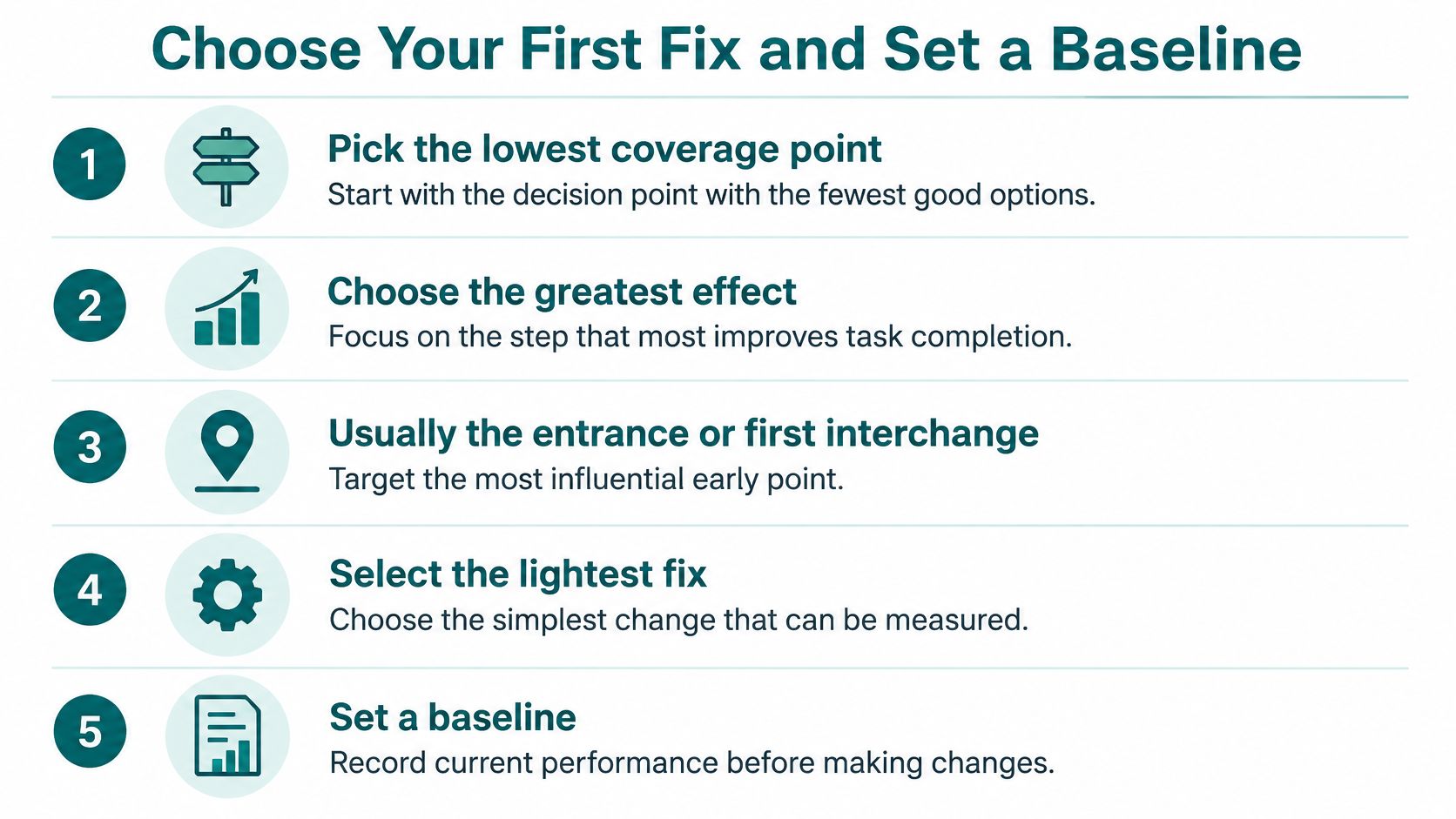
Start with the decision point that combines poor coverage with a serious effect on completion. An entrance mismatch or confusing first interchange deserves attention before a cosmetic improvement to an already understandable corridor.
Choose the lightest intervention that resolves the barrier. That might be a corrected sign, a pre-visit route note or a briefing that gives every shift the same entrance instructions. A frequently changing concourse may justify a different approach from a fixed library corridor.
Use this checklist to focus the first intervention.
Make the comparison fair
Write the test protocol before changing anything. Keep the starting point, destination, task wording and recording method consistent, and note differences in crowding or disruption.
Set a numerical target from the audit denominator. For example, a hypothetical entrance pilot could require every audited decision point to provide the agreed visual and audible information before acceptance. That's a proposed criterion, not an industry benchmark or promised outcome.
A cheaper fix isn't cheaper if staff must explain it to every visitor for the rest of its life.
Include recurring work in the business case. Signs need replacement and inspection; staffed support needs coverage; digital information needs an editor, approval rules and closure procedures. Hardware-free navigation removes one maintenance category, not all operating effort.
Give each buyer a workable approval case
Estates teams need to distinguish minor operational changes from works requiring capital approval. Transport operators need to account for maintaining assets across busy, changing environments, including access restrictions when maintenance teams need to reach equipment.
For licensed navigation services, separate procurement, integration, content ownership and visitor access in the specification. Don't assume an operating-budget purchase avoids internal approvals, or that a licence includes every implementation task.
Our process starts with understanding the client's needs and challenges, then designing a customised solution, executing it and measuring results and feedback. The useful output is a route-level decision: retain the intervention, revise it or stop spending on it.
Send estates and accessibility leads a compact before-and-after report. Include task outcomes, assistance delivery, information coverage, unresolved barriers and the staff effort required to keep the change working.
- Baseline: Record performance on the chosen route before intervention.
- Change: Implement the smallest fix that addresses the observed failure.
- Re-measure: Repeat the task and decide whether the result justifies wider deployment.
Visitor Experience Frequently Asked Questions
What is visitor experience in a large venue?
Visitor experience is how people understand, access and use a venue throughout their visit. For navigation, the practical test is whether a visitor reaches the exact destination with their preferred level of independence, and whether help arrives when they want it. A venue can hold up on paper, with lifts and toilets in place, and still fail that test on the walk from the entrance to the door.
How do you measure visitor experience?
Measure task completion, assistance fulfilment and information satisfaction, then segment by entrance, time of day and access need. Record unsuccessful attempts, not just the visitors who finished. Completion rate per route says more than any facility count, because it shows where the journey breaks rather than what was installed.
Why isn't satisfaction enough?
A satisfaction score describes the interactions that happened. It says nothing about the visitors who gave up at the second junction or never found the assistance point. Operators need records of missed, partial and abandoned assistance to judge reliability, and those usually come from staff logs or route audits rather than a survey.
Does the Equality Act 2010 cover wayfinding?
Wayfinding can form part of reasonable adjustments through accessible information, service changes and auxiliary support. What counts as reasonable depends on the disadvantage and the circumstances. No product automatically establishes compliance, and a supplier claiming otherwise is selling certainty that does not exist.
What is audio-visual coverage?
Audio-visual coverage is the proportion of audited decision points providing the required visual and audible information. Record whether the formats are usable and timely, not merely present. Signage that exists but is obscured at peak times counts as a gap.
Does a navigation layer need installed hardware?
A phone-sensor-based navigation layer needn't require installed beacons. It still depends on accurate mapping, maintained destination information and a non-phone alternative for visitors who can't or won't use a handset. Removing beacons cuts one maintenance task; it does not remove the need for someone to keep route content current.
What should an FAQ tell group organisers?
Arrival arrangements, participation requirements, where to meet and who to call when something changes. Activity-led venues publish that detail directly, as this escape room guidance for group outings shows; a large venue should give equally direct answers about its own entrances and access routes.
Waymap helps venues connect entrances, facilities and exact destinations through updateable navigation, available through our app, a venue-branded app or the web, free for visitors once live. Visit Waymap to discuss a priority route, the barriers your visitors face and how to measure whether an intervention improves completion and independence.
