
Accessible Tourism: How to Audit and Improve Your Venue
Accessible tourism is lost one journey at a time. A visitor who cannot confirm the route before leaving home never shows up as a complaint in the building. They do not come. I would audit the trip in stages, publish measurements instead of slogans, and only then decide where a phone can help. Staff and accurate pages still do the work a sensor cannot.
Written by Tom Pey, Founder of Waymap and a blind accessibility technologist.
How Do You Audit Accessible Tourism Journeys Stage by Stage?
Accessible tourism is a commercial segment, not a goodwill extra. VisitBritain's analysis of 2023 International Passenger Survey data found that 724,000 inbound overnight trips to the UK, 1.9% of all inbound overnight visits, were made by people with a health condition or impairment, or by groups that included someone with one. Those visits generated an estimated £624 million, equal to 2.0% of inbound visitor spend. The same analysis puts annual tourism expenditure in England linked to people with an impairment and their travelling companions at £14.6 billion, about £0.6 billion inbound, £5.8 billion from domestic overnight trips and £8.2 billion from day visits. Companions sit inside that total, so a broken route suppresses spend by families and groups, not only by the disabled visitor.
Counting ramps, lifts or accessible buses does not show whether anyone finished the trip. The Office for Statistics Regulation warns that transport statistics often count component features without capturing the end-to-end journey. Disabled adults in England made 25% fewer trips than non-disabled adults in 2023, 740 trips per person against 989. 20% of disabled adults' trips were as car passengers, compared with 12% for non-disabled adults, and 32% of disabled adults lived in households without car access in 2025. If the bus or rail hand-off fails, a large share of visitors have no private fallback.
Map ten stages before you count facilities
Say a shopping centre has a step-free main entrance. A works hoarding pushes the car-park path around three steps. An entrance count still reads as a pass. A stage map catches the detour, the delay and the person who turns back.
| Journey stage | What to test | What to record |
|---|---|---|
| Trip planning | Can a wheelchair user confirm step-free access before leaving home? | Share of visitors who answer that question online without calling |
| Arrival | Are the drop-off point and nearest accessible parking reachable without steps? | Completion rate and time to reach the entrance |
| Interchange | Can a visitor arriving by rail or bus find the step-free route from the stop? | Unplanned detours and delay minutes |
| Route-finding | Can a blind or low-vision visitor follow the route without asking staff? | Assistance requests per visit |
| Entry | Do all entrances, including the secondary one, work for every impairment group? | Abandonment at the threshold |
| Toilets | Is the accessible toilet signed from the route and free when needed? | Time to locate and use it |
| Refreshments | Can visitors order and pay at counters of different heights, with clear menus? | Completion rate and staff interventions |
| Attractions | Can visitors reach viewing points, seating and quiet areas? | Independent completion by zone |
| Evacuation | Are alarm signals visible and audible, with a named assistance route? | Drill outcomes recorded by impairment type |
| Return travel | Does the visitor reach the stop or car park with the same route quality? | Journeys completed independently, end to end |
How we run the audit
- Recruit paid testers across mobility, wheelchair use, vision, hearing, cognitive needs and mental health. A walk-round by the estates team is not a test.
- Write a route brief with real tasks. Buy a ticket, find a seat, use the toilet, and leave on a route of the same quality.
- Send testers through every stage. An observer logs completion, assistance requests, detours, delay minutes and abandonment.
- Test at least two entrances. The side door is where most failures sit.
- Check features against BS 8300-2:2018 and note Equality Act 2010 reasonable-adjustment duties. A drawing that passes is not a route a visitor can find.
- Log each failure with stage, impairment group, owner, fix and deadline.
- Re-test within an agreed period, before the next peak, not at the next annual away-day.
Practical rule: Score the percentage of journeys completed independently, with no unplanned intervention, by impairment type and venue zone. Do not score the number of accessible entrances.
Front-door-only testing, and treating wheelchair access as if it proved visual or cognitive access, will flatter the result. Assign an owner to each stage this week. I would start with trip planning and arrival, because both fail before anyone meets your front-of-house team. Our note on customer journey mapping sets out how to record those flows without losing the hand-offs.
Publish Accessibility Information Visitors Can Trust
The page a visitor reads the night before travel is part of the product. If it is vague, late or wrong, the trip dies in the kitchen, not at your door. VisitBritain's business guidance reports that 95% of disabled people check accessibility before visiting a new place, 87% expect that information on the venue website, 77% have not visited a venue because they could not find it, and 96% would be more likely to visit when information is available in advance. A slogan does not meet that test. Measurements do.
VisitScotland's visitor research shows why one label fails. Around 9% of visitors to Scotland said they had a long-term health condition, impairment or disability, and the same share reported a specific access need. Among those identifying a condition, the mix is wide, so the page has to be wide too.
| Need group | Share of visitors with a condition | Detail to publish |
|---|---|---|
| Physical or mobility impairment, no wheelchair | 33% | Step counts, surface changes, lift dimensions, seating |
| Wheelchair-related mobility impairment | 9% | Step-free routes, door widths, accessible toilet specification |
| Hearing impairment | 8% | Hearing loop locations, visual alerts, staff communication options |
| Mental-health condition | 6% | Quiet areas, crowd levels, advance notice of loud events |
| Condition that reduces daily activities | 37% | Plain-language route summary and contact route |
| Vision support | Not reported; survey on site | Tactile routes, contrast, audio navigation options |
Those shares are VisitScotland's split among visitors who already identified a condition. Vision support is not given as a percentage there, so collect it in your own survey before you invent a figure.
Keep facts separate from guesses
Name one owner for the page. Set a review date on every block, and publish temporary closures within a day. Mark what a member of staff has measured on site, and mark what is still an assumption. Static copy that survives a hoarding, a broken lift or a moved queue is worse than a short page, because people plan around it.
Replace "fully accessible" with the measurement. Door width, step count, surface change, lift car size, hearing loop, quiet room, alternative route.
Track the funnel from information viewed, to enquiry, to booking, to arrival, to cancellation, and compare disabled and non-disabled outcomes on the same steps. Our accessibility best practices note is a useful content brief for that page, including photographs and the contact route for anything you have not yet verified.
Train Front-of-House Staff and Plan Assistance Along the Route
For a rail-connected venue, the visit starts at the station, not at your door. Under government guidance on rail passenger rights, assistance with boarding or alighting at staffed stations must be free of charge. Passengers are advised to give at least 48 hours' notice, but no notice does not cancel the duty. Staff must make all reasonable efforts to assist. Unstaffed stations must point people to the nearest staffed station and explain how to get help directly. Standards also require a designated point, inside or outside the station, where a passenger can announce arrival and ask for help.
The Office of Rail and Road requires every licensed train and station operator to keep an Accessible Travel Policy. Passenger Assist is the industry service for people who need help to complete a rail journey, and operators must assist during the hours when trains are scheduled to call. If a station is inaccessible, the operator must provide an alternative accessible service to the next convenient accessible station at no extra charge. Your visitor information should name the arrival point in that policy and describe the last leg to your entrance.
Five skills for the team on duty
These steps apply at every venue. Rail duties above sit with operators and their stations. Everywhere else, the Equality Act 2010 duty to make reasonable adjustments is the test you are meeting.
- Learn the step-free route from the nearest staffed station to your entrance, and describe it in under a minute.
- Find the meeting point and practise the call-for-help process until it is boring.
- Offer guidance by voice, or by offering an arm. Do not take hold of someone without asking.
- Know which accessible toilets are open and how to report a fault the same hour.
- Record every assistance request so it feeds the audit, by stage, not as a vague "we helped".
When a request sits outside the plan, do not answer with a flat no. Log it, offer the closest reasonable adjustment, and send the gap back to the stage owner.
A stadium that briefs stewards on the drop-off and the lift at the coach bay will cut the first ten minutes of chaos on a match day. The steward who can only say "it's over there" has not been trained. Our staff training requirements page is the handover sheet I would give a duty manager before a trial shift.
Digital Navigation for Blind and Low-Vision Visitors
Signage runs out of wall, and staff cannot stand on every turn of a large site. Fixed beacons need power, surveys and someone to notice when a kiosk has moved. In buildings that refit often, that hardware becomes a maintenance job nobody owns. In 2024, 78% of respondents to Euan's Guide's UK Access Survey said they were not confident about visiting new places when they thought about accessibility. The survey was published in 2025. Confidence fails in the gaps between signs.
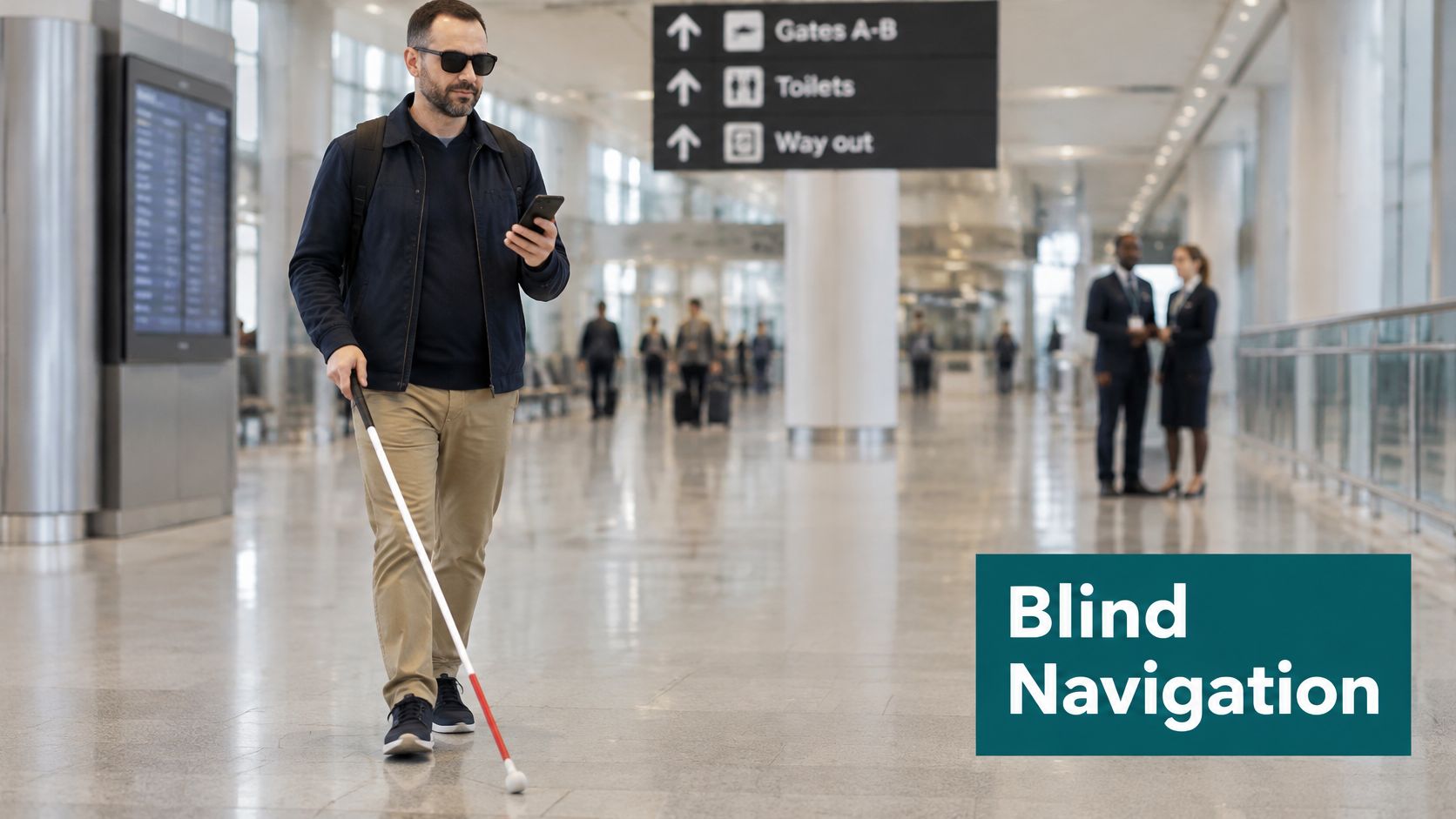
Waymap guides by dead reckoning from the phone's own motion sensors, fused with a detailed map. It does not use GPS, Wi-Fi, Bluetooth, beacons or any installed hardware, and it does not need a fresh survey every time staff change or a layout shifts. It learns walking style and step count, and we describe sub-3-metre accuracy in infrastructure-free environments. The Equality Act 2010 asks for reasonable adjustments that people can use in practice. BS EN 17210 sets functional requirements for an accessible built environment, so a route that exists only on a plan is not enough.
The same door-level detail matters on a leisure trip as on a commute. Someone arranging getting to Little Zoo Garden still needs the last turn, not a pin in the middle of a district.
What named sites have already shown
- Birmingham New Street. Testing with diverse user groups showed strong satisfaction, and visually impaired users reported more confidence navigating the station on their own.
- Bullring and Grand Central. Hammerson is working with us on accessible navigation across both sites in central Birmingham, tied to the UK's busiest regional train station.
- Lord's Cricket Ground. Step-free routing, guidance to accessible toilets, food and drink options, and instructions in more than one language are available to every user, not hidden behind a separate mode.
NHS estates managers often cannot get capital approval for beacons. Transport operators inherit the cost of hardware in high-footfall sites that change weekly. Retail teams need a dwell and spend case, not only a compliance file. An infrastructure-free layer sits on operating spend and can be updated when a route closes.
Waymap should not be used as the primary navigation solution for a disabled person. Pair it with staff and with tactile or human routes, and pilot with blind and low-vision testers before you buy. Our blind and low-vision navigation note sets out what that pilot should prove.
Measure Results and Confirm Your Next Step
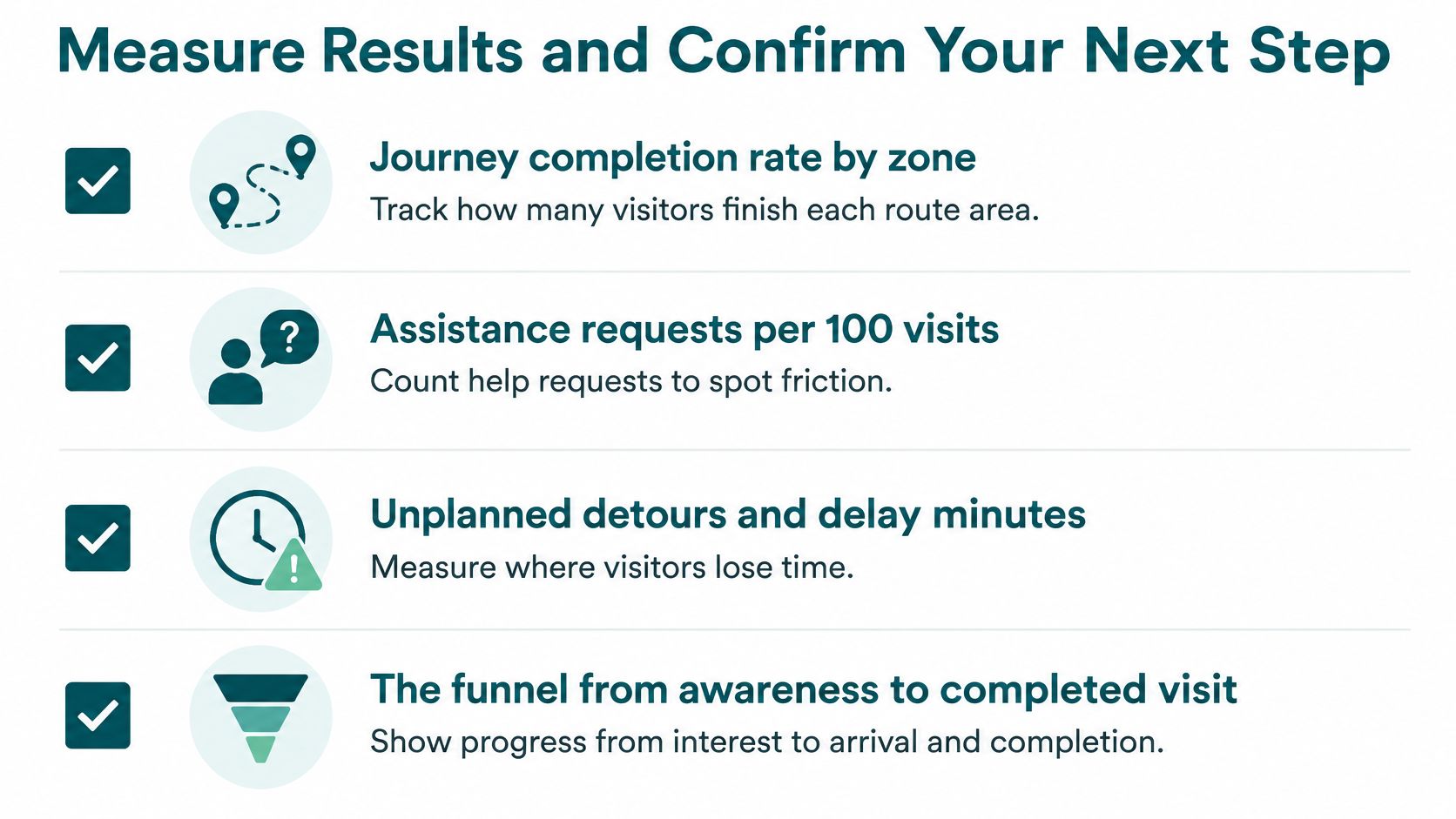
A board cannot manage a feeling. It can manage a short set of numbers, reviewed on a calendar, split so the gap between disabled and non-disabled visitors is visible on the same definitions.
| Metric | How to calculate it | Review cadence |
|---|---|---|
| Journey completion rate by zone | Journeys completed independently, with no unplanned intervention, by impairment and zone | Each audit cycle |
| Assistance requests | Requests per 100 visits, by journey stage | Monthly |
| Unplanned detours and delay minutes | Recorded during tester routes and logged in service data | Each audit cycle |
| Information funnel | Information viewed, then visit completed, for disabled and non-disabled visitors | Quarterly |
| Accessibility enquiries and abandoned bookings | Enquiries received and bookings cancelled for accessibility reasons | Monthly |
| Repeat visits and satisfaction | Return visits and satisfaction responses split by impairment group | Quarterly |
Use the independent-completion benchmark from the stage audit, cut by zone and impairment. If non-disabled visitors finish a zone and disabled visitors do not, the building is telling you where to spend. Assistance requests that cluster at one stage are a design fault, not a staffing compliment.
Four decisions after the first audit
- Choose the stage with the highest abandonment. Do not start with the easiest fix.
- Publish verified information for that stage within 30 days. Measurements, photos, and a named owner.
- Re-test with disabled testers before the next peak season. A fix that is not re-tested is a hope.
- Decide whether a digital layer belongs on that stage. Finance will ask if the spend is capital or operating. The deployment needs no infrastructure investment from the venue. Venues license Waymap on a SaaS model in which the venue pays and visitors use it for free once it is live, on the Waymap app, the venue's own app, or the web.
If a visitor cannot complete the journey without asking anyone, the job is not finished. Our accessibility compliance report is the format I would take to that quarterly review.
What Do Venues Need to Know About Accessible Tourism?
What is accessible tourism?
Accessible tourism means disabled visitors and their companions can plan, reach, enter, enjoy and leave a place without unplanned help. It covers the whole journey, including the information read at home and the route back to the stop.
How large is the accessible tourism market in the UK?
VisitBritain estimates £14.6 billion of annual tourism expenditure in England associated with people with an impairment and their travelling companions. That covers inbound trips, domestic overnight stays and day visits, so the opportunity is the travelling group, not a headcount of disabled visitors alone.
How do you audit accessible tourism at a venue?
Map ten journey stages, test each with disabled testers, and record completion rate, assistance requests, detours, delay minutes and abandonment. Pay the testers, use at least two entrances, and give every failure an owner and a deadline.
Does wheelchair access prove a venue works for blind visitors?
No. Wheelchair access does not show visual or cognitive access, so route-finding has to be tested on its own, with blind and low-vision visitors who are not coached by staff.
Do disabled visitors check access information before a visit?
Yes. VisitBritain reports that 95% check it, 87% expect it on the venue website, and 77% have skipped a venue because they could not find it. The same standard of advance detail helps other guests who need to judge a room before they book, including sensory accommodations for wedding guests.
Does Waymap replace staff or signage?
No. Waymap should be paired with staff assistance and with tactile or human routes, and piloted with blind and low-vision testers before any purchase. A phone that loses the plot still needs a person who knows the step-free door.
Waymap gives venues infrastructure-free, step-level navigation for the stages where signs and staff cannot cover every turn, while visitors use it at no charge once a site is live. If your audit shows people abandoning the route between station, entrance and seat, that is the stage to pilot. Visit Waymap to see how a venue maps the journey and tests it with blind and low-vision users before a wider rollout.
