
Staff Training Requirements for Accessible Venues
A blind passenger arrives at a busy interchange just as a platform change is announced. The staff member knows the station layout, but hasn't practised explaining a diversion, locating the safest step-free route, or supporting a passenger using assistive navigation. The answer becomes hesitant, inconsistent and dependent on whichever colleague happens to be nearby. For the passenger, the problem isn't a missing certificate in a training file. It's whether the next few minutes feel safe and manageable.
That's why staff training requirements should be treated as an operational control, not a one-off awareness course. Venue and transport teams need role-based training covering disability awareness, respectful communication, safe assistance, emergency procedures, personal information, accessible content and the use of assistive navigation technology such as Waymap. The control must also include contractors, agency workers, temporary staff and managers who make decisions about passenger services.
In practice, effective training produces three outcomes: staff who can act confidently under pressure, a consistent experience across shifts and locations, and records that demonstrate competence over time. The wider facilities context matters too, because training only works when it is connected to ownership of routes, disruptions, equipment and frontline response. Waymap's discussion of facilities management and operational responsibilities is useful for that reason.
The following framework starts with UK legal duties, then maps training depth to role risk, sets out a practical curriculum, explains refresher and evidence controls, and shows how infrastructure-free navigation changes what staff need to practise.
Why Staff Training Requirements Matter on Every Shift
Training must survive real operating conditions
A policy can say that accessible assistance is available. A training programme must prepare a member of staff to deliver it during a noisy event arrival, a lift failure, a last-minute platform alteration or an evacuation. Those situations expose the difference between awareness and competence.
Awareness may help someone choose respectful language. Competence requires more. The employee must know where the accessible route begins, how to communicate a change clearly, when to offer assistance without making assumptions, how to use the approved escalation route and how to record what happened afterwards.
A venue supervisor should therefore ask operational questions rather than only checking attendance:
- Can staff locate the accessible route: Can they describe the route when the usual entrance is closed?
- Can staff communicate a disruption: Can they give concise information without relying on visual signs?
- Can staff support safe assistance: Do they know the boundaries of their role and when to call a trained colleague?
- Can staff use the navigation workflow: Can they help a passenger start a route, recover from a wrong turn or report a route issue?
- Can managers prove coverage: Is every passenger-facing role linked to an induction date, assessment and refresher deadline?
Operational rule: If a person can affect a passenger's journey, that person needs a defined competency, not just access to a policy folder.
Accessibility is part of service delivery
The same principle applies in a shopping centre, stadium, hospital campus, university or rail station. Frontline teams influence whether an accessible environment works in practice. A step-free route that staff can't explain, a hearing loop that nobody knows how to activate or a digital service that publishes inaccessible content all create avoidable barriers.
Training should also reflect the workforce's reality. Permanent employees may know the building, while agency staff arrive during the busiest shifts. Contractors may control lifts, doors or security points without seeing themselves as part of the accessibility service. Senior managers may not handle passengers directly, but their rostering and disruption decisions determine whether trained staff are available.
A reliable programme links role, task, risk and evidence. It doesn't assume that a generic online module creates the same capability as supervised practice at a platform, entrance, concourse or boarding point.
What UK Law Expects From Staff Training Requirements
UK employers have a broad duty to provide the information, instruction, training and supervision necessary to protect employees' health and safety under the Health and Safety at Work etc. Act 1974 and HSE training guidance. HSE guidance also states that training should take place during working hours and at no cost to the employee. For venue operators, that means mandatory training belongs in the operating plan and paid working time, not in an expectation that employees will learn privately between shifts.
The Management of Health and Safety at Work Regulations 1999 add practical triggers. Employers must provide health and safety training on recruitment and whenever a person is exposed to new or increased risks. A new starter, a colleague moving from ticketing to platform duties, a venue opening a new public area and a team responding to a changed evacuation route can all require targeted learning.
Turn legal duties into training triggers
A useful compliance model has four triggers:
- Recruitment: Complete the induction relevant to the employee's work before independent duties begin.
- Role change: Add training when responsibilities introduce new hazards, passenger contact or assistance tasks.
- Operational change: Update staff when routes, equipment, layouts, systems or emergency arrangements change.
- Incident or observed gap: Provide corrective training when an event, complaint, drill or assessment shows that competence is weak.
The legal framework also includes a right-to-request element. In England, Wales and Scotland, employees with at least 26 weeks' service in organisations with at least 250 employees can request time off for study or training. That time is usually unpaid unless the employer agrees otherwise. The mechanism doesn't replace the employer's own duties, but it reinforces the expectation that learning is a legitimate workplace matter.
Training is mainstream, but provision is uneven
The UK Employer Skills Survey 2024 found that 63% of all employees received training in 2024, up from 60% in 2022, while total UK training expenditure reached £53.0 billion in 2024 prices, according to the HSE-linked evidence base. The earlier Employer Skills Survey 2019 reported that 61% of employers had funded or arranged training for at least some staff, showing that provision was widespread but not universal. Training expenditure in 2024 was still 18.5% lower than in 2011 in real terms, which helps explain why operators need to prioritise high-risk, high-contact tasks rather than buy disconnected courses.
For public-facing organisations, legal compliance also sits beside equality responsibilities. The practical implications of the public sector equality duty include understanding how policies and services affect disabled people, then equipping staff to deliver those services consistently.
The following embedded video can support a broader conversation about the relationship between workplace duties and practical training decisions.
Who Needs Training and How Depth Varies by Role
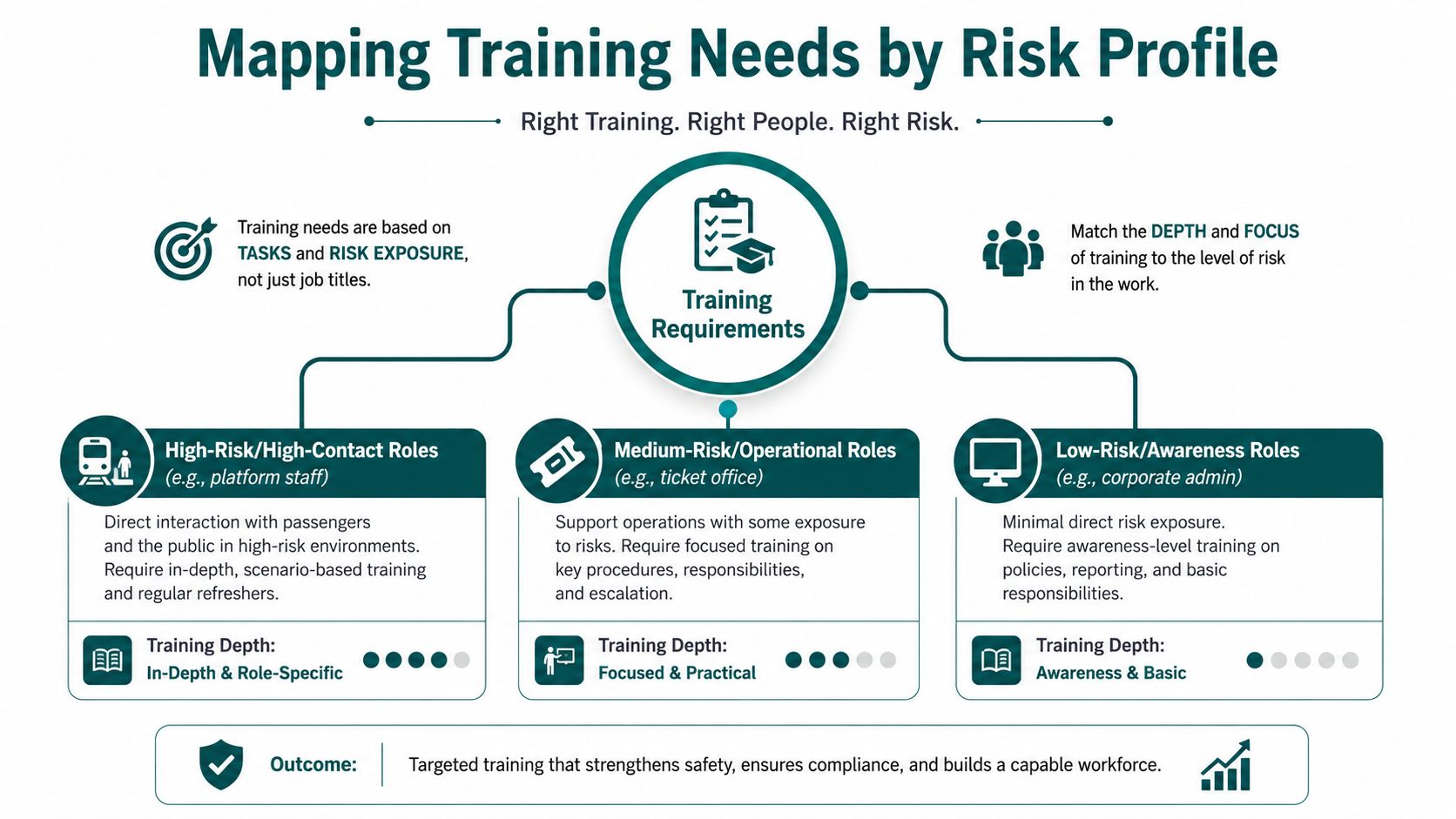
A job title doesn't tell you enough. A ticket-office employee may have limited physical contact with passengers but still needs to communicate accessible travel information. A platform employee may need to provide direct assistance, manage a boarding point and respond to a disruption. A content specialist may never meet a passenger, yet can publish instructions that determine whether a journey is usable.
UK maritime passenger-rights guidance under Regulation (EU) 1177/2010 makes this distinction explicit. Staff handling bookings, ticket sales or embarkation and disembarkation need disability-awareness training. Staff providing direct assistance to disabled passengers and persons with reduced mobility need both disability awareness and assistance training, as set out in the UK government training requirements guidance.
Build a competency matrix by task
A practical matrix should identify the task, the risk, the required outcome and the assessment method.
| Role group | Training depth | Evidence of competence |
|---|---|---|
| Booking, ticketing and reception | Awareness, respectful communication, accessible information and escalation | Knowledge check and observed customer interaction |
| Platform, boarding and passenger-assist staff | Awareness plus safe assistance, route knowledge, communication and disruption practice | Scenario assessment and supervisor sign-off |
| Security, stewards and event teams | Recognition of access needs, clear directions, emergency support and escalation | Walkthrough, drill participation and observation |
| Content and digital-service staff | WCAG requirements, accessible publishing and service testing | Content review and practical correction exercise |
| Managers and senior leaders | Service obligations, resourcing, incident oversight and assurance | Briefing, decision exercise and review of records |
| Contractors, agency and temporary staff | Condensed role-specific essentials before passenger contact | Attendance record plus task confirmation |
The ICO says induction training should cover all staff, including voluntary, temporary and contract staff, before they're allowed to process personal information. That principle is highly relevant to passenger operations because temporary staff often handle names, assistance requests, booking details or incident records during peak periods.
Don't leave managers outside the system
The Office of Rail and Road's accessibility training model included new staff, senior managers and key managers, not only frontline employees. That matters because a manager who can't explain the assistance standard may approve a roster that leaves trained coverage unavailable, or fail to recognise why a route update needs a briefing.
The most exposed gap is often baseline induction coverage. Ciphr found that only 25% of senior and middle managers and 23% of non-managerial staff had been offered onboarding or induction training in its cited workplace survey, as reported through the ICO's guidance. The figures shouldn't be treated as a complete measure of every operator, but they do identify a practical risk: organisations may have specialist policies while failing to train the people who need the basics first.
Core Curriculum That Meets Accessibility and Safety Goals
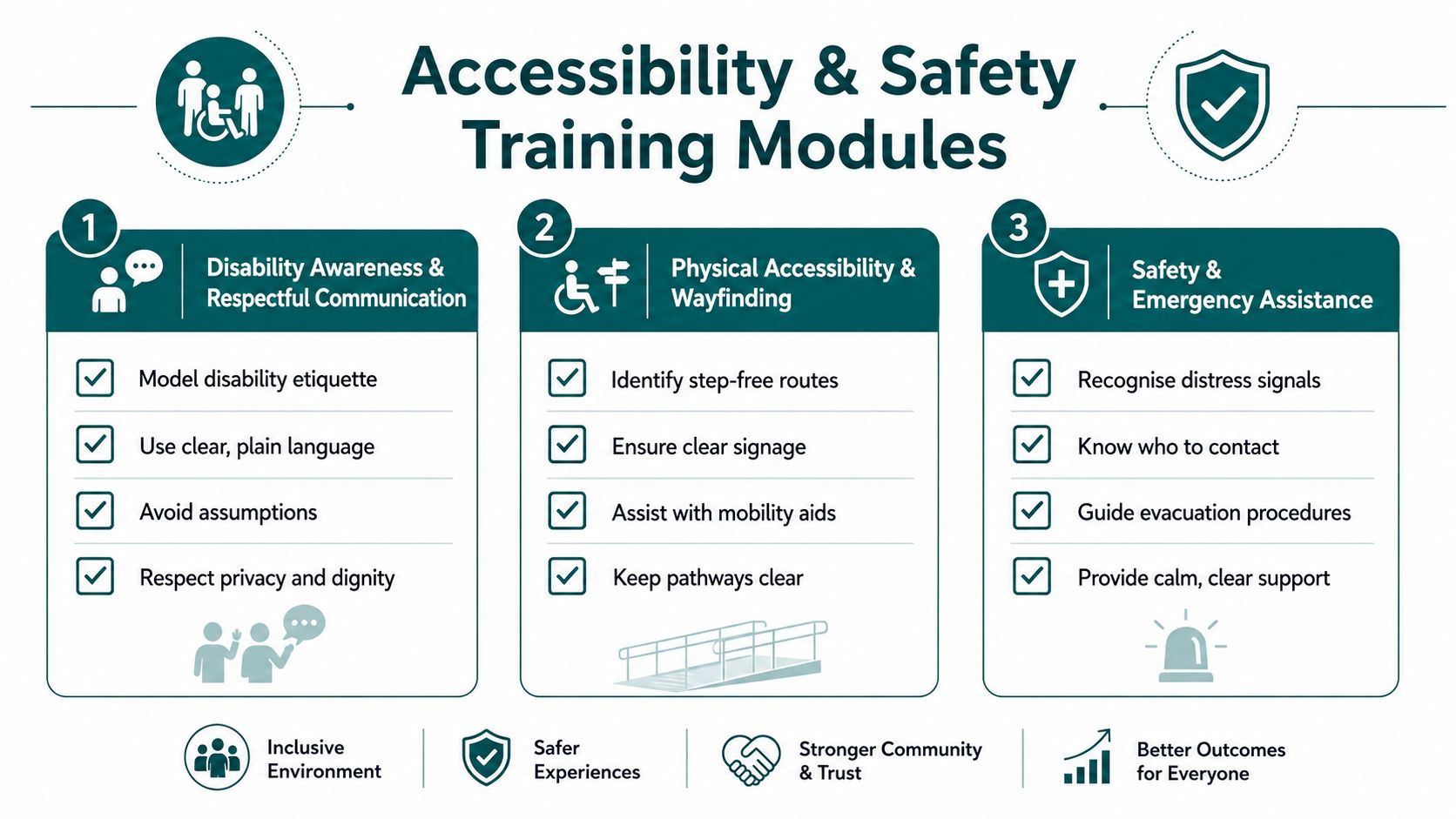
A useful curriculum moves from understanding to action. Staff first need to recognise different access requirements and communicate respectfully. They then need to apply that understanding to the actual building, route, equipment and emergency arrangements in front of them.
Start with communication and the environment
The first module should cover disability awareness, respectful language, consent and clear communication. It should avoid reducing disability to a checklist of etiquette. Staff need to practise asking what support a passenger wants, listening to the answer and explaining the next step without making assumptions.
The second module should use the venue itself. Walk staff through entrances, lifts, toilets, refuge areas, accessible seating, assistance points, alternative routes and common failure points. Ask them to guide a colleague from the ticket office to a platform or from a stadium entrance to a seat while a normal route is unavailable.
Safe assistance deserves supervised practice. The learning outcome isn't that every employee can perform every task. It's that each person understands what they can do, what requires a trained colleague, how to communicate before acting and how to escalate a concern. Emergency exercises should include disabled visitors without turning people into props. Use realistic decisions about communication, refuge, evacuation support and accountability.
Add digital and navigation competence
Digital teams require a separate pathway. NHS England says public-sector digital services must meet WCAG 2.1 AA, and that staff involved in setting up digital systems or creating content should be fully aware of the required standards. Organisations may also choose to make accessible-information training mandatory for all staff in that domain, according to NHS England's digital accessibility guidance.
For navigation support, staff should practise:
- Starting a journey: Help a passenger select the correct destination and understand the instructions.
- Handling a deviation: Recognise when a route has changed and follow the approved update or escalation workflow.
- Supporting independence: Offer assistance without taking control away from the passenger.
- Reporting defects: Capture a blocked route, inaccurate point of interest or access issue with enough detail for correction.
- Working during signal loss: Understand what the approved assistive tool can and can't do in the venue.
Waymap uses dead reckoning from device-native motion sensors, rather than GPS, Wi-Fi or installed beacons. Its stated capability includes sub-3-metre accuracy in infrastructure-free environments and no pre-mapping requirement for venues where layouts change frequently or staff turnover is high. That technical model creates a different training need from beacon-based systems. Staff must learn the user workflow, route-update process and support escalation, rather than maintain a network of physical transmitters.
The curriculum should be mapped against the Equality Act 2010, BS 8300, BS EN 17210 and, where relevant, ADA Title III expectations for accessible services and built environments. Waymap's material on inclusive design principles provides a useful prompt for connecting the physical and digital parts of that work.
For wider safety planning, operators can also use this practical resource on essential safety topics for work to check whether general workplace hazards are represented alongside accessibility-specific content.
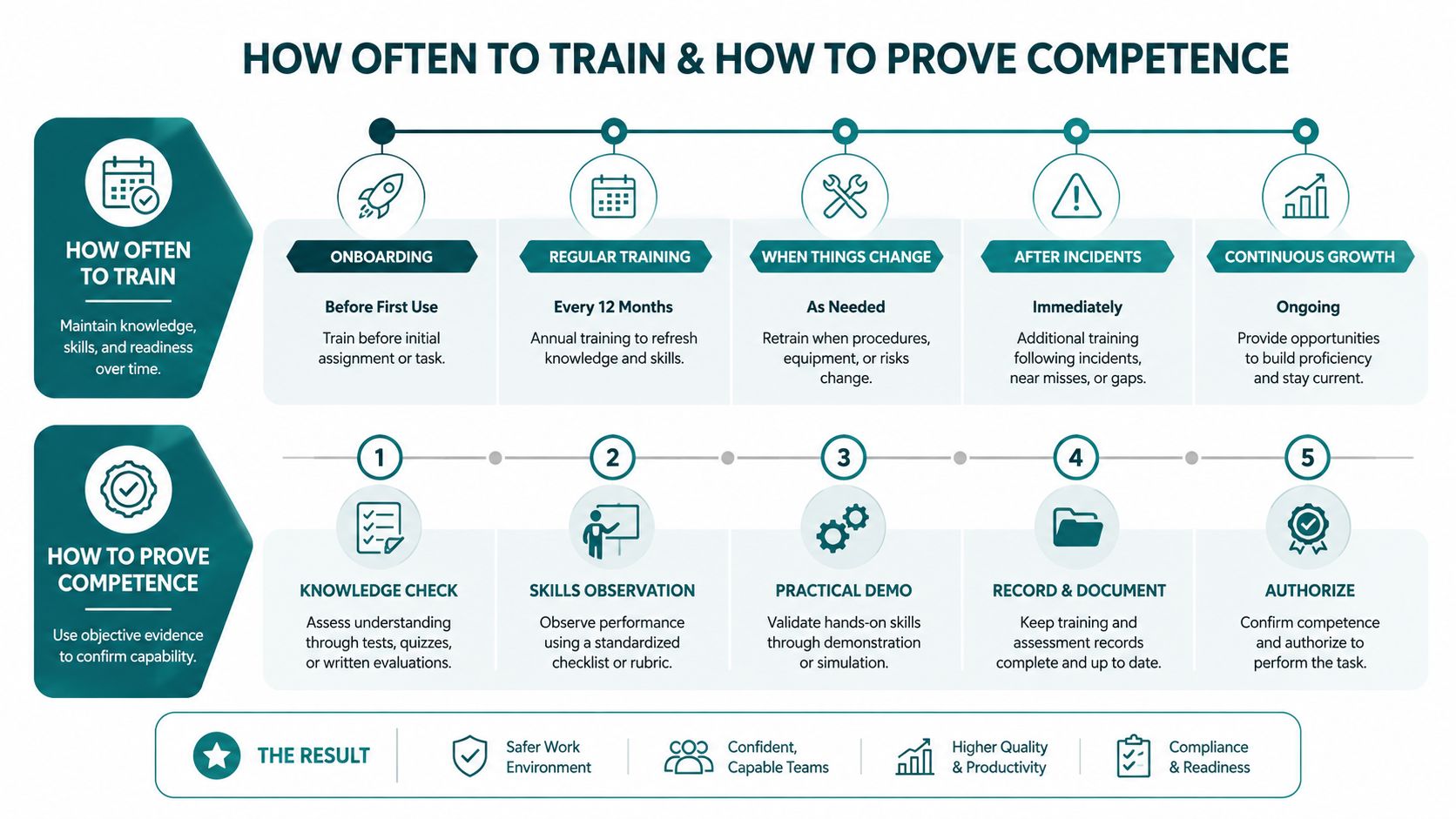
How Often to Train and How to Prove Competence
Attendance is not competence. A signed register proves that someone was present, but it doesn't prove they can explain an accessible route, provide safe assistance or respond correctly when a lift fails.
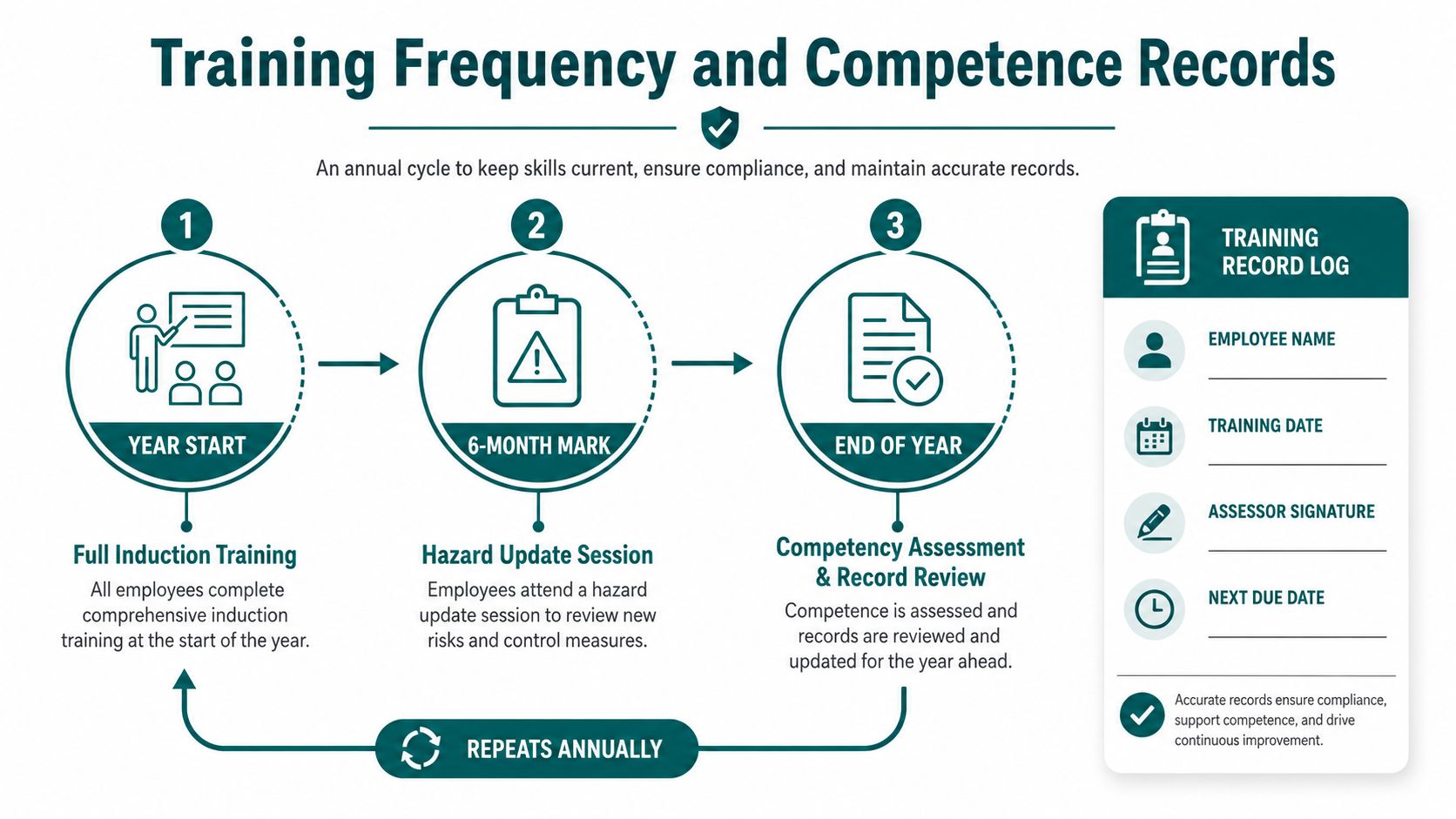
The Office of Rail and Road required train and station operators in Great Britain to ensure that all new staff, including senior and key managers, received disability awareness or disability equality training as part of induction by 31 July 2021. Passenger-facing frontline staff were expected to receive refresher training within 2 years, then at least every 2 years thereafter. Temporary and agency staff interacting with passengers were expected to receive a condensed version covering passenger assist, communication and safe assistance outcomes, as documented in the ORR assessment of disability awareness refresher training.
Treat the schedule like maintenance
The ORR model is valuable because it treats training as a recurring operational control. A venue can apply the same logic by assigning:
- An induction deadline: Before a new starter or contractor performs passenger-facing duties.
- A change-triggered session: When a layout, system, route, risk or service changes.
- A refresher date: Based on the role and the organisation's risk assessment.
- A practical assessment: A scenario, walkthrough, demonstration or observed interaction.
- A remediation route: Additional supervision or retraining when the assessment is weak.
Passenger-facing staff should be assessed on communication skills, accessibility knowledge and safe assistance outcomes. A short role-play often reveals more than a long quiz because it tests timing, judgement and clarity under pressure.
Maintain an audit-ready evidence set
Keep a role-based training matrix, attendance registers, certificates, competency assessments and version-controlled training materials. Each record should identify the employee, role, module, trainer or assessor, completion date, assessment outcome and next due date.
Retention practices vary by organisation and policy. UK compliance guidance commonly recommends retaining records for the duration of employment plus three years, while another practical baseline advises six years. Operators should select and document a retention rule that fits their legal, contractual, insurance and regulatory obligations, then apply it consistently. The key failure is not choosing between those approaches. It's having no controlled record at all.
Evidence standard: A regulator or auditor should be able to select any passenger-facing employee and trace the person from role assignment to induction, assessment, refresher and current status.
The evidence should also show what happened when a route changed or an incident exposed a gap. Waymap's approach to third-party verification is relevant to operators that need confidence that an accessibility service works beyond a written policy.
Training can also include communication technology that supports different access needs. For teams working with deaf and hard-of-hearing passengers, an overview of assistive technology for hearing loss can help managers distinguish general awareness from practical knowledge of the tools and communication methods available.
Integrating Waymap Into Training and Daily Operations
Infrastructure-free navigation changes the staff task. With a beacon or Wi-Fi-dependent system, employees may need to understand device placement, battery status and hardware faults. A system based on a smartphone's motion sensors and detailed maps shifts the operational focus towards route content, passenger onboarding, exception handling and escalation.
Waymap's navigation platform is designed to guide users indoors, outdoors and underground to exact doors, platforms and points of interest without GPS, Wi-Fi or installed hardware. Its dead-reckoning algorithm uses device-native sensors and adapts to walking patterns, with stated sub-3-metre accuracy in infrastructure-free environments. For venues with frequent layout changes or high staff turnover, the absence of a pre-mapping requirement can reduce the training burden associated with physical infrastructure maintenance.
Named deployments make the workflow easier to understand. At WMATA, the relevant operational problem is helping passengers find their way through complex transit environments to precise locations such as platforms and exits. At Lord's Cricket Ground, the need is similarly specific, guiding visitors through a large venue to destinations such as doors and seats. Staff training should focus on how those journeys begin, how a passenger recovers from a change and how a route issue reaches the person responsible for correcting it.
Match the tool to the operator's constraint
Different organisations face different barriers:
- NHS estates teams: Capital approvals and restrictions on new physical infrastructure can make a hardware-heavy accessibility project difficult to fund and maintain.
- Transport operators: Beacons and other installed devices create an additional asset-management task across high-footfall environments where equipment can be damaged, moved or made irrelevant by works.
- Retail and large venues: Frequent tenant, entrance and event changes make static route information difficult to keep current. A dynamic layer can support visitor independence while helping staff handle peak arrivals.
- Universities and campuses: Students, visitors and contractors may use unfamiliar buildings, so staff need a clear escalation route when a journey crosses departments or sites.
Waymap should be introduced in the same practical setting as the service it supports. During a briefing, staff can start a route, walk the first segment, test a destination change and practise explaining the tool without presenting it as a replacement for human assistance. They should also know when a passenger prefers direct support, because technology must extend choice rather than dictate it.
A connected access project may also involve other systems, such as a gate access API. The training boundary must be explicit. Staff need to know which system controls entry, which system provides navigation, who handles an access failure and how to record the event.
Waymap's implementation best practices can help operators turn deployment into a repeatable operational process. The most useful outcome isn't a technology demonstration. It's a workforce that can support a passenger before, during and after a journey, including when the environment changes.
Practical Implementation Guidance for Venue and Transit Operators
Start with an audit of actual coverage. Export the current staff list, add permanent employees, agency workers, contractors, volunteers and managers, then map each person to the duties they perform rather than the department they sit in. Compare that list with induction records, accessible-assistance training, emergency drills, role assessments and refresher dates.
Build the programme in the right order
Use a sequence that protects operations while avoiding a large, unfocused training project:
- Identify high-consequence tasks: Prioritise direct assistance, platform or boarding work, emergency response, route communication and access-control decisions.
- Define observable outcomes: Write what a competent employee must be able to do, such as explain a step-free diversion or escalate a blocked route.
- Assign owners: Give HR responsibility for joining records, operations responsibility for role competence, accessibility leads responsibility for content quality and managers responsibility for shift-level coverage.
- Schedule around rosters: Deliver short practical sessions across shifts instead of relying on one event that excludes night, weekend or casual workers.
- Test in the venue: Use walkthroughs, disruption exercises and scenario assessments at the entrances, platforms, concourses, stands or campus buildings where staff work.
- Close the record loop: Store attendance, assessment results, remediation actions, version-controlled materials and next due dates in one controlled system.
The ICO states that induction training should be delivered to all staff, including voluntary, temporary and contract staff, before they process personal information. Yet Ciphr found that only 25% of senior and middle managers and 23% of non-managerial staff had been offered onboarding or induction training, according to the ICO's cited workplace evidence. That gap should prompt a basic question: can a contractor access a passenger record, assistance request or incident system before completing the required induction?
Measure service performance, not course completion alone
Course completion is useful, but it's an input. Operators should also review whether staff provide consistent assistance, whether passengers can complete supported wayfinding journeys, whether route defects are reported promptly and whether complaints identify repeated communication failures. These measures need a defined baseline and a consistent collection method. Don't claim improvement unless the organisation has measured it.
Refresh the training whenever the venue changes. A new entrance, temporary works, altered platform, revised evacuation procedure or updated digital content should trigger a review of route instructions and staff practice. Infrastructure-free navigation can make route updates easier to manage, but it still requires accurate mapping, clear ownership and a briefing that reaches every affected shift.
The practical test: Ask a colleague who missed the last team meeting to handle a realistic accessibility request. Their response will show whether your programme is embedded or merely documented.
Operators should also connect training to the Equality Act 2010, relevant building and accessibility standards, emergency planning and, where applicable, ADA Title III expectations. The result is a programme that supports legal duties and day-to-day resilience without treating disabled passengers as an exceptional category of customer.
For a final readiness check, confirm that every passenger-touching role has a named competency, an induction record, an assessment method, a refresher rule, an escalation path and a current route or service brief. If one of those is missing, the training control isn't complete.
Waymap supports venue and transport teams with infrastructure-free navigation that guides passengers to precise destinations while giving staff clear workflows for onboarding, disruption handling and route updates. Visit Waymap to discuss how accessible navigation can fit your staff training and daily operations.
