
Ultra Wideband Module: What It Is and How It Works
You are probably looking at an indoor navigation problem that has stopped being theoretical. A passenger needs the right platform entrance, a blind visitor needs the exact accessible door, or a venue manager needs a positioning system that works where signs, maps, and staff briefings still leave gaps. An ultra wideband module sits in that decision space as one of several ways to locate people or assets inside a building, alongside Bluetooth beacons, Wi‑Fi fine-time measurement, and infrastructure-free smartphone guidance.
The hard part is that all of these can support the same outcome, finding the right gate, lift, or toilet, but they do it with very different trade-offs. The choice isn't just about radio performance. It's about installation effort, maintenance burden, procurement risk, and whether your team wants to add hardware to the venue or avoid that entirely.
For teams already weighing digital wayfinding against legacy infrastructure, a useful parallel is broadband rollout and site readiness, where broadband build expertise often matters as much as the equipment itself. The same procurement discipline applies here, because indoor location succeeds or fails on installation context, not on the radio acronym alone. If you want a non-radio comparison point for the user experience, see our accuracy overview.
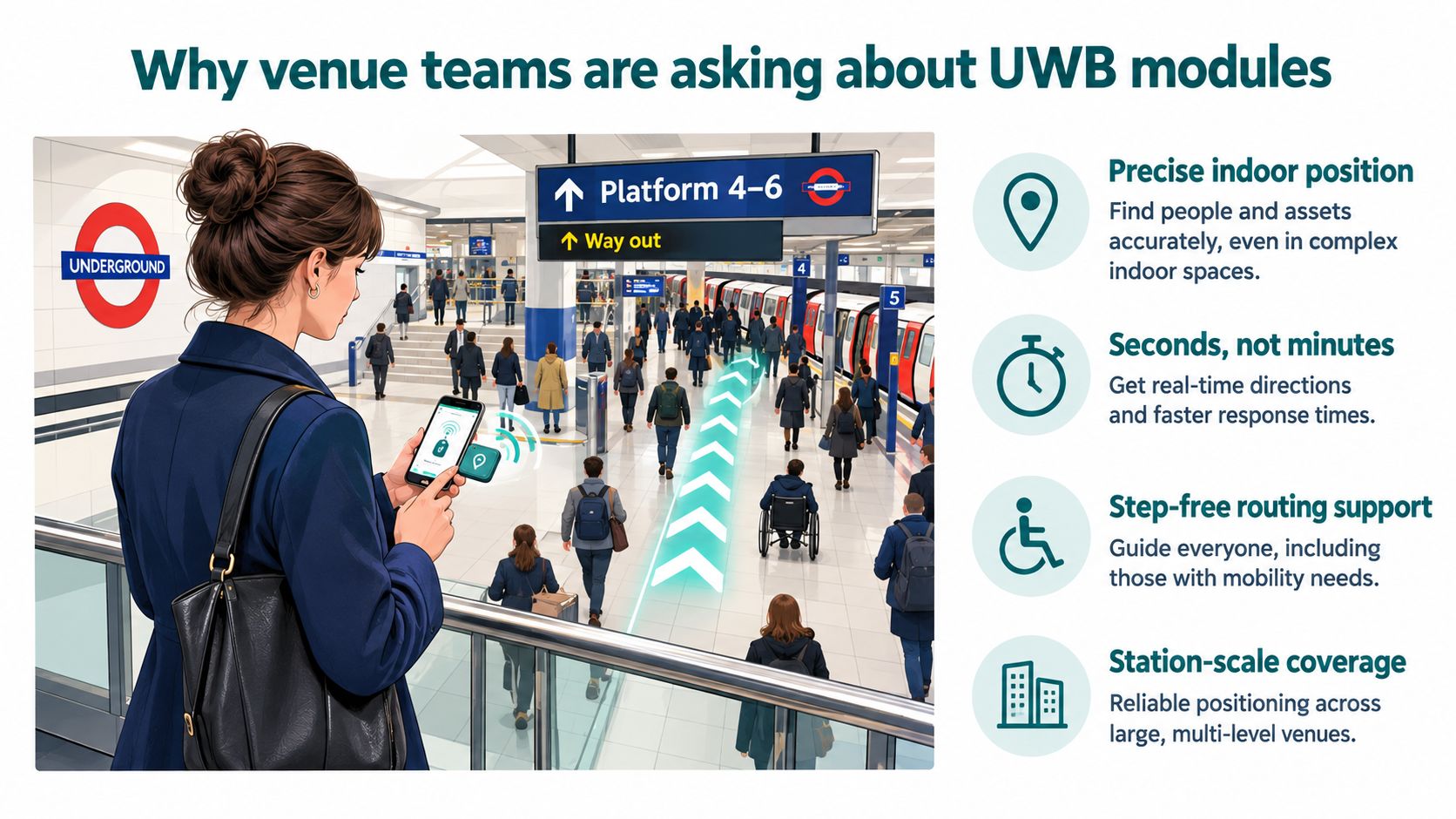
Why venue teams are asking about UWB modules
A station operator hears the same complaint in different forms. Someone says they could not find the right exit, a wheelchair user reaches the wrong lift bank, or a stadium support desk spends too much time directing people to the same entrance. An ultra wideband module enters the conversation when a venue wants precise indoor positioning rather than broad area presence.
The attraction is tight ranging, but the procurement question is wider. A venue can solve indoor wayfinding with beacons, Wi‑Fi methods, or motion-sensor guidance from a phone, and each path changes the build, support, and refresh model. If your team is already comparing hardware options for a large estate, the same discipline shows up in radio and telecom equipment tenders, where operational fit matters as much as the spec sheet.
For venue leaders, this is also a build choice. UWB only works well when anchors, placement, calibration, and maintenance are part of the operating model. That is why teams often compare it with smartphone-based guidance and with the broader accuracy trade-offs described in our accuracy overview. The hardware decision also sits beside other delivery concerns, including broadband build expertise, because indoor positioning succeeds when the site plan, installation effort, and support workflow are all realistic.
The decision behind the keyword
Before asking whether to buy UWB, decide what the venue is optimising for. If the goal is to guide a person to a specific door, platform entrance, or accessible facility, the team needs to know whether the site can support installed anchors, calibration, and lifecycle maintenance, or whether it should avoid that with a smartphone-first approach.
Practical rule: buy location hardware only when the venue is willing to own the full operating model, not just the first installation.
That matters because UWB is a radio tool, but venue navigation is a system. The antenna, the enclosure, the placement plan, and the maintenance ticketing process are part of the product. If those pieces are hard to support, the best paper spec will not save the deployment.
How an ultra wideband module measures distance
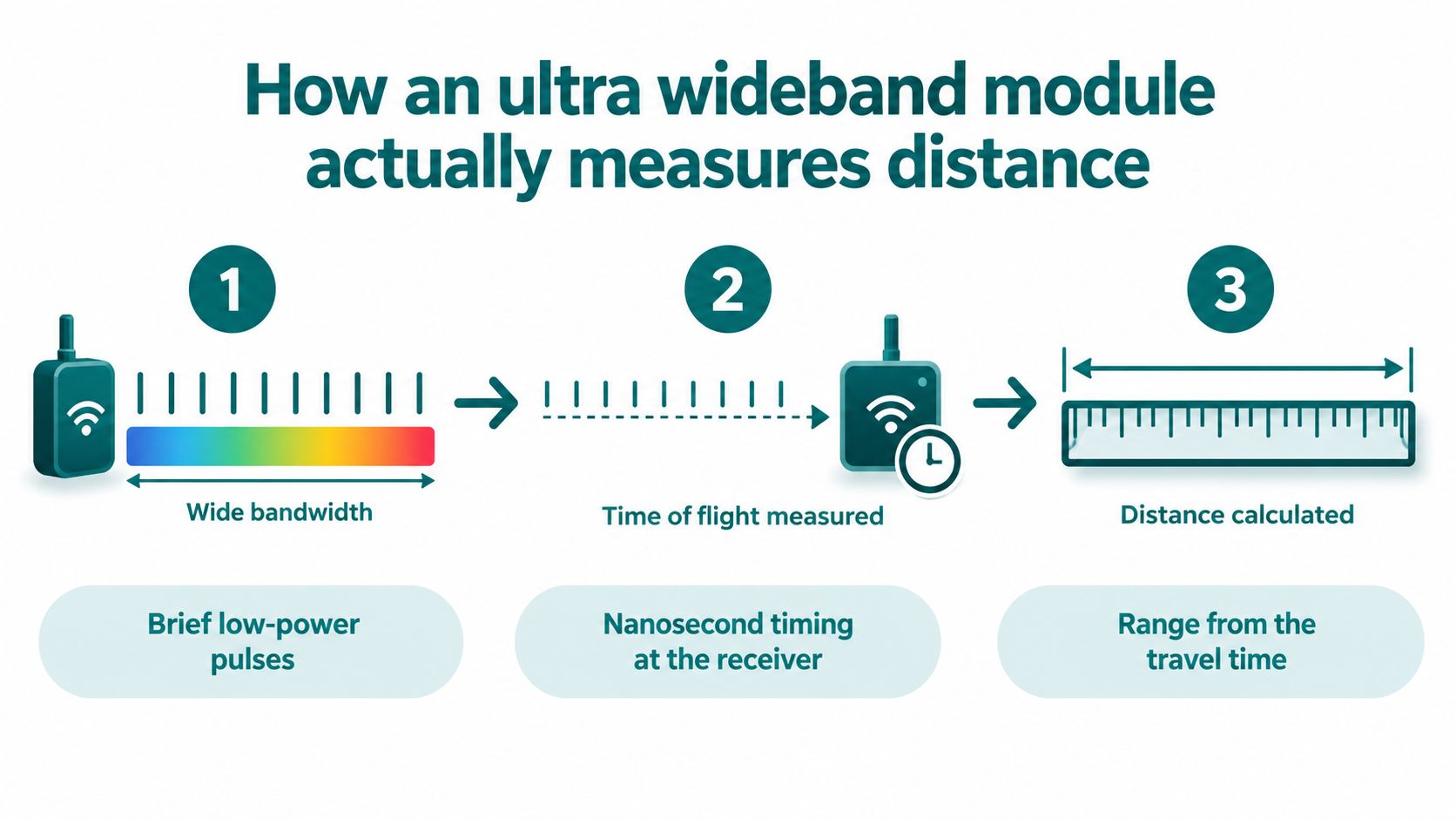
An ultra wideband module sends very short, low-power radio pulses across a wide slice of spectrum, then measures how long they take to travel. The method is close to timing an echo across a canyon, except the return path is a carefully measured radio signal between devices, not sound bouncing off rock.
Why wide bandwidth improves timing
More bandwidth gives the receiver finer time resolution. That means it can separate two closely spaced moments more precisely, which is why UWB can support accurate ranging under good conditions. The module is not guessing distance, it estimates it from propagation time.
The result still depends on the environment. Signal-to-noise ratio, antenna delay calibration, clock stability, line-of-sight, and multipath rejection all affect the reading. In a station or campus, metal structures and crowded corridors can create several signal paths, so a clean lab result does not automatically become a clean venue-wide result. For a broader explanation of how positioning systems combine signals, see this guide to how a navigation system works.
Why low-power duty cycle matters
UWB in the UK is not a licence to blast wideband energy. It is built around low-power emissions and controlled operating modes, including duty-cycle techniques referenced through the harmonised standard EN 302 065-1. That matters for procurement because the module has to stay inside a spectral mask, not just work in a demo room.
A ranging system is only as useful as the worst corridor it has to survive.
Typical components, antenna choices and datasheet specs
A buyer reading a UWB datasheet needs to separate the silicon from the system. The module usually contains a radio transceiver IC, a timing reference, an antenna, power regulation, and a host interface such as SPI, UART, or USB. Each part changes real-world behaviour, even when the headline chip name looks impressive.
The antenna often causes more trouble than the chip. PCB trace antennas, chip antennas, and external antennas all behave differently once they're put inside a plastic case, behind metal, or mounted near cabling. That matters because UK compliance is judged against the module's effective radiated emissions, not just the conducted power measured at the chip.
What the datasheet terms mean in venue language
| Datasheet spec | What it really means | Venue question it answers |
|---|---|---|
| Ranging accuracy | How close one device can estimate distance to another | Can this help a visitor find the right lift or gate? |
| Positioning accuracy | How close the system can place a user on the map | Will the app show the correct side of the concourse? |
| 95th-percentile range error | The error level most readings stay within | How often will people still get usable guidance? |
| Packet completion rate | How many location messages arrive successfully | Will tracking continue in a crowded station? |
| Tracking continuity | Whether the system holds position through motion and occlusion | Does the route survive lifts, corners, and crowds? |
A procurement team should read those lines carefully. A bench test can show clean ranging, but a reinforced-concrete concourse with reflective surfaces is a different problem. That's why a real evaluation should ask for results in the venue, not only in a lab.
If your team already handles indoor hardware refreshes, this internal note on beacons is a useful comparator because the maintenance logic is often similar even when the radio differs.
UWB vs BLE, Wi‑Fi, and smartphone dead reckoning
UWB is one of several ways to solve the same venue problem, and the alternatives differ more in operating model than in radio performance. Bluetooth Low Energy, Wi‑Fi fine-time measurement, and smartphone dead reckoning each make a different trade-off between installed hardware, precision, and upkeep.
UWB usually gives the tightest ranging, provided anchors are dense and carefully managed. BLE and Wi‑Fi can still support useful indoor positioning with less hardware on site, which is why many venues start there for broader coverage. Smartphone dead reckoning takes a different route. It uses the handset's motion sensors plus detailed mapping to guide the user without venue beacons, so the procurement question often begins with indoor location tracking requirements before anyone names a radio.
The trade-off that usually decides the fit
UWB is strongest when the application really needs precision. The cost sits around the whole system, anchors, calibration, battery replacement, and lifecycle support. BLE and Wi‑Fi can be easier to spread across a large footprint, while phone-based guidance removes venue hardware from the equation altogether.
For a venue team, that difference shows up in day-to-day operations. A public building with layout changes, tenant churn, or accessibility updates can make anchor maintenance a recurring task, and each change can affect accuracy if the site is not rechecked.
If sub-metre accuracy does not change the user outcome, the simplest workable system usually wins.
That is often true in wayfinding. A visitor may only need the right door, platform edge, or accessible entrance at the right moment. In many venues, handset guidance is enough. UWB becomes the better choice when the exact point changes the outcome, or when the site has a clear operational case for tighter location control, as seen in some radio and telecom equipment tenders.
UK regulation, emission limits and what they mean for procurement
For a venue team, UWB procurement starts with the rulebook, because a module that looks suitable on paper still has to fit UK radio law. The Wireless Telegraphy (Ultra-Wideband Equipment) (Exemption) Regulations came into force on 15 October 2009, and the 2015 rules widened permitted uses while keeping UWB inside a managed licence-exemption regime. In Great Britain, UWB is also treated as radio equipment under the Radio Equipment Regulations 2017, so conformity and marking sit inside the buying decision. For a government summary of product marking and conformity routes, see the UKCA and CE marking guidance.
The emission limits that shape the hardware
The UK rules define low-power bands rather than open-ended transmission. Up to 1.6 GHz, the limit is −90.0 dBm/MHz mean power spectral density and −50 dBm peak power. From 1.6 to 2.7 GHz, the limits are −85.0 dBm/MHz and −45 dBm. From 2.7 to 3.1 GHz, the limits are −70 dBm/MHz and −36 dBm. The rules also set limits in the higher bands, including 4.8 to 6.0 GHz and 6.0 to 8.5 GHz.
For the higher band used by many modules, the UK figure for 6 to 8.5 GHz is a maximum mean power spectral density of −41.3 dBm/MHz and a maximum peak power of 0 dBm. In 4.8 to 6 GHz, the limit is tighter, at −70 dBm/MHz mean and −30 dBm peak. Those limits explain why module choice, firmware configuration, antenna gain, and enclosure design affect legality as much as range or accuracy.
A procurement team should ask for the facts that determine whether the module can be installed. The supplier should show the supported band plan, antenna configuration, firmware region settings, and whether the product is intended for fixed or mobile use. General-use equipment normally belongs indoors, and outdoor equipment that is not fixed is restricted.
What procurement should ask for
Before installation starts, venue buyers should check three things.
- Band compliance: Does the module operate inside the UK-permitted emission limits?
- Operating context: Is it intended for indoor use, fixed outdoor use, or mobile use?
- Conformity evidence: Are the marking and compliance documents already available?
For how public-sector buyers structure these requirements, see this guide to public sector procurement.
The common mistake is treating performance claims as enough. In the UK, deployment depends on compliance first and positioning performance second. That is why UWB should be bought as a system decision, not just a radio chip decision.
What a UWB indoor-positioning system looks like in a real venue
A real deployment starts with anchors. In a regional station, those anchors might sit at ticket gates, lift lobbies, platform entrances, and wayfinding junctions, with tags on staff equipment and supported mobile devices. The site team then surveys the area, calibrates the geometry, and checks how the system hands over from one anchor to the next as people move through the building.
The difficult part is not the first map. It's what happens after the site changes. If a wall moves, a retail unit gets reconfigured, or a metal barrier is added near a platform entrance, the RF plan can shift enough to require another round of validation. That's the operational friction behind every installed UWB estate.
Where the maintenance burden shows up
Anchor maintenance is rarely the headline item on the buying form, but it becomes visible quickly. Batteries need replacing if the installation is not wired, calibration needs refreshing, and the maintenance team has to keep track of which nodes are healthy. If the venue includes retail tenants, crowds, or temporary structures, the radio planning can change faster than the facilities schedule.
That is one reason infrastructure-free smartphone guidance has become important in accessibility planning. At Lord's Cricket Ground, Waymap has used detailed mapping plus motion-sensor dead reckoning to provide step-by-step guidance without installed beacons. That contrast matters because it shows a different operating model, one that avoids anchor inventory and the work that comes with it.
The radio is only half the product. The other half is every visit your maintenance team has to make after installation.
For a station, campus, or stadium, that distinction can decide whether the system remains accurate after year one. If the venue needs frequent layout updates, the cost of revisiting the model is part of the technology choice, not an afterthought.
When UWB is the right choice and when it is not
UWB is the right choice when sub-metre precision changes the user outcome. A wheelchair user finding the correct lift call button, a depot team locating tagged assets, or a controlled environment needing tight proximity checks can justify installed anchors and the maintenance they bring. That is where the technology earns its keep.
It is not the right choice when the actual need is reliable step-by-step guidance through a large public space. In those cases, infrastructure-free smartphone navigation can often do the job with less hardware, less calibration, and less lifecycle risk. For transport, retail, and stadium operators, that difference is often more important than the radio brand.
Accessibility obligations support both paths. The Equality Act 2010 and the UN Convention on the Rights of Persons with Disabilities create demand for reliable navigation, but they don't require a specific radio choice. The procurement answer should follow the venue's operational reality, not the most technically elegant spec sheet.
If you're weighing UWB against infrastructure-free navigation for a station, campus, or stadium, Waymap can help you work through the trade-offs from a deployment point of view. Visit Waymap to see how step-accurate guidance can fit public venues without adding the maintenance burden of anchors, batteries, and RF rework.
