
Reasonable Adjustments for Venues and Transit
Most advice on reasonable adjustments starts with a policy, a list of examples and a ramp. That order is wrong for a station, stadium, hospital or university. A disabled visitor doesn't experience your policy. They experience a gateline at peak time, a lift that's out, a help point that gives the wrong route and a final 30 metres with no information at all. If that journey fails, the adjustment hasn't done its job, however compliant the building looks on paper.
We write as the Waymap team for estates, operations and accessibility leads who own that gap. The test I'd apply is simple. Can the person complete the journey independently, or with the fallback they chose, without extra charge and without hunting for help that should've been planned?
What Reasonable Adjustments Mean for Public Venues
Compliance isn't usability. A written accessibility policy and a technically accessible building can still leave someone unable to reach a platform, seat or clinic on their own. That distinction is where most operators get caught, because the failure usually sits between assets, not inside one asset.
Reasonable adjustments are the changes needed so a disabled person isn't put at a substantial disadvantage compared with other users of the same service. The government guidance on reasonable adjustments as a legal duty describes them as changes needed to ensure services are accessible to disabled people alongside everyone else, and it covers buildings, policies, procedures, communication methods and staff training.
For stations, civic buildings, universities and large venues, the Equality Act 2010 duty is anticipatory. You're expected to foresee likely barriers and reduce them before a visitor has to ask. The duty is about disadvantage, not a fixed list of conditions, and it's an organisational design job rather than a one-off request handled well by a helpful member of staff.
The Three Triggers Operators Need to Recognise
| Trigger | What it covers | Venue or transit example | Reasonableness test |
|---|---|---|---|
| Provision, criterion or practice | Rules or routines that disadvantage disabled people | Every visitor must use one entrance, or a gate that only opens after a staff call | Is the rule necessary, and can an alternative be offered without extra charge |
| Physical feature | Layout of the building, vehicle or site | Steps to a platform, a narrow door, furniture blocking a corridor, a lift out of use | Can the feature be removed, altered or avoided by a reliable step-free route |
| No auxiliary aid or service | Missing information, equipment or human support | No audio directions, no large print, no accurate step-free route, untrained staff | Would the aid or service remove the substantial disadvantage in practice |
Reasonableness turns on practicality, effectiveness, cost and the organisation's resources. Cost shapes the choice of adjustment. It doesn't cancel the duty. A small venue and a national operator won't be judged on identical spend, but both need a recorded reason for what they did, what they rejected and what interim step they offered.
Physical fixes still matter first where they're practicable. That includes lifts, ramps and wide doors, and detailed work such as learning how to improve bathroom access for mobility aids so an accessible toilet is usable in practice, not only labelled on a plan. BS 8300 and BS EN 17210 set design expectations for step-free routes in the built environment, and our overview of UK accessibility standards for venues and transport operators sets out how those standards sit alongside the Equality Act duty.
A layout that meets BS 8300 and BS EN 17210 can still leave a visitor unable to finish a journey without a tested route and clear information.
Start with one peak-time journey, from street or stop to the exact destination. Mark each failure point against the table. If you can't name the trigger, you probably can't assign the fix either.
How to Plan Reasonable Adjustments Before Visitors Arrive
A policy does not complete a visitor's journey. Plan adjustments as a repeating operations workflow, with named owners and deadlines, before a visitor has to report a barrier. That gives estates, operations and customer service a shared process for meeting the Equality Act duty.
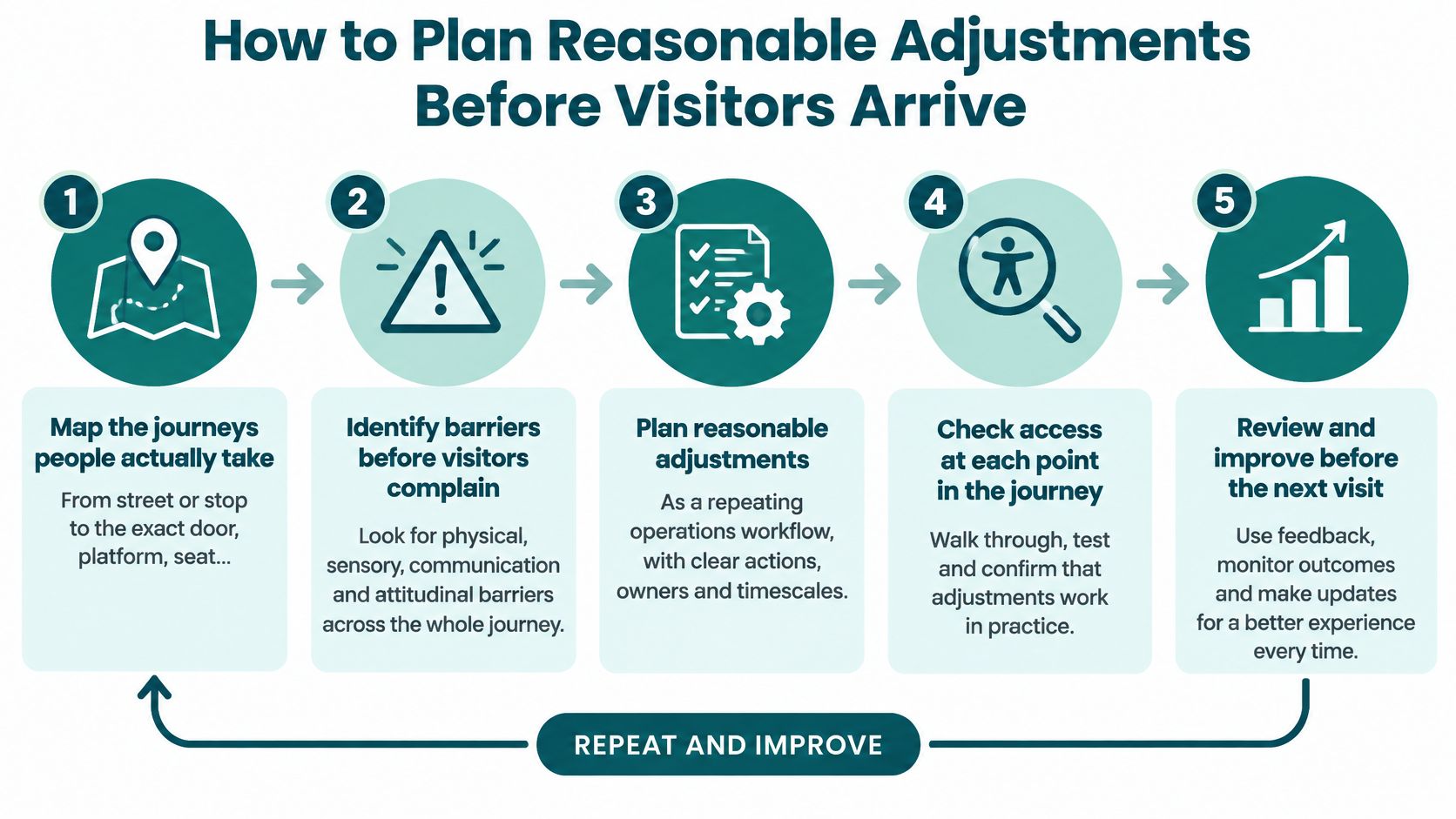
Five Steps That Turn the Duty into a Workflow
- Map the actual journey: Trace the route from street or stop to the exact door, platform, seat or clinic. Mark where a disabled visitor faces a substantial disadvantage, including peak crowding, temporary works and failed lifts.
- Consult on the barrier: Ask affected people and local access groups what prevents access and what would help. A diagnosis alone does not establish what adjustment someone needs.
- Assess options openly: Consider effectiveness, practicality, cost, resources and operational impact. Record why an option was chosen or rejected.
- Implement with an owner: Assign one person across estates, customer service or operations. Set a deadline, provide an interim aid and publish a fallback for a route failure.
- Review on a date: Retest at a set time and after any layout, staffing or route change. Record whether the disadvantage was removed, not just whether the work was completed.
The government research annexes on reasonable adjustment decision delays describe an iterative process: identify the disadvantage, consult, assess, implement and review. In the tribunal cases examined, misaligned expectations appeared in 68% of sampled cases, compared with 18% involving alleged implementation delay and 5% involving cost disagreements. These cases are not a measure of outcomes across all adjustments. They do show why a written plan should state the barrier, chosen intervention, owner, deadline, fallback and review test.
Track three timeframes: time to acknowledge, time to decide and time to implement. Record the visitor's intended outcome too. A scheduled lift repair does not explain how a wheelchair user can reach their destination tomorrow. An interim route, briefed staff and a published alternative do.
The video below can help duty managers explain why planning should begin before a request arrives.
Where Adjustment Plans Stall in Practice
| Failure | What UK evidence shows | What to do this month |
|---|---|---|
| Long wait | 1 in 8 disabled people waited more than a year; only 10% called the process easy | Track time to acknowledge, decide and implement; provide and publish a fallback in the meantime |
| Cost used as a stop | Cost can make decision-makers hesitate over adjustments | Record a proportionate interim aid before rejecting a request on cost |
| Unclear ownership | Requests can stall when responsibility for a decision or action is unclear | Name one owner across landlord, operator and tenant, with a deadline |
| Duty treated as optional funding | Access to Work does not pay for changes an employer must already make under the Equality Act 2010 | Budget ordinary access as a running cost, not as a grant bid |
The Equality and Human Rights Commission's written evidence to Parliament reported that 1 in 8 disabled people waited more than a year to receive the adjustments they needed and only 10% described the process as easy. Those figures concern employment adjustments. For venue operators, the practical lesson is to prevent delay, unclear ownership and cost concerns from obstructing a decision.
Apply the written plan to recurring failures, not only to individual arrivals. A lift outage, a closed entrance during works, a gateline that requires staff release and a platform change shown only on a screen each need an owner, an interim aid, a staff script and a review point.
Cost and responsibility can stall decisions. Our guide to inclusive design principles for large public venues explains how to account for operational constraints during design, rather than letting them defer access.
Practical rule: If a failure will recur, put it in a standing plan, not only in a visitor's complaint history.
Which Adjustment Fits a Physical or Information Barrier
A reasonable adjustment may change the building, provide an auxiliary aid or service, or offer another accessible way to reach the service. The Equality Act quick start guide for service providers includes accessible information, software and staff support among possible aids. Transport operators must anticipate disabled people's needs and, where required, provide an appropriate alternative accessible service without extra charge.
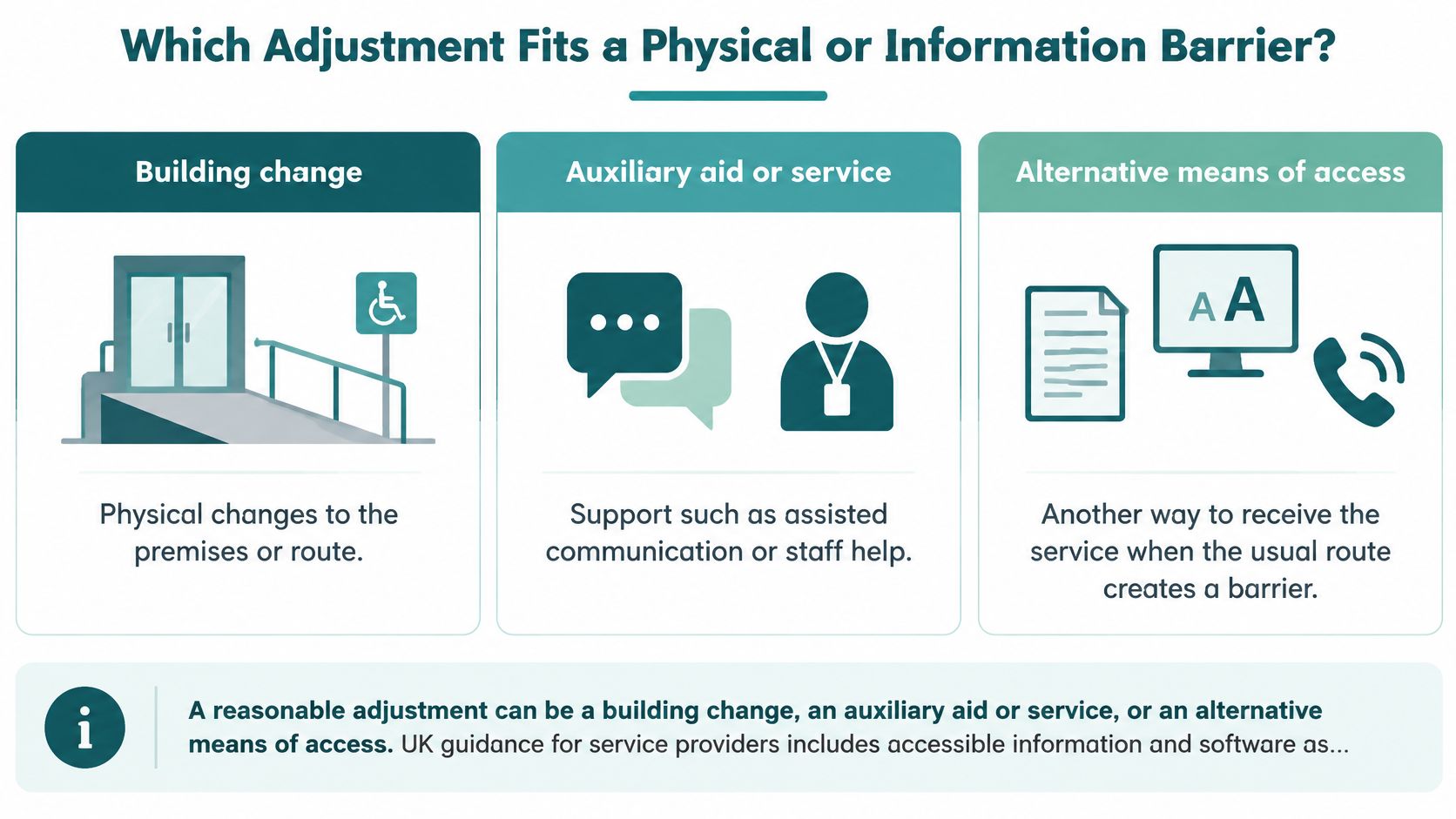
A Layered Model Beats a Single Fix
| Layer | Typical measures | Use it when | It does not replace |
|---|---|---|---|
| Remove or alter the barrier | Ramp, lift, wide door, tactile information, furniture moved off the route | A physical feature causes the disadvantage and works are practicable | A sign or app that only describes a barrier which should be removed |
| Auxiliary information and navigation | Step-free route information, large print, audio directions, live updates when a lift fails | People need an independent route through a large or changing site | Physical access, trained staff, or an alternative service |
| Human help or alternative service | Briefed staff, assistance, an alternative entrance or route at no extra charge | The other layers fail, the person prefers help, or there are works or faults | A standing reason not to fix a recurring barrier |
Digital access must be judged by its effectiveness, reliability, privacy and the choices it gives users. For video-based safety or service information, provide accessible captions and transcripts. Our guide to digital accessibility solutions for public venues explains how digital aids can support access without substituting for physical changes.
Waymap provides step-level navigation using a smartphone's motion sensors and detailed maps, without relying on GPS, Wi-Fi, Bluetooth beacons or installed hardware. It can offer step-free routing, accessible toilet guidance, personalised step counts and customised route preferences. It is an auxiliary aid, not a substitute for step-free infrastructure or staff support. Waymap should not be used as the primary navigation solution for a disabled person.
At Lord's, visitors can get guidance to the most appropriate entrance for their seating location, then to their seat, concessions, accessible toilets, bars, exits and other points of interest. The Birmingham New Street deployment had objectives that included supporting independent navigation for passengers with visual impairments and mobility challenges, improving passenger flow and demonstrating a model for other major UK stations. In either setting, information works as one layer alongside physical access and a human fallback.
Set ownership for each layer: estates teams handle physical barriers, operations maintain route information and staff procedures, and accessibility leads check that the arrangements meet visitors' needs. A policy or a ramp alone does not complete a journey. The adjustment must give people a usable way to reach the service, with staff assistance or an alternative route available when conditions change.
How to Check That the Adjustment Removed the Disadvantage
An adjustment that has been approved but not tested does not show that a visitor can complete the journey. Check the journey itself, not the policy, capital project or signed form.
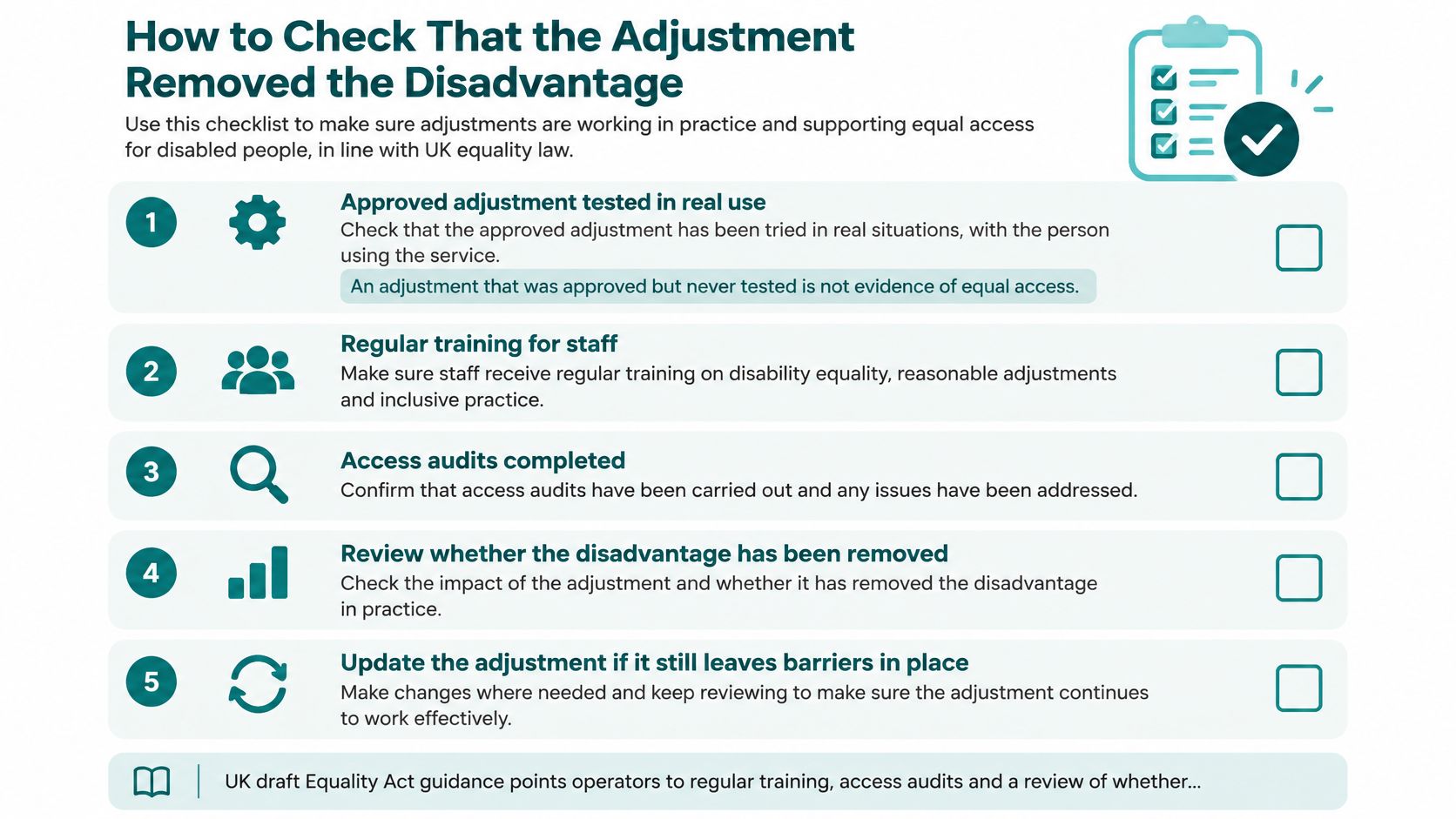
The rail regulator's guidance on accessible travel and Equality Act duties covers staff training, access audits and reviewing adjustments. Give each finding an owner and a deadline. Without clear responsibility, a route can remain untested even when the adjustment is well intentioned.
A Six Step Journey Test a Duty Manager Can Run
- Choose one journey: Select a route in the written plan, including the step-free option where relevant.
- Test it live: Walk or wheel the route during a busy period. Record decision points, requests for help and any remaining barriers.
- Assign each barrier: Name an owner in facilities or operations for every unresolved issue, and set a re-test date.
- Check staff directions: Compare what staff tell visitors with the route available in the building and its information systems.
- Repeat after changes: Re-test after a layout, staffing or route change, at each project opening, and when a fault recurs.
- Score three measures separately: Record whether the request was fulfilled, how long a working route took to provide, and whether it worked in practice.
A help point script that sends a wheelchair user towards a failed lift is not an effective adjustment, even if the lift appears on the plan. Staff instructions must match current conditions. Use accessibility testing in real visitor environments to focus checks on what visitors can do, rather than documents alone.
Keep the three results distinct. Fulfilment measures whether a suitable adjustment was provided. Timeliness measures how long it took to identify and provide a working route. Functional effectiveness measures whether the visitor could complete the journey independently or with the fallback they chose. A quick response that still leaves the route unusable should not count as success.
If a visitor cannot complete the journey, the adjustment has not removed the disadvantage.
Schedule reviews as well as responding to complaints. Re-test when a project opens, a major tenant or platform changes, or a recurring fault appears. Mark the adjustment complete only when the journey works for the visitor.
Put Reasonable Adjustments into Daily Operations
A reasonable adjustment is not complete when a policy is written or a ramp is installed. The visitor must be able to complete the journey, with accurate information and a human fallback when the planned route fails.
Choose one journey that a disabled visitor cannot reliably finish and put it under management this month. Record the barrier, the first change, any interim support, the named owner, the fallback and the date for reviewing the route. For a route affected by changing lifts, escalators or entrances, provide information staff can update and make clear who will help when that information is not enough. Our guide to staff training requirements for accessible venues covers how to brief staff on that fallback.
At Birmingham New Street, the West Midlands Combined Authority deployment aimed to improve independent navigation for passengers with visual impairments and mobility challenges, improve passenger flow and reduce congestion, and demonstrate a model that could scale to other major UK rail stations. Testing found strong satisfaction across user groups. Users with visual impairments reported increased confidence navigating the station independently.
At Lord's, the MCC Director of Estates described the partnership as a way for every visitor, regardless of ability, to experience the ground with greater ease and independence. The University of Edinburgh pre-post evaluation of Waymap at the Royal Hospital for Children and Young People is underway, with results to be published and made available on request.
This piece is from the Waymap team. Operators can apply the same operational discipline by setting an owner and deadline for each adjustment, then checking that the visitor can complete the journey. Our team helps venues choose a Waymap tier and format to suit their budget and timeline.
Questions Operators Still Ask About Reasonable Adjustments
Can an Operator Refuse a Reasonable Adjustment
Yes, if the adjustment isn't reasonable in the circumstances. A refusal needs a recorded reason covering practicality, effectiveness, cost and resources, plus any cheaper step that would still reduce the disadvantage.
Do We Have to Wait Until a Disabled Visitor Asks
No, because the service duty is anticipatory. Foreseeable barriers at entrances, gatelines, platforms and seats should be planned before an individual is disadvantaged.
What If Two Visitors Need Different Reasonable Adjustments
Provide the adjustment that removes each person's disadvantage where both are reasonable, rather than one default that suits the building. A step-free route and a quiet route can both be reasonable, and a conflict over a single room or seat is resolved by effectiveness and practicality, not by who asked first.
Do Temporary Works Suspend the Reasonable Adjustment Duty
No, temporary works create a new barrier rather than pausing the duty. Publish an alternative accessible route at no extra charge and update staff instructions the same day a lift fails, an entrance closes or hoarding blocks the usual route.
Are Visitor Adjustments the Same as Employment Adjustments
The legal idea of substantial disadvantage is the same, but the audience differs. Employment cases often concern one worker's hours, equipment or absence policy, while a venue or transit operator must anticipate many unknown visitors, so the control is the journey, the auxiliary aid and the fallback service, not a personal file.
If a disabled visitor still can't finish a journey through your station, stadium, hospital or campus, we can help you add the tested information layer that sits between your physical route and your staff fallback. Talk to the team at Waymap about an escorted versus independent journey trial on one route, with a named owner and a re-test date.
