
Digital Accessibility Solutions for Public Venues
A website that passes an automated accessibility scan can still leave a disabled visitor unable to find a platform, entrance, toilet, ticket machine, or staffed help point. The UK government reviewed 1,203 public-sector websites and 21 mobile apps between 2022 and 2024, identifying 29,787 accessibility issues. Organisations fixed 16,482 of them, or 55.3%, which shows that compliance work remains an operational programme, not a one-off audit (UK government accessibility monitoring).
For estates, transit, and venue leaders, the central question isn't “Which accessibility product should we buy?” It's “Which operational failure are we funding this solution to prevent?” Digital accessibility solutions range from conformance testing and staff training to live journey information and infrastructure-free indoor navigation. The right procurement decision depends on the barrier, the duty holder, the estate's rate of change, and the cost of maintaining the fix.
What Digital Accessibility Solutions Actually Cover
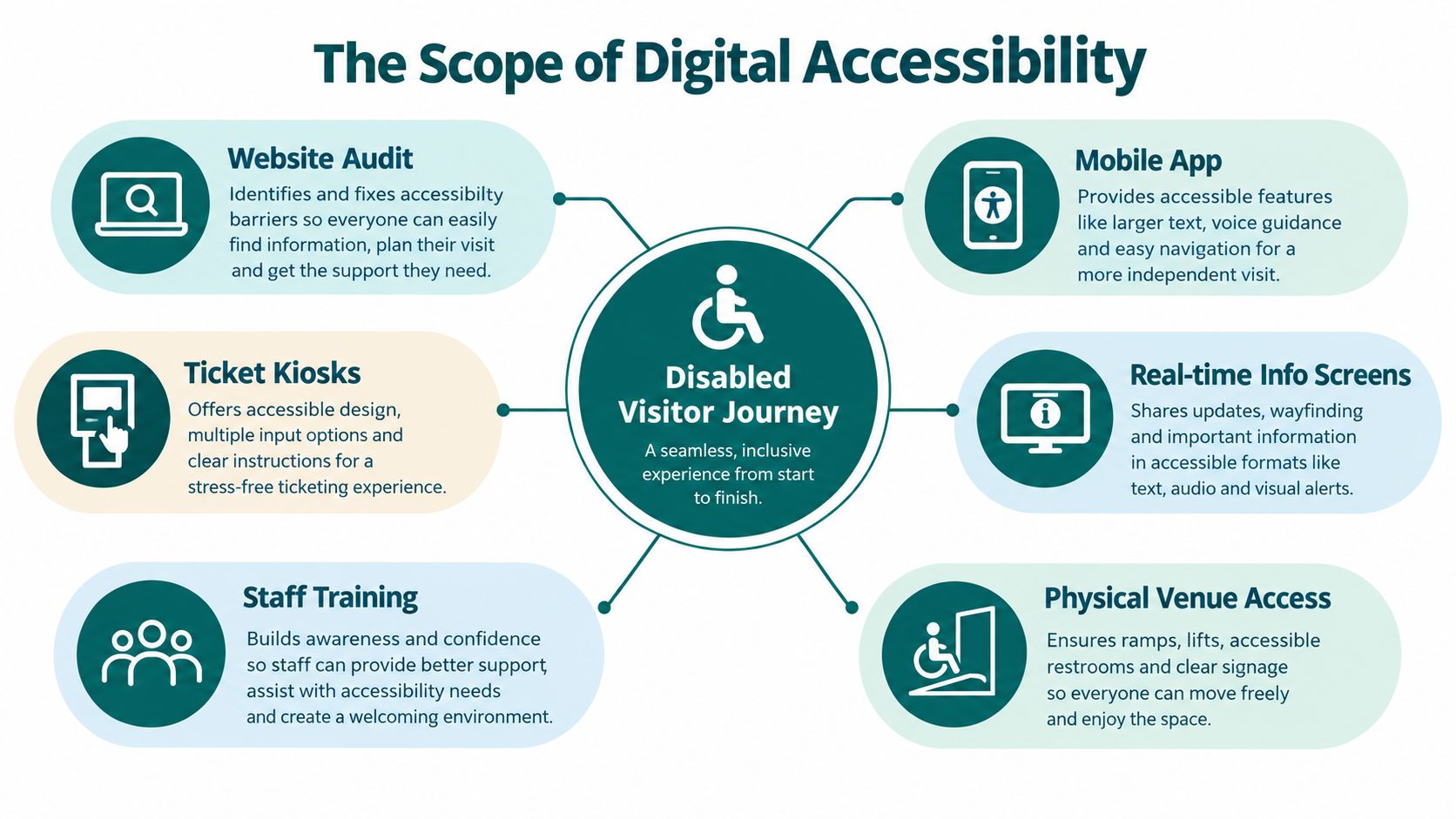
Digital accessibility isn't synonymous with a website audit. A disabled visitor encounters a connected service that may include a web page, mobile app, ticketing machine, real-time information display, staff interaction, physical route, lift, platform, room, and exit. A failure at any handover can undermine an otherwise accessible digital service.
The UK government states that accessible websites and apps are vital for 16.1 million disabled people in the UK. Its public engagement research found that disabled adults were less likely than non-disabled adults to complete most digital tasks without difficulty, at 59% compared with 82%, and less likely to report a very good experience of government digital services, at 30% compared with 37% (UK government digital inclusion findings).
That evidence points to a procurement portfolio with five separate buyer decisions:
- Pre-build audits and conformance testing address compliance exposure and retrofit risk before a new service reaches production.
- Runtime overlays and remediation tools provide a lower-capital route for parts of a legacy web estate, although they can't replace accessible source code or user testing.
- Staff training programmes reduce workforce capability gaps, especially where front-line teams handle assistance requests or alternative access arrangements.
- Physical-space wayfinding addresses missed gates, wrong platforms, inaccessible entrances, and uncertainty at transition points. Indoor navigation deserves its own specification, as outlined in this guide to wayfinding solutions.
- Policy and governance frameworks assign ownership, define escalation routes, and keep accessibility from disappearing when a supplier, service, or building changes.
Conflating these categories misallocates budget. An overlay won't teach station staff how to support a passenger. A staff course won't make a mobile journey planner compatible with a screen reader. A beautifully audited website won't guide a blind visitor through a changing concourse.
The Five Solution Categories Decision-Makers Buy
Procurement teams should define each category by the decision it supports, the team it consumes, and the failure that will force another purchase. A vendor's feature list isn't a cost model.
Five solution categories at a glance
| Category | Buyer decision | Annual cost band | Team consumed | Common failure mode |
|---|---|---|---|---|
| Pre-build audit and conformance testing | Whether a service is fit to launch or needs remediation | Variable, based on service scope and testing frequency | Product, design, engineering, procurement | Audit becomes a static report with no accountable remediation owner |
| Runtime overlay or remediation layer | Whether a legacy interface needs an interim accessibility route | Variable subscription or managed-service cost | Digital, IT, content, legal | Overlay masks defects without fixing the underlying interface |
| Staff training | Whether employees can provide consistent assistance | Variable programme and refresher cost | Operations, HR, customer service | Training is completed once and absent from induction or role changes |
| Accessible wayfinding | Whether visitors can reach exact destinations through the estate | Variable platform, mapping, integration, and support cost | Estates, transport operations, accessibility, IT | Maps become stale when routes, lifts, gates, or rooms change |
| Policy and governance | Who owns risk, evidence, complaints, and improvement | Variable internal governance cost | Executive sponsor, legal, procurement, service owners | Policy exists but has no review cadence, budget, or escalation route |
An audit is evidence for a procurement file. It should include manual testing, assistive technology testing, defects, severity, affected journeys, and a remediation owner. Automated scanning is useful for repeatable checks, but it won't capture every problem experienced with a screen reader, screen magnifier, speech recognition tool, keyboard, or alternative input method.
An overlay can be attractive to an estates or digital director facing a large legacy estate and limited capital. Treat it as a risk-managed interim measure, not a substitute for accessible design. The contract should state which source-level defects remain, how the provider tests its layer, and what happens when the underlying content management system changes.
Training is operational infrastructure. It needs role-specific content, induction integration, refresher arrangements, and a method for recording whether teams can respond to a request. A policy framework then binds audits, remediation, training, and physical access into one governance cycle. Teams comparing wider implementation partners may also consult this list of technology services, but the accessibility specification must remain owned by the venue or operator.
For wayfinding, buyers need to distinguish static mapping, beacon-based positioning, and infrastructure-free navigation. A useful starting point is this explanation of indoor positioning systems, followed by a site-specific assessment of route complexity, coverage, data freshness, and operational ownership.
The Regulatory Anchor Behind Every Procurement
Regulation should set the evidence required in the tender, not sit in a compliance paragraph after the technical specification. Each instrument creates a different ownership, service, or capital-spending decision for estates, transport, and venue teams.
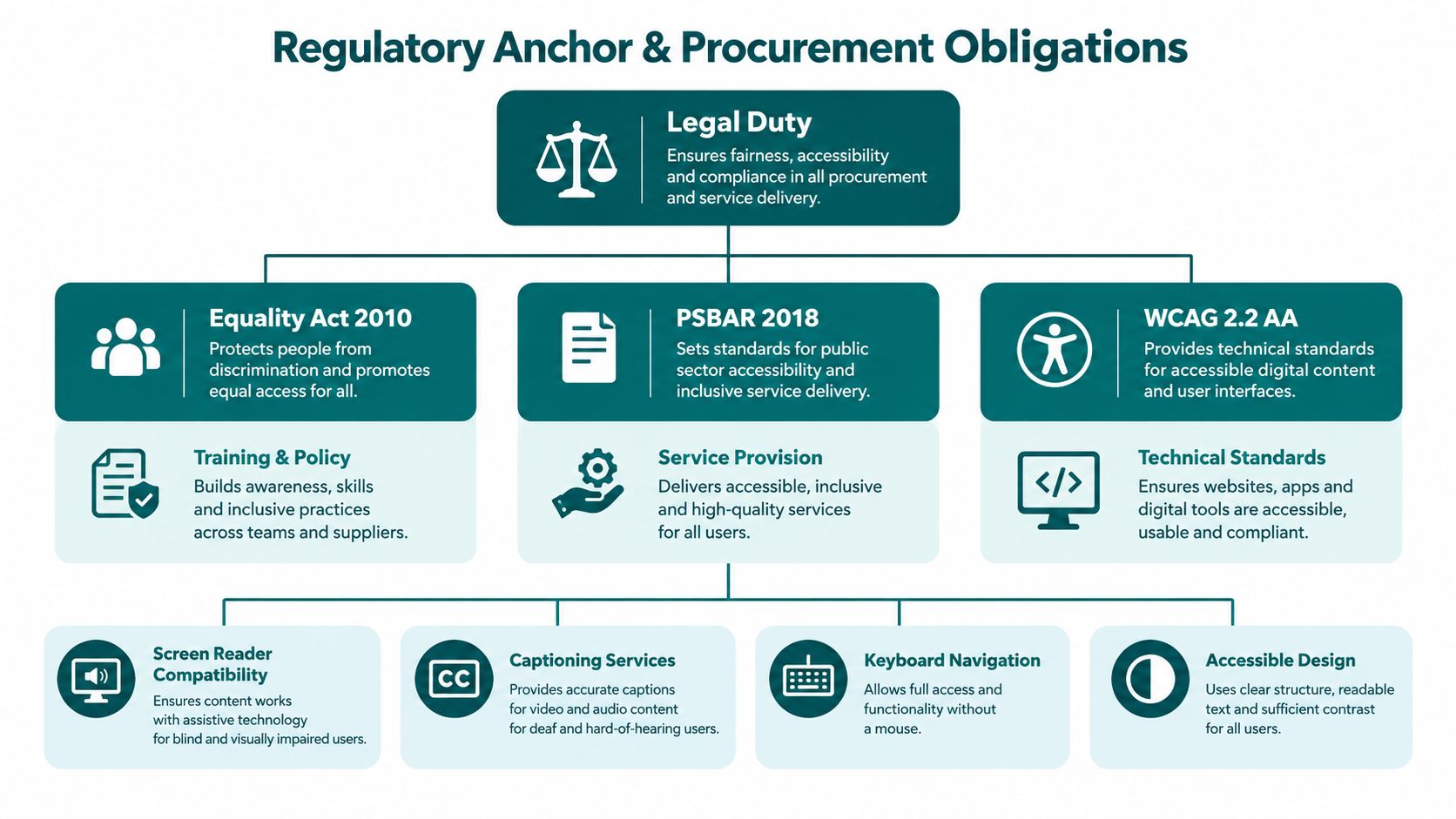
The Equality Act 2010 requires organisations to consider reasonable adjustments and remove disabling barriers from service provision. Procurement must therefore fund a named owner, trained staff, accessible alternatives, and a process for responding when a digital or physical route fails. The UN Convention on the Rights of Persons with Disabilities establishes the wider expectation of equal participation. Use it to frame access as a service requirement, then translate that principle into accountable contract deliverables rather than optional enhancements.
For UK public bodies, the Public Sector Bodies (Websites and Mobile Applications) Accessibility Regulations 2018 create specific digital duties. New public-sector websites were covered from 23 September 2018, older websites from 23 September 2020, and mobile applications from 23 June 2021. Government guidance states that services meet the legal standard when they satisfy WCAG 2.2 AA and publish an accessibility statement explaining limitations (UK public-sector accessibility requirements). For venue-specific duties, see this overview of accessibility requirements for public venues.
Put those duties into the tender:
- WCAG 2.2 AA: require a signed conformance report, test scope, known exceptions, test methods, and remediation dates. This gives the digital owner evidence to accept or reject delivery.
- Public-sector reporting: assign ownership for the accessibility statement, review schedule, complaint route, and updates to known limitations.
- Equality Act responsibilities: require a reasonable-adjustment workflow, staff responsibilities, and proof that alternative access works in practice.
- BS 8300-2: connect building and wayfinding requirements to routes, entrances, circulation, signage, and handover points. Require a conformance statement based on the actual site, so estates teams can price physical changes before approval.
- Assistive technology support: specify compatibility with commonly used screen magnifiers, screen readers, and speech recognition tools. Require disabled people to participate in user research, as set out in the UK service accessibility introduction.
Reject “compliant” as a standalone claim. Ask which journey was tested, with which technology, against which standard version, and who approved the result. Evidence-led specifications protect the buyer when costs, defects, and ownership are challenged.
Infrastructure-Free Wayfinding Versus Beacon-Based Systems
Infrastructure-heavy and infrastructure-free wayfinding are different procurement paths. Score both against accuracy, maintenance burden, deployment time, and total cost of ownership, then test them in the environment where the service will operate.
Beacon-based systems use fixed hardware distributed through a building or transport estate. The buyer must account for installation, power, replacement, surveying, calibration, asset registers, and access to areas where devices are mounted. That burden becomes more significant in exhibition venues, retail centres, hospitals, and transport concourses where walls, routes, shop units, gates, and temporary closures change frequently.
Infrastructure-free systems use device-native smartphone sensors alongside venue geometry and route data. Waymap describes its approach as dead reckoning that uses the phone's motion sensors, with sub-three-metre accuracy in infrastructure-free environments and no pre-mapping requirement for venues with high staff turnover or frequent layout changes. Buyers should verify those claims in their own building, with their own floor transitions, materials, route constraints, and user profiles. More background on GPS-free navigation is useful, but it doesn't replace a site proof-of-concept.
Infrastructure-Free vs Beacon-Based Wayfinding
| Criterion | Infrastructure-Free | Beacon-Based |
|---|---|---|
| Accuracy | Must be demonstrated against measured points and route outcomes in the target estate | Depends on beacon density, placement, signal conditions, calibration, and device performance |
| Maintenance burden | Primarily map, route, points-of-interest, and software maintenance | Map and software maintenance plus physical hardware, power, replacement, and calibration |
| Deployment time | Can begin with digital mapping and operational data, subject to validation | Requires site survey, hardware installation, configuration, testing, and ongoing asset management |
| High-change environments | Suitable for a procurement test where layouts and routes change frequently, provided updates reach users quickly | Risk of coverage gaps or stale hardware positions when the estate changes |
| Total cost of ownership | Concentrated in mapping, integrations, support, and service governance | Includes software plus installation, survey refreshes, hardware replacement, power, and access arrangements |
Vendor accuracy language needs scrutiny. “Precise” isn't a benchmark. Require a documented test plan that measures distance to known points, route completion, rerouting after closures, performance at entrances and lifts, and the experience of users with different walking styles.
Practical rule: Price the maintenance that the brochure leaves out. If a system depends on hardware across a changing estate, put survey refreshes, battery or device replacement, access permits, and calibration ownership into the five-year cost model.
What Named Deployments Reveal About Each Approach
Named deployments matter only when they expose the operating conditions behind the result. A venue reference should identify the estate covered, the team responsible for data, the journeys tested, and the evidence collected. A logo without those details is a procurement red flag. Request the number of points of interest maintained, update latency after a closure, and route-completion rate for blind users during the pilot. If the supplier cannot provide those three data points, fail the reference.
For a London Underground trial, require the supplier to name the stations, route boundaries, interchange conditions, assistance model, and operational owner. Test whether a passenger reaches the intended platform or exit, whether the service responds to closures and diversions, and whether station teams can update routes without new physical installation. The reference should include the number of stations tested and the time taken to reflect an operational change. Without that evidence, “navigation available” says little about deployment value.
The Royal Hospital for Children and Young People presents a different procurement test. Its outpatient departments, entrances, lifts, reception points, and temporary route changes create handovers between digital guidance and physical operations. Ask for the number of departments supplying points-of-interest data, the approval process used by accessibility teams, and the time required to update a route during construction or service changes. An “improved experience” claim without a baseline, test population, measure, and reporting method should fail review.
North American transit references such as WMATA Washington Metro require the same scrutiny. The WMATA Washington Metro case-study page belongs in the reference pack, alongside a live operator conversation. Request the stations covered, the number of underground or signal-poor test locations, the route-completion result, and the internal team that owned updates after launch.
Westfield London, SBS Transit, LTA Singapore, and CapMetro Austin can strengthen a shortlist only when their scope and current service status are documented. Ask for launch timing, operational constraints, the points-of-interest update process, and one measured journey outcome for each deployment. Treat missing evidence as an unverified capability statement, not as proof of fit.
How to Evaluate Vendors and Score the Shortlist
Start with the operational problem, not the product category. “Improve accessibility” is too broad for a tender. “Help a blind passenger reach a named platform from the accessible entrance while a lift closure is active” can be tested, costed, and assigned to an owner.
Define the problem in operational terms
Write the journey as a sequence of decisions and handovers:
- What information does the person need before arrival?
- Which digital interface provides it?
- Where does the digital route meet the physical estate?
- What happens if a lift, gate, room, platform, or entrance is unavailable?
- Who updates the service and how quickly?
- What alternative support exists if the digital route fails?
Use the same questions for websites, apps, kiosks, staff processes, and navigation platforms. This prevents a vendor from solving a narrow technical symptom while the visitor still encounters a broken journey.
Score ten weighted criteria
Use 10 weighted criteria in the shortlist matrix. Weight them according to your risk, rather than copying a supplier's scorecard:
- User outcome: Can disabled people complete the target journey?
- Assistive technology: Does the service work with relevant screen readers, magnifiers, speech recognition, and platform settings?
- Accuracy: Are location and route claims measured in metres and tested at known points?
- Coverage: Does the solution include entrances, transition zones, lifts, platforms, toilets, counters, and other required destinations?
- Operational updates: Can authorised staff amend closures, points of interest, and route constraints?
- Integration: Can the service ingest fragmented transport, venue, assistance, and accessibility feeds?
- Resilience: What happens when GPS, Wi-Fi, mobile coverage, or a source feed is unavailable?
- Data protection: What data is collected, why, where it is stored, and when it is deleted?
- Total cost: What will the operator spend on implementation, support, updates, hardware, surveys, and exit?
- Supplier accountability: What warranties, service credits, reporting duties, and exit rights apply?
Run a paid proof-of-concept in the actual venue. A four-week PoC period gives the team enough time to test ordinary operations, planned changes, user feedback, and maintenance workflows without allowing the exercise to become an indefinite pilot.
Before signing, verify references with named deployments and request raw test results, not selected screenshots. Your contract should cover data ownership, accuracy warranties, accessibility evidence, incident response, reconfiguration duties, service credits, and termination if contracted performance falls below the agreed threshold.
The demonstration should include a real closure, a route to a named destination, a lift or entrance transition, a user with assistive technology, and an administrator updating the map or service data. If the vendor won't demonstrate failure handling, you haven't seen the product you're buying.
A Buyer's Checklist for Transit and Venue Operators
Use this checklist in the procurement pack and in the contract clarification log. It forces suppliers to connect accessibility claims with operational accountability.
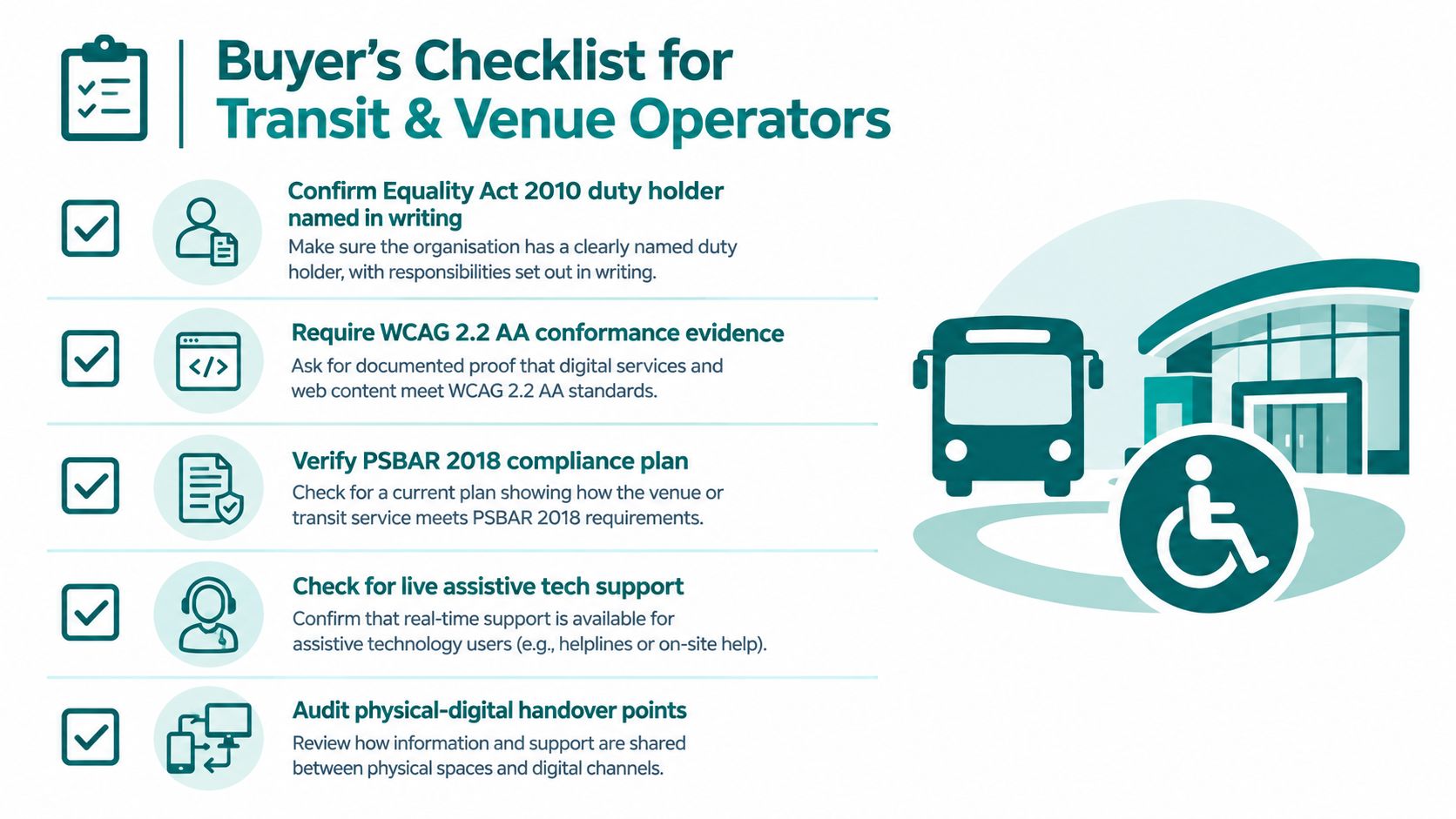
- Name the duty holder: Confirm in writing which organisation and senior owner carries the Equality Act 2010 and Public Sector Bodies Accessibility Regulations 2018 responsibilities.
- Request WCAG evidence: Require a current WCAG 2.2 AA conformance report for every web-facing layer, including the app, booking flow, account area, and embedded supplier component.
- Specify assistive technology: Confirm support for screen readers, screen magnifiers, speech recognition, keyboard access, larger text, contrast settings, reduced motion, and non-colour cues.
- Test physical-digital handovers: Check entrances, ticket machines, lifts, gates, platforms, reception desks, toilets, rooms, and assistance points.
- Measure accuracy: Demand location and route benchmarks in metres, with a test method and failure threshold. Vendor adjectives aren't benchmarks.
- Test transition zones: Include indoor and outdoor movement, underground areas, entrances, stair and lift choices, and changes between buildings.
- Test closures: Ask how a maintenance closure, temporary gate, moved exhibition, or inaccessible lift reaches users and front-line staff.
- Check multimodal journeys: Verify the handover between walking routes, rail, bus, taxi, cycling, and venue access where relevant.
- Price ownership: Require total cost of ownership for years one, three, and five, including survey refreshes and physical hardware for beacon-based proposals.
- Protect governance: Set data protection impact assessment requirements, accessibility statement publication timelines, audit rights, incident reporting, and an exit clause if performance falls below contract thresholds.
The UK transport accessibility data ecosystem isn't complete. The national dataset covers much of Great Britain and at least one file set is updated weekly, so systems that depend on route planning or assistance data should ingest fragmented feeds, reconcile source quality, and tolerate incomplete station-level attributes (UK transport accessibility data report).
Live information matters as much as static metadata. Independent UK research found that disabled travellers wanted real-time assistance staff availability, delay and cancellation processes, overcrowding, lift status, accessible toilets, and ramp availability, with each of those categories receiving substantial demand in the research findings (UK transport accessibility findings). Your checklist should therefore test event-driven updates, not only a polished map presented on launch day.
Questions Decision-Makers Ask Before They Sign
How do infrastructure-free and beacon-based systems compare?
Infrastructure-free systems avoid the installation and upkeep of fixed positioning hardware, while beacon-based systems add surveying, power, replacement, calibration, and access requirements to the software programme. Compare both using measured accuracy, launch process, route-change handling, and the cost of maintaining coverage when a station or venue changes quarterly.
What WCAG 2.2 AA and PSBAR evidence should a vendor provide?
Request a testable conformance report for each web or app layer, a list of known limitations, remediation ownership, an accessibility statement workflow, and annual review arrangements. For public bodies, require the evidence and reporting process to align with the Public Sector Bodies Accessibility Regulations 2018, rather than accepting a generic certificate.
How should the vendor handle UK GDPR?
The vendor should document what data it collects, the purpose for collection, retention periods, storage locations, deletion process, subprocessors, and user rights. Processing should be limited to the accessibility and navigation service, with the controller and processor responsibilities stated clearly in the contract and assessed through a data protection impact assessment.
What happens when accuracy degrades or the venue is reconfigured?
The contract should name the liable party, define the accuracy threshold, set recalibration or remapping times, establish service credits, and require prompt updates when routes, lifts, entrances, or points of interest change. The operator should retain access to its data and have a practical exit route if the supplier can't restore contracted performance.
Accessibility procurement succeeds when the service remains usable after launch, not when the tender presentation looks inclusive. Test the actual journeys, assign ownership, and make maintenance part of the commercial decision.
Waymap provides indoor, outdoor, and underground step-by-step navigation using smartphone sensors and detailed venue maps, without GPS, Wi-Fi, or installed beacons. Visit Waymap to discuss a proof-of-concept for your station, hospital, campus, shopping centre, stadium, or public venue.
