
Unlock Maintenance Cost Reduction: UK Venue Guide 2026
Maintenance cost reduction usually becomes urgent on a bad day. A lift fails before a weekend event. An air handling unit trips on a bank holiday. The contractor arrives on an emergency rate, parts have to be sourced fast, frontline staff absorb complaints, and operations lose half a day rearranging around the fault. Most estates teams know that pattern too well.
The expensive part isn't only the failed asset. It's the operating model behind it. Reactive maintenance pulls money into overtime, call-out premiums, rushed decisions, and avoidable disruption. It also hides costs in places many budgets treat as separate lines: visitor confusion, staff time spent giving directions, inaccessible environments that create complaints, and physical wayfinding infrastructure that needs its own upkeep.
For large UK venues, maintenance cost reduction isn't about asking teams to do more with less. It's about changing what the organisation pays for. The strongest business cases usually come from the same shift: less emergency response, more planned intervention, better asset visibility, and fewer operational frictions that drain labour every day.
That matters whether you run a rail station, hospital campus, stadium, shopping centre, university estate, or civic building. HVAC, lifts, escalators, lighting, and electrical systems still need disciplined asset management. But so do the parts of the environment that shape visitor movement and staff workload. If people can't find the right entrance, clinic, platform, stand, or service point, that failure lands on operations. Someone stops what they were meant to be doing and steps in.
The practical opportunity is to treat physical reliability, visitor experience, and compliance as one operating problem. That's where modern maintenance strategies become easier to justify to finance, procurement, and executive stakeholders. They stop looking like isolated maintenance spend and start looking like service continuity, cost control, and better use of the estate.
Introduction Beyond the Break-Fix Cycle
A reactive culture usually announces itself before anyone names it. Work orders pile up around urgent faults. Supervisors spend mornings reprioritising. Contractors know which sites call in distress and price accordingly. Visitors don't describe this as a maintenance problem. They describe it as a poorly run place.
For many estates leaders, the break-fix cycle feels unavoidable because the immediate failure is real and visible. The underlying cause is less visible. Planned work gets bumped. Asset history is incomplete. Teams service some equipment too often and other equipment too late. Signage changes lag behind building changes. Staff become the fallback navigation system.
Practical rule: If your best technicians spend too much of their week responding to surprises, your maintenance model is costing more than the repair invoice suggests.
The more useful way to think about maintenance cost reduction is as an operating redesign. It's more than trimming a budget line. You're moving spend from chaotic, high-friction activity into controlled, lower-cost work. In practice, that means three things:
- Reducing emergency dependence by identifying which assets and systems are forcing avoidable call-outs
- Targeting work to condition rather than relying only on the calendar
- Removing hidden operational maintenance such as outdated wayfinding infrastructure and the staff burden created by poor navigation
That last point is still underplayed in most maintenance discussions. Estates and facilities teams often inherit responsibility for the practical consequences of wayfinding without treating it as a maintenance issue. Yet static signs age, get replaced, become inaccurate after layout changes, and generate staff intervention when they fail users.
A modern estate can't separate asset reliability from user navigation for long. In public-facing environments, both affect continuity, labour use, compliance under the Equality Act 2010, and the quality of day-to-day operations.
What Are the True Drivers of High Maintenance Costs?
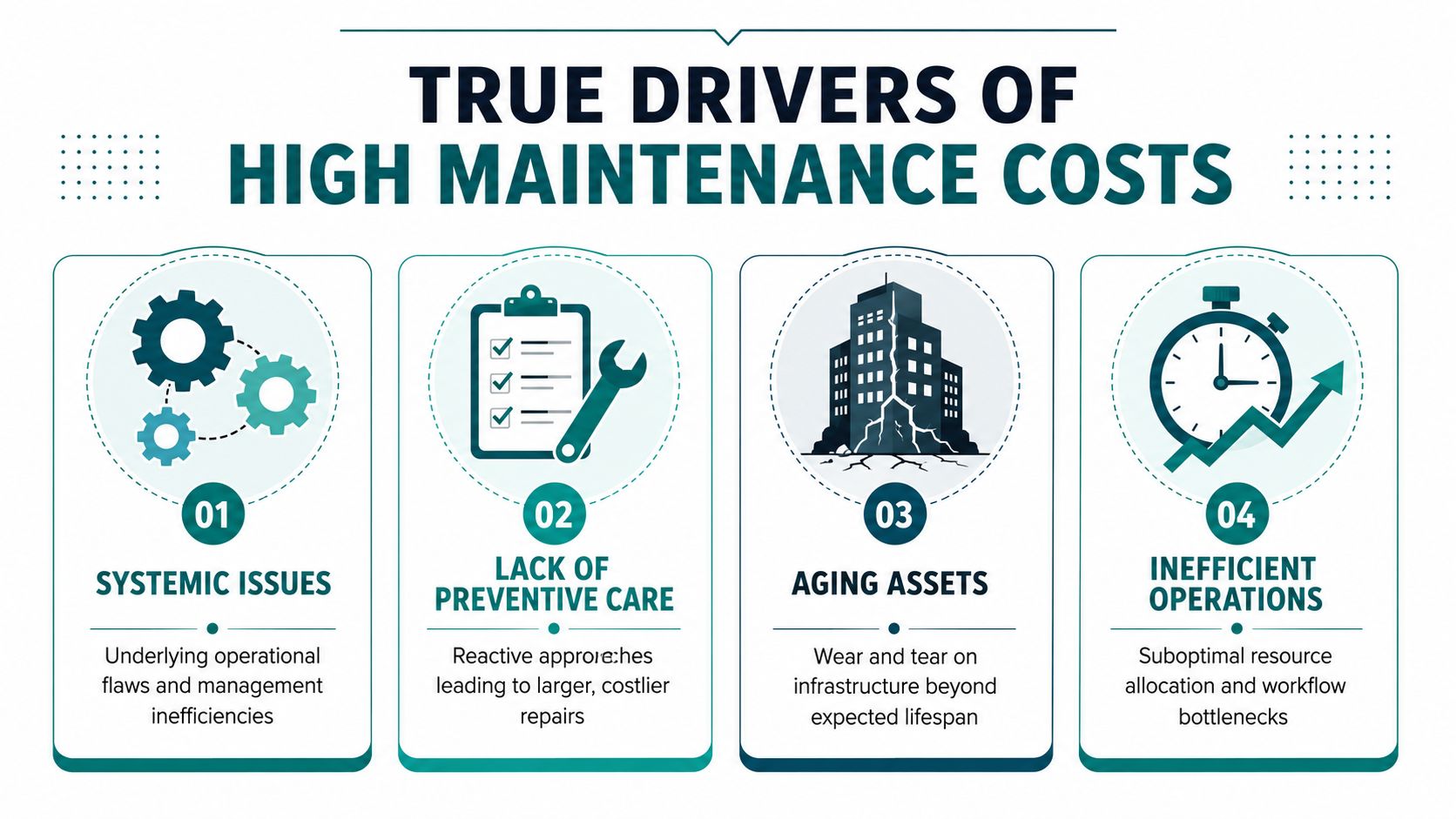
High maintenance costs usually build through routine operating choices, not one catastrophic breakdown. I see the same pattern across estates portfolios: small repairs pushed into next quarter, service intervals left untouched because no one has time to review them, patchy asset records, and visitor guidance treated as a front-of-house issue rather than part of estate performance.
Deferred work becomes a capital problem
Deferred maintenance changes the shape of the bill. Analysis indexed by PubMed Central found that every $1 deferred from maintenance can become about $4 in later capital-renewal cost, which is why backlog control matters to finance, compliance, and service continuity, not just the maintenance team (maintenance cost analysis in PubMed Central).
That pattern is easy to recognise on site. A roof defect turns into water ingress. A noisy bearing becomes a plant outage. An access control fault starts as a minor inconvenience and ends up affecting security procedures, staffing, and visitor flow.
The finance case is straightforward. Deferral is delayed liability, and it often converts a manageable maintenance job into a more expensive renewal project with more internal scrutiny.
Fixed schedules miss risk and waste labour
Time-based maintenance still has a place. Statutory inspections, warranty conditions, and some manufacturer routines need a calendar. The cost problem appears when the calendar becomes the whole strategy.
In that model, teams keep servicing low-risk assets that are performing normally while warning signs on more critical equipment develop between visits. HVAC is a common example. A rigid PM schedule can still leave you paying for emergency call-outs if it is not tied to condition, usage, or failure history. For a practical example of where planned work fits, this guide to preventive commercial HVAC maintenance shows the logic behind routine intervention, but the trade-off in larger estates is deciding which assets need fixed tasks and which ones need closer condition tracking.
That decision affects labour productivity more than many teams expect. Hours disappear into low-value routine work, then the same team is forced into urgent response when a fault develops in the gap between scheduled visits.
Weak information drives expensive decisions
Poor asset data is a cost driver in its own right. If the team cannot see age, condition, warranty status, failure history, or criticality in one place, work gets prioritised by whoever is shouting loudest or whichever system failed most recently.
That creates three familiar problems. Engineers attend with incomplete parts information. Managers approve repeat repairs because replacement history is unclear. Contractors spend time diagnosing issues your own records should already explain.
This is also where estates and operations need to work as one function. Waymap's article on the benefits of facilities management is useful because it frames facilities performance in service terms. That is the right lens for public-facing buildings.
Operational maintenance costs are usually hidden
One of the most undercounted drivers sits outside the plant room. Buildings generate maintenance cost when people cannot use them easily.
Poor wayfinding, outdated static signage, inaccessible routes after layout changes, and repeated visitor confusion all create a maintenance burden, even if it is coded to reception, security, or guest services rather than estates. Staff step in to escort visitors. Complaints increase. Temporary signs get printed, replaced, and contradicted by the next space change. In healthcare, higher education, transport, and leisure venues, that labour loss becomes normal enough to escape challenge.
From an operations director's point of view, that is still maintenance. The environment is failing to perform as intended, and people are compensating for the failure. The true cost sits across labour, compliance exposure, user experience, and interruption to core work.
How to Reduce Costs on Physical Assets and Infrastructure
If you want maintenance cost reduction to stick, start with the maintenance philosophy behind the work. Most estates teams operate across all three models below, but one of them usually dominates the spend.
Reactive, preventive, and predictive are not equal
Imagine it as running a fleet car.
If you only act when the engine fails on the motorway, that's reactive maintenance. If you service it at set intervals, that's preventive maintenance. If you monitor warning signs and intervene when data shows deterioration, that's predictive maintenance.
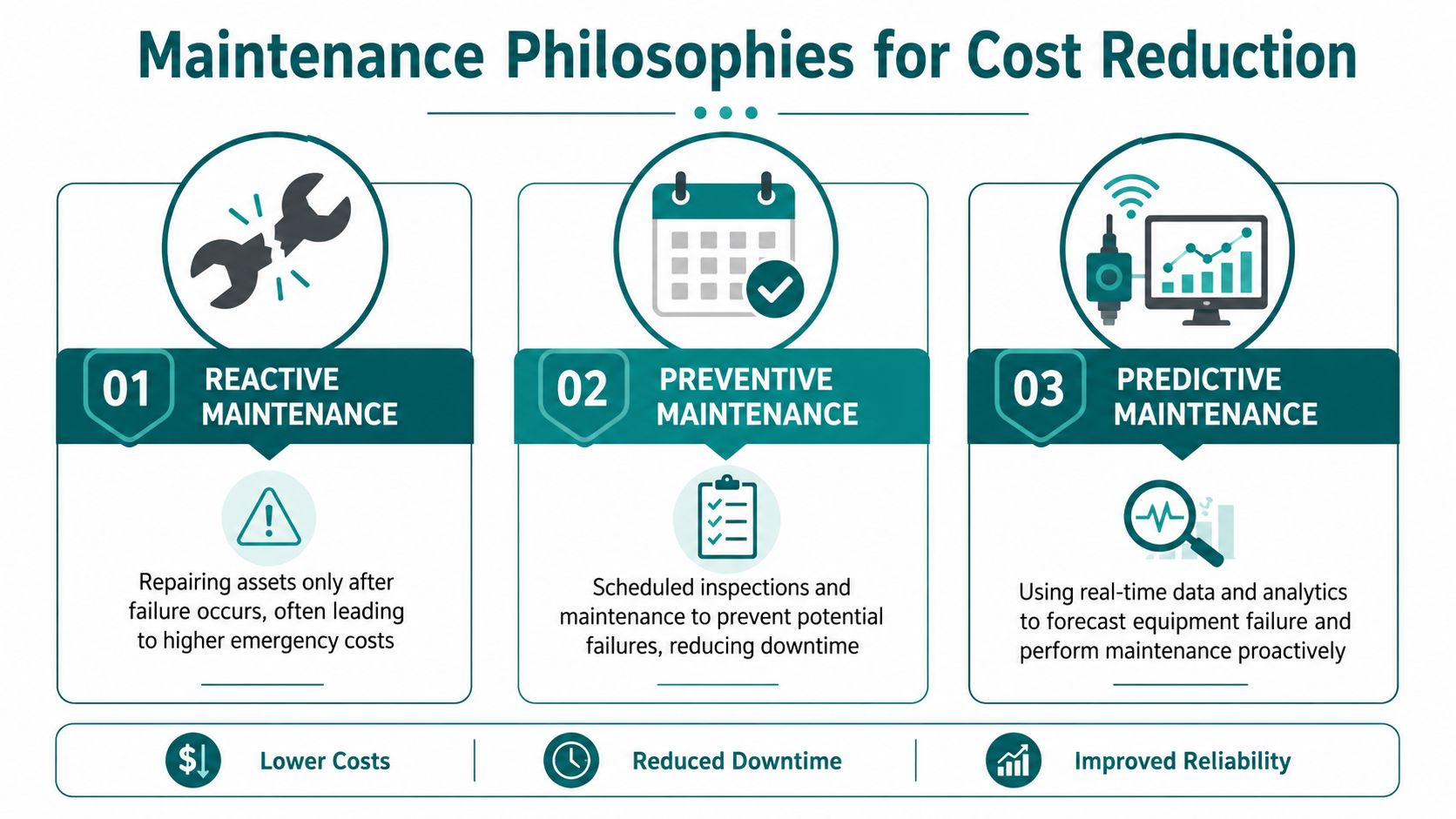
The economics are clear. Industry research summarised by Oxmaint shows reactive maintenance typically costs 3–5 times more than planned maintenance, while predictive maintenance can reduce maintenance expenditures by 18–25% versus traditional approaches. The same source notes that preventive maintenance can save 12–18% versus reactive approaches (maintenance cost reduction benchmarks from Oxmaint).
Start with critical assets, not the whole estate
A common mistake is trying to modernise everything at once. That creates cost, complexity, and resistance. A better route is to sort assets into criticality bands and begin where failure is most disruptive.
Use questions like these:
- Service continuity: What stops operations if it fails?
- Visitor impact: What creates immediate complaints or safety-managed disruption?
- Access constraints: Which assets are expensive to reach out of hours?
- Failure pattern: Which equipment generates repeat call-outs or chronic temporary fixes?
That tends to bring the same candidates to the top: air handling, lifts, escalators, electrical distribution, pumps, life-safety-adjacent systems, and major front-of-house environmental controls.
Replace blanket PM with a sharper mix
The point isn't to abandon preventive maintenance. It's to stop using it blindly. Good programmes usually combine statutory inspections, sensible PM, and condition-led monitoring on the assets that justify it.
A practical starter model looks like this:
| Asset group | Best first move | Why it helps |
|---|---|---|
| Critical plant | Add condition monitoring | Catches deterioration before costly failures |
| Stable low-risk assets | Review PM intervals | Removes unnecessary labour and parts use |
| Repeat-failure assets | Analyse repair history | Exposes whether the issue is maintenance, usage, or replacement timing |
| Seasonal systems | Align work to demand periods | Avoids peak-time disruption |
If your team needs a concrete example of what planned maintenance discipline looks like in one category, this guide to preventive commercial HVAC maintenance is useful because HVAC is often where avoidable reactive spend becomes highly visible to occupants.
Systems matter too. If the work order flow, asset hierarchy, and compliance data are weak, even a sensible strategy won't hold. That's why many estates teams pair maintenance reform with an integrated workplace management system or equivalent platform that gives finance and operations a shared view of what work is happening, on which assets, and why.
Why Your Biggest Savings Are in Your Visitor Experience
Many venues still separate maintenance from wayfinding. In practice, they're tightly connected. If the route to a clinic, platform, gate, stand, lecture theatre, or restroom is hard to follow, the venue creates extra work every day. Staff step in. Signs get patched, replaced, or added. Temporary layouts require more temporary fixes. The estate absorbs a recurring operating burden.

Physical wayfinding has a maintenance profile of its own
A lot of business cases are still underbuilt. A 2023 UK Department for Transport audit found that rail operators spend an average of £2.4 million annually per major station on sign replacement and beacon battery or maintenance, a cost that is often missed when teams compare physical wayfinding with software-led alternatives.
That matters because signs and beacons don't sit outside the maintenance conversation. They are maintenance. They need updating after refurbishments, tenant changes, service reconfigurations, accessibility upgrades, and event overlays. In high-footfall environments, they also degrade physically faster than many decision-makers assume.
Staff intervention is an operational maintenance cost
When wayfinding is weak, labour fills the gap. Staff at information points, security posts, reception desks, concourses, and entrances spend time correcting the environment's failure to guide people properly. The cost is not only payroll. It's distraction from core tasks, uneven visitor experience, and pressure on frontline teams during peaks.
This is particularly relevant in venues that also carry cleaning and sanitation complexity. Teams already balancing consumables, washroom standards, and cleaning equipment maintenance can't afford avoidable directional demand. For a practical look at that side of operations, this piece on optimizing sanitation equipment upkeep is a useful reminder that support infrastructure accumulates maintenance burden too.
If visitors need a person to do what the built environment should do, the site has created a repeatable operating cost.
Why software changes the economics
A software-led wayfinding layer changes the maintenance profile because updates don't rely on replacing physical assets across the estate. Route logic, destination names, and points of interest can be updated without dispatching teams to change every affected sign or service every installed device.
That's especially valuable in environments with frequent layout shifts, temporary closures, phased works, events, or tenant churn. It also reduces a common friction point for UK operators: capital approval for hardware estates that then need their own maintenance regime.
Later in the evaluation process, teams often want to understand how movement patterns relate to congestion, staffing, and layout decisions. A tool such as a 3-D heat map helps operational teams visualise where guidance and flow issues are likely to be creating avoidable friction.
The difference is easier to see in practice:
The modern view of maintenance has to include the user journey. Plant reliability still matters. So does the cost of helping people recover from a confusing building.
How to Build a Business Case for New Maintenance Strategies
Good ideas don't get approved because they sound sensible. They get approved because the numbers, risks, and operational effects are organised in a form finance and leadership can trust.
Start with the problem in current-state terms
Don't begin with technology. Begin with the cost of the current model.
That means documenting:
- Where emergency work is concentrated
- Which assets or spaces generate repeat intervention
- Which costs are buried in other teams, such as reception, security, or customer service
- Where compliance and accessibility risk are sitting today
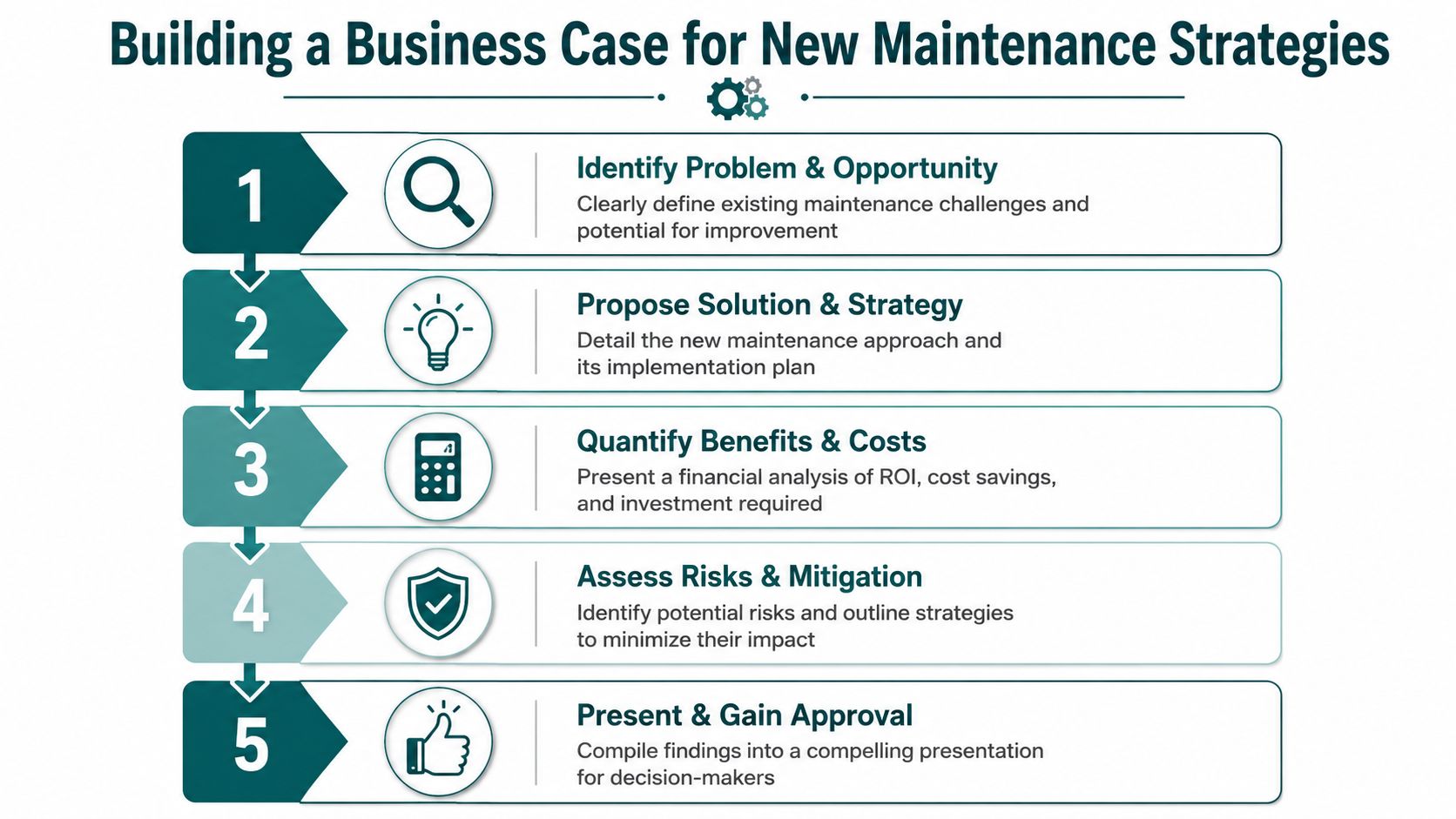
The best business cases usually show a before-state in plain language. Too many emergency call-outs. Too much planned work displaced by urgent work. Too much staff time diverted into navigation support. Too many updates handled physically.
Use KPIs that matter to both estates and finance
A narrow engineering case often stalls because it doesn't connect to organisational outcomes. Use a blended scorecard.
A practical KPI set includes:
| KPI | What it tells decision-makers |
|---|---|
| MTBF | Whether reliability is improving on critical assets |
| MTTR | Whether faults are becoming easier and cheaper to resolve |
| Reactive-to-planned ratio | Whether the operating model is becoming less chaotic |
| Cost per asset or asset group | Where spend is concentrated |
| Staff time reallocated from wayfinding | Whether labour is moving back to core tasks |
| Visitor complaints about navigation | Whether the user experience is improving |
You don't need every KPI on day one. You do need enough to show that the proposal affects cost, service, and compliance.
Anchor the case in proven maintenance economics
When you need external validation, use benchmark evidence sparingly and directly. Research summarised by WISS reports that proactive repairs cost 4–5 times less than emergency repairs on the same asset, that predictive maintenance is associated with 18–25% lower maintenance expenditure, and that organisations implementing predictive maintenance report positive ROI in 95% of cases, with full payback within 12 months in 27% of cases (predictive maintenance ROI benchmarks from WISS).
That supports a straightforward approval argument:
- Current state is expensive because emergency work dominates key costs
- The proposed model shifts work earlier and lowers disruption
- The benefit is not only engineering efficiency but service continuity
For public-facing venues, it also helps to connect maintenance strategy to commercial or experience metrics. In retail and mixed-use environments, articles on footfall in retail can help frame why navigation, congestion, and visitor flow belong inside the operating case rather than sitting in a separate customer-experience silo.
Finance signs off faster when the proposal reads like risk reduction with measurable operating gains, not a wishlist of tools.
Real-World Examples of Maintenance Cost Reduction in the UK
The strongest examples usually combine a familiar estates problem with a visible operating outcome. One is technical. The other is human.
Escalators, HVAC, and lift portfolios
Across UK estates, a common success pattern looks like this: a team stops treating major assets as a flat list and starts classifying them by operational consequence. Critical equipment gets tighter attention, repeat offenders get root-cause review, and low-risk assets stop receiving excessive routine work.
That kind of reset doesn't need a dramatic reorganisation to work. It needs better prioritisation, cleaner work-order discipline, and a willingness to stop measuring success by how quickly teams respond to failure. The better measure is how few expensive surprises the site now creates.
Wayfinding, compliance, and frontline labour
The second example is easier to miss because it sits outside the plant room. The Equality and Human Rights Commission reported in 2024 that 40% of large UK venues fail to meet accessibility standards due to inadequate wayfinding, leading to an average annual staff intervention cost of £180,000 for venues with high visitor volumes.
That has direct implications for hospitals, transport hubs, stadiums, and cultural venues. In those environments, inaccessible or inconsistent wayfinding doesn't only create frustration. It creates repeat labour demand and increases compliance exposure under the Equality Act 2010, alongside guidance such as BS 8300, PAS 78, and BS EN 17210.
A named example worth reviewing is Lord's Cricket Ground wayfinding deployment. It shows why large venues are rethinking navigation as an operational system rather than a fixed collection of signs. The lesson isn't confined to sport. Any complex venue with changing routes, varied visitor needs, and heavy event-day pressure faces the same management problem.
The practical test is simple. Can the venue guide people accurately when layouts change, footfall peaks, and not every visitor sees or processes signage the same way?
That's where maintenance cost reduction becomes broader than classic asset care. The cheaper building to run is usually the one that not only fails less, but also asks less of visitors and staff.
Frequently Asked Questions
What is the fastest route to maintenance cost reduction?
The fastest route is usually reducing reactive work on critical assets first. Start where failures trigger call-outs, disruption, and overtime, then tighten planned work and condition checks around those assets.
Does predictive maintenance always need a large capital project?
No. It doesn't have to start as a large capital programme. Many teams begin with a small set of critical assets, prove the operating case, and expand once the savings and workflow changes are visible.
How does wayfinding affect maintenance cost reduction?
Wayfinding affects maintenance cost reduction because poor navigation creates repeat operational work. Staff spend time giving directions, signs need constant updating, and inaccessible routes increase complaints and compliance pressure.
What should a maintenance business case include?
A maintenance business case should include current-state costs, affected assets or spaces, operational impact, compliance implications, implementation requirements, and a KPI set that finance can track after approval.
Which UK standards matter when maintenance changes affect accessibility?
The key anchor is the Equality Act 2010, supported by standards and guidance such as BS 8300, PAS 78, and BS EN 17210. If the environment is challenging to access, accessibility risk sits alongside the operating cost.
If you're reviewing how to cut maintenance costs without pushing more burden onto staff or visitors, Waymap is worth a closer look. Our precision navigation platform works indoors, outdoors, and underground without GPS, Wi-Fi, or installed hardware, helping venues replace high-maintenance physical wayfinding with a software layer that supports accessibility, reduces operational friction, and is easier to keep accurate as spaces change.
