
Hazard Awareness: A Guide for Modern Venues and Transit
Primary keyword: hazard awareness
Semantic variants: dynamic hazard awareness, real-time hazard information, venue safety, accessibility wayfinding, hazard communication
Meta description: Hazard awareness now demands real-time, accessible communication for venues and transit. Learn where static systems fail, how to build a stronger programme, and what operators need to measure.
By Tom Pey, Founder at Waymap and blind accessibility technologist.
Someone in the UK is killed or seriously injured on the roads every 17 minutes, according to Brake's UK road safety knowledge centre. That figure isn't a venue metric, but it captures the core truth about hazard awareness. Risk changes fast, people miss cues, and static information often arrives too late.
For operators of stations, shopping centres, hospitals, campuses, stadiums, and civic buildings, hazard awareness isn't a poster, an induction slide, or a once-a-year review. It's the practical ability to recognise risk, communicate it clearly, and adapt guidance when conditions change. If the environment is dynamic, hazard awareness has to be dynamic too.
Why Is Hazard Awareness a Critical Priority in 2026
In Great Britain, 680,000 workers sustained non-fatal injuries in 2024/25, with costs from workplace injury and work-related ill health running into the tens of billions, according to UK workplace injury figures. For venue operators, that is a warning sign. Harm is expensive long before it becomes catastrophic.
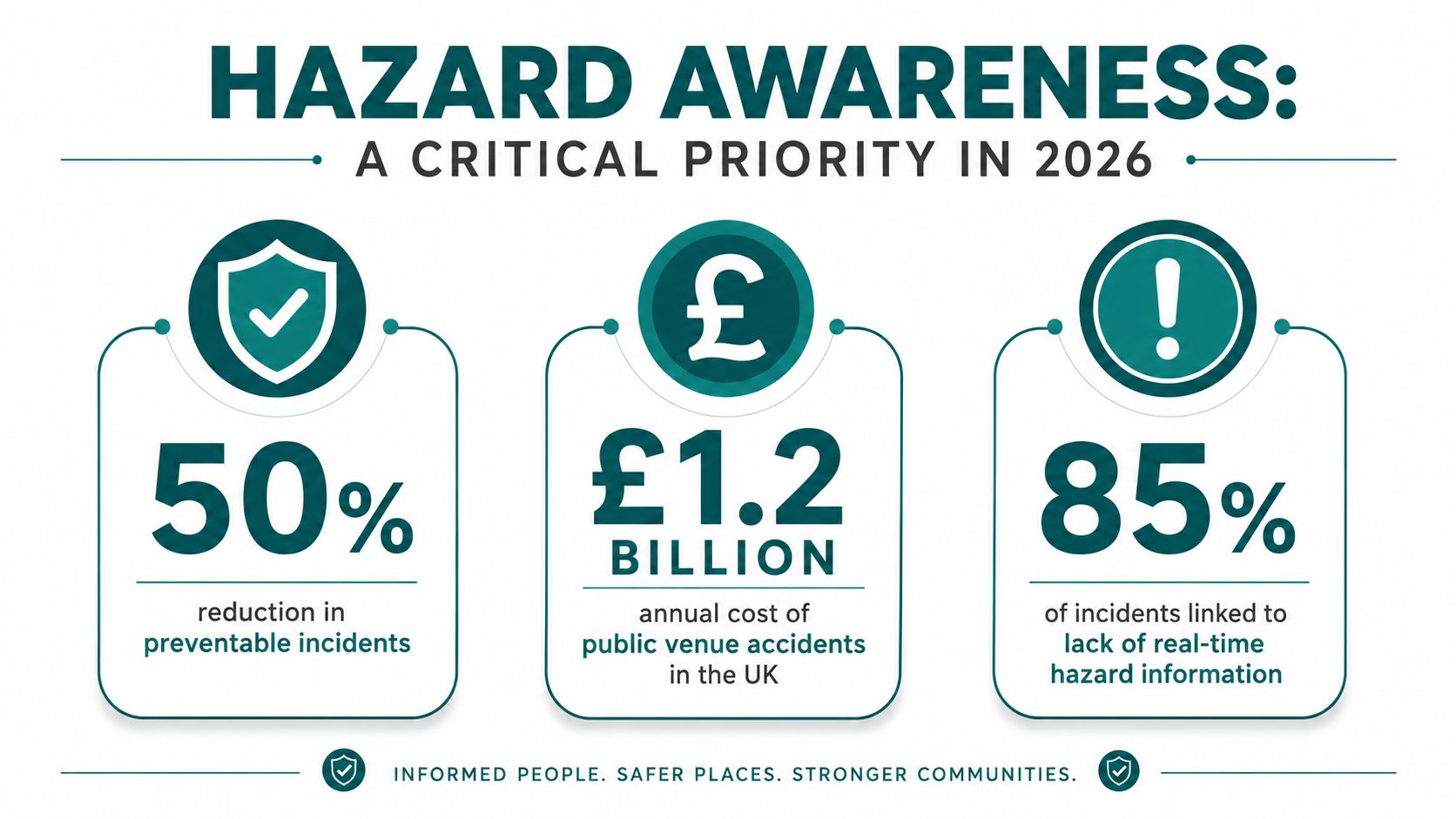
Public venues feel this pressure early. A spill near a station gate, a diverted route in a hospital, a lift outage in a shopping centre, or cleaning equipment left in a concourse may never appear in the news, but each one creates friction, delay, complaints, and avoidable exposure. In operations, the pattern is familiar. Minor incidents consume supervisor time, interrupt flows, trigger customer assistance requests, and weaken confidence in the venue's control of its own space.
By 2026, hazard awareness is no longer a fixed-building exercise. Venues change hour by hour. Queue lines move. Contractors close access points. Escalators fail. Lighting conditions shift. Crowd density changes the risk profile of the same corridor within minutes.
Static signs and periodic inspections still have a place. They do not solve the core problem. They cannot keep pace with temporary hazards, and they do very little for people who cannot rely on sight to detect a warning board, a floor cone, or a printed diversion notice. That is why operators need hazard communication that updates with the environment, including accessible real-time information that reaches people while the risk still exists.
This is also a compliance issue in the practical sense, not just the legal one. Duties under the Equality Act 2010 apply when routes change, not only when buildings are designed. If a safe path becomes unsafe at 11:15 a.m., the venue needs a way to communicate that change immediately and in formats non-visual users can effectively use.
Boards and senior operators usually focus on four outcomes:
- Fewer preventable incidents: Faster warning and clearer guidance reduce exposure before a small problem becomes an injury.
- Better operational control: Teams can respond to live conditions instead of relying on outdated site assumptions.
- Stronger accessibility performance: Hazard information reaches people who do not read static signage or cannot see it.
- Lower hidden cost: Less disruption, fewer complaints, less staff intervention, and less reputational damage.
Strong operators treat hazard awareness as part of live operations. They connect estates, safety, accessibility, and communications around one simple standard. If conditions change, guidance changes too.
That is the shift in 2026. Traditional hazard awareness is obsolete in dynamic public environments. Infrastructure-free technology now offers something static infrastructure never could: current, location-specific, accessible hazard information delivered at the point people need it.
What Are the Most Common Hazards in Large Public Venues
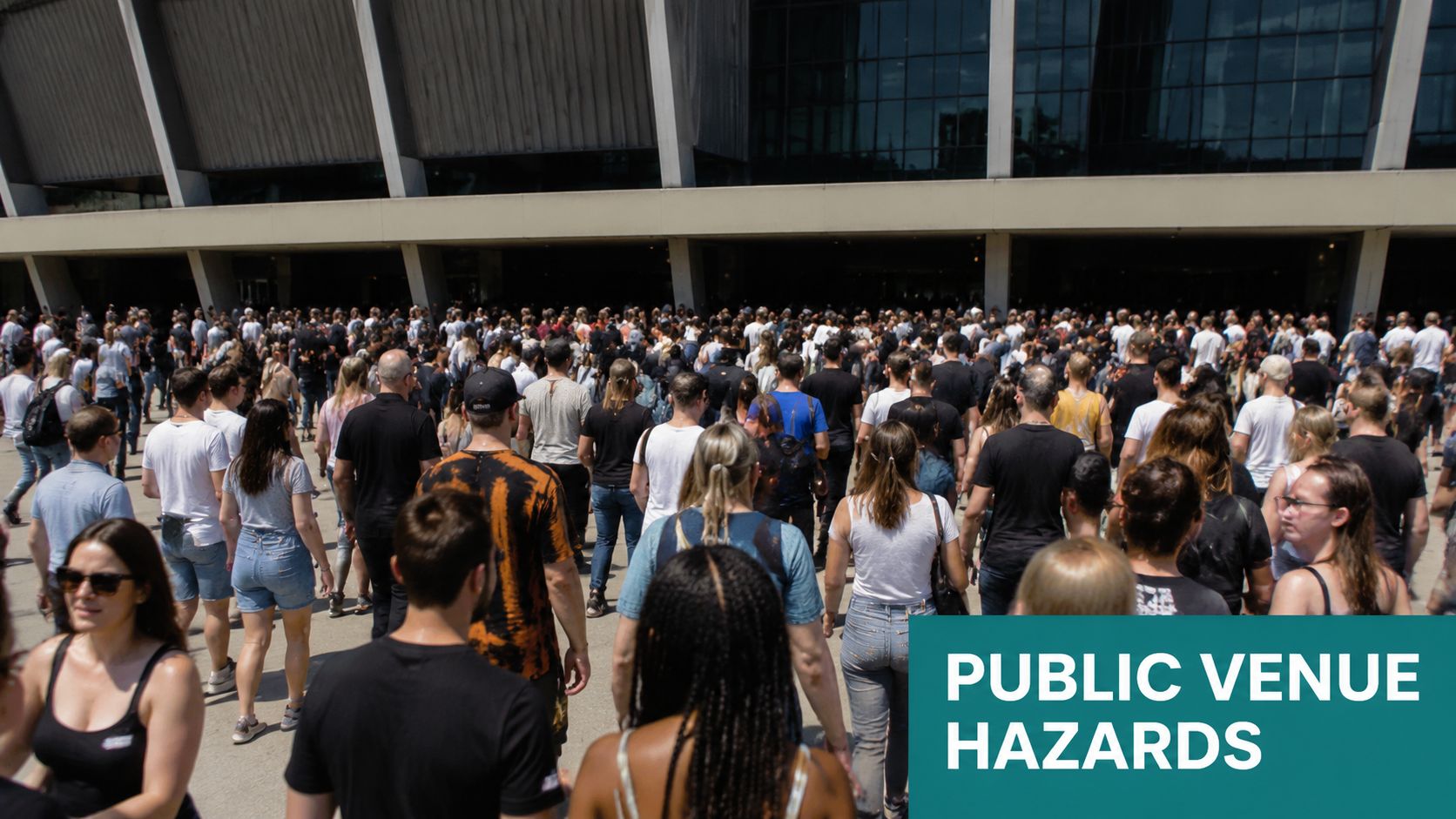
Large venues don't fail on one big hazard. They fail on combinations of small, changing, badly communicated risks. The useful way to manage hazard awareness is to sort hazards by how they behave, not just by how obvious they look.
Physical and environmental hazards
These are the hazards commonly recognised first. They include slips, trips, falls, poor lighting, damaged flooring, blocked walkways, exposed edges, badly placed furniture, and congestion at thresholds or pinch points.
They matter because they're common, but also because they combine easily. A dim corridor plus a temporary trolley plus a diverted route creates a different level of risk than any one condition on its own.
A practical review should look at:
- Walking surfaces: Spills, uneven flooring, loose mats, and threshold changes.
- Vertical movement: Stairs, escalators, platform gaps, and lift outages.
- Visibility conditions: Glare, shadows, poor contrast, and inconsistent lighting.
- Obstacles: Cleaning equipment, bins, delivery cages, and ad hoc queue barriers.
Dynamic and temporary hazards
Many programmes weaken at this stage. A venue may be safe in its designed state but unsafe in its operating state.
Temporary construction, emergency closures, maintenance work, queue changes, delivery activity, pop-up retail, crowd surges, and event-day barriers all alter the user journey. In practice, those are often the hazards that catch visitors out because the official route and the actual route are no longer the same.
Static signs work best when the building behaves as designed. Public venues rarely do.
That's also why emergency planning and assembly guidance need to connect with day-to-day hazard communication. Operators that already think carefully about emergency assembly point planning are usually better prepared to communicate temporary route changes before they become incidents.
Accessibility-specific hazards
Some hazards are only visible if you design from the perspective of disabled users. A broken lift is an inconvenience for some visitors and a complete route failure for others. A low object may be outside a sighted person's normal scan but still present a collision risk. A silent escalator closure can create confusion if no equivalent non-visual cue is provided.
This is also where chemical and cleaning hazards need clearer handling. Under UK COSHH regulations, a substance's Safety Data Sheet must include Section 2 Hazard Identification with standardised GHS pictograms and the signal words “Danger” or “Warning”, and the accuracy of that section drives the first-aid measures in Section 4, as explained in this review of how to read a Safety Data Sheet. For venue operators, that means substance-related hazards aren't just back-of-house paperwork. They affect frontline handling, incident response, and public safety where cleaning or maintenance activity intersects with public space.
How to Build an Effective Hazard Awareness Programme
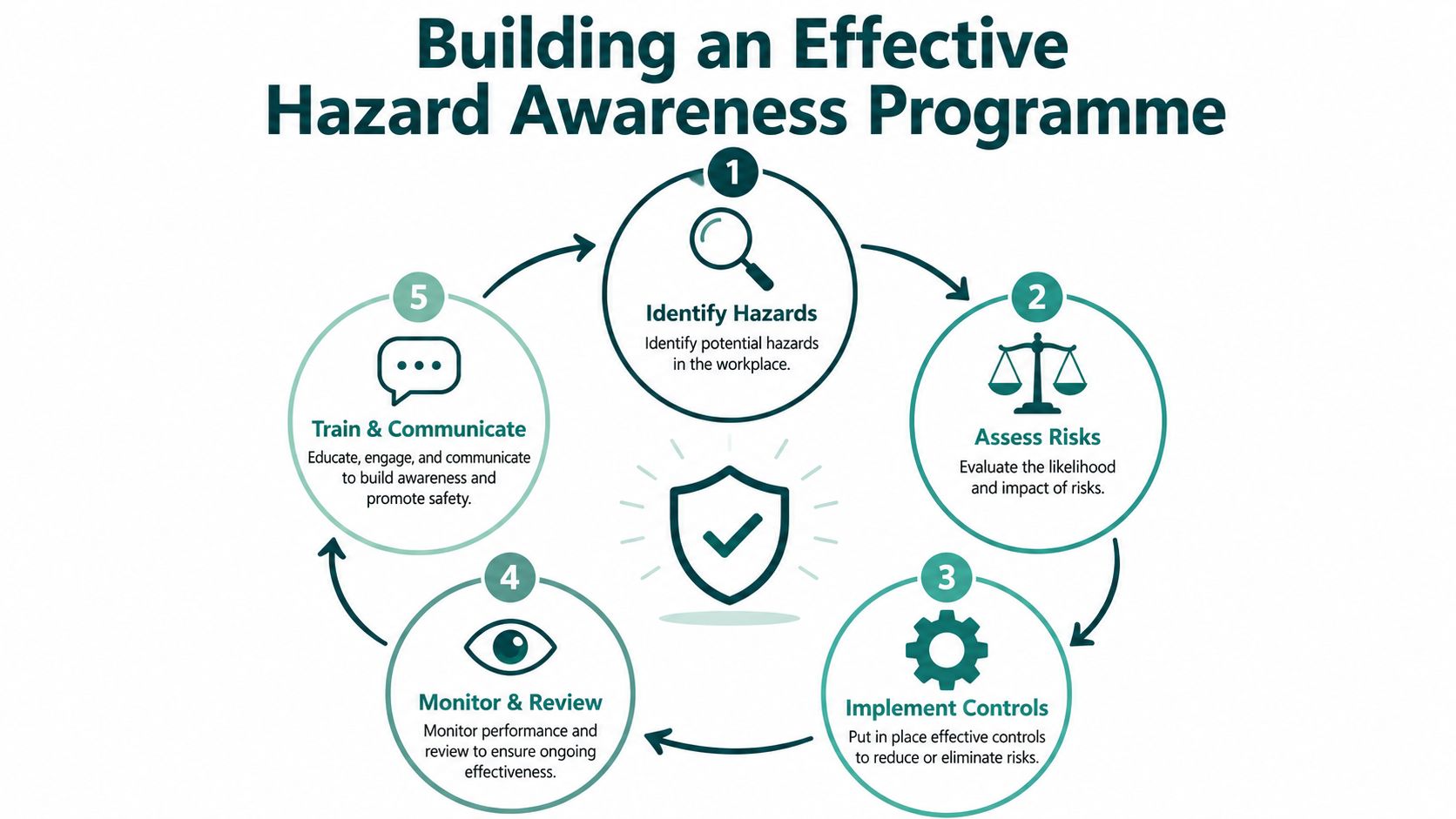
An effective hazard awareness programme doesn't start with signage. It starts with a management habit. Operators need a repeatable cycle that identifies risk early, tests assumptions in live conditions, and keeps communication aligned with what people experience.
Start with route-based risk assessment
Most risk assessments are area-based. That misses how people really move. A better approach is to review the venue as a sequence of journeys.
Ask simple operational questions. What does a first-time visitor do from entrance to destination? Where does a wheelchair user need an alternative route? What happens when a lift is unavailable? Where does a blind visitor lose reliable cues? Standards such as BS 8300 help because they force teams to think in terms of inclusive access, not just nominal compliance.
A practical assessment should include:
- Primary routes: Main entrances, ticket halls, retail circulation, waiting areas, and exits.
- Failure points: Lift outages, escalator closures, crowd build-up zones, temporary barriers.
- User groups: Staff, first-time visitors, disabled users, contractors, and people under time pressure.
- Change triggers: Cleaning windows, maintenance periods, event mode, emergency mode, diversion mode.
Build reporting into operations, not policy
A hazard awareness programme fails when reporting sits outside daily work. Staff need a quick route to raise issues, classify urgency, and confirm that something changed as a result.
In transport, retail, and healthcare estates, the strongest systems connect frontline observation with operational tools. If a team already uses an integrated workplace management system, hazard reporting should feed into that workflow rather than live in a separate spreadsheet or email chain.
A useful reporting model includes:
- Fast frontline input: Staff can flag hazards without leaving the floor for long.
- Clear ownership: Someone is responsible for triage, action, and closeout.
- Visible status: Teams can see whether a hazard is open, mitigated, or resolved.
- Pattern review: Repeated temporary hazards signal a design or process problem.
Train for scenarios, not scripts
Classroom safety training often overstates certainty. Real venues are messy. Staff need to make good decisions when information is incomplete and conditions are changing.
That means scenario-based training. Run through a platform closure during peak flow. Test a hospital route while contractors occupy a corridor. Simulate a stadium egress with a blocked staircase. Review how staff support blind and low-vision visitors when the normal route fails.
Operator test: If your team knows the policy but can't explain the safe alternative route in plain language, the programme isn't ready.
Teams looking for a practical outside checklist can adapt these security and risk assessment steps to complement internal safety and accessibility reviews. The useful part isn't the label. It's the discipline of identifying assets, threats, controls, and response responsibilities in one place.
Replace sign dependence with multi-format communication
One of the biggest mistakes in hazard communication is assuming that static signs are a sufficient default. Recent UK transit data indicates that 68% of wayfinding errors happen in signal-poor underground stations where static signs are insufficient for navigating closures or diversions, as set out in this overview of hazard awareness in changing environments.
That figure should change how operators think. If a venue is complex, underground, crowded, or frequently altered, the communication model has to do more than point. It has to update.
A modern programme should combine:
- Physical cues: Signage, barriers, floor markings, and staff presence.
- Operational alerts: Temporary closure notices, live instructions, and route changes.
- Accessible formats: Audio, plain language, and information that doesn't depend only on vision.
- Feedback loops: Confirmation from users and staff that the revised route works.
The Hidden Gaps in Traditional Hazard Awareness
Traditional hazard awareness assumes a stable environment and a sighted user. That assumption breaks down in exactly the places where safety matters most.
The dynamic hazard problem
A fixed sign is only accurate until the next change. In live operations, that might be minutes. A spill appears. A platform edge route narrows. A contractor closes a corridor. A crowd spills into a secondary circulation space. By the time the next printed notice goes up, the safest route may already be different.
That gap matters because most venues manage risk through layers. Design controls, staff instructions, signs, barriers, cleaning protocols, public announcements. When one layer goes stale, the others carry more weight. If the communication layer is stale, visitors are left to infer what's safe from partial clues.
Operators often tell themselves that staff presence fills the gap. Sometimes it does. Often it doesn't. Staff are busy, spread thinly, and not always positioned where a visitor first encounters the problem.
The accessibility chasm
The second gap is deeper. It affects people who can't rely on visual cues as their primary safety channel.
An estimated 2.1 million people in the UK live with sight loss, and they face three times as many wayfinding hazards in complex metro systems. The same source notes that 92% of conventional hazard awareness guidance focuses exclusively on visual cues and fails to address non-GPS indoor navigation challenges, according to this discussion of wayfinding risk for blind and low-vision users.
For operators, that isn't a niche issue. It goes directly to the anticipatory duty under the Equality Act 2010. The duty isn't satisfied by waiting for a complaint or helping one person ad hoc. Venues are expected to think ahead about barriers and remove them where reasonably possible.
Compliance fails when a venue says information is available, but the person at risk can't perceive it in the moment it matters.
That's why visual-first hazard awareness is obsolete in complex public environments. It can't claim to be complete if it excludes people who need non-visual guidance, and it can't claim to be current if it can't adjust when infrastructure, access routes, or crowd conditions change.
How Technology Creates Dynamic Hazard Awareness
Temporary hazards are rarely the problem operators fail to identify. The failure point is getting the right warning to the right person quickly enough, in a format they can effectively use. In 2026, that cannot depend on static signs, fixed hardware, or a staff member happening to be nearby.
What works better than static infrastructure
Dynamic hazard awareness starts with a simple operational principle. If conditions change in real time, safety information has to change in real time too.
For large venues and transport interchanges, infrastructure-free guidance delivered through a smartphone is usually the only model that can keep pace without creating a second maintenance problem. Fixed beacons, added signage, and estate-wide hardware can support a narrow use case, but they also bring procurement delays, battery replacement cycles, installation constraints, and ongoing coordination across facilities, IT, accessibility, and operations teams. I have seen projects stall for months because the hardware estate became the project.
A digital approach avoids that trap and gives operators more control over live conditions:
- Live route updates: Closures, diversions, and blocked corridors can be reflected as they happen.
- Non-visual guidance: Audio instructions reach users who cannot rely on signs or screens.
- Lower estate burden: No venue-wide hardware layer needs servicing and replacing.
- Faster operational changes: Teams can update routes, destinations, and hazard information digitally.
The result is broader than accessibility. A system that helps a blind passenger avoid a closure also helps a first-time visitor, an older traveller, or a parent getting a buggy through a disrupted route.
Why sensor-led guidance matters underground and indoors
The venues with the highest hazard complexity are often the least suited to conventional digital wayfinding. GPS drops out indoors and underground. Wi-Fi coverage is inconsistent. Hardware-based positioning adds cost in exactly the places where layouts, works, and passenger flows change most often.
That is why smartphone-native positioning matters. Waymap's sensor fusion algorithm for infrastructure-free indoor positioning uses device sensors and dead reckoning to deliver precise guidance without relying on installed hardware. For operators, the trade-off is clear. Instead of maintaining another physical system across the estate, teams can issue location-aware guidance that continues to function in signal-poor environments and can be updated at operational speed.
Static infrastructure struggles to keep pace. A sign can only say what was true when it was installed. A dynamic system can reflect what is true now.
A live transit environment makes that difference obvious. In a network such as WMATA, platform changes, closures, and diversions are operational facts, not edge cases. Hazard awareness only works if the guidance changes with them.
Here's a closer look at the operating context:
Digital reporting supports better safety decisions
Dynamic hazard awareness is not only about public guidance. It also depends on faster reporting loops inside the operation.
The Health and Safety Executive reports thousands of non-fatal workplace injuries under RIDDOR each year in Great Britain, as shown in its latest work-related injury statistics. Reporting systems still miss part of the picture when staff log issues late, describe them poorly, or rely on fragmented channels. Digital hazard reporting improves that flow by shortening the time between identification, escalation, and action.
For venue operators, the practical choice is straightforward. Static infrastructure is familiar, but it cannot keep up with changing risk, and it does little for people who need non-visual information at the point of use. Infrastructure-free digital guidance is the model that can adapt in real time, support inclusive access, and meet the standard modern compliance now demands.
Measuring the ROI of Your Hazard Awareness Programme
A hazard awareness programme shouldn't be judged only after an incident. Operators need measures that show whether the system is becoming more reliable before harm occurs.
Leading indicators show whether the programme is alive
Leading indicators are operational signals. They tell you whether people are seeing hazards, reporting them, and resolving them quickly.
Useful examples include:
- Near-miss reporting quality: Are staff logging issues early and clearly?
- Resolution speed: How quickly is a temporary hazard mitigated or removed?
- Route update responsiveness: How fast does public guidance reflect a closure or diversion?
- Accessibility feedback: Do disabled users report that instructions are clear and usable?
Teams using digital products should also track behaviour inside the system. Measures such as alert engagement, reroute completion, and repeat use are often more revealing than raw adoption numbers. For product and service teams, these kinds of user retention metrics help show whether people return because the information is reliable.
Lagging indicators still matter
Lagging indicators confirm whether controls worked over time. These include incident patterns, claims experience, complaint themes, disruption costs, and recurring route failures.
A simple measurement table helps:
| Measure type | What to track | Why it matters |
|---|---|---|
| Leading | Near-misses, update speed, hazard closure time | Shows whether teams are acting early |
| Lagging | Incident trends, complaints, recurring closures | Shows whether risk is reducing |
| Accessibility | Disabled user feedback, route confidence, support requests | Shows whether the programme works for everyone |
| ESG and governance | Evidence of inclusive access practice and reporting discipline | Supports board-level accountability |
The strongest ROI cases combine safety, operations, and accessibility. If a programme reduces confusion, improves route reliability, strengthens inclusive access, and lowers the operational drag of temporary hazards, it's doing more than compliance work. It's improving how the venue runs.
What Operators Need to Know About Hazard Awareness
What is hazard awareness in a large venue
Hazard awareness is the practical ability to identify, communicate, and respond to risks that affect people moving through a space. In a large venue, that includes fixed hazards, temporary hazards, and accessibility barriers.
What's the difference between risk assessment and hazard awareness
Risk assessment is the formal process of identifying and evaluating risk. Hazard awareness is the day-to-day operational discipline of noticing hazards, communicating them clearly, and adjusting behaviour or routes when conditions change.
Why doesn't static signage solve hazard awareness
Static signage only works when the route and the risk stay stable. Large public venues rarely stay stable, especially during closures, maintenance, crowd pressure, or emergency changes.
Why does hazard awareness need to be accessible
Hazard awareness needs to be accessible because safety information that only some people can perceive is incomplete. If guidance depends only on vision, it leaves blind and low-vision users at disproportionate risk and weakens compliance with the Equality Act 2010.
How does dynamic hazard awareness support ESG goals
Dynamic hazard awareness supports ESG goals by showing that an operator manages safety, inclusion, and governance in a measurable way. It demonstrates that accessibility is built into operations rather than treated as a separate policy statement.
What should operators improve first
Start with live route communication, accessible information formats, and a reporting process that connects frontline observations to operational action. Those three changes usually expose the biggest gaps fastest.
Waymap helps operators turn hazard awareness into live, accessible navigation across stations, hospitals, campuses, retail destinations, and other complex venues. If you need a practical route beyond static signage and hardware-heavy wayfinding, see how Waymap supports precise indoor, outdoor, and underground guidance for real-world operations.
