
Emergency Assembly Point: A Planner's Guide for 2026
Meta description: Emergency assembly point planning for UK venues. Learn how to choose a compliant location, design for accessibility, improve signage, and strengthen evacuation planning.
If you're responsible for a stadium, shopping centre, campus, station, theatre, or hospital site, you've probably inherited an emergency plan that looks tidy on paper. The map is marked. The sign is in place. The fire wardens know the route. The problem appears solved until you ask a harder question.
Can every person on your site reach the emergency assembly point quickly, safely, and with enough clarity to avoid hesitation?
At Waymap, we work with venues that are under pressure from several directions at once. They need to meet fire safety duties, avoid obstructing operations, support disabled visitors and staff, and make decisions that won't trigger another long maintenance burden. An emergency assembly point isn't just a post with a green sign. It's a live operational decision that affects safety, accessibility, crowd movement, and trust.
Why Your Static Assembly Point Is No Longer Enough
A static sign works when the situation is simple. Many venues aren't simple.
A weekday office block might have regular staff who know the site well. A large public venue doesn't. It has first-time visitors, contractors, agency staff, school groups, people who don't read English confidently, people who are stressed, and people who need step-free or lower-sensory routes. In that environment, a single fixed instruction can break down fast.
The old assumption is that compliance ends once the assembly area has been nominated and marked. In practice, that's only the starting point. A venue also has to consider whether that point remains usable when exits are crowded, whether the route is understandable under stress, and whether people with different access needs receive equivalent guidance.
Operational reality: A compliant point that people can't find, can't access, or can't use without assistance is still a weak evacuation outcome.
This matters under both fire safety and accessibility duties. The built environment has to work for the people who use it, not the average person imagined in a diagram. That's why assembly planning sits alongside broader obligations around inclusive design, route legibility, and safe movement through public space. Our thinking on this is closely related to the wider compliance picture covered in building code compliance guidance.
Where static planning fails in real venues
The failure points are usually practical, not theoretical:
- Unfamiliar users lose confidence: Visitors often stop at decision points, especially where a concourse, plaza, or external forecourt opens into several possible directions.
- Crowds split unintentionally: People follow whoever looks certain, even when that person is wrong.
- Access needs get treated too late: If a route only works for people who can move quickly, hear alarms clearly, and interpret signage instantly, it isn't universally effective.
- Threat types differ: Fire evacuation is not the only emergency scenario a venue plans for.
The last point is often ignored. The term assembly point gets treated as universal, but emergency response isn't universal. In some UK contexts, including active assailant scenarios or certain industrial hazards, standard assembly behaviour may be unsafe. The terminology also matters inside the building. A refuge point is not the same as an assembly point, and treating them as interchangeable creates risk.
A venue that relies only on fixed signs and a standard script is planning for an ideal evacuation. Real evacuations are messier than that.
How to Select a Compliant Emergency Assembly Point Location
Choosing the location is the decision that shapes everything else. If the point is wrong, no amount of signage or drill discipline will fully correct it.
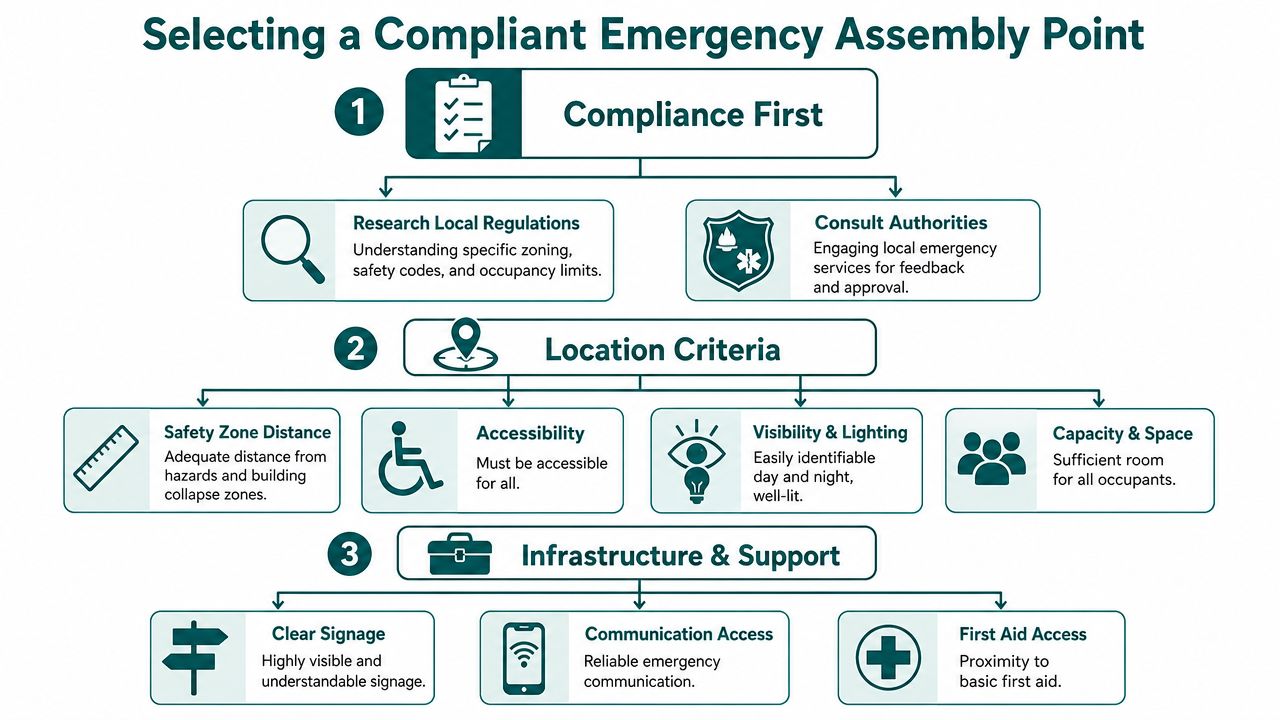
Start with the essential requirements. In the UK, emergency assembly points should sit outside the collapse and debris zone. A widely adopted benchmark used by UK fire safety authorities is at least 1.5 times the building height. For a 20-metre building, that means a minimum 30 metres from the structure, as explained in this assembly point guidance.
Start with distance, then remove bad options
Distance is the first filter, not the final answer. Once you've drawn the safe perimeter, eliminate areas that create obvious operational conflicts.
An assembly area shouldn't dump people into service traffic, loading bays, plant access, or a route that responding crews need to keep clear. It also shouldn't place evacuees beside obvious hazards such as substations, fuel stores, or delivery movements. Public venues often default to the nearest open space, but the nearest open space is often the busiest one.
A practical selection method looks like this:
- Mark the minimum standoff distance: Use building height first, then test whether the resulting area is protected from falling debris and radiated heat.
- Check emergency access lines: Leave room for fire and rescue service operations. If appliances or responders need the same space, it isn't your assembly point.
- Remove secondary hazards: Reject areas beside vehicle conflict points, service compounds, or anything that could worsen the incident.
- Test the route, not just the destination: A good destination reached by a poor route will still fail under pressure.
- Nominate a fallback location: One point is rarely enough for a complex venue.
What works and what doesn't
A good emergency assembly point tends to share a few features:
| Selection factor | What works | What doesn't |
|---|---|---|
| Safe separation | Outside the collapse and heat zone | Close enough to feel convenient |
| Access | Step-free and easy to approach from main exits | Kerbs, pinch points, uneven surfacing |
| Visibility | Open sightlines and clear landmarking | Hidden corners or visually noisy plazas |
| Operations | Away from rescue access and service movements | Areas used by deliveries or vehicle marshalling |
A defensible location is one you can justify to operations, fire wardens, access leads, and emergency services without rewriting the rationale for each audience.
Document primary and secondary points
Large sites should document both a primary and a secondary emergency assembly point location. The secondary point isn't there to pad the plan. It's there because gates get locked, worksites move, weather changes conditions, and one side of a venue may become unusable.
For multi-occupied estates, documentation matters as much as placement. Site maps, tenant packs, contractor inductions, and steward briefings should all point to the same designated areas. If one team calls a plaza the muster point, another calls it a refuge point, and a third uses an outdated map, confusion will show up at the worst time.
Calculating Capacity and Ensuring True Accessibility
The failure point is often not the route out of the building. It is the last 30 metres, when several exit streams converge on one outdoor space and the site loses order.
That is why assembly point planning has to cover more than code compliance. Venue teams need enough space to receive people, account for them, brief them, and hold them safely for as long as the incident requires. Under the UK fire safety framework, the responsible person must assess whether evacuation arrangements work for the people who use the premises, including disabled occupants and visitors. The Health and Safety Executive summary of fire safety law is a useful starting point, but the practical test is simple. Can this area function under pressure, in bad weather, with a mixed crowd, and with partial staff coverage?
Capacity is about flow, dwell time, and control
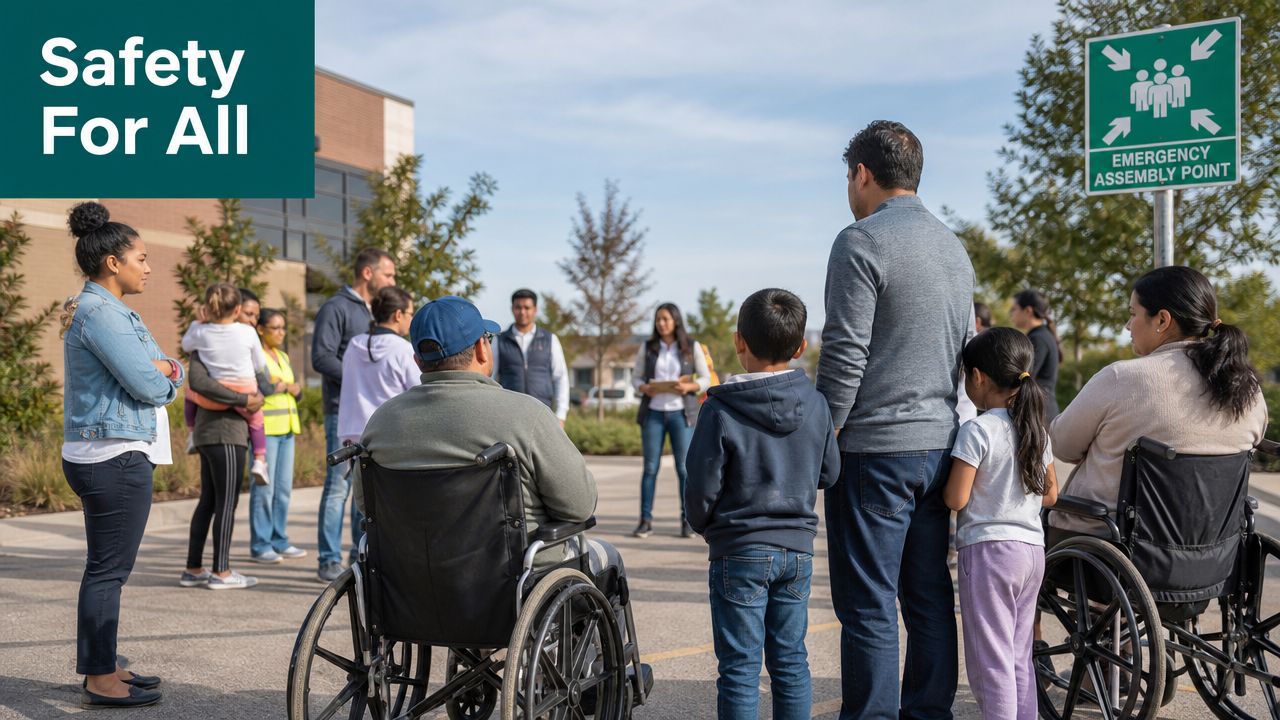
Headcount matters, but standing room on a site plan is a poor measure on its own. I assess assembly capacity by asking four operational questions:
- Can people arrive without conflict? Crossing flows, tight gate lines, and sharp turns slow movement and increase stress.
- Can they wait there safely? The space needs room for wheelchair users, people with mobility aids, pushchairs, assistance animals, and those who cannot stand for long.
- Can staff manage the group? Fire wardens, stewards, and supervisors need clear sightlines and enough space to count, brief, and redirect people.
- Can the area stay clear of other hazards? Overflow into roads, service yards, cycle routes, or adjacent occupiers creates a second incident.
Static planning often falls short in large venues. A plaza that works on a quiet weekday may fail during an event overlay, a market day, or a maintenance closure. Digital movement reviews can help identify those pinch points before a drill exposes them in real time. For large sites reviewing route stress and arrival bottlenecks, tools such as a 3D heat map for movement analysis can support better planning before the next drill exposes the problem live.
Refuge points and assembly points serve different functions
Teams still confuse these terms, and the consequences are serious.
A refuge point is a temporary protected space inside the building for people who cannot complete evacuation immediately. An assembly point is the external location where evacuees gather after leaving the building. The two locations need different signage, different procedures, and different staff actions. Guidance from the UK Fire Safety Advice Centre on refuge points explains that refuges form part of an evacuation strategy for disabled people and must not be treated as the final destination.
Rule for operations teams: If people are waiting for assisted evacuation, they are in a refuge. If they have left the building and are being accounted for, they are at an assembly point.
That distinction affects Personal Emergency Evacuation Plans, radio calls, accountability checks, and rescue expectations. It also prevents a common failure in mixed-use venues, where one team uses outdated terminology and another team acts on it.
Accessibility has to work in practice
Accessible assembly planning is not limited to dropped kerbs and minimum widths. It includes how people understand the route, how they tolerate the environment, and how long they may need to remain there.
A workable assembly point should account for:
- Step-free primary routes: Not a secondary workaround. The main route needs to work for everyone expected to use it.
- Firm, even surfaces: Grass can be acceptable in some conditions, but not if it becomes soft, slippery, or inaccessible after rain.
- Clear landmarking: People with low vision, cognitive impairments, or limited familiarity with the site need consistent cues to confirm they have arrived.
- Low-conflict waiting areas: Some occupants need a little more space, less noise, seating nearby, or closer staff support.
- Simple instructions: Staff should be able to direct people quickly without relying on complex language or local shorthand.
Modern wayfinding presents a key source of operational value. Static signs still do their job, but they cannot adapt when barriers move, surfaces degrade, or a step-free route is temporarily blocked. Infrastructure-free digital wayfinding gives venue managers a way to support accessible routing without adding another layer of fixed hardware to maintain. For estates balancing compliance, budget pressure, and constant change, that is a practical advantage, not a technology extra.
Effective Signage and Multilingual Communication Strategies
Physical signage remains the backbone of emergency wayfinding. It gives people a shared visual language and a fixed point of reference when staff aren't immediately beside them.
In the UK, fire exit signs must comply with British Standard 5499, using green signs with white pictograms such as the running man and arrow, and they should be placed so the next sign is visible from the last. That line-of-sight principle is set out in Cardinus guidance on UK fire escape regulations.
What static signage does well
Static signs are reliable in a narrow sense. They don't depend on battery life, mobile coverage, or a control room update. In a familiar building with predictable routes, that matters.
They are particularly strong at:
- Marking direction of travel
- Reinforcing final exits
- Creating consistency across an estate
- Supporting routine drills and inductions
For compliance, there is no shortcut around them. If the physical environment needs a sign, it needs a sign.
Where signs reach their limit
Large venues rarely operate under ideal conditions. Routes change because of maintenance works, queue systems, event overlays, deliveries, crowd control barriers, or temporary closures. Static signs don't adapt.
They also don't solve for language, confidence, or context. A visitor may recognise the running man symbol and still be unsure which external area is the correct emergency assembly point once they leave the building. On campuses, transport interchanges, and shopping centres, the outside environment is often the least legible part of the journey.
A simple comparison shows the gap:
| Method | Strength | Limitation |
|---|---|---|
| Static signage | Always present and compliance-friendly | Can't respond to changing conditions |
| Staff direction | Reassuring and situational | Depends on staff availability and training |
| Digital messaging | Flexible and updateable | Needs governance and content discipline |
Signs are essential. On their own, they aren't enough for multilingual, high-footfall, fast-changing venues.
Communication has to work for more than one audience
A good communication plan recognises that people absorb instruction differently. Some want a pictogram. Some need plain language. Some need spoken guidance. Some need reassurance in their first language.
That's where multilingual support becomes part of safety, not just customer service. Venue operators thinking about this gap should look closely at how multi-language support in digital wayfinding can complement, rather than replace, compliant physical signage.
The Role of Digital Wayfinding in Modern Evacuations
The biggest weakness in most evacuation plans is the assumption that once people leave the building, they will naturally know where to go next. In a complex venue, they often don't.
Digital wayfinding significantly impacts the quality of the response. Instead of relying only on fixed signs and verbal direction, a venue can provide turn-by-turn guidance to a designated emergency assembly point through a user's own smartphone. That matters most in places where the route crosses plazas, concourses, campuses, external circulation areas, or transport interchanges that are easy to misread under pressure.

Why infrastructure-free navigation fits emergency planning
For venue managers, the critical question isn't whether digital guidance is useful. It is. The harder question is whether it adds another estate burden.
Infrastructure-heavy systems often fail that test. Beacons need installing, checking, replacing, and maintaining. Wi-Fi-dependent solutions can be unreliable indoors or in congested conditions. Capital approval for additional hardware is slow in public-sector estates and difficult to justify when budgets are already committed to core life-safety systems.
Waymap was built differently. Our platform uses dead reckoning from device-native smartphone sensors to provide sub-3-metre accuracy in infrastructure-free environments, without relying on GPS, Wi-Fi, or installed beacons. That matters in stations, hospitals, shopping centres, and campuses where signal conditions vary and layouts change.
Why that matters to operators
For an NHS estates manager, a rail operator, or a retail landlord, the friction is rarely conceptual. It's operational.
They ask sensible questions:
- Who will maintain this?
- Does it require new hardware?
- What happens when layouts change?
- Can we update routes without another installation cycle?
- Will it help disabled visitors as well as the general public?
Infrastructure-free digital wayfinding answers those questions more cleanly than beacon-based alternatives. It reduces dependency on installed hardware across high-footfall environments where maintenance access is expensive and change is constant. That is often the difference between a promising idea and a deployable one.
Planning benefits beyond the individual route
Digital wayfinding is also useful before an evacuation ever happens. Operators can test route logic, compare route options, and align digital instructions with incident plans and stewarding strategy. For teams building that wider picture, situational awareness maps are a useful companion resource because they help emergency planning teams visualise incidents, assets, and operational geography in one place.
A strong evacuation model increasingly combines several layers:
- Compliant fixed signage for universal baseline instruction
- Staff and warden procedures for control and reassurance
- Digital route guidance for precision and accessibility
- Operational mapping tools for planning and response coordination
The aim isn't to digitise the whole emergency plan for its own sake. The aim is to remove the moments where uncertainty causes delay.
Real deployments matter more than abstract claims
Waymap's work with WMATA is relevant because transit environments expose the hardest navigation problems. They are busy, multilayered, and often signal-poor. A platform that can guide users accurately in that context is solving a genuine operational challenge, not a lab exercise.
For venue teams assessing the user experience side of this, our wayfinding app overview shows how a smartphone-based guidance layer can support navigation to precise destinations without adding physical infrastructure across the estate.
Drills, Maintenance, and Continuous Improvement
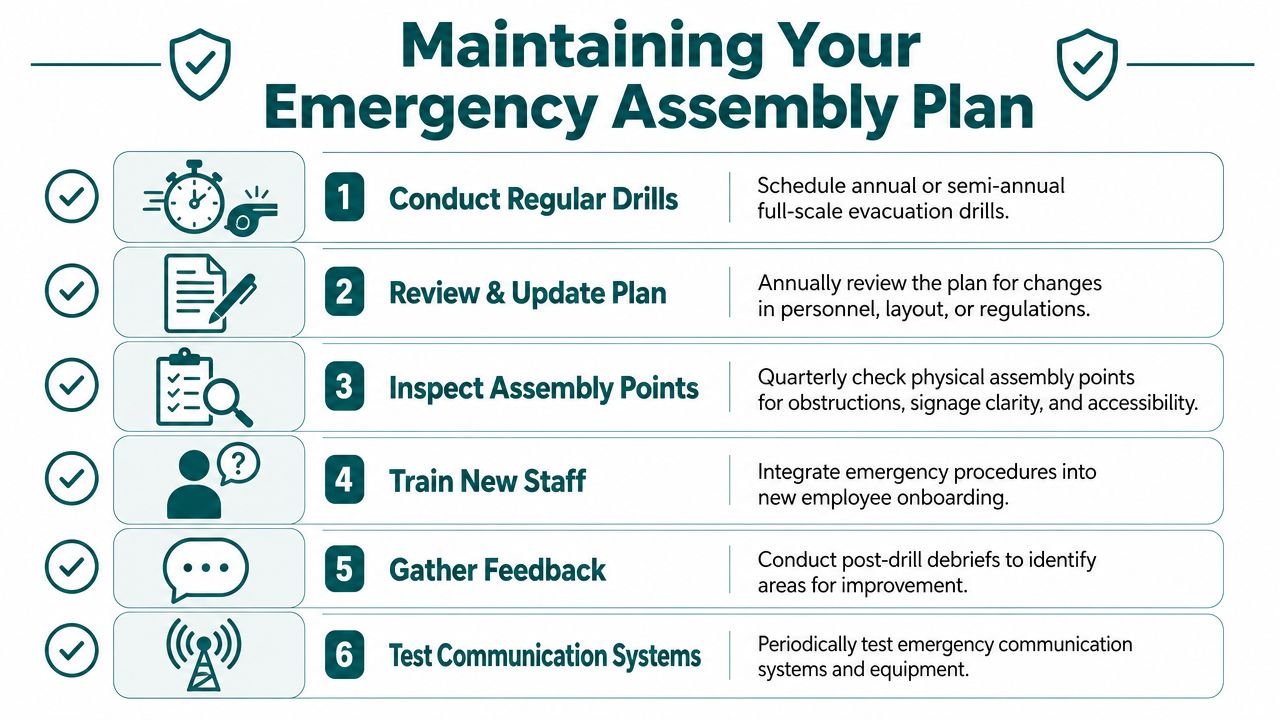
An emergency assembly point plan degrades if nobody checks it. Landscaping changes. Temporary works become semi-permanent. Deliveries encroach on open space. A sign fades into the background. The route still looks fine on the PDF.
Regular review keeps the plan usable. UK fire safety guidance also notes that assembly points should be at least 50 feet away from the building to protect people from radiated heat, falling debris, and collapse risk while avoiding interference with fire and rescue operations, as set out in this fire emergency evacuation plan guidance.
What to inspect between drills
The best review routines are short, repeatable, and owned by named people. They don't need to be complicated to be effective.
A practical maintenance checklist should include:
- Route condition: Check for barriers, surface defects, temporary fencing, or changed pedestrian flows.
- Assembly area usability: Confirm the space is still clear, legible, and not being repurposed informally.
- Signage visibility: Make sure signs are clean, visible, and not obscured by seasonal planting, event kit, or contractor materials.
- Access quality: Verify that the primary route still works for people with mobility impairments and other access needs.
- Lighting and arrival cues: Test whether people can identify the area in poor weather or lower light.
Make drills produce better data
A drill shouldn't only measure how fast people moved. It should reveal where the plan loses clarity.
After each exercise, gather structured feedback from fire wardens, security, front-of-house teams, access leads, and participants. Ask where people paused, where they asked for help, whether they reached the correct emergency assembly point, and whether any group was disadvantaged by the route or holding area.
Useful debrief prompts include:
- Where did people hesitate
- Which exit-to-assembly route was least clear
- Did any instruction conflict with the physical environment
- Were refuge arrangements and assembly arrangements understood correctly
- Did anyone need support that the plan hadn't anticipated
"The most valuable drill feedback usually comes from the point where a participant says, 'I wasn't sure where to go next.'"
Keep the plan live
Venues change constantly. New kiosks appear, queue barriers move, entrances close, and public realm projects alter external circulation. Your emergency assembly point plan has to keep pace.
That is one reason many operators are interested in tools that lower the burden of route changes and estate updates. For teams under pressure to avoid repeated hardware interventions, maintenance cost reduction in navigation systems is not a side issue. It's part of whether the safety plan remains maintainable over time.
Frequently Asked Questions About Assembly Points
What is an emergency assembly point
Alarms sound, front-of-house staff start directing people out, and the first operational question arrives fast: where do we gather everyone once they are outside?
An emergency assembly point is the designated external location where evacuees go after leaving the building so staff can account for them, keep them clear of danger, and avoid blocking fire and rescue operations. Under the UK Regulatory Reform (Fire Safety) Order 2005, the responsible person must provide suitable emergency routes and exits and maintain effective evacuation arrangements. UK government fire safety guidance explains those duties in the Fire safety risk assessment guides.
Is a muster point the same as an emergency assembly point
In many venues, yes. Staff often use muster point and assembly point to mean the same external gathering place after evacuation.
The risk is inconsistency. If security says "muster point," event staff say "assembly point," and accessibility briefings use different language again, people hesitate. Pick one term for the site, use it across signage, induction, radio procedure, and public messaging, and define refuge point separately because it serves a different function.
Can one location serve as both a refuge point and an assembly point
No. A refuge point is an internal protected waiting area used as part of a phased or assisted evacuation process. An assembly point is outside the building and used after people have evacuated.
Blurring those two terms causes practical problems during incidents. I have seen teams assume a refuge space is a final destination, which delays assisted evacuation and confuses accountability.
Who is responsible for choosing the emergency assembly point
The responsible person for fire safety carries the duty, but the decision should not be made in isolation. Facilities, operations, security, event management, and accessibility leads all need input because the best location on a fire plan can fail badly in live venue conditions.
The trade-off is usually between distance, space, control, and simplicity. A point farther away may improve safety separation but create route confusion or accessibility problems. A closer point may be easy to find but interfere with emergency vehicle access or normal crowd dispersal.
How many assembly points does a large venue need
Large venues often need more than one. One point may be workable on paper and unworkable at peak load, especially where exits discharge into different streets, concourses, or service yards.
Use multiple points where they reduce cross-flows, avoid pinch points, and match how the venue empties in an incident. This is also where digital wayfinding starts to add operational value. Static signs cannot adapt to temporary closures, event overlays, or changed estate layouts, while infrastructure-free digital guidance can support the same compliant plan without adding another layer of installed hardware to maintain.
What should staff review if they are updating their evacuation procedures
Review terminology, route instructions, signage wording, accessibility arrangements, accountability procedures, and how public information is delivered during an incident. Then check whether the plan still works under current operating conditions, not last year's layout.
For venue managers under budget pressure, that review should also cover maintenance burden. If every route change means replacing signs, reprinting maps, or retraining around outdated public instructions, the plan becomes harder to keep current. For teams comparing public guidance formats and alerting approaches, SafePing's help section is a useful reference point for how emergency information is commonly presented to end users.
If you're reviewing how people reach an emergency assembly point across a large, complex venue, Waymap can help you close the gap between compliant planning and real-world navigation. We provide precision wayfinding that works indoors, outdoors, and underground without GPS, Wi-Fi, or installed hardware, helping venues support accessibility, reduce maintenance burden, and give visitors clearer guidance when it matters most.
