
Multi Language Support: A Guide for Venues & Transit
Meta description: Multi language support is now an operational, accessibility, and compliance requirement for venues and transit. Learn how to implement multilingual wayfinding in signal-poor spaces.
A family arrives at a major London station with luggage, two children, and a tight connection. They can read platform numbers, but the disruption notice, alternative route, and spoken announcements are all in English. They stop, look around, and fall behind the flow of the crowd. Staff can help, if they can be found. Static signs can help, if they're visible and understood. In practice, neither is enough.
That's the hidden cost of weak multi language support. People miss turns, queue at help desks, enter the wrong concourse, or avoid parts of a venue entirely because they're not confident they'll find their way back. For blind and low-vision visitors, the problem is sharper. If the critical wayfinding layer exists only in signage or visual cues, access breaks down fast.
For operators, this isn't just a user experience issue. It affects accessibility, staffing pressure, reputational risk, and how well a venue handles real-time change. A hospital, airport, shopping centre, stadium, or metro network doesn't stand still. Platforms change. Entrances close. Retail units move. Temporary barriers appear. Any multilingual wayfinding system has to keep up with the venue people are walking through, not the one shown on an old sign plan.
That's why we treat multilingual guidance as operational infrastructure, not a translation add-on. If you're reviewing navigation tools, accessibility duties, or visitor experience across complex spaces, the question isn't whether multi language support matters. It's whether your current wayfinding stack can deliver it in the places where signals fail, layouts change, and people need confidence most.
The Hidden Barrier in Every Large Venue
The barrier usually isn't the building. It's the gap between what the venue knows and what the visitor can understand in the moment.
A family travelling through a busy interchange may only need one clear instruction in their own language: which platform, which lift, which exit, which side of the concourse. When that instruction doesn't arrive, every decision gets harder. They slow down, retrace their steps, or ask a stranger. The venue feels more hostile than it is.
This happens in transport hubs, but it also happens in shopping centres, hospitals, university campuses, and visitor attractions. The complexity changes shape, not substance. In a station, the challenge may be a platform change. In a hospital, it may be finding radiology across multiple buildings. In a retail centre, it may be locating parking, toilets, and a specific store during peak footfall.
Why translation alone doesn't solve it
Basic translation tools help with static content. They don't solve live navigation. A poster translated into several languages still can't react when an entrance closes. A generic text-to-speech layer still can't guide someone step by step to the exact door they need.
Practical rule: If your multilingual offer depends on people stopping to interpret a sign, it isn't wayfinding. It's reference material.
Effective multi language support has to be location-aware, updateable, and usable without visual confidence. It also has to work in the awkward parts of real estates: underground corridors, concrete concourses, stair cores, and crowded interiors where GPS and connectivity are unreliable.
The organisations that understand this tend to make better decisions about digital navigation, accessibility spend, and visitor operations. The ones that don't keep paying the hidden cost of confusion. That cost shows up in service desks, missed appointments, delayed journeys, and people choosing not to return.
We explored that operational drag in more detail in the hidden price of getting lost.
Why Does Multi-Language Support Matter for Large Venues
A passenger arrives at a busy interchange after a delayed flight. The station is crowded, announcements are hard to catch, and mobile signal drops as soon as they head underground. They do not need a paragraph of translated information. They need clear, step-by-step guidance to the right platform, in a language they can process quickly, with enough precision to avoid a wrong turn that costs them a train.
That is the operational case for multi-language support in large venues. In airports, hospitals, rail stations, stadiums, university campuses, and shopping centres, language affects whether people can use the estate as intended. If wayfinding works only for confident English speakers who can interpret signs under pressure, a large part of the visiting public is being asked to work harder than necessary.
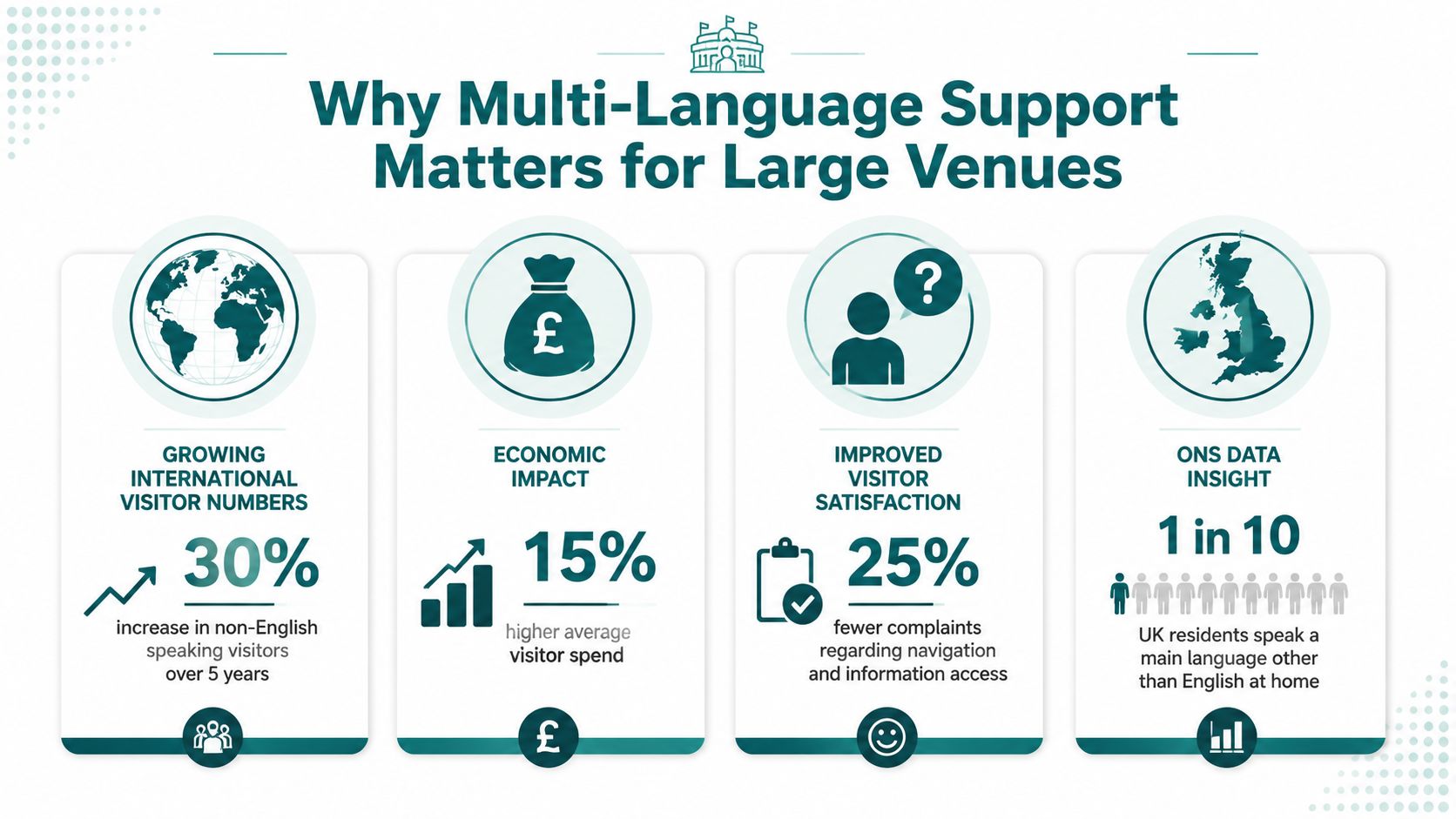
For venue operators, the effects are measurable in daily operations. Staff at information desks spend time giving repeat directions. Security teams get pulled into avoidable customer support. Hospital reception teams manage late arrivals caused by confusion between departments, buildings, and entrances. In transport, a missed turn at a gateline or interchange can quickly become a missed connection.
The commercial and service case is straightforward.
- Fewer routine interruptions for frontline staff: Visitors who can follow guidance in their own language ask fewer basic directional questions.
- Better flow through high-pressure decision points: Junctions, lifts, exits, concourses, and boarding areas work better when people do not have to stop and interpret unfamiliar wording.
- Higher use of digital wayfinding tools: A navigation app is only useful if the instructions are understandable at the moment they are needed.
- A better visitor experience for international and multilingual audiences: Large venues compete on ease as much as destination value.
Translation on its own still falls short in complex estates. A multilingual poster cannot react to a platform alteration. A static sign cannot account for a closed corridor in a hospital or a temporary entrance change at an arena. Precision matters here, especially in signal-poor interiors where GPS is unreliable. Infrastructure-free navigation changes the standard because it can deliver turn-by-turn guidance inside those spaces without requiring beacons or new hardware across the estate.
At Waymap, we see this most clearly in transport and healthcare. The hard part is not producing words in several languages. The hard part is delivering the right instruction at the right moment, with enough positional accuracy to tell someone which staircase to take, which side of a concourse to follow, or which clinic door they have reached. Multi-language support only becomes useful when it is tied to live, location-aware guidance.
A good starting point is to combine multilingual wayfinding with wider inclusive design principles for the built environment. That helps estates, digital, and accessibility teams design for real behaviour rather than assuming every visitor reads signs, understands local terminology, or feels confident asking staff for help.
Digital guidance handles this better than physical signage because it can present the same route differently for different users. One person may need spoken instructions in Arabic. Another may need simplified written guidance in Polish. A blind user may need audio prompts and confirmation that they have reached the lift lobby rather than the escalator bank. The route is the same. The delivery has to change.
The shift is easier to grasp when you see it applied in practice:
For large venues, this is not a courtesy feature. It is part of how the place works. If a station, airport, or hospital serves a multilingual public, wayfinding has to reflect that reality in the physical environment people move through, including basements, tunnels, concrete corridors, and crowded interiors where conventional positioning struggles. That is why multi-language support belongs in the core navigation system, not at the edges of it.
How Multi-Language Support Ensures Regulatory Compliance
Accessibility law doesn't ask whether a service is difficult to make inclusive. It asks whether the organisation made reasonable adjustments.
In the UK, multi-language support in digital navigation platforms must comply with the Equality Act 2010, which requires services for disabled people to be reasonably accessible. In practice, that means core wayfinding content can't be treated as an English-only layer if the venue serves a multilingual public. The transport case is clear. A 2023 study by the UK Department for Transport found that 34% of metro users in London who speak English as a second language reported difficulty navigating stations without multilingual signage, as set out in the verified policy summary provided for this article.
Why static signage often falls short
Static signs matter, but they're limited in three ways.
- They can't adapt in real time: Temporary closures, revised entrances, and platform changes create immediate information gaps.
- They privilege visual interpretation: That creates obvious issues for blind and low-vision users.
- They struggle with intersectional access needs: A person may need audio, plain language, and another language at the same time.
That's why digital wayfinding increasingly sits inside the compliance conversation. It gives estates teams and transport operators a practical way to show that accessible information isn't just present, but available in the form the user can use.
Compliance is easier to defend when guidance is current, accessible, and available at the point of decision.
What compliance officers should look for
When teams review navigation procurement, the legal question shouldn't be limited to “Do we have signs?” It should be broader.
A stronger compliance review asks:
| Question | Why it matters |
|---|---|
| Can the system present route guidance in key languages? | Language access is part of equitable service delivery. |
| Does it work for blind and low-vision users? | Accessibility duties don't stop at visual signage. |
| Can content be updated quickly? | Outdated directions undermine reasonable accessibility. |
| Does it preserve user context during language changes? | People can't be forced to restart navigation mid-journey. |
The compliance burden is often heavier in complex estates with frequent operational change. That includes metro networks, hospitals, and large public venues where route accuracy depends on current conditions, not just building plans.
For teams mapping legal duties to implementation detail, building code compliance in digital wayfinding is where policy language becomes specification language. That's the point where accessibility moves from aspiration into procurement criteria, testing, and audit evidence.
What Are the Technical Components of Effective Multilingual Wayfinding
A multilingual wayfinding stack fails when it's built as a translation layer bolted onto a weak navigation engine. The technical foundation matters more than the language count.
If a route drops when connectivity changes, if the app loses position underground, or if changing language resets progress, the user experience breaks regardless of how good the wording is. That's why procurement teams should specify the underlying behaviours, not just ask whether a product “supports multiple languages”.
Start with route continuity and accessibility standards
Technical implementation needs to align with WCAG 2.1 AA, including the requirement that language switching must not reset user progress. In a 2024 benchmark, Waymap achieved a 98.3% success rate in maintaining route continuity during language transitions because its state-persistence architecture caches data locally rather than depending on cloud connectivity, as stated in the verified benchmark summary supplied for this article.
That point sounds narrow until you watch someone change language halfway through a journey in a station, hospital, or shopping centre. If the route restarts, trust disappears. If the route continues from the current location with the same progress preserved, the tool behaves like real navigation should.
Specify the components that matter
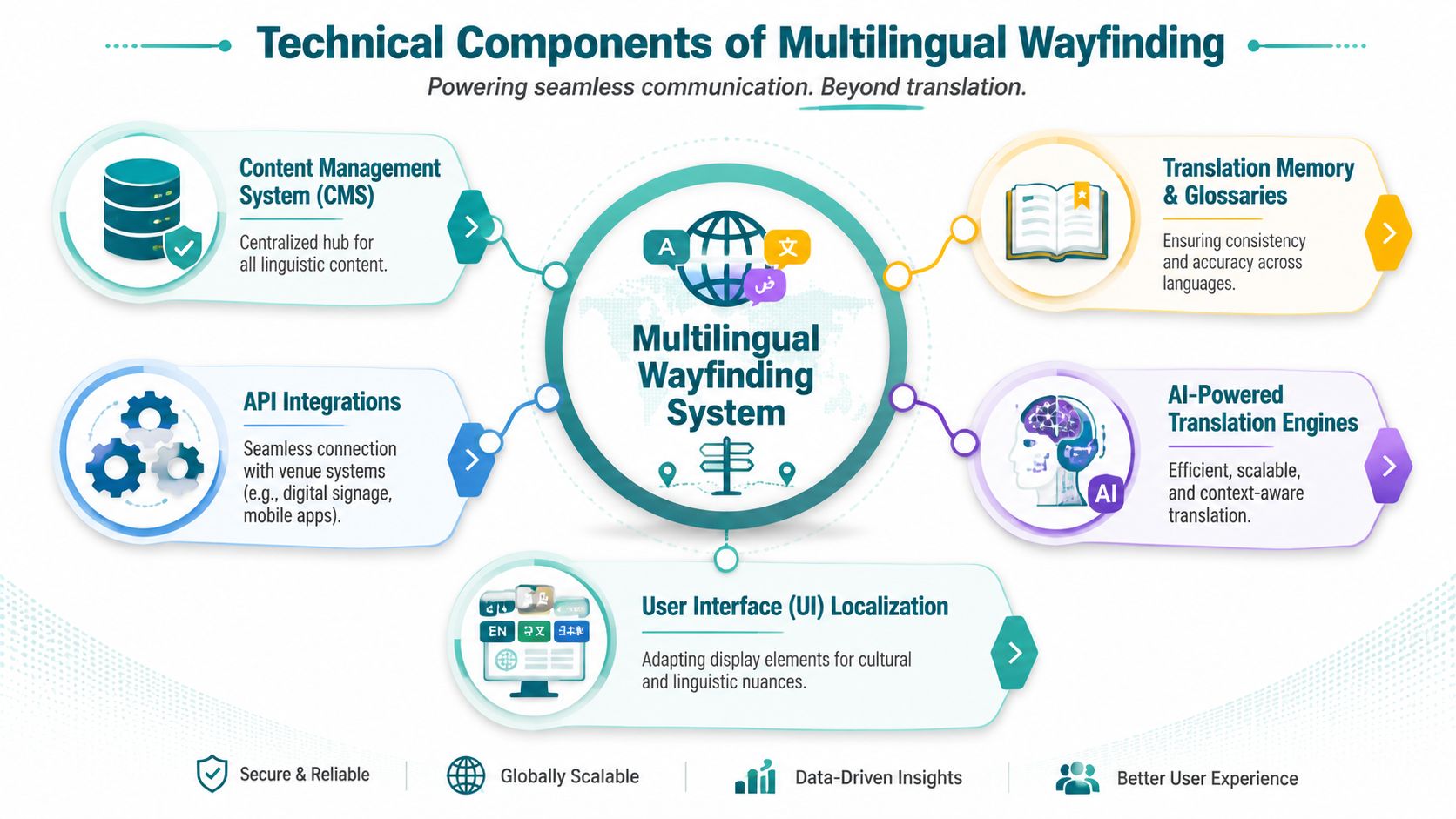
A useful multilingual wayfinding specification usually includes these technical pillars:
- Content structure: Route instructions, points of interest, alerts, and safety text should sit in a managed content framework, not hard-coded strings spread across multiple systems.
- Locale handling: Translation isn't enough. The interface needs to support local date formats, terminology, and culturally appropriate phrasing.
- Audio quality: Text-to-speech is only useful when pronunciation, pacing, and clarity work in noisy environments.
- Offline resilience: Signal-poor environments are common in transport and large buildings, so navigation has to keep working without Wi-Fi.
- Operational publishing controls: Venue teams need to update destinations, closures, and guidance without waiting on a redevelopment cycle.
This is also where the wider digital estate matters. If your venue team is rebuilding customer-facing digital services, a specialist partner such as a Digital marketing agency for custom websites can help connect content, UX, and integration planning across web and venue systems.
Infrastructure-free positioning changes the design brief
Beacon-based multilingual navigation can work, but it creates operational friction. Hardware has to be installed, maintained, replaced, and monitored. In high-footfall estates, that becomes a facilities problem as much as a digital one.
A different approach uses device-native sensors and detailed maps to maintain precise positioning without relying on GPS, Wi-Fi, or installed hardware. For complex environments, that matters because the system remains usable underground, indoors, and through temporary operational change.
Technical checkpoint: Ask whether the navigation engine still performs when the venue is crowded, underground, and offline. If the answer is unclear, the language layer won't save it.
For a deeper explanation of how sensor-based positioning works in practice, see how a navigation system works in complex indoor environments.
How to Implement a Multi-Language Navigation System
Most implementation problems start with the wrong architecture choice. Teams assume multilingual navigation requires hardware, Wi-Fi dependency, or a long capital programme. That's often why projects stall.
The older model is infrastructure-led. It depends on Bluetooth beacons, physical installs, ongoing maintenance rounds, and change control every time the venue layout shifts. That's manageable in small, stable environments. It becomes awkward in rail estates, hospitals, campuses, and retail sites where layouts, tenants, and temporary barriers change regularly.
Compare the deployment models before you procure
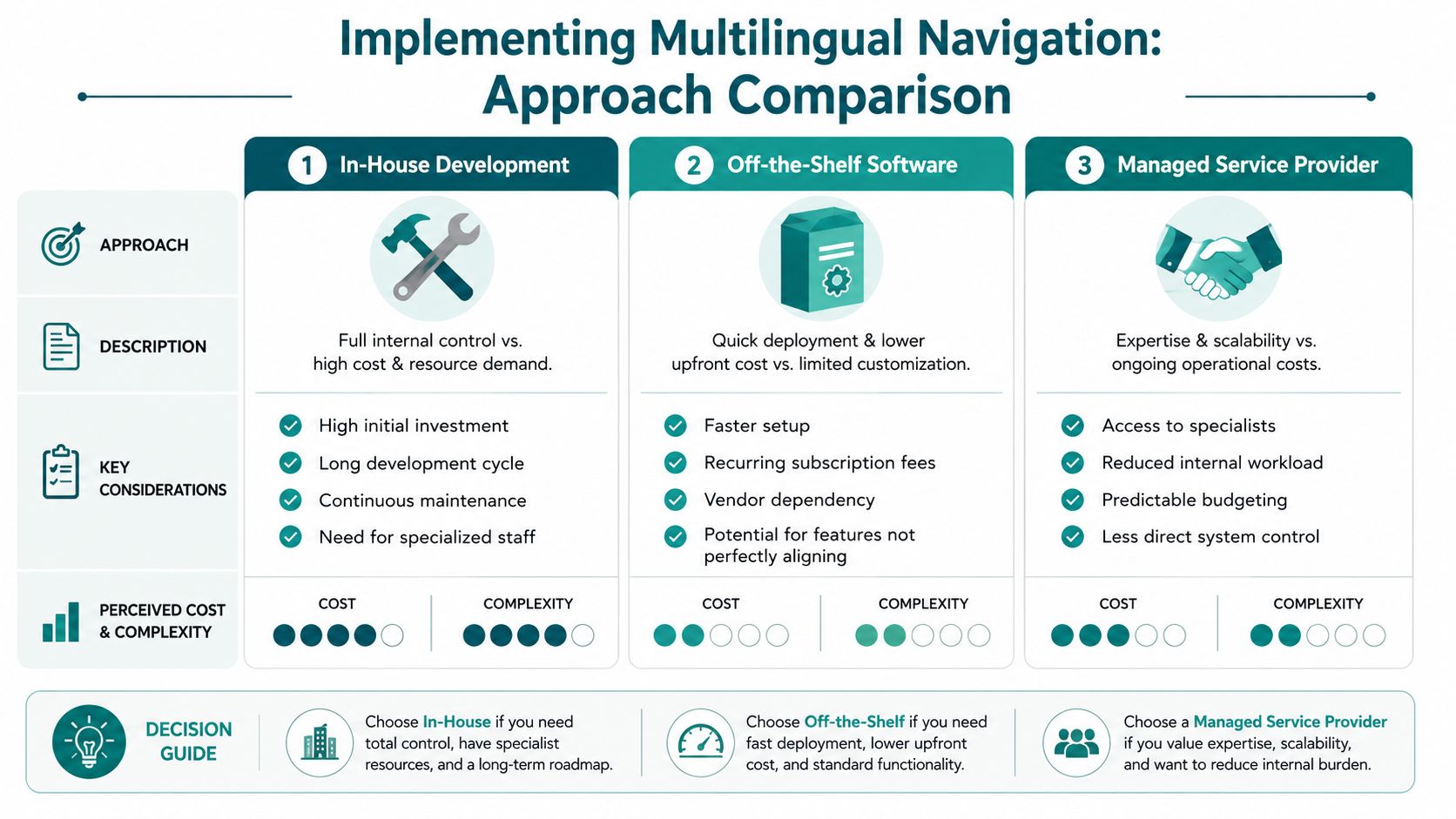
A practical comparison helps.
| Approach | Strength | Trade-off |
|---|---|---|
| In-house development | Full internal control | Higher build complexity, longer delivery, ongoing maintenance burden |
| Off-the-shelf software | Faster rollout | Feature constraints and vendor roadmap dependence |
| Managed service provider | Specialist support and predictable service model | Less direct control over every component |
The bigger decision is often not who supplies the system, but whether the model is hardware-dependent or software-defined.
A key challenge is dynamically updating multilingual guidance in real time without Wi-Fi. In the UK, 72% of large venues lack budget for beacon-based systems. The software-only model is attractive because smartphone motion sensors and offline maps can support infrastructure-free updates, reducing latency from days to seconds, according to the verified implementation summary provided for this article.
A rollout sequence that works in real venues
The strongest deployments usually follow a simple operational order:
- Define the journeys that matter most: Start with routes people ask about most often. Entrances to platforms, reception to clinics, car parks to lifts, or gates to amenities.
- Pick the priority languages: Use your audience profile and local demand rather than trying to publish everything in every language on day one.
- Set an update workflow: Someone has to own temporary closures, renamed destinations, and event-day changes.
- Test with real users: Include blind and low-vision participants, non-native English speakers, and first-time visitors.
- Train frontline teams: Staff don't need to become technical experts, but they do need to know how the guidance works and when to recommend it.
Only in this implementation context is it useful to mention a specific platform. Waymap uses smartphone motion sensors and offline maps to deliver infrastructure-free navigation in signal-poor spaces, which makes it suitable for venues that can't justify beacon installation or want to avoid maintaining physical hardware.
The operational advantage is flexibility. If a hospital corridor is diverted, a store unit changes, or a station entrance closes, digital guidance can be updated without replacing signs or servicing beacons. That's a different maintenance model, and for many estates teams it's the one that finally makes multilingual navigation realistic.
For teams evaluating deployment options in more detail, this guide to venue wayfinding apps is a useful starting point.
Measuring the Impact of Multilingual Guidance at Real Venues
Budget holders usually support multilingual wayfinding once the impact is measurable in operational terms. Accessibility matters. So do service desk load, journey completion, and visitor confidence.
The cleanest KPI is navigation error reduction. The UK Department for Transport's 2025 Accessibility Report states that 4.2 million annual passenger journeys in the UK rail network involve passengers with limited English proficiency or disabilities, and that multi-language support in digital wayfinding has reduced navigation errors by 34% in major transit hubs since 2022, as referenced in this summary of multilingual support statistics.

Measure what the venue actually feels
Good reporting goes beyond downloads or app opens. The stronger indicators are operational.
- Directional queries to staff: Track whether “How do I get to...?” requests fall after launch.
- Journey completion confidence: Use post-visit feedback to see whether people reached the intended platform, clinic, gate, or store without intervention.
- Visitor satisfaction: Check whether multilingual users rate the experience differently before and after rollout.
- Change responsiveness: Measure how quickly updated route information reaches users after closures or disruptions.
Use named environments, not abstract scenarios
The most persuasive measurement frameworks come from real operating conditions. In a transit system such as WMATA, the meaningful question is whether riders can complete journeys during disruptions without extra staff support. In a shopping destination such as Westfield London, the question may be whether international visitors can find their way through entrances, amenities, and anchor tenants without friction. In a healthcare site such as the Royal Hospital for Children and Young People, the lens is different again. Arrival stress, appointment punctuality, and confidence matter more than retail dwell time.
The right KPI is the one your operations team already feels when navigation goes wrong.
That's why multilingual guidance shouldn't be measured only as an accessibility feature. It should be measured as a venue operations layer. When users can orient themselves in their own language, the impact reaches staffing, queue management, missed connections, and the overall perception of how easy the place is to use.
Frequently Asked Questions About Multi-Language Support
What is multi language support in wayfinding
Multi language support in wayfinding means a navigation system can provide route instructions, interface text, and key destination information in more than one language. In complex venues, that support also needs to be dynamic, location-aware, and accessible through audio as well as text.
Why isn't translated signage enough
Translated signage helps, but it doesn't handle live operational change. If entrances close, platforms move, or temporary barriers appear, static signs can't update fast enough to guide people turn by turn.
Which venues benefit most from multilingual navigation
Transport hubs, hospitals, shopping centres, airports, stadiums, universities, libraries, and large office campuses benefit most. The bigger and more changeable the environment, the more useful digital multilingual guidance becomes.
Does multi language support help with accessibility compliance
Yes. It supports accessibility compliance by making core wayfinding information more usable for disabled visitors who are also non-native English speakers. It's especially relevant where reasonable adjustments under the Equality Act 2010 depend on information being accessible at the point of use.
What should we ask in a procurement brief
Ask whether the system works offline, preserves route progress during language changes, supports accessible audio guidance, and can be updated without hardware replacement. You should also ask who owns content publishing and how temporary route changes are handled.
Is infrastructure-free navigation realistic in signal-poor spaces
Yes. Sensor-based navigation can work well in signal-poor environments when it relies on device-native motion sensors and detailed maps rather than GPS or venue-installed hardware. That matters in underground stations, dense public buildings, and multi-level indoor estates.
How many languages should a venue launch with
Start with the languages most relevant to your audience and operations. A focused launch with strong route coverage, accurate terminology, and maintainable updates works better than a broad rollout that's hard to keep current.
If you're reviewing how your venue, campus, or transport network handles multilingual navigation, Waymap shows what infrastructure-free, precision wayfinding can look like in real operational settings. We build navigation for complex indoor, outdoor, and underground environments where accessibility, route accuracy, and real-time updates matter.
