
ESG Reporting Requirements UK: A 2026 Reference Guide
A March year-end is approaching, and your compliance team has four folders open: SECR energy data, climate-governance disclosures, FCA requirements and the emerging UK Sustainability Reporting Standards. The difficulty isn't a lack of guidance. It's knowing which UK ESG reporting requirements apply to your organisation this year, what evidence each one needs and how to avoid building separate reporting systems that contradict one another.
This guide is written for estates, compliance and finance directors at venues, transport operators, universities and other complex organisations. It gives you a practical map of the current UK framework, then turns that map into an operating plan for 2026.
Why ESG Reporting in the UK Feels Fragmented in 2026
A venue group may open its reporting year with energy records, governance papers, investor disclosures and sustainability data in separate folders. The compliance risk is not missing information. It is assigning the right evidence to the wrong entity, boundary or disclosure route.
Start by identifying four facts before building a reporting template:
- Which legal entity is reporting? Confirm whether it is a quoted company, large unquoted company, LLP, listed issuer, asset manager or public body.
- Which thresholds and scope tests apply? For SECR, large unquoted companies and LLPs generally enter scope when they exceed at least two relevant size tests.
- Where must the disclosure appear? The required destination may be an annual report, strategic report, corporate governance section or FCA-related disclosure.
- What decision must be made for the next cycle? UK SRS is available voluntarily in 2026. FCA rules are proposed to move towards mandatory application from January 2027, subject to the FCA's final policy process. The UK government's UK SRS guidance confirms the current voluntary position and developing timetable.
These questions give an estates or compliance director a usable test for this year. They also prevent a common error: collecting data before confirming which organisation, reporting period and rule require it.
Practical rule: Maintain one controlled evidence base, then prepare the disclosures required for each applicable regime. Do not maintain separate climate spreadsheets for separate audiences.
For a lower-cost compliant approach, map each obligation to its owner, evidence source, approval point and publication route. Record the boundary decisions and retain the supporting records. That control structure lets the organisation reuse verified energy, emissions, governance and risk information without forcing every audience into the same disclosure format.
The detailed regime definitions, scope tests and disclosure contents should be assessed separately. The immediate job is to establish the reporting perimeter, identify gaps and decide which voluntary preparation work will reduce next-cycle cost without treating proposed requirements as settled law.
The Four Overlapping UK ESG Regimes You Need to Know
A venue, transit operator or estates group can face several reporting duties in the same year. The correct starting point is the organisation, reporting period and activity in scope, not the preferred framework. These four regimes overlap, but they impose different tests, disclosures and publication routes.
SECR is the operational baseline. It requires many UK quoted companies, large unquoted companies and LLPs to report energy use and related greenhouse-gas emissions in annual reports. For unquoted companies and LLPs, the energy threshold is more than 40 MWh of UK energy use, subject to the regime's wider scope and exemptions. The UK ESG reporting framework overview sets out how SECR sits alongside other UK disclosure duties.
Climate-related financial disclosure rules require in-scope entities to cover Governance, Risk Management, and Metrics and Targets, including Scope 1 and Scope 2 emissions as minimum reporting requirements. They test how climate risk enters governance, planning and decision-making, rather than focusing only on energy totals.
FCA climate and investment-market rules apply to relevant FCA-regulated asset managers and asset owners, as well as relevant listed issuers. The FCA introduced mandatory TCFD-aligned climate disclosures for the largest firms on 1 January 2022, with smaller firms following one year later where they exceeded the £5 billion exemption threshold. The first public disclosures were due by 30 June 2023, according to the cited UK ESG requirements analysis.
UK SRS is the incoming standardised framework. UK SRS S1 covers general sustainability-related financial disclosures, while UK SRS S2 covers climate-related disclosures. The government says both standards are available for voluntary use today, and the FCA intends to publish a Policy Statement in autumn 2026, with rules coming into force from January 2027.
| Regime | Primary source | Scope test | Disclosure location | 2026 status |
|---|---|---|---|---|
| SECR | Companies Act framework and government guidance | Quoted companies, plus large unquoted companies and LLPs meeting the relevant tests | Annual report | Mandatory where in scope |
| Climate-related financial disclosures | UK company and financial-market disclosure rules | In-scope entities under applicable company or FCA rules | Annual report and related public disclosures | Mandatory for applicable entities |
| FCA climate and asset-manager requirements | FCA rules | Relevant FCA-regulated firms, asset owners and listed issuers | Public entity or product disclosures | Existing duties continue |
| UK SRS S1 and S2 | Department for Business and Trade and FCA framework | Voluntary broadly, with proposed mandatory application for defined cohorts | Sustainability disclosures linked to financial reporting | Voluntary in 2026 |
For venues and operators comparing reporting frameworks, Waymap's ESG reporting frameworks guide provides wider context. Use it as orientation, then confirm the applicable legal test and reporting route.
The management conclusion is direct: one organisation may sit inside several regimes at once. Build one controlled evidence base, then produce the disclosures each regime requires. A report that satisfies SECR can still leave climate-risk or FCA-related gaps.
SECR Thresholds, Intensity Ratios and What Your Annual Report Must Contain
For an operating business deciding what must be filed this year, SECR is the first practical test. A quoted company is generally in scope. An unquoted company or LLP is usually included when it meets at least two of these conditions: more than 250 employees, turnover above £36 million, or balance sheet total above £18 million. The government's 2025–26 sustainability reporting guidance sets out the current baseline.
Passing the scope test does not produce a compliant disclosure by itself. The annual report needs a traceable record from meters, invoices, fuel records and operational systems through to the reported figures. Set the reporting boundary before collecting data, or the team will spend year-end resolving avoidable gaps.
What to prepare for the annual report
Build the disclosure around five required components:
- Energy consumption: Total relevant UK energy use, with energy sources identified and converted on a consistent basis.
- Emissions: Associated greenhouse-gas emissions, including the applicable Scope 1 and Scope 2 treatment.
- Intensity ratio: At least one ratio that relates performance to the organisation's scale or activity.
- Methodology: The boundaries, methods, conversion factors and assumptions used to calculate the figures.
- Efficiency action: At least one energy-efficiency action taken during the reporting period.
The ratio must help a reader interpret performance. Choose a denominator that reflects how the organisation operates and apply it consistently. A venue group should reconcile every site to the group total. A transport operator should separate operational fuel, purchased electricity and relevant estate consumption. A university should decide whether leased buildings, residences and shared services fall inside the boundary.
The report is only as credible as its weakest meter, boundary decision or conversion-factor record.
Check exemptions and special treatments against the entity's circumstances. These include the low-energy-user position and rules affecting first-year reporting. Do not copy a generic checklist into the annual report. For group reporting, document which entities and activities the consolidated figure covers, then test for omissions and double counting.
Create a site-level evidence ledger now. Record the source, period, responsible owner, boundary decision and review status for each figure. Waymap's carbon footprint reduction guidance for complex venues supports the operational point: energy and emissions explanations carry more weight when they connect with movement, access and estate decisions rather than appearing as isolated totals.
| SECR element | What must be reported | Required location |
|---|---|---|
| Energy use | Total relevant UK energy consumption | Annual report |
| Greenhouse-gas emissions | Associated emissions and applicable Scope 1 and Scope 2 information | Annual report |
| Intensity ratio | At least one relevant intensity ratio | Annual report |
| Methodology | Basis of preparation and calculation method | Annual report |
| Efficiency action | At least one action taken during the period | Annual report |
UK SRS Timeline From Voluntary 2026 to Mandatory 2027 Onwards
A listed group preparing its 2026 annual report has two jobs: meet existing mandatory duties and decide whether to adopt UK SRS voluntarily. Treating UK SRS as a replacement for SECR or current climate disclosures would leave a compliance gap.
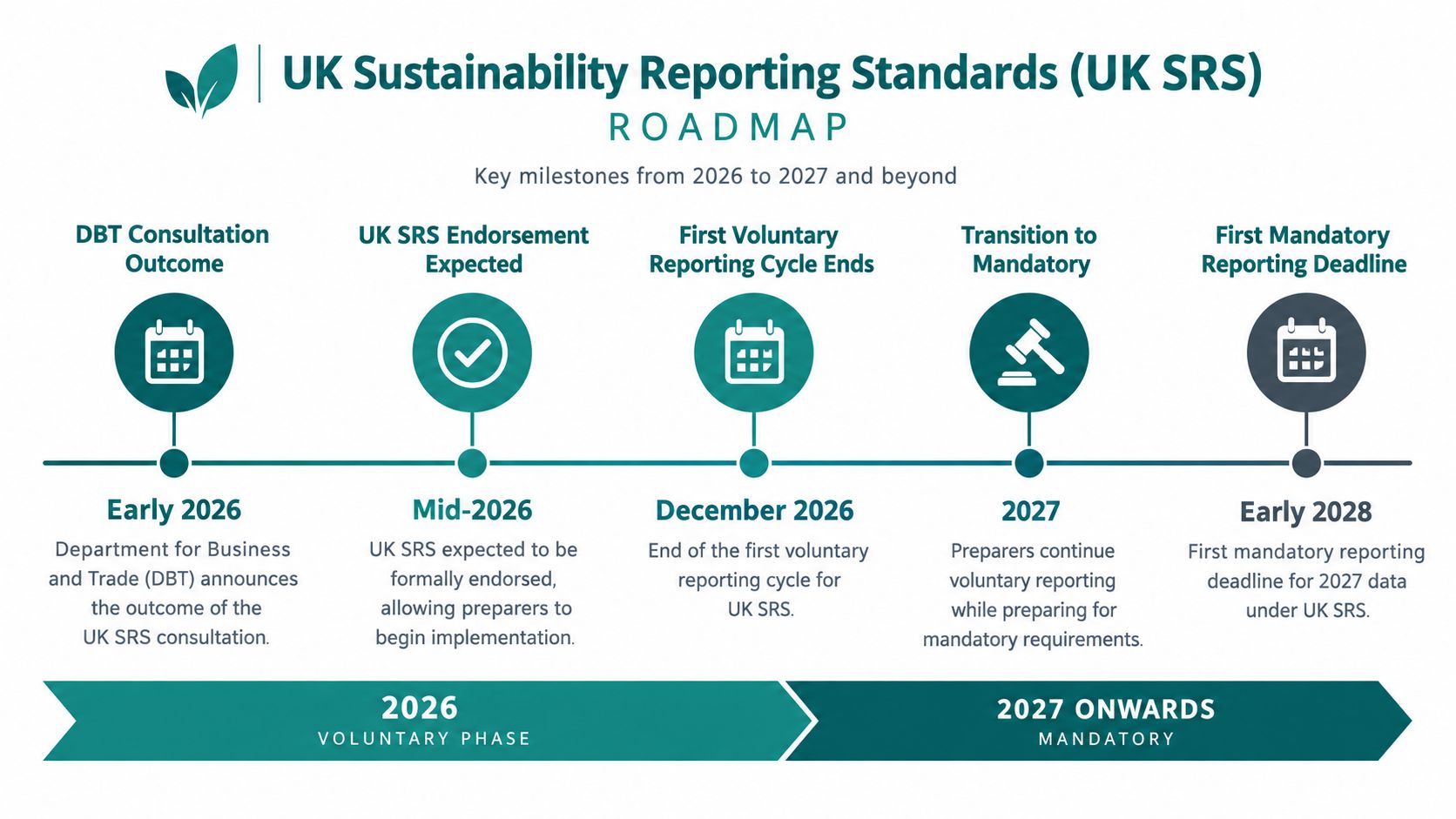
UK SRS changes the central question from “What climate information do we have?” to “Which sustainability-related risks and opportunities could affect the organisation and its financial reporting?” The government's final UK SRS publication confirms that the standards are available for voluntary use in 2026. The FCA has said it intends to publish a Policy Statement in autumn 2026, with rules coming into force from January 2027.
What changes operationally
Voluntary adoption in 2026 makes sense for listed groups and businesses facing financing or stakeholder pressure. It also gives estates, facilities and compliance teams time to test data ownership and evidence before mandatory requirements apply. Keep the current rule set running: voluntary UK SRS reporting does not remove applicable SECR or climate disclosure duties.
The FCA's proposed direction is mandatory climate disclosure under UK SRS S2 for many listed issuers from accounting periods starting on or after 1 January 2027. Scope 3 emissions would move to a comply-or-explain basis from 2028. Broader UK SRS S1 non-climate disclosures are proposed on a similar basis from 2029. The UK SRS timeline summary sets out these milestones, but the FCA's final rules will determine implementation.
Use 2026 to establish the controls that will carry into the first mandatory period:
- Set reporting boundaries across subsidiaries, estates and value-chain activities.
- Assign owners for energy, emissions, procurement, transport and facilities data.
- Select and document the Scope 2 calculation method.
- Link sustainability evidence to financial reporting periods.
- Test whether scenario, risk and transition-plan information can be supported.
- Review completeness, cut-off and methodology before report drafting begins.
Start before the final policy statement. Data architecture, ownership and review controls must be operating before the first applicable reporting period closes.
Who Is in Scope Under Each Regime and How the Tests Stack Up
Scope decisions become difficult when an organisation has more than one identity. A large private company may be in SECR but not yet subject to the proposed FCA listed-company rules. A listed group may face SECR, existing climate disclosures and the incoming UK SRS model. An FCA-regulated asset manager has a different set of product and entity obligations from a venue operator, even if both publish climate information.
The table below is a practical triage tool. It doesn't replace entity-level legal review, but it helps a director identify where specialist advice is needed.
| Regime | In-scope entities | Headline test |
|---|---|---|
| SECR | Quoted companies, large unquoted companies and LLPs | Unquoted companies and LLPs generally meet at least two tests: more than 250 employees, turnover above £36 million, balance sheet total above £18 million |
| Climate-related company disclosures | Relevant in-scope companies and listed entities | Entity and listing status determine the applicable climate governance and metrics duties |
| FCA climate disclosures | Relevant FCA-regulated asset managers and FCA-regulated asset owners | Firm status, assets and applicable FCA rules determine scope |
| FCA listed-company requirements | Relevant listed issuers | Listing category and final FCA rules determine application |
| UK SRS | Voluntary entities in 2026, with proposed future cohorts | Government and FCA implementation decisions determine mandatory scope |
Use the matrix to find cumulative burden
The highest-risk organisations are those sitting at the intersection of several rows. Their problem isn't merely producing more pages. It's preserving consistent definitions across annual reports, FCA disclosures, board papers, emissions calculations and operational systems.
Central government bodies have a separate reporting position. Government guidance says the 2025–26 annual reports and accounts cycle is the final stage of mandatory comply-or-explain TCFD-style requirements for relevant central government bodies. Public bodies should therefore follow their specific guidance rather than assume private-company rules apply.
For a private estate operator, the lowest-cost compliant path is usually to meet SECR properly, map UK SRS gaps, and avoid claiming full UK SRS alignment until the organisation can support the required evidence. For a listed issuer or financial-market participant, early alignment is more defensible because the future FCA timetable affects reporting design, governance and assurance planning.
A Practical Compliance Workflow That Holds Up Under SECR and UK SRS
A strong workflow starts with ownership, not software. Assign one ESG controller with authority to resolve boundary disputes, approve methodology and maintain the reporting calendar. Site teams can provide data, but they shouldn't each define energy, emissions or activity measures differently.
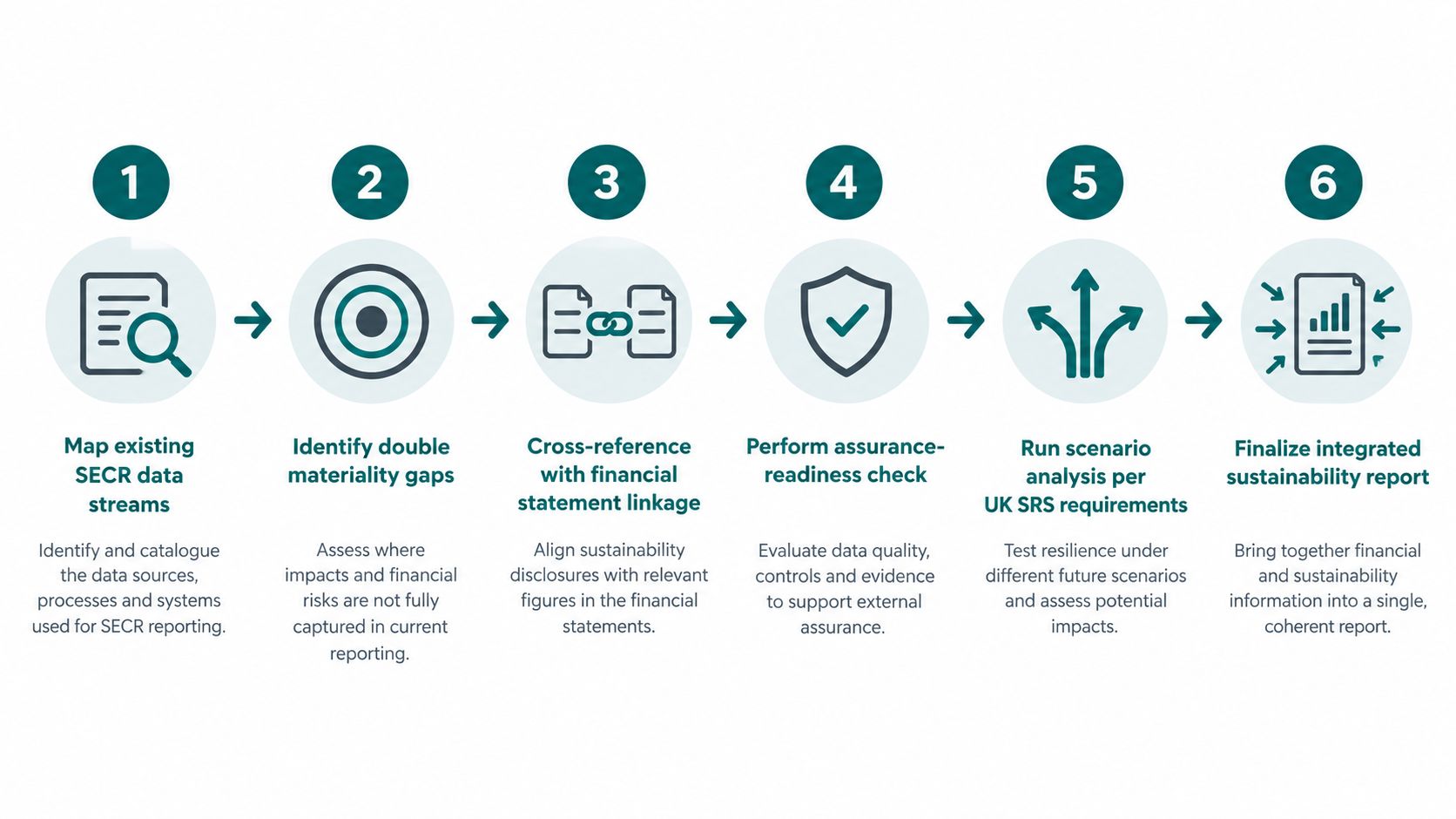
Six controls for the 2026 reporting cycle
- Map the entity structure. List subsidiaries, leases, joint operations, sites and reporting responsibilities. Record why each item is included or excluded.
- Create one evidence ledger. Centralise meter readings, invoices, fuel, refrigerants, mileage, procurement and relevant value-chain information. Give every input an owner and review status.
- Lock the methodology. Document the GHG Protocol Corporate Standard approach, SECR kWh conversion factors, Scope 2 treatment and any estimation methods. Put the basis of preparation in writing.
- Run a UK SRS gap review. Compare current disclosures with UK SRS S1 and S2 requirements before the annual report is drafted. Focus on material risks, opportunities, metrics, targets and governance.
- Record board oversight. Capture climate and sustainability decisions in board and audit committee minutes. Premium-listed and FCA-regulated organisations need evidence that governance is active, not decorative.
- Stress-test assurance readiness. Ask whether every figure is complete, correctly classified, supported by source evidence and cut off in the right reporting period.
A practical compliance-reporting system should make ownership, definitions and traceability visible. Waymap's compliance reporting system guide addresses those controls in an operational context.
For teams training staff or aligning stakeholders, this explainer can support the process:
The workflow should produce a review pack, not just a final PDF. Include the entity map, data dictionary, evidence ledger, methodology note, unresolved estimates, approval records and a list of management judgements. That pack gives finance, estates and assurance teams a common point of reference.
The Hidden Reporting Risk Most UK Companies Are Missing
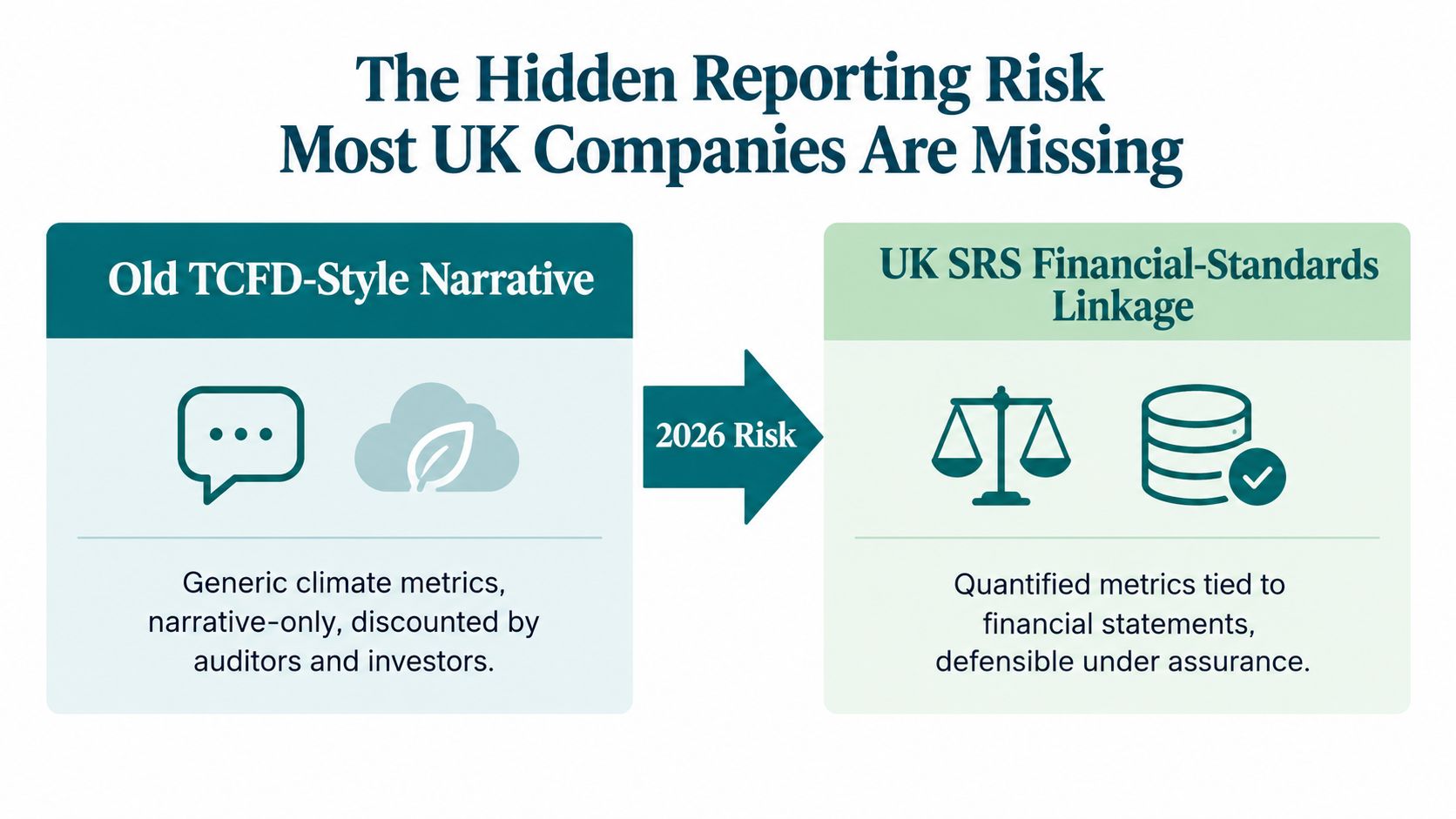
A 2026 disclosure can contain an accurate emissions figure and still fail its purpose. The risk is a generic statement that does not show how sustainability issues affect operations, risk, capital allocation or financial performance.
Legacy TCFD-style reporting often relied on broad narrative about governance, resilience and strategy. UK SRS raises the standard by linking sustainability-related financial disclosures to the financial reporting period and the organisation's material risks and opportunities. A standalone tCO2e figure may be correct, yet remain too detached from decisions to support reliable reporting.
For a venue, test the evidence against building energy, transport access, maintenance demand, visitor movement and service resilience. A station operator may need passenger flow, interchange friction, estate energy and the operational effect of accessibility interventions. A university may need evidence from campus buildings, movement between sites and the resilience of access routes.
Record only the details that support a material conclusion. Then preserve the chain from activity to risk, control and outcome.
Use four checks for each material datapoint:
- What happened? Identify the activity, location and reporting period.
- Why does it matter? Link it to a sustainability risk, opportunity or stakeholder impact.
- Who controls it? Name the accountable owner and approval route.
- Can someone verify it? Retain source records, definitions and calculation logic.
Waymap's third-party verification article addresses the evidence problem. The practical conclusion is clear: auditability comes from connected operational records, not longer narrative sections. That connection gives finance, estates and compliance teams a defensible basis for deciding what belongs in the report.
How Infrastructure-Free Navigation Strengthens UK ESG Evidence
Accessibility and mobility become useful ESG evidence when they are tied to an operational control. For UK venues, the relevant context includes the Equality Act 2010, inclusive-design expectations, and the need to explain how sustainability-related risks and opportunities affect the organisation.
A large venue may change entrances, platforms, rooms or routes during refurbishment. Installing and maintaining beacons across those changing layouts adds capital approval, hardware maintenance and service-disruption work. Waymap provides indoor and outdoor navigation using device-native motion sensors and detailed maps, without GPS, Wi-Fi or installed hardware. Its infrastructure-free navigation approach is therefore relevant where estates teams need evidence without adding a fixed positioning system.
Consider a terminal that updates its accessible route after a layout change. The estates team can direct a blind or low-vision visitor to the revised entrance, log the map change, retain anonymised flow data for the reporting period, and reference the control in the governance note as evidence of inclusive design. The record should identify the route, owner, review date and applicable privacy and data-governance safeguards.
That creates reporting value across four areas:
- Social reporting: Whether inclusive access works in practice, rather than appearing only in policy.
- Governance reporting: Which team owns accessibility performance, map changes and service feedback.
- Operational reporting: How routes interact with estate layouts, maintenance cycles and visitor movement.
- Risk reporting: Whether building or network changes create barriers or affect service resilience.
The evidence does not become an emissions calculation. It supports a sustainability narrative by showing how inclusion informs a defined operational decision and how management reviewed the result.
For compliance directors, set the metric, document collection, assign an owner, review the output and retain the underlying record. An accessible-estate statement carries more weight when the organisation can show what changed, who controlled it and how users experienced the route.
Quick Reference Card for UK ESG Reporting Requirements
Use this card as a first-pass triage tool. It won't resolve every legal question, but it will tell you where to direct the next review.
| Regime | In-scope test | 2026 status | Next trigger |
|---|---|---|---|
| SECR | Quoted companies, plus unquoted companies and LLPs meeting at least two tests: more than 250 employees, turnover above £36 million, balance sheet total above £18 million | Mandatory where in scope | Include the required energy, emissions, intensity, methodology and efficiency information in the annual report |
| Climate-related financial disclosures | Relevant in-scope entities with duties covering governance, risk management, metrics and targets | Existing requirements apply | Confirm annual-report coverage and Scope 1 and Scope 2 information |
| FCA asset-manager and asset-owner rules | Relevant FCA-regulated asset managers and FCA-regulated asset owners | Existing FCA duties apply | Check firm-specific reporting dates and public-disclosure requirements |
| FCA listed-company climate rules | Relevant listed issuers | Further UK SRS rules are proposed | FCA Policy Statement intended in autumn 2026, with rules intended from January 2027 |
| UK SRS S1 and S2 | Voluntary use available to entities in 2026, with future mandatory scope determined by implementation rules | Voluntary in 2026 | Prepare for proposed S2 application from accounting periods starting on or after 1 January 2027 |
| Central-government guidance | Relevant central government bodies | 2025–26 is the final stage of mandatory comply-or-explain TCFD-style reporting | Follow the applicable annual reports and accounts guidance |
SECR action: Confirm the entity test and reconcile every reporting site to the annual-report total.
FCA action: Identify whether the organisation is a listed issuer, asset manager or asset owner affected by current or proposed FCA requirements.
UK SRS action: Build the data, governance and financial-linkage controls before voluntary or mandatory adoption becomes a reporting deadline.
Frequently Asked Questions on UK ESG Reporting Requirements
Should a UK company report voluntarily against UK SRS in 2026?
Yes, if it has the data and governance controls to do so without weakening existing compliance. UK SRS S1 and S2 are available for voluntary use in 2026, but voluntary reporting doesn't remove SECR or existing climate-related disclosure duties. The sensible approach is to run a gap assessment first, then adopt only when the organisation can support its boundary, materiality, methodology and evidence statements.
What changes for issuers and asset managers from January 2027?
The reporting model becomes more structured and more closely linked to financial reporting. The FCA intends to publish a Policy Statement in autumn 2026, with rules coming into force from January 2027. Its proposed direction includes UK SRS S2 climate disclosures for relevant listed issuers, Scope 3 on a comply-or-explain basis from 2028 and broader UK SRS S1 disclosures on a comply-or-explain basis from 2029. Review the FCA's climate reporting requirements and prepare the data architecture before the final rules arrive.
How do physical access and mobility fit into UK ESG reporting?
They fit as evidence of social impact, operational resilience and governance when they affect material decisions. SECR won't turn accessibility data into an energy metric, but UK SRS can require a broader account of sustainability-related risks, opportunities and stakeholder impacts. Estates and transport teams should define access measures, document ownership and retain evidence showing how mobility and inclusive design influence investment, maintenance and service decisions.
Waymap helps venues, transport operators, campuses and public bodies create infrastructure-free indoor and outdoor navigation to exact doors, platforms and points of interest, including in signal-poor environments. If your ESG reporting needs stronger operational evidence for inclusive access and place-based performance, visit Waymap to discuss a practical deployment.
