
How to Audit Disabled Access in Venues: A Practical Guide
You've got a lift, a ramp and an accessible toilet on your access statement, so disabled access looks sorted. Then a visitor arrives, the lift is out, and nobody can tell her where the step-free route resumes. Every asset still passes its certificate; the journey fails anyway. This guide audits one real visit from arrival to exit, logs where it breaks, and shows you how to fix the highest-impact failure first.
By Dr. Tom Pey, Founder of Waymap.
Why Disabled Access Is a Journey, Not a Checklist
Venues certify assets. Visitors experience routes. Disabled access fails in the gap between those two things: a compliant ramp, a working hearing loop and an accessible toilet can all pass inspection on the same afternoon a visitor turns back, because the unlit path between the drop-off point and the entrance was never part of anyone's checklist.
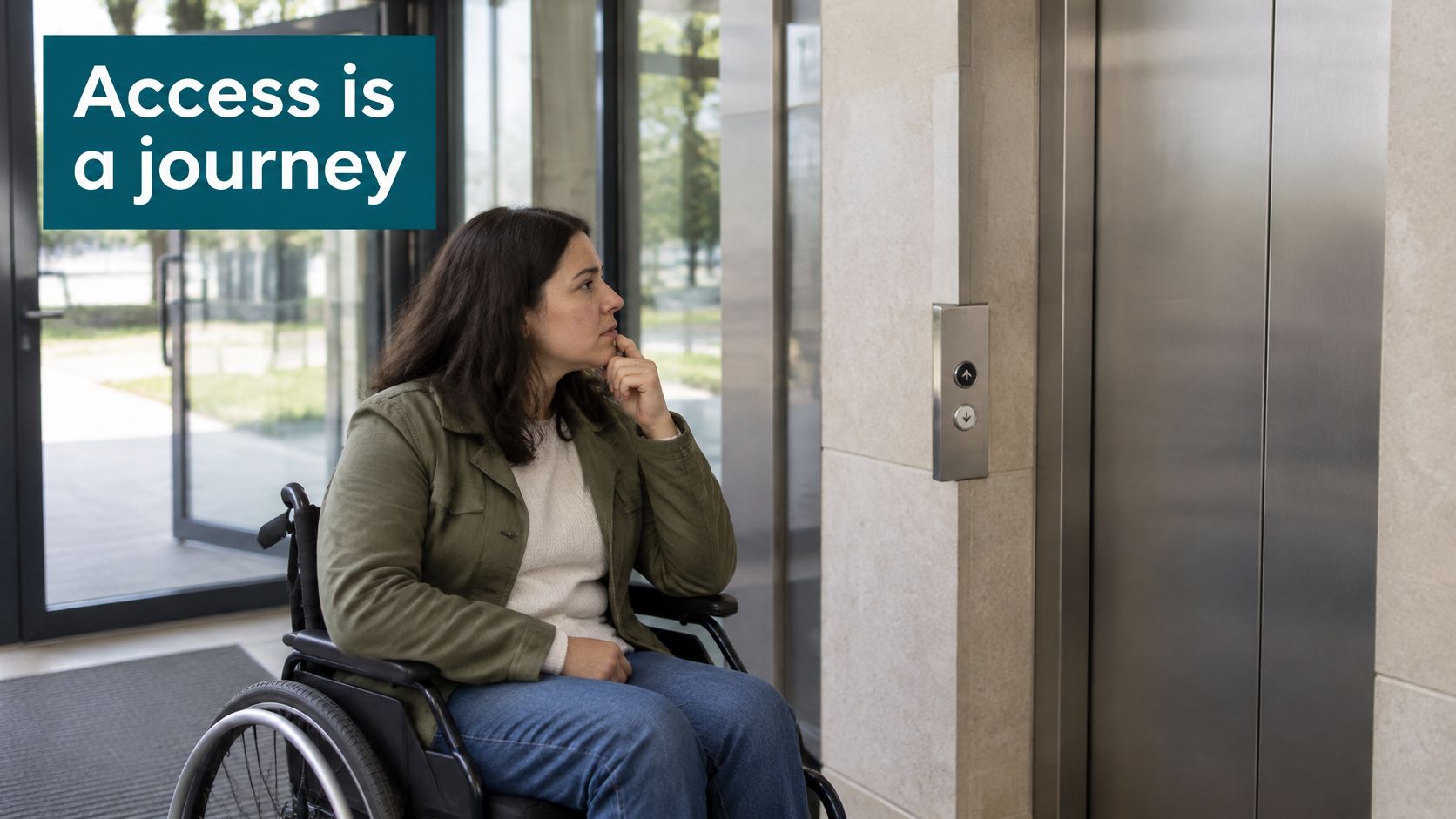
The scale makes that distinction matter. The Department for Transport disability and accessibility statistics for 2023 to 2024 report National Travel Survey data showing disabled adults in England made an average of 740 trips per person in 2023, compared with 989 trips for non-disabled adults, which is 25% fewer journeys. The same publication notes the UK Family Resources Survey reported 16.7 million people were disabled in 2024–25, equivalent to 25% of the UK population. Each of those trips is a chain of transfers, thresholds and handoffs, and it breaks at its weakest link.
What Certification Does Not Prove
Certification measures an asset, not a route. By 31 March 2024, 99.5% of buses in England had accessibility certification, while 52.8% provided audio-visual information, according to the Department for Transport figures above. A passenger who can't hear or see the next stop may board an accessible bus and still not complete the trip independently.
Audit the connections between assets, not the assets alone. A lift, a ramp and a platform only work if a visitor can move between them without guessing.
The Office for Statistics Regulation has flagged the same blind spot, noting that statistics often measure separate components rather than complete journeys. I would start where that criticism points: treat arrival, internal movement and departure as one chain and test the whole thing. A clear customer journey mapping approach for venue visits gives you that structure. The audit's verdict is whether a person can finish a visit.
How to Audit and Test Disabled Access Along One Real Route
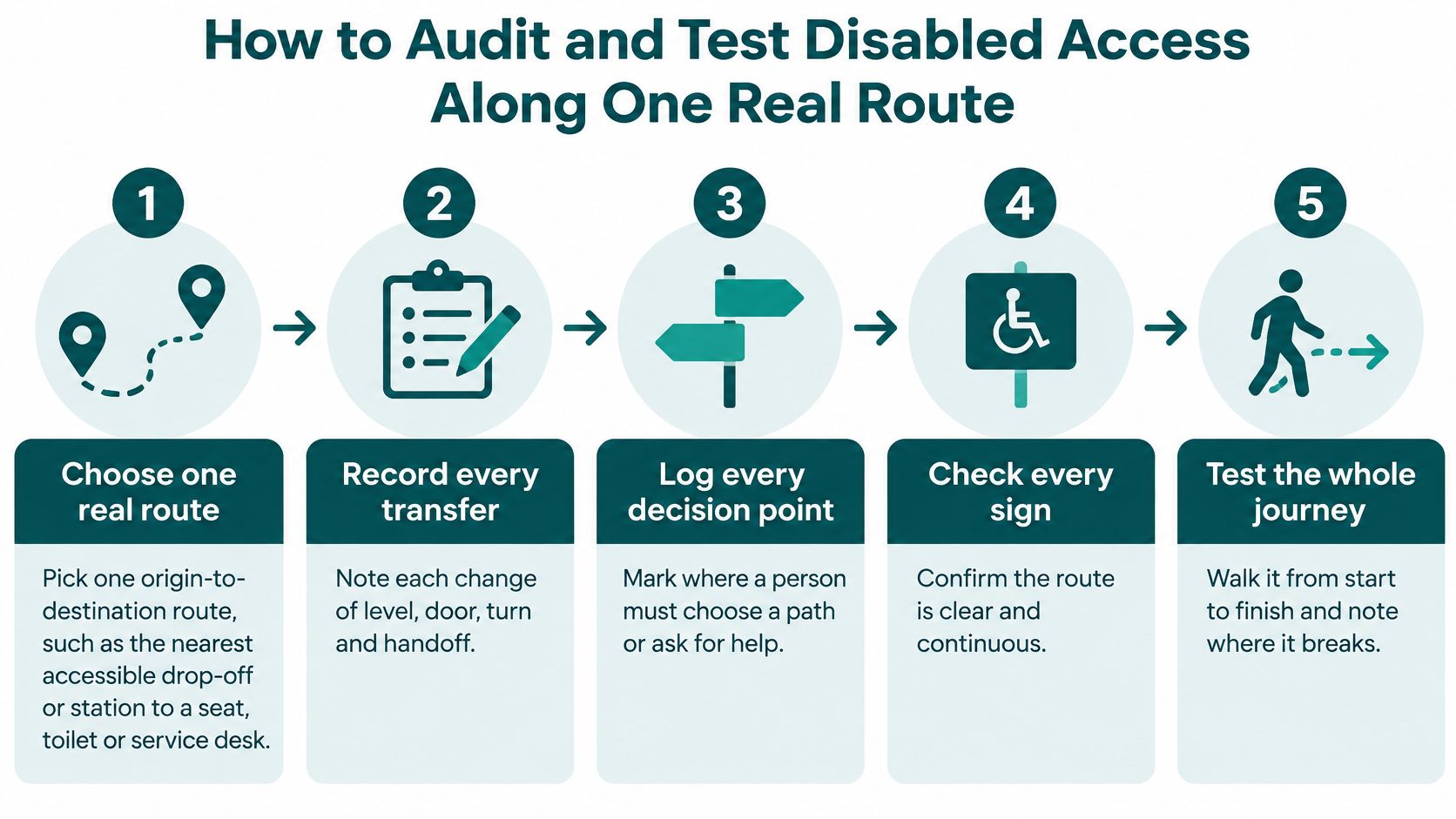
Pick a route a visitor needs, not the easiest one to pass. The path from the nearest accessible drop-off or station entrance to a seat, an accessible toilet and back out to an exit makes a strong first test, because it covers arrival, internal navigation and departure in one walk.
Step 1 Define the Origin and Destination
Write down the exact start and finish. "Station entrance to clinic reception" is testable. "Accessible entrance" isn't. Record every transfer, level change, door, turn and handoff along the way, because the Office for Statistics Regulation review of transport accessibility statistics identifies fragmented measurement as a weakness, with connections between journey legs often omitted. That review sets the benchmark as successful independent completion, not asset availability.
Step 2 Walk the Route at Visitor Pace
Walk it slowly, the way someone using a wheelchair, a cane or a hearing loop would experience it. Log what a stranger would find, not what you already know. If the lift sits round a corner with no sign pointing to it, that's missing information, and you record it as a failure rather than a footnote.
Check pavement width, dropped kerbs, temporary works, queue barriers and doors that take real force to open. Note where the route narrows at peak time. A corridor that's clear at 10am can fail completely when a train unloads or a match ends.
Step 3 Score Five Variables at Every Stage
Apply the same five checks at each stage so results stay comparable across the route. Log one failure code per failure, with a location and a photo or timestamp where that's appropriate.
| Variable | What to check at each stage | Failure code to log |
|---|---|---|
| Route continuity | Each transfer and decision point leads to the next step on the route | Broken route |
| Step-free availability | Lifts, ramps and level links are open, signed and working | Broken step-free link |
| Information accessibility | Signs, digital guidance and staff directions are clear and available in accessible formats | Inaccessible information |
| Physical obstructions | Street furniture, temporary works, uneven surfaces and crowding along the route | Poor street design |
| Assistance reliability | Booked and unbooked staff help arrives when needed | Unavailable staff support |
Good wayfinding signage design for accessible routes matters at decision points, not just at entrances. A sign that confirms the destination only after the turn is reassurance, not direction. Move the decision earlier, or add confirmation before the visitor has to commit.
For toilets on the route, check the approach, door width, turning space and emergency cord rather than settling for the cubicle symbol. If you're redesigning that space, layout guidance for Dublin bathroom renovations from Modern Bathrooms is a useful practical reference for clearances and layout before you brief a contractor.
Step 4 Repeat Under Stress
Repeat the walk at peak and off-peak times. Then run a planned disruption: close a lift in your test plan, block the usual corridor, or simulate a platform change, and check whether the alternative route is signed, staffed and published.
The video below shows why a route that works on a quiet walkthrough can fail once timing, noise and crowding are added.
Government statistics for England cited in the National Centre for Accessible Transport evidence report show disabled adults were less satisfied than non-disabled adults with information for planning journeys, at 47% versus 54%, and satisfaction with information about accessible buses was only 39%. The same source reports 43% of disabled respondents experienced unreliable or unavailable step-free station access and 47% said staff assistance was unavailable even when booked. Test those two failure modes directly, because a blended satisfaction score will hide both of them.
Step 5 Test With Disabled Users
Recruit people with mobility, visual, hearing and cognitive access needs. Give them only the information a typical visitor receives. No escort who corrects mistakes, no briefing that reveals the route, no staff member tipped off in advance unless booked assistance is part of the test.
Record these measures for each participant:
- Completion: Did the person finish without an unanticipated barrier?
- Wrong turns: Where did hesitation or reversal happen?
- Assistance requests: Was help needed, available and timely?
- Delay minutes: How much longer did the route take than planned?
- Confidence rating: Would the person repeat the visit alone?
The National Centre for Accessible Transport 2025 highlight report drew on 482 survey responses and in-depth engagement with 50 disabled participants, and found problems including unclear boarding points and poor information clarity at bus stops. A venue test needs that same mix of scale and observation: survey numbers show how often a failure happens, while watched journeys show exactly where.
Testing among diverse user groups at Birmingham New Street showed strong user satisfaction across all groups, with particularly positive responses from visually impaired users who reported increased confidence navigating the station independently. Confidence is a legitimate outcome. A route a person completes once, under high stress, isn't a route they'll choose again.
Step 6 Calculate One Completion Rate
Your headline KPI is simple:
Completion rate equals planned journeys completed without an unanticipated barrier, divided by all planned test journeys.
Split results by impairment type, mode and journey purpose. Small samples mislead, and inconsistent definitions make subgroup claims unreliable, so publish your sample size and method alongside the result. If wheelchair users complete the route but blind visitors don't, a single average hides the failure you most need to fix.
Avoid three common pitfalls. Don't test only the destination facility. Don't assume certification guarantees usable access. Don't publish static claims without checking lift status and works on the day.
Where a venue adds digital navigation, test it on this same route under the same stress conditions. Our system fuses the smartphone's motion sensors with detailed maps and does not rely on WiFi or GPS, which helps on routes where signal is weak, and it can reroute around lift or escalator faults in real time. It doesn't replace a white cane, a service dog or staff, so your audit should prove the physical route works without it first.
Finish with a failure log and one completion rate rather than a certificate. That log becomes your works list, your staff briefing and your evidence for budget decisions.
Information Gaps That Stop Visitors Before They Arrive
77% of respondents found venue websites misleading, confusing or inaccurate when checking access information, and 62% would avoid a venue that had not published disabled-access details because they assumed it was inaccessible, according to the Euan's Guide Access Survey 2025. The same survey found 50% of disabled respondents said they lack confidence visiting unfamiliar places, and 80% had experienced a disappointing trip or changed plans because of poor accessibility.
Those figures change the priority. Your access page isn't marketing copy. It's a risk decision a visitor makes before leaving home. If it's vague, many people won't call to clarify. They'll choose another venue, or stay home.
Questions Your Access Page Must Answer
Answer these in plain language, with distances and locations where you can measure them:
- Exact destination: Can I get from the entrance to the specific platform, seat, toilet or service desk?
- Lift failure: What happens if a lift is out of order, and what's the alternative route?
- Busy periods: Is the accessible route still usable when queues, crowds or events fill the space?
- Assistance: How do I book help, where do I meet staff, and what happens if nobody arrives?
- Exit: Does the step-free route work in reverse, including after an event ends?
More information isn't automatically better. Vague or wrong detail creates false confidence, which is worse than an honest warning because the visitor commits to travel and discovers the barrier on site. If a lift is unreliable, say how status is updated and who to contact. If part of the route needs staff operation, say so before arrival.
Strong accessible wayfinding information across channels keeps the website, signs, audio guidance and staff script aligned. If those channels disagree, visitors trust none of them.
| Channel | What must be accurate | Update trigger |
|---|---|---|
| Venue website access page | Step-free entrances, lift status and the route from the nearest station | Any lift fault, closure or works |
| Printed and tactile signage | Direction to entrances, accessible toilets and exits | Any layout change or works |
| Audio or app wayfinding | Route steps and the alternative route when a step-free link fails | Any closure, plus a scheduled check |
| Staff script | How to arrange booked assistance and what to offer when a lift is closed | Each staffing change |
State the limit of any digital layer plainly. Waymap should not be used as the primary navigation solution for a disabled person. Our Terms advise users to wear headphones that don't block out their environment and to keep relying on a white cane or service dog. Apply the same rule to any audio system you add. It supplements signage and staff. It never replaces them.
What the Equality Act 2010 Requires From Venues
Under the Equality Act 2010, service providers must take reasonable steps when a policy, practice, procedure or physical feature places a disabled person at a substantial disadvantage compared with a non-disabled person, as set out in the Equality Act 2010 adjustments provisions. That duty covers the provision of auxiliary aids and services, and the statutory Code of Practice gives accessible information, such as accessible-format directions, as an example. Directions, instructions and service information sit in scope alongside ramps and lifts.
That matters for audits. A venue can pass every check on the entrance ramp and still create disadvantage in the gap between the ramp and the reception desk, through unclear layouts, inaccessible instructions or assistance that depends on which staff member picks up the phone.
Treat information failure as an access failure, because the legal framework does.
What Reasonable Means in Practice
Reasonableness depends on circumstances. Decision-makers weigh the cost of the adjustment, its likely benefit, the organisation's resources and how practical implementation is. The same barrier can demand a different answer at different venues: a small café might reasonably rearrange furniture and retrain staff, while a large terminus with a broken step-free route is expected to sign and staff a diversion. Staff training, policy changes and tactile signage can all form part of the response.
If a building cannot reasonably be made accessible, the service can be provided another way, such as at another venue or through a home visit where appropriate. Treat that as the fallback once the main route cannot be fixed, and record why the route can't be fixed, which alternatives you assessed and how the chosen option avoids the disadvantage. My rule of thumb: if the adjustment still depends on one particular staff member being free, log it as a partial fix and keep it on the audit list.
Detailed reasonable adjustments guidance for service providers helps teams turn the duty into operational decisions. For physical works, be specific about dimensions and clearances before drawings are approved. If a project includes washrooms, compare residential and ADA shower dimensions from SouthRay Kitchen & Bath as a starting reference, then check the UK requirements that apply to your venue with a qualified adviser.
| Adjustment type | Venue example | Trigger in audit |
|---|---|---|
| Change a provision, criterion or practice | Revise booking rules so disabled visitors can reserve assistance | Policy or process change |
| Change or avoid a physical feature | Modify an entrance, add a ramp or fit tactile signage | Building change or works |
| Provide an auxiliary aid or service | Supply accessible-format maps, induction loops or extra staff support | Information or staffing change |
Tag each audit finding with one of the three types. That single tag shows whether the fix is a process change, a building change or an aid, which decides the owner and the budget line.
Standards such as BS 8300 and BS EN 17210 set design benchmarks for the built environment. A certificate against them says nothing about whether a visitor can complete the route today. Use them for design quality, and use route testing for operational truth. Take written advice from a qualified adviser for your venue.
Quick Wins and Phased Upgrades for Venue Budgets
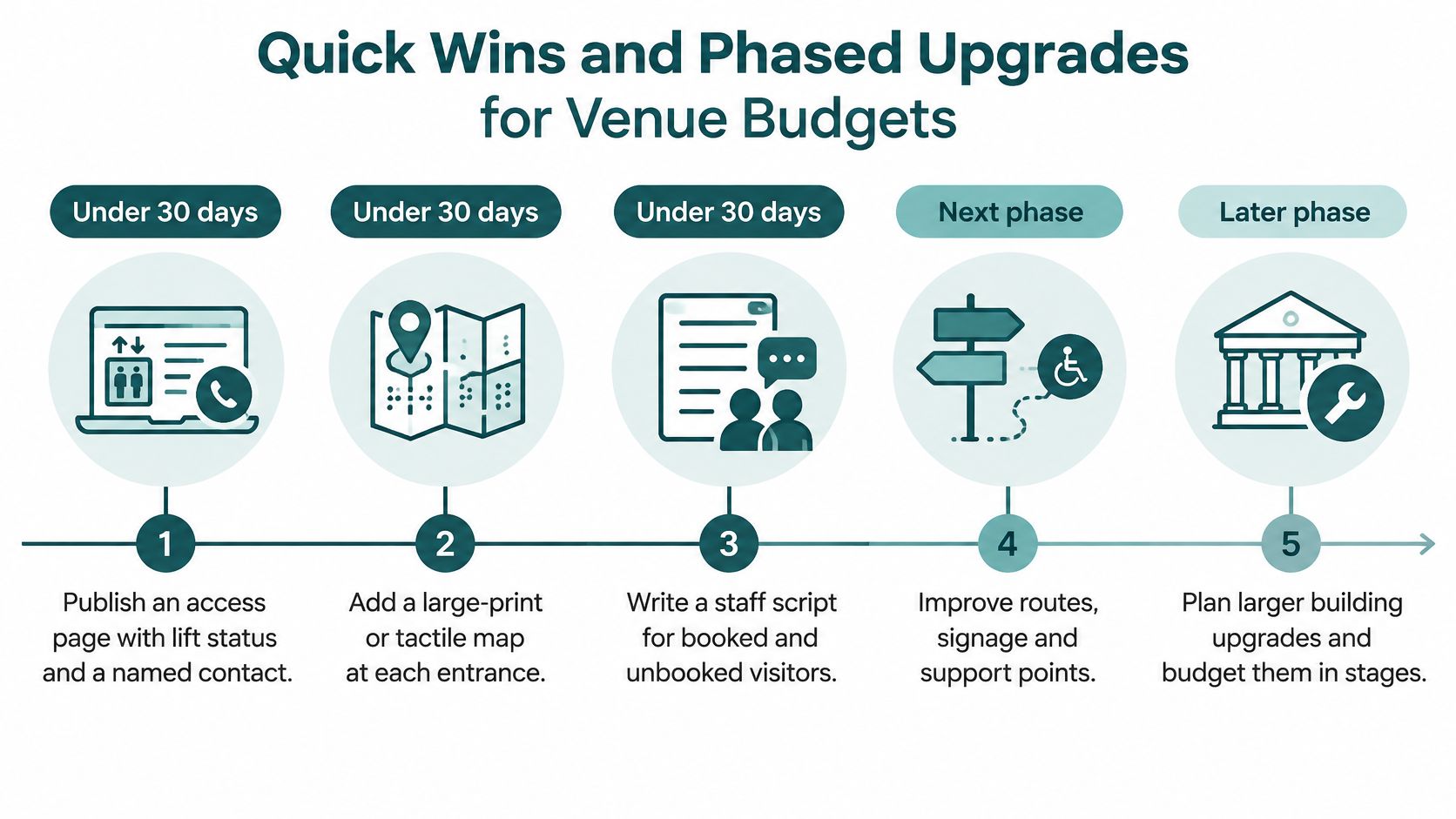
Start with fixes that remove failures without capital approval. I would sequence work by completion-rate impact, not by which department shouts loudest.
Under 30 Days
- Access page: Publish step-free entrances, lift status, accessible toilets and a named contact.
- Entrance maps: Add a large-print or tactile map at each main entrance.
- Staff script: Write one script for booked assistance, unbooked requests and lift closures.
- Diversion route: Set and sign a fixed alternative route for when a lift is closed.
These are cheap because they're mainly labour and print. They're also measurable. Retest the same route and see whether wrong turns, assistance failures and delays fall.
Three to Twelve Months
Run the full route audit and user testing in the next phase, then update information systems and staff training. Beyond twelve months, plan capital works such as entrances, lifts and layout changes, using your failure log to rank them. A lift that breaks the only step-free route outranks a cosmetic entrance upgrade every time.
When buying systems, ask suppliers for evidence of end-to-end journey testing, not only product features. Ask what must be installed, who maintains it, how route changes are handled, and whether it depends on your network. Weak answers become your operational problem after procurement.
Name the budget friction. Public-sector managers face approval cycles and capital spend restrictions that make new physical installations hard to justify. Retail operators need a revenue and dwell-time case that the venue must measure itself, not only a compliance case. Transport operators carry the burden of maintaining hardware across high-footfall, high-change environments.
Use accessibility best practices for phased venue upgrades to keep each phase tied to your completion rate. That figure makes the business case because it connects spend to finished visits, fewer failed arrivals and less staff time spent rescuing preventable problems.
Set Your First Disabled Access Audit This Quarter
Do one route well this quarter. Don't audit the whole estate badly.
- Choose one route: Pick the highest-volume origin-to-destination journey and run the audit.
- Log failures by code: Use the five codes, not general impressions such as “signage could improve”.
- Fix the best value item: Remove the most failures for the lowest cost first.
- Test before capital: Schedule disabled user testing before any major spend decision.
If you're considering an audio and on-screen wayfinding layer, test it on your own route rather than a vendor demonstration. At Lord's, step-free routing, guidance to accessible toilets, food and drink options, and wayfinding instructions in multiple languages are available to all users. At Bullring and Grand Central, users can travel between any two points within the estate, including stores, restaurants, restrooms, accessible entrances, accessible toilets and exits. Ask any vendor for named deployments, the constraint each addressed and the measured outcome, and publish only figures you can source.
Our system requires no ongoing infrastructure maintenance, no building access for hardware updates, and no dependency on the hospital's network in that deployment context. Test the claim that matters to your site, on your route, with your visitors.
Frequently Asked Questions About Disabled Access
Does the Equality Act 2010 Require Venues to Provide Disabled Access?
Yes. Service providers must take reasonable steps when a policy, practice, procedure or physical feature places a disabled person at a substantial disadvantage compared with a non-disabled person.
Is Accessible Information Covered by the Equality Act 2010?
Yes. Accessible information counts as an auxiliary aid, so the duty covers directions, instructions and service information as well as ramps, lifts and entrances.
What Is the Difference Between Disabled Access Compliance and Usable Access?
Compliance means an asset meets a design standard such as BS 8300 or BS EN 17210. Usable access means a disabled visitor can complete the whole route independently, including transfers, decisions and exit.
How Often Should a Venue Audit Disabled Access?
Run the route audit at least once a quarter, and again after any layout change, lift fault or major event that alters crowd flow.
What Should a Venue Publish About Disabled Access?
Publish the step-free route from the nearest station, current lift status, accessible toilet locations, assistance arrangements and a named contact. Update each channel when its trigger occurs, not on a vague annual cycle.
Can a Navigation App Replace Staff Assistance?
No. A navigation app shouldn't be the primary navigation solution for a disabled person. Signage, staff and the person's own aids, including a white cane or service dog, remain essential.
Run your first route audit this quarter, then test any navigation layer against that same route before you commit budget. Waymap provides infrastructure-free audio and on-screen guidance designed starting with blind and visually impaired users, with step-free routing and directions to doors, platforms, lifts and accessible toilets. Visit Waymap to discuss a test on your venue's real route and measure whether completion improves.
