
Disability Inclusion Roadmap: Policy to Measurement
16.7 million people in the UK were disabled in 2024-25, 25% of the population, according to the Family Resources Survey published by the Department for Work and Pensions. That is one in four, up from 12.9 million, or 20%, in 2014-15. Organisations that treat disability inclusion as a specialist workstream risk overlooking a substantial part of the population.
Published accessibility information does not prove that a disabled person can complete a journey independently. The practical test runs from the bus stop to the correct door and floor. A venue needs to check each stage in practice, assign an owner to fix failures, and keep evidence of the outcome.
A useful roadmap gives every stage a named owner, a first action and evidence that can withstand a board review, an audit or a change of director. Its measure is whether people can complete the journey independently, not whether the organisation has filed compliance paperwork. Tom Pey, Waymap's founder, is a former chief executive of the Royal Society for Blind Children and a former director at Guide Dogs.
Disability Inclusion Roadmap by Stage
Prevalence rises steeply with age. A single access standard applied uniformly across a national estate can therefore under-serve some sites and waste money at others. The roadmap below gives each stage a lead owner, a first action and evidence that another team can review.
| Stage | Lead owner | First action | Evidence to keep |
|---|---|---|---|
| Policy | Chief executive or board sponsor | Adopt a written policy covering reasonable adjustments and journey standards | Signed policy with a 12-month review date |
| Recruitment | HR director | Audit application, assessment, interview and onboarding steps for barriers | Audit log with dated fixes |
| Procurement | Finance and procurement lead | Add accessibility questions and evidence requirements to tenders | Supplier responses and testing evidence on file |
| Technology | Operations or estates director | Test wayfinding on three real journeys with disabled users | Journey results with failure points logged |
| Measurement | Insight or data lead | Define an independent-arrival metric and establish a baseline | Baseline and quarterly trend report |
| Culture | People director | Brief frontline staff on predictable assistance and route changes | Staff confidence survey results |
These stages overlap. Policy sets the mandate and budget; recruitment and procurement apply it to hiring and contracts. Technology and measurement test whether people can complete journeys independently, while staff practice helps sustain that work after project teams change.
Rule that ends most arguments: a stage is complete when its evidence is filed and someone outside the project team can review it.
The main failure points are often at the hand-offs. An estates manager may lack capital approval for fixed hardware; an HR director may own hiring but not the building; a procurement lead may have no test method for a supplier's accessibility claim. Assigning one lead owner to each stage makes those gaps visible before they become expensive to fix.
Start where the risk sits. A council can review its policy first because duties for services and public functions are anticipatory. A transit operator can begin with a journey walk to test conditions on the platform. An employer can audit the application process to find barriers for disabled candidates. For venues, include people with hearing loss in the assessment of assistive listening and visual alerts. US hearing loss statistics offer a comparison point, but the roadmap's measure is whether a disabled person can complete the whole journey independently, with an owner and evidence at every stage.
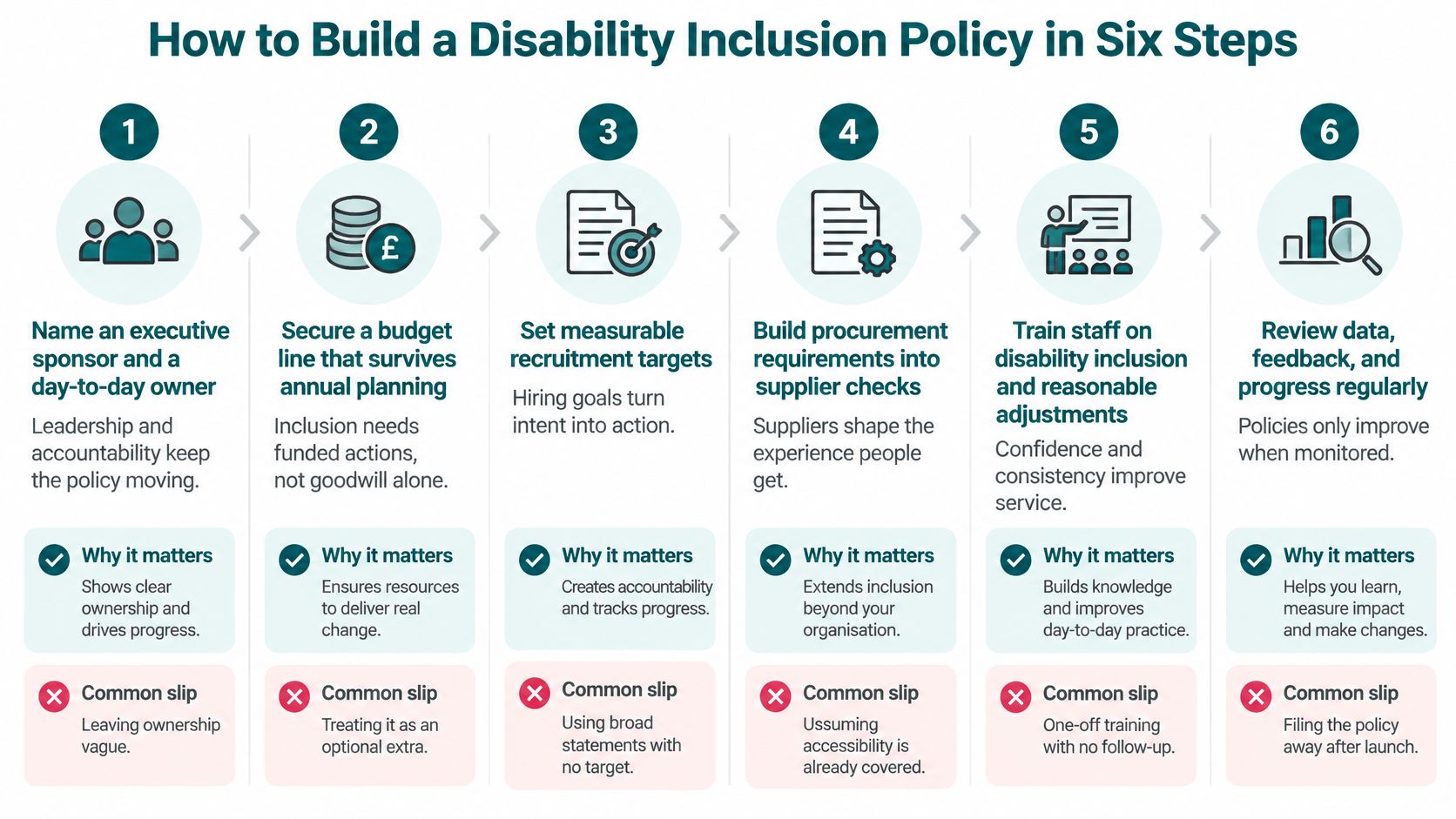
How to Build a Disability Inclusion Policy in Six Steps
Most policies fail for one of two reasons: nobody owns them, or nobody funds them. Six steps fix that, and each has a predictable slip worth watching for.
1. Name an executive sponsor, a day-to-day owner and a budget line. The sponsor clears blockers at director level; the owner runs the work weekly. A policy with no budget behind it becomes a document that gets cited in tenders and ignored in practice.
2. Map the legal duties before the first complaint. The Equality Act 2010 duty on employers to make reasonable adjustments applies where a provision, criterion or practice, a physical feature of premises, or the absence of an auxiliary aid places a disabled person at a substantial disadvantage. It covers employers and also services and public functions, and for public bodies it's anticipatory, so the policy has to exist before anyone hits the barrier. Reasonableness turns on cost, practicality and the organisation's resources, and the Act prescribes no single technical solution. The common slip is waiting for a case to force the issue.
3. Split access into four layers, not one. Government guidance on reasonable adjustments as a legal duty is explicit that physical changes such as lifts, wide doors, ramps and tactile signage are only part of it. Procedures and staff training may need to change so services work equally well for people with learning disabilities, and in health and adult social care the Accessible Information Standard makes readable, understandable information a legal requirement. A plan covering ramps and lifts alone misses the two layers that decide whether a visit works.
4. Consult disabled staff and users on the draft, then record what changed. Publish the list of amendments alongside the policy. The slip is a document written by the estates team with no disabled input, which reads well and fails the first real journey.
5. Agree who signs off changes to routes, signage and suppliers. At the Royal Hospital for Children and Young People in Edinburgh, Edinburgh Children's Hospital Charity initiated and funded the deployment while NHS Lothian provided institutional access, clinical leadership and senior sign-off. That split is the pattern worth copying: a funder with a clear mandate and a clinical owner with authority to approve.
6. Set a 12-month review date and publish a one-page summary. Nobody reads 40 pages, and everyone reads one. A policy that's never reviewed is the most common slip of all.
A visual version of the process, with the common slip next to each step, lands better in a leadership briefing than the full document.
Two obligations run in parallel here. The public sector equality duty sets the strategic frame for councils, NHS trusts and transport authorities, while reasonable adjustments set the individual duty. Another useful reference when your remit includes digital content is inclusive education for disabled learners from Queens Online School, where the same four-layer principle applies to learning materials rather than buildings.
What to Require in Recruitment and Procurement
The employment picture explains why hiring deserves its own stage. In July to September 2024, 10.44 million people aged 16-64 reported a disability, and 5.67 million of them were in work. That's a disability employment rate of 54.4% against 81.9% for people who aren't disabled, a gap of 27.5 percentage points, according to the government statistics on the employment of disabled people. The number of disabled people in employment rose by 350,000 year on year, and the gap persists anyway.
Legal commitment alone doesn't shift that. Operational barriers do, which is why recruitment needs auditing step by step rather than announced in a values statement.
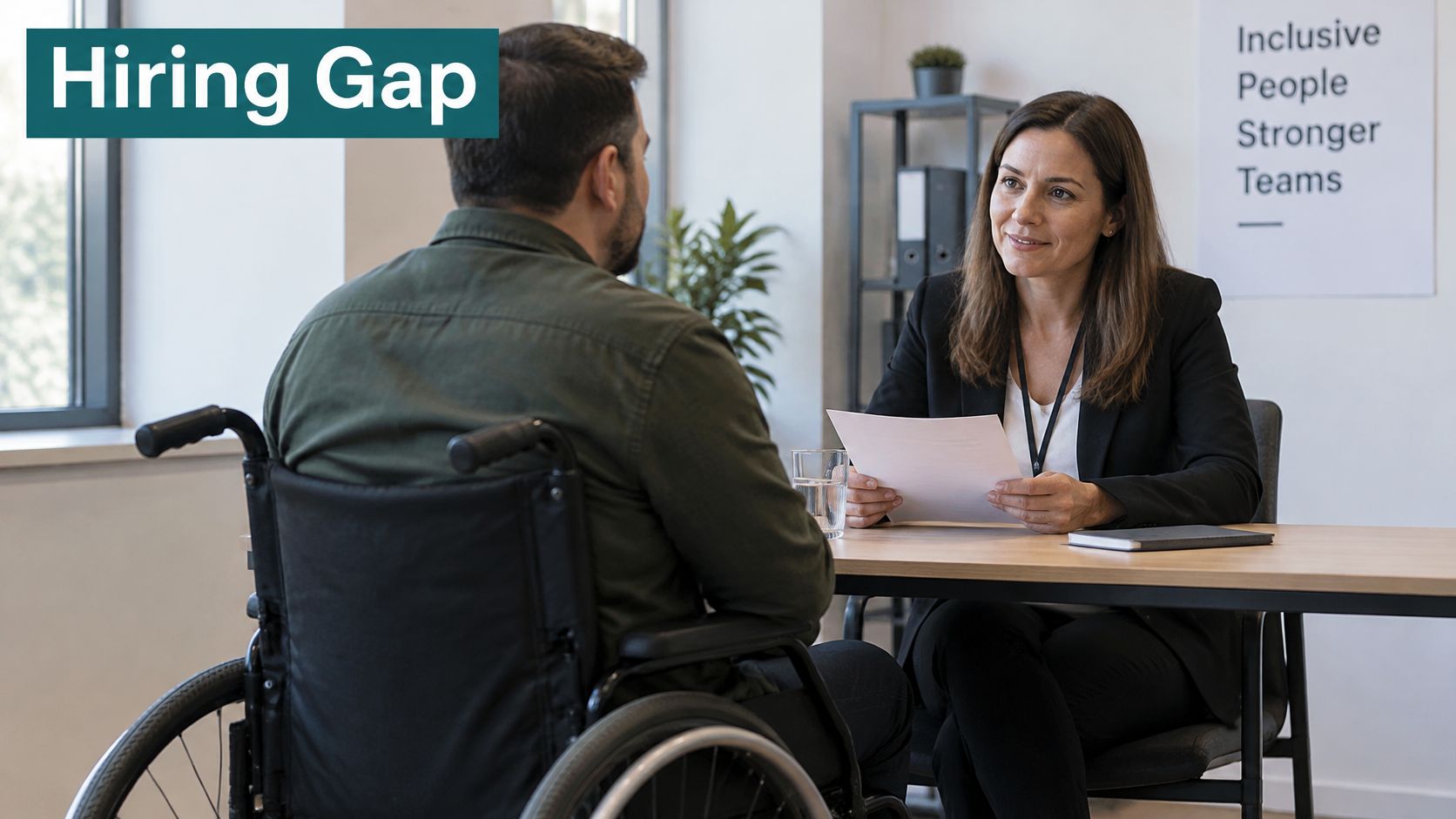
Recruitment checks that remove real barriers
- Application forms that work with a screen reader. Test them with NVDA or VoiceOver before the vacancy goes live. Untagged PDFs and image-based forms fail.
- Assessments with an alternative format agreed in advance. A timed online test with no alternative is a filter, not a test of ability.
- Interview venues with a step-free route from the main entrance. Confirm the route, the accessible toilet location and the meeting room, and put the description in the invitation.
- An adjustment question at the invitation stage, not after the offer. Asking early signals that adjustments are normal, and it removes the need for a candidate to disclose under pressure.
Clauses to add to tenders
Procurement is where accessibility commitments either become contractual or evaporate. Ask suppliers for evidence of testing with disabled users, not a statement of intent. Require accessible formats for documents and interfaces. Ask plainly whether the solution needs physical installation and who maintains it across high-change venues. Then require a commitment to update content when layouts change, with a named contact and a response time.
Cite the standards in the tender so responses are comparable. BS 8300 covers the design of buildings and their surroundings, BS EN 17210 covers accessibility of the built environment, and PAS 78 is the guide to commissioning accessible websites.
A supplier who can't show you a failed test hasn't run one.
Six questions to paste into a tender or a recruitment review, and to ask again at contract renewal:
- Which disabled users tested this, and what failed?
- Does the solution need hardware installed, and who replaces it when it breaks?
- What happens to the information when a route, lift or entrance changes?
- Are all documents and interfaces available in accessible formats on day one?
- Who is the named owner for accessibility in delivery and after handover?
- How will you report failures back to us each quarter?
Our public sector procurement guidance covers how to structure those questions so suppliers answer in comparable terms rather than in marketing language.
Where Waymap Fits in Accessible Wayfinding
In the 2025 Euan's Guide Access Survey, 47% of respondents struggled to find access information before leaving home, and 57% struggled to find it while out. The same survey found that 56% had difficulty getting around venues because of narrow corridors, poor layouts or missing lifts, according to Euan's Guide survey results. Published access information only helps if it matches the route a person can take.
These options differ in how quickly operators can update wayfinding when a venue changes.
| Option | Installation | Upkeep when layouts change | Suits high-change venues |
|---|---|---|---|
| Printed signage | Fixed boards and fittings | Reprint and reinstall after each change | Partly, static and slow to update |
| Bluetooth beacons | Hardware placed across the venue | Battery, hardware and mapping upkeep | Limited, needs installed infrastructure |
| Waymap | No installed hardware; uses smartphone motion sensors and maps | Update points of interest in the map layer | Yes, no installed hardware to maintain |
Waymap combines smartphone motion sensors with detailed maps to provide step-accurate guidance indoors, outdoors and underground, including in signal-poor environments. It does not rely on GPS, Wi-Fi or installed beacons. Operators can update points of interest in the map layer, such as when a help desk moves or a lift closes. Those updates still depend on someone at the venue keeping route information accurate.
Waymap was designed starting with users who are blind or have visual impairments. It also provides step-free routing for wheelchair users and pushchairs, guidance to accessible toilets, and food and drink options suited to users' needs, without a separate accessibility mode or special configuration. Accessible toilets are a practical test of whether wayfinding ends somewhere useful: the route must lead to a facility the visitor can access, not merely identify it on a map. Bathroom access planning for seniors addresses bathroom planning from a different perspective, but venue operators still need to check that toilet locations and routes are clearly represented.
At the Royal Hospital for Children and Young People in Edinburgh, a pre-deployment internal NHS Lothian survey of 100 families found that 4 in 10 needed help finding their way around the hospital. Confirmed by NHS Lothian, RHCYP is the first hospital in the world to deploy this category of personal navigation technology. A consultant there said the technology was designed with accessibility at its heart, not added on later.
Wayfinding technology supports a journey; it does not replace established mobility aids. Waymap's Terms advise users to keep relying on a white cane or service dog and to wear headphones that do not block out their surroundings. Venue teams should treat it as one part of accessible journey planning, not as a disabled person's primary navigation solution.
The Euan's Guide survey also found that 42% said they would avoid a venue if they could not find disabled-access information. For operators, the practical measure is whether a visitor can complete the whole journey independently, from arrival to the intended destination. Assign an owner to each stage, define the first action when a route fails, and record whether the person reached the destination without assistance. Waymap's accessible wayfinding guidance explains how indoor navigation can support that end-to-end approach.
Metrics That Prove Disability Inclusion Beyond Compliance
A journey counts as accessible only if the person can complete it independently, from the starting point to the intended destination. Track each one-way journey by stage, and define the main transport mode as the stage covering the greatest distance. The National Travel Survey uses this definition of disability: a physical or mental health condition expected to last at least 12 months that limits day-to-day activities, as set out in the disability, accessibility and Blue Badge statistics for England.
| Metric | Definition | Data method |
|---|---|---|
| Independent arrival rate | Share of journeys reaching the intended entrance, platform or point without staff help | Journey logs and anonymised intercept surveys |
| Stage failure rate | Share of journeys where a stage fails, recorded by stage | Stage-level journey logs |
| Assistance requests | Staff or assistance requests per visit or journey | Assisted-journey logs |
| Time to destination | Minutes from entry to the intended point, by user group | Timed journey walks and app data |
| Abandoned or rerouted journeys | Journeys ended or changed before arrival, with the reason | Structured staff reporting and short exit surveys |
| Confidence to travel alone | Share of users who feel confident completing the journey alone | Repeated anonymised survey |
Completed-trip analytics alone will flatter performance: they exclude people who avoid travelling and those who abandon a journey. Pair them with anonymised intercept surveys, assisted-journey logs and structured reports of abandoned trips. Record the reason and the stage where the journey failed, so the team responsible can act on the evidence.
Sampling warning: household surveys can miss people living in communal establishments, which may leave them underrepresented in accessibility estimates.
Compare trends carefully. Pre-2020 National Travel Survey results should not be compared directly with 2020–2022 or later results without checking changes in data collection and the effects of the pandemic. Mark any break in a three-year chart; otherwise, readers may mistake a change in measurement for a change in access.
Set targets against your own baseline. An external benchmark may describe a different building, footfall and population, while your quarter-on-quarter independent arrival rate shows whether a specific change improved the journey. Assign an owner to each stage, record the first action after a failure, and use the evidence to show whether it worked. The guide to accessibility compliance reporting explains how to present those measures as operational performance rather than a compliance annex.
Culture Change That Survives Staff Turnover
Attitudes are a physical barrier in everything but name. A 2025 National Centre for Accessible Transport study reported that 59% of disabled people experienced negative attitudes while travelling across transport modes, and it identifies those attitudes as a significant barrier, according to the Invisible Barriers report. Confidence is the casualty: the Euan's Guide survey found 50% of respondents lacked confidence visiting new places because of accessibility concerns, only 13% felt confident, and 60% said access problems affected their independence and autonomy.
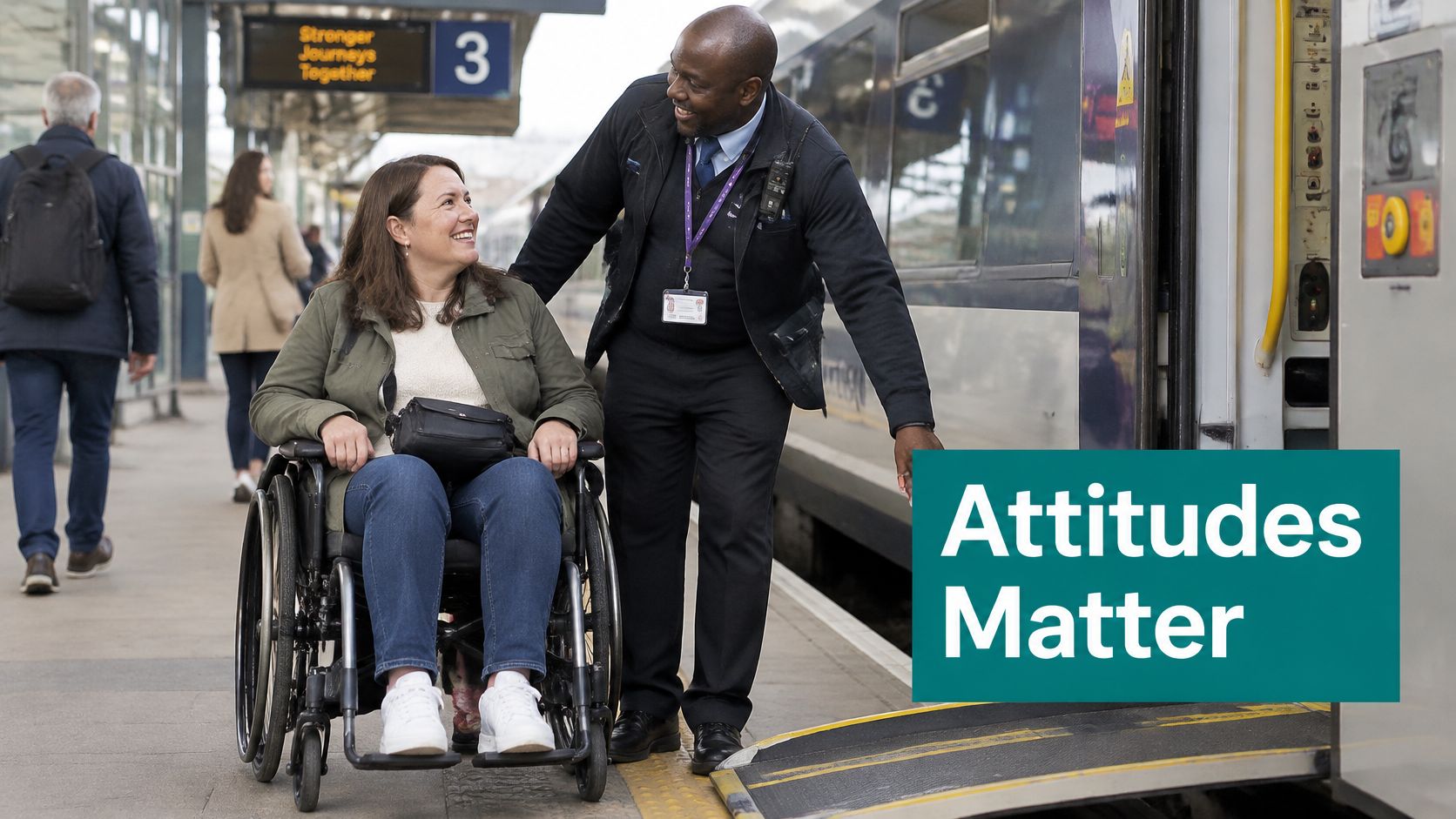
A technically accessible station can still be functionally exclusionary when nobody can predict whether the lift, the signage or the assistance will work on the day. Four practices survive rota churn better than a training day.
- Write short scripts for frontline staff on offering assistance without taking over: ask, wait for the answer, follow the instruction, don't grab the wheelchair or the arm.
- Brief staff after every rota change and every layout change. A five-minute handover beats an annual e-learning module nobody remembers.
- Publish a fallback route for when a lift or entrance is closed, and put it where people look, which is the app and the platform, not the intranet.
- Walk each route with disabled staff and users after changes. They'll find the failure in ten minutes that a facilities inspection missed for a year.
Predictability is part of accessibility, and it can be measured.
Track the effect with the confidence-to-travel-alone measure rather than a training completion rate. Staff who've been briefed, tested on a real route and given a fallback will produce a rising confidence score. Staff who've watched a video will produce a certificate. Our staff training requirements note sets out what to cover in the briefing itself.
Book a Journey Audit Before Your Next Budget Round
You don't need a capital budget to start. You need three journeys, walked with disabled colleagues or paid users, and a log. Do it before the next budget round so the ask arrives with evidence attached.
Pick the three journeys that matter most in your venue: from the transport interchange to the platform, from the main entrance to the accessible toilet, and from the entrance to the staff help point. Walk each one, log every stage that fails, note where the person had to ask for help, and record the time taken.
Then compare the results against the baseline you set for independent arrival. Choose one fix that changes the stage with the highest failure rate, name an owner, set a date, and report the outcome to the board as a movement in independent arrival rate rather than a list of completed works.
Two options worth testing on the same three journeys are our accessible navigation for people who are visually impaired and our step-free routing for wheelchair users and pushchairs. Test them as aids alongside existing mobility aids, not as replacements.
Frequently Asked Questions About Disability Inclusion
Does Waymap replace mobility aids?
No. Waymap isn't a primary navigation solution for a disabled person, and users should keep their white cane, service dog or other aids while using it.
Does the Equality Act 2010 apply to a private venue?
Yes. The reasonable-adjustment duty covers services and public functions, so a private venue providing a service to the public is caught, not just employers.
What is the reasonable-adjustment duty?
It's the duty under the Equality Act 2010 to adjust a provision, criterion or practice, a physical feature of premises, or the absence of an auxiliary aid that places a disabled person at a substantial disadvantage. Cost, practicality and resources determine what's reasonable.
Does a journey audit need a full budget?
No. Three walked journeys and a written log are enough to start, and they produce better evidence than a consultant's report.
What does the disability employment gap measure?
It measures the difference in employment rates between disabled and non-disabled people. In July to September 2024 the disability employment rate was 54.4% against 81.9% for non-disabled people, a gap of 27.5 percentage points.
How does the National Travel Survey define disability?
It uses a physical or mental health condition expected to last at least 12 months that limits day-to-day activities. That's the definition to adopt if you want your transport metrics to be comparable.
Why should pre-2020 National Travel Survey results not be compared directly with later results?
Because data-collection changes and pandemic-related reductions affect trend comparability, so the methodology has to be checked before any trend claim is made.
If you want to test the measurement half of this roadmap without a capital project, Waymap gives you a wayfinding layer that works indoors, outdoors and underground with no beacons, no Wi-Fi and no GPS, so the three journeys you audit this quarter can be walked with guidance that updates when your venue does. We built it with blind and low-vision users first, then extended it to step-free routing, accessible toilets and multi-language instructions for everyone else who needs to arrive at the right door. Start with a journey audit, then visit Waymap to see how the independent arrival rate gets measured in practice.
