
Digital Accessibility Standards: A Complete Guide
Digital accessibility standards such as WCAG define technical compliance for digital interfaces, but real-world accessibility in venues and transit requires covering the full end-to-end journey from planning to arrival. In the UK, public-sector digital services use WCAG Level A and AA as the operative benchmark, yet an accessible app alone can't guarantee an accessible route to a platform, doorway, classroom, or seat.
A passenger may plan a journey in a keyboard-accessible app, receive clear information about a station, and still arrive to find a closed entrance, an unmarked level change, or no reliable directions from the concourse to the correct platform. A venue visitor may book an accessible seat online but struggle to locate the right entrance once inside. For operators, the difficult question isn't just whether the website passes an audit. It's whether a person can complete the journey independently, with confidence, when conditions change.
Why Digital Accessibility Standards Are Not Enough
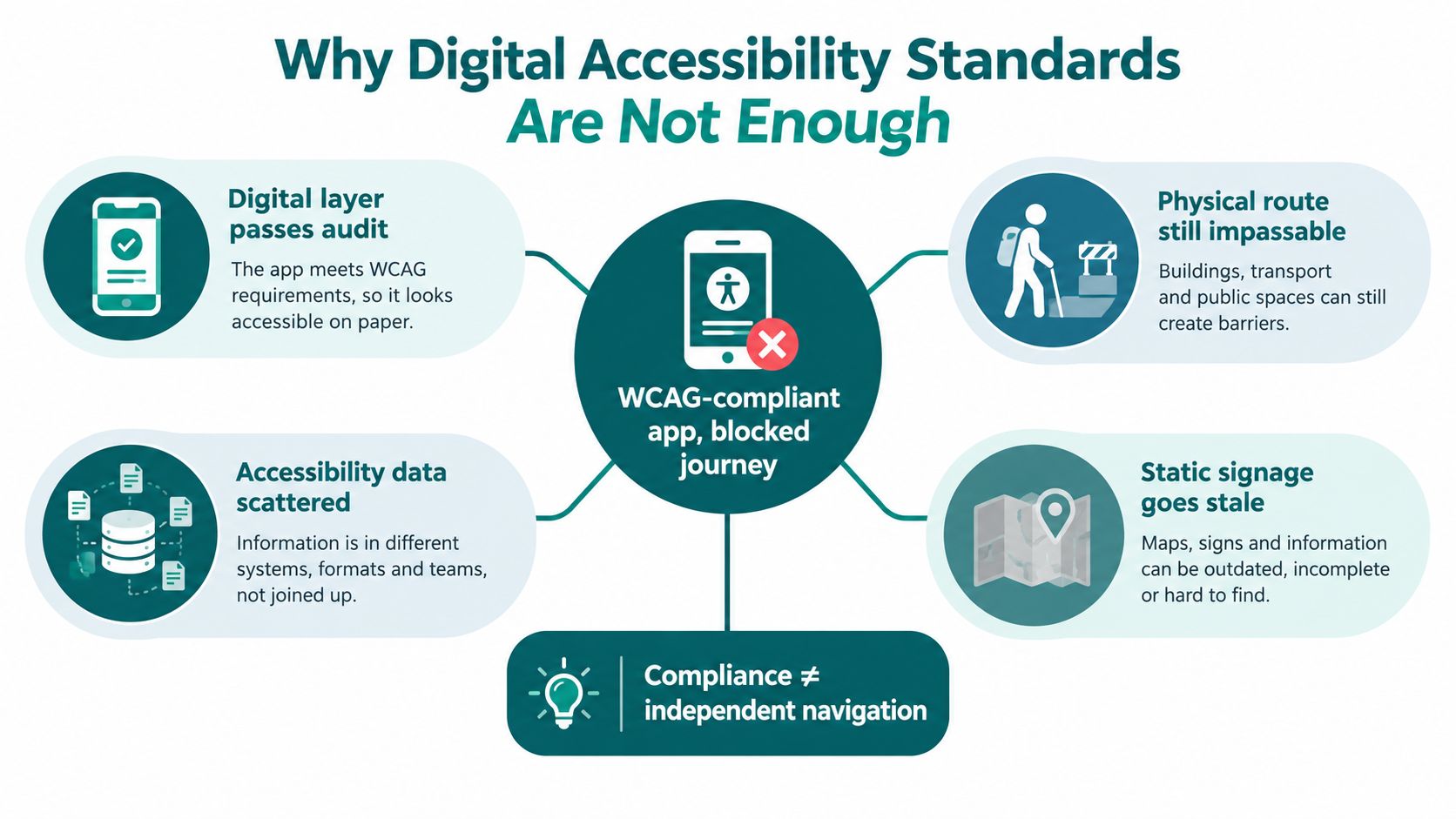
WCAG governs digital content and functionality. It addresses whether information can be perceived, whether controls can be operated, whether instructions are understandable, and whether content works with assistive technologies. It doesn't, by itself, verify that a passenger can move from a station entrance to a platform or that a visitor can find a particular door in a large venue.
That distinction matters because accessibility information often breaks down between the digital and physical layers. The National Centre for Accessible Transport found, in a survey of more than 1,200 disabled people, that 23% said vehicle information was unavailable or inaccessible, while 21% reported limited accessibility information when planning journeys. The report identified fragmented transport data and called for information that is more reliable, standardised, and real time. Read the National Centre for Accessible Transport's report on transport accessibility data.
The journey is the real service
For a transport operator, accessibility includes journey planning, arrival, ticketing, transfers, platform access, disruption handling, and finding the final destination. For a university or hospital, it may include the route from a gate or car park through several buildings. For a stadium or shopping centre, it includes entrances, lifts, facilities, seating, and temporary changes.
Practical rule: Treat accessibility as a journey outcome, not a collection of compliant screens.
Useful measures therefore extend beyond conformance results. Operators should examine task completion, route confidence, assistance requests, missed connections, time to destination, and accessibility incidents. These measures don't replace a WCAG audit. They show whether the audited service works when connected to the built environment and live operations.
Understanding WCAG Levels and Principles
WCAG gives teams a shared baseline for digital accessibility, but in practice it only helps if you apply it to the whole service people use. In stations, hospitals, campuses, and venues, that means checking more than a homepage or app shell. It means examining the map, the route controls, the booking steps, the alerts, and the moments where someone has to act under time pressure.
WCAG is built on four principles. Content and services must be perceivable, operable, understandable, and reliable. These principles apply across websites, mobile applications, documents, maps, booking flows, and dynamic content.
- Perceivable: People must be able to get the information through available senses. Text alternatives, captions, readable layouts, and sufficient colour contrast all sit here.
- Operable: Controls and navigation must work with the input methods people commonly use. Keyboard access, touch interaction, focus order, and alternatives to complex gestures matter.
- Understandable: Labels, instructions, navigation, and error handling need to be clear and predictable.
- Resilient: Content must work with a range of browsers, devices, user agents, and assistive technologies.
Conformance is cumulative. Level A is the starting point. Level AA includes all applicable Level A and Level AA success criteria. Level AAA includes all applicable criteria at A, AA, and AAA. Passing a batch of automated checks is not enough. Teams still need to assess the relevant criteria across the content and functions in scope, as set out in The W3C WCAG 2.2 specification.
What teams should test
WCAG 2.2 added six additional success criteria compared with WCAG 2.1. A practical test plan covers keyboard use, screen readers, zoom and reflow, contrast, touch input, reduced motion, authentication, search, maps, booking, payment, alerts, and error recovery.
Some AA requirements are very specific, which is why they are useful in delivery. Normal text requires a minimum 4.5:1 contrast ratio, and functions that rely on multipoint or path-based gestures must also work with a single pointer unless the gesture is essential. I have seen teams pass a digital audit and still miss the user outcome because the route map, wayfinding controls, or disruption messages broke down at the point of travel. That is why WCAG accessibility standards for digital wayfinding matter in operational settings.
For large estates, Procright automated mapping can help connect requirements, evidence, and ownership.
How US, UK, and EU Regulations Compare
Accessibility law differs by jurisdiction, but the operational message is consistent. A venue or transport operator needs to understand both the digital service and the physical experience, then assign ownership for evidence, remediation, procurement, and feedback.
In the UK, the Public Sector Bodies (Websites and Mobile Applications) (No. 2) Accessibility Regulations 2018 came into force on 23 September 2018. They apply to public-sector websites and mobile applications, use the four WCAG principles, and establish Level A and AA success criteria as the basis for meeting the accessibility requirement. Covered bodies must publish an accessibility statement and keep it under regular review. The timetable required new websites published from 23 September 2018 to comply by 22 September 2019, existing websites by 23 September 2020, and mobile applications by 23 June 2021. See the UK Government's accessibility requirements for public-sector websites and apps.
The Equality Act 2010 sits alongside those regulations and requires service providers to make reasonable adjustments for disabled people. That is relevant to transport users, venue visitors, students, employees, and citizens, including people using services operated by organisations such as Transport for London.
| Jurisdiction | Key Regulation | Scope | Enforcement |
|---|---|---|---|
| United Kingdom | Equality Act 2010 and Public Sector Bodies Regulations | Reasonable adjustments across services, plus public-sector websites and apps | Legal duties, accessibility statements, monitoring, and public accountability |
| United States | ADA Title III and Section 508 | Accessible services and facilities under the ADA, with Section 508 applying to covered federal technology | Litigation, procurement requirements, and federal compliance processes |
| European Union | National accessibility duties supported by standards such as EN 17210 | Accessible built environments and related service delivery | National enforcement, procurement, and contractual obligations |
The Americans with Disabilities Act Title III is central for covered private venues and services in the US, while Section 508 governs accessibility requirements for covered federal information and communication technology. In the EU, EN 17210 addresses accessibility and usability of the built environment, giving project teams a practical reference for inclusive physical design.
Regulations define duties. Operators still need a working system for routes, data, testing, updates, and user feedback.
Procurement teams should record which obligation applies to each service, facility, supplier, and technology component. Applied's regulatory guide offers useful context for organising regulatory requirements. Waymap also discusses the relationship between 508 compliance testing and practical digital service review.
The Compliance Gap in Physical Navigation
A website can meet WCAG while the journey around a building remains inaccessible. This happens when operators treat accessibility data as a content field rather than an operational asset. A lift may be listed but unavailable, a temporary entrance may not appear in the journey planner, or a map may identify a building without guiding someone to the exact door.
Static signage has a similar limitation. It can't respond to a platform closure, a diverted entrance, a changed retail layout, or a temporary event barrier. Staff can provide assistance, but a service that depends on a person being available at every decision point doesn't provide the same independence as reliable route guidance.

Why infrastructure changes the decision
Beacon-based navigation can add useful location signals, but installed hardware creates a maintenance obligation. Transport operators and venue managers must track device condition, battery replacement, coverage, interference, procurement, and changes to the physical environment. That burden becomes particularly difficult in high-footfall locations with frequent construction, tenant changes, or temporary event layouts.
Infrastructure-free wayfinding addresses a different operational requirement. Waymap uses dead reckoning with device-native smartphone sensors, detailed maps, and movement data rather than GPS, Wi-Fi, or installed hardware. Its stated capability includes sub-3-metre accuracy in infrastructure-free environments, and it doesn't require pre-mapping for venues where staff turnover or layout changes make fixed infrastructure difficult to manage.
The value isn't that one technology removes every accessibility problem. It is that an updateable navigation layer can connect digital compliance with the physical route, provided operators maintain accurate maps, test real journeys, and involve disabled users in validation.
Real Deployments That Bridge the Gap
Wayfinding problems vary by environment. A metro network has transfers and service disruptions. A hospital has unfamiliar corridors and sensitive destinations. A shopping centre has changing tenants and multiple access points. A navigation service must reflect those operational conditions rather than treating every location as a static floor plan.
The Waymap deployment portfolio includes WMATA, SBS Transit, the Royal Hospital for Children and Young People, and Westfield London. These named environments illustrate why infrastructure-free navigation is relevant to public transport, healthcare estates, paediatric settings, and retail.
Different sites, similar operational pressure
For WMATA, a large metro network, the practical problem is helping blind and disabled passengers move through complex stations and transfers without requiring a fixed hardware layer at every decision point. SBS Transit demonstrates the same issue across Singapore's rail and bus systems, where information must connect different transport modes and remain useful as operations change.
At the Royal Hospital for Children and Young People, navigation has to account for a setting where families may be unfamiliar with the site, destinations can be difficult to identify, and a route may involve more than a single public entrance. Westfield London adds the retail challenge: tenants, entrances, facilities, and internal routes can change, so a static directory doesn't provide a dependable end-to-end experience.
Waymap's documented capabilities include heads-up, hands-free audio instructions, stride-adaptive guidance, multilingual directions, and instant map updates. Those capabilities address different failure points, but deployment outcomes still depend on operator governance. A route database needs an owner, changes need a process, and customer feedback needs to reach the people who can correct a map or instruction.
The Waymap digital accessibility solutions overview provides further detail on how the platform is positioned for venues and transport environments.
These deployments also show why infrastructure-free wayfinding can support duties under the Equality Act 2010 and broader accessibility or ESG programmes. It doesn't replace accessible architecture, trained staff, clear information, or compliant digital interfaces. It can provide an updateable layer that helps people move through the environment those measures are intended to make usable.
Turning Standards Into Operational Advantage
Accessibility work becomes more effective when operators connect requirements to service performance. A compliant interface is necessary, but the operational advantage comes from reducing avoidable friction for visitors, passengers, staff, and families.
Waymap can provide heads-up audio instructions, stride-adaptive navigation, multilingual guidance, and map updates that operators can amend as locations change. In practice, these capabilities should be tied to measures such as assistance requests, visitor satisfaction, route confidence, time to destination, and accessibility incidents. The point isn't to claim that a navigation tool automatically improves every measure. The point is to create evidence that operators can monitor after launch.
Map standards to ownership
BS 8300 provides guidance relevant to accessible buildings and the built environment. PAS 78 addresses the commissioning and management of accessible websites, while the UN Convention on the Rights of Persons with Disabilities establishes a broader rights-based context for participation and access. These instruments don't turn a navigation platform into proof of compliance. They help organisations define the experience they need to deliver and the responsibilities they must assign.
A practical governance model gives separate owners responsibility for:
- Procurement: Require accessibility evidence, testing scope, update responsibilities, and support arrangements in supplier contracts.
- Content and mapping: Assign ownership for doors, platforms, lifts, facilities, temporary closures, and points of interest.
- Operations: Connect incidents and service changes to route updates.
- User validation: Test with disabled people and record how feedback changes the service.
- Reporting: Distinguish technical conformance from journey outcomes.
The Waymap accessibility compliance report is relevant to teams building that evidence trail. A report is useful only when it reflects current functionality, known limitations, testing methods, and the actions an operator has taken.
Roadmap for Venue and Transit Operators
A passenger arrives at a station with an accessible app, a valid ticket, and no clear way to find the lift, judge whether the route is open, or confirm the right platform edge. That is the operational gap teams need to close. A roadmap works when it starts with the actual journey, not with procurement.
Audit the existing journey. Review the website, app, booking flow, signs, maps, staff instructions, entrances, interchanges, lifts, platforms, and final destinations as one service. Test with keyboard users, screen reader users, people who zoom or reflow content, and people with different mobility and sensory needs. In practice, operators usually find the break between digital compliance and physical independence.
Map gaps by severity. Separate a missing label from a blocked route, inaccurate lift status, or a destination that cannot be identified on arrival. Record the location, affected users, operational owner, frequency, and available workaround. Teams that need a practical benchmark can use this accessibility requirements checklist to distinguish a content defect from a journey-critical failure.
Prioritise interventions by impact. Start with entrances, transfers, platforms, decision points, and routes where people still rely on staff assistance. Include temporary changes. A correct permanent map still fails the user if works, closures, or disruption are not reflected quickly enough.
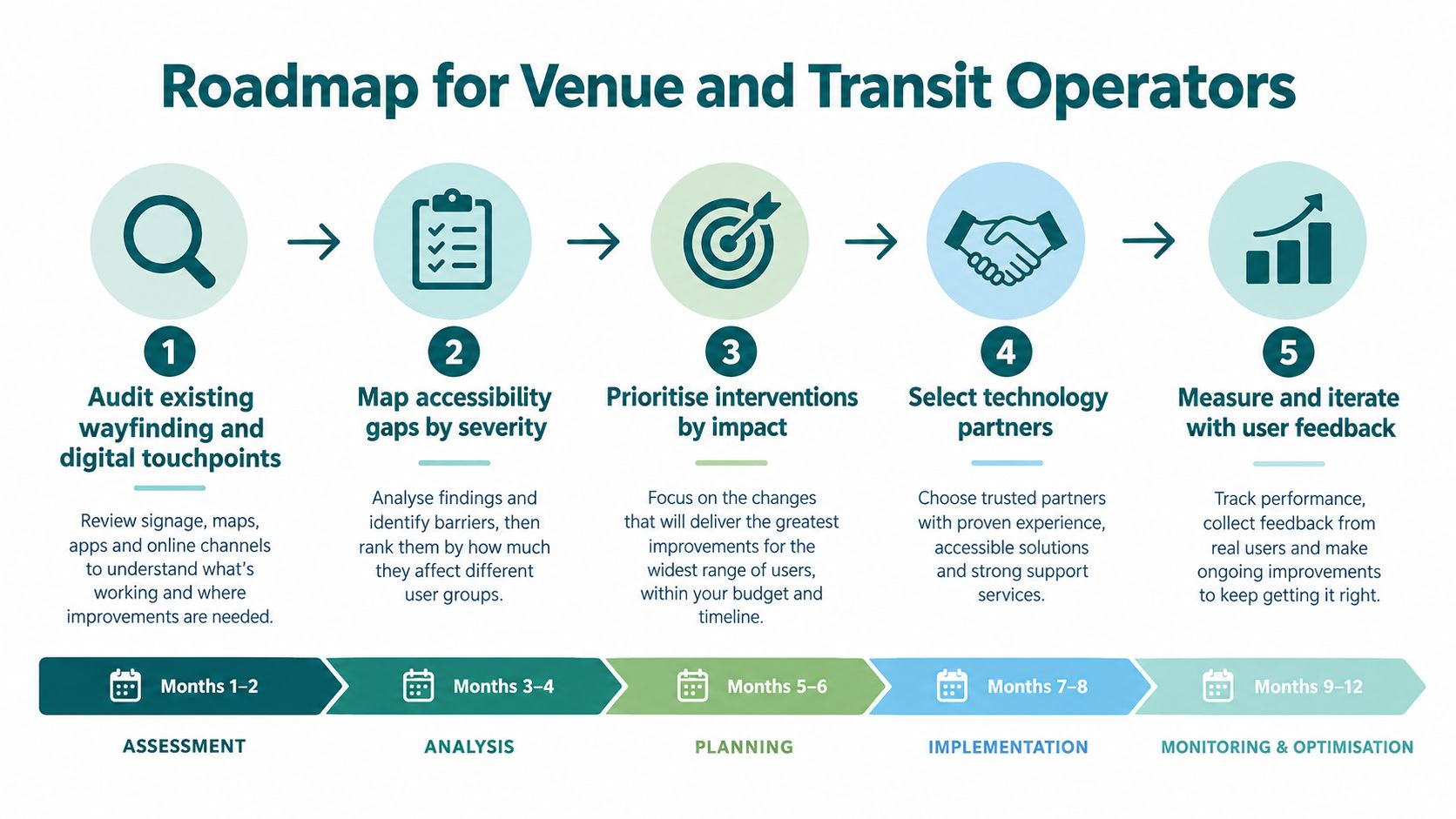
Select technology partners carefully. Compare infrastructure-free and beacon-based approaches, but do not stop at feature lists. Check map update workflows, sensor performance, audio guidance, language support, integration options, accessibility testing, and supplier accountability. Ask who maintains route data after launch, how temporary changes are published, and what happens when operations teams are under pressure.
Measure and iterate. Combine WCAG evidence with task completion, route confidence, assistance requests, time to destination, missed connections, and incident records. Review results with disabled users, then feed corrections back into mapping and operations.
The governance piece matters just as much. Public-sector teams should maintain a versioned accessibility statement, document known exceptions, provide a feedback mechanism, and test the full journey. The UK Government's accessibility requirements guidance confirms that WCAG 2.2 is used for monitoring from October 2024 onward.
A capital project should lock in accessibility data ownership and update processes before construction finishes. Otherwise, the organisation can inherit an accessible building without a dependable way to explain how people use it.
Frequently Asked Questions About Accessibility Standards
What are digital accessibility standards?
Digital accessibility standards define requirements for making websites, apps, documents, and digital services usable by people with disabilities. WCAG uses the principles of perceivable, operable, understandable, and reliable content, with Level A, AA, and AAA conformance levels. Digital compliance doesn't prove that a person can move through the connected physical environment independently.
Is WCAG Level AA legally required in the UK?
WCAG Level A and AA are the operative legal benchmark for UK public-sector websites and mobile applications under the Public Sector Bodies Accessibility Regulations. Covered bodies must also publish and regularly review an accessibility statement. The Equality Act 2010 sits alongside those regulations and requires service providers to make reasonable adjustments for disabled people.
How can an operator prove accessibility in practice?
An operator should combine conformance evidence with user-centred outcome evidence. Keep the audit scope, test methods, versioned accessibility statement, known exceptions, feedback records, and remediation decisions. Add journey measures such as task completion, route confidence, assistance requests, time to destination, missed connections, and accessibility incidents.
Are accessibility exceptions a blanket waiver?
No, an exception applies to specific content or requirements and needs documented evidence. GOV.UK guidance recognises that valid legal reasons may exist for not meeting particular standards, and some content, including certain pre-recorded audio and video published before 23 September 2020, can fall within specified exemptions. Organisations should record the exact content, legal basis, and evidence rather than treating an exemption as permission for an entire website, app, or service. See the UK guidance on monitoring public-sector accessibility.
Should operators choose beacons or infrastructure-free wayfinding?
The right choice depends on the site, accuracy needs, maintenance model, and update frequency. Beacons can provide installed signals but require hardware management across the environment. Infrastructure-free systems use device-native sensors and mapped routes, which can reduce physical maintenance, but operators still need accurate mapping, testing, operational ownership, and feedback loops.
Waymap provides infrastructure-free, indoor, outdoor, and underground navigation to exact doors, platforms, and points of interest using smartphone motion sensors and detailed maps. Visit Waymap to discuss how an updateable wayfinding layer can connect digital accessibility standards with the complete journey.
