
How to Create Theme Park: UK Playbook for 2026
If you're trying to create a theme park, you're probably balancing three pressures at once. The concept has to excite investors, the site has to work operationally, and the finished park has to serve real guests rather than a pitch deck. That's where many projects go wrong. They chase spectacle early, then discover too late that circulation, compliance, and operating model were never properly resolved.
At Waymap, we look at large venues through the lens of movement, access, and operational reality. A theme park isn't just a collection of rides. It's a controlled environment where guest flow, service design, accessibility, maintenance access, retail placement, digital wayfinding, and capital discipline all have to align from the start.
Is Your Theme Park Concept Commercially Viable?
A strong theme park concept starts with an uncomfortable question. Why should this park exist, and why would guests choose it over every other leisure option in the region?
In UK practice, serious projects begin with a feasibility report before design is allowed to harden. The reason is simple. Designers need to test economics and market potential before they start locking in a layout, and they need demographic and psychographic insight before they turn a concept into a creative strategy, as outlined in Katapult's theme park design process.
What investors will ask first
Investors rarely start by asking whether the park looks impressive. They ask whether the park can sustain itself through seasonality, staffing demands, maintenance cycles, and changing guest expectations.
A useful early business case should answer:
- Who the park is for. Families, thrill-seekers, school groups, destination tourists, local repeat visitors, or mixed audiences.
- What the park offers that nearby attractions do not. If the concept can be substituted by an existing waterpark, zoo, retail-led leisure scheme, or established operator such as Alton Towers or Thorpe Park, the case is weak.
- How money enters the business. Ticketing is only one line. Food and beverage, merchandise, premium access, events, accommodation, and sponsorship can all matter depending on the model.
- What operating pressure points exist. Labour, utilities, guest transport, weather resilience, queue management, cleaning, security, and ride downtime all affect viability.
Practical rule: If your commercial case depends on perfect weather, peak attendance every weekend, or guests spending heavily without queue frustration, the model is too fragile.
What a credible feasibility study should include
A real feasibility study is part market analysis, part operational stress test. It should examine catchment, likely trip purpose, travel time tolerance, local competition, planning constraints, and the type of experience the market will support.
It also needs a cost spine. Early-stage teams often underestimate soft costs, technical coordination, utilities, access roads, drainage, staff facilities, and the price of changing their minds after design packages are issued. That's why quantity and estimating discipline should sit alongside concept development. Tools such as Exayard construction estimating software can help teams structure cost assumptions before the project drifts into wishful budgeting.
Revenue works differently in a park than in a brochure
The best commercial concepts aren't always the ones with the biggest headline ride. They're the ones that convert movement into spend without making guests feel managed.
That means asking practical questions:
| Decision area | What works | What usually fails |
|---|---|---|
| Ticketing mix | Clear entry proposition with optional premium layers | Complicated pricing that confuses families |
| Food and beverage | Positioned where dwell time naturally occurs | Treating dining as an afterthought |
| Retail | Tied to story, exit moments, and emotional peaks | Shops placed only where rent looks attractive |
| Repeat visits | Seasonal programming and fresh reasons to return | One-time spectacle with little rediscovery value |
Wayfinding also has a commercial role here. Better navigation changes how guests discover secondary spend locations and whether they reach them in time to buy. That's why footfall strategy matters beyond retail-only environments, and the same logic applies in leisure destinations, as discussed in Waymap's piece on footfall in retail.
Define the park's actual proposition
Many failed concepts are broad when they should be sharp. “A family entertainment destination with immersive experiences” says almost nothing. A viable proposition identifies its audience, emotional territory, and operating model in one move.
A park can be:
- Narrative-led, where story and environment drive dwell time.
- Ride-led, where mechanical attractions dominate demand.
- Hybrid, where one anchor ride system supports a wider placemaking strategy.
- Resort-linked, where the park supports longer stays and bundled spend.
The mistake is trying to be all four from day one. Create the commercial logic first. Then let the creative team build inside it.
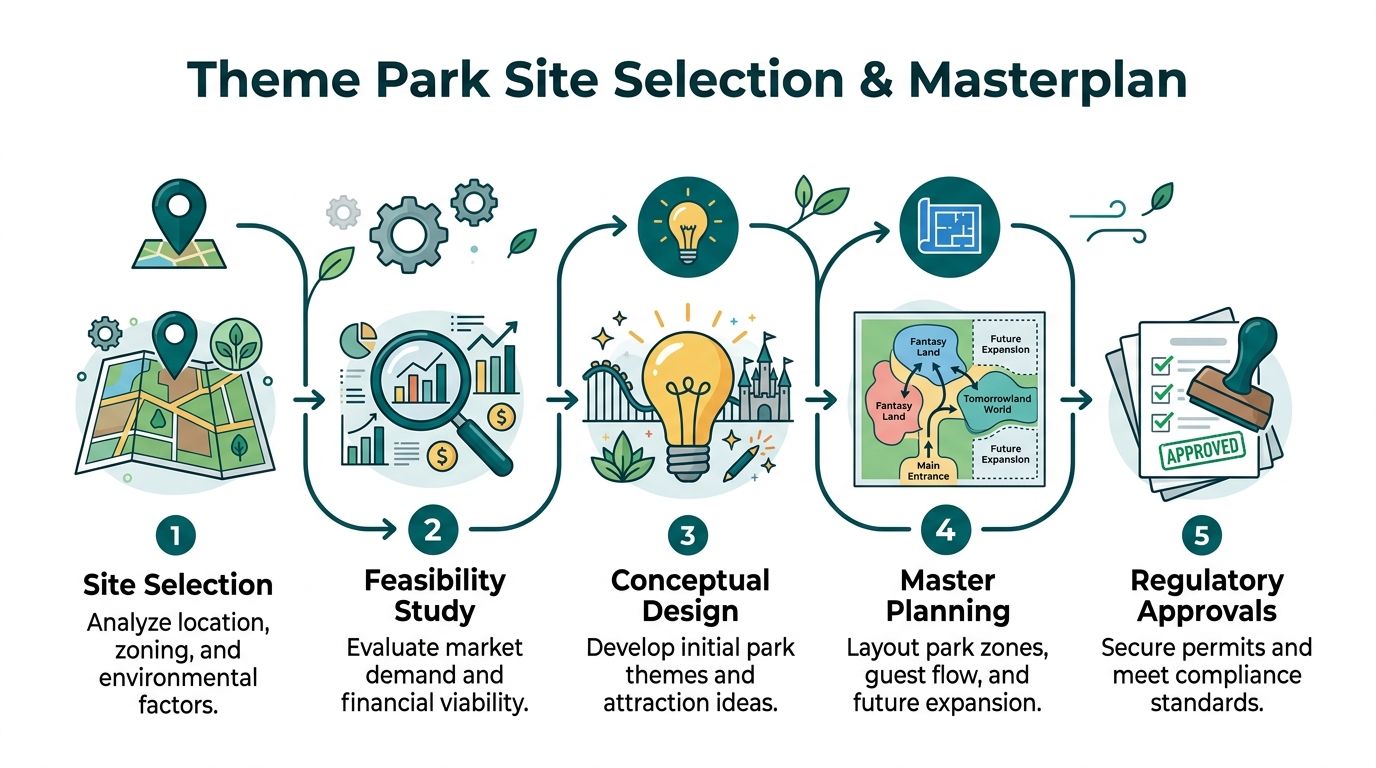
How to Select a Site and Develop the Masterplan
A project can clear concept approval, secure investor interest, and still become expensive to operate because the wrong site was chosen. I have seen parks inherit avoidable problems before a single ride package is tendered. Coach access conflicts with guest drop-off. Utility upgrades consume contingency. Accessible routes get forced into steep, indirect paths because the landform was never tested properly at concept stage.
Site selection sets the operating model. It affects transport demand, drainage strategy, service yards, noise exposure, staffing access, emergency response times, and how comfortably guests can move across the park during peak periods. It also determines how much flexibility you have in phase two and phase three, when capital is tighter and the business needs new capacity without major rework.
What to assess before you buy or lease a site
A site pack can make almost any parcel look workable. The real test is whether it can support daily operations, planning approval, and future expansion at a cost the business can carry.
Assess five areas early:
Arrival and dispersal
Separate guest arrivals, coaches, staff access, service traffic, and emergency routes from the start. If they cross each other in the first draft, they will keep causing problems in operation.Planning and environmental constraints
Local authority priorities, visual impact, flood risk, ecology, and noise restrictions can reshape the brief or slow approvals. These are budget and programme issues, not paperwork to leave for later.Catchment and transport reality
A site needs more than theoretical population nearby. It needs reliable road access, public transport options, and a journey profile that matches the park's price point and target dwell time.Serviceability
Waste handling, plant access, maintenance compounds, deliveries, and ride evacuation routes require space that guests never see but operations depend on every day.Expansion capacity
Growth should fit the land without tearing up core circulation, replacing utilities, or reducing guest comfort in the process.
Accessibility belongs in this first filter, not in a later compliance review. If gradients, surface conditions, crossing points, transport links, and arrival sequences do not work for wheelchair users, older guests, families with prams, and visitors with low vision, the site carries a commercial penalty from day one. Poor access reduces length of stay, secondary spend, and return intent. It also raises staffing pressure because guests need more assistance to do basic things.
Why the masterplan carries the real commercial risk
Concept art helps sell a vision. The masterplan determines whether the park can trade well.
A strong masterplan controls circulation, queue placement, sightlines, food and beverage timing, toilet access, parade routes, service roads, utilities, and phased development. It also decides whether inclusive design is built into the guest journey or patched in after approvals, when every correction costs more.
The trade-off is simple. Early planning work feels slow and expensive when teams want visible progress. Late changes cost more, trigger redesign fees, create planning revisions, and often reduce operating efficiency for the life of the asset.
I treat accessibility and digital wayfinding as part of the core business case here. If guests can orient themselves quickly, find the next suitable attraction, locate toilets, quiet areas, dining, and exits without depending on staff, the park runs with less friction. That improves guest confidence and helps spread demand across the estate instead of overloading the headline rides and the front-of-park service team.
A practical masterplanning sequence
Use a sequence that tests guest flow and operations at the same time:
- Map the full arrival journey. Car park, coach drop-off, security, ticketing, entry, orientation, and first decision point.
- Set primary circulation before plotting individual attractions. Widths, gradients, crossing points, shaded rest areas, and accessible alternatives need to be solved at plan level.
- Place operational infrastructure early. Service roads, back-of-house yards, waste, plant, maintenance access, and emergency response routes should not be squeezed into leftovers.
- Model peak pressure points. Gate surges, queue spill-out, bridges, parade crossings, restaurant peaks, and bad-weather shelter demand.
- Position revenue around natural pauses. Dining, retail, paid upgrades, and photos perform better when they sit on intuitive routes rather than forced detours.
- Test navigation for different guest needs. Families, first-time visitors, guests with low vision, wheelchair users, and non-native speakers all read space differently.
Digital tools help at this stage if they are used for decisions, not just presentations. Spatial models support route testing, signage planning, and access reviews well before construction. Waymap's piece on 3D site models for navigation and spatial planning shows why that data matters once the goal is operational use rather than a polished visual.
What usually goes wrong
The recurring failure is fragmented planning. Parking is designed by one team. Entry is developed by another. Attractions get fixed before service access is resolved. Food, shade, toilets, and quiet spaces are pushed into residual plots. Then the access consultant is asked to make it work.
That sequence produces permanent inefficiency. Staff spend more time giving directions. Mobility routes become longer than standard routes. Queues block retail frontage. Deliveries cross guest streets. Expansion projects become harder because the original plan left no logical reserve capacity.
Good masterplanning avoids those costs. Guests should feel that the park is easy to read, easy to move through, and easy to enjoy in changing weather and changing crowd conditions. If that experience is present, the planning team usually made the right choices long before the first foundation was poured.
What Goes into Designing World-Class Attractions?
Guests rarely remember an attraction as a specification. They remember a feeling. Anticipation in the queue. Relief in the pacing. Surprise in the reveal. The moment the soundtrack, set, ride motion, and story all line up.
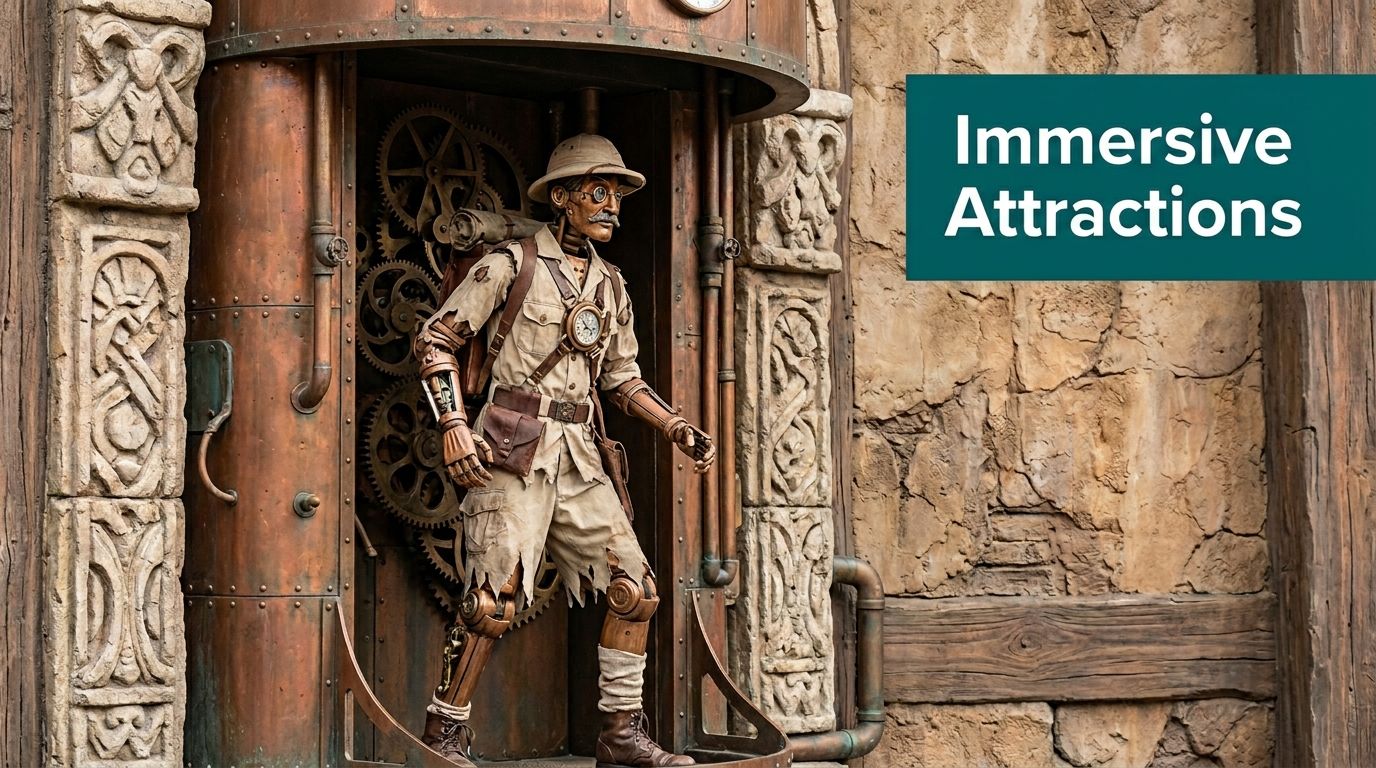
A world-class attraction does two jobs at once. It carries emotional weight for the guest and throughput discipline for the operator. If either side fails, the ride underperforms. A beautiful low-capacity attraction creates queue pain. A high-throughput ride with no emotional residue becomes forgettable.
Build the park as a sequence of emotional states
The strongest parks don't treat rides as isolated products. They use attractions to create rhythm across the day.
One zone may create energy and noise. Another may slow the pace and extend dwell. A family dark ride can act as a pressure valve after a high-intensity coaster cluster. A walk-through environment can absorb guests while preserving the sense that something is always happening.
That's where themed storytelling matters. Details in façades, ambient sound, pre-shows, scent, queue reveals, and exit environments all contribute to whether guests feel they visited a place rather than boarded machinery.
Hidden details drive repeatability. Guests come back to discover what they missed the first time.
Balance capacity with memory
Operators need a mix of attraction types. Too many headline rides can strain capital and maintenance. Too many low-intensity fillers flatten demand.
A balanced attraction portfolio usually includes:
- Capacity anchors that absorb peak demand and reduce queue pressure across the estate.
- Story-led rides that deepen brand identity and give the park a signature.
- Low-threshold family attractions that broaden appeal across ages and confidence levels.
- Interactive or exploratory experiences that keep non-riders engaged.
Themed attraction planning also depends on map logic. Guests should be able to understand where major experiences are, what type of experience they offer, and how they connect to food, shade, toilets, and rest areas. A park map that only looks decorative usually fails guests. Waymap's perspective on an amusement park map maker is a useful reminder that a map is an operational tool, not just a souvenir.
Show design has to survive operations
Some attraction concepts die the moment operations reviews them properly. Scenic reveal points interfere with evacuation routes. Queue stories require staffing levels that the operating budget can't support. Interactive moments break down under high daily use. Water, smoke, lighting, and media effects create maintenance burdens that the concept art never acknowledged.
Experienced teams become practical, asking whether the attraction can still feel rich after simplification, whether replacement parts are manageable, and whether the queue experience remains legible when the park is busy and weather conditions change.
A good example of how attraction mood and environmental storytelling are built from layered design choices is worth watching here:
The best attractions fit the whole park
A great ride in the wrong location can still hurt the park. It may pull crowds into a dead end, create queue spill into a family route, or strand guests far from food and amenities at the wrong time of day.
World-class attraction design isn't about buying impressive hardware. It's about placing the right experience in the right operational context, then supporting it with story, maintenance logic, and guest understanding.
How to Plan for Universal Accessibility and Inclusivity
Accessibility has to be part of the original park strategy. If it arrives late, it becomes expensive, partial, and visibly compromised.
In the UK, service providers have a duty to make reasonable adjustments for disabled people under the Equality Act 2010, and 21% of people in Great Britain were disabled in 2024, according to the Department for Transport's transport disability and accessibility statistics. For a theme park, that isn't a niche design issue. It affects guests, carers, families, and employees at meaningful scale.
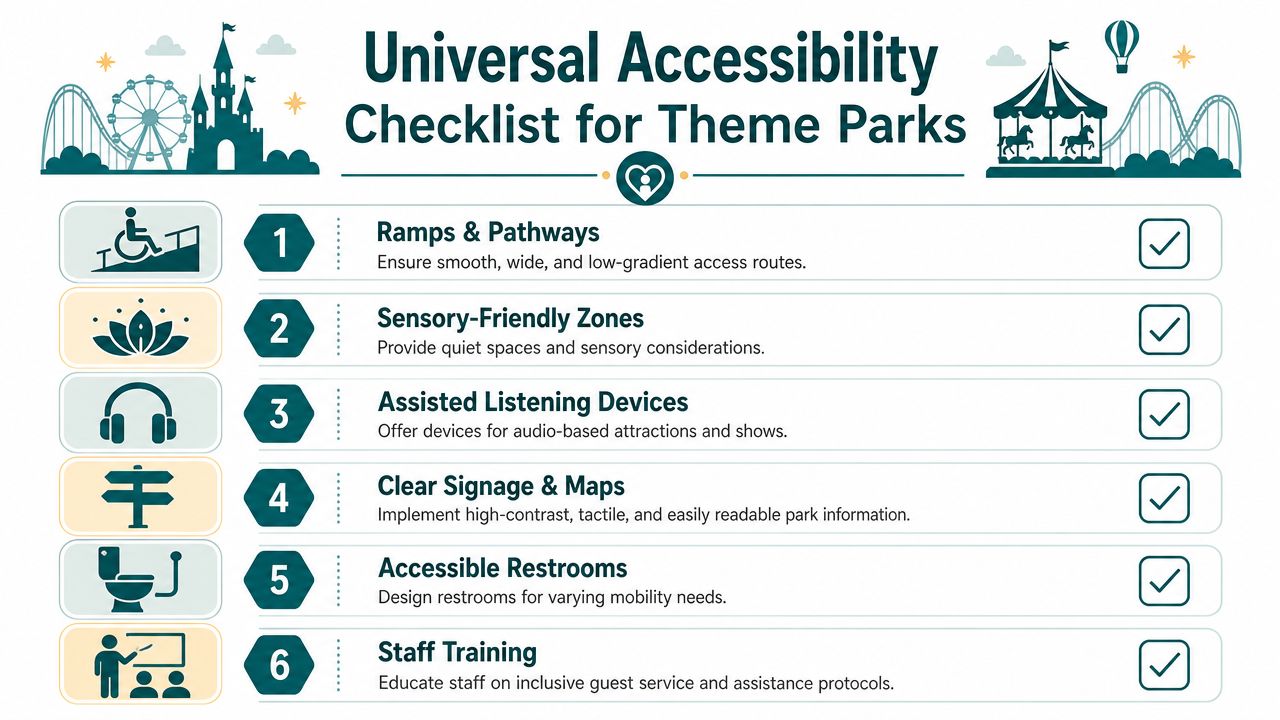
What inclusive design looks like in a theme park
Parks often reduce accessibility to ramps and toilets. Those matter, but they are not the whole experience.
An inclusive park plans for:
- Step-free circulation across the main guest journey, not just on selected routes
- Rest opportunities with shade, seating, and clear orientation points
- Readable signage with contrast, consistency, and logical placement
- Sensory considerations including quieter spaces and predictable route information
- Accessible amenities that are distributed properly rather than hidden in one zone
- Operational training so staff can give useful, respectful assistance
This is the difference between compliance language and lived usability. If a guest can technically enter the park but cannot confidently move through it, find amenities, or understand route options, the experience remains exclusionary.
Why navigation is part of accessibility, not an add-on
Theme parks are unusually hard environments for wayfinding. Routes bend. Sightlines are blocked by scenery. Temporary changes happen often. Ambient noise can mask announcements. Printed maps are hard to use while moving, and static signs rarely provide the confidence a blind or low-vision visitor needs.
That's why digital wayfinding belongs in early planning. It should sit alongside signage strategy, route hierarchy, and guest information design.
At Waymap, we approach this as an operational layer rather than installed hardware. Inclusive design principles matter, but they become far more useful when they're tied to active guidance in the venue.
The financial case for getting this right early
Late accessibility changes are expensive because they tend to touch fixed elements. Paths, gradients, handrails, toilet cores, queue geometry, and crossing points are much cheaper to resolve in planning than after procurement.
There's also a commercial trade-off. Better accessibility reduces confusion, shortens help-seeking interactions, and makes more of the park usable to more people. Families choose venues partly on whether every member of the group can participate with dignity. Park operators feel that in guest satisfaction, complaint handling, and repeat intent.
Accessibility from day one improves circulation, clarity, and confidence for everyone, not only disabled guests.
Where digital wayfinding fits
Infrastructure-heavy navigation systems often struggle in parks because layouts change, seasonal overlays appear, and maintaining physical hardware across a large estate creates ongoing operational burden.
One option is Waymap, which uses dead reckoning from device-native smartphone sensors and can provide sub-3-metre accuracy in infrastructure-free environments, without relying on GPS, Wi-Fi, or installed beacons. In a theme park context, that means a venue can offer turn-by-turn guidance to rides, restaurants, toilets, guest services, and quieter routes without adding another hardware maintenance programme.
That matters for blind and low-vision visitors, but it also supports wider guest wayfinding. A digital route layer can help the park keep maps current, reflect temporary route changes, and reduce dependence on static signage alone.
Make accessibility part of every review gate
The practical mistake is treating accessibility as a specialist package reviewed near the end. It should be present at concept review, masterplanning review, detailed design review, operations planning, and soft opening.
Use a simple internal test:
| Review gate | Accessibility question |
|---|---|
| Concept | Who is excluded by this idea if nothing changes? |
| Layout | Can guests move independently through the park? |
| Queue design | Are waiting conditions legible and manageable? |
| Amenities | Are key facilities easy to find and use? |
| Operations | Can staff support guests without improvising every time? |
If those questions are answered late, the park is already carrying avoidable risk.
What Infrastructure and Technology Will Your Park Need?
Opening week often exposes decisions made two years too late. A transformer trips during peak attendance, a service road pinches food deliveries behind a parade route, and the guest app sends people to an entrance that operations closed an hour ago. Parks do not struggle because one system fails. They struggle because civil, building, ride, and digital decisions were never coordinated into one operating model.
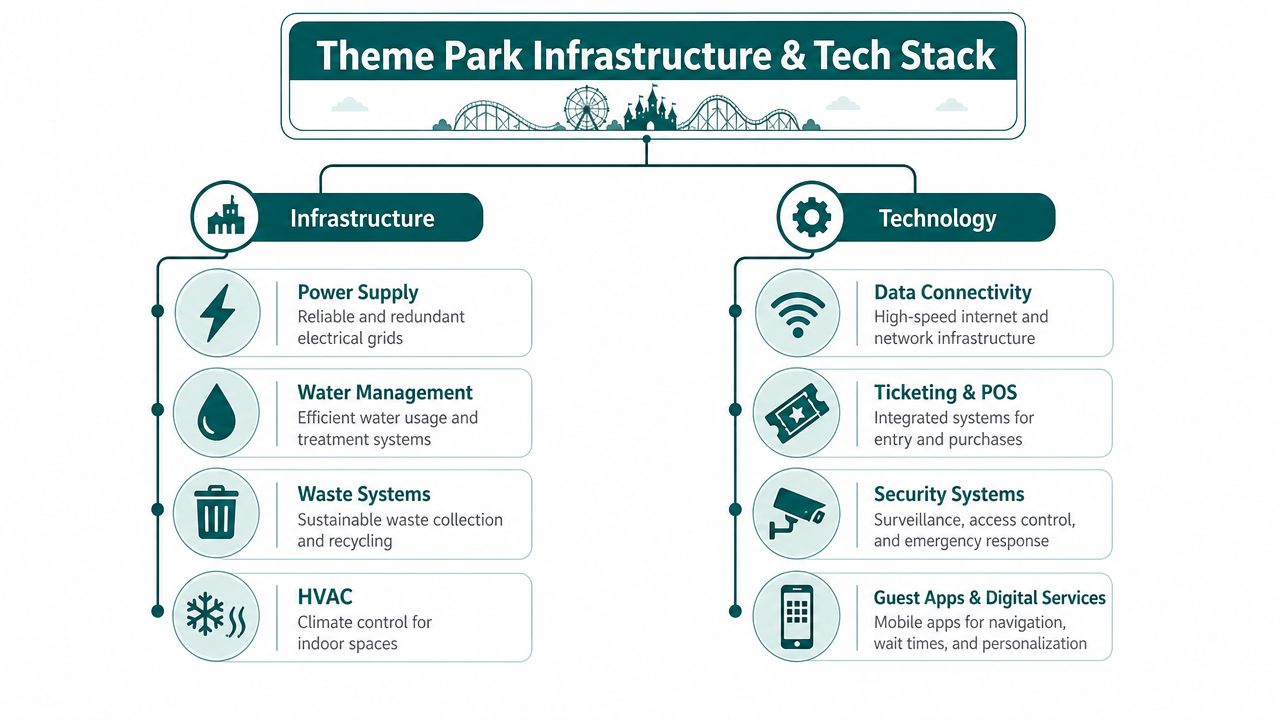
A park needs two infrastructure layers working together. The first is the physical estate, power, water, drainage, waste, HVAC, roads, plant, kitchens, workshops, storage, and buildings. The second is the operating technology stack that controls admissions, payments, security, communications, maintenance workflows, and guest movement. If those layers are procured separately, the park pays twice. Once in capital cost, then again in staffing friction, downtime, and retrofits.
Why BIM matters on a park-scale project
On projects like this, I recommend Building Information Modelling as the coordination standard because it gives architects, engineers, ride vendors, fabricators, and operators one shared model for geometry, sequencing, and technical interfaces. Theme park BIM guidance from Pinnacle Infotech gives a useful overview of how that process supports coordination across complex themed environments.
The value is practical. Ride envelopes clash with steel. Show systems compete with sprinkler zones. Themed facades hide access panels that maintenance still needs on day one. A coordinated model helps teams catch those conflicts before procurement locks the wrong solution into the budget.
Use BIM for more than design sign-off. Carry it into package coordination, utility routing, access reviews, and asset handover. That improves cost control and shortens the gap between practical completion and stable operations.
Build infrastructure around operating realities
Utilities should be sized around peak operations, weather exposure, maintenance access, and recovery time after failure. Code compliance is only the floor. A plant room that technically works on paper can still create avoidable downtime if technicians cannot reach equipment safely during operating hours.
The same rule applies to circulation and service logistics. Guest paths, parade routes, waste removal, deliveries, emergency access, and back-of-house crossings need to be resolved as one movement plan. I have seen parks spend heavily on front-of-house finishes while underinvesting in service corridors, only to create daily conflicts that guests notice within minutes.
Access control also needs a clear purpose. Entry gates, staff-only compounds, cash rooms, ride control areas, and vendor yards each carry different security and throughput requirements. The technology should fit that operating logic. For controlled access tied to wider venue workflows, a tool such as the Nimbio gate control system can be useful where physical entry points need to connect with operations rather than function as isolated hardware.
Choose digital systems that reduce maintenance burden
Parks often overspecify guest technology. The instinct is understandable. New builds attract vendors, and every platform promises better visibility, faster decisions, or more personalisation. The trade-off is long-term support. Every installed sensor, beacon, kiosk, and field device adds maintenance, replacement cycles, firmware updates, and failure points.
That is why I separate fixed infrastructure from digital layers that can change with the operation. Life safety, major security systems, utility monitoring, and core network infrastructure justify permanent installation. Guest information, route guidance, and temporary event overlays often work better with lighter systems that can be updated centrally as the park changes.
Indoor positioning is a good example. Many operators assume they need a beacon estate across the whole property, then discover the upkeep is hard to justify once maps, walls, queue lines, and seasonal routes start shifting. Waymap's overview of indoor positioning systems is a useful reference when comparing infrastructure-heavy approaches with lighter options.
That decision has an inclusion and revenue dimension, not just a technical one. If digital wayfinding works accurately across arrival, queues, food locations, toilets, retail, and quieter routes, more guests can move independently and staff spend less time giving ad hoc directions. That improves throughput, reduces friction at guest services, and supports visitors who may otherwise cut their stay short.
Use a simple test before approving any system
Review each infrastructure or technology decision against three questions:
| Question | Good answer |
|---|---|
| Does this solve a recurring operating problem? | It removes a known source of delay, confusion, or labour cost |
| Can the park maintain it with its actual team and budget? | Ownership, spares, service intervals, and support are clear |
| Will it still work after seasonal overlays, route changes, or future expansion? | Updates are manageable without major physical rework |
Projects that pass those tests tend to age well. Projects that fail them usually create technical debt disguised as innovation.
How Do You Staff and Operate a Modern Theme Park?
A park's culture is visible within minutes of arrival. Guests can tell whether staff know the site, whether queues are being actively managed, and whether operations are coordinated or merely reactive.
Staffing a theme park well means designing roles around the guest journey and the operating day, not filling an org chart. Ride operations, maintenance, guest services, food and beverage, custodial teams, security, technical support, entertainment, and supervisors all shape the same experience from different angles.
Build operations around repeatable standards
The strongest operators document what good looks like. They don't rely on individual heroics.
That means creating practical SOPs for:
- Ride loading and dispatch
- Queue management and accessibility support
- Cleaning response and public realm presentation
- Guest information and complaint handling
- Weather response and temporary route changes
- Incident escalation and communication
Training should reflect live conditions rather than classroom abstraction. Staff need to rehearse noisy, busy, imperfect operating scenarios because that's what they'll face on peak days.
Hire for clarity and judgement
Theme parks need specialists, but they also need frontline staff who can read a situation and act consistently. A guest services host who can explain routes clearly, spot distress early, and resolve low-level friction is often more valuable than an undertrained team member following a script badly.
A modern staffing model usually works best when it combines:
- Technical competence for rides, maintenance, and systems
- Hospitality discipline for guest-facing teams
- Accessibility awareness so assistance is respectful and informed
- Escalation judgement so unusual situations move quickly to the right people
For public-facing venues, security planning should be integrated with crowd management and guest service rather than isolated from them. This guide to professional event security is a helpful reference on how protection functions intersect with large-event operations.
Train for the day you actually operate
Soft opening periods matter because they expose what written procedures miss. Routes that looked obvious on plans become confusing. Queue barriers create dead spots. A service desk gets overloaded because signage is weak. Staff cluster in the wrong places.
Use pre-opening and early operations to test:
- How quickly staff can re-route guests
- Whether disabled visitors receive consistent support
- Where information requests spike
- Which handoffs between departments break down
- How well supervisors can see and correct pressure points
A park earns repeat visits when staff make the place feel organised, helpful, and calm. Guests notice the attractions first. They remember the operation longer than most operators think.
What Is the Strategy for Launch and Long-Term Growth?
Opening day gets attention. The operating model after opening determines whether the park keeps momentum or burns through goodwill.
A disciplined launch strategy doesn't try to prove everything at once. It establishes a clear proposition, protects the guest experience during ramp-up, and leaves room to improve with real-world evidence rather than internal optimism.
Launch with control, not bravado
Large parks often benefit from phased opening logic, even when the public marketing story feels bigger. That may mean controlled previews, invite-only operations, staggered attraction availability, or a defined first-season scope.
Why this works:
- Operations teams learn under pressure without total exposure
- Guest feedback is based on real behaviour, not workshop assumptions
- Defects surface while the team still has room to respond
- Marketing can build on actual guest advocacy rather than pure anticipation
A rushed full launch often creates the worst combination. Maximum attention with minimum operational maturity.
Growth should follow observed behaviour
The first season reveals where the business model is strong. Some zones overperform because dwell is higher than expected. Some rides attract the wrong queue profile. Some food locations miss demand because they sit outside natural pause points.
That's why post-launch review should focus on observed patterns such as:
| Area | What to look for |
|---|---|
| Guest movement | Where people hesitate, bunch, or backtrack |
| Spend behaviour | Which locations benefit from dwell and which are bypassed |
| Service pressure | Where staff spend time resolving confusion |
| Accessibility performance | Whether guests can move independently and consistently |
| Expansion logic | Which additions would strengthen, not complicate, the current layout |
Use the MVP mindset carefully
A minimum viable park doesn't mean a cheap or unfinished park. It means opening with a coherent core experience rather than overextending capital into too many dependencies at once.
That approach is useful when:
- The site has expansion potential
- Demand needs to be validated in operation
- Future phases depend on planning or infrastructure timing
- The business wants to preserve flexibility
What doesn't work is opening with obvious gaps in guest comfort, orientation, or core amenity provision. Guests will forgive a smaller opening offer. They won't forgive a park that feels incomplete in basic service terms.
Launch strategy should protect the brand from the project's learning curve.
Long-term growth is operational, not only creative
Parks grow well when they use operating insight to guide capital deployment. The next attraction should improve not just headline appeal but also park balance. The next investment in food, shade, route clarity, digital services, or accessible navigation may deliver more practical value than another expensive icon.
That's the discipline behind successful growth. Start with a viable concept. Lock in a working masterplan. Build attractions that fit the operating model. Design access and wayfinding from day one. Coordinate infrastructure properly. Train staff for real conditions. Then expand with evidence, not ego.
Frequently Asked Questions About Creating a Theme Park
How do you create a theme park that actually works commercially?
You create a theme park commercially by proving demand, defining a clear audience, testing the concept in a feasibility study, and building a business model that works beyond ticket sales.
What is the most important stage in a theme park project?
The most important stage is the masterplan because it locks in circulation, zoning, queue layout, amenities, and operational capacity before expensive detailed work begins.
How early should accessibility be considered when you create a theme park?
Accessibility should be considered from day one. Late changes are more expensive and usually produce weaker guest outcomes.
Do you need BIM to create a theme park?
For complex projects, BIM is the practical standard because it helps coordinate rides, theming, MEP systems, and circulation in one model and exposes clashes before construction.
What technology is most useful in a modern theme park?
The most useful technology is the technology that solves recurring operational problems. In practice, that usually includes coordinated design tools, entry systems, digital guest information, and adaptable wayfinding.
How do you make a theme park inclusive for blind and low-vision visitors?
You make a park more inclusive for blind and low-vision visitors by combining accessible route planning, clear information design, trained staff, and precise digital navigation rather than relying on static signage alone.
If you're planning to create a theme park and want accessibility and navigation designed as part of the operating model, not bolted on later, speak to Waymap. We help large venues add precise, updateable wayfinding that supports inclusive design and practical operations from the outset.
