
Bilingual vs Multilingual Venue Accessibility
A visitor arrives at a large transport hub and needs a platform, toilet or accessible entrance. The signs offer English and one translated language, but the visitor speaks neither confidently. Around them, announcements compete with crowd noise, routes split across several levels, and every extra sign makes the concourse harder to scan. For estate managers, bilingual vs multilingual isn't an abstract language question. It's a decision about movement, staff workload, accessibility and how much physical infrastructure a venue can maintain.
Static signs can support predictable journeys, but they can't adapt when a visitor chooses another language, a route changes or information needs to be presented at a larger size. Dynamic wayfinding changes the proposition by moving language selection and route instructions onto the user's device, rather than trying to print every possibility onto walls, columns and directories.
Why Static Wayfinding Breaks Down in Complex Venues
At a major station, a visitor may recognise the destination name but miss the instruction attached to it. “Platform change”, “concourse”, “ticket hall” and “step-free route” are harder to interpret under pressure, especially for someone carrying luggage, travelling with children or entering an unfamiliar building.
A bilingual sign can appear to solve that problem. It adds a second language without requiring the operator to redesign the whole venue. The sign still occupies one fixed location, uses fixed wording and follows a fixed visual hierarchy. Visitors must find it, read it and connect it to the route ahead before the crowd moves them beyond the decision point.
Why static wayfinding breaks down
Physical signage has limited space. Adding a second language lengthens the sign. Adding several more can force smaller type, denser layouts and weaker separation between the primary instruction and supporting detail. Symbols help with recognition, but they do not remove the need to understand destinations, restrictions and exceptions.
The operational burden grows when the building changes. A temporary closure, relocated gate or revised queue can make an accurate sign misleading. Staff then add temporary notices, verbal directions and improvised barriers. Each layer creates more information for visitors to interpret, while staff spend time correcting the limitations of the permanent system.
Practical rule: Treat language support as part of route design, not as translation added after sign approval.
At a stadium, shopping centre or hospital, the journey continues well beyond the entrance. Visitors may need lifts, toilets, reception desks, platforms, gates or specific rooms. A bilingual model can support common routes while leaving other visitors reliant on staff or phone translation. A multilingual model can cover more languages, yet a dense wall of translations may be difficult to read for people with low vision or cognitive disabilities.
For estate managers, the practical choice sits between expanding static signage indefinitely and adding a flexible navigation layer. Dynamic wayfinding can present each user with the relevant instruction, language and route on demand, without adding another permanent sign to the building. That infrastructure-free approach scales more effectively as languages, routes and access requirements change.
Understanding the UK Language Demographic Shift
UK venues aren't serving a simple English-first audience with one secondary language. The available evidence describes a population with varied language backgrounds, mixed households and different levels of formal language ability.
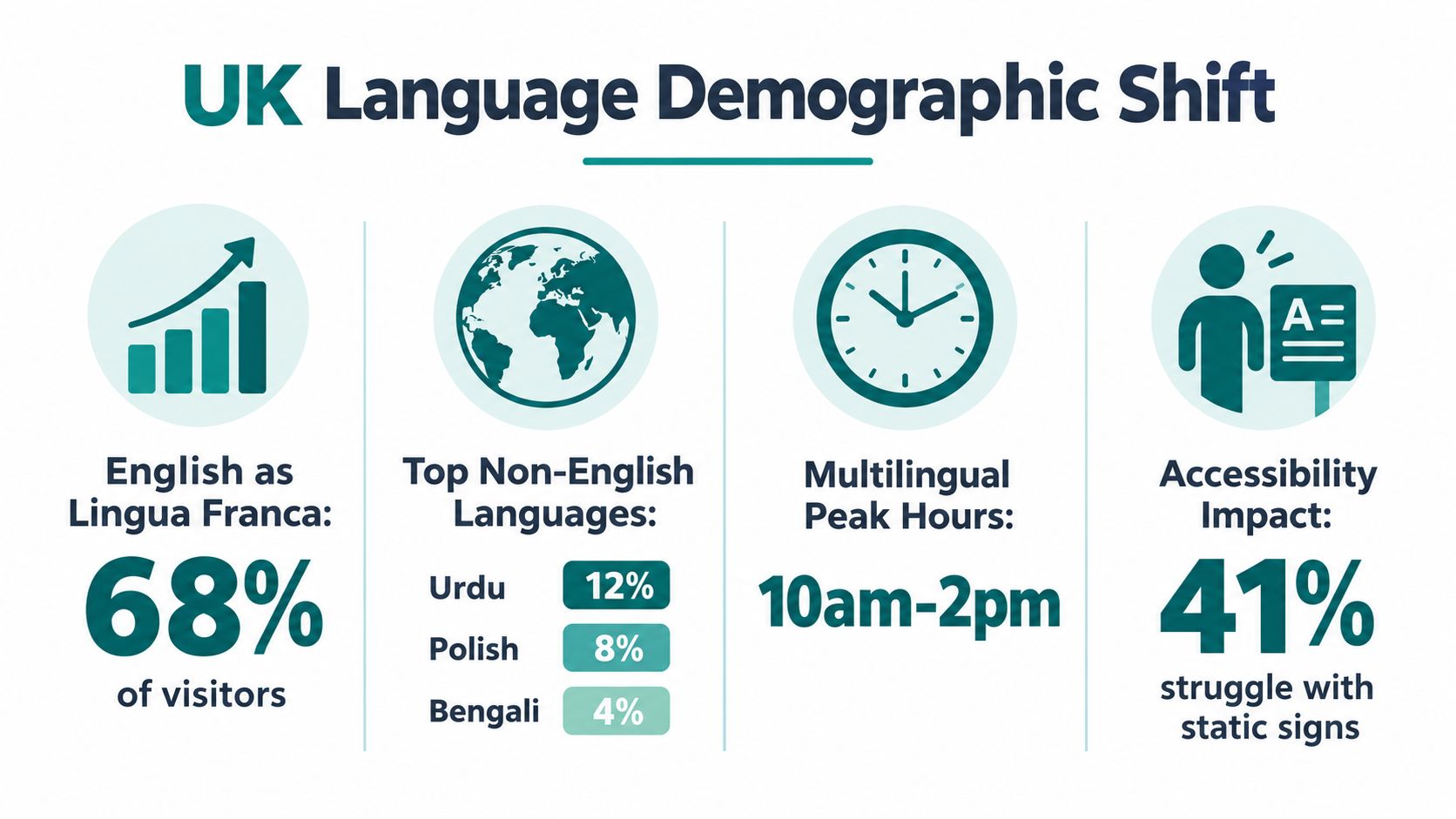
In England and Wales, Census 2021 recorded 91.1% of usual residents aged three and over, or 52.6 million people, as having English or Welsh as their main language, down from 92.3%, or 49.8 million, in 2011. The Office for National Statistics Census 2021 language bulletin therefore records 8.9% of residents, more than five million people, with another main language.
That isn't a case for replacing English signage. It is a reason to stop treating one translated language as a universal proxy for language access.
The most visible language communities
The same ONS bulletin identifies Polish as the most common non-English main language, at 1.1%, or 612,000 residents. Romanian accounted for 0.8%, or 472,000, while Panjabi accounted for 0.5%, or 291,000, and Urdu for 0.5%, or 270,000. These communities are substantial, but they don't represent every language used by visitors to a particular venue.
The data also needs to be read at household level. A household may include partners or generations with different main languages, so a child, parent and grandparent may not interpret a sign or announcement in the same way. That creates a service-design issue: a venue may need to support a mixed group travelling together, rather than a single language preference applied to every person.
The UK baseline is also more nuanced than the binary labels suggest. A Pearson consumer report states that 76% of UK adults speak only one language and 24% speak more than one. Within that multilingual group, 17.5% are bilingual and 6.5% are multilingual, meaning they speak three or more languages fluently. The report records multilingual ability as more common among ethnic minority adults, at 55%, than among White UK adults, at 21%. These figures come from the Pearson MFL GCSE 2024 consumer report.
Why venue teams need local evidence
National data supports the direction of travel, but it shouldn't determine a venue's language menu on its own. Estates teams should compare local visitor feedback, ticketing information where appropriate, staff observations and community engagement. Survey design matters too, and demographic survey question examples can help teams ask about language use without reducing people to an assumed nationality.
Education adds another layer. In England, languages are a statutory part of the National Curriculum at Key Stages 2 and 3, roughly ages seven to fourteen, while provision isn't uniform across the UK's four jurisdictions. The UK language education policy overview explains this difference and notes that Northern Ireland has no statutory primary-language provision following the loss of its Primary Modern Languages Programme.
The result for venue operators is clear. Language support must account for spoken preference, reading ability, age, family groups and the specific tasks visitors need to complete. A static bilingual sign can't capture all of those variables.
Evaluating Bilingual and Multilingual Signage Strategies
A bilingual signage programme can be appropriate when two languages dominate a defined service journey and the information rarely changes. It offers a visible, familiar reference point and doesn't require visitors to open a device. The weakness is that it assumes the venue can identify the right second language and fit both versions into a layout that remains readable.
Multilingual signage broadens coverage, but each additional language adds words, proofing requirements and maintenance dependencies. The physical sign still has to serve people who need large text, high contrast, clear spacing or a simple instruction. More translation can therefore reduce accessibility if the design treats inclusion as a volume problem.
Static signage strategy comparison
| Criteria | Bilingual Approach | Multilingual Approach |
|---|---|---|
| Coverage | Supports English and one selected language effectively on key routes | Supports several language communities, but may still exclude others |
| Readability | More space remains for legible type, contrast and directional hierarchy | Additional text can create visual density and smaller type |
| Change management | Fewer translations to update when routes or destinations change | Every amended sign requires broader translation review and production |
| Procurement | Simpler specification, manufacturing and installation | More complex artwork, proofreading, fabrication and replacement cycles |
| Visitor control | Everyone sees the same fixed information | Everyone still sees the same fixed information, regardless of preference |
| Accessibility | Can preserve clearer layouts if designed well | Can conflict with low-vision and cognitive-accessibility needs when overloaded |
| Best fit | Stable, high-volume journeys with a clearly evidenced second language | Permanent information where multiple language communities need visible support |
The language-services market itself isn't the main obstacle. A UK pricing study reports that prices for traditional language services have been constant or slightly decreasing. It also reports that the forty largest providers sold £720 million in services in 2014, with smaller providers adding another £300 million to £400 million. The Association of Translation Companies pricing study indicates a mature professional market.
The harder cost sits in the physical system around the translation. Estates teams must commission artwork, approve terminology, manufacture panels, install them without disrupting operations and replace them when routes change. A multilingual sign can be linguistically accurate and operationally wrong if it points visitors towards a closed entrance.
More languages on a sign don't automatically produce more accessible navigation. The instruction must remain findable, readable and current.
The better procurement question is which information belongs on a wall. Keep durable orientation cues, room names and essential safety information in the built environment. Move variable, personalised route guidance into a digital layer. Waymap's multi-language support approach is relevant to that division because it treats language as a selectable navigation experience rather than another permanent block of text.
Intersecting Language Support with Accessibility Mandates
Language access and disability access often meet at the same decision point. A visitor may need a translation, larger text, spoken instructions, a step-free route or all of these at once. A sign that accommodates one need by adding more content can make another need harder to meet.
The Equality Act 2010 provides the UK legal context for reasonable adjustments and non-discrimination. In the United States, ADA Title III addresses access to places of public accommodation. BS 8300 provides UK guidance for the design of an accessible and inclusive built environment. None of these anchors turns translation into a checklist. They point estate managers towards environments that people can use with dignity and reasonable independence.
Why more text can reduce access
Static signs serve the average reader imagined during design approval. They don't know whether a person prefers Arabic, French or English, whether that person reads confidently, or whether the visitor needs audio because of low vision. They also can't adapt the route when a lift is unavailable or a corridor is temporarily closed.
Bilingual and multilingual design intersects with cognitive accessibility. A visitor who is unfamiliar with the venue may need one clear next action, not a dense panel containing every possible destination and translation. A person with low vision may need information delivered through audio or a high-contrast digital interface. A companion may need to share the same route without navigating separate signage systems.
Design for choice instead of accumulation
An inclusive system should let users select the language and presentation mode that suits them. That might mean on-screen text, spoken instructions, vibration, larger type or a route that avoids stairs. The venue still needs physical signs, especially for orientation, emergency information and users who don't have a suitable device. Dynamic navigation should add flexibility, not become an excuse to remove basic environmental communication.
The Waymap guide to inclusive design principles reflects this broader approach. For an estate manager, the practical test is whether a visitor can make the next decision without asking staff to translate, interpret a crowded sign or explain a route that the venue could have presented clearly.
Standards and legislation create the obligation to consider access. They don't prescribe a single technology. The technology choice should follow the barrier: where fixed information works, keep it clear; where language, route conditions and personal access needs vary, provide an adaptable layer.
Auditing Your Venue for Language and Navigation Friction
A language audit should begin with real journeys, not a list of translations. Select the routes that generate questions, late arrivals, staff interventions or missed connections. Include arrival from public transport, entry through security, movement to reception, access to toilets and the final approach to the destination.
Six checks for an estate team
Assess the existing signs. Record language coverage, type size, contrast, mounting height, sightlines and whether visitors can identify the next decision point before they reach it.
Ask visitors directly. Gather feedback from people who use the venue in different languages and from disabled visitors. A short questionnaire can reveal whether visitors understand the words but still lose the route.
Map friction by location. Mark lifts, gates, ticket machines, junctions, temporary barriers and service desks where people stop, turn back or ask for help. Location usually exposes the operational cause more clearly than a general satisfaction score.
Test digital alternatives. Ask participants to follow a route on a phone while walking at a normal pace. Check whether the interface supports language selection, audio, large text and route changes without requiring constant screen reading.
Prioritise high-consequence zones. Start with places where confusion affects a connection, appointment, accessible entrance, evacuation route or staff queue. Don't spend the first budget on low-risk decorative directories.
Repeat after change. Review the system after refurbishments, tenant changes, event layouts and transport timetable changes. A quarterly review may suit a frequently changing venue, while a stable site can set a different rhythm based on its risk and operational profile.
The audit should include staff. Front-of-house teams know which questions recur and which directions take several attempts to explain. Compare their observations with visitor feedback, then test the most common journeys at busy and quiet times without inventing traffic statistics.
Digital touchpoints need the same care as signs. If a venue uses QR codes to open menus, maps or translated information, teams can consult a practical digital menu QR code setup guide while checking that the code has a clear label, an accessible alternative and a dependable destination.
The Waymap guidance on wayfinding signage design can support the physical-sign review, but the audit should end with decisions. Identify which signs need rewriting, which routes need better landmarks, which languages deserve digital support and where staff currently compensate for a design failure.
Deploying Dynamic Wayfinding for Inclusive Environments
Dynamic wayfinding resolves the central weakness of the bilingual versus multilingual signage debate: a phone doesn't need to display every language at once. The visitor selects a preferred language and receives only the route instruction relevant to the next movement, while the venue keeps its permanent signs focused and legible.
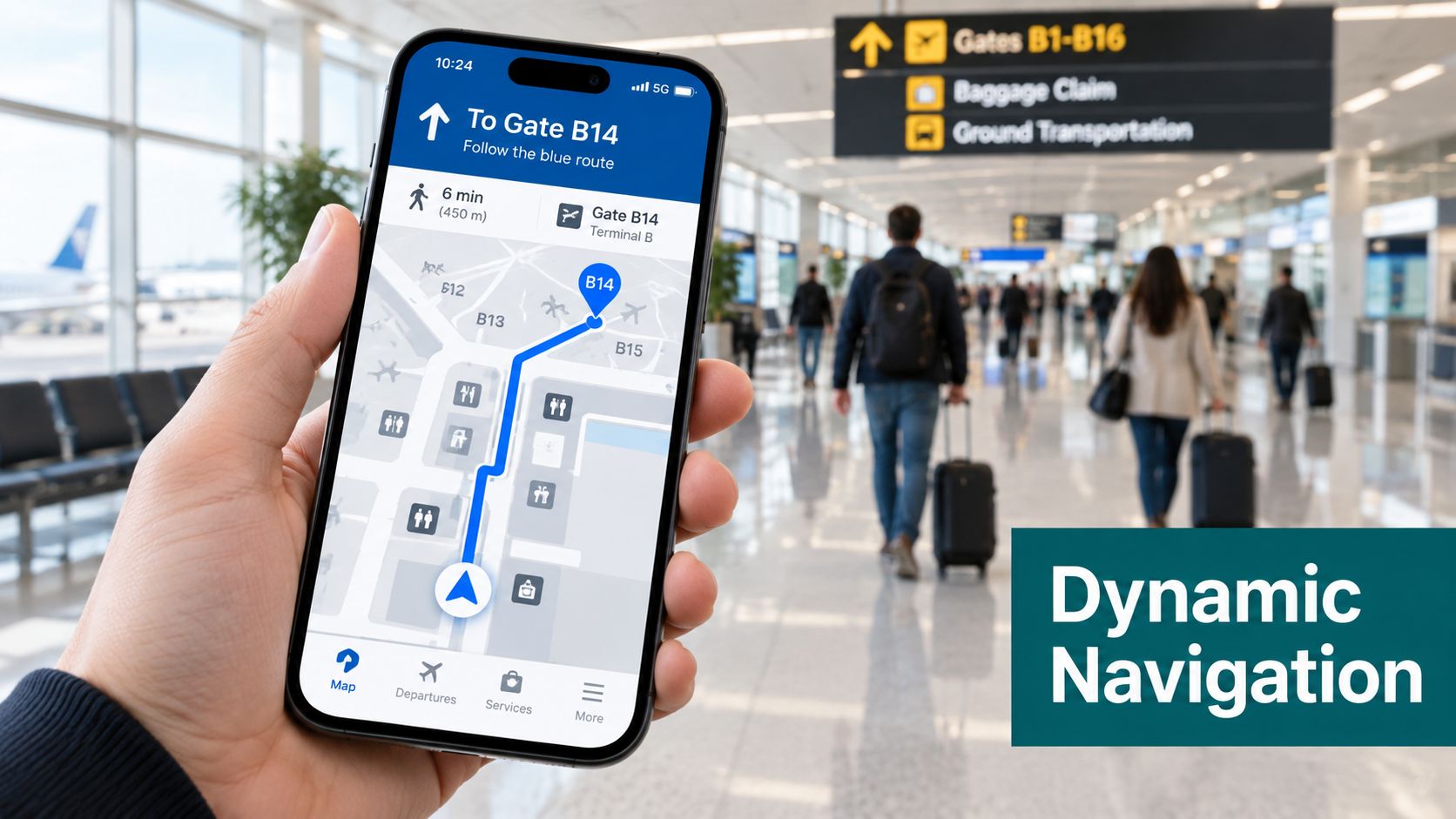
For infrastructure-free deployment, Waymap uses dead reckoning from device-native motion sensors rather than GPS, Wi-Fi or installed Bluetooth beacons. Its mapping and positioning approach is designed for sub-three-metre accuracy in infrastructure-free environments, including signal-poor indoor and underground spaces. It doesn't require pre-mapping hardware, which matters in venues with frequent layout changes or teams that can't maintain beacons across a large estate.
What the user receives
The experience can provide step-by-step audio and on-screen directions in a selected language. Heads-up, hands-free guidance reduces the need to stop at every sign, while route instructions can direct a visitor to an exact door, platform or point of interest. The same navigation layer can support people who need spoken guidance because of visual impairment and people who need language support because the venue's fixed signs aren't in their preferred language.
This is different from translating a PDF map. A translated map still requires the visitor to locate themselves, understand the scale and decide which turn to take. Dynamic guidance connects the instruction to the user's movement and the venue's mapped route.
Language decisions also need more than literal translation. Teams comparing a translation versus localisation strategy should agree terminology for destinations, accessibility features and operational instructions before publishing route content. A word that is technically correct may not be the phrase visitors recognise on the ground.
Waymap's translation management system is relevant when a venue needs to maintain route content across languages and update it as destinations change. The important operational principle is separation: retain durable physical cues, then manage dynamic language-specific instructions in a system that can be amended without fabricating and installing a new sign for every change.
Named venue deployments make the model concrete. Waymap has been used in contexts including Lord's Cricket Ground, alongside work associated with WMATA, SBS Transit, LTA Singapore and CapMetro Austin, where visitors may need to move through large public venues or transport environments with different access requirements. Estate teams should verify the scope and outcome of any deployment before using it as a procurement benchmark, but the operational pattern is consistent: put changing, personalised guidance on the device and avoid covering every possible language scenario with permanent infrastructure.
Overcoming Implementation Barriers and Measuring Impact
The common objection is that visitors won't download an app or use digital wayfinding. Some won't. That doesn't justify making every visitor depend on static multilingual signs, and it doesn't remove the need for clear physical information. Offer the digital route at booking, arrival, reception and QR touchpoints, while retaining accessible environmental signage and staff support.
Budget approval is easier when the proposal addresses estate friction rather than presenting another app. Infrastructure-free navigation avoids the installation and maintenance burden of beacon hardware, and digital route content can be amended when a venue changes. Start with one high-friction journey, define ownership between estates, accessibility and communications teams, then expand after user testing.
Measure practical outcomes: whether visitors reach the intended destination, how often staff give repeated directions, whether route changes are reflected quickly, and whether users can select the language and presentation mode they need. The Waymap accessibility best-practice resource offers a useful reference for turning those checks into an ongoing programme rather than a one-off compliance exercise.
Waymap provides infrastructure-free indoor, outdoor and underground navigation with step-by-step audio and on-screen guidance in multiple languages. If your venue is relying on crowded bilingual signs or expanding multilingual panels that are difficult to maintain, visit Waymap to discuss a dynamic route layer for your visitors.
