
Translation Management System Guide for Venues and Transit
Three hours before kick-off, a stadium operations lead discovers that a gate change has reached the English app but not the Spanish or Arabic guidance. The companion British Sign Language content is still pointing visitors towards the old entrance, while printed signs are already being carried into position. The problem isn't a lack of translation. It's the absence of a controlled system that can connect live operational changes with every language, channel, and accessibility format.
That is where a translation management system becomes more than a localisation tool. For venues, airports, stations, campuses, and transit networks, it can act as the content backbone linking approved terminology, human review, machine translation, version control, and digital delivery. The best results come when multilingual content is treated as operational data, not as a document that gets translated once and forgotten.
The Multilingual Wayfinding Problem in Modern Venues
A gate reassignment is a small change in a source system, but it creates a large chain of consequences. The operations team must update the venue app, website, digital signs, staff briefing, audio announcements, printed material, and any accessibility content that describes the route. If each language is managed separately, one change quickly becomes several parallel tasks with different owners and different completion times.
The traditional process often relies on email, spreadsheets, shared folders, and agency handoffs. A project manager exports text, a translator edits a file, a reviewer sends comments separately, and a developer or venue technician republishes the result. That process may survive a planned campaign. It struggles when a platform changes, a lift closes, or a temporary route needs to be altered during a busy event.
Operational rule: A multilingual instruction isn't complete when someone translates it. It's complete when the approved version has reached every channel that depends on it.
A TMS provides the missing control layer. It stores the source string, links it to its translations, records who reviewed the change, and provides a route for returning the approved content to the systems that publish it. That structure matters particularly for wayfinding, because a visitor may encounter the same instruction in an app, on a sign, through staff, and in an audio prompt. If those versions disagree, the visitor carries the risk.
The UK language-services market was estimated at £1.94 to £2.20 billion in 2022, and the UK was described as the largest market outside the United States and China in industry survey reporting from the EAGx and EULOGOS community. The same reporting found that surveyed UK language-service companies had average growth of 12.5%, while domestic clients represented about 49.5% of revenue, reinforcing the strength of home-market demand.
For venue operators, that mature supplier base supports a more organised model. A TMS can coordinate agencies, internal reviewers, accessibility specialists, and technology teams around one multilingual source of truth. Practical guidance on multilingual support for navigation reflects the same principle, content must remain aligned with the environment people are trying to traverse.
What a Translation Management System Actually Does
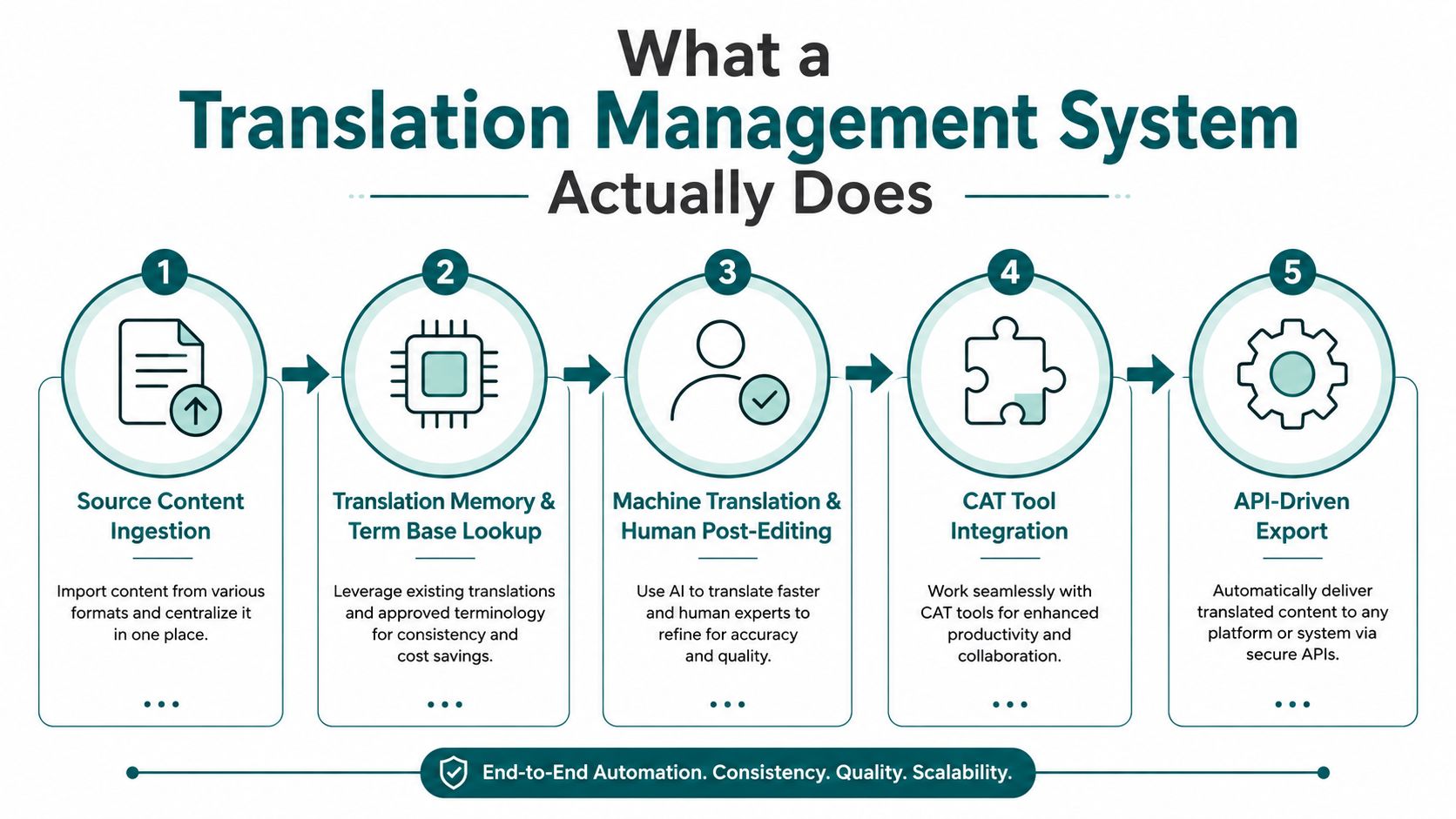
A translation management system organises the movement of content from source creation to approved multilingual publication. It doesn't replace every translator or decide whether a machine-generated sentence is safe to publish. Instead, it automates repetitive handling while giving people a controlled place to translate, review, approve, and release content.
It starts with structured content
The first job is ingestion. A TMS receives strings, documents, captions, announcements, or interface content from a CMS, repository, operations platform, or file exchange. Structured content is easier to track than text copied into an email because each item can retain an identifier, status, language, context, and version.
Next, the system checks its translation memory. This is a store of previous source and target segments. If the venue has already approved a phrase such as “Gate change”, the TMS can surface that earlier translation when the same or similar string appears again. A translator can accept it, adapt it, or send it for review rather than starting without context.
Terminology protects meaning
A term base or glossary controls words that must remain consistent. For example, “Step-free access” may need a defined translation because it describes a specific service, not a general description of a route. Medical assistance, platform names, accessibility features, and branded venue areas deserve the same treatment.
The TMS then supports the translation workflow. Machine translation can produce an initial version, but professional workflows treat machine translation post-editing as a separate human stage. A UK provider describes MTPE as a process where translation memory is checked first, machine translation is applied, and a translator post-edits and quality-checks the output in its explanation of machine translation post-editing.
Finally, approved content is exported. An API or connector can return a corrected phrase to a venue app, website, digital signage platform, or navigation service. The technical choices behind that exchange are covered in Waymap's data migration process, but the operational test is simple. Can the team identify the change, approve it, and publish the correct version without rebuilding the entire content chain?
Core Components Inside a Modern TMS
A vendor demonstration can make every TMS look similar. Buyers should ask what each component does during a real venue incident, not just whether the feature exists.
Translation memory and terminology
Translation memory stores approved source and target pairs for reuse. It helps prevent small wording changes from creating unnecessary variation across announcements, signs, and app instructions.
A term base provides stronger control. A venue can define how it translates “lift”, “accessible entrance”, “platform”, or a named concourse. The system should make those approved terms visible to translators and flag deviations before publication.
The CAT editor and post-editing workflow
A computer-assisted translation editor gives linguists the working environment for source text, target text, translation-memory suggestions, terminology prompts, comments, and context. It is different from the wider TMS, which assigns work, controls roles, tracks status, and delivers the result.
Machine translation can be useful for speed, particularly when a human linguist is available to revise the output. It should not bypass review for content that affects route choice, assistance, safety, or a regulated service. The reviewer needs enough context to understand whether a phrase is describing a physical route, a service status, or an instruction for a particular audience.
Workflow, QA, and version control
Role assignment determines who can translate, review, approve, or publish. Quality checks can identify missing strings, inconsistent terminology, malformed placeholders, punctuation problems, or text that no longer matches the source.
Version control is essential when content changes during an event. The team needs to know which translation belongs to which source version, what changed, and whether an older export is still active. A TMS with client review, file sharing, threaded comments, and version control gives non-linguist stakeholders a place to add context without editing blindly. A UK-facing description of Phrase TMS collaboration highlights this practical review pattern.
| Component | What It Does | Example in a Venue or Transit Context |
|---|---|---|
| Translation memory | Reuses approved source and target segments | Recalls the accepted wording for a recurring gate-change message |
| Term base | Enforces approved specialist vocabulary | Flags an inconsistent translation of step-free access |
| CAT editor | Gives translators context and controlled editing tools | Lets a linguist review an announcement beside its interface label |
| Machine translation and post-editing | Produces a draft for human revision | Routes a disruption notice to a reviewer before release |
| Workflow management | Assigns tasks and records approvals | Sends Welsh content to a language reviewer and then an operations approver |
| QA checks | Detects errors before publication | Identifies a missing placeholder or conflicting platform name |
| Version control | Links content to a defined source state | Prevents yesterday's route instruction returning after a late update |
| API integration | Moves approved content between systems | Publishes a reviewed string to an app or signage platform |
An integrated TMS should fit the wider estate rather than becoming another isolated repository. The relationship between translation operations and facilities information is also relevant when assessing an integrated workplace management system, because both depend on reliable, structured information about the environment.
Why Venues and Transit Operators Need a TMS Layer
Venues and transit operators don't publish multilingual content in one place. They publish it through ticketing systems, websites, station displays, public-address scripts, mobile apps, staff tools, printed signs, and accessibility services. Each channel has a different release process, but the visitor experiences them as one journey.
A TMS gives the operator a governed layer between operational change and public communication. A station closure entered at 04:00 can become one source update, followed by translation, review, and controlled delivery to the channels that support the affected route. Without that layer, teams often maintain separate spreadsheets for signs, app copy, announcements, and accessibility information. Those files drift as soon as the environment changes.
The regulatory context makes inconsistency more than an inconvenience. UK organisations must consider duties under the Equality Act 2010, while rail operators work within accessibility requirements that include the Persons with Reduced Mobility Technical Specification for Interoperability. Aviation operators also manage passenger assistance and communication obligations that make clear, usable information an operational responsibility. A TMS doesn't prove compliance by itself. It provides evidence of ownership, review, terminology control, and release history.
The content risk depends on the source
A permanent visitor-information page may have a planned review cycle. A platform swap may need immediate treatment. A lift closure can make an otherwise accurate accessible route unusable.
| Content Source | Update Frequency | Compliance Anchor | Risk If Untranslated |
|---|---|---|---|
| Ticket and arrival instructions | Planned and event-driven | Equality Act 2010 and customer communication duties | Visitors may arrive at the wrong entrance or miss assistance information |
| Gate, platform, and concourse signs | Changed by operations | Accessible information expectations and local operating procedures | People may follow obsolete directions in a crowded environment |
| Lift, ramp, and step-free route content | Changes when infrastructure or access conditions change | Equality Act 2010 and PRM-TSI considerations for rail | A stated accessible route may no longer be usable |
| Service disruption announcements | Often urgent | Passenger information and assistance obligations | Travellers may not understand a change that affects their journey |
| App and web wayfinding instructions | Updated through digital releases | Digital accessibility practice | Screen-reader, audio, or translated content can become inconsistent |
| Staff briefings and assistance scripts | Updated for operational plans | Equality and service-delivery duties | Front-line teams may give different instructions from digital channels |
Public procurement can also reinforce central governance. The Government Commercial Agency's RM6302 Language Services agreement provides translation, transcription, and interpreting across the UK for public and third-sector bodies through a managed commercial route. That model reduces supplier fragmentation, but the operator still needs internal control over terminology, versions, approvals, and channel delivery.
Dynamic Content, APIs, and the Live Wayfinding Loop
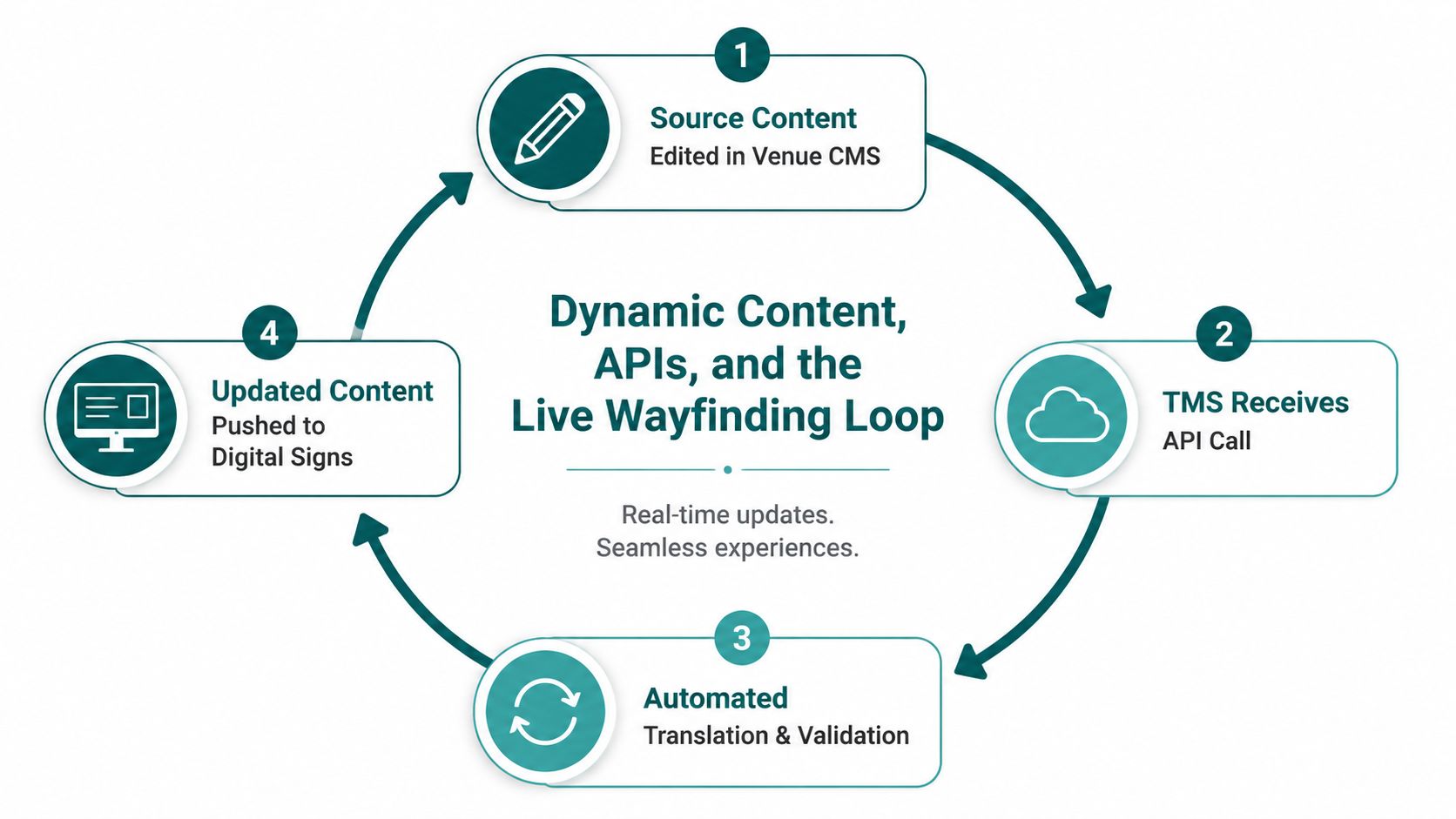
A TMS becomes operationally valuable when it behaves like a live content spine rather than a static archive. The source instruction begins in an operations console or venue CMS, travels through translation and review, then returns to the systems that deliver guidance to visitors.
Consider a matchday sequence. The stadium changes the assigned gate, delays the start, and closes a route used by visitors who need step-free access. Those are three different operational facts, but the TMS should treat each as structured content with identifiers, language states, reviewer ownership, and a release history.
The process works best when the integrations are explicit:
- Source update: An authorised operations user changes the gate, timing, or route condition.
- API request: The venue system sends the affected strings and context to the TMS.
- Translation and validation: Translation memory, terminology controls, machine translation, human post-editing, and QA checks run in a defined sequence.
- Controlled publication: Approved content returns through an API or webhook to signs, apps, web pages, audio prompts, and navigation clients.
An open API matters because manual export introduces a delay and creates another opportunity for the wrong file to be published. Webhooks can notify connected systems when content is ready, while closed platforms may require an operator to download, rename, and upload files by hand. That distinction determines whether the multilingual wayfinding layer can respond to operational signals or merely document what happened later.
The same principle applies to map content. If a point of interest, entrance, or route condition changes, the update should reach every relevant interface through an identifiable content event. A practical example is the controlled publication pattern described in show-on-map guidance, where operational information needs to appear where people make route decisions.
A TMS also needs a failure mode. If a translation isn't approved, the system should show its status, preserve the previous approved version where appropriate, and alert the responsible owner. Silent fallback is dangerous because it creates false confidence. The operator may believe every language is current when one channel is still carrying an obsolete instruction.
The technical architecture should remain testable. Teams need staging environments, sample payloads, clear field definitions, and a record of what each downstream system received. That discipline is more valuable than a long integration catalogue because live venues rarely fail through a missing feature. They fail when ownership and release state are unclear.
Choosing a TMS That Fits Accessibility-First Operations
A venue shouldn't select a TMS because its feature list is long. It should select one that keeps accessible information accurate when staff are busy, routes change, reviewers are unavailable, and several publication channels need the same update.
The first test is integration depth. Ask whether the platform offers documented APIs and webhook support, whether it handles your file formats, and whether a translated string can reach the mobile wayfinding client without a manual export. A connector that works only for scheduled batch files may be adequate for marketing pages, but it may not fit disruption messaging or temporary access changes.
Governance must be visible
Role-based workflows should separate translation, linguistic review, operational approval, and publication. That doesn't mean every sentence needs a committee. It means the organisation can define which content requires specialist sign-off and can prove who approved a change.
Ask vendors:
- Who owns the term base? The answer should include named owners for medical, assistance, transport, and venue terminology.
- What happens during an out-of-hours incident? The workflow should identify cover when a translator or reviewer is unavailable at a weekend event.
- Can reviewers see context? A phrase describing a lift, platform, gate, or route must be tied to the screen, sign, or prompt where it appears.
- How are rejected translations handled? Comments and decisions should stay attached to the segment, not disappear into email.
- Can the organisation audit releases? The history should show source version, target version, reviewer, approval state, and destination.
Accessibility output is another decisive area. Check support for right-to-left languages, screen-reader labels, alt text, ARIA-related content, audio prompts, high-contrast sign formats, and text expansion. Don't assume a linguistically correct string will fit a sign, button, announcement, or spoken instruction. The content model must preserve the purpose and constraints of each output.
GOV.UK explicitly includes making translations accessible in its digital accessibility guidance. Its translation-improvement work describes normalising locale files, extracting untranslated strings, sending them to an external agency, and merging the results back into the files. That practical pipeline shows why structured assets, repeatable extraction, and controlled reintegration matter.
Buyer question: Ask the vendor to demonstrate a late route change, not a perfect planned project. The demo should show what the operator sees, what the reviewer approves, and what the visitor receives.
Finally, assess security and data ownership. AI-assisted translation introduces questions about confidential operational information, auditability, terminology drift, and how human oversight is enforced. Faster output isn't automatically better output. A TMS earns its place when it reduces operational uncertainty while preserving human accountability.
How Waymap Deployments Pair With TMS-Driven Multilingual Content
The strongest architecture separates two jobs. The TMS governs language content, terminology, review, and release. The navigation layer uses that approved content to guide people through the current physical environment.
At an airport terminal, the content team may manage 30+ language pairs for gate changes, but that figure appears in the supplied deployment concept rather than verified market data, so it should be treated as an illustrative operating scenario, not a general industry statistic. The practical requirement is clear. A gate update must connect the flight-information source, translated text, audio instructions, accessibility metadata, and the navigation experience without forcing staff to edit every channel separately.
A stadium has a different pattern. Its physical spaces may be reused between sports fixtures, concerts, conferences, and community events. The content model needs to distinguish the venue map, event configuration, entrances, restricted areas, and temporary accessibility routes. A TMS can supply the approved multilingual labels and instructions, while the navigation platform consumes the current event state.
A metro network adds another layer of complexity. Service messages, line changes, interchange guidance, and step-free routes need to reflect the network's current operating condition. A translation workflow that is separate from the passenger-information system creates lag. A governed API exchange lets the operator update content once and deliver it to the relevant passenger-facing surfaces.
Why infrastructure changes the translation equation
Physical wayfinding hardware creates a maintenance dependency. If an operator relies on Bluetooth beacons or other installed equipment, a multilingual content change may still require teams to verify, move, replace, or reconfigure hardware in the environment. That burden becomes more difficult in high-footfall sites where layouts and operational conditions change frequently.
Infrastructure-free navigation removes that hardware refresh cycle. Waymap's approach uses device-native motion sensors and detailed maps for dead reckoning, rather than relying on GPS, Wi-Fi, or installed beacons. The product description also states that the system is designed for indoor, outdoor, and underground use, with heads-up, hands-free audio guidance. Those capabilities make the content integration cleaner, because a route update can be delivered through software rather than tied to a physical installation.
Before launch, brief the TMS vendor and navigation provider on:
- Content identifiers: Every entrance, platform, lift, route condition, and point of interest needs a stable identifier.
- Context fields: Translators need to know whether text appears on a sign, in an app, in audio, or in staff guidance.
- Approval states: The integration should distinguish draft, linguistically reviewed, operationally approved, and published content.
- Fallback behaviour: Define what happens if a target language is pending or a downstream client is unavailable.
- Accessibility metadata: Keep step-free routes, assistance points, audio prompts, and user-facing labels connected to the same operational object.
- Event configuration: Separate permanent venue data from temporary layouts and service changes.
Named Waymap venues and partners, including WMATA, SBS Transit, LTA Singapore, CapMetro Austin, Royal Hospital for Children and Young People, and Westfield London, illustrate the range of environments in which navigation content must align with real places and operational constraints. The relevant question for a buyer isn't whether a TMS can translate a sentence. It's whether the combined system can keep a visitor's next instruction accurate when the environment changes.
Explore the Waymap venue applications to see how an infrastructure-free navigation layer can sit alongside your multilingual content operation.
Waymap combines precision indoor, outdoor, and underground navigation with software-based updates, so venues and transit operators can connect approved multilingual content to accessible route guidance without installing or maintaining beacons. Visit Waymap to discuss how your TMS, operational systems, and visitor-facing navigation can work as one governed workflow.
