
Best Event Management Software for Nonprofits: 2026 Guide
How do you choose event software when every penny counts? Selecting the best event management software for nonprofits is more than a technical purchase, it's a decision that shapes your budget, your brand, and the way supporters experience your cause. For UK charities, the right platform has to support registration, payments, donation capture, reporting, and the realities of lean staffing. It also has to fit the wider nonprofit environment, where the Charity Commission counted 170,779 registered charities in England and Wales as of March 2024 and the ONS placed the sector's income at £88.3 billion in the latest UK Civil Society Statistics release, which means operational efficiency matters at scale. For background on how online donations and digital participation changed expectations, the Charities Aid Foundation reported that 38% of UK adults donated to charity through an online platform in 2023. In other words, your event tool is now part ticketing system, part fundraising engine, part supporter journey.
That's why this guide goes straight to the shortlist. If you're planning galas, community fundraisers, hybrid briefings, or member events, focus on the practical trade-offs that affect real delivery, low fees, branding control, UK payment flows, accessibility, and whether the software helps you reduce manual admin. If your event includes an online auction, browse the online charity auction guide for a useful adjacent workflow.
Practical rule: if a platform makes registrations look cheap but pushes you into clunky reporting, weak branding, or awkward donor follow-up, you usually pay for it later in staff time.
1. Ticket Tailor
Ticket Tailor makes sense when cost control and data ownership come first. It's a UK-born ticketing platform with a flat-fee mindset, so it suits charities that don't want a marketplace-style checkout diluting their brand or inflating costs with every ticket sold. For smaller galas, volunteer briefings, and community events, that predictability matters more than flashy extras.

Why it works for UK nonprofits
Ticket Tailor is strong on the basics that nonprofit teams use, including unlimited events, a free check-in app, seating charts, donation collection alongside tickets, and custom domains with white-label checkout. It also connects with Stripe, PayPal, and Square, so payouts can stay aligned with your existing finance setup. For charities that want their own branding front and centre, that's a cleaner experience than sending people through a marketplace-first flow.
The trade-off is depth. Ticket Tailor doesn't try to be a full CRM, so you'll need integrations if you want richer supporter journeys or development reporting. It's also lighter on automation than enterprise suites, which is fine for straightforward events but less ideal if your event programme sits inside a wider stewardship calendar.
Practical rule: choose Ticket Tailor when you want a controlled checkout, clear pricing, and ownership of attendee data, not when you want the platform to behave like a full fundraising CRM.
Best fit and website
It fits charities, schools, and community groups that value simplicity and strong branding control. You can learn more at Ticket Tailor.
2. Enthuse
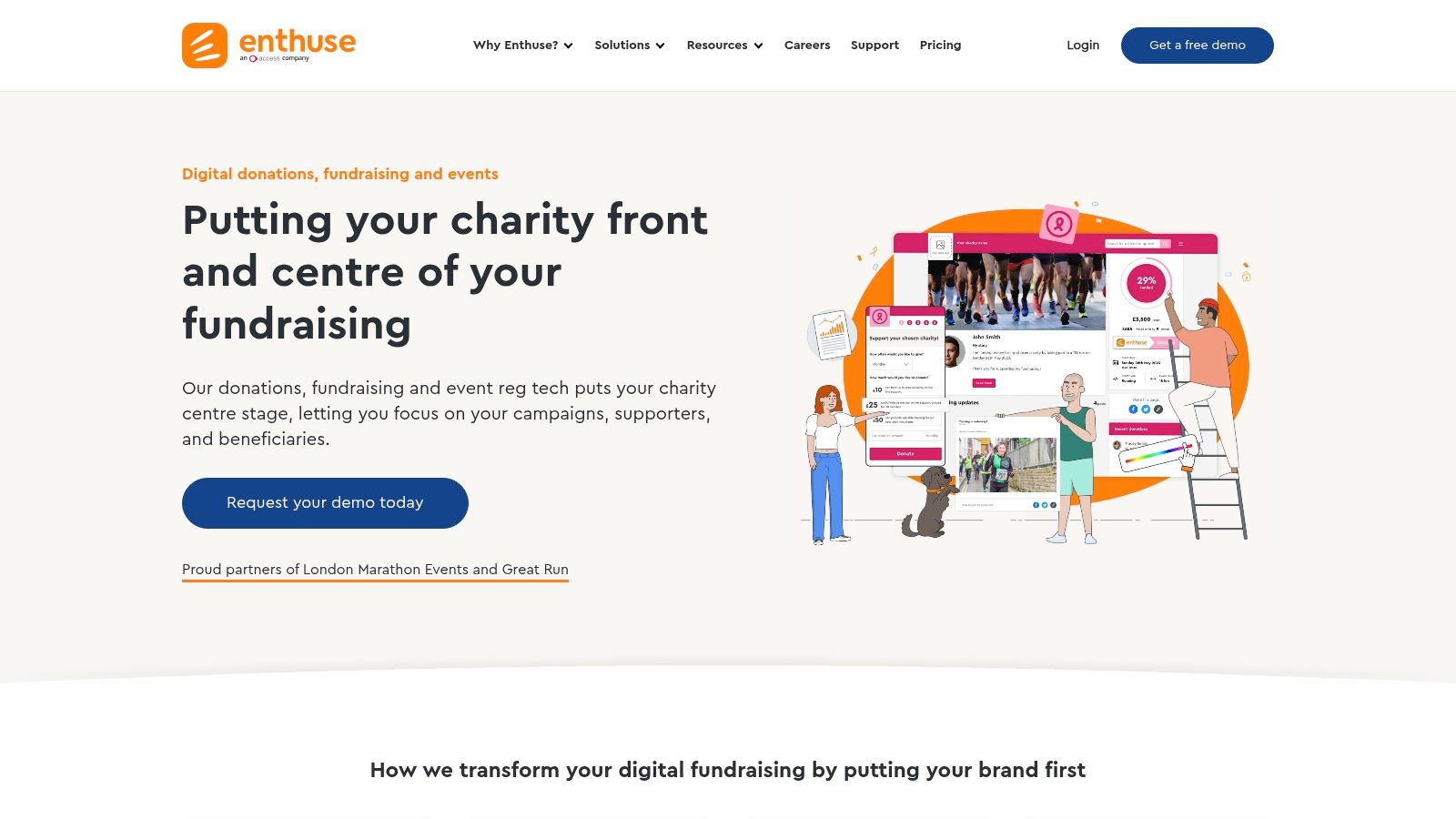
Enthuse is the obvious choice when events and donations need to live together under one charity-first brand. It's built for organisations that want registration, fundraising, and Gift Aid handling in the same environment, rather than stitching together separate tools and hoping the data matches up later.
What it does well
Enthuse supports individual, team, and corporate event registration, and it includes fundraising pages and branded supporter journeys. Its built-in Gift Aid capture and HMRC-ready exports make it particularly relevant for UK charities that need clean record-keeping, not just attractive pages. The platform also keeps supporters on your domain, which helps maintain trust and reduce the “someone else's site” feel that weakens conversions.
The main downside is cost structure. Gift Aid processing comes with an extra fee, so the platform is not the cheapest route if you're running very lean events. It's better suited to charities that care about a joined-up donor experience and are willing to pay for that operational simplicity.
Where it wins and where it doesn't
- Best for: UK charities that want fundraising and event registration in one brand-controlled platform.
- Strongest value: Gift Aid capture, supporter accounts, and reducing tech sprawl.
- Weak point: Can cost more than bare-bones ticketing tools when you're only selling a few tickets.
For a charity that wants to reduce the number of systems volunteers have to learn, Enthuse is one of the cleanest operational fits. Visit Enthuse if your event strategy is tightly tied to fundraising.
3. Eventbrite
Eventbrite is still the broadest mainstream option for nonprofits that want reach as much as registration control. Its discovery marketplace can help public-facing events find an audience beyond your existing mailing list, which is useful for open community talks, volunteer recruitment events, and awareness campaigns.
The practical upside
Eventbrite includes timed entry, recurring events, onsite check-in, add-ons, donations, and waitlists, plus a large app ecosystem for CRM, marketing, and analytics integrations. If your team wants something familiar that staff and supporters already recognise, that lowers training friction. It also helps when you need a simple route to market fast rather than a fully customised workflow.
The downside is visibility trade-off. Marketplace branding can pull attention away from your own site, and percentage-based fees can become painful on higher-priced tickets. For a charity with expensive gala tickets or a donor-heavy audience, that matters more than the convenience of a familiar platform.
Practical rule: Eventbrite is strongest when discovery matters more than pure margin, and weakest when you want every click to reinforce your own brand.
Best fit and website
Use it when you want a mature feature set, public reach, and broad integrations without building a custom stack. See Eventbrite for its current nonprofit options.
4. Donorbox Events
Donorbox Events suits charities that already use Donorbox for fundraising and want events folded into the same supporter journey. That matters when your event isn't a standalone transaction, but part of a broader donation workflow where recurring gifts, donor records, and quick checkout all need to line up.
Why it's useful for simpler fundraising events
The platform supports ticket types, sales tax or VAT handling, attendee tracking, donation upsells, donor accounts, and QuickDonate. For UK charities, its Gift Aid integration and multi-currency support help keep the donation side aligned with local needs. It's especially attractive if you want to ask for a ticket purchase and a donation in one flow without making supporters bounce between tools.
The limitation is structure. Donorbox Events is less suited to complex reserved seating or large, multi-venue operations. If your event has complicated table layouts, box office workflows, or venue-specific logistics, you'll outgrow it quickly.
Best for the donor-led workflow
- Use it when: your fundraising and event records should sit together.
- Avoid it when: your event requires detailed seating or advanced onsite logistics.
- Watch for: a clean checkout, but not a heavyweight event operations layer.
One useful comparison point is how the platform fits into the broader accessibility conversation around inclusive attendance and physical arrival friction, which is often ignored in software roundups. The Waymap article on app for good is relevant if you're thinking beyond digital checkout and into the full attendee journey.
Visit Donorbox Events if you want event ticketing that sits naturally inside an existing donor platform.
5. Spektrix
Spektrix is built for arts organisations, theatres, festivals, and cultural nonprofits that need more than simple ticketing. It's closer to an operating system for audience relationship management than a lightweight event tool, which is exactly why it suits venues with reserved seating, memberships, donations, and marketing campaigns running together.
Where the depth matters
Spektrix offers unified CRM workflows across ticketing, memberships, and fundraising. It also supports white-label purchase paths and complex seating management, which is critical when venues need to protect the audience experience rather than forcing everything through a generic event page. For cultural organisations, those details are not nice-to-have extras, they're central to selling the right seat, retaining members, and nudging buyers into donation or upgrade paths.
It does ask more from your team. Implementation and training take time, and it can be more system than a small charity needs. That's the trade-off with enterprise-grade functionality, you get depth, but you also accept a heavier rollout and more internal ownership.
The relevant angle for UK nonprofit leaders is integration depth. Most software comparisons talk about features, but fewer address how well a platform fits operationally with the rest of the stack. The Waymap piece on floor mapping software is a useful reminder that digital tools have to support the physical environment, not sit beside it.
Best fit and website
Choose Spektrix if your events are tied to memberships, donor journeys, and complex venue operations. Learn more at Spektrix.
6. TryBooking
TryBooking is a sensible pick for schools, PTAs, charities, and local organisers that need practical ticketing without a heavy learning curve. It focuses on the sort of event work volunteers do, such as seating plans, tabled events, vouchers, and straightforward box-office tools.
What stands out in practice
Funds flow to your TryBooking balance in real time, with scheduled payouts, which gives small teams a clearer operational picture of what's coming in. Organisers can also pass fees to buyers with a clear fee calculator, which helps when budgets are tight and you need transparency at checkout. UK-based support is another real advantage for volunteer-run groups that don't want to troubleshoot a tool built for somewhere else.
The downside is ecosystem size. TryBooking doesn't have the broad third-party app world that Eventbrite does, and the interface is intentionally simple rather than fully customisable. That simplicity is useful for many community events, but it can feel limiting once your programme becomes more ambitious.
Practical rule: if your volunteers need a tool they can learn quickly and use without hand-holding, TryBooking is a strong fit.
Best fit and website
It suits local fundraising events, school activities, and community organisers who need sensible pricing and UK support. Explore TryBooking UK for details.
7. Eventcube
Eventcube is a strong option if branding control and fee control matter most. It is a UK platform that lets you sell under your own name, manage booking fees, and combine ticketing with memberships or recurring access.

Why charities pick it
The platform supports branded storefronts, embeddable widgets, membership tiers, QR scanning for entry, and Stripe-based payments. For organisations that run repeated programmes or want to build a loyalty model around events, that mix is useful because it keeps the buyer journey under one roof. It also gives you more control over whether fees sit with the organiser or the buyer.
The trade-off is ownership. Eventcube assumes you are prepared to handle a bit more setup, which means it suits teams with clear event responsibility rather than ad hoc volunteer operations. Some features also vary by region, so you need to check exactly what is available before you commit.
The physical attendance piece matters here too, especially for inclusive event planning. The Waymap article on map your show is relevant if your events happen in venues where arrival and indoor navigation shape whether supporters make it to the event. If your venue planning also covers emergency evacuation planning, that same thinking helps you assess how access, wayfinding, and safety work together for every attendee.
Best fit and website
It is a good option for charities and cultural organisations that want white-label ticketing and membership control. See Eventcube for current features.
8. Humanitix
Humanitix is a strong fit for mission-aligned nonprofits that want ticketing to feel ethically consistent with their values. Its appeal is simple, booking fees fund children's education projects, which makes the platform easy to explain to supporters who care about where fees go.

The strategic appeal
Humanitix includes modern event pages, timed entry, discount codes, scanning apps, data tools, integrations, and seat maps for selected use cases. It uses no subscription model, instead relying on per-ticket service and processing fees. That can be attractive if you want straightforward pricing without committing to a monthly platform bill.
The limitation is ecosystem depth. Compared with larger platforms, its app ecosystem is smaller, and features can vary by region. For some teams that will be fine, especially if they want clean ticketing and an impact story. For others, particularly those with intricate CRM or marketing stacks, it may feel too light.
The inclusive attendance piece is important too, because accessible arrival and venue navigation often decide whether supporters can participate fully. The Waymap article on inclusive design principles connects well to this topic if your event strategy includes physical accessibility as well as digital registration.
Best fit and website
Choose Humanitix if values alignment is part of the buying decision and your event requirements are fairly straightforward. Visit Humanitix UK to review its current setup.
9. Universe
Universe, by Ticketmaster, works well for organisers who want self-serve ticketing with a path to larger-scale Ticketmaster services later. It's a decent option for public-facing events where scalability, uptime, and operational tooling matter more than nonprofit-specific fundraising features.
Where it fits
Universe supports reserved or general admission ticketing with timed entry, multi-date events, add-ons, upsells, mobile check-in, and reporting. You can sell through your own site or through Universe event pages, which gives some flexibility depending on how much control you want over the user journey. For larger public events, that combination is solid and familiar.
The weakness is nonprofit specificity. It isn't built first for charity workflows, so you won't get the same donation or supporter-centric design that you'd expect from a charity-focused platform. Fees can also be higher on mid-priced and high-priced tickets than flat-fee alternatives.
Best fit and website
It's a fit for organisations that care about scale and operational reliability, but don't need deep charity features. Learn more at Universe.
10. TicketSource
TicketSource is a practical UK option for community theatres, schools, and charities that want local support and familiar event tooling. It's especially relevant where volunteer teams need reserved seating, box office support, and manageable payout flows without enterprise complexity.
What makes it dependable
TicketSource offers reserved seating, POS and box office tools, phone sales support, marketing tools, seat maps, reporting, and UK bank payouts after events. Registered charities can also access discounts, and the platform supports fee pass-through, which helps keep pricing transparent for supporters. It's a particularly sensible fit where a local venue still relies on a mix of online and offline sales.
The trade-off is reach. Its marketplace presence is smaller than Eventbrite's, and the feature set won't match a full CRM-driven suite. For many nonprofits, though, that's a worthwhile exchange because the platform is easier to manage and less likely to overwhelm a small team.
What to prioritise before buying
- Support model: UK-based help can matter more than an extra feature you'll never use.
- Payout timing: cash flow is not a minor detail for volunteer-run charities.
- Gift Aid workflow: if you handle eligible donations, the reporting path matters.
The broader accessibility issue is easy to miss when software comparisons stay locked on checkout. If your attendees struggle with arrival, indoor navigation, or venue orientation, the experience breaks before the ticket scan ever happens. That's why event planning for nonprofits should account for both digital registration and the physical journey.
See TicketSource if you need a straightforward UK ticketing tool with charity-friendly operations.
Top 10 Nonprofit Event Management Software Comparison
| Platform | Core features ✨ | UX & Reliability ★ | Pricing & Value 💰 | Target audience 👥 | Standout / Strengths 🏆 |
|---|---|---|---|---|---|
| Ticket Tailor | Unlimited events; white‑label checkout; check‑in app | ★★★★ | 💰 Low flat fees; free for free events | 👥 Charities, schools, community groups | 🏆 Predictable fees & data ownership |
| Enthuse | Event registration + fundraising; Gift Aid built‑in | ★★★★ | 💰 Charity‑focused pricing; Gift Aid fee applies | 👥 UK charities & fundraisers | 🏆 Donation + ticketing in one branded flow |
| Eventbrite | Marketplace discovery; timed entry; apps & integrations | ★★★★★ | 💰 % fees on paid tickets; free events free | 👥 Public events, organisers seeking reach | 🏆 Massive audience & app ecosystem |
| Donorbox Events | Ticketing layered on donations; Gift Aid & multi‑currency | ★★★★ | 💰 Good value if already on Donorbox | 👥 Donorbox users; small–mid nonprofits | 🏆 Unified donor + attendee records |
| Spektrix | CRM + ticketing + fundraising; complex seating | ★★★★★ | 💰 Enterprise pricing | 👥 Theatres, festivals, cultural orgs | 🏆 Deep arts & CRM‑grade automation |
| TryBooking (UK) | Seating plans, vouchers, box‑office tools | ★★★★ | 💰 Low, transparent fees; pass fees option | 👥 Schools, PTAs, volunteer organisers | 🏆 Community‑friendly pricing & UK support |
| Eventcube | Branded storefronts; membership & fee control | ★★★★ | 💰 Custom/white‑label pricing | 👥 Organisations needing full white‑label | 🏆 Fee control + memberships in one system |
| Humanitix | Modern event pages; scanning; seat maps | ★★★★ | 💰 Low per‑ticket fees; profits to education | 👥 Mission‑aligned charities & events | 🏆 Social‑impact model + transparent reporting |
| Universe (by Ticketmaster) | Multi‑date, upsells, mobile check‑in | ★★★★ | 💰 % fees; can be higher on expensive tickets | 👥 Large public events, scaling organisers | 🏆 Scales well; Ticketmaster pathway |
| TicketSource | Reserved seating, POS, phone sales, Gift Aid help | ★★★ | 💰 Free for free events; charity discounts | 👥 Community theatres, schools, local venues | 🏆 Practical UK tools & local support |
Making Your Final Decision
The best event management software for your nonprofit is the one that matches your mission, budget, and supporter journey. If you want the lowest-friction, low-fee route, Ticket Tailor and TryBooking are strong starting points. If fundraising and Gift Aid sit at the centre of the event, Enthuse and Donorbox Events deserve serious attention. If you need discovery reach or a broader ecosystem, Eventbrite and Universe can make sense. If you run memberships, reserved seating, or arts programming, Spektrix and Eventcube are more relevant than generic ticketing tools.
The biggest mistake I see is choosing software by the prettiest landing page rather than the full operating model. A charity leader should ask who owns the data, how ticket fees are handled, whether Gift Aid is supported cleanly, how easy the platform is for volunteers to learn, and what happens after the ticket sale. If a tool looks affordable but creates manual work in finance, CRM updates, or supporter follow-up, it usually costs more than it appears.
Accessibility deserves its own place in the buying decision. UK nonprofits often focus on online registration and ignore the physical experience of getting to the venue, finding the entrance, and reaching the right room or seat. For inclusive events, the software should support the journey, not just the checkout, and your venue planning should reflect the Equality Act 2010 as part of a broader commitment to access.
A short demo shortlist is usually the right next move. Pick 2 to 3 platforms that match your event size, payment needs, and reporting requirements, then test them with the people who will use them, fundraising staff, finance, volunteers, and where relevant, accessibility leads. The best platform on paper is the one your team can run confidently on event day without adding stress.
Waymap helps organisations think beyond registration and into the full attendee journey, including the step-by-step experience of getting to the right place once someone arrives. If your nonprofit runs events in large venues, campuses, stadiums, or transport-linked spaces, Waymap can add precise indoor, outdoor, and underground navigation that supports accessible attendance and reduces arrival friction.
