
Airport Passenger Experience: How Airports Improve It

Airport passenger experience is judged first by scale: UK airports handled a record 302 million terminal passengers in 2025, approximately 0.7% above 2019, according to the Civil Aviation Authority's airport statistics. At that volume, a confusing junction or an unclear assistance meeting point is an operational problem that deserves an owner, a measurement and a correction.
Our position is straightforward: meeting assistance waiting-time standards doesn't make a terminal independently usable. Measure three things alongside waiting times: whether passengers can follow the route unaided, whether they can recover when disruption breaks the plan, and whether a complaint ends in a remedy rather than an apology.
By Tom Pey, Founder of Waymap.
What Good Airport Passenger Experience Looks Like in Numbers
A national passenger total tells an airport board how much activity the sector handles. It doesn't tell a terminal manager where passengers lose their way. For that, the airport needs to connect headline benchmarks with observations at specific junctions, facilities and handovers.
UK airport passenger experience benchmarks
| Measure | Latest UK figure | Operator KPI to add |
|---|---|---|
| Terminal passengers, 2025 | 302 million, about 0.7% above 2019, as reported in the CAA statistics cited above | Peak and off-peak flow, not an annual average |
| Assistance users, 2025 | 5.9 million, with requests up 115.8% since 2015, according to the CAA accessibility update | Assistance demand by terminal, informed by the reported airport-level range of 0.6% to 3.4% |
| Overall air-travel satisfaction | 88%, according to the Aviation Accessibility Implementation Group annual report | Split by disability and digital access |
| Satisfaction, accessibility needs | 82%, in the same annual report | Gap against overall satisfaction |
| Disabled consumers reporting difficulty | 58%, with walking, standing and carrying luggage among common problems, in the same annual report | Unaided completion to gate, toilet and help point |
| Security satisfaction, 2025 | 86% satisfied or very satisfied, according to the Department for Transport's security-screening survey | Time lost between process stages |
| Security queue up to five minutes | 63%, in the same Department for Transport survey | Share still inside that band at peak |
| Security queue six to fifteen minutes | 31%, in the same Department for Transport survey | Perceived reliability even when service levels are met |
| Security queue over fifteen minutes | 6%, in the same Department for Transport survey | Peak-period failure, not a rounding error |
| Complaint handling | 66% of disabled passengers satisfied versus 74% of non-disabled passengers, according to the CAA's consumer findings | Time to a corrected route and a recorded remedy |
These measures have different scopes. Air-travel satisfaction isn't a terminal-only score, and security satisfaction doesn't describe the walk to boarding. Use them as prompts for investigation, not interchangeable ratings.
Turn the benchmark into a local decision
Define unaided completion as reaching the intended destination without an unplanned request for staff directions. It must never mean withholding support that a passenger wants. Record requested assistance separately from help needed because the environment was confusing.
Track route-completion time, wrong turns and staff-direction requests alongside satisfaction by disability status. Our guidance on customer satisfaction metrics is relevant to choosing measures that lead to an operational action rather than another dashboard.
During the CapMetro deployment, internal teams used operational insights from usage data to support planning for transport and pedestrian flow management. That's a useful management principle for airports, not evidence of a quantified airport performance improvement.
Commercial systems deserve the same discipline. Vendmoore Enterprises' resource on telemetry for airport vending machines offers a related operational perspective: consider concession availability alongside whether passengers can reach the service.
Practical rule: Baseline a peak departure bank and an off-peak bank before approving terminal works. Otherwise, the airport can't distinguish an improvement from a quieter operating period.
How to Rebuild the Journey from Kerb to Gate
Start with the route passengers take, including diversions, queues and uncertain handovers. A floor plan describes space; a journey map must describe decisions.
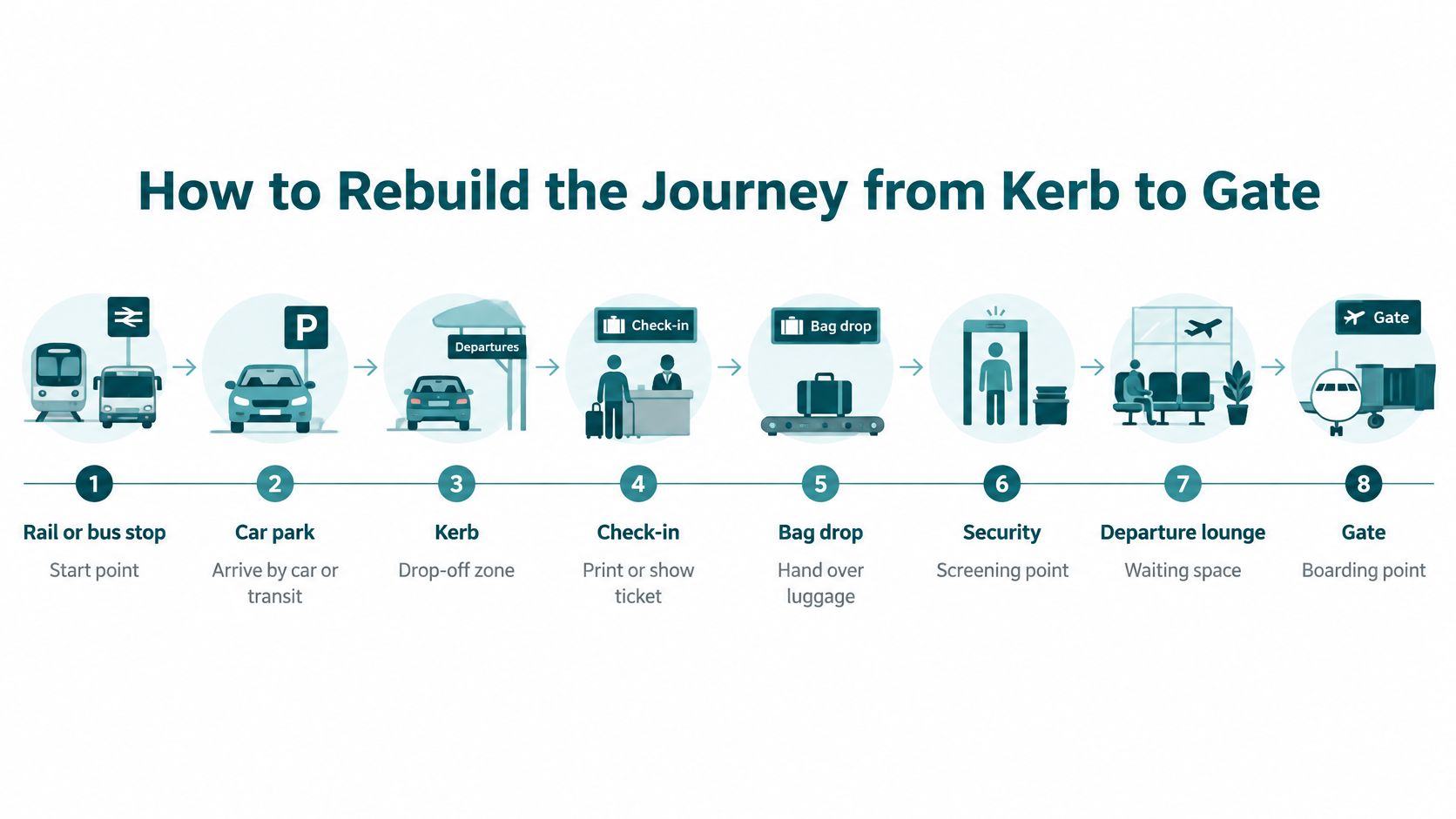
Use this terminal sequence as the starting point for observation.
Run the terminal walk as an operational audit
Map the path. Follow arrivals from the rail or bus stop, car park and kerb through check-in, bag drop, security, departure lounge and gate. Audit the reverse journey through border control, baggage reclaim and onward transport. The measure is continuity: every handover must have a usable next instruction.
Time each leg during an identified departure bank. Record the operating conditions, not just elapsed time. Separate queueing from walking, searching and waiting for information. The security queue bands in the benchmark table should remain visible rather than disappearing inside an average.
Mark the places where passengers ask staff. Observe level changes, pier junctions, toilet approaches, assistance points and the space immediately after screening. Record the question as well as its location. A repeated question about the same lift usually calls for a route correction, not another general welcome sign.
Write step-level directions for different needs. Test walking, step-free and luggage-heavy routes with passengers who would use them. Give staff the same destination names and instructions. Measure wrong turns and completion separately for each route rather than assuming the shortest path suits everyone.
Attach an exception rule. Identify who receives gate-change and lift-outage information, who approves the replacement path and how passengers receive it. Test whether the corrected instruction reaches someone already travelling towards the affected junction.
Keep throughput separate from journey quality. A faster screening lane can coexist with a confusing exit. Measure unaided arrival at the next destination, route-completion time and staff intervention independently of screening throughput.
Our customer journey mapping guidance supports this distinction between an organisational process and a passenger's continuous route.
Test handovers beyond the terminal door
The CAA's departing passenger survey reports cover Birmingham, East Midlands, Gatwick, Heathrow, London City, Luton, Manchester and Stansted in 2024. That named coverage matters because a national result can conceal very different terminal layouts and transfer arrangements.
For booked ground transport, examine how the driver and passenger identify the same collection point. Hamptons Leisure Limo's Hamptons airport pickup safety tips provide a useful comparison for collection-point communication, not a substitute for the airport's own operating instructions.
Use the video alongside the walk-through to prompt discussion about navigation across connected spaces.
Commission a two-week shadowing exercise on a single pier. Include passengers with different access requirements, record consent appropriately, and ask observers to distinguish a deliberate stop from uncertainty. Give the terminal manager a marked-up map, an issue register and an owner for each correction.
Why Assistance Times Still Leave Passengers Lost
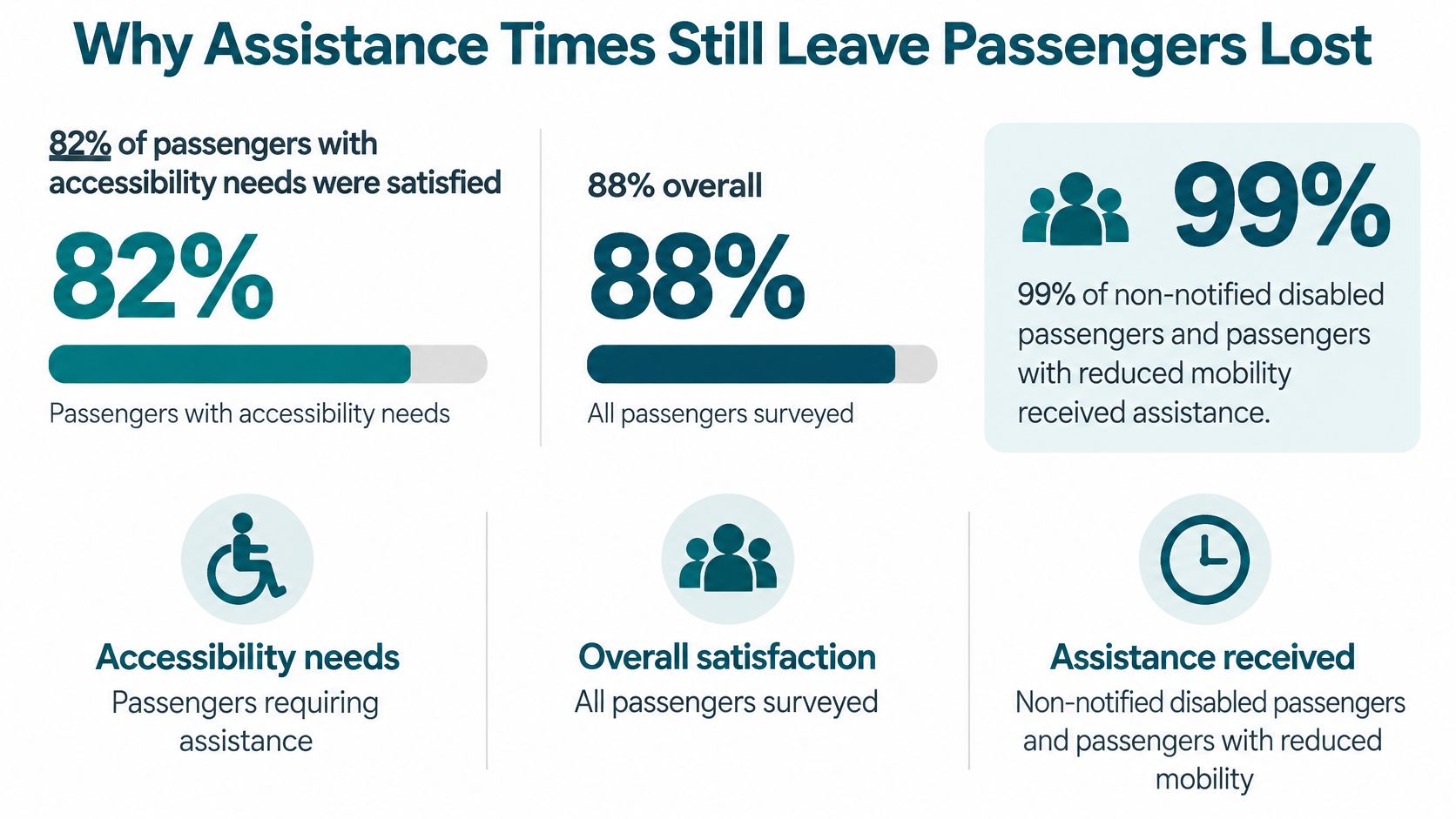
Passengers with accessibility needs report lower satisfaction than the travelling public overall, despite strong reported performance against assistance waiting-time measures. Those results aren't contradictory. They measure different parts of the journey.
An assistance clock can establish whether someone received support after identifying themselves at a designated point. It can't establish whether they could find that point, locate a toilet afterwards or understand a changed gate announcement.
The contrast is clear in the accessibility measures below.
Assess the spaces between assistance handovers
Assistance teams organise people, vehicles, meeting points and handovers. Estates teams manage a terminal that changes with building works, airline moves and retail fit-outs. Neither team should assume the other has checked the passenger's complete route.
For a blind passenger, a sign that was correct when printed doesn't necessarily provide a usable instruction today. My recommendation is to judge a route by whether a passenger can follow it independently, not whether the airport has installed information somewhere nearby.
The regulatory and design review should distinguish Assimilated Regulation (EU) No. 1107/2006, the Equality Act 2010, the CAA Quality Standards Framework, BS 8300 and BS EN 17210. They aren't interchangeable documents, and none should be reduced to a claim that a particular navigation technology is mandatory. Use the relevant legal duties and design standards to examine access, assistance and usability with the airport's accessibility advisers.
Infrastructure-free navigation is an operational choice within that review. It avoids the question of maintaining a positioning hardware grid across changing public space, but it doesn't remove the airport's responsibility to maintain accurate routes.
Take evidence from independent navigation seriously
The WMCA deployment at Birmingham New Street had distinct objectives: enhance independent navigation for passengers with visual impairments and mobility challenges, improve passenger flow and reduce congestion, and demonstrate a scalable model for major UK rail stations.
Testing among diverse user groups showed strong satisfaction across the groups. Users with visual impairments gave particularly positive responses and reported increased confidence navigating the station independently. That's relevant evidence about user experience in a complex transport environment, not a claim that an airport will achieve identical results.
A clear end-user support process remains necessary. Independent navigation and human assistance should complement each other, with neither used as a reason to withdraw the other.
Apply these design tests before accepting a route:
- Late assistance: A passenger who wants to continue independently can still understand where to go and how to request help.
- Step-free continuity: For someone who selects it, the step-free option is the planned route, not an improvised detour.
- Changed destination: A gate change replaces the route the passenger already holds, rather than leaving them to discover the conflict.
How to Shorten Wasted Time Between Modes
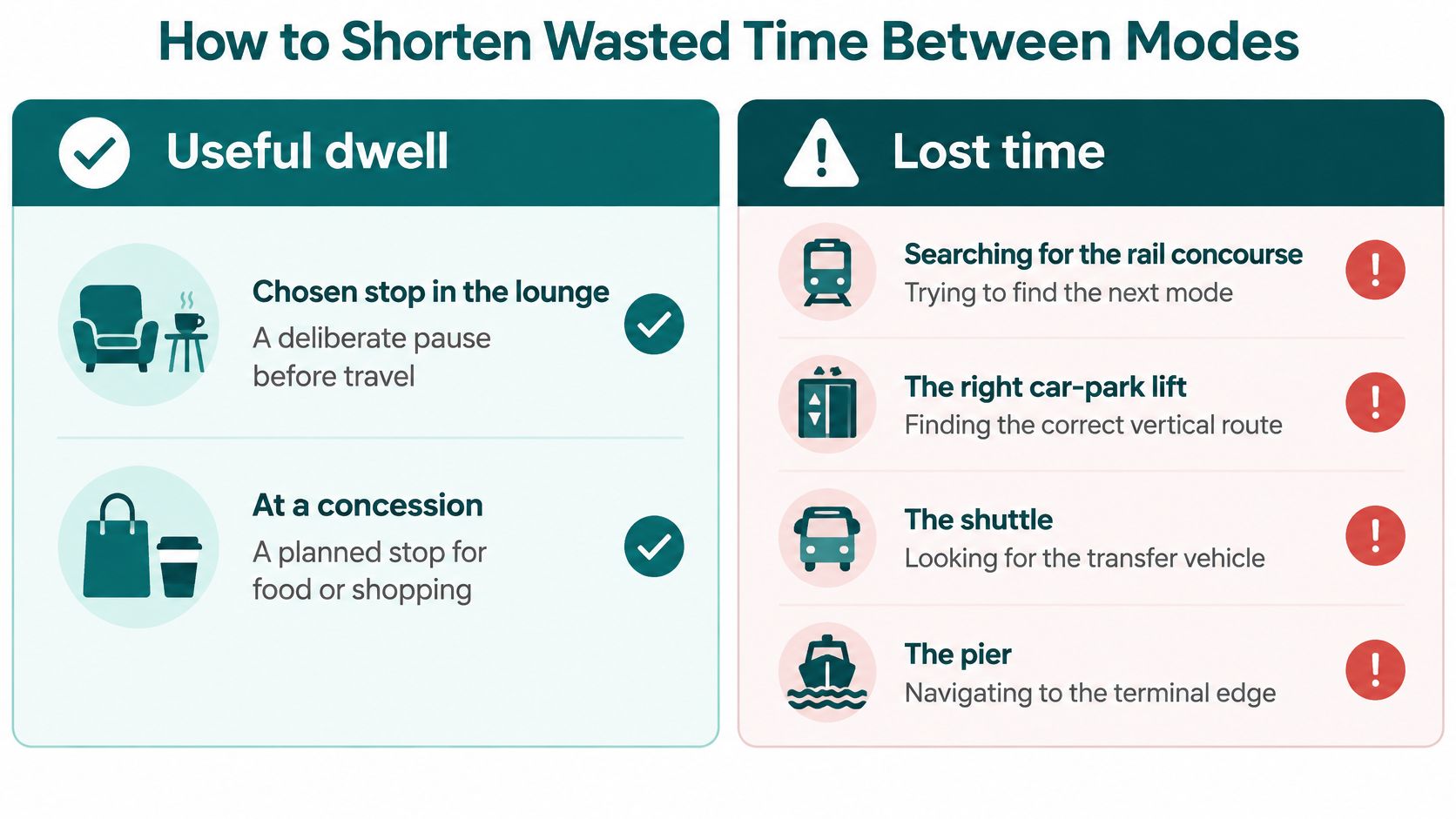
Useful dwell is a chosen stop. Lost time is an unwanted search. A passenger having a meal before boarding is using time differently from someone looking for the correct car-park lift.
Operations and commercial teams should preserve that distinction. A long stay in the terminal isn't automatically valuable dwell, and a short journey isn't successful if someone abandoned a planned stop because they couldn't find it.
Use the comparison below when reviewing transfer routes with retail and ground-transport colleagues.
Measure the connection rather than the building
Use timestamped observations to establish:
- Transit arrival to check-in: Time from the primary rail or bus stop to the intended check-in area.
- Parking to security: Time from the relevant car-park pedestrian exit to security entry.
- Arrivals to onward travel: Time from the arrivals door to the correct platform, stop or collection point.
- Direction requests: The share of observed passengers who need staff to explain those legs.
Publish a coherent onward route before arrival where the airport's communication channels allow it. Don't leave passengers to reconcile competing signs at the arrivals exit.
International travellers also need continuity between airport instructions and local mapping conventions. Simsima's guide to use Naver Map in English is a practical example for passengers continuing journeys in South Korea. The wider lesson is to name the destination and transport entrance consistently across channels.
Wasted minutes between modes are an operations failure even when security scores stay high.
Our guidance on real-time transit information addresses the connection between current service information and the next action a traveller needs to take.
Give retail access a commercial test
Retail and operations directors should agree which concessions lie on the step-free route to each gate area. Guidance can identify those shops without sending passengers on an undisclosed detour.
Ask concession teams for dwell-time and spend-per-passenger information. Compare comparable operating periods and routes where a concession is named against those where it isn't. Treat any difference as a question to investigate, not automatic proof that navigation caused the sales result.
Keep the gate journey primary. If a gate moves, reassess the walking route before recommending a shopping stop, especially for passengers who find walking, standing or carrying luggage difficult.
For missed connections, the recovery instruction should name the new platform, stop or desk and the person who can resolve the problem. Start with a one-week count of direction requests at the rail interface and arrivals exit, then correct the most frequently misunderstood handover.
A Practical Rollout for Terminal Wayfinding
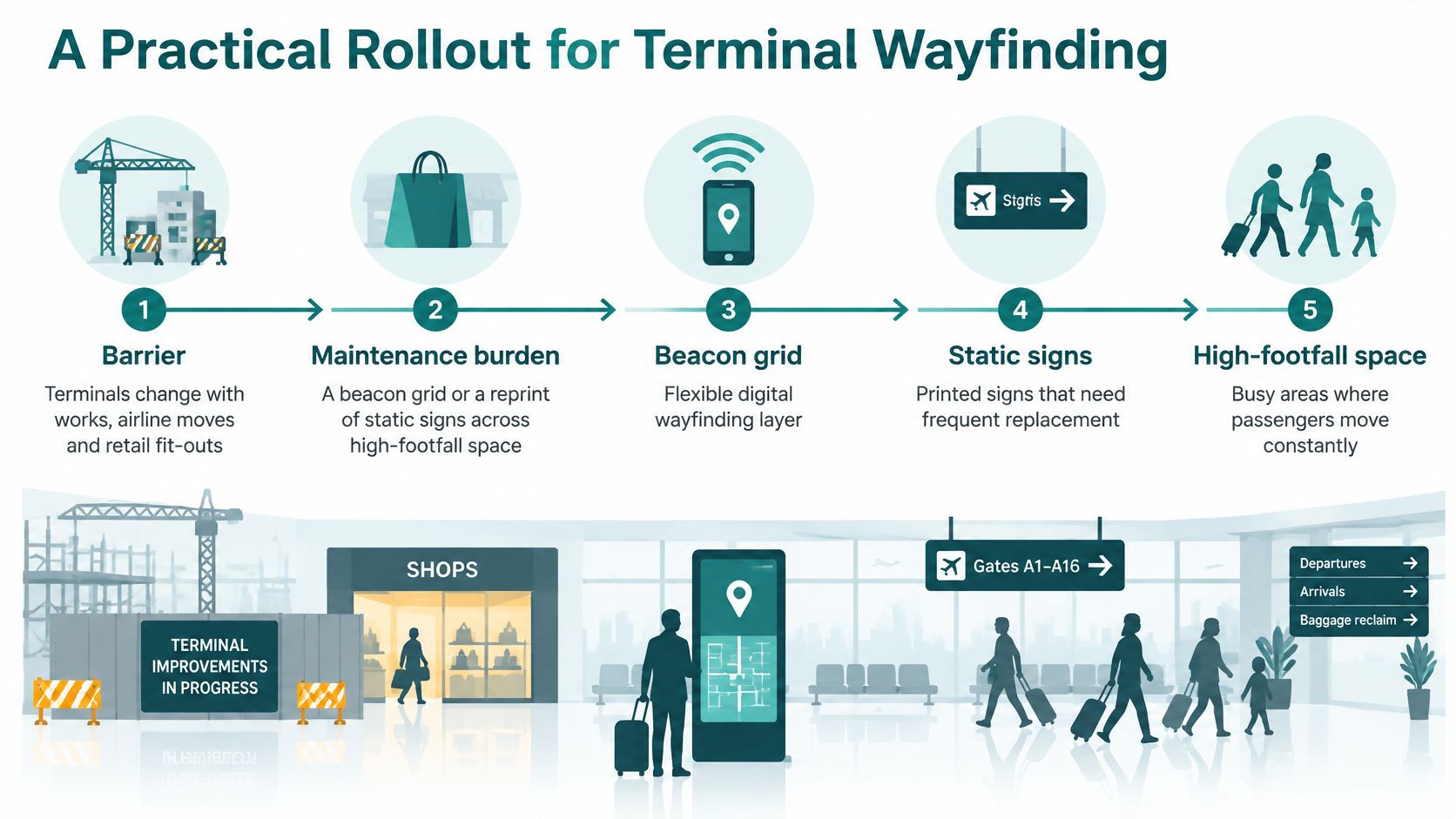
Terminals change with works, airline moves and retail fit-outs. Airport managers therefore need to compare the maintenance obligations of each wayfinding layer, not only its purchase or installation requirements.
Static signage, phone navigation and staff assistance solve different problems. An effective rollout specifies where each belongs and who keeps it current.
Wayfinding options for a changing terminal
| Layer | What the airport must maintain | Fails when | Use it for |
|---|---|---|---|
| Static signs and maps | Print, mounts and wayfinding audits | Gates, shops or works move without corresponding changes | Fixed statutory messages and orientation |
| Bluetooth beacons | Power arrangements, surveys, batteries and hardware access | Hardware maintenance or positioning changes are missed | Zones where a phone trigger is sufficient |
| Sensor-based phone guidance | A living map and an editor on duty | A closure isn't reflected in the map | Step-level routes, step-free options and gate changes |
| Staff assistance | Rosters, meeting points and handovers | The passenger must find an unexplained next point alone | Passengers who have requested support |
Choose the maintenance model before procurement
Waymap's positioning uses dead reckoning with device-native motion sensors, fused with detailed maps, rather than GPS, Wi-Fi or installed Bluetooth beacons. Guidance adapts to walking patterns and supports multi-level, step-free routes; it doesn't mean the venue needs no mapping.
Our system automatically provides real-time routes around works or faults affecting lifts, escalators and areas, and integrates live train schedules. It supports continuous navigation outdoors, indoors and underground. The airport must still supply accurate layout information, manage access restrictions and keep operational changes current.
The October 2024 Birmingham New Street launch was the first major infrastructure-free navigation deployment on the UK rail network. Its relevance to airport procurement is the deployment model, not an unsubstantiated accuracy claim or a promise of identical outcomes.
The CAA's assistance performance report anchors free assistance rights in Assimilated Regulation (EU) No. 1107/2006 and reports that 99% of departing pre-notified passengers received assistance within 30 minutes, while 99% of departing non-notified passengers received it within 45 minutes, after identifying themselves at a designated point. These assistance measures don't describe whether a changed route was communicated successfully.
Use this rollout framework to connect procurement with operational ownership.
Expand only after the pilot proves usable
- Discover: Assemble the route inventory, baseline observations, assistance handovers and recurring complaints.
- Pilot: Select a difficult pier and test with passengers who have different navigation and access requirements.
- Connect: Extend the validated route to rail, bus and car-park interfaces.
- Exercise exceptions: Rehearse gate changes and lift closures, including passengers already following instructions.
- Review: Examine unaided completion, wrong turns and corrected incidents monthly.
Our airport terminal signage guidance supports treating digital directions and physical signs as coordinated layers.
Assign a named airport owner for map edits, separate from the assistance contractor. Give that owner access to works notifications and facilities changes, with a documented approval and escalation process.
Frequently Asked Questions About Airport Passenger Experience
What should a passenger do when the assistance plan fails?
Contact the airport's published assistance point or on-duty staff and ask for three things: a live owner, a confirmed meeting point and a corrected onward plan. The airport should publish that escalation route in advance, not expect someone to discover it during disruption.
Exception recovery needs its own audit. Build a missed handover into the pilot exercise and check whether staff can resolve it without sending the passenger between desks. A prompt pickup still fails the passenger when nobody owns the onward journey.
Who can resolve a wayfinding or access problem immediately?
The airport should designate a duty manager with authority to coordinate facilities, airline information and assistance services. The assistance contractor alone may not control the closed lift, changed gate or restricted corridor.
Give that duty manager a route issue register and a named escalation contact for each dependency.
Test the arrangement on the pilot pier before expanding coverage.
Who edits the route when a gate or lift changes?
A named map owner should be accountable for publishing each route change, with a duty manager authorised to trigger urgent corrections. The role needs cover arrangements, not just a person's name in a project document.
Measure the interval between an operational notification and the passenger receiving a valid alternative. Where the wayfinding layer is live, routes can update automatically around lift closures and escalator faults, so the audit question becomes how quickly the airport confirms a change rather than whether anyone noticed it.
Record each correction and who approved it.
Do airports need beacons for indoor navigation?
No. Positioning can run on a smartphone's motion sensors and detailed maps, so installed hardware is a procurement choice rather than a requirement.
A beacon-free approach still needs accurate maps and operational ownership. During the pilot, assess the complete route and update process rather than accepting a positioning demonstration as proof of passenger usability.
Where should an airport passenger experience programme start?
Start with the pier where passengers most often lose their way or need unplanned help. Compare independent completion, wrong turns and satisfaction across passengers with different access requirements.
Choose a manageable pilot boundary, but include its difficult junctions and the facilities passengers depend on most. An uncomplicated corridor will not answer the operator's real questions.
How should passengers report a missed pickup or inaccessible route?
Offer a clear reporting channel that records the location, time, intended destination and what went wrong. Provide an immediate alternative where possible, then assign the underlying correction to an accountable owner.
Don't make a smartphone the only reporting method. Staff should be able to log the same issue for someone who reports it in person.
Will a complaint produce a measurable remedy?
It should produce a recorded action and confirmation that the correction works, not merely an acknowledgement. The complaint-handling gap in the benchmark table makes this a management priority.
Classify each remedy as a route correction, facilities action, handover change or communication update. Check the affected journey again before closing the issue, and feed the result into the pilot review.
Fix the path a passenger can follow alone, then scale assistance around that path.
Waymap offers infrastructure-free navigation that connects terminal routes with the wider passenger journey. Visit Waymap to discuss a pilot on your most difficult pier, with agreed measures for independent completion, route corrections and disruption recovery.
