
Airport Accessibility: Rules, Needs and Wayfinding
Airport accessibility is usually reported as a response time. A passenger asks for help, a staff member arrives inside the target window, and the statistic is logged as a success. What that number never captures is whether the same passenger could have found the lift, the accessible toilet or the gate without asking anyone at all.
Demand for help keeps climbing, and the experience of disabled travellers keeps falling short of the service levels airports report. The rules are specific, the obligations are broad, and the measurement is narrower than the duty. What follows works through what the law requires, who needs what, where the journey breaks down, and how to measure independent navigation as an outcome in its own right.
What UK Law Requires for Airport Accessibility
UK airports must provide free assistance to disabled passengers and passengers with reduced mobility from their arrival at the departure airport through to leaving the aircraft at the destination airport. Those rights arise under Assimilated Regulation (EU) No. 1107/2006, which applies to journeys departing from UK airports and to relevant flights arriving in the UK, as the CAA's guidance on the regulation sets out.
The regulation uses the term persons with reduced mobility (PRMs) for anyone whose mobility is limited by disability, age or a temporary condition. Its airport obligations sit on the practical work of moving people through the building. Airports, or the assistance providers they contract, help passengers move around the terminal, board aircraft and disembark. The same regulation requires airports to establish quality standards for assistance, which is what turns accessibility into a defined legal service duty rather than a customer-service extra.
The whole route is in scope. The obligation covers entrances, designated meeting points, check-in, security, gates and aircraft stands. A passenger who cannot find the assistance meeting point has not received the service the law promises, which puts wayfinding inside the legal duty rather than beside it.
| Requirement | Source | Who delivers it |
|---|---|---|
| Free assistance from arrival at the departure airport to leaving the aircraft at the destination | Assimilated Regulation (EU) No. 1107/2006 | Airport or contracted assistance provider |
| Quality standards for assistance | Assimilated Regulation (EU) No. 1107/2006 | Airport operator |
| Reasonable adjustments so disabled people are not at a substantial disadvantage | Equality Act 2010 | Service providers, including airports and airlines |
| Accessible design of routes, entrances, toilets and signage | BS 8300-2 | Design teams and estates managers |
| Accessibility of the built environment | BS EN 17210 | Design teams, estates managers and operators |
The Equality Act 2010 sits alongside the aviation regulation and applies to airports and airlines as service providers. It requires reasonable adjustments so that disabled people are not put at a substantial disadvantage compared with non-disabled people. That reaches further than a timed escort, because it covers information, booking, the physical route and the way changes get communicated.
Two standards supply the design detail. BS 8300-2 covers accessible design of routes, entrances, toilets and signage, and BS EN 17210 sets out functional accessibility requirements for the built environment. Neither is statute. They carry weight because regulators and courts treat them as evidence of what good practice looks like, and because they give design teams something concrete to specify against. The accessibility compliance requirements that apply to UK venues follow the same logic.
Tom Pey, founder of Waymap and a blind accessibility technologist, built the platform around the distance between a passenger being helped and a passenger arriving independently. The rest of this article tests whether the duties above are met in practice, and where current measurement falls short of the obligation.
How Many Passengers Need Airport Assistance Today
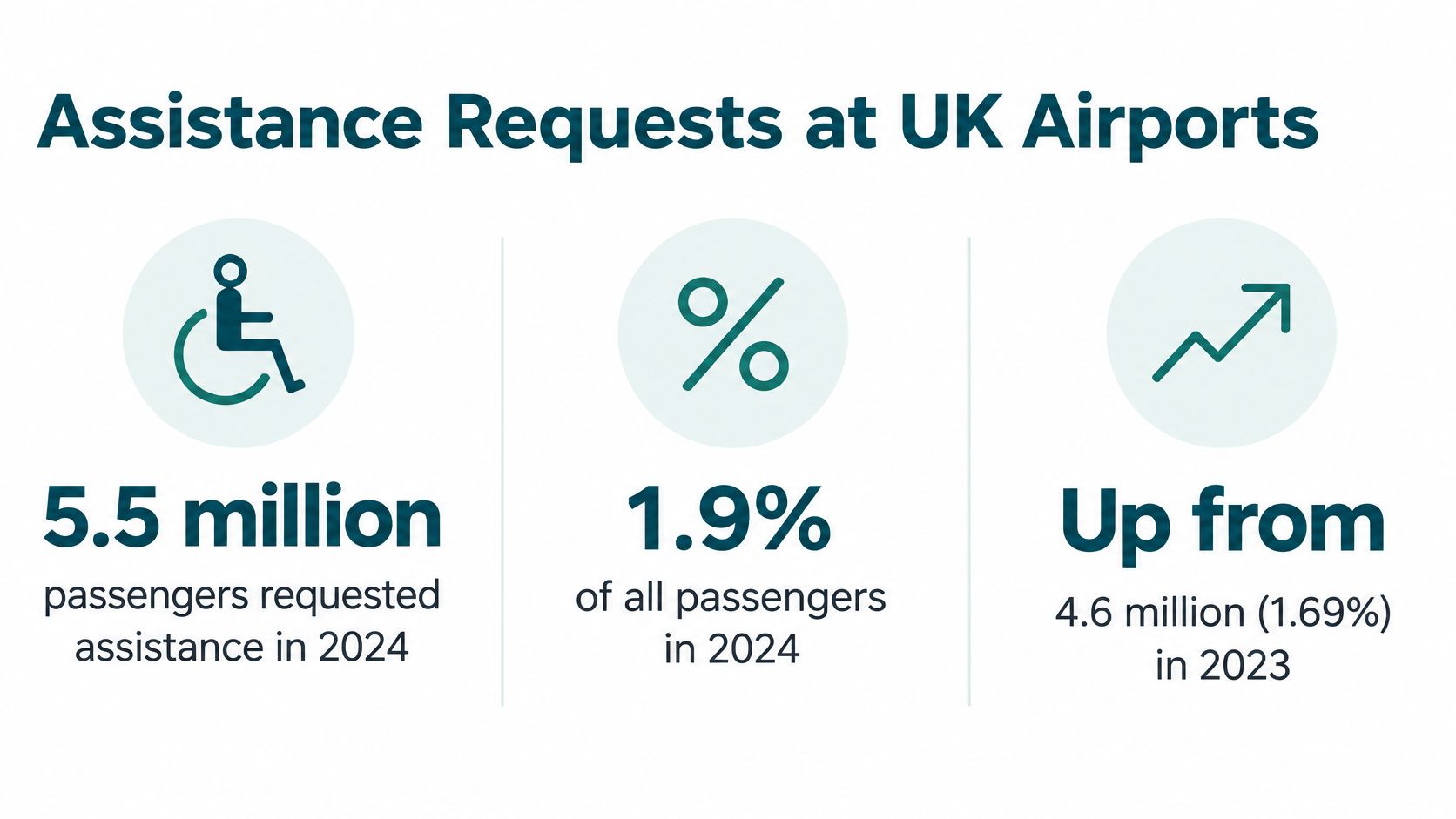
In 2024, approximately 5.5 million passengers requested assistance at UK airports, representing about 1.9% of all passengers, up from 4.6 million, or 1.69%, in 2023. The CAA's accessibility report puts the longer trend in view as well: passengers requesting assistance were 0.94% of UK airport traffic in 2010 and 1.35% in 2019.
The growth rate is the part that should hold an operations director's attention. Between 2015 and 2024, assistance requests rose by roughly 115.8%, while total passenger numbers grew by only 23.9%. Accessibility demand isn't tracking passenger volume, it's outpacing it by a wide margin, and it's now a standing operational responsibility for airports, airlines and transport authorities rather than a niche requirement.
The 2023 breakdown shows what kind of help people ask for, and each category fails in a different part of the building.
| Need category | Share of 2023 requests | What it means for wayfinding |
|---|---|---|
| Reduced mobility, needs help moving around the airport | 86.4% | Distance, transfers and waiting areas drive the difficulty |
| Complex physical needs, often travelling with own wheelchair | 5.7% | Step-free routes, lift locations and accessible toilets need to be found reliably |
| Blind, deaf or other invisible disability | 7.9% | Audible information, tactile cues and clear staff directions matter most |
For the largest group, the barrier is distance and endurance. Long pier walks, a transfer between terminals, a gate change at the far end of a concourse and a lack of seating along the route all convert a straightforward journey into a physical test. For passengers with complex physical needs, the critical information is whether the route is step-free and where the nearest functioning lift and accessible toilet sit. For blind, deaf and invisibly disabled passengers, the barrier is information format and predictability: audible announcements, tactile cues, clear staff directions and early warning of changes.
The CAA reports that the average share of passengers receiving assistance varies considerably by airport, reflecting local passenger demographics, terminal layouts, transfer distances and service design. Two airports with similar passenger volumes can carry very different assistance loads, so a national benchmark sets context rather than a target.
Pull your own assistance request data for the last four quarters, split it by the same three categories, and compare the mix with this national baseline. If your complex-needs share is climbing faster than your reduced-mobility share, lift capacity and the reliability of step-free routes need attention before your staffing plan does.
Where Disabled Passengers Get Stuck in Airports
58% of disabled consumers reported difficulty accessing or using airports and flying, according to CAA research on the passenger experience. Assistance can be available and still leave a passenger unable to find their gate independently. The measure that matters is not only how quickly help arrives, but whether the building supports the journey without an escort.

Walking, standing and carrying luggage are among the most commonly reported needs. In practice, the barriers often appear at predictable points:
- Kerb to check-in. Drop-off points, car park exits and assistance meeting points can be difficult to identify for someone unfamiliar with the terminal. A first-time visitor may not know which entrance is closest to the correct desk.
- Security. Queue layouts, separate lanes and the move to the tray station can obscure the route. Passengers may be directed through without clear instructions about what happens next.
- Airside transfers. Moving between piers or terminals may involve a train, a long walk or a change of level. Distance and route details are not always clear before the passenger sets off.
- Facilities. Toilets, changing places, food outlets and assistance desks can be hard to locate when signs are inconsistent.
- Gate changes. A new gate can mean finding a different route and somewhere to sit near it. Passengers already in transit may have to work out the journey again under time pressure.
A blind passenger who cannot access departure-board information in a usable format may need to ask for directions at each decision point. A passenger with a cognitive disability may hear an audio-only gate-change announcement but lack clear guidance to the new gate or a nearby seat.
Independent wayfinding is a separate outcome from timely assistance. An airport can meet its escort response targets while passengers still cannot reach their gate alone. A walkthrough should therefore test whether a passenger can complete key journeys independently, not just whether staff can take them there. One useful test is whether someone can find the gate after a change without having to restart the search from the beginning.
The same person-centred principle appears in community participation options in Ballarat: services should support individual goals and routines. For airport teams, that means checking whether the building lets passengers complete the journeys they need to make, independently where possible.
Which Design Features Help Blind and Low-Vision Travellers
Fixed design does the work that no staffing model can scale. A passenger who can find their own gate needs no escort at all, which is the outcome that separates an accessible airport from a well-staffed one. Each feature below has a reason behind it, and each one is verifiable on a site visit.
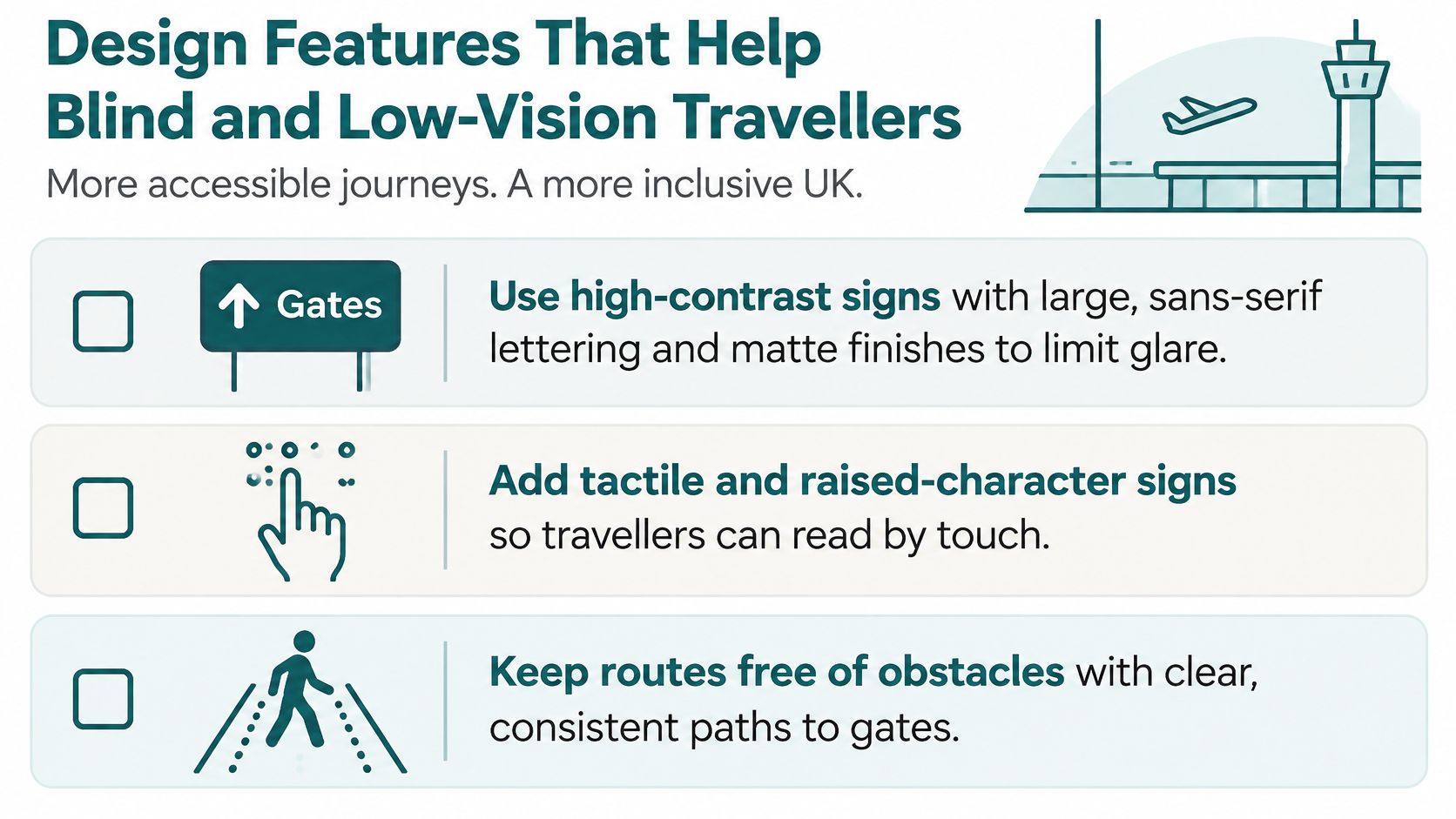
- High-contrast signs with large, sans-serif lettering and matte finishes. Glare is one of the main things that defeats a low-vision reader, so the finish matters as much as the font size.
- Tactile and raised-character signs at decision points. Place them where a route choice happens, such as lift lobbies, corridor junctions and the entrance to each pier, following the guidance in BS 8300-2.
- Consistent audible announcements, plus a sound cue at entrances, lifts and gate areas. A sound beacon lets a passenger locate a facility by ear instead of hunting for a stranger.
- Tactile floor guidance from the kerb to the terminal entrance, continuing through check-in. Continuity matters more than the surface type; a guide path that stops at the door teaches the passenger not to trust it.
- The same layout pattern repeated on every floor. A passenger who learns the departures level can then predict the arrivals level, which cuts the cognitive load of an unfamiliar building.
- Meeting points marked clearly and linked to a known step-free path. A marked point at the bottom of an escalator excludes every wheelchair user from using it.
- Digital information that works with screen readers and voice output. The same content has to be available on a phone, in the hand, at the moment of decision.
The principle running through the list is that no passenger should depend on a single sense, or on a stranger, to find a gate. Design that only works for a sighted reader who can ask for help is a queue with better lighting, not accessible design. The same reasoning drives navigation for blind and low-vision users that does not assume sight at any point in the route.
The limit of fixed signage: it can't be rewritten when a gate changes, a stand moves or a lift goes out of service. Design solves the predictable journey and leaves the disrupted one to staff.
Test the route before the next design review
Walk each route from arrival to gate and confirm every feature on the list exists along the whole way, not just at the front door. Record the gaps with a photograph and a location so they can be priced and scheduled. Then ask a blind or low-vision user to walk it with you and time each leg. That single test will surface more than a design review, because it finds the points where the building contradicts its own signage.
Which KPIs Show Airport Accessibility Is Working
The measure that matters most isn't how fast help arrives. It's whether the passenger finished the journey without needing help at every transition. Current UK reporting leans heavily on the first: 99% of notified departing passengers received assistance within 30 minutes in 2024/25, and 99% of non-notified passengers received it within 45 minutes, according to the CAA's analysis of assistance performance. Neither figure explains whether a traveller can find check-in, security, toilets, gates, transfer points or the assistance desk without repeated staff intervention.
| Measure | Latest figure | Source |
|---|---|---|
| Notified departing passengers assisted within 30 minutes | 99% (2024/25) | CAA |
| Non-notified passengers assisted within 45 minutes | 99% (2024/25) | CAA |
| Satisfaction with complaint handling, disabled vs non-disabled | 66% vs 74% | CAA |
| Airports rated very good, good, needs improvement (28 assessed, 2023/24) | 11, 12, 5 | CAA |
| Trips completed without staff intervention | No published UK benchmark | Airport baseline, not CAA |
| Route changes communicated in an accessible format | No published UK benchmark | Airport baseline, not CAA |
The rating context is useful for calibration. The CAA assessed 28 UK airports for the 2023/24 reporting year, rating 11 very good, 12 good and 5 as needing improvement, and published the results in August 2024.
Those ratings reward the right things, but they still don't tell you whether autonomy improved. Build a navigation set alongside the response times: the share of assisted trips completed without a staff escort, the number of staff interventions per 100 assisted passengers, the time taken to reach a gate, toilet or assistance desk from the security exit, the share of route changes communicated in an accessible format, and complaint satisfaction split by disability. Report them alongside your accessibility compliance reporting rather than in a separate document nobody reads.
Sampling is where most KPI programmes fail. Test during the busiest hour, in every terminal, with blind, low-vision, wheelchair and cognitive-disability users. A route that works at 6am on a Tuesday tells you nothing about the same route at 8am on a Friday.
Two rows in that table have no published benchmark behind them, which means every airport sets its own baseline first. Do that deliberately: pick a target for each measure, record the baseline date, and book the review date in the same meeting.
The threshold to argue for: a target you'd be embarrassed to miss is more useful than a target you can't measure. Set both, then publish the pair.
How Waymap Guides Passengers Without Beacons or GPS
Waymap builds its position from the smartphone's own motion sensors, a method known as dead reckoning, matched against detailed venue maps. The app learns each user's stride and walking pattern as they move, so the audio instructions stay step-accurate rather than approximate. Because nothing depends on GPS, Wi-Fi, Bluetooth beacons or installed hardware, the guidance holds in signal-poor environments, and Waymap works in underground stations without an internet connection at all.
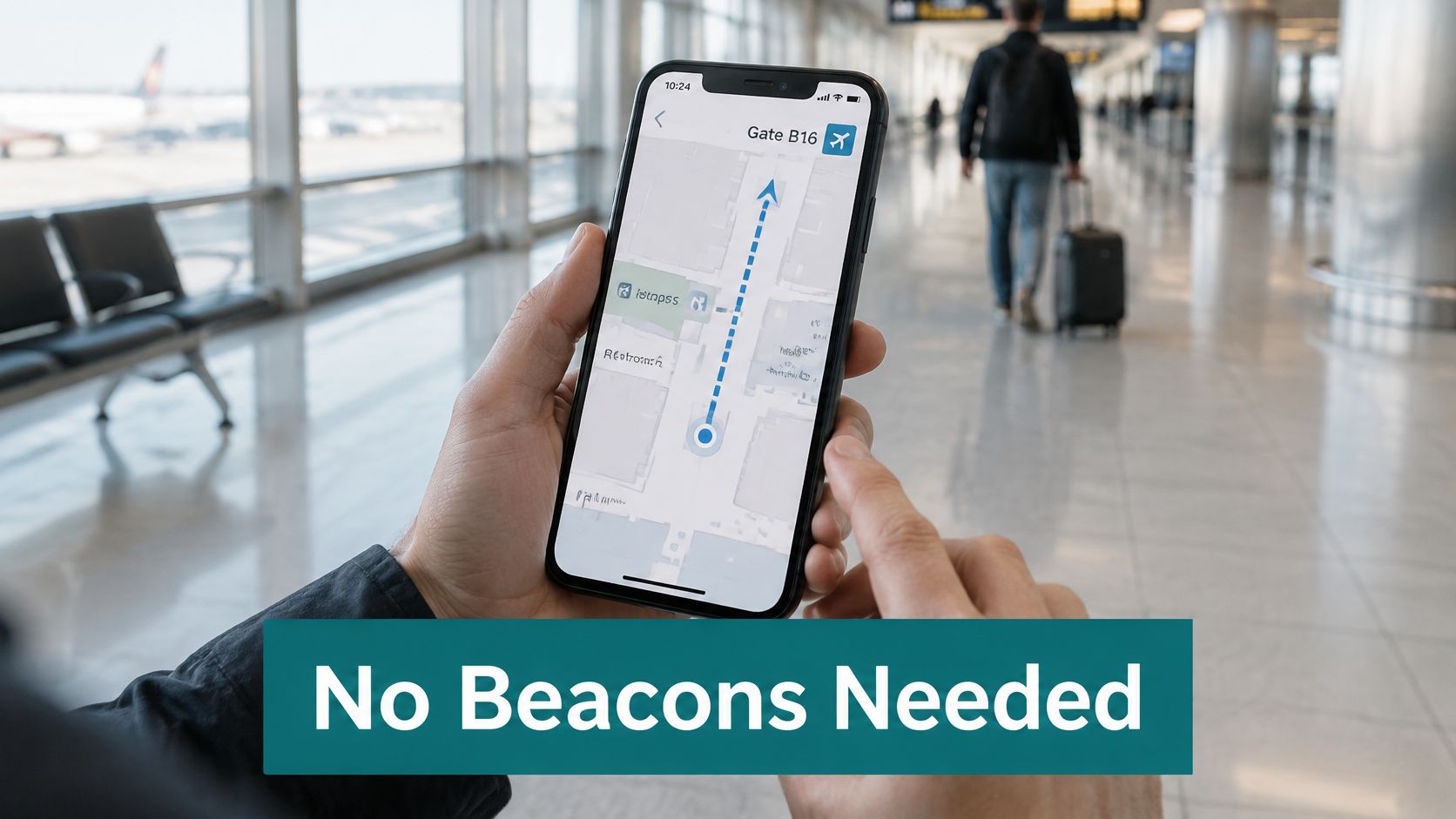
For an airport, that changes both the cost structure and the maintenance burden. No venue-side hardware to buy, install, power or service, and no beacon estate to keep in step with a refit. The navigation layer changes when the building changes, which is the opposite of how a sign package behaves. Waymap also reroutes automatically around works or faults in escalators, lifts and areas, which matters on the day the only step-free route to a pier closes at short notice. Step-free routing, directions to accessible toilets and personal route preferences sit in the standard app, so an assistance team configures nothing extra for a blind passenger that it wouldn't for anyone else.
The evidence base for that claim comes from venues rather than terminals. At Birmingham New Street, the West Midlands Combined Authority deployment had three objectives: enhance independent navigation for passengers with visual impairments and mobility challenges, improve passenger flow and reduce congestion, and demonstrate a scalable model for major rail stations across the UK. Testing among diverse user groups showed strong satisfaction across all groups, with particularly positive responses from users with visual impairments, who reported increased confidence navigating the station independently. The October 2024 launch was the first major infrastructure-free navigation deployment on the UK rail network.
At Lord's Cricket Ground, visitors are guided to the most appropriate entrance for their seating location, then to their seat, accessible toilets, bars, exits and other points of interest. Across the Bullring and Grand Central estate in Birmingham, users can route between any two points, including stores, restaurants, accessible entrances, accessible toilets and exits.
No airport deployment sits behind that evidence, so the airport case is an inference from rail, stadium and retail environments, and it should be read that way. Navigation doesn't replace staff assistance or the airport's legal duties; it reduces how often a passenger has to invoke them. What it answers is the question escorted-assistance targets never ask: whether a passenger can follow a route alone. Fixed signs can't be rewritten when a gate or stand moves. Infrastructure-free guidance can, which is why airport indoor navigation belongs in the independence column of an accessibility review rather than the convenience one.
Audit Your Airport's Wayfinding Gaps First
Four actions, in this order, produce an audit you can act on and defend at a budget meeting.
- Map the three routes assisted passengers use most, from kerb or car park to gate, and mark every point where a passenger has to ask for directions.
- Test each route with a blind or low-vision user and a wheelchair user. Time each leg and log every staff intervention, including the ones that felt minor.
- Compare the share of trips completed without staff help against your KPI baseline, then set a target and a review date in writing.
- Decide whether fixed signage can close the gaps or whether the route changes often enough that you need a layer that updates with the building.
The friction here isn't staff willingness, it's the capital cycle. Sign and beacon hardware has to be funded, installed and then maintained across terminals where layouts, contractors and tenants keep changing, so a dynamic option becomes a decision about operating cost as much as capital. That's the argument that stalls in most estates meetings, and it's the argument worth reframing. Our approach to disabled access in large venues starts with the route rather than the hardware, which is why the audit comes before the procurement paper.
Waymap requires no infrastructure investment from the venue. Once live, a venue is navigable on the Waymap app, the venue's branded app or the web, free for every visitor, with turn-by-turn directions delivered directly through Waymap, through your own branded app, or through a browser.
What to ask for next: a route test with your accessibility lead before the next capital or review cycle, with the audit results on the table.
Book the route test, bring the intervention counts and the timed legs, and let the building show the committee what it currently costs passengers to find their gate.
Airport Accessibility Questions Answered
What does airport accessibility require under UK law?
UK airports must provide free assistance to disabled passengers and passengers with reduced mobility from arrival at the departure airport until they leave the aircraft at their destination. Assimilated Regulation (EU) No. 1107/2006 also requires airports to set quality standards for that assistance.
How many passengers requested airport assistance in 2024?
About 5.5 million passengers requested assistance at UK airports in 2024, roughly 1.9% of all passengers, up from 4.6 million, or 1.69%, in 2023.
Do assistance response times show whether passengers can navigate alone?
No. A target such as assisting 99% of notified departing passengers within 30 minutes measures how quickly an escort arrives. It does not show whether passengers can independently find their gate, a toilet or the assistance desk. Track independent navigation separately, against its own baseline.
How does infrastructure-free wayfinding work?
Waymap combines a smartphone's motion sensors with detailed venue maps, without relying on GPS, Wi-Fi or installed beacons. Its guidance adapts to each user's stride and walking pattern.
Has Waymap been deployed at an airport?
The examples considered here are Birmingham New Street, Lord's Cricket Ground, and the Bullring and Grand Central estate, rather than an airport. These deployments show how independent wayfinding can work in complex, high-footfall settings.
What should an airport measure first?
Start with the share of assisted trips completed without staff intervention, measured against an airport-specific baseline. Pair it with staff interventions per 100 assisted passengers, and report both alongside assistance response times.
Airports can meet escort targets while passengers still cannot find their gate independently. Measuring both outcomes gives operators a clearer picture of assistance performance and wayfinding gaps. Waymap provides step-by-step directions through its app, a venue's branded app or a web browser, without GPS or installed infrastructure. A route test can help assess the passenger experience before the next capital cycle. Visit Waymap to book a walkthrough with your accessibility lead.
