
ADA Compliance UK: What the Equality Act 2010 Requires
The Americans with Disabilities Act is US federal law. It does not set the legal duty for UK premises. Organisations in England, Wales and Scotland answer to the Equality Act 2010, while Northern Ireland remains under the Disability Discrimination Act 1995, and Approved Document M governs building work in England.
The popular advice is to import an ADA checklist, tick ramps, lifts and a WCAG statement, and call the building done. That advice fails estates and operations leaders. ADA compliance UK is a search phrase, not a legal status you can hold. A US Title III audit will not tell you whether a station, campus or shopping centre meets its own duties. I would set aside any template that starts with "readily achievable" barrier removal and never mentions an anticipatory duty.
The pages that follow map each UK duty against its ADA equivalent, then test a harder question. Can a disabled person finish the route alone, or does the venue only possess accessible features? A ramp that ends at a locked door and an induction loop nobody switches on both pass a feature audit. Neither passes the journey test, and the journey test is the one a court, an inspector or a claimant will apply.
Which UK Laws Replace ADA Compliance
A UK building is not judged under the ADA. Organisations that run venues, stations, campuses, offices or public services answer to the Equality Act 2010 for services, premises and information, and to Building Regulations when they carry out building work.
The BBC explainer on the Equality Act sets out the core position. The 2010 Act consolidated and strengthened the Disability Discrimination Act 1995, made disability a protected characteristic, and extended protection against direct and indirect discrimination, harassment and other unequal treatment. Service providers must take proportionate steps so disabled people are not put at a substantial disadvantage when they use services or facilities. That duty is an ongoing operational responsibility, not a one-off construction sign-off, and it follows the whole journey rather than individual features. A step-free entrance counts for little if the route beyond it ends at stairs, and wayfinding, information and access to a precise destination all sit inside the duty when ordinary signs or layouts create a barrier. The Act covers England, Wales and Scotland, and it sits alongside sector transport rules.
The Equality Act 2010 does not extend to Northern Ireland, where the Disability Discrimination Act 1995 still applies. Approved Document M covers England only.
| Instrument | Jurisdiction | Type | What it covers | Physical or digital |
|---|---|---|---|---|
| ADA Title III | United States | Federal civil rights law | Places of public accommodation, including private venues open to the public | Physical; website claims brought under Title III case law |
| ADA Title II | United States | Federal civil rights law | Services, programmes and transit run by state and local government | Physical and digital |
| Equality Act 2010 | England, Wales and Scotland | Primary legislation | Services, public functions, premises, employment and education | Physical and information formats |
| Approved Document M | England | Building Regulations guidance | Access to and use of buildings, including facilities such as toilets | Physical |
| Building (Scotland) Regulations and Technical Handbooks | Scotland | Building standards | Building work and access within buildings | Physical |
| Building Regulations in Wales | Wales | Building standards | Building work and access within buildings | Physical |
| Public Sector Bodies (Websites and Mobile Applications) Accessibility Regulations 2018 | UK public sector | Statutory regulations | Public-sector websites and mobile apps | Digital |
| PAS 78 | UK | Publicly Available Specification (guidance, not law) | Good practice for web accessibility | Digital |
Read the table as three layers. Statute creates the duty to people. Building rules set dimensions when you build or alter. BS 8300-2:2018, BS EN 17210:2021 and PAS 78 are guidance, not a substitute for either. A UK organisation that also operates venues in the United States must meet ADA Title III on those US sites. It does not import Title III back into Birmingham or Edinburgh.
Establish three facts before you commission an audit. Which jurisdiction the site sits in. Whether you are a public body, which brings the public sector equality duty and extra digital rules. Whether the work is a new build, an alteration, or existing premises that will not be rebuilt. Get these wrong and the audit measures the site against the wrong instrument, which is the most common way compliance budgets are wasted.
Where ADA and UK Duties Overlap and Diverge
Both regimes aim at equal access. They do not use the same test.
Under ADA Title III, barrier removal in existing facilities is required where it is readily achievable, meaning easily accomplishable without much difficulty or expense. Under the Equality Act, the question is whether a provision, criterion or practice, a physical feature, or a missing auxiliary aid puts disabled people at a substantial disadvantage compared with non-disabled people. Government guidance on reasonable adjustments defines that threshold as more than a minor or trivial disadvantage. You do not have to prove that every disabled person is excluded before you act.
| Criterion | ADA Title III (US) | Equality Act 2010 (UK) |
|---|---|---|
| Trigger | Barriers in existing facilities removed where readily achievable | Reasonable steps where a provision, criterion, practice, physical feature or lack of auxiliary aid causes substantial disadvantage |
| Threshold | Readily achievable: easily accomplishable without much difficulty or expense | Substantial disadvantage: more than a minor or trivial disadvantage |
| Cost consideration | Cost and resources weighed within the readily achievable test | Cost, practicality, organisational resources and benefit weighed; adjustments cannot be charged to disabled customers |
| Timing | Barrier removal in existing facilities; design standards for new construction | Anticipatory duty: likely access needs considered in advance, not after a complaint |
| Digital scope | Shaped mainly by court decisions on websites | Information in accessible formats; PSBAR 2018 sets obligations for public-sector websites and apps |
| Enforcement | Private lawsuits and US federal agency enforcement | Civil claims in the County Court or High Court (England and Wales) or Sheriff Court (Scotland); Equality and Human Rights Commission enforcement powers |
The same guidance treats three responses as reasonable adjustments: change how you operate, alter the built environment, or provide an auxiliary aid or service. Lifts, ramps, wide doors, tactile signage, accessible information, induction loops, specialist software and extra staff support all sit in that list. If the building cannot reasonably be altered, providing the service somewhere else, or through a home visit, can itself be the adjustment. Cost, practicality, resources and the benefit to disabled people and other users all weigh in the decision. What is reasonable for a national rail operator is not the same calculation as for a small campus office.
A new visitor attraction can meet Building Regulations on day one and still face an Equality Act claim the week a lift fails, if the only published route has no step-free alternative.
Cost is a factor in both regimes. In the UK it is weighed against practicality, organisational resources and benefit, and you cannot bill disabled customers for the adjustment. The planning overlap is simpler than the legal labels. Both expect you to look for barriers before someone is stuck. Neither is satisfied because one ramp, one accessible toilet or one policy sentence exists.
What Venues and Transit Operators Must Provide
Under section 20 of the Equality Act 2010, the duty is anticipatory. The Equality Act draft code of practice is direct. Service providers and bodies exercising public functions must take reasonable steps when a policy, practice, physical feature or lack of auxiliary aid places disabled people at a substantial disadvantage. You consider likely access needs before a complaint arrives. The duty reaches policies, procedures, information formats, staff support and auxiliary services, not only ramps and lifts.
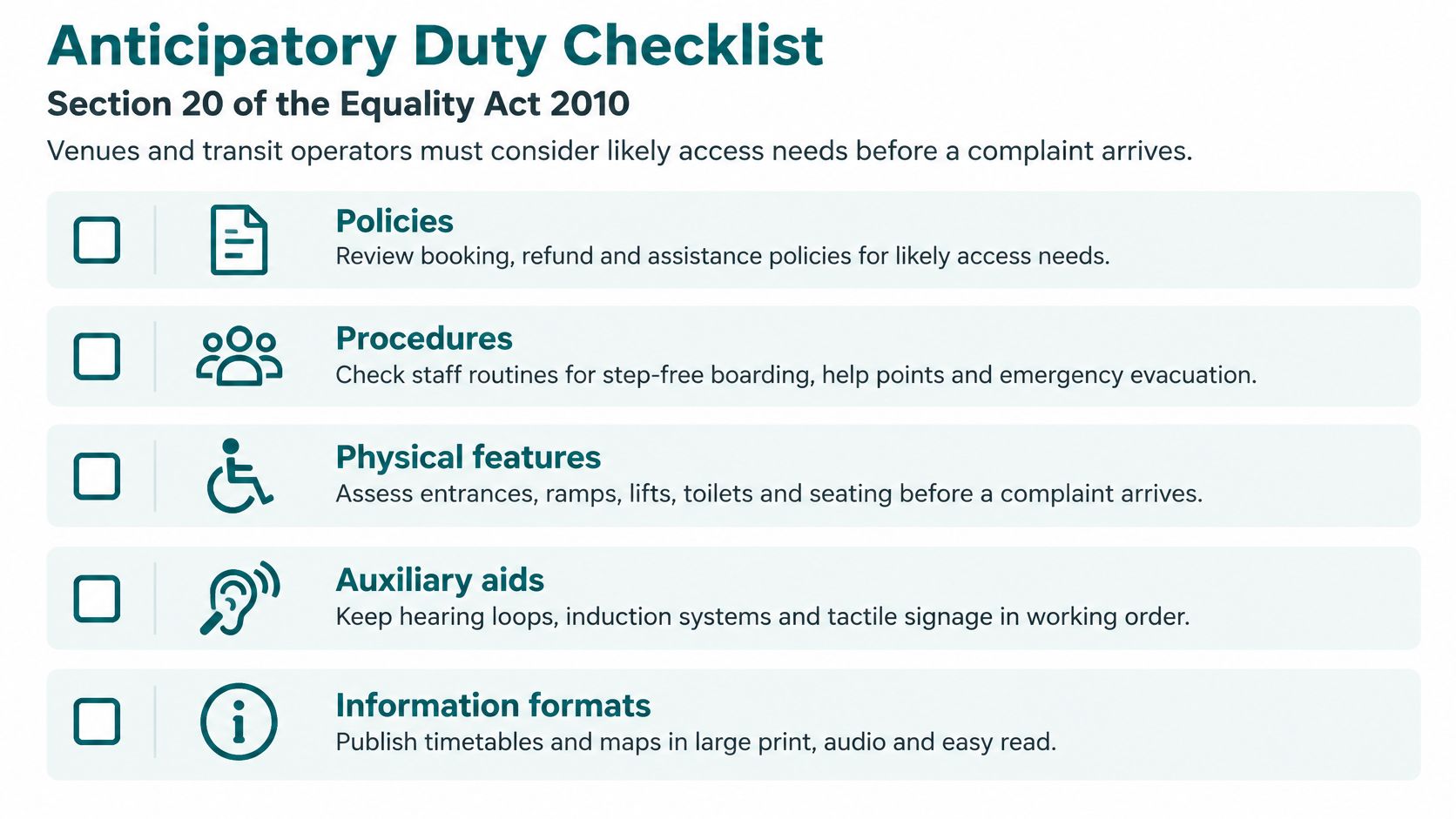
Turn that into an operations checklist. Each line needs a named owner.
- Adjust the cause. Take reasonable steps where a provision, practice or physical feature causes substantial disadvantage.
- Offer another method. Where you cannot reasonably remove a physical barrier, provide another way in, such as staffed assistance or a relocated entrance.
- Do not charge. Do not charge disabled customers for reasonable adjustments.
- Cover unpaid services too. Apply the duty to services offered to the public whether or not anyone pays, including transport, venues, universities, offices and shopping centres.
- Test the whole journey. Check entrance, ticketing, platforms, toilets, exits and assistance points, not only the accessible room.
- Treat it as governance. The House of Lords Library briefing on the Equality Act records that Parliament identified transport as one of the greatest challenges for disabled people and called for urgent action, so journey access belongs on the same agenda as safety and service quality. Our note on accessible public transport sets out why operators cannot stop at the vehicle.
- Keep wayfinding current. Publish it in accessible formats and update it when layouts, closures or platform assignments change.
A short briefing for duty managers makes the same point in practice.
If nobody owns the update, a facility that looked compliant at handover stays functionally inaccessible the first time the layout changes.
Which Building Dimensions Routes Must Meet in England
Approved Document M gives route data numbers you can store and test. The government access specification that cites Approved Document M states a 900 mm minimum clear width for each flight of stairs and a 1,200 mm minimum clear width for certain wheelchair approach routes. It specifies 1,500 mm by 1,500 mm passing or turning spaces at route ends and at intervals of no more than 10 m. It describes a parked wheelchair space as 900 mm wide by 1,400 mm deep. The document covers access to and use of buildings, movement through them, and facilities such as toilets.
| Element | Minimum dimension in Approved Document M | What routes must test |
|---|---|---|
| Stair flight clear width | 900 mm minimum for each flight | Stair width recorded as route data, not only the presence of stairs |
| Wheelchair approach route | 1,200 mm minimum clear width | Corridors and gaps along the full route, including narrowed sections |
| Passing or turning space | 1,500 mm by 1,500 mm at route ends and at intervals of no more than 10 m | Turning points along the route at the required spacing |
| Parked wheelchair space | 900 mm wide by 1,400 mm deep | Bay size and approach at seating, parking and drop-off points |
A route that reaches the right door can still fail. Miss the turning square, ignore a narrowed gap, or skip a level change, and a wheelchair user stops even though the destination pin looks fine on a plan. External stairs have their own going, rise and guarding rules. Outdoor step safety with Binks Balustrades is a useful check when the accessible route leaves the building and meets the public footway.
What to store on each leg
Record width, gradient, steps, lift, door and obstruction as attributes, then test every destination against a mobility profile. A profile that needs a 1,200 mm clear approach should fail the leg the moment a retail pod cuts the corridor, not when someone is already halfway along it. Our summary of UK accessibility standards is the place to line those attributes up with the wider standards set.
These figures are as stated in the cited guidance. Check them against the current edition of Approved Document M before you design or sign off work. Scotland and Wales apply their own building standards. Approved Document M mainly governs new work and alterations, so an untouched existing route is still tested under the Equality Act.
How Digital and Wayfinding Tools Meet UK Duties
Public-sector digital services have their own statute. The Public Sector Bodies (Websites and Mobile Applications) Accessibility Regulations 2018 came into force on 23 September 2018 for websites, with a mobile-app deadline of 23 June 2021. Covered sites and apps must meet the applicable accessibility standards and publish an accessibility statement recording the level of compliance and any known exceptions. Government guidance treats WCAG as the technical standard, and sample testing commonly checks against WCAG 2.2 Level AA. The net is wider than the homepage: digital forms, online booking and passenger information belong in the same plan as the building.
Physical wayfinding has the same problem on a larger scale. Static signs cannot keep up with a closure, a lift outage or a platform change, and I would not approve another beacon grid as the first fix. Estates managers already lose months in capital-spend cycles, and transit operators then carry hardware across high-footfall spaces that change every week.
Waymap works by dead reckoning from the phone's own motion sensors, fused with the venue map. It does not depend on GPS, Wi-Fi or installed beacons. Managers amend points of interest in the content management system, so a lift outage or a new platform assignment is handled as a content update.

What the Birmingham deployments were built to prove
Waymap went live at Birmingham New Street and University station in October 2024. The West Midlands Combined Authority deployment had three objectives: independent navigation for passengers with visual impairments and mobility challenges, better passenger flow and less congestion at New Street, and a scalable model for major UK rail stations. Testing across diverse user groups reported strong satisfaction, and the findings are qualitative rather than a published percentage: passengers with visual impairments described greater confidence navigating the station independently. That is the test that matters, whether a disabled person can complete the full route alone.
Hammerson has partnered with Waymap to deliver accessible navigation across Bullring and Grand Central in central Birmingham. For retail I would lead with the operational case: the commercial argument is that a visitor who reaches the shop, the accessible toilet and the train without a detour is more likely to stay and spend, and a deployment is how you test that on your own floor. Compliance comes second. A practical extra for assistance points is to set up a QR contact card so a visitor can reach the right desk without hunting for a printed extension that went out of date last year. The wider case for accessible wayfinding is that route information has to survive the journey, not only the website audit.
Common Pitfalls and the Measures That Expose Them
A list of accessible features is not an accessible journey. The Transport Committee's Access Denied findings show how wide the gap is. 92% of disabled people surveyed experienced at least one transport barrier. 67% said problems occurred always or most of the time. 50.8% had decided against a journey at least monthly because they expected difficulties. The obstacles were mostly not missing buildings. 59% met street obstructions, 39% reported pavement or kerb problems, 24% had difficulty booking assistance, and 47% had problems using assistance.
Disability and accessibility statistics for England, 2023 to 2024 put a number on participation. In England in 2023, disabled adults made an average of 740 trips per person, compared with 989 for non-disabled adults, a difference of 25%.
| Pitfall | Typical symptom | Measure that exposes it |
|---|---|---|
| Accessible facility without an accessible route | A lift is present but no step-free path reaches the platform or exit | Successful independent arrivals at named destinations |
| No alternative during lift outage | A lift is out of service and signage still points to it | Time taken to find an alternative step-free path |
| Static signage not updated | Closures or platform changes are not reflected in printed or fixed signs | Accuracy of accessibility information after each change |
| Information held only on the website | Visitors arrive without the route information they checked online | Failed-route rate across channels, including on-site |
| Assistance dependent on staff availability | Assistance is booked but not delivered at the expected time or place | Share of journeys that need staff intervention to complete |
Three mistakes that survive a tidy audit
Building Regulations do not police the building you already have. They govern building work. An existing concourse can sit outside that regime and still put passengers at a substantial disadvantage.
A WCAG pass is not live operations. Conformance of the website does not tell a passenger whether the lift is running or where the assistance staff are standing during disruption.
An inclusion statement with no owner rots. If nobody has an update service level, the statement describes last year's layout. Each measure in the table becomes a test in the audit below. If you cannot count independent arrivals, you are still counting features.
How to Audit Full Journeys and Close the Gaps
An audit fails when it checks whether features exist rather than whether a disabled person finishes the route. Run one site end to end before you commit budget to the wider estate.
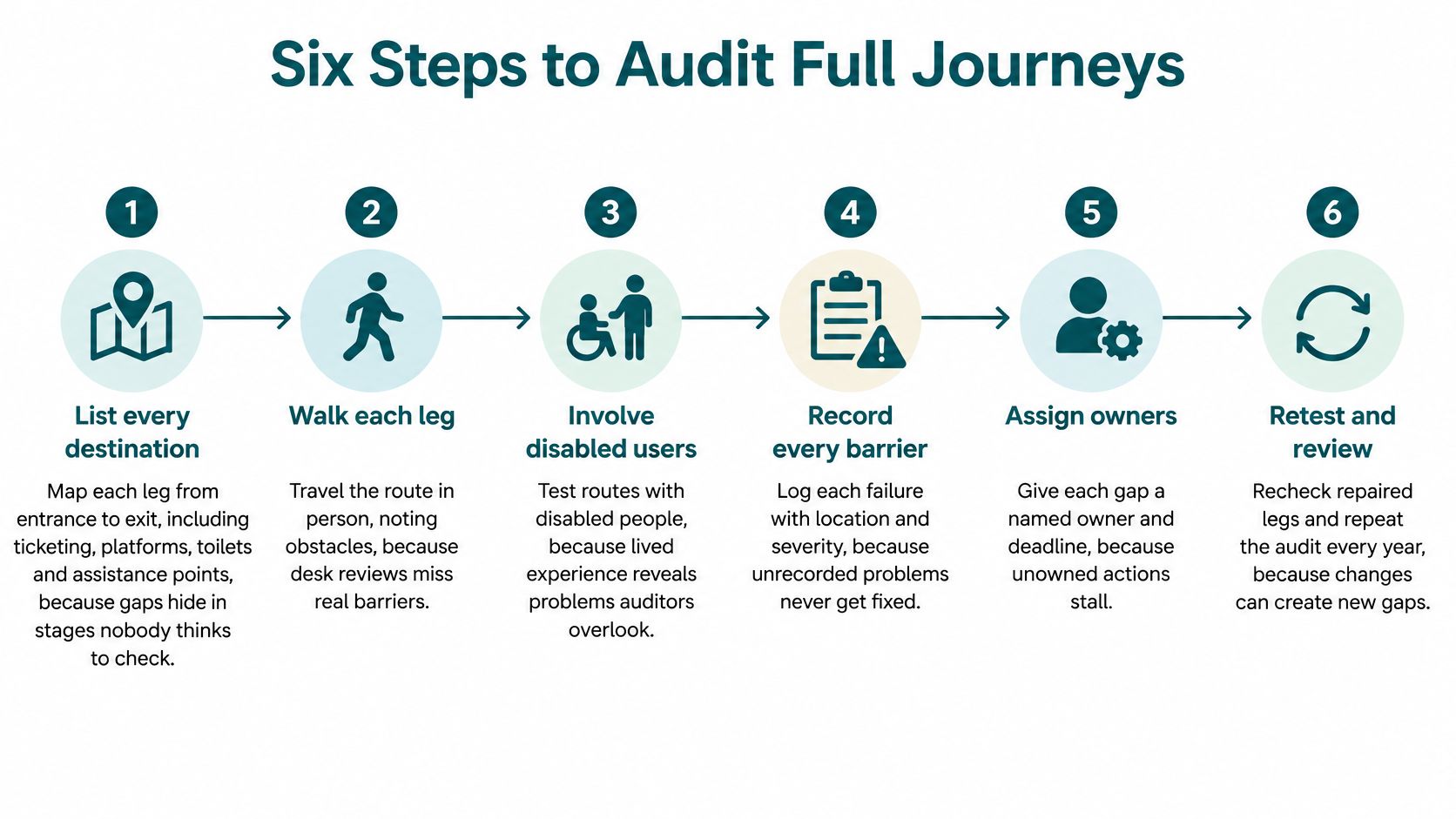
- List every destination and each leg. Include ticketing, platforms, toilets and assistance points, from entrance to exit. Gaps hide in legs nobody wrote down.
- Test each leg against two or three mobility profiles and the Approved Document M dimensions where they apply. A route can reach the pin and still fail on turning space.
- Record width, steps, lift status and obstructions, with a named owner and an update service level. An unowned attribute is a rumour.
- Run timed arrival tests with disabled users travelling to named destinations, and score a leg as passed only if the person completes it unaided. Log failed routes and minutes lost. A desk review will not show a kerb that appears only at busy times.
- Close physical gaps first, then information gaps, then journeys that only finish if a member of staff appears. That order stops you publishing a pretty map of a route that is still blocked.
- Add an updatable wayfinding layer where fixed signs cannot keep pace, and put that layer through the same arrival tests. If the fallback is wrong on the day, publish the nearest verified step-free alternative and a staff contact until the record is corrected.
For the website half of the same audit, website accessibility guidance from Presidio is a clear walkthrough of what a structured digital check looks like. Pair it with on-site arrival tests rather than treating the screen as the whole service. Our note on accessibility compliance testing is written for that combined check.
Liverpool ONE, a mixed indoor and outdoor complex of about 1.4 million sq ft, deployed Waymap's navigation app and content management system. The Royal Hospital for Children and Young People in Edinburgh is, as NHS Lothian confirms, the first hospital in the world to deploy this category of personal navigation technology. At Lord's, step-free routing, guidance to accessible toilets and to food and drink, plus instructions in more than one language, are available to all users.
Run steps 1 to 4 on one site before you commit budget to a wider rollout. A failed arrival on a single concourse teaches you more than a portfolio slide.
Waymap was founded by Dr. Tom Pey.
Frequently Asked Questions About ADA Compliance in the UK
Is ADA compliance a legal requirement in the UK?
No. The ADA is US federal law, and UK organisations answer to the Equality Act 2010 and to Building Regulations. Searching for ADA compliance UK should send you to those instruments, not to a US checklist.
What replaces the ADA in the UK?
The Equality Act 2010 governs services, premises and information. Approved Document M in England, and the Building (Scotland) Regulations, govern building work.
Does the Equality Act 2010 apply in Northern Ireland?
No. Northern Ireland remains under the Disability Discrimination Act 1995.
Do Building Regulations apply to existing buildings?
Largely no. They apply to building work, so existing routes are tested under the Equality Act 2010.
What counts as a substantial disadvantage?
It is a disadvantage of more than a minor or trivial level, measured against non-disabled users. You do not need proof that every disabled person is excluded.
Can a service provider charge disabled customers for reasonable adjustments?
No. Adjustments cannot be charged to disabled customers.
Do UK websites need to meet WCAG 2.2?
Public-sector websites and apps must meet the applicable standards under the 2018 regulations, and testing commonly checks samples against WCAG 2.2 Level AA. Private operators still owe accessible information under the Equality Act.
Waymap gives venues and transit operators step-accurate, infrastructure-free navigation so a disabled passenger can finish the route, not only find a labelled facility. If your audit is still counting ramps while lift status and platform changes sit on paper, start with one site and the arrival tests above. Visit Waymap to see how that wayfinding layer is already running in UK stations, hospitals and retail.
