
ADA Compliance Training That Actually Changes Behaviour
A guest arrives at a large venue with a wheelchair, reaches reception, and asks for an accessible route to a specific entrance. The receptionist wants to help, but only knows that the lift is “somewhere past the main hall”. Security gives different directions, a temporary barrier blocks the usual path, and the guest eventually needs an escort. The organisation may have completed its accessibility course, but the service still failed at the point that mattered.
ADA compliance training should change what people do under pressure. For transport operators, stadiums, airports, campuses, hospitals, and shopping centres, that means turning legal duties into reliable behaviours, assigning training by role, testing competence in realistic situations, and measuring whether visitors receive better assistance.
Why ADA Compliance Training Fails Without Behaviour Change
Awareness slides rarely prepare a member of staff for a crowded concourse, a cancelled lift, a confusing interchange, or a visitor who asks for directions to a precise destination. Staff might remember respectful language from a course but still point vaguely, move a mobility aid without permission, speak to a companion instead of the disabled person, or overlook the accessible route when normal operations change.
The operational failure usually begins with a reasonable intention. A receptionist says, “The entrance is just over there,” while pointing across a noisy lobby. A platform colleague tells a passenger to follow the signs, even though the signs lead through a temporary closure. A venue steward knows that assistance is available but doesn't know who owns the next action. The organisation has trained people to recognise accessibility as a value, not to complete the next observable step.
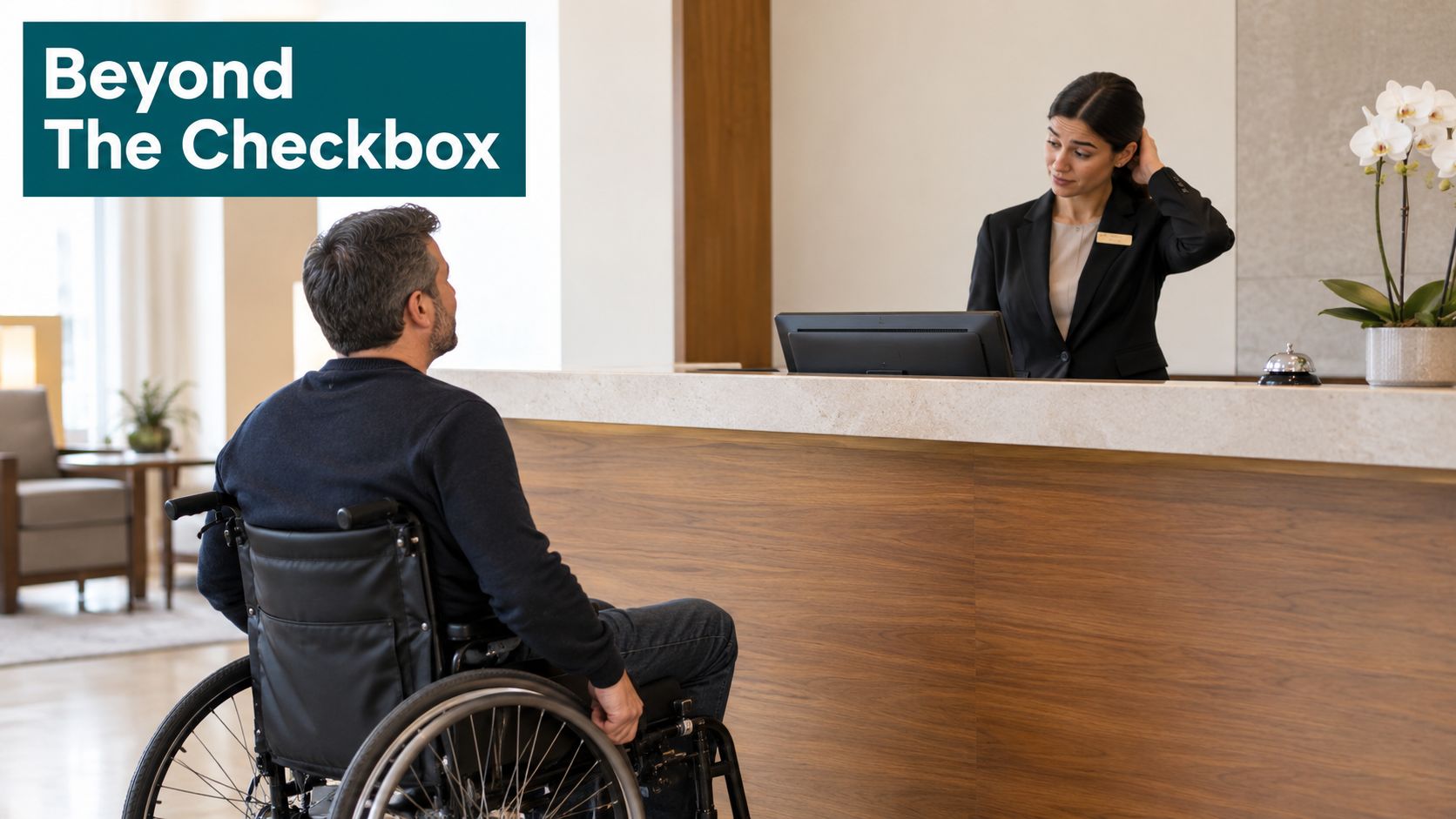
Compliance is experienced at the point of contact
A policy may promise equal access, but visitors experience the organisation through greetings, explanations, route choices, assistance offers, and follow-through. Inconsistent behaviour creates missed assistance, repeated questions, complaints, and avoidable escalation. It can also expose the organisation to legal risk when staff fail to recognise a barrier or respond appropriately to a request for support.
The Equality Act 2010 remains the core anti-discrimination law in force in Great Britain and the legal foundation for much accessibility training under the legislation. In regulated sectors, training has moved beyond optional guidance. The Health and Care Act 2022 created a legal duty for registered health and social care providers to ensure staff receive disability-related training, while transport operators covered by Accessible Travel Policies must ensure frontline staff complete disability awareness training and receive refresher training within two years.
Practical rule: If a manager can't describe the behaviour they expect to see on the floor, the training objective isn't operational enough.
Wayfinding is part of the service response
A digital navigation layer doesn't replace staff judgement. It gives staff another practical option when a visitor needs accurate directions through a complex environment, particularly where GPS, Wi-Fi, or installed hardware can't provide dependable guidance. Waymap uses smartphone motion sensors for dead reckoning, works without GPS, Wi-Fi, or beacons, and is designed to guide people to exact doors, platforms, and points of interest.
That capability only helps when staff understand how to introduce it, explain its limits, and respond if a route changes. The same principle applies to signage, help points, maps, escorts, and accessible entrances. Training succeeds when every support channel connects to a clear frontline action, rather than sitting in a separate HR module. Teams developing adoption plans can also draw on practical user adoption strategies when introducing new accessibility services.
What Good ADA Compliance Training Must Achieve
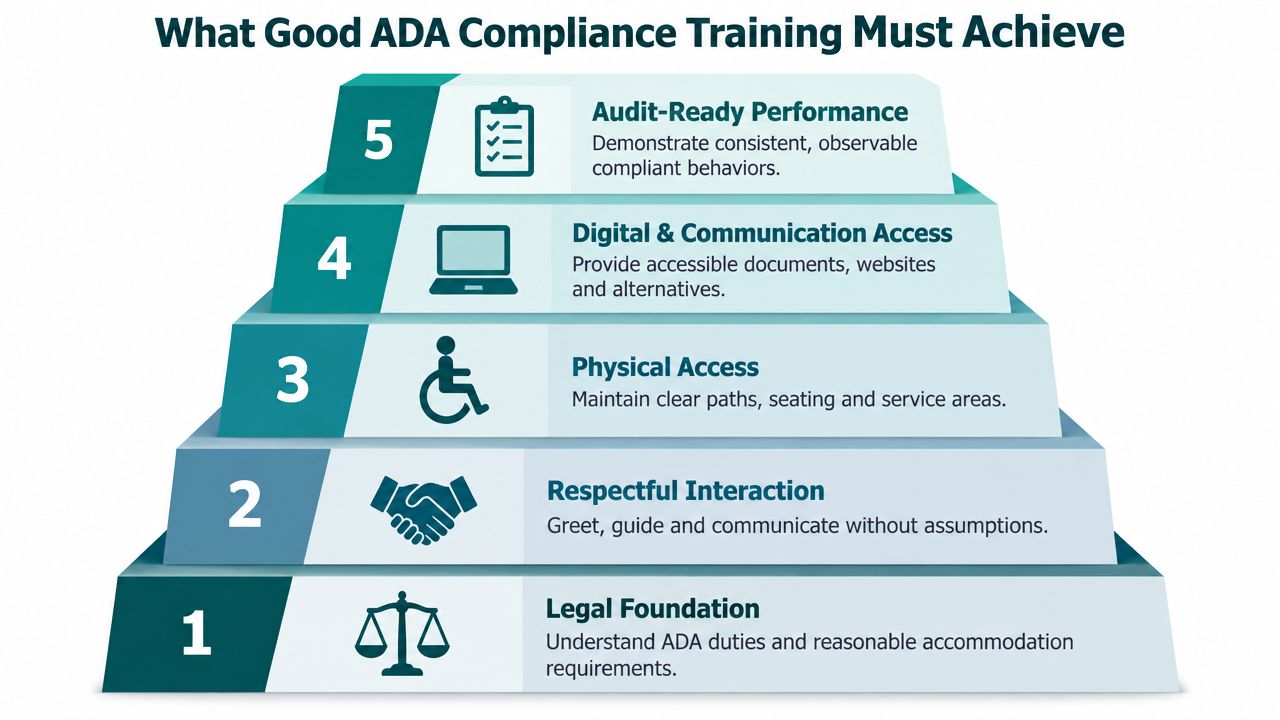
Good ADA compliance training defines the actions staff must take during a live shift. A useful programme specifies what employees must be able to say, do, recognise, and record. Supervisors can then observe competence instead of relying on attendance data, and the organisation can connect training to why accessibility matters for visitor experience.
In Great Britain, section 20 of the Equality Act 2010 requires duty-bearers to take reasonable steps where a provision, criterion, or practice places a disabled person at a substantial disadvantage. The duty also covers disadvantages caused by physical features or the absence of an auxiliary aid, as set out in section 20 of the Equality Act. US organisations applying ADA Title III should align training with their legal advice and operating context, while using recognised accessibility principles for public-facing services.
Define the behaviours before building modules
Staff should be able to:
- Recognise access barriers: Identify blocked routes, inaccessible service points, missing alternatives, and digital or communication barriers.
- Communicate respectfully: Ask before assisting, address the person directly, avoid assumptions, and offer useful choices.
- Explain routes precisely: Give directions to a named destination, describe relevant access conditions, and confirm whether the visitor wants support.
- Apply an escalation process: Know when to contact a supervisor, facilities colleague, station controller, safeguarding lead, or accessibility team.
- Protect independence: Provide information and options without taking control of a person's movement, equipment, or decisions.
- Record recurring failures: Capture route closures, lift outages, inaccessible documents, and repeated complaints so operations teams can act.
Connect legal duties to physical and digital access
Training should connect a ramp, website, ticketing kiosk, and wayfinding app as parts of one visitor journey. A visitor may discover an event online, buy a ticket on a mobile device, enter through a controlled gate, find a toilet, and reach a seat through several linked touchpoints. One failure can undermine access to the whole service.
Standards such as BS EN 17210 and PAS 78 help teams discuss accessibility in the built environment and digital communications. They do not create competence by themselves. Managers must translate each requirement into a service decision: can the employee identify an alternative route, provide accessible information, arrange an auxiliary aid or adjustment, and report a physical feature that creates disadvantage?
The UK government says employees should have equal access to training, including accessible online training and appropriate support when training takes place away from the usual workplace in its line-manager guidance. The training system must meet the standard it teaches.
End with an operational test: Could a supervisor observe the required behaviour during a live shift and record whether it happened? If not, rewrite the objective.
How to Build Role Based Curricula That Staff Actually Use
A security officer, a ticketing adviser, and an estates manager don't face the same accessibility decisions. Giving every employee the same awareness module may be efficient to administer, but it leaves the people closest to visitors without enough practice and gives technical teams too little operational context.
Role-based design starts with exposure. Identify who greets visitors, controls movement, maintains routes, manages information, handles complaints, and authorises changes. Then give each group the smallest complete set of knowledge and practice needed for its decisions.
Assign content by responsibility
| Training Topic | Front-Line Staff | Facilities Managers | Managers and Supervisors |
|---|---|---|---|
| Respectful interaction | Ask before assisting, communicate directly, and avoid assumptions | Consider how building changes affect independent access | Model appropriate language and challenge poor practice |
| Route and wayfinding support | Give precise directions and explain current restrictions | Maintain accessible paths, entrances, lifts, and service points | Escalate failures and confirm that staff know alternatives |
| Auxiliary aids and adjustments | Know what is available and who can authorise support | Plan, maintain, and review aids and physical features | Recognise requests and route them to the correct process |
| Digital and written information | Offer accessible alternatives and report unusable content | Coordinate accessible signage, systems, and updates | Ensure teams don't separate digital access from visitor service |
| Incident response | Provide calm assistance during closures or disruption | Resolve the physical cause and communicate the change | Coordinate teams, document decisions, and review recurrence |
| Performance evidence | Complete scenario checks and report barriers | Maintain records of corrective actions | Review completion, observation results, complaints, and coaching |
Ticketing staff need practice with accessible booking questions, payment alternatives, seating information, and requests that may require escalation. Security staff need route knowledge and a clear response when the usual path is closed. Reception teams need to describe destinations rather than gestures. Customer-service teams need to manage complaints without becoming defensive.
Facilities staff need a different level of detail. Their work includes clear paths, seating and service areas, lift availability, temporary works, signage, accessible toilets, and the physical features that affect a visitor's route. They also need a process for updating digital touchpoints when a change makes published information inaccurate.
Treat digital and physical access as one journey
A campus map can be technically accessible while the route it describes contains a locked gate. A building can have an accessible entrance while the website fails to explain where it is. A navigation service can provide an accurate route while staff fail to tell a visitor about a temporary closure. The curriculum should make these connections visible.
For teams formalising responsibilities, how to build an employee training plan offers useful planning context. The accessibility version of that process should add role exposure, route complexity, shift patterns, adjustment needs, and evidence of competence.
Use a simple decision matrix during planning:
- High visitor exposure and high route complexity: Provide scenario-based induction, supervised practice, route updates, and regular refreshers.
- High decision authority and lower visitor contact: Focus on legal duties, escalation, procurement, facilities controls, and documentation.
- Low visitor exposure but shared systems responsibility: Cover accessible documents, digital touchpoints, reporting, and handover.
- Temporary or agency staff: Provide concise pre-shift instruction, named escalation contacts, and a route-specific briefing before deployment.
Waymap can sit within this operating model as one navigation option. Its dead-reckoning approach uses device-native sensors and doesn't require venue beacons or Wi-Fi infrastructure, which is relevant for sites where hardware maintenance, changing layouts, or capital approval create operational friction. Staff still need to understand the live route information and know when to escalate a physical access problem. The staff training requirements should be considered alongside the venue's own role matrix, not treated as a substitute for it.
How to Deliver ADA Compliance Training and Prove Competence
A trained steward can still fail a visitor if the lift is closed, the route has changed, or a request is handled poorly during a busy shift. Delivery therefore has to match operational reality. One classroom session may suit a small permanent team, but it will not reliably reach rotating shifts, contractors, seasonal stewards, or staff working across sites. Self-paced learning distributes core knowledge efficiently, yet it cannot show whether someone can handle a difficult interaction on a crowded concourse.
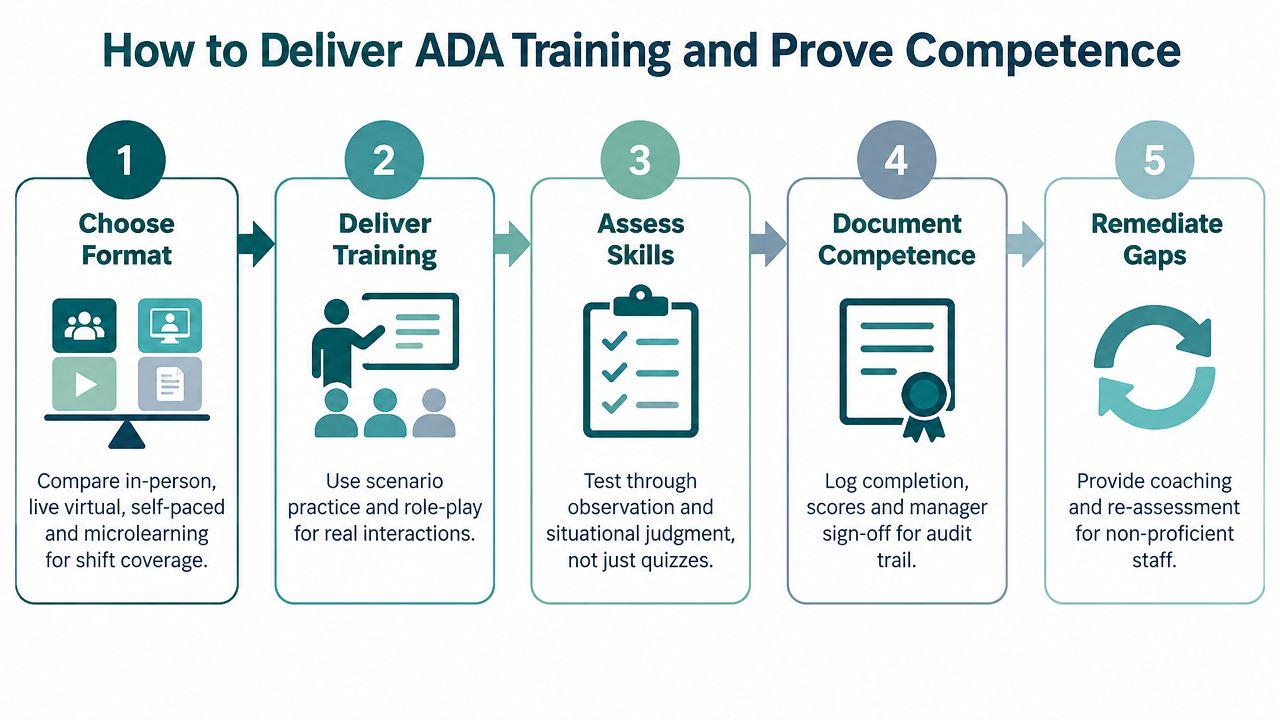
Use a blended model. Give every worker a short foundation, then add role-specific practice, local route knowledge, and supervisor observation. Set the mix according to staffing patterns, turnover, language needs, venue complexity, and the consequences of an error. Waymap can be included as one navigation option where infrastructure-free wayfinding is useful. Its dead-reckoning approach uses device-native sensors and does not require venue beacons or Wi-Fi infrastructure. Staff still need to understand current route information and escalate physical access problems.
Choose the format for the shift pattern
In-person workshops suit role-play, route walks, equipment demonstrations, and discussion of local barriers. They require release time and careful scheduling, but they expose assumptions that a quiz will miss.
Live virtual sessions help multi-site teams attend a shared briefing and ask questions. Use accessible materials and captions where required, then provide a separate opportunity to practise physical scenarios.
Self-paced modules cover legal foundations, terminology, policies, and accessible digital content efficiently. They should support, rather than carry, the programme because completion does not prove applied skill.
Microlearning fits shift handovers and refresher cycles. A short scenario about a blocked lift or unclear directions can reinforce one behaviour when a manager follows it with observation and feedback.
Teams planning communication, practice, and follow-up can use these engaging compliance training tips. Make training easy to access, while keeping competence difficult to fake.
Test decisions, not just recall
An attendance record shows that a worker accessed training. It does not show whether they can recognise a barrier, offer assistance appropriately, explain an alternative route, or escalate a problem.
Assess competence through several checks:
- Situational judgement: Present a realistic interaction and ask the employee to select the next action.
- Observed practice: Watch the employee greet, ask, guide, and escalate during role-play or a route exercise.
- Local knowledge checks: Test destination-specific information, including accessible entrances, lifts, toilets, help points, and disruption procedures.
- Supervisor sign-off: Require the manager to confirm observed behaviour, not attendance alone.
- Remediation: Provide coaching and reassessment when the employee cannot meet the required standard.
Record results in a compliance reporting system that links the person, role, assessment date, observed gaps, action taken, and reassessment outcome. The record should help supervisors deploy staff safely, not become a storage exercise.
Make the training accessible to trainees
A programme about inclusion fails if disabled employees cannot access the learning. Official reasonable-adjustments guidance states that employers must not deny training opportunities because someone is disabled. Examples include different formats, sign-language interpreters, extra time, individual instruction, a personal assistant, extended delivery, and changes to the training premises.
CITB's access arrangements and reasonable adjustments policy explains that arrangements should be agreed before registration. Options may include a computer reader, extra time, or a word processor, with reasonableness assessed by need, effectiveness, cost, impact, timing, and assessment integrity.
Build adjustments into booking and delivery instead of waiting for a trainee to struggle. Provide accessible materials, test online modules with assistive technology, allow suitable response methods, and keep confidential support routes clear.
For UK transport operations, induction alone does not establish continuing competence. The Office of Rail and Road reported a formal requirement for ongoing training for new and current staff, with refresher training across defined areas and a compliance deadline in July 2021 in its progress report. The operational lesson is clear: combine induction, observed competence, refreshers, and documented remediation.
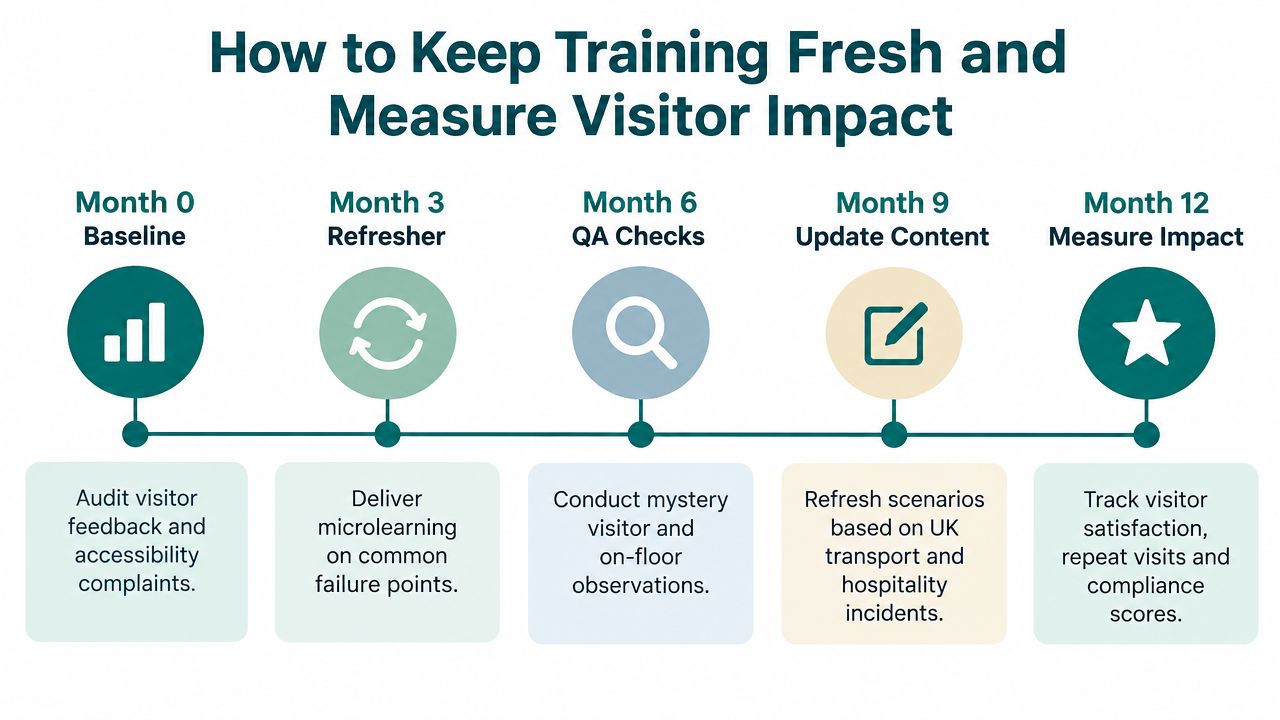
How to Keep Training Fresh and Measure Impact on Visitors
Training becomes outdated when the site changes faster than the learning record. A lift closes, a gate moves, a contractor changes a queue layout, or a ticketing platform introduces a barrier. Staff can remain marked complete while their instructions no longer match the visitor journey.
Set a review cycle around operational change, not only course expiry. Parliament has noted that frontline staff working under Accessible Travel Policies must complete disability awareness training, with refresher training required within two years in its briefing on disability and accessibility statistics. England's transport data also records a near-universal operator-level training baseline, with 97% of bus operators required to train staff in disability awareness and 100% of drivers and onboard staff working for operators that mandated it in the Department for Transport statistics.
Audit coverage, not just course availability
A completion report can hide uneven performance. Reported figures have shown a gap between overall customer-facing completion and the much higher completion achieved by some customer-contact teams in a defined reporting period [in its reporting cited by the ORR progress evidence]. Managers should therefore review results by department, visitor exposure, location, and date of first completion.
A maintenance dashboard should answer practical questions:
- Who completed the foundation? Include permanent, temporary, agency, contractor, and volunteer populations where they interact with visitors.
- Who demonstrated competence? Separate attendance from observed or assessed performance.
- Which routes and touchpoints fail repeatedly? Connect complaints and incidents to lifts, entrances, signage, booking, information, and staff response.
- Which teams need targeted refreshers? Use observation and incident evidence instead of assigning the same module to everyone.
- What changed after remediation? Record whether the original failure returned and whether staff followed the revised process.
Use the dashboard to trigger action. A route change should prompt a short briefing and an observed check for affected teams. A recurring complaint should lead to a revised instruction, a named owner, and a later review.
Measure visitor outcomes without overclaiming
Useful measures include the quality and speed of assistance, successful wayfinding interactions, resolved accessibility complaints, repeated barriers, visitor feedback, and the time needed to restore an accessible route. These measures cannot prove that training caused every improvement, because staffing, construction, technology, and policy may also change. They can show whether trained behaviour is appearing in service results.
Wayfinding is suitable for direct observation. At a station, check whether staff give a precise route to a platform rather than a general direction. At a stadium or shopping centre, check whether visitors receive accurate information about restrictions and current points of interest. A hardware-free navigation layer can reduce maintenance linked to installed beacons, while staff still need a process for reporting route changes and assisting visitors who choose digital guidance.
The government Disability Action Plan includes standards, monitoring, training, and guidance on accessibility and inclusion across government. For venue operators, that supports treating quality assurance as routine operations rather than paperwork prepared for an audit. The visitor satisfaction survey approach can help connect accessibility interactions with broader experience feedback.
ADA Compliance Training FAQs Answered Directly
What is ADA compliance training?
ADA compliance training teaches employees how to provide equal access and respond appropriately to disability-related barriers and requests. For venues and transport operators, effective training covers respectful interaction, physical access, communication, digital touchpoints, wayfinding, escalation, and evidence of competence. UK organisations should also connect the programme to the Equality Act 2010 and applicable sector duties.
Who needs ADA compliance training?
Anyone whose work can affect access or service delivery needs an appropriate level of training. That includes reception, ticketing, security, customer service, facilities, supervisors, digital teams, contractors, and managers. The depth should reflect visitor contact, decision authority, route complexity, and responsibility for physical or digital systems.
How often should ADA compliance training be refreshed?
Training should be refreshed when roles, routes, systems, or policies change, and at a defined recurring interval. For UK transport operators covered by Accessible Travel Policies, Parliament has noted a requirement for refresher training within two years. Local risk, staff turnover, incidents, complaints, and operational changes may justify more frequent practice.
How do you prove that employees are competent?
Use observation and situational judgement, not attendance alone. Ask employees to handle realistic interactions, explain an accessible route, identify a barrier, offer assistance appropriately, and escalate when they can't resolve the issue. Record completion, assessment results, manager sign-off, and remediation.
Does accessibility training cover digital and physical access?
It should cover both because visitors experience them as one journey. AbilityNet's 2025 survey found that only 35% of organisations reported general digital accessibility training for all staff, while 16% reported including digital accessibility training in induction in its survey reporting. Staff may need to support accessible documents, websites, mobile tools, signage, routes, and in-person assistance.
Can Waymap support an accessibility training programme?
Waymap can provide an infrastructure-free navigation option that staff learn to explain and support. Its system uses smartphone motion sensors for dead reckoning, can operate without GPS, Wi-Fi, or beacons, provides sub-3-metre accuracy in infrastructure-free environments, and allows points of interest to be updated without pre-mapping requirements. Tom Pey, Waymap's founder and a blind accessibility technologist, developed the platform around practical navigation needs, but operators still need local training, route governance, and human assistance procedures.
Waymap helps transport agencies, venues, campuses, and public-facing organisations add precise indoor, outdoor, and underground navigation without installed beacons or Wi-Fi dependence. Visit Waymap to discuss how infrastructure-free wayfinding can fit your ADA compliance training, route-support, and visitor-outcome programme.
