
ADA Compliance in the Workplace: Essential Guide
The popular advice on ADA compliance in the workplace starts with ramps, accessible toilets, and door widths. Those matter, but they aren't where most employers lose control. The serious exposure usually begins when a manager sits on an accommodation request, HR gives inconsistent answers across sites, or nobody records why a request was refused.
For a multi-site organisation, accessibility is an operating system, not a facilities checklist. The employer needs a clear owner, response targets, evidence standards, escalation rules, and a way to make the same decision consistently in an office, warehouse, campus, airport, or stadium. This guide sets out that process, while also distinguishing US ADA duties from the UK framework that applies to organisations operating in Great Britain.
Why ADA Compliance Is Really a Process Problem, Not a Ramp Problem
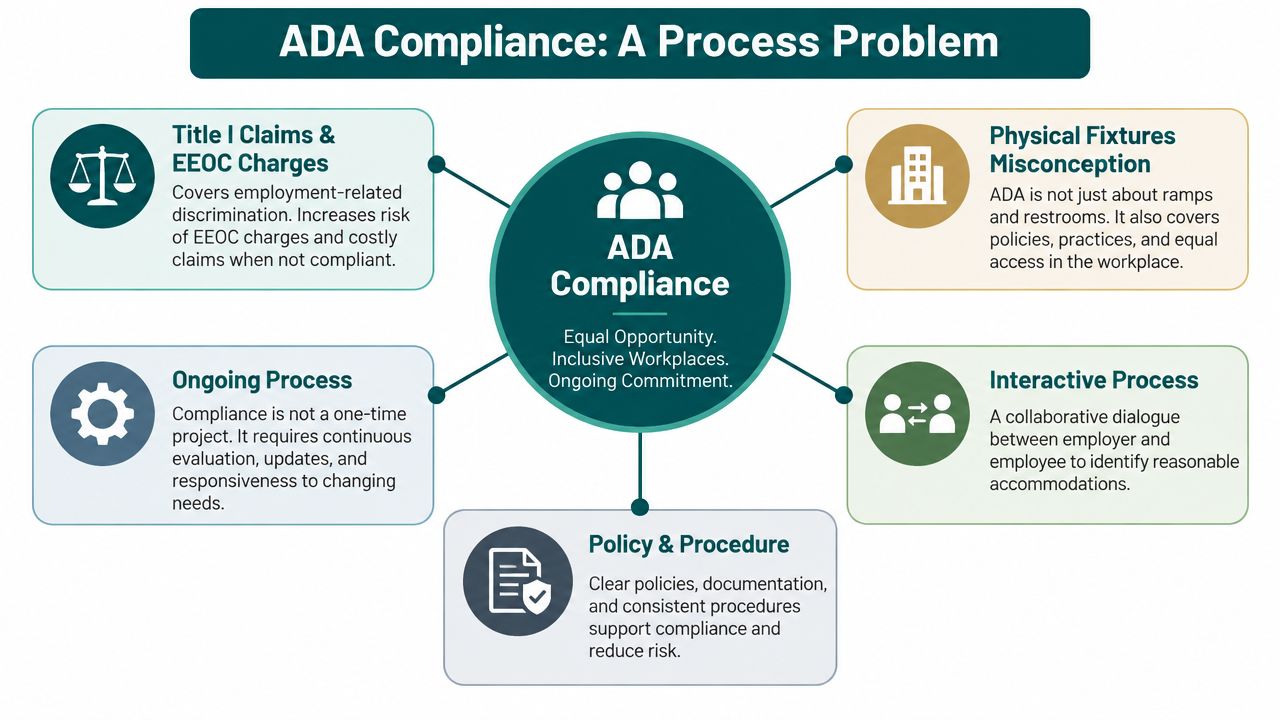
Most workplace leaders picture ADA compliance as a physical-access issue. They inspect ramps, lifts, parking bays, doorways, and washrooms, then assume the programme is under control. That approach misses the more common failure mode: a person asks for help, and the organisation responds slowly, informally, or differently from the way it handled a similar request at another location.
Title I of the Americans with Disabilities Act creates an employment duty for covered employers. The operational question isn't whether the organisation has an accessibility policy. It's whether a request reaches the right person, whether the employer engages with the worker, whether alternatives are assessed, and whether the final decision is recorded.
The real control points
A defensible programme should measure operational behaviour, not just building features:
- Time to acknowledgement: The employee or applicant should know who owns the request and what happens next.
- Time to decision: HR should distinguish straightforward requests from complex cases and set an internal target for each.
- Decision consistency: Similar limitations and job functions should produce comparable reasoning across sites.
- Evidence quality: The file should show the request, relevant limitations, options considered, implementation, and follow-up.
- Escalation discipline: Managers shouldn't improvise a refusal when the question involves essential functions, medical information, safety, or cost.
Practical rule: A manager's job is to identify and escalate a request, not to decide whether the employee has a disability or whether an accommodation is legally reasonable.
This is also a change-management issue. New processes fail when frontline teams don't know what changes, who owns the decision, and how the workflow affects daily operations. Waymap's guidance on change management strategy is relevant to that implementation challenge, particularly for employers coordinating accessibility across multiple facilities.
What ADA Compliance in the Workplace Actually Requires
ADA compliance in the workplace requires covered employers to avoid disability discrimination and provide reasonable accommodation to a qualified applicant or employee, unless the accommodation would create an undue hardship. Title I generally applies to employers with 15 or more employees, according to the employer guidance summarised by HR Certification.
The duty operates through three practical steps:
- Recognise the request. An employee doesn't need to use legal terminology. A statement that a health condition is making work difficult may require HR follow-up.
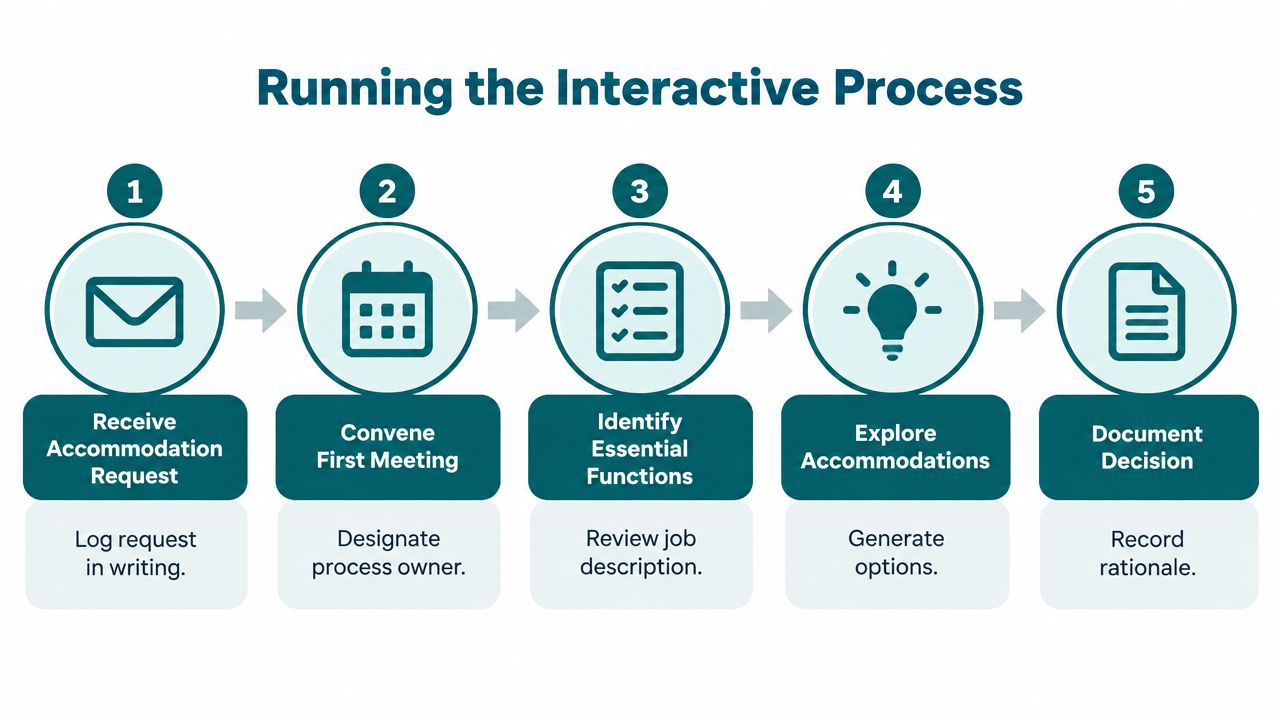
- Run the interactive process. Identify the job barrier, review essential functions, ask for limited job-related information where appropriate, and discuss effective options.
- Implement or justify the decision. Put an effective accommodation in place promptly. If the employer refuses, document the specific reason, including any evidence supporting an undue-hardship conclusion.
Consider a warehouse associate who has a lifting restriction. A supervisor shouldn't reply that the employee must perform every listed task or take unpaid leave. HR should review which duties are essential, examine equipment or task-allocation options, consider a temporary schedule change where appropriate, and determine whether reassignment to a vacant role needs review.
Title I and Title III address different settings. Facilities teams often confuse employment accommodation duties with public-access requirements, which creates gaps in both programmes.
| Dimension | Title I, Employment | Title III, Public Accommodations |
|---|---|---|
| Primary concern | Equal opportunity for applicants and employees | Access to goods, services, facilities, and public-facing premises |
| Typical control | Accommodation workflow, job analysis, manager training, confidential records | Facility design, access routes, signage, entrances, toilets, kiosks, and service policies |
| Decision test | Effective accommodation unless it creates undue hardship | Compliance with applicable access standards and removal of barriers where required |
| Operational owner | HR, supported by managers and facilities | Estates, facilities, operations, digital, and customer-service teams |
Digital teams should also separate employment systems from public websites while coordinating both. Organisations reviewing web accessibility deadlines for enterprises should include applicant tracking systems, employee portals, training platforms, and internal forms in their accessibility inventory. Waymap's explanation of what ADA compliance means provides an additional accessibility context for organisations managing physical and digital access together.
How to Run the Interactive Process Without Losing Control of It
The interactive process shouldn't be an informal conversation that disappears into email. It should be a controlled case workflow with a named owner, a defined evidence trail, and a decision route that regional managers can follow without inventing a solution from scratch.
Set the internal standard before a request arrives. A practical operating target is to acknowledge a request within five business days and aim to decide non-complex cases within 30 days. Those are internal service levels, not statutory deadlines, so the employer must still act promptly when the circumstances require faster action.
Assign ownership before assessing options
Use a simple responsibility map:
- Frontline manager: Receives the concern, avoids a promise or refusal, and sends it to the process owner.
- HR or ADA coordinator: Opens the case, schedules the first discussion, requests only relevant information, and coordinates the decision.
- Job owner: Confirms essential functions and operational constraints.
- Facilities or IT: Tests physical, digital, equipment, and workspace options.
- Legal counsel: Reviews high-risk refusals, disputed essential functions, safety-sensitive decisions, or cases likely to escalate.
The case file should contain the original request, acknowledgement, meeting notes, relevant medical information, job analysis, options considered, implementation record, and follow-up outcome. Store medical information separately and restrict access. The manager usually needs the work restriction and the agreed adjustment, not the diagnosis.
If the request is unclear, ask what work task or workplace feature creates the barrier. If the employee doesn't participate, record the attempts to engage, keep the process open where practical, and don't treat silence as automatic permission to deny. A refusal should explain whether the proposed option wasn't effective, whether another effective option was offered, or whether the organisation has evidence of undue hardship.
Before each meeting, give managers a short script: acknowledge the concern, thank the person for raising it, avoid medical interrogation, explain that HR will coordinate the next step, and protect confidentiality. Waymap's material on staff training requirements reinforces the broader operational point: accessibility procedures only work when staff know how to apply them at the moment a person needs support.
Reasonable Accommodations Worth Approving the First Time
Employers often overcomplicate low-friction accommodations. A modified schedule, accessible parking, speech-to-text software, captioning, a workstation change, or an alternative document format may remove a barrier without changing the essential job. The correct question is whether the adjustment is effective and reasonable, not whether the manager has seen it before.
The UK provides a useful comparison for organisations with operations on both sides of the Atlantic. Under the Equality Act 2010, employers in Great Britain must make reasonable adjustments where a disabled worker would otherwise face a substantial disadvantage. The duty can arise from a provision, criterion or practice, a physical feature, or the absence of an auxiliary aid or service, as explained in official Equality Act employer guidance.
| Category | Example request | Typical cost band | Likely outcome | Defensibility note |
|---|---|---|---|---|
| Physical | Modified workstation, accessible parking, support rail, adjusted washroom access | Low to moderate | Often approve after site review | Record the barrier, proposed change, and facilities assessment |
| Digital | Screen-reader-compatible software, captions, speech-to-text, accessible documents | Low to moderate | Often approve where the tool supports essential work | Test the actual system, not just the vendor's accessibility statement |
| Scheduling | Flexible start time, modified hours, planned breaks | Low | Often approve where coverage remains workable | Tie the decision to attendance, handover, and essential functions |
| Work location | Remote work or a different accessible workspace | Variable | Assess task requirements and equivalent alternatives | Compare the requested arrangement with the actual job, not assumptions |
| Reassignment | Transfer to a vacant role | Variable | Consider after other effective options | Record vacancy checks, qualifications, and why alternatives were or weren't effective |
The weak response is an immediate “no” based on habit. The stronger response identifies the restriction, tests an option, defines review points, and records why the result works or doesn't. Under UK guidance, costs can't be passed to the disabled person, and failure to make a reasonable adjustment can amount to disability discrimination, as set out by Citizens Advice guidance on workplace changes.
For navigation barriers in offices, campuses, and public-facing sites, Waymap's products for vision-impaired users illustrate how a specific access problem can be addressed through guided wayfinding rather than through a generic promise to “improve accessibility”. The employer still needs to assess the individual request and the site context.
Physical and Digital Accessibility Standards Most Employers Underweight
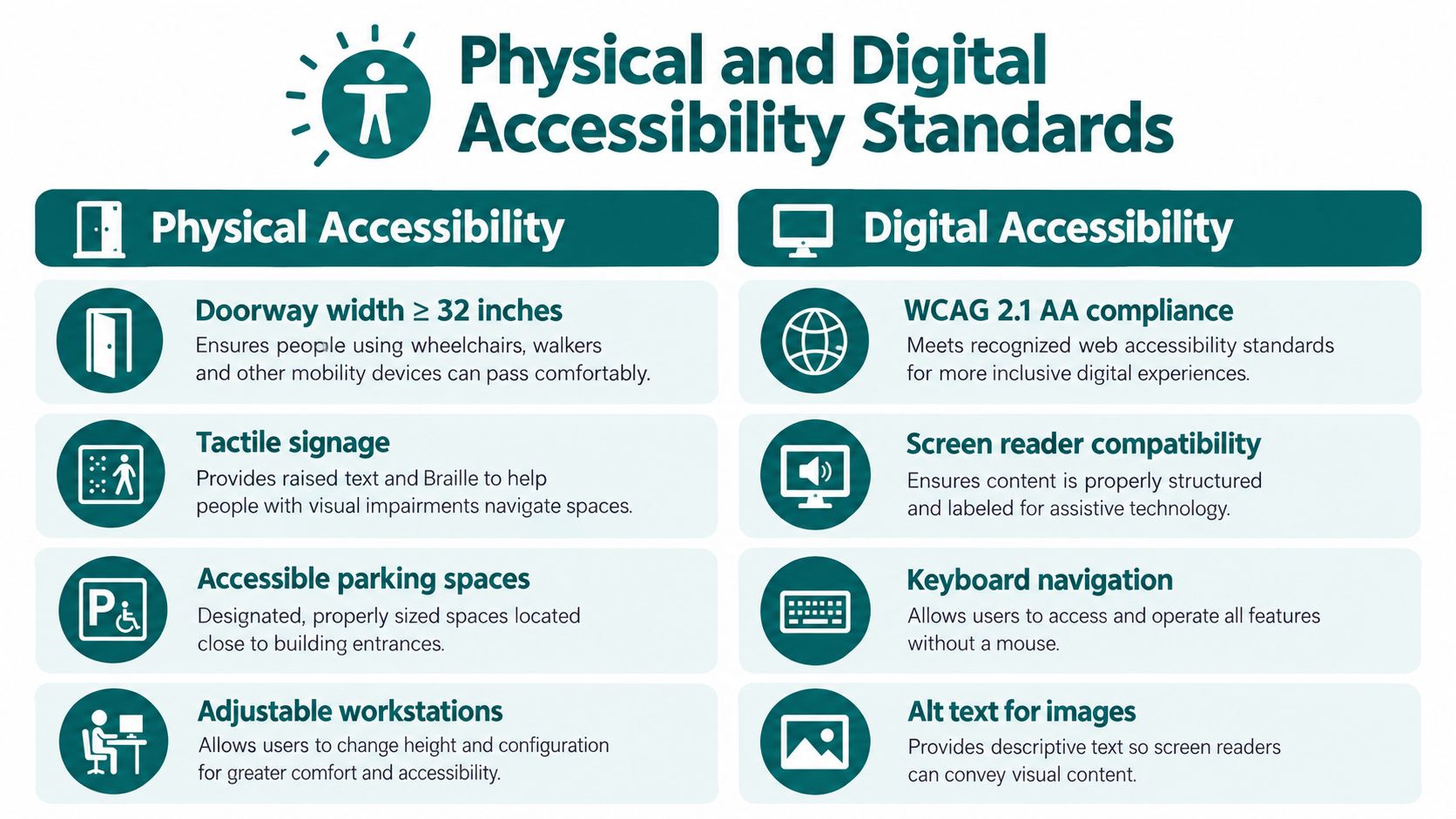
A site can pass a facilities inspection and still exclude people. The overlooked failures are often ordinary operational details: a PDF that a screen reader can't interpret, a training video without captions, a kiosk positioned beyond comfortable reach, or an emergency message that doesn't reach deaf employees.
For digital services, teams commonly use WCAG 2.1 AA as a practical benchmark for websites, intranets, applicant systems, forms, and learning platforms. Mobile interfaces need the same discipline. Keyboard access, focus order, headings, labels, contrast, alternative text, captions, and error messages should be tested with assistive technology and with real users where possible.
Audit the experience, not just the specification
Physical reviews should examine the complete journey from arrival to task completion:
- Arrival: Parking, public transport approaches, entrances, and accessible routes.
- Movement: Lifts, corridors, floor surfaces, doors, signage, and temporary obstructions.
- Work task: Desk height, equipment controls, meeting rooms, toilets, and break areas.
- Emergency response: Audible, visual, tactile, and staff-led communication routes.
- Information access: Printed material, digital documents, kiosks, and visitor instructions.
Renovation projects are the point at which employers should revisit the 2010 ADA Standards for Accessible Design, rather than waiting for a complaint. Facilities teams should require accessibility criteria in the brief, verify them during construction, and retain inspection records. A retail operator reviewing online customer journeys can use this practical overview of ADA compliance for Shopify stores, but the same principle applies to employee portals and internal purchasing systems.
Multi-site operators need a central defect register. Record the site, barrier, affected journey, temporary control, permanent remedy, owner, and target date. A central register exposes recurring design failures that local teams otherwise keep solving separately.
Where Waymap Fits Inside an ADA Accessibility Programme
Waymap can sit inside an accessibility programme as a navigation layer. It doesn't replace compliant entrances, accessible routes, signage, lifts, workplace adjustments, or digital-access controls. It addresses a different operational question: can a person reach the exact door, platform, ward, room, or point of interest once they arrive at the site?
The platform uses device-native motion sensors and detailed maps for dead-reckoning navigation, rather than relying on GPS, Wi-Fi, or installed beacons. Its stated capability includes sub-three-metre accuracy in infrastructure-free environments and no pre-mapping requirement, an important distinction for venues with frequent layout changes or high staff turnover.
Apply the tool to a defined journey
A transport operator might map the journey from a station entrance to a particular platform. A university can define routes to lecture rooms, reception points, libraries, and accessible facilities. An office accessibility manager can use guided directions from the campus boundary to a specific workspace, meeting room, or welfare facility.
Waymap has named deployments and partnerships involving WMATA, SBS Transit, LTA Singapore, and CapMetro Austin, as well as venue contexts including Westfield London and the Royal Hospital for Children and Young People. Each example should be assessed against its actual site, mapped destinations, maintenance process, and user need. Employers shouldn't cite a deployment as proof that their own workplace is compliant.
The defensible use is narrower and stronger. Define the access problem, map the relevant points, test the route with disabled users, document the result, and integrate updates into the site's change-control process. For a complaint or individual accommodation discussion, that evidence can show that the employer has provided a repeatable navigation option. It remains one control within the programme, not a substitute for the ADA's independent duties.
Enforcement Risk, Damages, and Why Documentation Is Your Best Defence
This section requires restraint. The provided evidence doesn't establish a reliable figure for ADA settlement amounts, civil penalty ranges, or total EEOC charge volumes, so employers shouldn't use invented enforcement numbers in an internal risk paper. The practical risk is still clear: inconsistent decisions create evidence that a claimant can use, while a well-run file shows good-faith engagement.
UK evidence demonstrates why process friction deserves executive attention. The Parliamentary committee reported an employment rate of 54.3% for disabled people versus 81.1% for non-disabled people in 2021/22, a gap of 26.8 percentage points, and recorded that disabled people were more than twice as likely to be unemployed, 6.9% versus 3.6%. The committee's evidence is available in its written evidence summary.
Acas reported that disability discrimination cases rose from under 10% of early conciliation cases in 2020 to 2021 to 14% in the first two quarters of 2023 to 2024. It recorded 15,361 disability discrimination issues in 2024/25, according to the committee's cited evidence and related reporting. Those figures don't predict the result of an individual case, but they show why a verbal-only refusal is poor risk management.
| Enforcement pathway | Typical remedy | Penalty range | Documentation lever |
|---|---|---|---|
| Employment discrimination claim | Compensation, corrective action, settlement, or litigation defence | Assess case-specific exposure with counsel | Request log, interactive-process notes, decision rationale |
| Agency conciliation or investigation | Resolution, policy changes, training, or settlement | Depends on the matter and forum | Consistent records across sites |
| Public-access complaint | Corrective works, service changes, agreement, or litigation | Confirm current exposure with counsel | Site audit, defect register, remediation evidence |
| Internal grievance | Reconsideration, accommodation, manager action, or policy review | Operational and legal risk varies | Escalation trail and follow-up record |
Warning signs are predictable: a late acknowledgement, a manager's email saying “we can't do that”, medical information stored in a personnel file, no record of alternatives, and no follow-up after implementation. Use an accessibility compliance report as part of a wider evidence pack where navigation is an identified site barrier. Documentation won't cure a bad decision, but it can expose the problem early and demonstrate how the organisation responded.
Your 90-Day ADA Compliance Action Plan and Common Questions
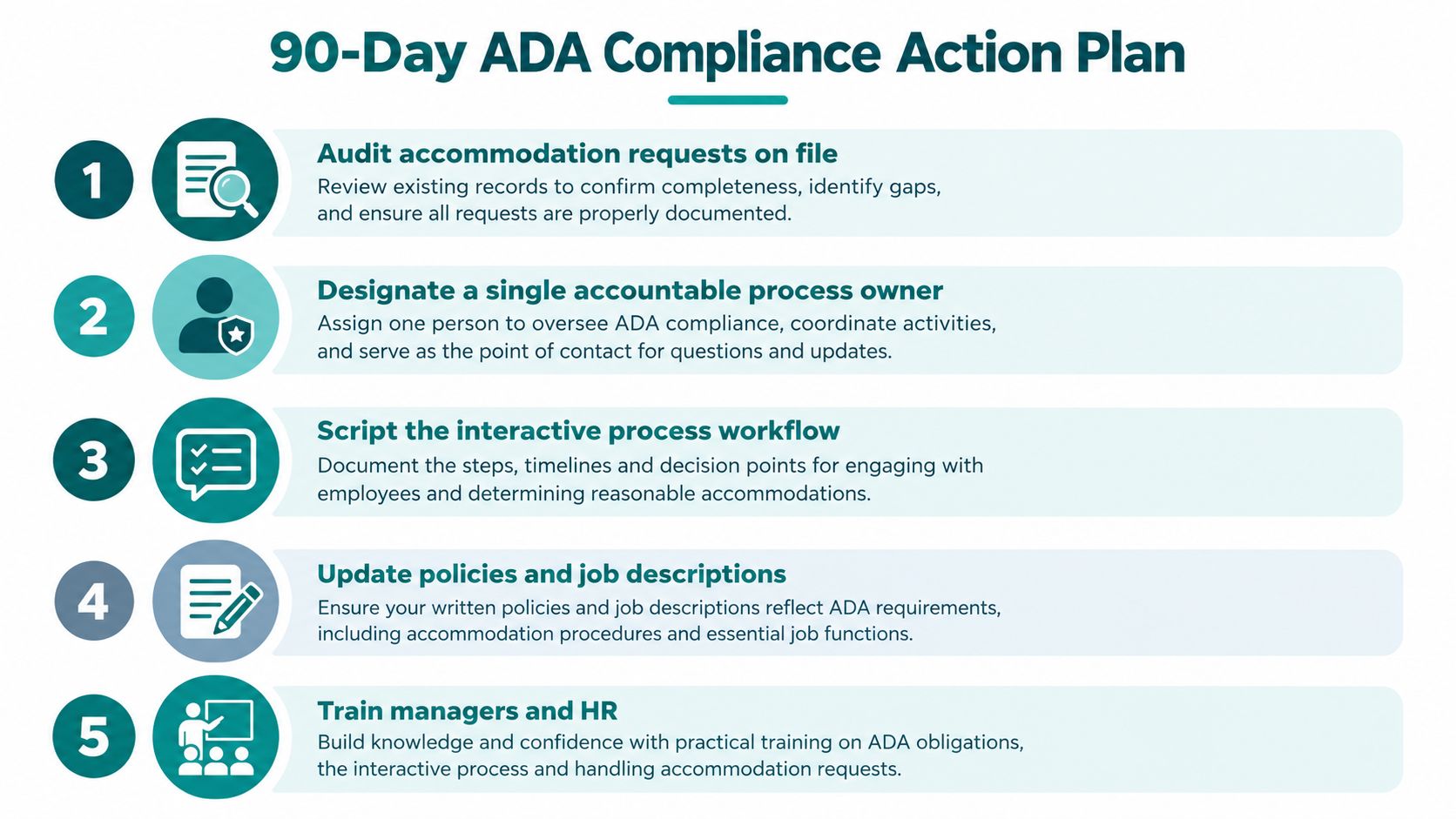
A multi-site director should be able to assign this plan at the next leadership meeting:
- Days 1 to 15, audit open and recent requests. Produce a list of cases, owners, response dates, decisions, missing documents, and overdue follow-ups.
- Days 16 to 30, appoint one process owner. Publish the name, backup contact, escalation route, and confidential storage location.
- Days 31 to 45, script the workflow. Create the acknowledgement email, first-meeting agenda, information request, options log, and decision memo.
- Days 46 to 60, update the manager guide. Add examples for physical, digital, scheduling, remote-work, and reassignment requests, plus a clear rule against on-the-spot refusals.
- Days 61 to 90, review performance quarterly. Report open cases, time to acknowledgement, time to decision, repeat barriers, overdue actions, and outcomes by site.
Common questions from operations leaders
What should we do when a requested accommodation seems unreasonable on its face? Don't reject it at manager level. Identify the job barrier, discuss alternatives, assess effectiveness and undue hardship, and document the reasons for the final decision.
How should we handle a remote-work request when the role appears site-based? Test the essential functions against the actual work, not the job title. Consider whether the duties can be performed remotely, whether another accessible workspace would work, and whether a different effective accommodation is available.
Can a private employer request medical documentation? Yes, where the disability or need for accommodation isn't obvious and the information is job-related and necessary. Request only what the decision requires, keep it confidential, and don't ask for a diagnosis when functional limitations are sufficient.
Waymap provides infrastructure-free indoor, outdoor, and underground navigation to specific doors, platforms, wards, rooms, and other points of interest, using smartphone sensors rather than GPS, Wi-Fi, or installed hardware. If navigation is a recurring barrier across your offices, campuses, stations, or venues, visit Waymap to discuss a measurable wayfinding layer that can sit alongside your ADA accessibility programme.
