
What Is ADA Compliance and How It Applies in the UK
ADA compliance is adherence to the US Americans with Disabilities Act. In the UK, the equivalent duties usually sit under the Equality Act 2010 and the Public Sector Bodies (Websites and Mobile Applications) (No. 2) Accessibility Regulations 2018, with public-sector websites and apps expected to meet WCAG 2.2 AA.
A visitor arrives at a large station, hospital or campus. They can enter the building, but that isn't the same as being able to complete the journey independently. They still need to find the right entrance, follow the route, understand service changes, reach the correct platform or clinic, and get help when the environment changes around them.
That's where many searches for what is ADA compliance become muddled for UK organisations. The search term is American. The operational problem is often British. Estates teams, transport managers and digital leads aren't usually asking about a US statute for its own sake. They're trying to work out what legal duties apply to their website, app, venue, customer journey and wayfinding.
We see this confusion every day at Waymap. A university may ask about ADA when it really needs to understand the Equality Act. A venue operator may focus on ramps and lifts, then miss the digital service, the accessibility statement, or the need to plan adjustments before a complaint lands. A transport authority may have accessible vehicles but still leave passengers struggling with end-to-end navigation across concourses, crossings and platforms.
If you need the UK version of this answer, Waymap's guide to UK accessibility standards is a useful starting point.
Introduction What ADA Compliance Means for UK Organisations
For UK organisations, ADA compliance is usually shorthand for a wider accessibility question: “What do we have to do so disabled people can use our services on equal terms?”
That question only sounds simple. In practice, it cuts across buildings, customer service, transport operations, websites, mobile apps and procurement decisions. A shopping centre can have step-free entry and still create a barrier if the route to a specific store is unclear. A hospital can have compliant entrances and still leave patients lost between departments. An airport can provide assistance on request and still fall short if independent wayfinding is poor.
Why the search term causes confusion
The Americans with Disabilities Act is a US law. UK organisations are generally dealing with a different legal structure. The key instruments are the Equality Act 2010, public-sector accessibility rules for digital services, and built-environment duties that apply to premises and service delivery.
That distinction matters because a UK board paper, procurement brief or compliance review needs the right framework from the start. If your team uses the wrong label, it often scopes the wrong work. People over-focus on physical features and under-scope policy changes, staff processes, auxiliary aids and digital access.
Working rule: If your organisation serves the UK public, ask first which UK duties apply to your venue, service and digital estate. Don't start with US terminology and try to force-fit it.
What decision-makers usually need to know
Most readers searching this topic need four practical answers:
- Which law applies: Is this an ADA issue, an Equality Act issue, a public-sector digital compliance issue, or a mix of duties?
- What counts as accessibility: Is the issue a ramp, a route, a website form, a mobile app, staff support, or all of them together?
- How compliance is judged: Are you being measured against a legal duty, a technical standard such as WCAG 2.2 AA, or a reasonableness test?
- What to do next: Do you need an audit, an accessibility statement, a wayfinding review, staff training, or physical and digital changes?
Those are the questions that matter in real venues such as Transport for London networks, NHS estates, universities, shopping centres, stadiums and airports. They also explain why end-to-end navigation keeps appearing in accessibility conversations. Access isn't just getting through the door. It's being able to complete the journey.
What Is ADA Compliance in Plain Terms
ADA compliance means meeting the requirements of the Americans with Disabilities Act, a US civil rights law designed to prevent disabled people being excluded from employment, public services and public-facing places.
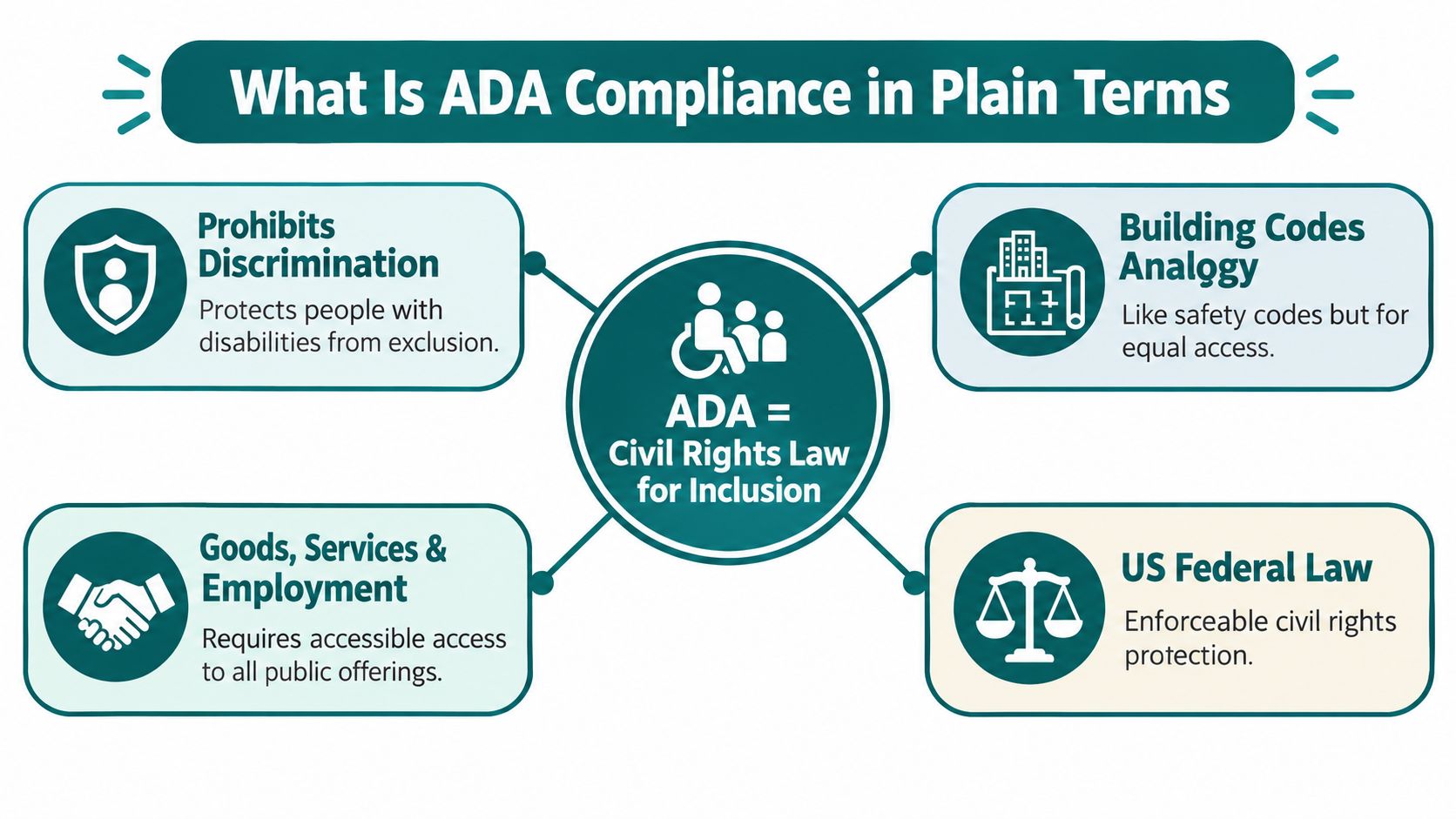
A simple way to explain it is this. Building regulations tell you how to make a structure safe. Accessibility law tells you how to make participation fair. It's not only about whether a person can enter a space. It's about whether they can use what's inside on terms that are meaningfully comparable.
Definition: ADA compliance is the process of ensuring that disabled people aren't excluded from using facilities, services and public-facing experiences because of avoidable barriers.
What people usually mean when they ask
In everyday business language, people use “ADA compliant” to mean a place, service or digital product is accessible. That can include:
- Physical access such as entrances, toilets, seating areas and routes through a venue
- Service access such as booking processes, assistance policies and communication methods
- Digital access such as websites, mobile apps and self-service tools
In the US, those questions are framed through the ADA. In the UK, the closest practical translation is usually the Equality Act 2010 plus any sector-specific rules and digital requirements that apply.
The UK version is about reasonable adjustments
The Equality Act's core accessibility idea is the duty to make reasonable adjustments. Section 20 creates a three-part duty. If a provision, criterion or practice puts a disabled person at a substantial disadvantage, an organisation must take reasonable steps to avoid that disadvantage. The same principle applies to physical features and to providing auxiliary aids or services, as set out in section 20 of the Equality Act 2010.
That's the point many generic explainers miss. UK compliance isn't only about whether a building has obvious accessible features. It's also about whether your policies, service model and supporting tools remove disadvantages in practice.
For public bodies, the duty is also anticipatory. Government guidance says organisations should plan for likely needs in advance rather than wait until a disabled person encounters a barrier. Waymap's accessibility explainer gives a practical overview of why that matters in live environments.
The plain-English takeaway
If someone in the UK asks, “What is ADA compliance?”, the useful answer is this:
- The ADA is the US legal framework.
- The UK equivalent question is whether your organisation is meeting its duties under the Equality Act and, where relevant, public-sector digital accessibility regulations.
- The test isn't just whether access exists somewhere. It's whether people can use the service without avoidable disadvantage.
Where ADA Compliance Applies From Buildings to Digital Services
Accessibility obligations show up in three places at once: the built environment, transport and pedestrian infrastructure, and digital services.
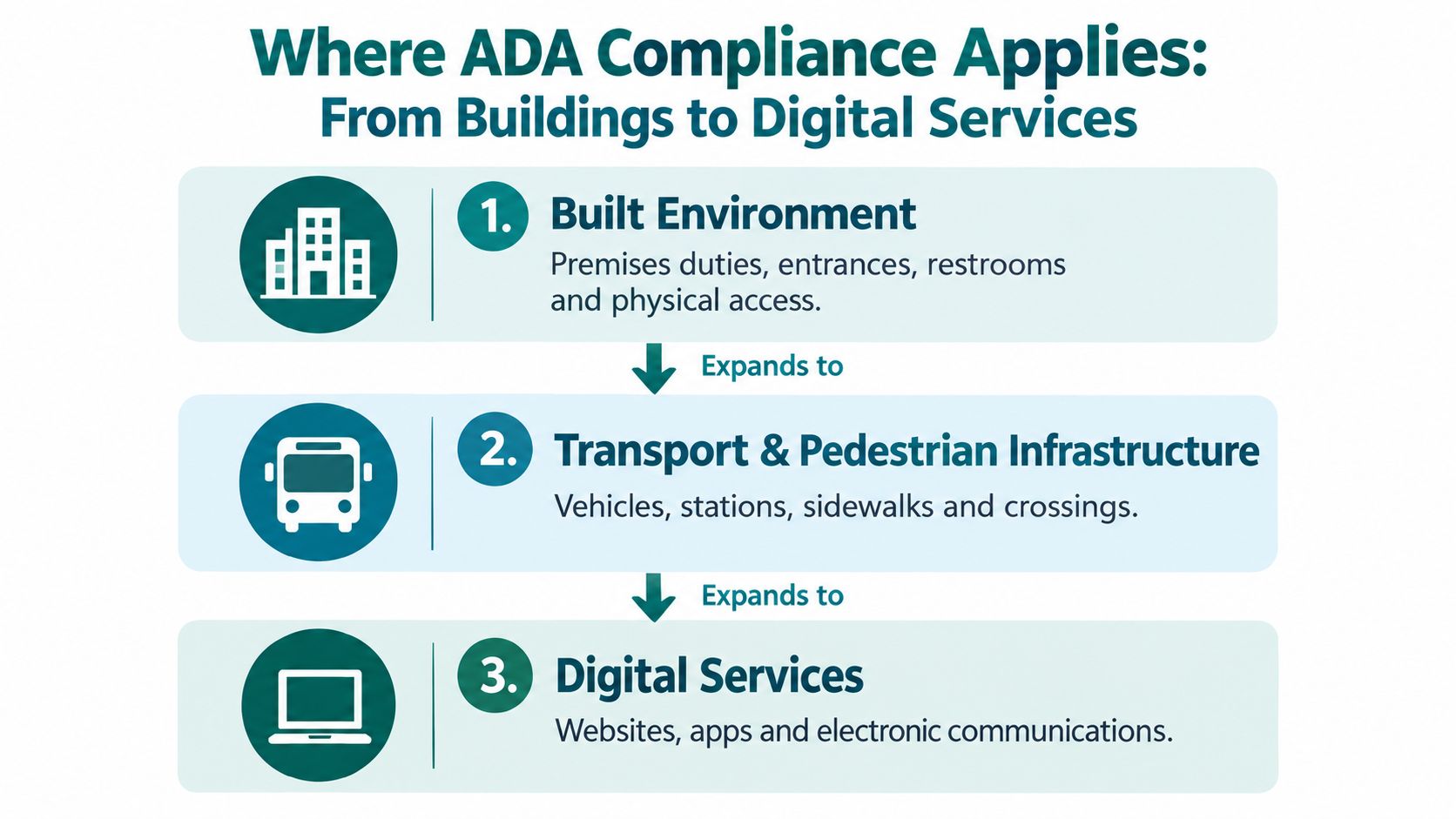
Decision-makers often split these apart because different teams own them. Estates handles premises. Operations handles assistance. Digital handles websites and apps. The user experiences them as one journey.
Buildings and premises
For venues such as shopping centres, stadiums, universities, libraries and hospitals, accessibility starts with the physical environment. Entrances, routes, doors, signage, toilets, lifts and counters all matter. So do the spaces between them.
Government guidance on reasonable adjustments says changes can include physical features such as lifts, wide doors, ramps and tactile signage, but also policies, procedures and staff training. The same guidance states that, for public-sector bodies, the duty is anticipatory. They should prepare in advance for likely needs rather than wait for a problem to arise, according to the UK government's guidance on reasonable adjustments.
Transport and pedestrian infrastructure
For metro systems, airports, rail stations and bus interchanges, the question becomes more operational. A route may cross entrances, ticket halls, concourses, kerbs, crossings, platforms and staffed assistance points. The law also treats some transport duties differently from premises duties, so operators need to check the right regime for infrastructure and vehicles.
Recent guidance underlines that accessibility is broader than a platform edge or lift. It includes wayfinding, support processes and assistance with boarding and alighting. That matters because government guidance also notes that there are almost 2 million people in the UK living with sight loss, including around 360,000 who are registered blind or partially sighted, as noted in Inclusive Mobility.
A short explainer can help teams align around scope.
Websites and mobile apps
Digital services are often where organisations get a hard-edged compliance test. Public-sector websites and mobile applications in the UK are covered by the Public Sector Bodies Accessibility Regulations 2018. Those rules apply to both websites and apps, so a customer journey that starts online and ends on site can't be treated as a separate issue.
For practical scoping, ask which of these you operate:
- Public information sites for venues, services, opening hours or event information
- Transactional services such as ticketing, bookings, patient portals or student systems
- Mobile apps used for journey planning, service updates, navigation or customer support
If you run any of those in a public-sector context, accessibility isn't a side project. It's part of the service.
How ADA Relates to WCAG Section 504 and UK Law
A UK estates manager or transport manager searching “ADA compliance” is usually trying to answer a practical question. What is our duty here, and which rule tells us how to prove we met it?
The clean way to answer it is to separate three different jobs. First, civil rights law sets the duty not to disadvantage disabled people. Second, technical standards set the test for websites and apps. Third, built-environment and service-design decisions determine whether a person can complete the journey through a station, hospital, campus or venue.
ADA, WCAG and UK Law at a Glance
| Framework | Jurisdiction and Scope | What It Requires in Practice |
|---|---|---|
| ADA | United States. Civil rights law covering disability discrimination in public life, including services, transport and public-facing access. | Organisations must remove barriers and avoid excluding disabled people from services and facilities. |
| Section 504 and Section 508 | United States. Accessibility duties linked to federally funded activity and federal electronic and information technology. | Teams use these frameworks to assess accessible service delivery and digital procurement in US public settings. |
| WCAG 2.2 AA | International technical standard for digital accessibility. Not a law by itself. | Provides test criteria for making web and app content perceivable, operable, understandable and resilient. |
| Equality Act 2010 | United Kingdom. Applies broadly to organisations providing goods, facilities or services to the public. | Creates the duty to make reasonable adjustments across policies, physical features and auxiliary aids or services. |
| Public Sector Bodies Accessibility Regulations 2018 | United Kingdom public sector. Covers websites and mobile applications. | Requires public-sector digital services to meet WCAG 2.2 AA and publish an accessibility statement. |
For UK readers, ADA is the nearest US reference point. The closer legal mapping is usually the Equality Act 2010 for service access, plus the Public Sector Bodies Accessibility Regulations 2018 for public-sector websites and apps.
That distinction matters because the UK duty is anticipatory. A university cannot wait until a blind student complains before fixing wayfinding gaps. A transport authority cannot treat accessible journey planning as an individual exception. The law expects barriers to be identified in advance and addressed across the service.
How the digital pieces fit together
WCAG is a measuring tool, not the legal duty itself. It works like a building specification. The specification tells you how to check the work, but the legal duty comes from the rule that says access must be provided.
For UK public-sector digital teams, the Public Sector Bodies Accessibility Regulations 2018 make that specification concrete. Government guidance states that websites and mobile apps must meet WCAG 2.2 AA and publish an accessibility statement, as set out in GOV.UK accessibility requirements for public-sector websites and apps.
In the US, teams often discuss ADA, Section 504, Section 508 and WCAG in the same conversation. In the UK, the more accurate translation is different. Equality Act duties sit at the service level. The 2018 Regulations set specific digital requirements for public bodies. If you need that legal translation set out plainly, Waymap's guide to Equality Act 2010 requirements explains the UK position directly.
Why estates, transport and digital teams need the same map
A website can pass WCAG checks and still leave a person stranded on arrival.
That is the gap many UK organisations miss. Digital compliance checks whether information and functions are accessible on screen. Built-environment duties deal with entrances, routes, lifts, signage, boarding points and service points. Reasonable adjustments often sit between the two, in the live handoff from phone to pavement to platform to reception desk.
Consider a hospital, rail station or local-authority building. The user journey does not start at the front door. It starts at home, with route planning, booking, service updates and arrival information. If the last metre of that journey depends on asking staff for help, finding a temporary sign, or learning a site layout by trial and error, the organisation still carries accessibility risk even if ramps, lifts and alt text are in place.
This is why infrastructure-free navigation matters in UK compliance planning. It helps meet the anticipatory reasonable-adjustment duty without waiting for a capital project, beacon installation or major rebuild. For complex estates and transport interchanges, that is often the missing link between legal duty and usable access.
For teams reviewing wider online obligations alongside accessibility, taxes and privacy policies explained is a useful companion because digital governance usually spans more than one legal requirement.
Common Misconceptions About ADA Compliance That Create Risk
The biggest accessibility mistakes usually come from bad assumptions, not bad intent.
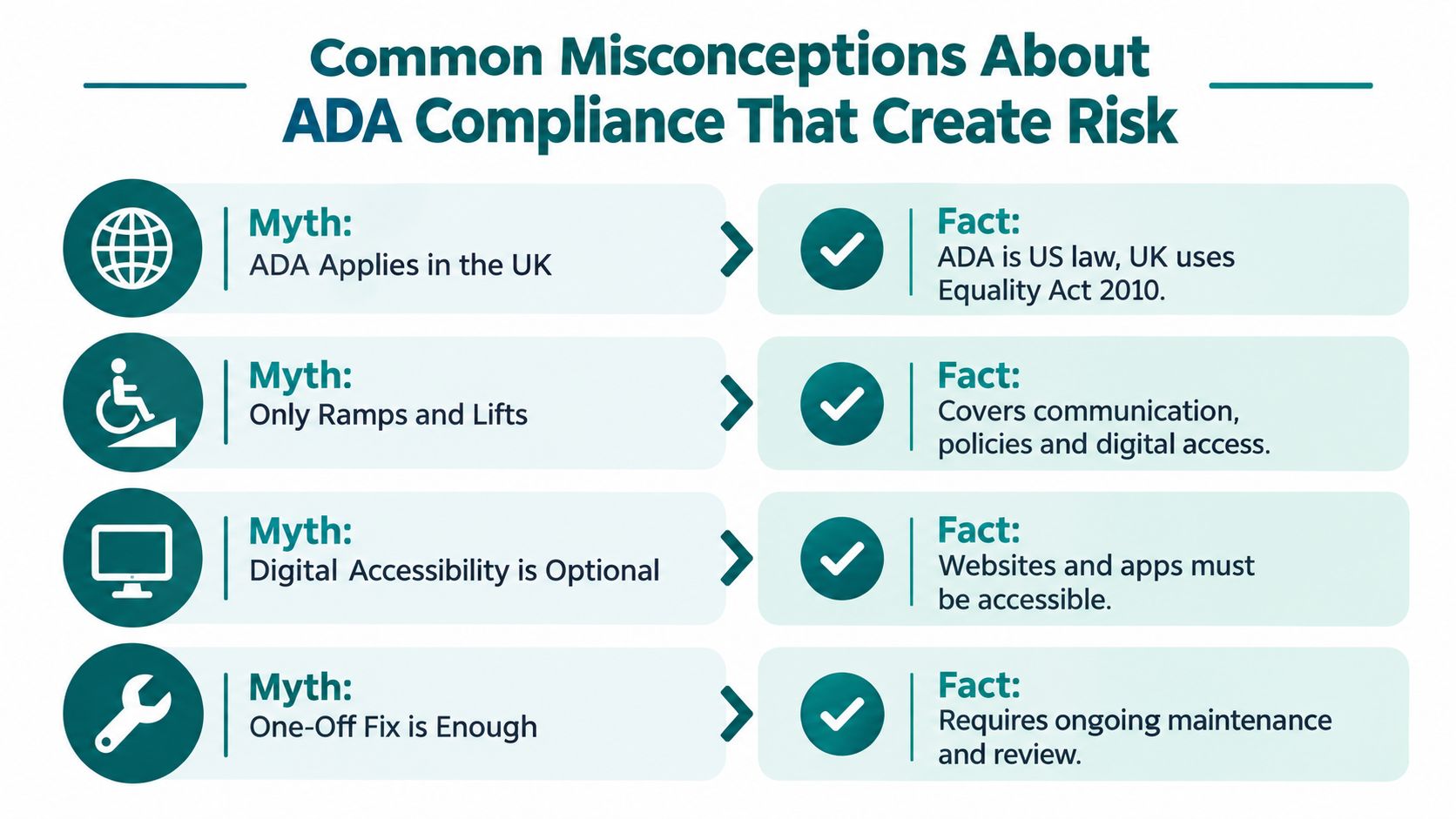
Misconception one that ADA applies in the UK
This is the most common confusion. The ADA is US law. In the UK, organisations usually need to assess duties under the Equality Act 2010, public-sector digital regulations, building rules and sector-specific transport requirements.
That isn't a semantic point. It changes which legal test you apply, which teams need to be involved, and what evidence of compliance matters.
Misconception two that accessibility only means ramps and lifts
Physical access matters. It just isn't the whole picture.
Government guidance and legislation make clear that reasonable adjustments can involve more than physical alterations. The duty can be triggered by a provision, criterion or practice, a physical feature, or the need for auxiliary aids or services. That means policies, booking rules, signage, hearing support, staff processes and wayfinding can all be part of the answer.
A building can be technically accessible at the entrance and still be inaccessible as a service.
Misconception three that digital accessibility is optional
For UK public-sector bodies, digital accessibility is not optional. Websites and mobile apps are within scope, and those services must meet a defined standard and publish an accessibility statement, as covered earlier.
In practical terms, that means a venue app, patient information app, student portal or journey planner can't be left outside the accessibility programme just because estates doesn't own it.
Misconception four that one project fixes the issue
Accessibility isn't a one-off capital task. Layouts change. Websites are updated. Service patterns shift. Staff turnover alters how assistance is delivered.
The wider public equality framework also matters here. Public authorities, including private companies carrying out public functions, must have due regard to the need to advance equality and consider disabled people's needs under the public sector equality duty, as set out in the Equality Act 2010 legislation.
A simple self-check helps expose risk:
- If your team says “the building is compliant”, ask whether routes, service policies and customer communications were reviewed too.
- If the website passed once, ask who owns accessibility in content updates, app releases and procurement.
- If assistance is “available on request”, ask whether the journey can still be completed when a person wants independence rather than escorted support.
What Organisations Should Do Next to Meet Accessibility Duties
Most organisations don't need another abstract accessibility policy. They need a practical sequence of decisions.
Start with the journey, not the asset list
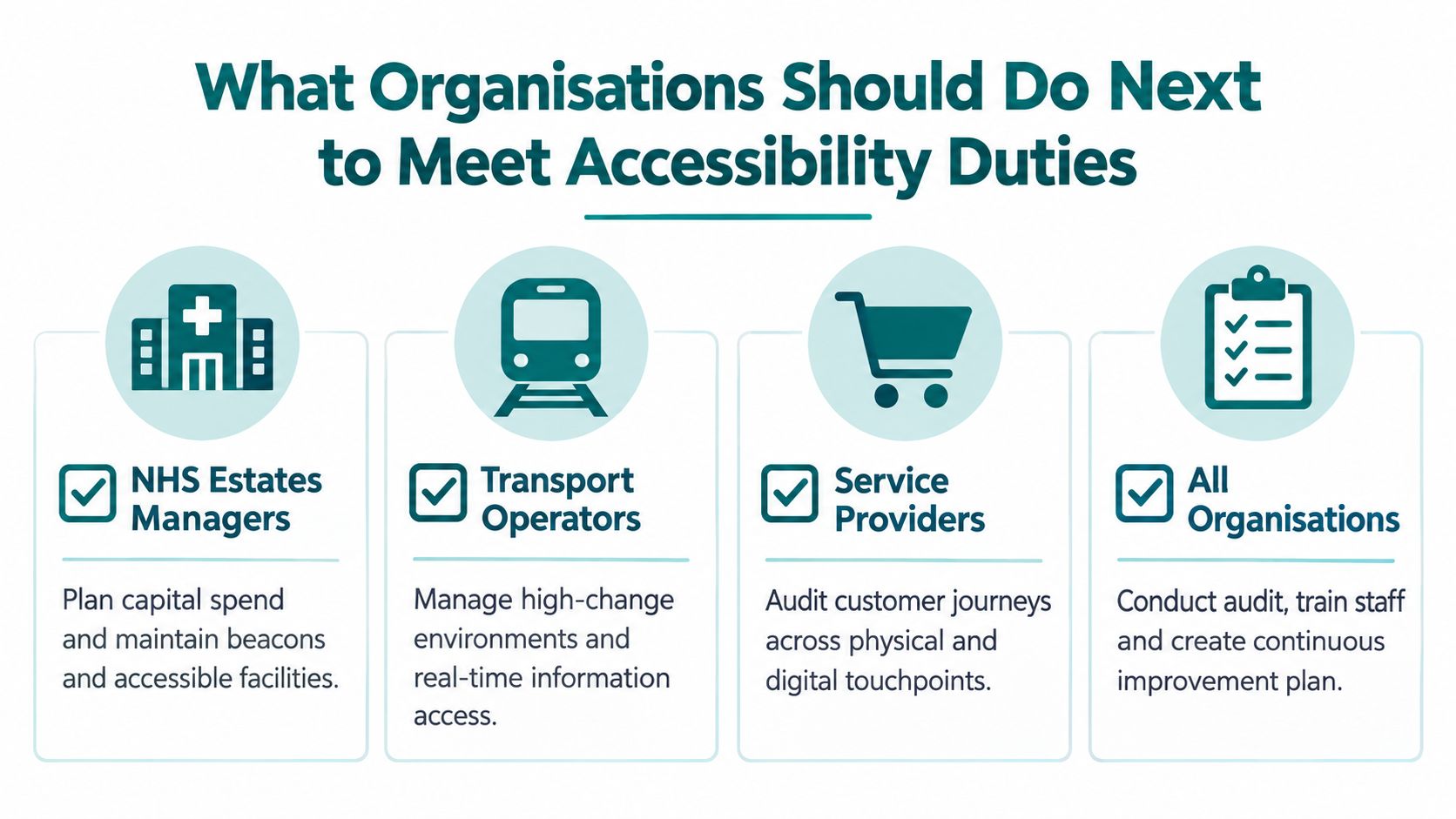
If you manage an NHS estate, a metro system, a shopping centre or a university campus, review the full user journey from arrival to destination. That means entrance, route choice, information points, digital touchpoints, service counters, toilets, exits and any transfer points in between.
Different sectors hit different friction points:
- NHS estates managers often face capital approval cycles that make hardware-heavy solutions difficult to justify and maintain.
- Transport operators deal with high-change environments where platform information, closures and temporary routing shift regularly.
- Retail and venue teams need accessibility measures that support both compliance and a usable visitor experience across large, complex footprints.
Separate what needs rebuilding from what needs redesigning
Some barriers require physical works. Others require service redesign, better digital information or an auxiliary aid.
That's why the anticipatory duty matters. Parliament's report on disability and the built environment notes that, since October 2004, people responsible for buildings open to the public have been required to proactively ensure those buildings are as accessible as can reasonably be, and that the Equality Act 2010 extends duties to employers, service providers and public authorities using buildings, as noted in the Parliamentary report on disability and the built environment.
Practical test: If a disabled visitor arrived tomorrow without prior notice, could they understand the route, use the service, and reach the right destination without avoidable dependence on staff?
Use navigation and information tools that fit live environments
For complex sites, infrastructure-heavy wayfinding can create its own maintenance burden. Waymap uses dead reckoning from device-native sensors, works indoors, outdoors and underground without GPS, Wi-Fi or beacons, and is used in venues including WMATA, the Royal Hospital for Children and Young People, Westfield London and SBS Transit. That matters for operators who need a navigation layer that can support anticipatory reasonable adjustments without installing and maintaining hardware across changeable estates.
The legal point is straightforward. If independent navigation is part of equal access, then a practical route to independent navigation can be part of the adjustment strategy.
What to put on the action list now
- Audit your digital estate: Check websites and mobile apps against WCAG 2.2 AA where the public-sector rules apply.
- Publish or review the accessibility statement: Make sure it reflects the current state of the service.
- Review wayfinding as an accessibility issue: Don't confine it to signage or branding. Treat route finding as part of service access.
- Check policies and staff practice: Booking rules, assistance procedures and fallback processes often create barriers even where premises are improved.
- Assign ownership: Estates, digital, operations and customer experience all need named responsibilities.
For a practical baseline, Waymap's accessibility requirements guide is a useful reference point.
Frequently Asked Questions About What Is ADA Compliance
Does ADA compliance apply to UK businesses
No. ADA compliance refers to a US law. UK businesses usually need to assess accessibility duties under the Equality Act 2010, with additional rules depending on sector and whether they operate public-sector websites or apps.
What is the difference between ADA and the Equality Act 2010
The ADA is an American civil rights law. The Equality Act 2010 is the main UK legal framework that covers discrimination and creates the duty to make reasonable adjustments for disabled people in services, premises and related areas.
Is WCAG legally required in the UK
For UK public-sector websites and mobile apps, yes. Government guidance says those services must meet WCAG 2.2 AA and publish an accessibility statement under the public-sector accessibility regulations.
What counts as a reasonable adjustment for a large venue
A reasonable adjustment can include physical changes, changes to policies or procedures, and auxiliary aids or services. For a large venue, that might involve route information, tactile signage, staff assistance processes, digital access improvements or changes to how people request support.
Is accessibility only about the built environment
No. Accessibility includes the built environment, service delivery and digital access. Large venues often fail not at the doorway but in the route, the process, the app, or the way assistance is organised.
When did the UK duty to plan ahead become proactive for public buildings
The proactive duty has been in place since October 2004 for people responsible for buildings open to the public, and public-sector bodies also have an anticipatory duty to plan for likely needs rather than wait for barriers to be reported.
If you want a broader plain-English answer set, Waymap's FAQ library covers common accessibility and navigation questions in more detail.
Waymap provides precision navigation for complex indoor, outdoor and underground environments, helping organisations support accessible, independent journeys without relying on GPS, Wi-Fi or installed hardware. If you're reviewing what ADA-style compliance means in a UK venue, campus or transport setting, visit Waymap to see how digital wayfinding can support reasonable adjustments and end-to-end access.
