
ADA Compliance Guidelines for Transit Venues
ADA compliance guidelines for large venues require attention to accessible routes, signage, entrances, platform edge safety, and digital wayfinding, with ongoing operational duties under Title III. For a transit hub, stadium, airport, or shopping centre, compliance means keeping the entire journey usable when construction, crowds, service changes, and temporary closures alter the environment.
A visitor may arrive at a station through an accessible entrance and still be unable to reach the correct platform independently because a tactile route is blocked, a temporary sign hides the alternative path, or an audible announcement doesn't identify a changed boarding point. Static design features remain essential, but they can't communicate every operational change. Facility teams need a living accessibility programme that connects physical access, information, staff procedures, and navigation.
Why ADA Compliance Matters in Transit and Large Venues
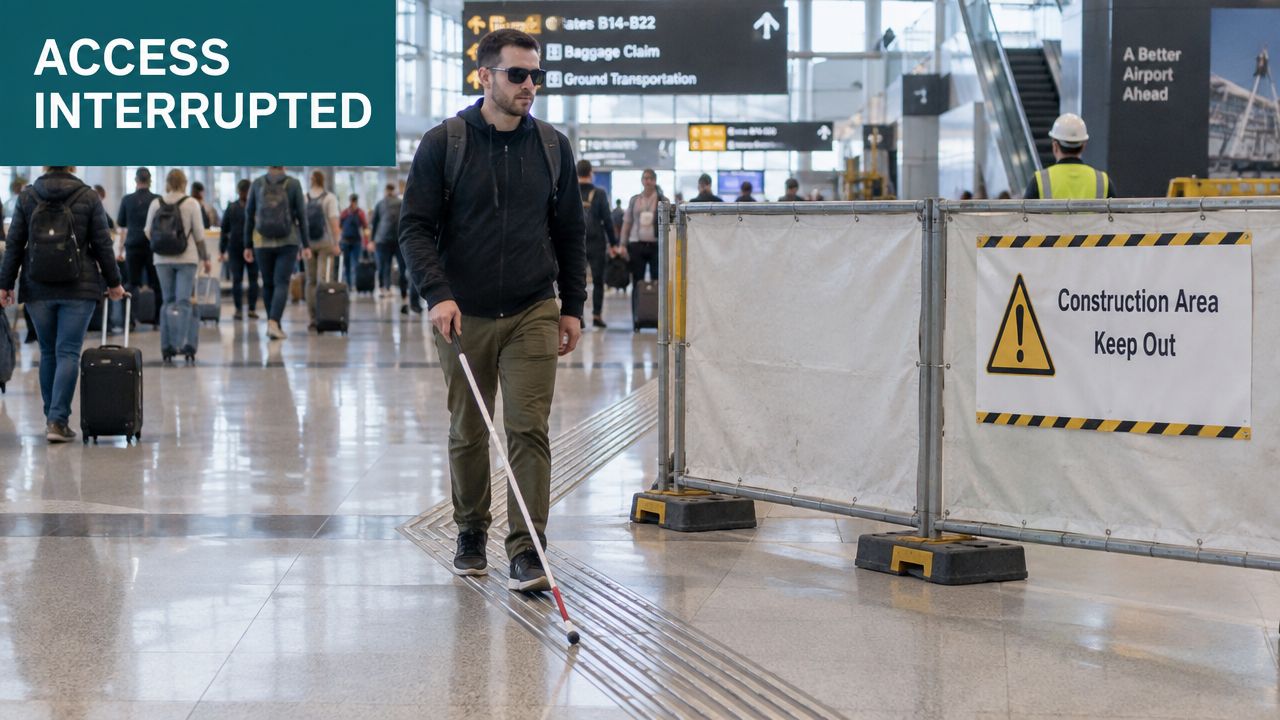
A busy interchange can expose the difference between technical provision and practical access within minutes. A traveller who is blind may follow a familiar route towards a platform, encounter construction barriers, and find that the replacement sign is visible but provides no tactile or audible information. A passenger with limited mobility may reach a lift only to discover that an event barrier has narrowed the approach. Someone with a hearing impairment may see a service alert but miss an announcement that explains where boarding has moved.
These aren't isolated design defects. They interrupt the end-to-end accessible journey, from the pavement, car park, or transit stop to the entrance, ticketing point, amenities, platform, seat, and exit. In a venue with frequent works, temporary staging, retail changes, or crowd-control measures, a route can become inaccessible after the original inspection has passed.
Title III creates an operational responsibility
Title III of the Americans with Disabilities Act applies to private places of public accommodation, including stadiums, convention centres, transport terminals, and large retail venues. The accessibility question therefore extends beyond whether a building was constructed correctly. Operators also need to consider reasonable modifications, effective communication, auxiliary aids, staff assistance, and the way services operate in changing conditions.
A physical sign can identify a destination, but it can't know that a platform has closed this morning. A tactile path can guide someone along its intended alignment, but it can't explain a temporary diversion. Operators need a process for identifying changes, updating information, testing the revised route, and briefing frontline teams.
Practical rule: Treat every temporary change as an accessibility change. Construction hoardings, security queues, event furniture, and closed lifts belong in the accessibility review.
Digital accessibility still matters, particularly for venue websites, ticketing journeys, mobile applications, and service alerts. Teams reviewing that part of the experience may find guidance on how to make your site ADA compliant useful, but a compliant website can't compensate for an inaccessible station or stadium route. Waymap's discussion of why accessibility matters captures the wider principle: people need to move through the physical environment, not merely read about it.
The ADA Titles and Standards Most Relevant to Venue Operators
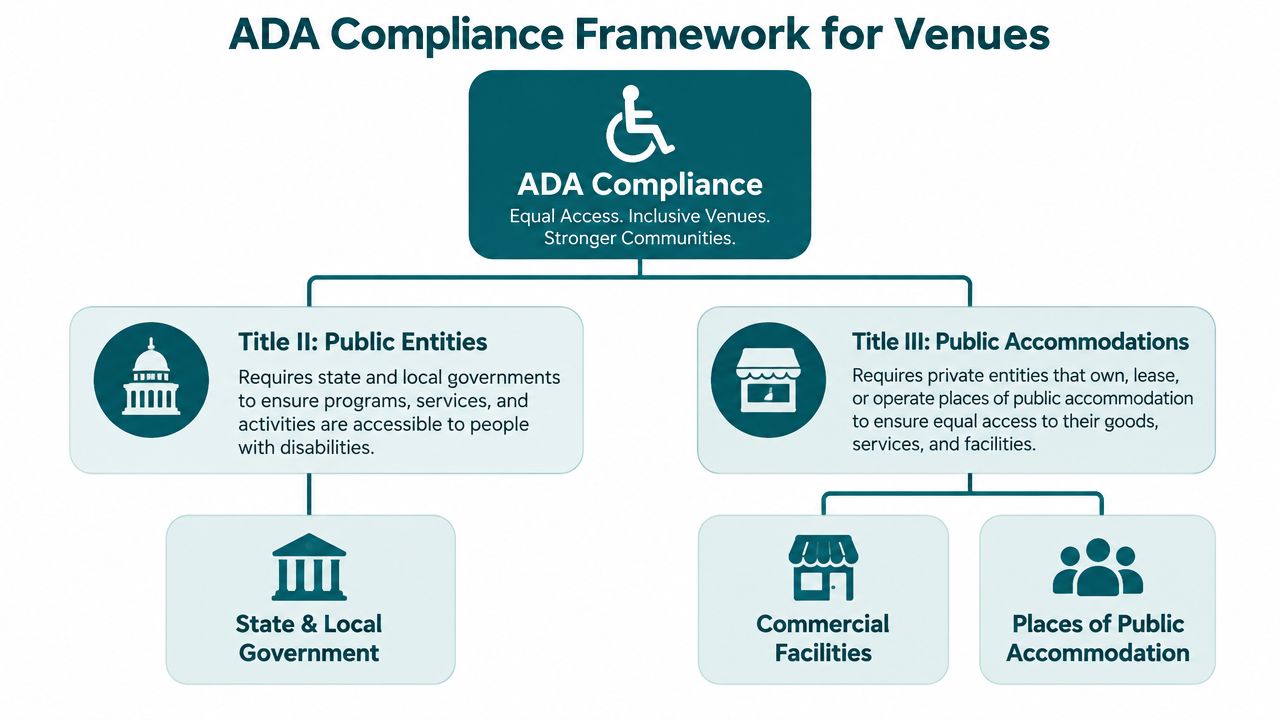
Venue operators need a clear legal map before they choose inspection methods or technology. Title II applies to state and local government entities, including public transport authorities and publicly operated facilities. Title III applies to private entities that operate places of public accommodation, such as privately owned stadiums, shopping centres, hotels, and entertainment venues.
The 2010 ADA Standards for Accessible Design provide the principal technical requirements for accessible facilities, while the Department of Justice offers interpretive guidance. ANSI A117.1 is also relevant where projects use its technical specifications for accessible and usable buildings and facilities. Operators should keep the legal obligation separate from the technical reference: a design standard can guide construction, but operational practice determines whether people can use the service in reality.
The four ADA titles in practical context
The four statutory titles aren't equally relevant to every venue. Facility and accessibility teams should identify the provisions that govern their organisation and services.
- Title I concerns employment. It affects recruitment, workplace access, staff accommodation, and the accessibility of operational areas used by employees.
- Title II concerns public entities. Transit agencies, city-owned arenas, public universities, and municipal facilities need accessible programmes, services, and facilities.
- Title III concerns private places of public accommodation and commercial facilities. It covers access to the goods, services, facilities, privileges, advantages, and accommodations a venue provides.
- Title IV concerns telecommunications and communication access. It informs how people receive information, particularly where communication systems support public services.
For international operators, the American framework isn't the only reference point. In the UK, the Equality Act 2010 establishes an anticipatory duty to make reasonable adjustments, while Part M of the Building Regulations provides a building-access baseline in England. BS 8300:2018 offers a broader inclusive-design code of practice, with one part covering external environments and another covering buildings. These frameworks don't replace local legal advice, but they help multinational teams compare obligations and design assumptions.
The practical testing question is simple: can a disabled person reach and use the service with equivalent independence, information, and dignity? Teams looking for a structured approach can review Waymap's material on ADA compliance testing, then adapt the process to the venue's legal jurisdiction and operating model.
Accessible Routes and Circulation Paths Checklist
An accessible route is only useful if it remains continuous. I inspect routes as journeys, not isolated measurements. The route from a rail entrance to a platform, or from a stadium gate to a seat, should be tested under the same conditions visitors face, including queues, temporary furniture, security screening, and active construction.
Inspect the route in sequence
Start at every arrival point, including accessible parking, passenger drop-off areas, taxi ranks, bus stops, and pedestrian approaches. Follow the route to each principal entrance and continue through the destinations visitors use.
Use the 2010 ADA Standards for Accessible Design as the governing reference for the applicable technical provisions, and record both the measured condition and the operational context.
- Clear width: Verify that the route provides the required unobstructed width and that doors, bollards, ticketing equipment, queue rails, and merchandise displays don't reduce it.
- Passing and turning space: Check manoeuvring areas where a person using a wheelchair or mobility device needs to change direction, pass another user, or approach equipment.
- Surface condition: Look for stable, firm, slip-resistant surfaces. Loose mats, abrupt joints, drainage grates, cables, and temporary floor coverings can create barriers even when the permanent floor complies.
- Slope and level changes: Inspect ramps, cross slopes, kerbs, thresholds, and transitions. Confirm that handrails, edge protection, landings, and detectable warnings are present where the applicable standard requires them.
- Headroom and protrusions: Identify low signs, suspended displays, open doors, advertising boards, and other objects that can create hazards along the pedestrian line.
- Route continuity: Confirm that the accessible path reaches ticketing, concessions, toilets, seating, lifts, refuge areas, and egress routes without forcing a user into an undocumented detour.
Test temporary conditions separately
A route that passes during a quiet morning inspection may fail during a match, concert, or overnight works. Ask the operations team to demonstrate how they manage a closed lift, diverted entrance, obstructed platform access, or changed security queue.
Temporary signs should identify the accessible alternative, and staff should know where that alternative begins and ends. Don't accept a verbal assurance that someone will help. Record the route, test it with the intended information, and confirm that the revised path remains usable.
Web and mobile guidance should support the same journey rather than describe a separate experience. Teams comparing physical and digital considerations can consult this practical resource on modern web design accessibility, while remembering that web conformance doesn't validate a physical route.
Walkthrough test: Ask a person unfamiliar with the site to reach a destination using only the information available to the public. Note every point where they need to ask for help.
A strong checklist records the destination, route condition, obstruction, responsible owner, corrective action, and verification date. That turns an inspection into governance instead of another document filed after the audit.
Signage and Wayfinding Compliance Requirements
Compliant signage and effective wayfinding solve related but different problems. A permanent room sign tells a visitor what a destination is. A directional system helps the visitor decide where to go. In a large venue, both need to work for people who read visual information and people who rely on touch, sound, or assistance.
Permanent identification signs generally need to address character proportions, visual contrast, tactile characters, Braille where required, mounting location, and the relationship between the sign and the destination. The applicable ADA Standards provisions should guide the design review. Temporary signs need the same level of care when they redirect users around works, closures, queues, or event infrastructure.
What static signs do well
A well-designed sign provides a stable reference. High contrast, consistent placement, clear wording, recognised pictograms, and tactile information help people identify entrances, toilets, lifts, exits, and other fixed destinations. Pictograms shouldn't stand alone where equivalent text is required. Directory signs also need a clear logic, because a list of destinations isn't the same as an instruction about the next decision.
Static signs work particularly well when:
- The destination is permanent: Room identification and facility signs benefit from durable, predictable placement.
- The decision point is stable: A sign at an unchanged corridor junction can provide dependable orientation.
- The information is close to the user: Visitors can inspect tactile content when the sign is mounted and positioned appropriately.
They work less well when the building changes faster than the signage programme. Reprinting plates, relocating signs, and checking every route after construction creates a maintenance burden. A sign may remain technically legible while its direction becomes wrong.
Where dynamic guidance adds value
Dynamic navigation can communicate temporary closures, changed points of interest, accessible entrances, and route adjustments without requiring a new physical sign at every decision point. Waymap uses dead reckoning from device-native motion sensors, with sub-3-metre accuracy in infrastructure-free environments, and doesn't require GPS, Wi-Fi, Bluetooth beacons, or pre-mapped venue hardware. Its role is complementary, not substitutive: physical signage remains part of the built environment, while digital guidance supplies adaptable route information.
That distinction matters in underground stations, airports, stadiums, and campuses where signal conditions and layouts vary. The design principles outlined in Waymap's wayfinding and signage guidance are most useful when teams treat signs, announcements, staff support, and digital navigation as one coordinated information system.
Entrances, Exits, and Door Accessibility
An accessible entrance must be usable from the approach route and connected to the service beyond the threshold. Check every public entrance, not only the one shown on the access statement or labelled as accessible. If a venue directs visitors to a particular gate, that gate becomes part of the promised journey.
Inspect door clear width, opening force, hardware, closing speed, thresholds, vision panels, and manoeuvring space against the applicable ADA Standards requirements. Lever handles and other usable hardware generally serve more people than tight knobs, while raised thresholds, mats, and poorly controlled automatic doors can create avoidable barriers.
Test the complete arrival sequence
The inspection should begin outside the door. Check accessible parking and drop-off connections, kerb transitions, weather protection, intercoms, turnstiles, ticket validators, and security screening. A compliant door doesn't solve a route that ends at a step or a screening lane that requires a person using a wheelchair to take a separate, unexplained path.
Multiple entrances need a clear operational plan. A staffed gate may offer assistance, but assistance shouldn't become the only way to enter when an equivalent independent route is feasible. Unstaffed entrances need reliable information, functioning equipment, and a way to obtain help without placing the visitor at a disadvantage.
Security procedures deserve a separate exercise. Ask whether wheelchair users, people with guide dogs, people with sensory sensitivities, and visitors carrying assistive equipment can complete screening without unnecessary delay, public explanation, or loss of independence. Train security and front-of-house staff to explain the alternative process respectfully.
Wayfinding can make the difference between an accessible entrance that exists and one that people can find. A dynamic layer can direct visitors to the correct gate, identify a lift or accessible screening lane, and update the route when an entrance closes. The technology doesn't remove the need for compliant doors or trained staff. It helps operators keep the entrance usable as conditions change.
Platform Edge Safety and Transit-Specific Requirements
Transit platforms combine building access, vehicle interfaces, crowd movement, and time-sensitive information. A passenger may need to locate the correct platform, identify the boarding zone, understand the platform edge, find a gap-free boarding point, and respond to a last-minute service announcement. That sequence is more demanding than reaching a general room in a venue.
Inspect the platform-to-vehicle interface for the relevant network and rolling stock. Review the gap and height conditions, accessible boarding equipment, level boarding arrangements, ramps, lifts, and staff procedures. Tactile warning surfaces should be detectable, continuous where required, and kept clear of advertising, temporary barriers, luggage, and crowd-control equipment.
Passenger information must reach different users
Visual displays and audible announcements should communicate the same essential service information, including platform changes, delays, boarding instructions, and emergency messages. A hearing passenger may rely on the screen, while a blind passenger may rely on audio or staff support. Neither channel should assume that the other is available.
The route to the platform also matters. Check lifts, ramps, stairs, gates, paid-area boundaries, help points, and changes between operator-controlled spaces. A station map can show the accessible route, but it may not reflect a closed lift or temporary platform restriction unless the operator maintains it actively.
A platform warning surface is a safeguard at the edge. It isn't a navigation system for reaching the correct boarding position.
Transit agencies should rehearse disruption scenarios, not just inspect normal service. Ask staff to guide a passenger through a lift outage, platform reassignment, replacement bus connection, or inaccessible entrance closure. The response should provide equivalent information and a workable route, rather than only telling the passenger to seek help.
These procedures also support accountability. Record the change, the public information issued, the accessible alternative, the staff owner, and the point at which the route was verified. That evidence helps operators manage a living system instead of relying on a certification that describes an earlier configuration.
Digital Wayfinding and Infrastructure-Free Navigation
Static signage can't keep pace with every change in a major transport environment. Construction, closed lifts, altered platform access, retail refits, event barriers, and temporary security arrangements can all invalidate a previously familiar route. Digital wayfinding addresses that operational gap when it provides precise, accessible instructions and when venue teams can update the underlying destination data.
Waymap is a precision navigation platform that uses smartphone motion sensors and detailed maps rather than GPS, Wi-Fi, Bluetooth beacons, or installed hardware. Its dead-reckoning approach provides sub-3-metre accuracy in infrastructure-free environments, and it doesn't require a pre-mapping installation of physical devices. That is relevant underground and indoors, where satellite signals may be unavailable and maintaining beacons across a large estate can be difficult.
How the technology fits the accessibility duty
Title III's auxiliary-aids obligation is broader than a sign inventory. An accessible navigation option can provide heads-up, hands-free audio instructions that adapt to a person's walking style, using stride and movement patterns to refine step-accurate directions. That can help a blind or low-vision visitor follow a route to a specific door, platform, ticket machine, or point of interest.
Waymap's named transport context includes WMATA, SBS Transit in Singapore, and LTA Singapore, where the operational problem is not just identifying a building entrance. It is helping people traverse complex public transport environments with changing routes, multiple levels, and signal-poor areas. Operators still need compliant construction, signs, announcements, trained employees, and emergency procedures. A navigation platform can supplement those measures by keeping route information updateable.
The infrastructure-free model is particularly relevant where staff turnover is high or layouts change frequently. Teams can amend points of interest, route instructions, language options, and diversions through the digital layer instead of replacing hardware throughout the estate. That makes navigation a maintained service asset rather than a one-time capital installation.
The distinction between assistance and independence should guide procurement. Staff support remains necessary, but a visitor shouldn't have to depend on finding an available employee for every ordinary journey. Operators evaluating the technical model can review Waymap's GPS-free navigation explanation.
The following demonstration shows how the navigation experience can support movement through complex spaces.
Operational Friction and Governance for Facility Teams
A lift fails before a sold-out event, a tenant moves into a concourse, or security barriers close the usual entrance. The accessibility question is then operational: who confirms the alternative route, updates every information channel, tests it in real conditions, and records the result?
Transit operators also manage a physical maintenance burden. Beacons, displays, signs, help points, lifts, gates, and route markings operate in busy spaces where equipment can be damaged, moved, obscured, or taken out of service. Every hardware layer adds inspection, replacement, recalibration, and asset-management work.
Venue managers face competing funding demands. Capital budgets may cover a building alteration, while recurring accessibility spending competes with security, energy, crowd management, and commercial projects. A stronger proposal links the work to measurable operational outcomes, such as fewer failed journeys, clearer staff escalation, better visitor feedback, and more reliable information during change. Retail and stadium operators can also assess whether easier wayfinding encourages visitors to stay longer, reach more destinations, or return. Those measures require a defined baseline and consistent collection.
Build a continuous governance cycle
Assign named owners for route data, physical assets, customer communications, staff training, incident escalation, and verification. The operating plan should state what happens after a lift failure, tenant change, platform alteration, or event layout blocks the usual path. A digital wayfinding layer can fill information gaps that fixed signs cannot, but it does not remove the need for compliant construction, trained staff, and tested emergency procedures.
Use a recurring cycle:
- Capture the change: Record the closure, obstruction, new destination, or service alteration.
- Assess the accessible journey: Identify who is affected and whether the alternative preserves independent access and equivalent information.
- Update every channel: Amend signs, web pages, apps, announcements, maps, staff briefs, and customer-service scripts.
- Test in the live environment: Walk the route under representative conditions, then correct gaps.
- Close the record: Retain the owner, action, verification, and review information.
An updateable digital layer can reduce reliance on beacon replacement, recalibration, and repeated signage reprints. It can also support multilingual guidance and rapid route changes, provided the venue maintains accurate maps and gives operations teams authority to publish corrections. Waymap's change-management strategy guidance addresses that governance challenge.
UK operators should also understand that accessibility duties extend beyond the American framework. The Equality Act 2010 requires providers to anticipate reasonable adjustments, including changes to practices, physical features, and auxiliary aids or services. Providers cannot charge disabled customers for reasonable adjustments, as set out in section 20 of the Equality Act and the government's disability guidance for service providers. In England, Part M provides the technical building baseline, while BS 8300:2018 offers more detailed inclusive-design guidance for external environments and buildings, as described in this overview of BS 8300.
Digital obligations need their own register. UK public-sector websites must publish accessibility statements under the public-sector website and app requirements. The regulations for mobile applications took effect on 23 June 2021, and government monitoring uses WCAG 2.2 Level AA as its technical standard for websites and apps, according to current public-sector monitoring guidance. Government guidance describes accessible content as perceivable, operable, understandable, and adaptable. Published accessibility statements can identify partial compliance and ongoing fixes.
The planning benchmark is substantial. UK government material used in the technical review of Approved Document M reports that between 20% and 40% of the population in England are disabled or have a long-term health condition (parliamentary evidence). Accessible navigation therefore belongs in core infrastructure planning, not in a specialist add-on budget. In England, the 2010 and 2013 amendments to Approved Document M took effect on 1 October 2015, while Part M dates back to 2004, according to the same government material.
Future-proofing requires attention to changing technical benchmarks. UK guidance cited in accessibility commentary anticipates WCAG 3.0 moving towards a draft candidate recommendation in Q4 2027, so operators should favour systems that can be updated through content and software rather than repeated physical installation work (UK WCAG 2.2 guidance). For venue teams, that is the practical link between legal reasonableness and durable investment.
Waymap provides infrastructure-free, indoor, outdoor, and underground navigation to exact doors, platforms, and points of interest, with hands-free audio guidance and updateable route information for changing venues. Visit Waymap to discuss how a maintained digital wayfinding layer can support ADA compliance guidelines, staff procedures, and accessible visitor journeys.
