
The Uptime Guarantee: A Guide for Venues & Transit
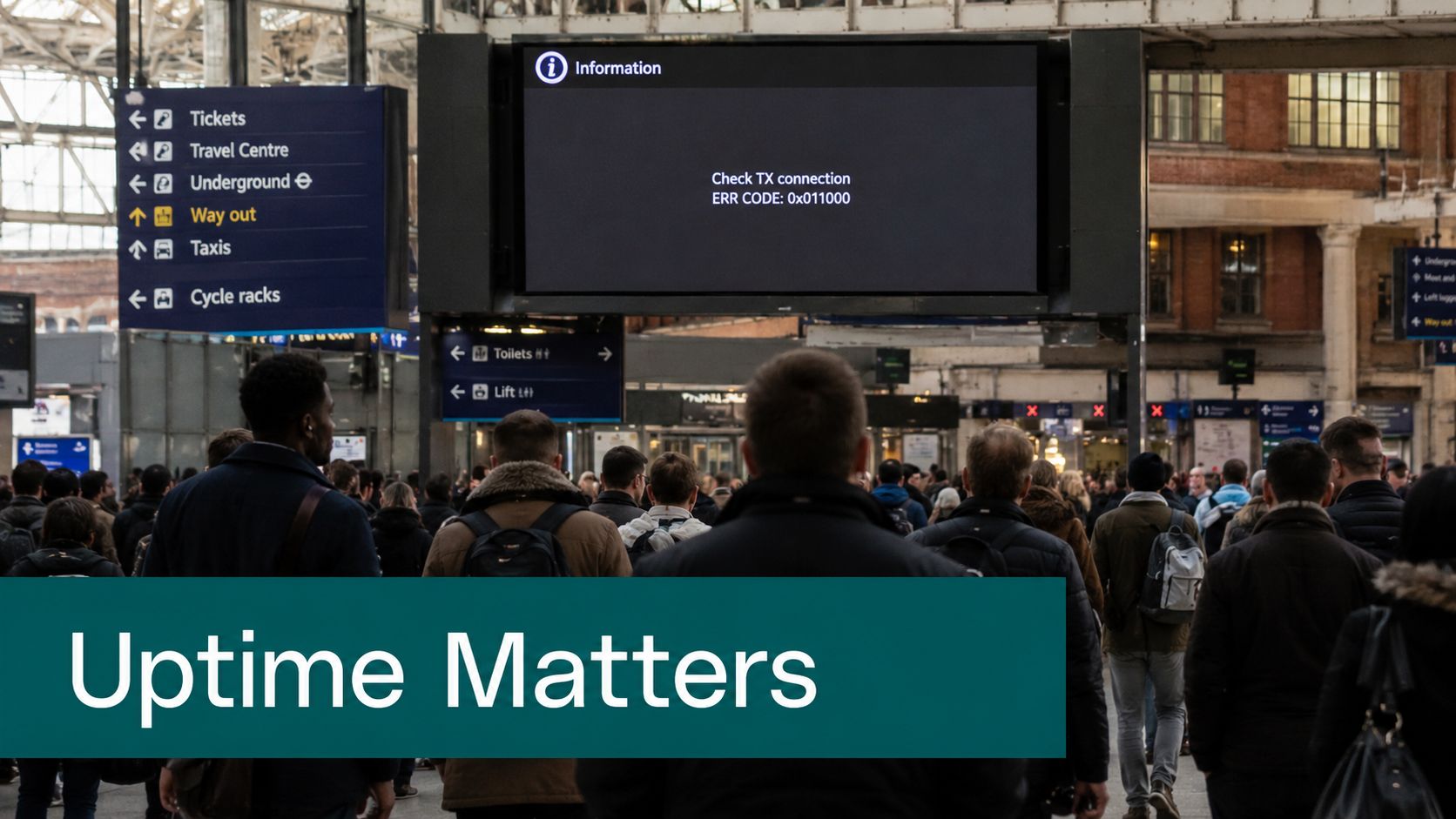
A weak uptime guarantee only looks harmless until the first peak-period failure. A station concourse fills, a venue opens its doors, and the wayfinding app that staff rely on for passenger guidance, accessibility support, or digital signage stops answering at the worst possible moment. At that point, the conversation is no longer about server percentages, it's about confused visitors, diverted staff, and a service that's no longer doing the job it was bought to do.
For UK transport hubs, universities, and large venues, a service that promises 99.9% availability still allows nearly 9 hours of annual downtime, which can be significant if the system supports wayfinding, ticketing, or accessibility workflows, and UK government guidance treats digital service continuity as a critical national infrastructure resilience issue (Algolia on uptime and resilience). In procurement terms, that means the number alone never tells the full story. Ultimately, the question is whether the service remains usable when the building is busy, the network is stressed, and the people who depend on it need it most.
A strong contract has to reflect the operational stakes. For venue operators, accessibility leads, and transit teams, the question isn't whether a vendor can stay online in ideal conditions, it's whether the service still supports the flow of people when disruption hits. That's where an uptime guarantee becomes part of accessibility planning, service continuity, and public trust, not just IT housekeeping. For practical facilities context, see how digital services affect facilities management decisions.
Why Your Uptime Guarantee Matters More Than You Think
A concourse can look orderly right up until the wayfinding layer disappears. Staff start repeating directions, passengers cluster near ticket gates, and visitors who depend on digital guidance get pushed back to generic signage or manual assistance. A small outage becomes a human problem quickly, especially in complex buildings where people are already trying to move, connect, board, or find accessible routes.
That's why an uptime guarantee belongs in the same conversation as service quality and accessibility, not just hosting. Under the Equality Act 2010, operators of public-facing environments need to think carefully about barriers that affect disabled users and anyone who depends on reliable digital support. If a navigation or passenger-information service fails at the moment it's needed, the impact lands on operations immediately, not in some abstract risk register later.
What downtime really looks like on site
Downtime in a venue isn't only a blank screen. It can mean staff being pulled off their posts, queues growing at information desks, and frontline teams making up for a system that's gone silent. It also creates reputational pressure, because users remember the failure they experienced in the middle of a journey more than the vendor's uptime claim.
The best procurement teams treat this as an operational exposure, not a technical inconvenience. They ask whether the service is mission-critical, whether accessibility workflows depend on it, and whether the service credit on offer compensates for the disruption. A percentage in a sales deck won't answer those questions.
Practical rule: if a digital service changes how people move through a venue, its availability is a service issue, an accessibility issue, and a customer-experience issue at the same time.
The same logic applies whether the site is a campus, rail hub, airport, or stadium. If the service is down during a peak arrival window, the cost is absorbed by staff time, visitor frustration, and reduced confidence in the operator's ability to manage the space. That's why buyers need to evaluate the promise, not just admire it.
How Is Uptime Actually Measured
A uptime guarantee only becomes useful when you translate it into elapsed time. Once that happens, the procurement impact is easier to see. A 99.9% SLA allows roughly 43.8 minutes of downtime per month or 8.76 hours per year, while 99.99% cuts that to about 4.38 minutes per month or 52.56 minutes per year (Quostar on uptime calculations). That gap matters in contract review, because “three nines” and “four nines” are not the same level of operational protection.
That calculation matters because operators do not lose time in a vacuum. They lose it during boarding surges, lecture changeovers, event arrivals, or accessibility journeys where a short interruption creates extra support work immediately. A service can still be technically online and yet fail the moment people need it most.
Uptime percentage vs downtime allowance
| Uptime Guarantee | Permitted Downtime per Month | Permitted Downtime per Year |
|---|---|---|
| 99.9% | 43.8 minutes | 8.76 hours |
| 99.99% | 4.38 minutes | 52.56 minutes |
The move from 99.9% to 99.99% is a tenfold reduction in tolerated annual downtime, which is why four nines sits in a materially higher availability class (Quostar on uptime calculations). For a transit or venue operator, that distinction is not academic. It changes how much disruption you can absorb before staff, passengers, or visitors start feeling it.
Procurement teams should ask vendors to state the promise in percentage terms and in elapsed time. They should also ask what happens when the service misses the target, because a number without a remedy is only a sales claim. If the supplier cannot explain the arithmetic clearly, the guarantee is unlikely to protect the operation in a meaningful way.
For systems that support passengers, visitors, or students, the response path matters just as much as the headline percentage. A practical reference for incident handling is Waymap's troubleshooting guide, because availability language only becomes meaningful when the team responsible for the service can detect faults, classify them, and restore function quickly.
What to Look for in a Service Level Agreement
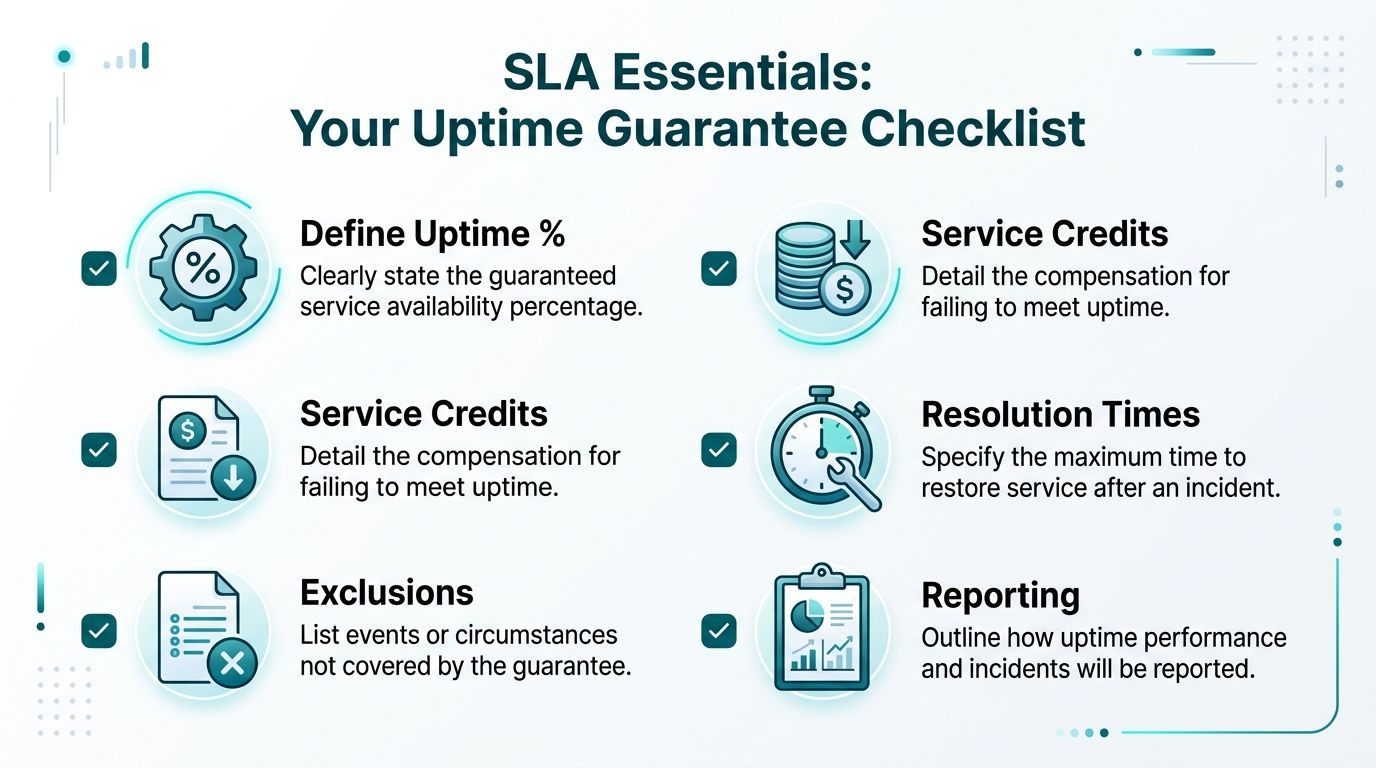
An uptime guarantee without a strong SLA is just a promise with no teeth. The contract needs to say exactly what counts as downtime, how availability is measured, what gets excluded, and what remedy applies if the target is missed. That's the difference between a useful procurement control and a marketing phrase.
The first thing to read is the definition of availability. Some SLAs measure only core application access, while others include login, data sync, API response, or end-user usability. For a transit or venue operator, that distinction matters because a platform can appear online while the user journey is still broken. If ticketing, wayfinding, or accessibility functions are part of the service, they need to be described explicitly.
The clauses that decide whether the guarantee has value
The strongest contracts usually answer five questions in plain English:
- What counts as downtime? The SLA should define whether partial outages, degraded performance, or failed transactions count.
- What are the service windows? Availability measured over business hours can look very different from 24/7 public-facing service.
- What is excluded? Scheduled maintenance, third-party outages, and customer-side network problems are common exclusions, but they need to be written clearly.
- What is the remedy? Service credits, refunds, or escalation paths should be specific enough to matter.
- How fast is recovery? Repair speed, not just percentage uptime, should be written into the agreement.
That last point is often missed. A service that promises a respectable uptime figure but has no meaningful response time commitment can still leave a venue exposed for too long. For transit agencies and other operators, MTTR deserves the same attention as the headline availability percentage.
The procurement side matters too. A practical public-sector reference on buying decisions and contract discipline is Waymap's public sector procurement guidance. Use that mindset when you review exclusions and remedies, because the weakest SLA language is usually the language that pushes responsibility somewhere else.
A good contract should also separate planned maintenance from unplanned outages. If a vendor treats both as invisible, the promised uptime can be technically true and operationally useless. In a venue, a maintenance window during a quiet hour is manageable. A hidden dependency failure during an event is not.
How to Calculate the Real Cost of Service Downtime
A service credit rarely covers the full cost of an outage. It might offset a slice of the invoice, but it won't restore the staff hours lost to confusion, the reputational hit from a failed public-facing service, or the accessibility burden created when people can't get to where they need to go. That's why the cheapest bid is often the most expensive contract once downtime starts.
One useful way to approach the numbers is to think in layers. First, there's the direct operational interruption. Then there's the knock-on effect on staff workload, help-desk volume, passenger flow, and visitor confidence. Finally, there's the wider cost of appearing unreliable in a building where people expect continuity.
For procurement teams under budget pressure, that layered view matters. Industry analysis suggests that while 99.5% uptime is reasonably achievable without excessive cost, higher guarantees become exponentially more expensive (pragmatic perspective on uptime guarantees). That doesn't mean buyers should settle for weaker service. It means they should decide deliberately whether they're paying for more built-in resilience or planning to absorb the risk another way.
The right question is not “Can we afford the higher SLA?” It's “Can we afford the disruption if the lower SLA fails during a public-facing peak?”
The business case gets stronger when the service supports accessibility workflows. If an outage forces manual assistance, re-routing, or repeated support interventions, the organisation is paying for the failure in labour as well as in service quality. For some operators, that can make a slightly more expensive but more resilient service a rational purchase.
A helpful adjacent read on operational resilience is predictive maintenance and security ROI, because the same procurement logic applies. Preventive thinking is cheaper than repeated emergency response, especially when the service is visible to the public.
How Service Architecture Impacts Real-World Reliability
Not every uptime promise fails in the same way. A cloud service that depends on local hardware has different failure points from one that runs without site-installed kit. For venue operators, that matters because the more components you place on site, the more you own the upkeep, the spares, the fault calls, and the hidden failure modes.
Infrastructure-free navigation offers a structural advantage. Waymap's model uses dead reckoning from a smartphone's native sensors and can deliver sub-3-metre accuracy without relying on GPS, Wi-Fi, or installed hardware. That removes a whole class of site-side dependencies, including beacon maintenance, access-point failures, vandalism, battery replacement, and the operational drag that comes with managing physical kit across a changing estate.
Why hardware dependency changes the SLA conversation
If a system needs on-site hardware, the uptime risk is no longer just software availability. It becomes a mix of device health, connectivity, physical installation quality, and local support response. For large estates, that is difficult to police consistently, especially where layouts change, tenants turn over, or staff change frequently.
That's also why fibre quality, resilient connectivity, and service design need to be discussed together. A useful primer on connectivity dependency in hosted environments is Fibre internet for Hosted PBX. The lesson carries over cleanly, the best architecture is the one with fewer brittle links in the chain.
Waymap's infrastructure-free approach has been deployed in challenging underground settings, including WMATA in Washington, D.C., where traditional signal-dependent approaches can be fragile. For operators, the relevance isn't the brand name, it's the architecture. The fewer site-specific failure points you introduce, the easier it is to keep the service usable when a venue is busy or the physical environment changes.
The maintenance burden is the hidden cost many teams underestimate. A hardware-heavy model can look manageable in a pilot and become awkward across a live estate. By contrast, a software-led model that avoids installed infrastructure is easier to scale, easier to update, and less exposed to on-site fault chains. For a fuller operational view, the benefits of an infrastructure-free approach to wayfinding are often decisive in procurement.
Your Vendor Evaluation Checklist for Resilience
A vendor can say “high availability” and still leave you with a weak contract. The only way to test that claim is to ask questions that expose the underlying architecture, the actual support model, and the complete dependency chain. Procurement teams shouldn't be shy about that. If the service matters to passengers, visitors, or accessibility users, the vendor should be ready to explain how it stays available.
Start with the data centre and failover basics, then move down to the user journey. A platform may look healthy on a status page while a venue network, identity service, or local device issue still blocks the end user. That's why a credible SLA needs to define the boundary of responsibility clearly, not just report a server heartbeat.
Questions to ask in the RFI or tender
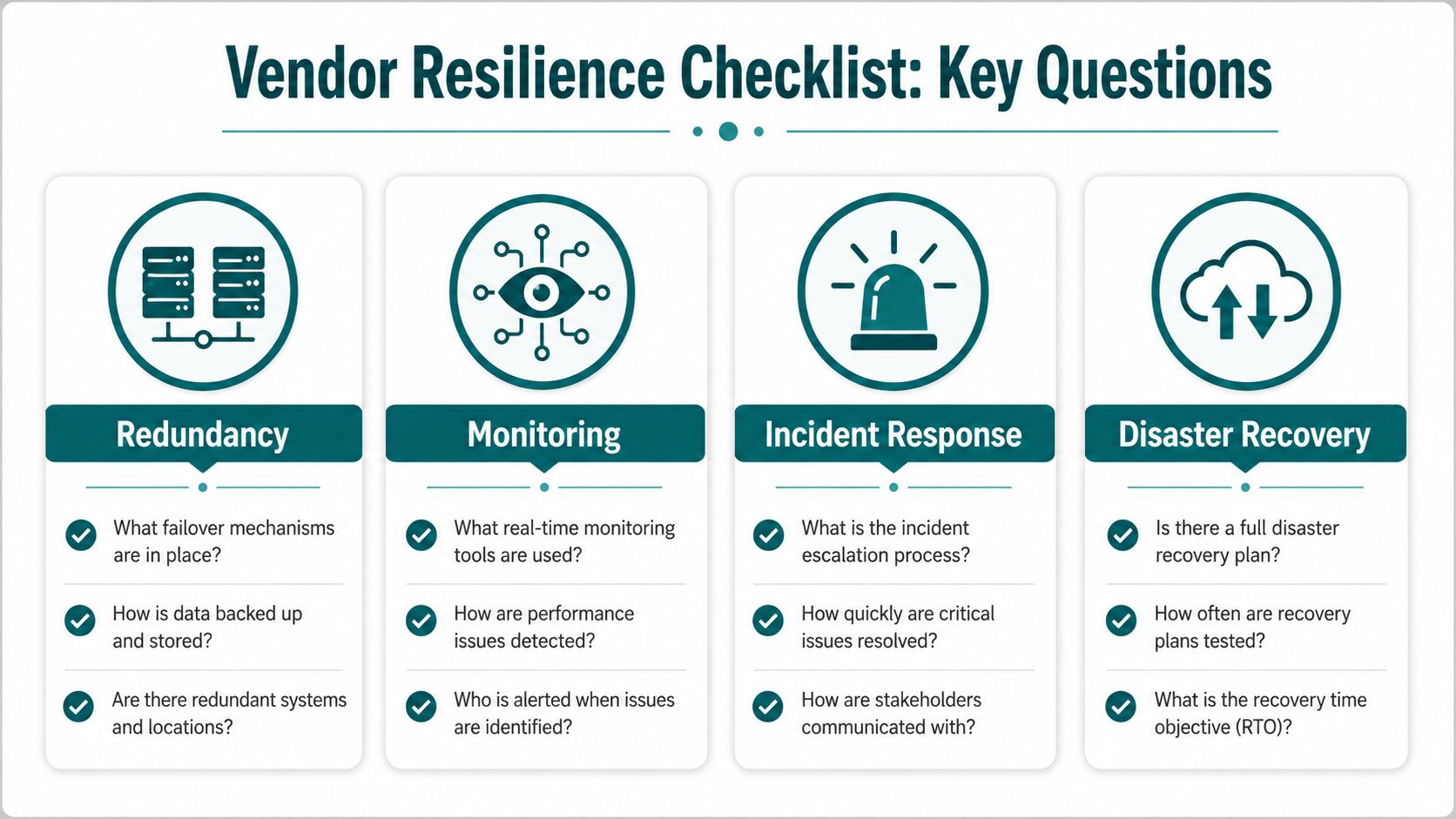
- What failover mechanisms are in place? Ask how traffic is rerouted if a primary service fails, and whether the fallback is automatic.
- How is data backed up and stored? Clarify backup frequency, recovery process, and where critical data lives.
- What real-time monitoring tools are used? You want to know how quickly the vendor sees a fault before your staff do.
- How are performance issues detected? Distinguish between full outages and degraded service, because degraded service is often where users feel pain first.
- What is the incident escalation process? Ask for named contacts, not vague promises.
- How quickly are critical issues resolved? MTTR should be explicitly addressed in the contract discussion.
- Does the SLA cover the whole user journey? If not, ask who owns local connectivity, device issues, app availability, and data sync.
A critical evaluation question is whether the guarantee measures only the vendor's service or the entire user journey. A platform can be “up” on paper but unusable if the venue network or user's device is the bottleneck (vendor SLA guidance on whole-user-journey uptime). That's the test that separates a paper SLA from an operational one.
For venue and transit teams, resilience also means planning for the failure you can't fully prevent. That's why Waymap's indoor location tracking overview is relevant to procurement conversations, because the best service design makes fewer assumptions about the local environment and the hardware around it.
One final point: don't let the vendor convert resilience into a narrow technology conversation. If the service is part of passenger guidance, accessibility, or visitor movement, the business need is continuity, not just uptime on a dashboard.
Frequently Asked Questions About Uptime Guarantees
Is a service credit enough compensation for missed uptime?
No. A service credit may reduce the next invoice, but it does not pay for staff time, visitor disruption, or the operational cost of a public-facing failure. For transit and venue operators, the primary loss is usually in the service interruption itself, not the credit that follows.
Should planned maintenance be counted in an uptime guarantee?
Only if the SLA says so. Planned maintenance should be defined separately from unplanned outages, so you know whether the availability figure reflects normal operation or includes agreed downtime windows. If that distinction is vague, the uptime number is harder to use in procurement or operations reviews.
What is the difference between availability and reliability?
Availability asks whether the service can be reached at a given time. Reliability asks whether it performs properly once people depend on it. A system can be available and still fail the user journey if it is slow, partially broken, or dependent on another service that has already gone down.
Is 99.9% uptime good enough for a public venue?
It can work for some services, but it is often too loose for mission-critical passenger guidance or accessibility workflows. A 99.9% uptime guarantee still allows about 8.76 hours of downtime per year, as noted earlier, and that can be too much if the system supports continuous public movement. In a station, campus, or arena, even short interruptions can affect wayfinding, crowd flow, and confidence in the service.
What should I ask about MTTR in an SLA?
Ask how quickly critical issues are restored, who owns escalation, and what happens if the first response does not fix the fault. MTTR matters because a service can miss only a small amount of uptime on paper and still leave you with long periods of unusable service if recovery is slow. You want the contract to show who responds, who makes decisions, and how the vendor keeps the issue moving until service is back.
Why does the whole user journey matter in an uptime guarantee?
Because the user experiences the full chain, not just the vendor's server status. If the venue network, device, or local connectivity fails, the service may be technically up and still unusable in practice. For accessibility and passenger-information systems, that gap is where procurement teams need to be most demanding.
A service-level review should always ask where the failure can occur and who owns that part of the chain. If the answer stops at the vendor's cloud platform, the guarantee is too narrow for real operations.
