
Stadium Technology Explained: Stack, Access and ROI
The UK smart-stadium market generated US$1,346.9 million in revenue in 2024, according to Grand View Research. That spending makes a practical question unavoidable: does your stadium technology help people enter, buy, find their seat and move around independently, or does it add another system for staff to maintain?
At Waymap, we judge venue technology by what happens on event day. The useful investment removes a real barrier, survives peak demand and has a named person responsible when something changes.
What Stadium Technology Includes and Why It Matters
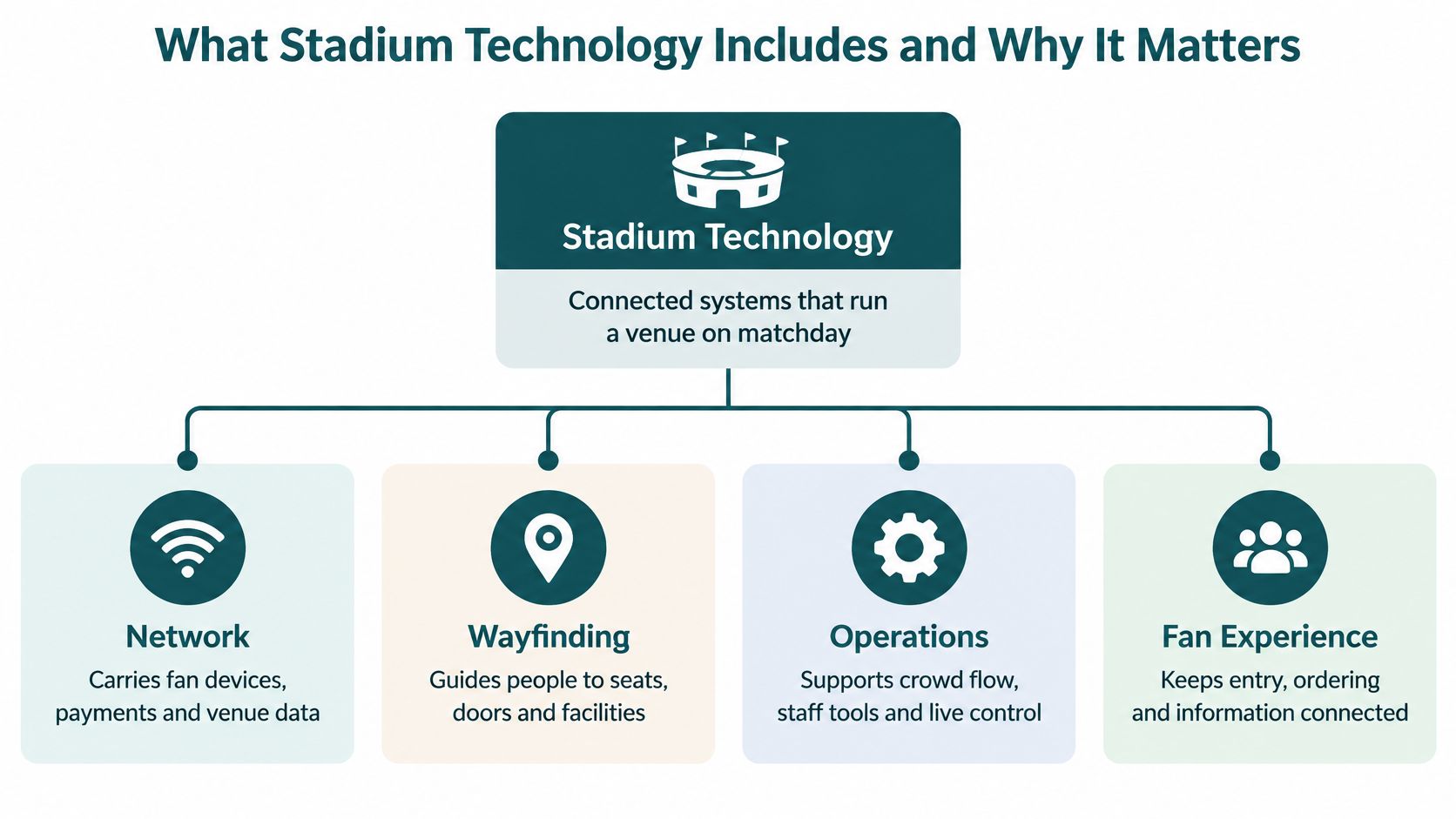
Stadium technology is the connected systems that run a venue on matchday, from the network carrying fan devices to the tools guiding people to a seat. It includes stadium connectivity, digital ticketing, cashless payments, crowd management, digital signage and indoor wayfinding. Operators should treat these as dependent services, not separate procurement categories.
The distinction matters when allocating money. A new app can't compensate for an inaccurate venue map, and another wireless access point won't resolve a broken ticketing integration.
The five layers of stadium technology
| Layer | What it does | Typical systems | Main dependency |
|---|---|---|---|
| Connectivity | Carries fan devices, staff systems and broadcast traffic | Wi-Fi, 4G and 5G coverage, distributed antenna systems, fibre backhaul | Coverage and capacity designed for peak occupancy |
| Ticketing and payments | Handles admission, cashless purchases and in-seat ordering | Mobile tickets, bank cards, mobile wallets, stadium payment cards | Reliable connectivity and non-digital alternatives |
| Crowd management | Counts people, balances gate loads and diverts flow | Entry counters, camera analytics, gate and concourse sensors | Accurate counts and a staff response plan |
| Digital signage | Shows live information and messages | Screens, LED displays, app notifications | A content update workflow that matches the venue's current state |
| Indoor navigation | Routes visitors to seats, amenities and exits | Smartphone-based wayfinding, venue maps, audio and on-screen guidance | Accurate, current venue maps |
The diagram groups these systems by their operational role.
Find the dependency before buying the feature
Consider a cashless concession purchase. The spectator presents a card or mobile wallet, the terminal communicates with the payment service, and the point-of-sale system records the sale. Without a supported fallback, a coverage gap can stop the transaction even though the terminal appears operational.
For network procurement, stadium WiFi solutions from Purple Access provide a useful category reference. Evaluate that network layer separately from the applications it will carry, then test the complete transaction rather than accepting individual component demonstrations.
Different services also need different failure tolerances. A delayed promotional screen update isn't equivalent to stale directions to an unavailable lift. Operational signage requires stricter handling than advertising content.
Our stadiums and sports venues overview offers context for the navigation part of this stack. The investment decision comes down to which dependency needs funding first, whether accessibility improves in practice, and how the operator will establish a credible return.
How Connectivity, Payments and Crowd Flow Depend on Each Other
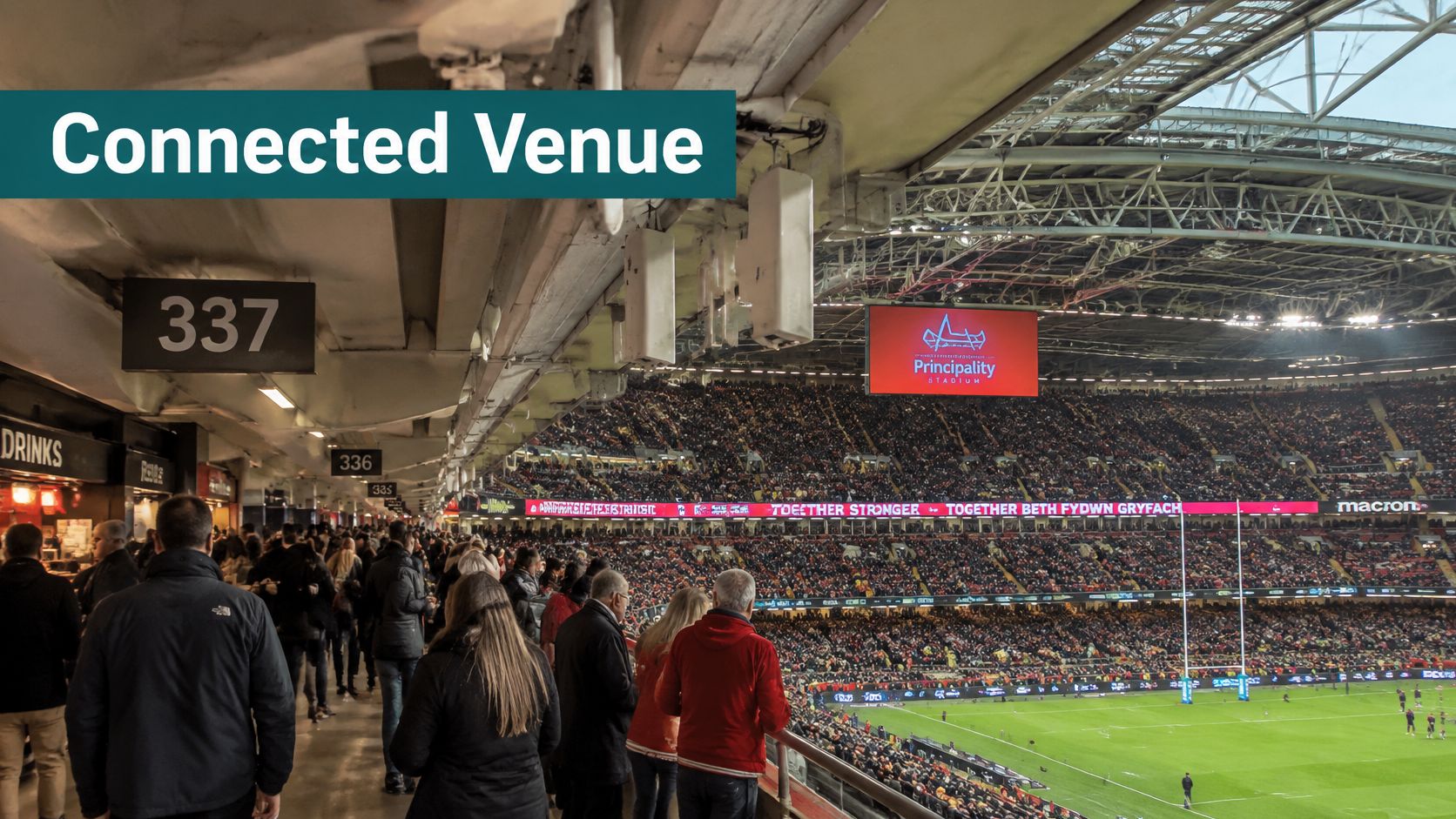
Principality Stadium in Cardiff shows the physical scale behind digital services: its 74,000-seat venue required radio equipment equivalent to ten mobile masts and approximately 30 kilometres of fibre-optic cabling, according to VodafoneThree's account of stadium connectivity. Antennas positioned throughout the stadium connect the venue to Vodafone UK's network and the wider internet.
That isn't occasional event coverage. It's permanent infrastructure supporting digital tickets, purchases, venue information, operational communications and location-based assistance.
The stadium's footprint helps explain why ordinary building coverage isn't an adequate benchmark.
Test capacity where spectators actually gather
Model the bowl, concourses, hospitality spaces and entry and exit routes as separate high-density cells. Test transaction completion and application responsiveness during representative occupancy, not just signal strength in an empty building.
A Broadcom response to Ofcom's spectrum consultation states that stadiums typically require 14–26 non-overlapping Wi-Fi channels to limit co-channel interference at expected device densities. More visible access points don't automatically mean more usable capacity.
Apply these acceptance checks:
- Peak occupancy: Can operational services complete their tasks when spectators are uploading, streaming and messaging?
- Degraded service: What remains usable when connections slow or disappear?
- Recovery: Do maps, points of interest and service updates synchronise correctly when connectivity returns?
Cashless operation changes the failure model
Tottenham Hotspur Stadium, with capacity exceeding 62,000, is described as the world's first fully cashless stadium in FC Business's account of its connected fan experience. It uses bank cards, Apple Pay, Google Pay and stadium-issued payment cards, including prepaid and gift-card formats.
Operators can reduce physical cash handling and make purchasing more traceable. Faster purchasing is a potential benefit, not a substitute for testing queues and payment completion.
Set the operational risks beside those benefits:
- Connectivity dependence: Confirm terminal behaviour when a payment connection fails.
- Peak-demand failure: Test the busiest purchase period, not a quiet hospitality demonstration.
- Payment exclusion: Provide an assisted alternative for visitors who can't use mainstream digital payment methods.
Crowd management adds a coordination problem. If a gate closes, the control room must align physical signs, app messages and steward instructions before diverting visitors. A count or camera alert is useful only when someone has authority to act.
Keep optional fan marketing separate from essential services. Purple Engage's fan marketing data collection checklist is a useful prompt for reviewing collection purposes and permissions without making marketing participation a condition of basic venue access.
How Indoor Navigation Guides Fans to Exact Doors and Seats
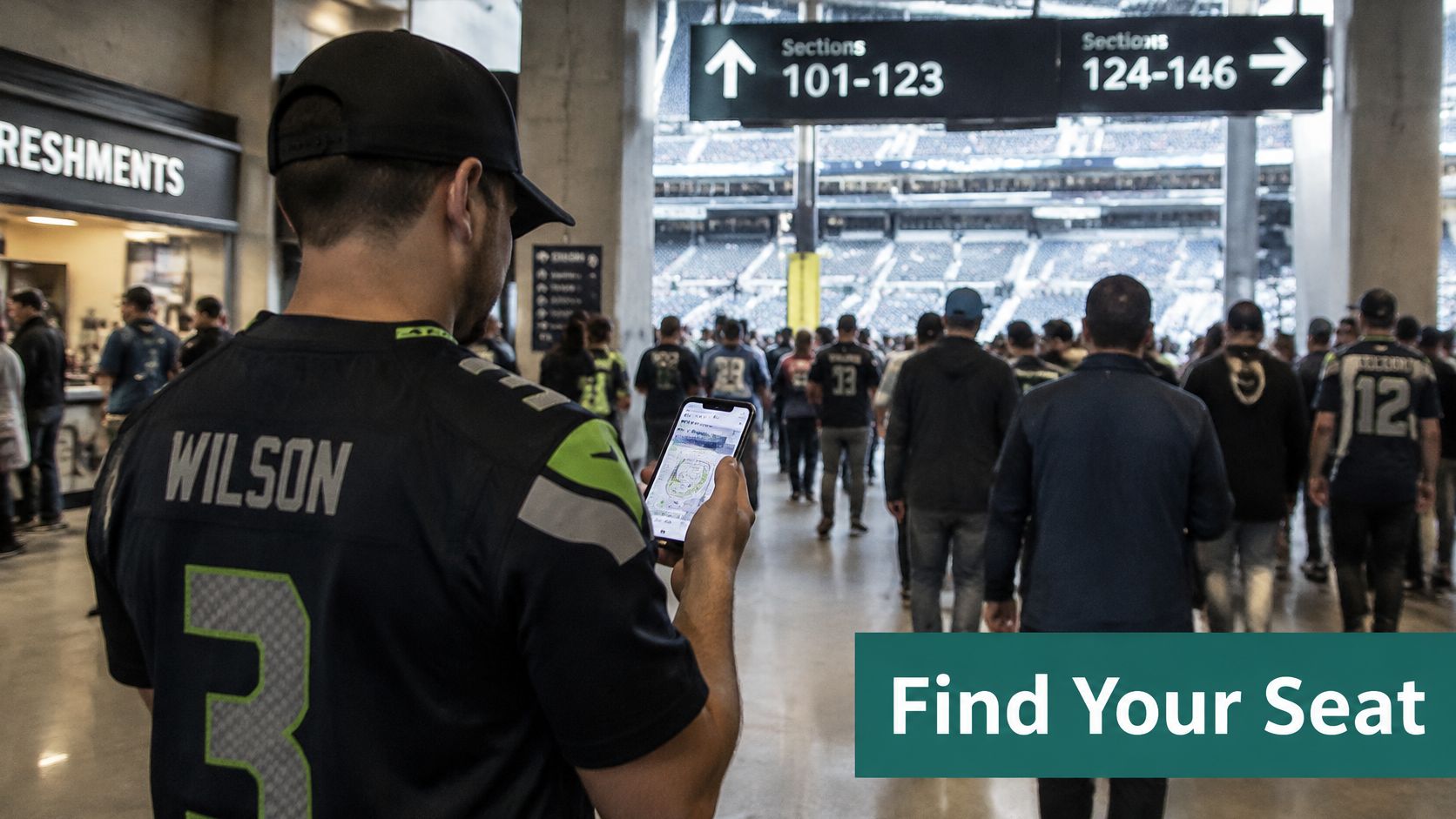
Indoor navigation needs a positioning method suited to the building, not an assumption that outdoor GPS will continue working inside. Satellite reception can be obstructed, and a busy wireless network shouldn't become a prerequisite for knowing which corridor to take.
The practical destination is also more precise than a stadium postcode. A spectator needs the appropriate entrance, the correct level and a route to an allocated seat or facility.
How sensor-based positioning becomes a usable route
Waymap's proprietary algorithm fuses smartphone motion sensors with a detailed venue map, without relying on GPS, Wi-Fi, Bluetooth or installed beacons. Our team combines venue plans with movement patterns to create a navigation model, then calibrates positioning to the environment after processing its data.
The distinction is important: infrastructure-free positioning doesn't mean map-free navigation. Reliable plans still need entrances, floor connections, destinations and route restrictions represented correctly.
At Lord's Cricket Ground, which became the first stadium in the world to implement Waymap in 2025, visitors can be guided to the most appropriate entrance for their seating location, then to their specific seat, concession stands, accessible toilets, bars and exits. Full journey routing connects locations anywhere within the M25 with step-by-step guidance inside the ground.
These are defined deployment capabilities, not a claim that attendance, spending or independence improved by a measured amount. Our digital wayfinding system article provides further context for evaluating this approach.
The following video provides another view of digital wayfinding.
Why exact facility locations matter
The SGSA Accessible Stadia supplementary guidance says an accessible toilet should be within 40 metres of any amenity or easy-access seating, with one accessible toilet for every 15 disabled spectator seats. It also calls for a choice of accessible viewing areas and provision for companions to sit alongside spectators using amenity or easy-access seating.
A generic toilet icon doesn't establish that the facility is suitable or reachable. The navigation map should distinguish the exact accessible facility and its usable approach.
Practical rule: Validate the route to the facility, not just the pin marking its location.
When an amenity closes, withdraw the affected destination or redirect users to a verified alternative. Keep printed plans and staff assistance available too. A precise digital route is valuable, but it can't make an unavailable destination usable.
Which Accessibility Gains Technology Can and Cannot Deliver
In the 2025 UK Annual Fan Survey, only 13% of respondents identified stadium technology as an accessibility provision, compared with 51.5% for accessible toilets, 43% for easy-access seating and 40% for accessibility stewards; among disabled fans who would benefit from accessible parking, 76% rated it very or extremely important to their matchday experience.
That ordering exposes a weak feature-led case. Digital information can remove uncertainty before and during the event, but it cannot substitute for an open gate, a working lift, a toilet that meets the venue plan or a steward who knows what to say.
What technology can and cannot do at each stage of the accessible journey
| Journey stage | What technology can do | What still needs staff or physical access |
|---|---|---|
| Planning before arrival | Publishes routes, entrance choice and closure notes before travel | Accessible transport, parking and drop-off details the operator controls |
| Arrival and entry | Sends each visitor to the gate that fits the seat | An entrance that is open, staffed and usable |
| Movement inside the venue | Keeps guidance on step-free paths | Lifts working and routes kept clear |
| Finding facilities | Pinpoints accessible toilets, bars and concessions | Facilities built and maintained to the venue plan |
| Event-day changes | Reflects a concourse closure in the route | Stewards who can confirm the change face to face |
| Sight-loss support | Gives heads-up audio instructions matched to the person's movement | Steward awareness, audio description and programmes in usable formats |
Test independence rather than app adoption
A reasonable-adjustments test is practical: did the barrier shrink for a real visitor on a busy day? An app download does not show that someone reached their seat with more confidence, or that staff intervention stopped being necessary.
The RNIB's guidance for spectators with sight loss, developed through work with English Premier League and English Football League clubs, identifies five elements: belonging, sight-loss awareness training for stewards, effective audio description and commentary, an accessible physical environment, and accessible matchday programmes.
Turn those principles into event-day checks:
- Independence: Record whether visitors complete their intended journey with their preferred level of assistance.
- Confidence: Ask where uncertainty remains: entrances, floor changes and route decisions.
- Reliability: Log unavailable facilities, incorrect instructions and abandoned routes.
- Operational effect: Track missed starts and the staff time required to resolve wayfinding problems.
Our accessibility features guidance can help teams frame those checks around tasks visitors attempt, not interface features.
At Birmingham New Street, testing among diverse user groups showed strong user satisfaction, with particularly positive responses from users with visual impairments who reported increased confidence moving through the station independently. It supports the approach without supplying a stadium outcome or a numerical guarantee.
A useful accessibility improvement gives visitors more choice about assistance. It still leaves the option to ask a person for help.
Waymap was founded by Dr. Tom Pey. The company's focus is independent navigation alongside accessible facilities and trained staff, because event-day access succeeds only when the digital route and the physical venue agree.
How to Judge Vendor Integration and Ownership
Who maintains the venue's digital map and validates directions on event day? Answer that before comparing demonstrations. A supplier can deliver convincing guidance while leaving the operator without a workable process for changing it.
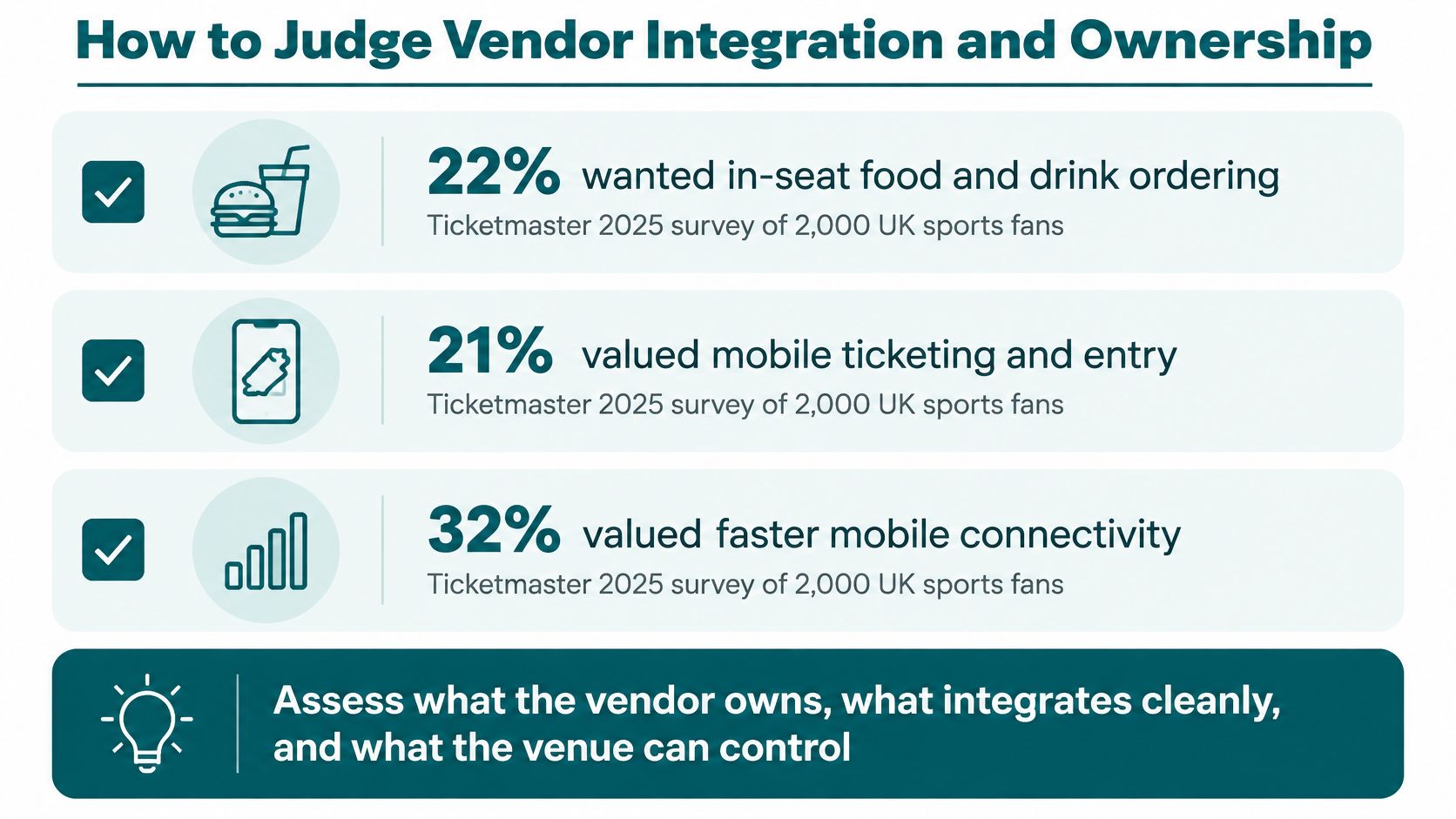
Ticketmaster's 2025 survey of 2,000 UK sports fans found that 22% wanted in-seat food-and-drink ordering, 21% valued mobile ticketing and entry, and 32% valued faster mobile connectivity. Those preferences establish demand for convenience, not evidence that a service remains dependable during disruption.
The distinction belongs in procurement discussions.
Put operational control in the contract
Take this checklist into the procurement meeting:
- Named map owner: Assign an operator role and a deputy responsible for approving changes.
- Update lead time: Specify when an approved change must appear across affected channels.
- Integration boundaries: Document interfaces with ticketing, point-of-sale and content systems, including failure ownership.
- Degraded mode: Demonstrate what critical directions remain available without a live connection.
- Data rights: Define ownership, permitted processing, retention, export and deletion.
- Accessibility acceptance: Include disabled users in task-based testing before go-live.
- Incident management: Rehearse closures, escalation and the withdrawal of incorrect instructions.
- Route-accuracy target: Define a testable service level, including what counts as a wrong or stale route.
Our vendor selection criteria support this kind of operational assessment. Require evidence from the proposed configuration, not an unrelated reference deployment.
Fit the system into the accessibility plan
The Sports Grounds Safety Authority's accessibility guidance expects access planning to address ticketing, transport, parking, staff and steward training, entry and exit, amenities, viewing accommodation, signage, printed information and hearing loops. It also says venues should conduct an access audit before hosting an event.
Use that plan to identify who supplies each piece of information. Estates may own lift status, ticketing may own entrance allocation, and event control may approve a temporary closure. The map owner needs an agreed update path from each.
Capital approval cycles and hardware maintenance make infrastructure-free approaches attractive, but those approaches still need operational ownership. Removing beacons doesn't remove responsibility for the map.
We help venues choose a tier and format that fits their budget and timeline. Where reliable plans exist, further mapping is often unnecessary, but drawing quality and venue complexity should determine the delivery scope rather than a generic installation promise.
Measure ROI and Decide Which Layer to Fund First
Fund the layer whose failure would stop entry, payment or a usable route first. Then prioritise the improvement with the strongest measurable benefit. A discretionary fan experience shouldn't take precedence over a persistent access or transaction failure.
Set targets before buying, using records the venue already holds. Supplier dashboards can support evaluation, but the baseline should remain accessible to the operator.
ROI measures for stadium technology
| Metric | How to measure it | Source of baseline |
|---|---|---|
| Missed-start rate | Share of visitors arriving after kick-off, by seating zone | Ticketing and entry scan data |
| Steward time on route questions | Logged wayfinding enquiries per matchday, with handling duration | Staff rota and incident logs |
| Route accuracy | Reported wrong or stale directions per event | Map change log and visitor feedback |
| Cashless transaction share | Share of concession and merchandise sales by payment type | Point-of-sale data |
| Accessible facility use | Use of accessible toilets and viewing areas at peak times | Steward counts and sensor data |
| Map update lead time | Hours between a venue change and updated directions | Change control records |
Make the baseline fit the claim
Entry scans show arrival at the gate, not arrival at the seat. If the intended outcome is fewer spectators missing kick-off, supplement scan data with seating-zone observations or voluntary feedback.
Similarly, enquiry counts aren't the same as staff time. Log handling duration before claiming labour savings, and distinguish time reassigned to visitor support from actual expenditure reductions.
Follow a controlled rollout:
- Record a matchday baseline: Capture the proposed metrics before changing the service.
- Pilot a defined zone: Use a concourse or entrance area with clear operational ownership.
- Compare similar events: Account for attendance, staffing, visitor mix and event format.
- Extend after acceptance: Resolve incorrect routes and update failures before widening coverage.
Our guide to measuring cost savings provides a starting point for structuring the financial case.
Separate commercial returns from accessibility outcomes
Measure concession spend and dwell time as commercial outcomes, not proof of accessibility. Cashless share describes payment mix, while facility-use counts need context: lower use might reflect reduced attendance or a barrier rather than better provision.
For ESG reporting, full-journey routing at Lord's can support sustainable transport choices, but routing availability alone doesn't prove lower emissions. Use observed travel-mode changes before claiming an environmental result.
Once a venue is live, navigation is free for every visitor through the Waymap app, the venue's branded app or the web. Put the venue's agreed deployment and operating costs into the business case, rather than assuming visitor charges will recover them.
Investment test: Approve the pilot against an outcome and a total operating cost, not a feature count.
Start scoping with existing drawings, the event calendar and the owner checklist. That makes the investment discussion specific enough to identify both the cheapest useful fix and the work that can't be deferred.
Stadium Technology Questions Answered
What is stadium technology?
Stadium technology is the connected systems used to operate a venue and support the spectator journey. It covers connectivity, admission, purchasing, crowd management, information displays and indoor navigation. The important procurement boundary is the complete service, not just the device or app a visitor sees.
Which stadium technology layer should a venue fund first?
Fund the layer whose failure blocks an essential matchday task. Investigate the actual bottleneck before purchasing an upgrade. Poor entry performance, for example, may come from ticket validation or operating procedures rather than insufficient wireless coverage.
Does stadium technology improve accessibility for disabled spectators?
It can, when testing demonstrates that it removes a real journey barrier. Digital information should complement accessible facilities and human assistance. Evaluate task completion with disabled spectators rather than assuming that more features mean better access.
What does SGSA guidance say about accessible toilets?
Accessible toilets should meet the proximity and provision guidance for amenity and easy-access seating. Operators also need to verify that each mapped facility is open, correctly identified and reachable by the route presented. A compliant location on a drawing doesn't establish current availability.
Does indoor navigation work without GPS or Wi-Fi?
Yes, sensor-based indoor positioning can operate without those signals. Positioning and live information updates are different functions, however. Procurement testing should establish how stored maps behave and how changed venue information reaches visitors.
Who should own the venue's digital map?
A named operator owner should be accountable for the digital map. Suppliers can process updates, but venue staff must authorise operational changes. Give the owner a deputy, an escalation route and contractual control over update timing.
How do you measure return on stadium technology?
Compare operational and visitor outcomes with a recorded matchday baseline. Include the cost of integration, staff training, support and ongoing map maintenance. Separate demonstrable savings from potential revenue benefits, and don't attribute every change in spending or satisfaction to the technology.
Waymap helps stadium operators turn venue plans into precise navigation, with event-day ownership and accessible journeys built into the scoping discussion. Visit Waymap to discuss your existing drawings, priority routes and timeline, and define a pilot with measurable acceptance criteria.
