
Proptech Explained: Market, Uses and ROI for Operators

Approximately £1.6 billion was invested in UK PropTech firms in 2021, more than 15 times the 2016 amount. The UK Government's Local Digital programme cited that figure while describing the sector as building “significant momentum” in its industry survey. The money didn't go into one app category. It tracked software and data applied across buildings, sites and the way people use them.
Momentum isn't a business case. A control system that never shows up on the meter, or a map that never gets someone to the right lift, hasn't earned its place in the budget. Proptech only pays when you can measure what changed: energy, escort time, signage cost, or whether people arrive on their own.
What Proptech Means and What It Covers
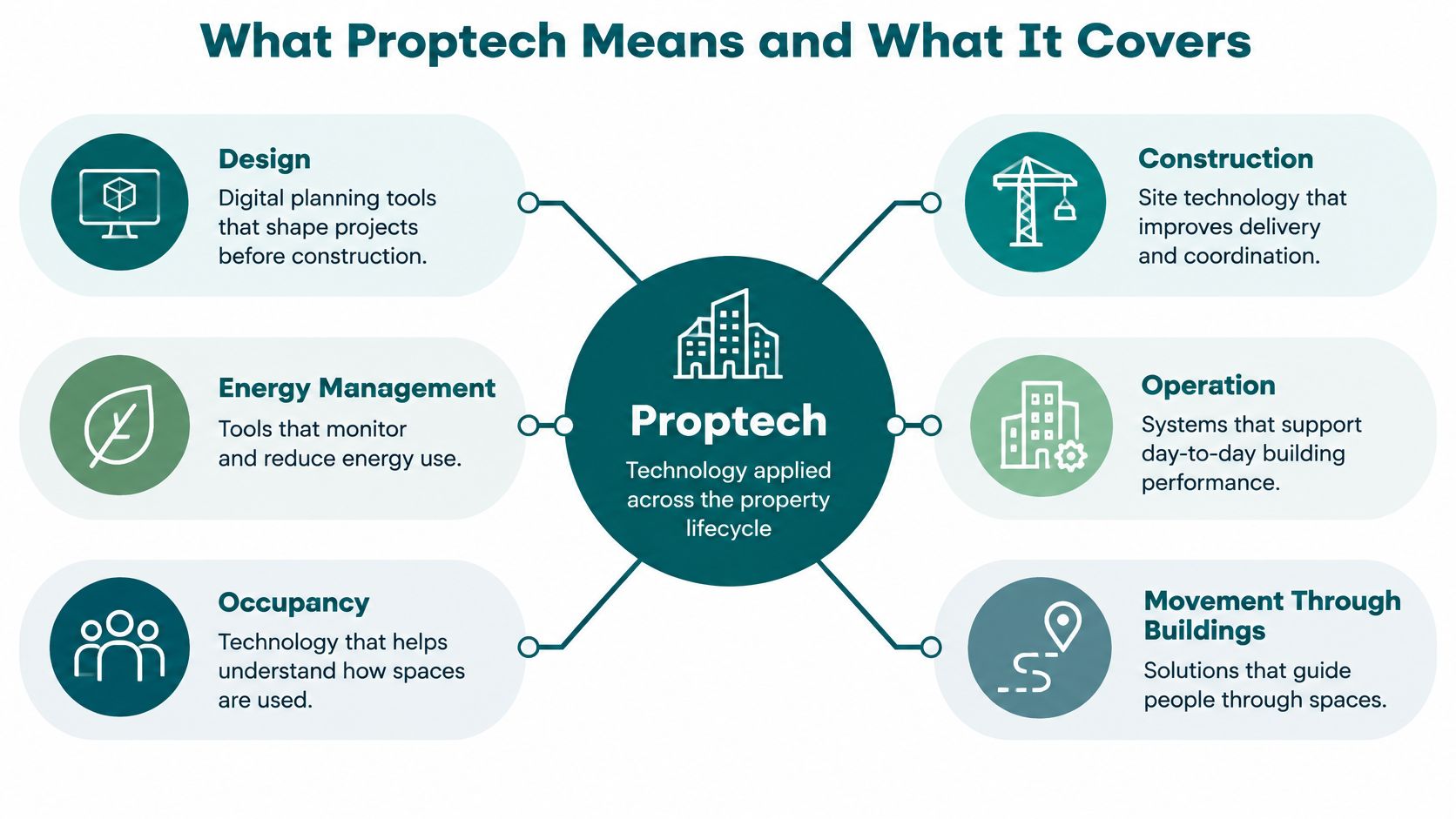
Proptech is technology applied across the property lifecycle: design, construction, operation, energy management, occupancy and the way people move through buildings. The term covers software, sensors, data platforms and digital services. It isn't one product.
In January 2025, a report co-produced by the UK PropTech Association and PUBLIC set a formal evidence base for the sector. It moved the field from a loose label toward a standard definition and taxonomy, and it treated public bodies, transport operators, campuses and large venues as buyers alongside residential agents.
Who buys which layer
| Category | What it does | Typical buyer |
|---|---|---|
| Smart building controls | Automate lighting, HVAC and occupancy responses | Facilities and estates teams |
| Energy management (BEMS) | Monitor and optimise energy use and HVAC loads | Estates managers and building owners |
| Digital twins | Combine 3D/BIM models with live asset and occupancy data | Operators of large sites and infrastructure owners |
| Property management software | Handle leases, maintenance requests and tenant records | Landlords and managing agents |
| Construction technology | Plan, build and track projects with digital tools | Developers and contractors |
| Wayfinding and navigation | Guide visitors to exact entrances, lifts, platforms and exits | Transit operators, venues, campuses and healthcare sites |
The common misreading is that proptech means residential estate-agency software. Lettings tools are one row of the table. Transit operators, hospitals, universities and venue managers buy the rest because they run physical assets every day.
A tool counts as proptech when it manages, measures or moves people through a physical asset using data. The practical test is output, not category membership: does it change energy consumption, staff escort time, signage maintenance cost or the share of visitors who arrive on their own? Each row of the table produces at least one of those measures.
Waymap sits in the last row. Its navigation engine runs on smartphone inertial sensors and AI algorithms rather than GPS, Wi-Fi or installed beacons, and it reroutes in real time around works or faults in lifts and escalators. Dr Tom Pey founded Waymap in 2018 and serves as its President.
How Big Is the UK Proptech Market?
The UK market is large enough to matter, but belief still runs ahead of budget. For a budget paper, the useful signal is not a headline market size; it is the gap between stated confidence and released capital.
| Indicator | Figure | Year | Source |
|---|---|---|---|
| UK PropTech investment | Rose sharply from 2016 levels | 2021 | UK Government Local Digital programme |
| Developers reporting a funding or technology budget constraint | A substantial minority | 2025 | Landmark |
| Property professionals agreeing proptech investment is worthwhile | 85.5% | 2024 | PayProp Rental Confidence Index |
In 2024, 85.5% of UK property professionals surveyed for PayProp's Rental Confidence Index agreed that investing in proptech was worthwhile. That enthusiasm still collides with procurement reality. Landmark's 2025 developer survey points to funding and dedicated technology budgets as common brakes, which helps explain why pilots are easier to approve than portfolio rollouts.
Market context should be framed the same way. Teams weighing a station, campus or retail scheme can access Zoopla listing data for a current read on how nearby space is marketed, then decide whether a digital layer sits in the same investment case as the asset or in an operations budget.
The stronger test is operational: count independent arrivals, staff escort time and signage maintenance cost, plus three baseline measures chosen before the pilot, all inside one pilot window. If those six measures do not move, novelty is not a business case.
Practical rule: Treat novelty as a reason to pilot, and measured return as the only reason to roll out.
How Do Smart Buildings Cut Energy Use With Proptech?
A building energy management system (BEMS) is the control layer, not a dashboard. It watches energy use and adjusts lighting, electrical loads and heating, ventilation and air-conditioning (HVAC). Conditions, plant performance and set-points inform each other in a loop. If a zone is empty, the system should ease the load. If a valve sticks, the meter should show it.
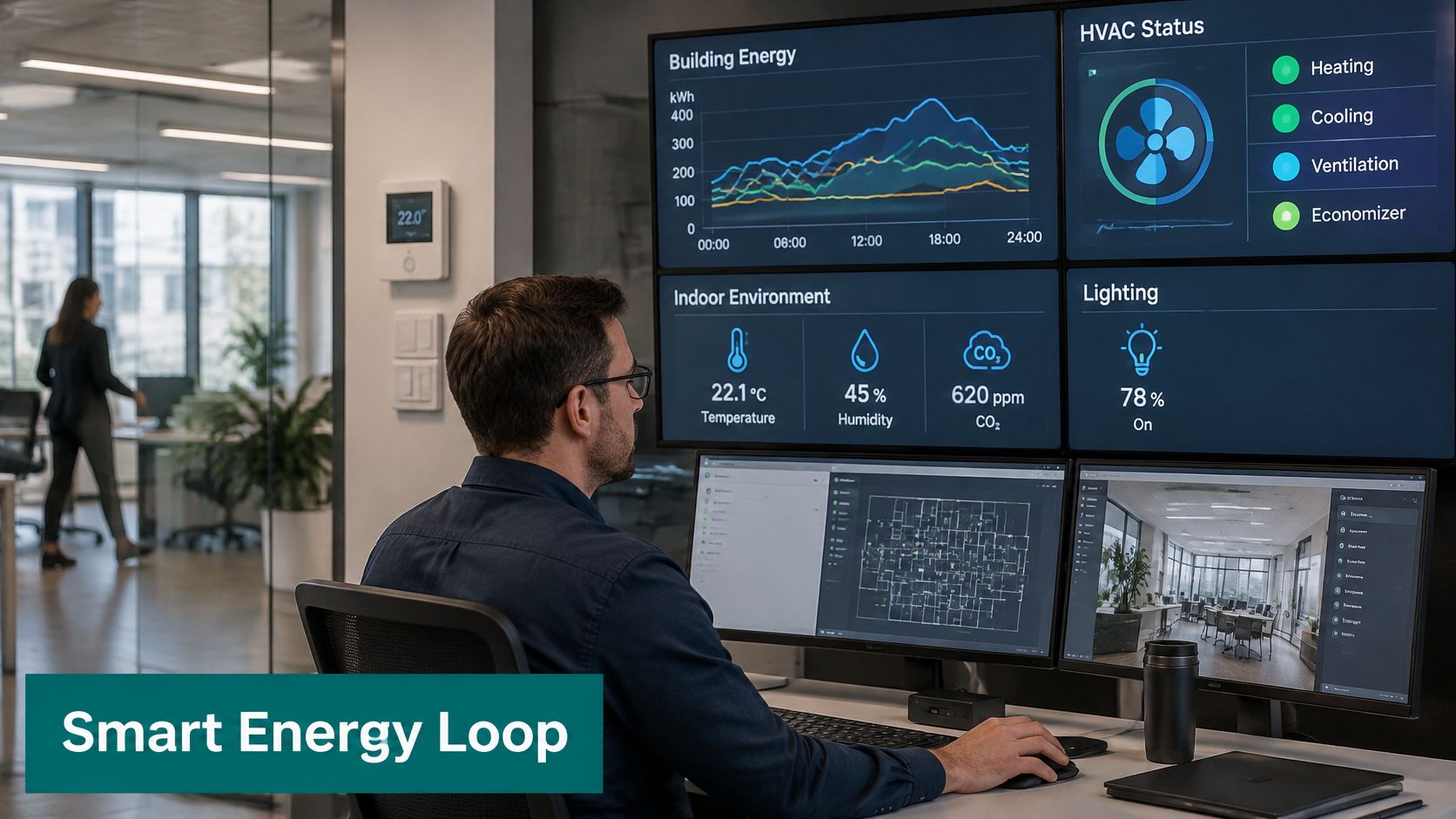
Evidence submitted to the UK Parliament indicates that an extensive intelligent BEMS can deliver up to 30% energy and carbon savings in non-domestic buildings. The same evidence estimates that mandating Class B advanced BEMS across UK non-domestic buildings could save £13.4 billion in energy bills between 2025 and 2030. That figure is an estimate, not a result your site has already banked. Studies cited in the submission report average power and energy reductions of 34.78% in smart buildings, which is a study average, not your baseline.
A digital twin sits beside that loop. As a UK built-environment briefing describes them, twins are data-rich applications of IoT that join 3D or BIM geometry to live asset and occupancy data. Operators can watch parking, desk use, ventilation, fire-alarm status and defects, and test a change before they make it on site. The twin is only as good as the model, the asset IDs and the feeds.
Five tests before you trust a saving
- Sensor coverage: Are all zones metered, or only the plant room?
- Interoperability: Do HVAC and lighting controls take the instruction?
- Data latency: How often do readings update?
- Commissioning quality: Were controls tuned after installation, not only at handover?
- Measurement and verification: Is consumption compared with a baseline from before the change?
Up to 30% is a ceiling in the evidence, not a promise. Your own meters decide the result. For how sensors and controls fit a wider building stack, see our note on the Internet of Things in smart buildings.
Does Proptech Wayfinding Help Meet Accessibility Duties?
A station can be step-free and still fail the passenger who can't find the lift, the platform or the exit. A published map or a static sign doesn't update when a lift is out, a route is closed or the boarding point is unclear.
| Measure | Figure | Source |
|---|---|---|
| Disabled people's journeys compared with non-disabled people | 38% fewer | National Centre for Accessible Transport |
| Disabled adults' trips in England compared with non-disabled adults (2023) | 25% fewer | Department for Transport |
| Disabled people's rail trips compared with non-disabled people | 53% fewer | UK Government accessible railways roadmap |
| Rail stations with good step-free access | 1,481 stations (56%) | UK Government accessible railways roadmap |
| Rail journeys reaching step-free platforms | Approximately 66% of 1.3 billion journeys | UK Government accessible railways roadmap |
The government's accessible railways roadmap reports that 1,481 stations (56%) offer a good level of step-free access under the A or B1 classifications, while about 66% of 1.3 billion journeys reach step-free platforms because volumes sit at larger stations. The same roadmap says disabled people take up to 25% fewer trips than non-disabled people, and 53% fewer by rail. In England in 2023, disabled adults made 25% fewer trips overall. Someone who arrives by car can still be lost inside a campus, stadium or shopping centre.
What the duty actually requires
Under the Equality Act 2010, where a policy, a physical feature or a missing auxiliary aid puts a disabled person at a substantial disadvantage, the organisation must take reasonable steps to avoid it. The duty follows the visitor's route, not only the building fabric. BS 8300 and BS EN 17210 govern physical design. They don't tell a visitor which lift is working this afternoon.
Live navigation is an auxiliary aid. It sits beside ramps, lifts, tactile signs and staff help. It doesn't replace them, and it can't repair an inaccessible layout. What to measure is whether disabled visitors arrive independently, and how fast a reported failure is fixed. Our guide to accessibility requirements sets that duty next to day-to-day operations.
Step-free infrastructure answers whether a route exists. Wayfinding answers whether a person can use it today.
What Do Waymap's Lord's, Hospital and CapMetro Deployments Show?
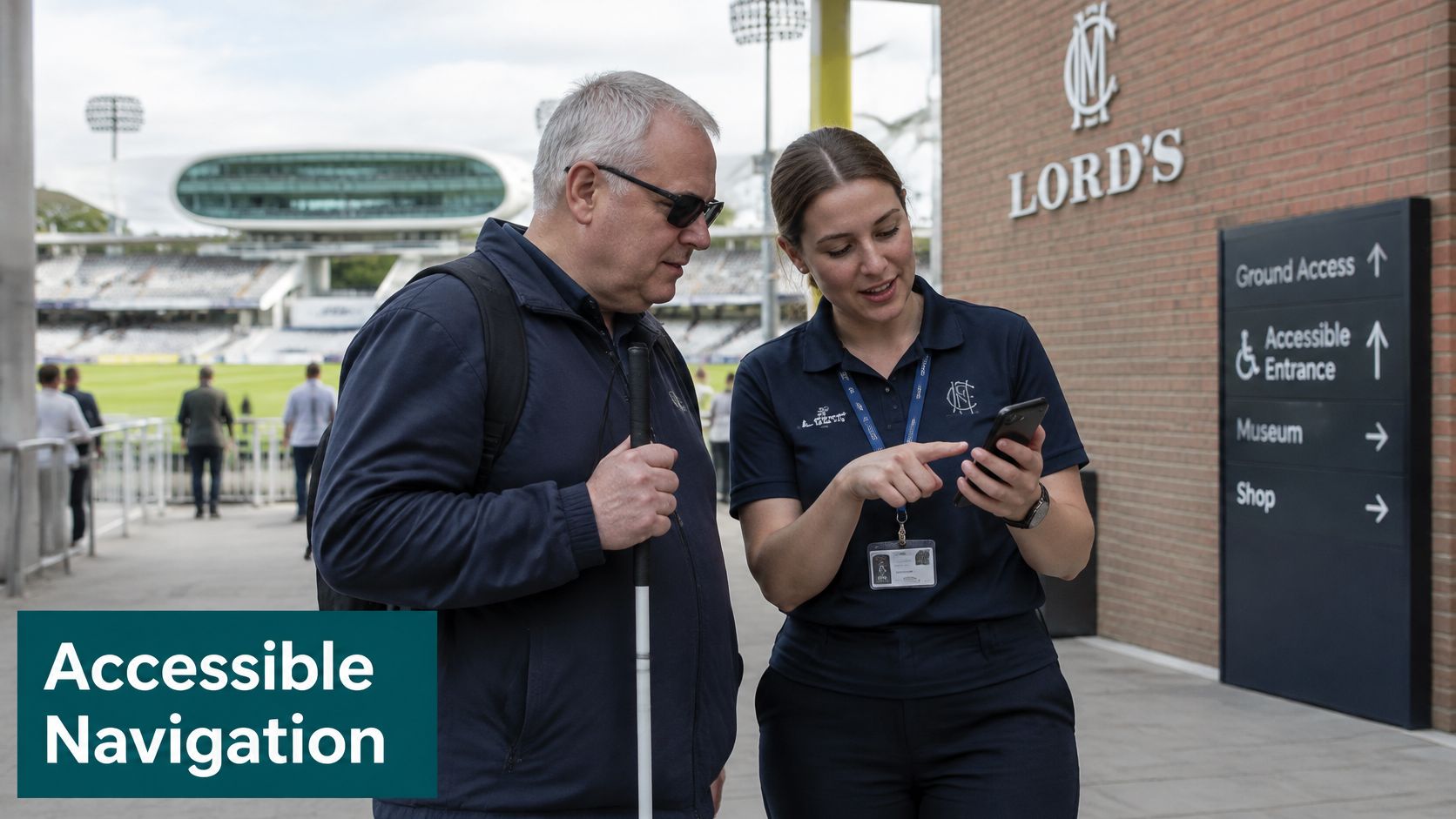
Two sites, two constraints. Neither is a claim that every visitor outcome is already published, which matters when a buyer weighs launch announcements against evidence.
The Royal Hospital for Children and Young People in Edinburgh is, as NHS Lothian confirms, the first hospital in the world to deploy this category of personal navigation. Before the app went live, Waymap's team scanned the interior with a LiDAR scanner and produced a three-dimensional digital twin of the building. The scan creates the map. The positioning itself is dead reckoning from the phone's inertial sensors, with AI estimating step length and direction of travel in real time, so guidance holds without GPS, Wi-Fi or installed beacons. When a lift, escalator or area goes out of service, routing recalculates around the fault automatically. A consultant at NHS Lothian said the technology is designed with accessibility at its heart, not added on later.
STV News broadcast a segment on the launch on 13 February 2026, showing a family using the app inside the hospital.
CapMetro in Austin deployed the same engine across a transit network, with step-free routing and personalised navigation settings, and guidance that extends from a rider's home to the stop with real-time updates. During the deployment, CapMetro's internal teams used operational insights from usage data to support planning for transport and pedestrian flow. The CapMetro deployment case study is the public record of that work.
Dr Tom Pey founded Waymap in 2018, working with mathematicians and technologists on a blunt test: instructions must stay accurate when the building changes and no signal is available. Guidance that cannot be trusted at the next junction adds anxiety instead of removing it, which is why the system was built for blind and low-vision users first.
Taken together, the two deployments show that one positioning engine runs in a hospital and a transit network with no installed hardware. What they do not yet show is harder evidence. Independent arrival rates, escort-time reductions and signage savings are not published for either site. Those numbers come from the operator's own pilot baseline, a separate exercise from a launch announcement.
How Do You Measure Proptech ROI Before Rolling Out?
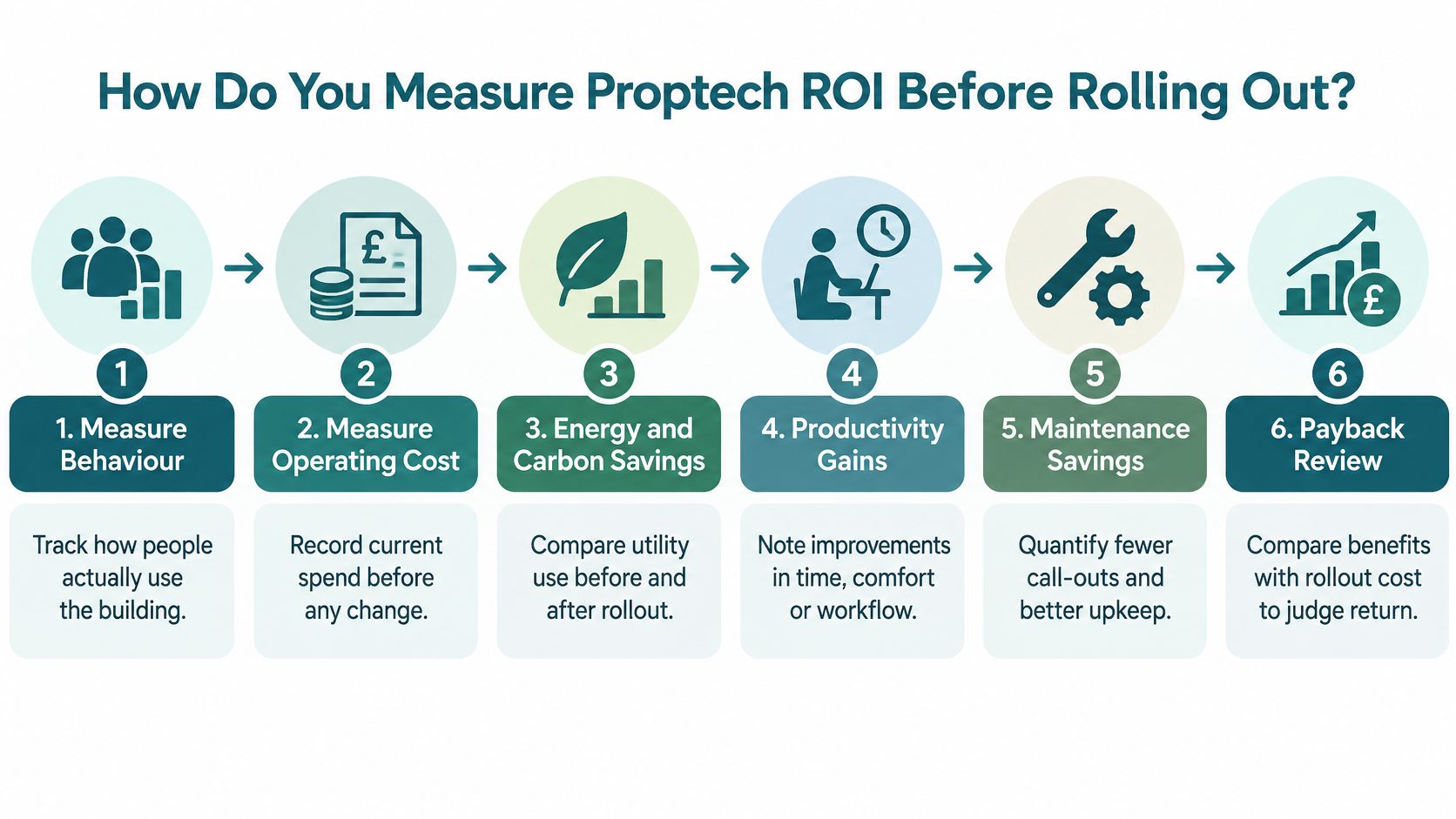
The useful business case tracks behaviour and operating cost. It doesn't stop at “we deployed a smart system”. Capture a baseline before launch, then read the same six measures at the end of a fixed window.
| Measure | How to capture it | Likely owner |
|---|---|---|
| Energy and carbon savings | Metered consumption before and after commissioning | Estates team |
| Staff escort requests | Helpdesk and staff logs compared across the pilot window | Operations |
| Signage maintenance cost | Work orders and replacement spend per site | Facilities |
| Response time to accessibility failures | Incident log from report to fix | Accessibility lead |
| Visitor satisfaction by access need | Post-visit survey split by access need | Customer experience |
| Missed connections | Timetable performance and passenger data | Transport operations |
A pilot you can finish
- The venue shares CAD drawings or floor plans with us.
- Pick one site, zone or route.
- Record baselines for the six measures.
- Agree a fixed pilot window and a reporting cadence.
- Review feedback from disabled users next to the operational logs.
- Decide whether to extend, with cost set against the measured gains.
The friction differs by buyer. NHS estates managers face capital controls and approval cycles that make fixed beacon hardware hard to justify. Transport operators carry the cost of maintaining physical kit in high-footfall sites that change often. Retailers need a revenue and dwell-time case, not only a compliance file.
In 2025, 47% of UK developers surveyed by Landmark said a lack of funding or a dedicated technology budget constrained data and technology adoption. A bounded pilot with six baselines is easier to fund than an open-ended estate programme. For how to turn those logs into a saving, see how to measure cost savings.
Which Proptech Project Should You Start With?
Start with the problem that carries a measurable cost.
If energy spend is the pressure, begin with a building energy management system and let the meter judge commissioning quality. If visitors cannot find the right entrance, lift, platform or exit, begin with wayfinding on one route and count independent arrivals. If the estate changes often and asset data is stale, begin with a digital twin built from an accurate model rather than a slide deck.
Then check four things before you buy: a problem with a baseline, data someone will keep current, a route into the systems you already run, and a named owner for accessibility information and its updates. One accountable person keeps those updates live; a shared inbox tends to let them slip.
Waymap comes in two tiers, Core and Pro, both available as an app, an SDK integration or a web app. Pro suits complex multi-level sites: it adds camera-based positioning and a LiDAR scan of the venue, and routes update in real time around out-of-service lifts, escalators and works. The delivery process is the same either way: understand the constraint, design the solution, run it, then measure results and feedback. A vendor selection checklist helps you test any supplier against those points before you sign.
This month, send floor plans or CAD drawings to the Waymap team, name one pilot site and the six measures, and put a review date in the diary.
Frequently Asked Questions About Proptech
What is proptech?
Proptech is technology applied across the property lifecycle, including design, construction, operation, energy management and how people move through buildings. It is a set of tools and data services, not a single product.
How big is the UK proptech market?
About £1.6 billion was invested in UK PropTech firms in 2021, more than 15 times the amount invested in 2016. Many buyers still pilot rather than roll out, because funding and a dedicated technology budget are the constraint.
Does a building energy management system save energy?
An extensive intelligent BEMS can deliver up to 30% energy and carbon savings in non-domestic buildings, according to evidence submitted to the UK Parliament. Actual savings depend on sensor coverage, controls integration and commissioning, so your meters decide.
Does proptech wayfinding meet the Equality Act 2010?
It can support the reasonable-steps duty as an auxiliary aid. It complements physical access and signage. It doesn't replace them, and it doesn't remove a barrier you could reasonably redesign.
How do I measure proptech ROI?
Measure energy, staff escort requests, signage maintenance cost, incident response time, satisfaction by access need and missed connections. Take each baseline before launch, then compare it over a fixed pilot window.
Does Waymap need beacons, Wi-Fi or GPS?
No. Navigation uses dead reckoning from the phone's own sensors and doesn't depend on installed infrastructure. A LiDAR or drawing-based model of the building is separate from that live positioning.
Which proptech project should I start with?
Start with the problem that already has a measurable baseline, such as energy cost, wayfinding failures or out-of-date asset data. Leave the technology label until that problem, its owner and its data source are named.
Waymap gives venues and transport operators step-by-step guidance to exact doors, platforms and seats, indoors and underground, without beacons or a GPS fix. If you are weighing a pilot, bring one route, your escort and signage logs, and a date to read the six measures. Visit Waymap to start that conversation with our team.
