
Phipps Atlanta Mall: A Practical Visitor's Guide
You've just pulled up at Phipps Plaza with a phone in one hand and a shopping list in the other, and the first problem is obvious. Which entrance gets you to the right place without wandering through half the property? That is the key question behind phipps atlanta mall, because Phipps isn't a simple retail box, it's a layered Buckhead destination with shopping, dining, entertainment, and offices all sharing the same site.
If you want to move through it efficiently, stop thinking in terms of “the mall” and start thinking in terms of destinations. Phipps Plaza sits off GA 400 at Peachtree and Lenox Roads in Buckhead, and Explore Georgia describes it as a climate-controlled indoor shopping mall with more than 100 stores and anchors including Saks Fifth Avenue, Nordstrom, Belk, Tiffany & Co., and Gucci (Explore Georgia). That mix is why first-time visitors get turned around. The building rewards people who plan their entry point before they arrive.
I'm going to give you the route-first version, not the glossy brochure version. If you care about mobility, parking, efficient entrances, or indoor navigation, this guide will save you time and backtracking. If you care about retail operators, it will also tell you why the place works the way it does.
What Phipps Plaza Actually Is Today
Phipps Plaza is not a single mall with a single front door, and pretending it is only makes the visit harder. It's a climate-controlled indoor mall in Buckhead, but it also functions as a mixed-use property with retail, entertainment, and office traffic moving through the same footprint. That matters because the experience changes depending on whether you're headed to a boutique, the AMC theatre, or One Phipps Plaza.
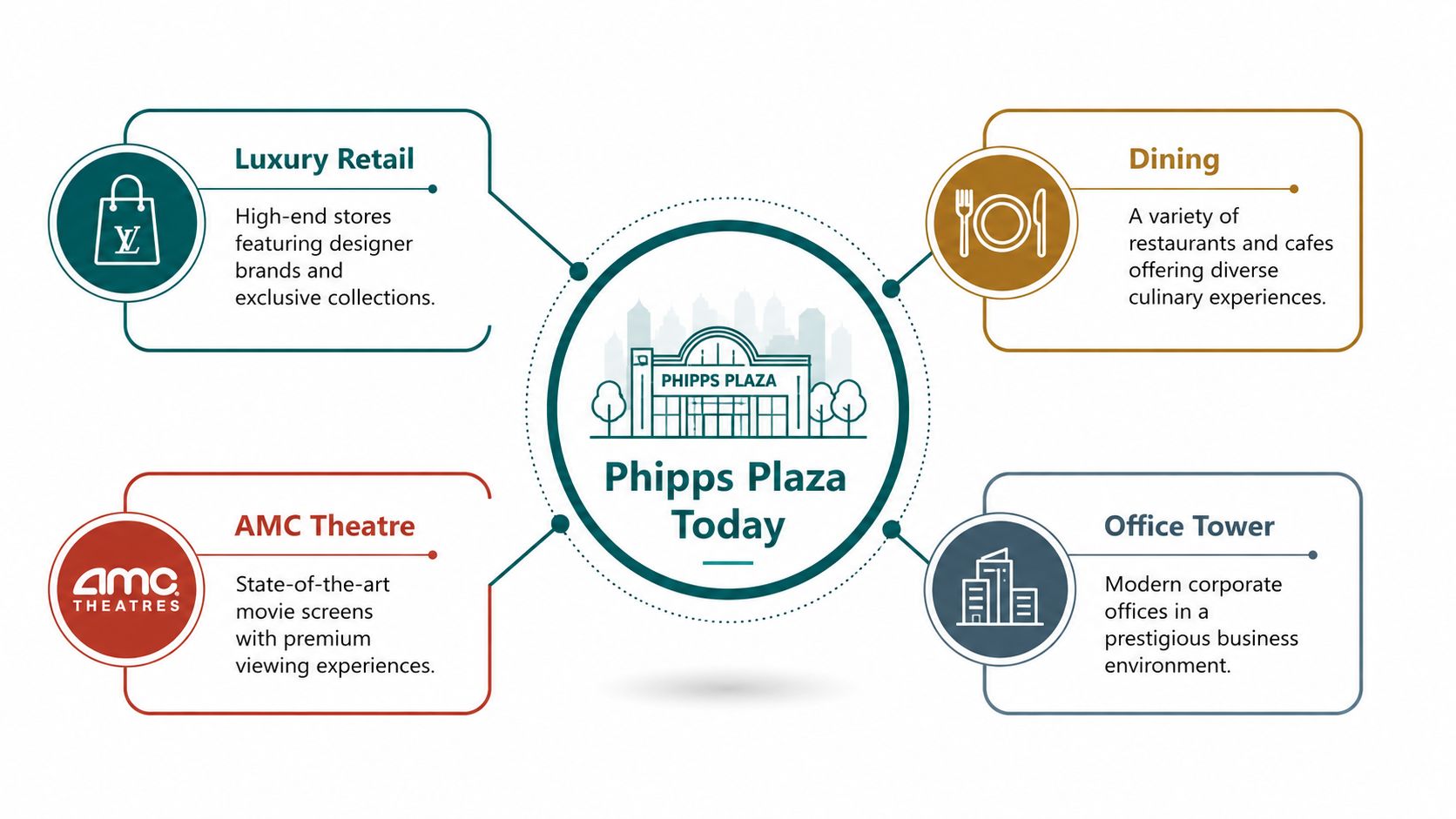
The practical takeaway is simple. Don't arrive and improvise. Pick your first destination, then choose the entrance that lines up with that destination, because Phipps is easiest when you treat it like a navigation problem rather than a browsing problem.
What the building mix means for a visitor
The mall's layout is shaped by retail, office, and hospitality uses sharing one site. That means there are different trip types on the same property, and they don't all want the same parking, elevator, or drop-off strategy. A shopper looking for luxury retail should not use the same mental map as a guest trying to reach an office appointment or a dinner reservation.
That's also why the property can feel larger than it looks from the road. Wide indoor concourses, multiple vertical connections, and several destination zones make the building forgiving for casual browsing, but unforgiving for people who arrived without a plan. If you're there for a specific store or restaurant, route choice beats spontaneity every time.
For a venue like this, clean glass, legible entrances, and bright sightlines matter more than decorative polish. If you care about how large retail centres maintain the customer-facing side of that experience, Retail center glass cleaning pros is a useful reference point for the standards operators have to keep up with.
If you're mapping a broader venue strategy, the internal overview at Waymap's venue examples shows how mixed-use destinations are approached when navigation is treated as infrastructure, not decoration.
Practical rule: At Phipps, the correct entrance is the one closest to your first stop, not the prettiest one.
How Phipps Plaza Became Atlanta's First Multi-Level Mall
Phipps Plaza was built to stand apart from the start. Historical sources identify it as Atlanta's first multi-level and first fully enclosed mall, and one source says the original center opened as a two-level shopping center before it became Atlanta's first double-tiered mall. The opening happened in stages, not as a single splashy debut, with Saks Fifth Avenue opening on August 12, 1968, the main mall on March 20, 1969, and Lord & Taylor on October 15, 1969 (Phipps Plaza history).
That phased rollout explains the building's layout. Phipps was planned as a luxury retail destination from the beginning, not as a flat suburban center with a few extras tacked on later. For a visitor, that means the property already expected layered movement, which is why the mall still feels more vertical and more segmented than newer one-level centers.
Why the 1992 expansion still shapes your visit
The biggest shift came in November 1992, when a $172 million redevelopment added a third level, a new wing, a Parisian anchor, a 14-screen AMC theatre, a new food court, and updated elevators (Alchetron summary). A separate source notes the property was sold in 1992 for $488 million. Those figures matter because they show how far the center moved beyond its original footprint.
Phipps stopped being just an upscale mall and became a much larger mixed-retail destination. The third level, the new wing, and the theatre are the reason this place rewards visitors who know their target before they walk in. A mall with that history does not behave like a simple one-floor shopping trip.
The architecture still gives that story away in the way people move through the building. The practical lesson is blunt. Once you understand why Phipps became multi-level, its circulation patterns stop feeling confusing and start looking deliberate. For floor-by-floor planning, a shopping mall floor plan guide is the right reference point.
Stores, Dining and Anchors by Level
Treat Phipps Plaza as three shopping experiences stacked on top of each other, not one continuous browsing floor. The anchor names do the heavy lifting here, because they give you orientation points before you even see a directory. Saks Fifth Avenue, Nordstrom, Belk, Tiffany & Co., and Gucci are the clearest way to understand the centre's internal geography.
Use anchors first, categories second
If you're going for luxury fashion, start near the anchors and work outward into the surrounding boutiques. If you're going for beauty, fragrance, jewellery, athleisure, or tech, do the same. That is the sensible way to handle a property with more than 100 stores, because it keeps you from drifting down dead-end corridors that look promising but do not get you to the store you wanted.
Dining works the same way. The food court suits a fast in-and-out meal, but it is the least strategic choice if you are already spending time in the luxury wings. The better sit-down move is to aim for the upper-level restaurants when you want a proper break, especially if you are combining shopping with a film or an office visit. The bars and lounges tied to the hotel and office components are better for lingering than for quick refuelling.
Route rule: If you can name the anchor first, you can usually pick the right level before you leave the car park.
What to expect by zone
- Saks and the luxury wing: Best for high-end fashion, accessories, and beauty runs that need a clear starting point.
- Nordstrom and the broader retail stretch: Better when you want variety and do not need to stay in one premium corridor.
- Belk and adjacent retail areas: Useful for a more mixed shop list, especially when you are not browsing just one luxury category.
- Dining nodes: Food court for speed, upper-level restaurants for a sit-down, more deliberate visit.
- Hotel and office-adjacent venues: Better for meetings, drinks, and meals where you are not trying to rush back to a car park.
For floor-by-floor planning, the shopping mall floor plan guide is worth keeping in mind if you are comparing how large retail buildings organise movement, because Phipps is exactly the kind of place where anchor-based wayfinding matters.
Getting There by Car, MARTA and Ride-Share
Driving is the most forgiving option if you're carrying bags, travelling with someone who needs reduced walking, or planning to hit several parts of the property in one visit. The 1992 redevelopment increased parking capacity from 2,034 to 4,082 spaces across surface and structured parking, so Phipps is built for cars first even though it's still a walkable indoor destination (ULI case study). That extra capacity matters less as a bragging point than as a route-planning fact. More parking means more entry choices, and more entry choices mean you should park for your destination, not just for the nearest open bay.
MARTA is viable if you're comfortable with a short walk and don't mind arriving a little more exposed to weather. Ride-share is the cleanest option for visitors who want a direct drop-off and no parking hassle, especially if they're heading to the hotel, office tower, or a specific mall entrance. The right choice depends on where you're going once you're inside.
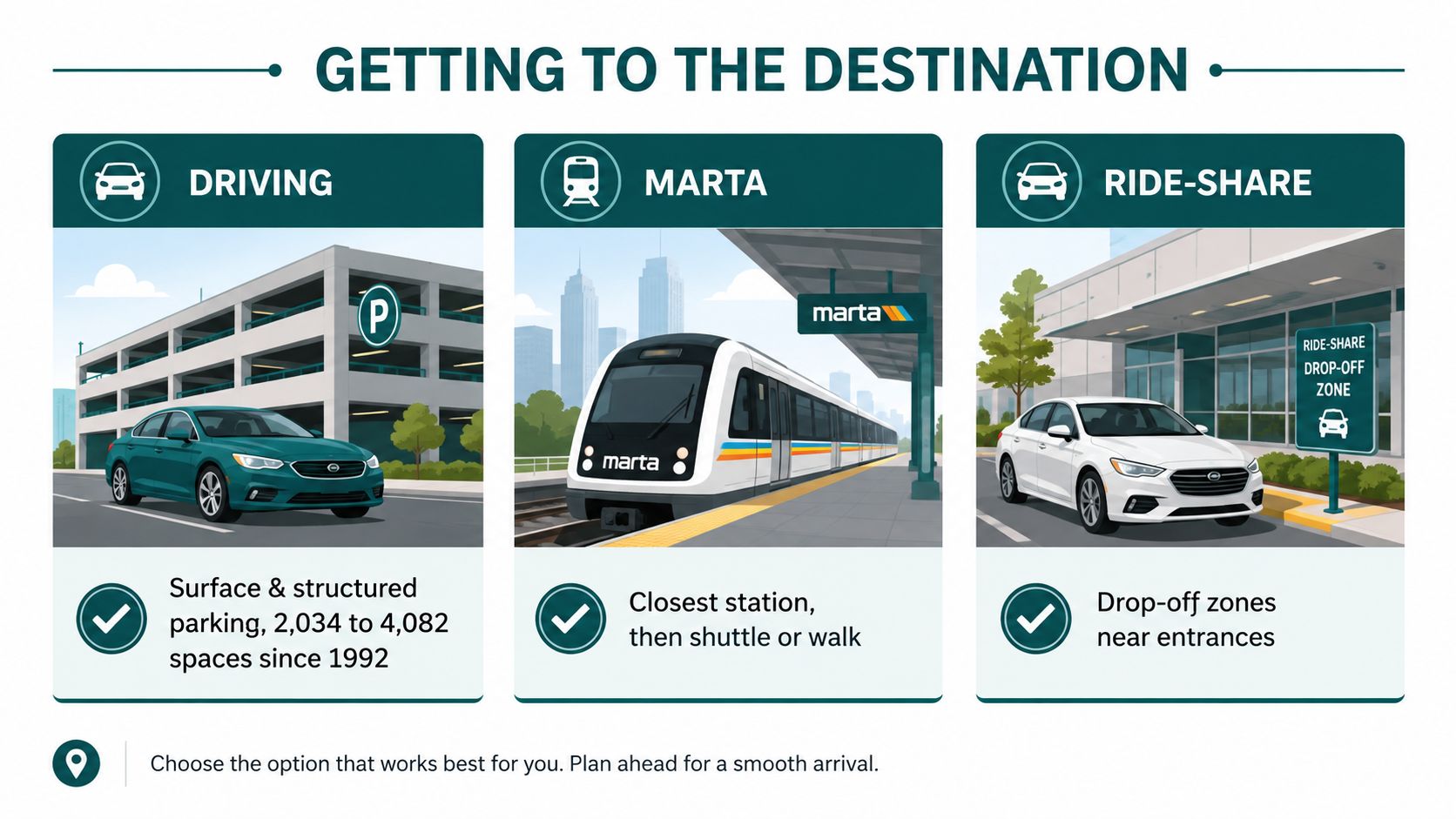
Choose the mode based on your first stop
The Buckhead MARTA station on the Red Line is the practical transit reference point for visitors heading to the mall. If you're able-bodied and the weather is decent, walking from there is manageable. If mobility is a concern, don't romanticise the walk, choose the arrival mode that reduces strain.
Ride-share drop-off on the Peachtree Road side is the easiest for a first visit, because it drops you closer to the mall's primary public-facing entrances. The office tower has its own drop-off, which is the better choice when your destination is One Phipps Plaza rather than the retail concourse.
Arriving at Phipps Plaza by mode
| Arrival mode | Drop-off point | Approx. walk to mall | Best for |
|---|---|---|---|
| Driving | Surface or structured parking | Depends on where you park | Visitors with bags, families, and multi-stop trips |
| MARTA | Buckhead station area | Short walk | Transit users who can handle a bit of outdoor walking |
| Ride-share | Peachtree Road side or office tower drop-off | Very short | First-time visitors, hotel guests, and mobility-conscious trips |
For transit users who want cleaner trip planning, Waymap's public transport directions guide is the right kind of reference, because the arrival decision at a place like Phipps should be made before you're standing at the curb.
Accessibility, Step-Free Routes and Wayfinding
A first-time visitor to Phipps Plaza needs a route plan, not a vague promise that the mall is accessible. On a property this large, the question is whether you can get from parking to shopping, then to dining, and back out without detours that waste time or leave you guessing.
Access standards point in the same direction. ADA Title III in the US, BS 8300 in the UK, and the UN Convention on the Rights of Persons with Disabilities all push venues toward end-to-end usability, not just a compliant entrance. In a multi-level mixed-use building, that means the route has to work from the curb or parking deck all the way to the destination inside.
A practical detail matters here. ADA compliant automatic door openers reduce friction before a visitor even reaches the concourse, and that kind of hardware is often what separates a decent entry from a frustrating one.
What works better than guesswork
Use the nearest vertical circulation from your parking spot, then go straight to the level that contains your store or restaurant. That is the cleanest move, and it avoids wandering through the building just to figure out where you are.
For a concrete step-free example, the Peachtree Road entrance connects directly to the Saks Fifth Avenue level by ramp, which lets you reach ground-floor retail without hunting for an elevator first. If you already know your destination, that route is the one to use.
Accessibility rule: If you cannot describe the route from your parking spot to your destination in one sentence, the layout is making you do too much work.
Good wayfinding cuts down on dependence on signs alone. Phipps has multiple entrances, level changes, and mixed-use destinations, so a single directory board cannot cover every move a visitor needs to make. The internal map at Waymap's mall mapping resource fits that reality because the route itself has to do the heavy lifting.
How Indoor Navigation Works Without Beacons or Wi-Fi
Infrastructure-free navigation is the right model for a property like Phipps Plaza because the building changes, but visitors still need reliable directions. Waymap's approach uses only the smartphone's motion sensors and dead reckoning to learn each person's stride and movement pattern, then guides them with sub-3-metre accuracy indoors and underground. That matters in a mall because the route has to stay useful even when the user can't rely on GPS, Wi-Fi, or installed hardware.
Older indoor wayfinding systems get expensive in the wrong places. Bluetooth beacons and Wi-Fi fingerprinting require physical installation, maintenance, and re-mapping when tenants change or stores move. A mall that wants to stay flexible shouldn't have to rebuild its navigation layer every time its retail mix shifts.
The cleanest proof that this model works in a high-footfall environment is Waymap's 2025 rollout at Lord's Cricket Ground, which was described as the first stadium deployment. That matters because stadiums, like major malls, have dense circulation, changing crowd patterns, and multiple destination types that can't be handled by static signage alone.
Why this model fits Phipps Plaza
Phipps Plaza has large floor plates, multiple levels, and separate retail and office uses. That combination is exactly where infrastructure-free navigation earns its keep, because the visitor needs the route to adapt to where they are, not where the sign happened to be installed. A system that can follow a user from parking, to concourse, to store, and back again without hardware overhead is a better operational fit than a patchwork of fixed devices.
For venue teams comparing options, the practical difference is simple. Hardware-based systems create an ongoing maintenance burden, while sensor-based indoor navigation can update routes without ripping up the site. That is why large mixed-use destinations should be thinking about dynamic wayfinding as part of operations, not as a nice-to-have digital extra.
A Pre-Visit Routine That Saves an Hour Inside
Start with the basics the morning of your visit. Check the hours, pick your first store, and decide whether you're arriving by car or MARTA based on weather, luggage, and mobility. Then open your navigation app before you leave so it can start learning your stride as soon as you begin the walk from the station or car park.
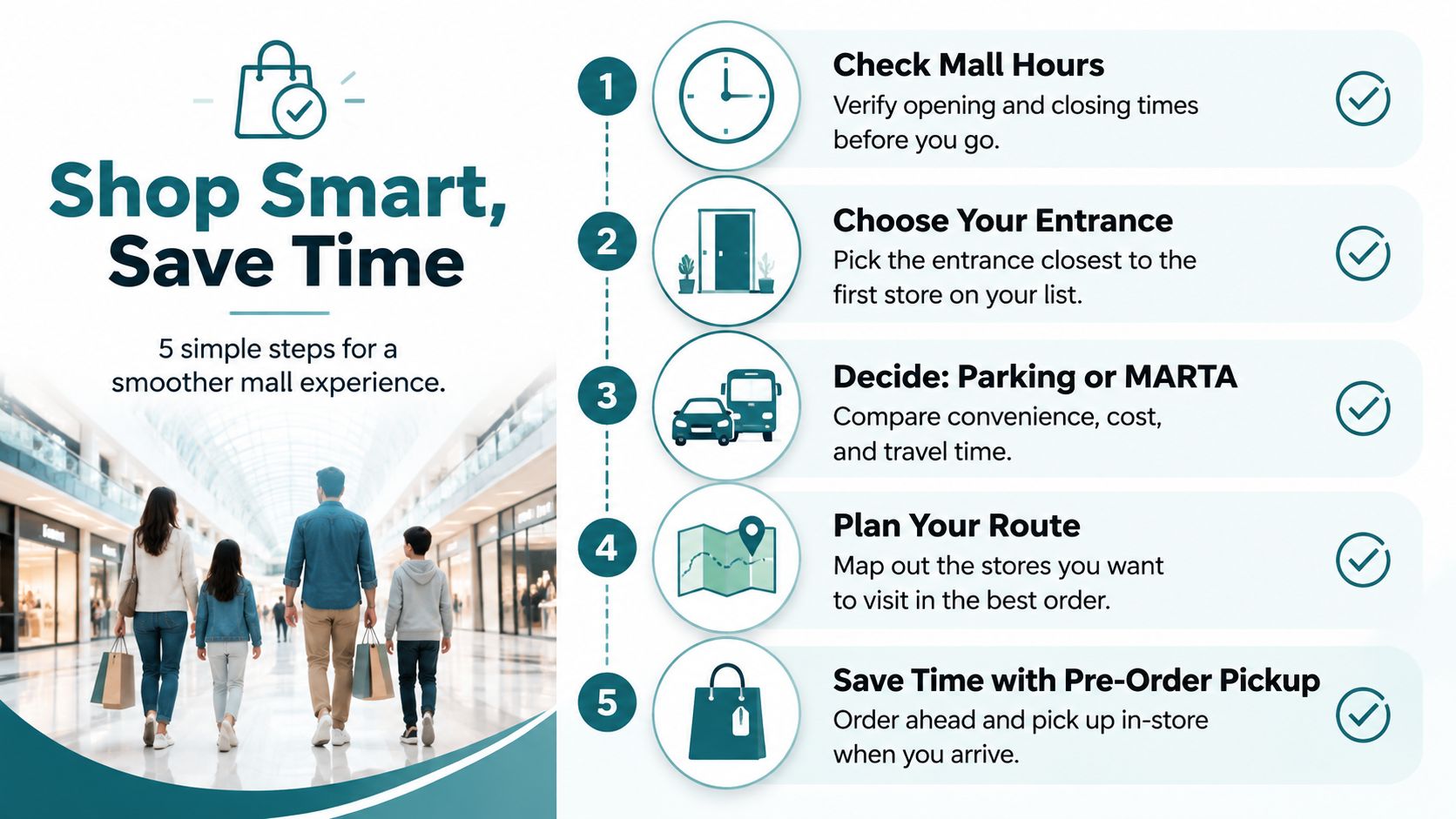
Three things first-timers usually miss
The closest entrance to Saks Fifth Avenue is the one you should target if Saks is your first stop, not the entrance that looks closest on a map. The main elevator bank near the AMC theatre is the useful vertical reference point when you need to move between levels without wandering. And if your schedule is tight, skip the food court and head straight to the upper-level restaurants, because the food court is better for speed than for making the visit feel organised.
Visitor habit that works: Enter with one anchor, one level, and one fallback dining option already decided.
Use that routine to cut the chaos before it starts. One store, one arrival mode, one route through the building. That's how you stop Phipps from eating your afternoon.
For anyone comparing consumer navigation tools, Waymap's free navigation app overview shows how a route-first approach changes the experience in large venues without forcing the visitor to study a floor plan first.
Questions Visitors Ask Before They Go
:If you are planning a first visit to Phipps Plaza, start with the practical question, not the glossy one, what are you trying to do here. A luxury-focused, mixed-use Buckhead stop makes sense if your day includes shopping, dinner, or an AMC visit. If you only want a quick pass through a single store, the building will feel like more effort than it is worth.
The cleanest arrival from MARTA is the Buckhead station walk-in, then a straight move toward the mall entrance that matches your first stop. Keep it simple. The walk is workable for visitors who are comfortable covering some distance, but it is still a choice that depends on your pace, weather, and energy level.
Indoor direction gets harder here because the entrances, elevators, and destinations do not line up neatly. If you cannot depend on visual signage, use a route-based navigation tool first and ask staff only if you need a final check. For visitors who want a better sense of mall security procedures, the GM GROUP Services mall security guide gives useful context for what a managed retail environment expects from guests and staff.
Opening hours are tenant-specific, so check the mall and the store you plan to visit before you leave. That matters more at a property like this than at a simple single-level center, because the destination inside the building often defines the trip more than the building itself.
If you are responsible for a venue like Phipps Plaza, or you are tired of guessing your way through places built for people who already know the layout, Waymap gives you a route-first indoor navigation layer for exact doors, exact paths, and mixed-use buildings like this one. It helps when signs are weak, staff are busy, and the visit needs to start at the right entrance the first time.
